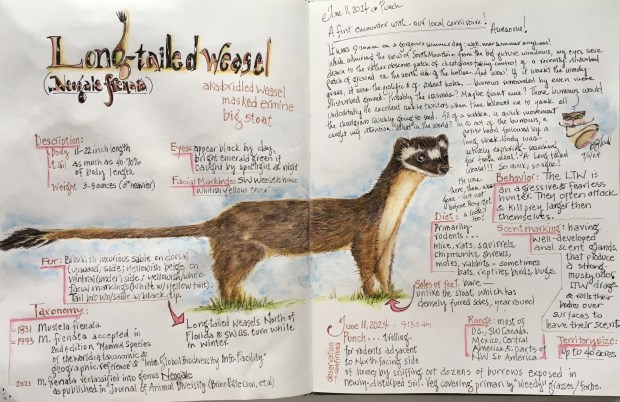
Such a surprise and total delight to find a long-tailed weasel hunting on our property! Busy probing numerous rodent burrows for an easy meal, he was too occupied to notice us staring in awe. What a beautiful little guy ……. from the white mask markings on his head, to his luxurious sable-colored fur draped over creamy buff-colored underparts; from his ground hugging, long, thin and sleek body, to his equally long or longer tail with a dashing black tip ……. the long-tailed weasel is a sight to behold!
long-tailed weasel tracks
Although their range includes southwest Canada, all of the lower “48,”Mexico, Central America and parts of northwest and southwest South America, seeing a long-tailed weasel is rare. Only one animal occupies a territory roughly 40 acres in size, which boundaries are aggressively maintained by frequent scent marking.
Even though the neighborhood pack rat, mole, squirrel and mice populations might suffer within a long-tailed weasel’s territory, we would enjoy and appreciate seeing more of this ferocious, pint-sized carnivore around our home!
Have you ever seen this or any weasel species? If you’ve seen this weasel (aka ermine) during winter, fully cloaked in brilliant white except for a black-tipped tail, ooooooooo! How lucky! Share your weasel observations please.
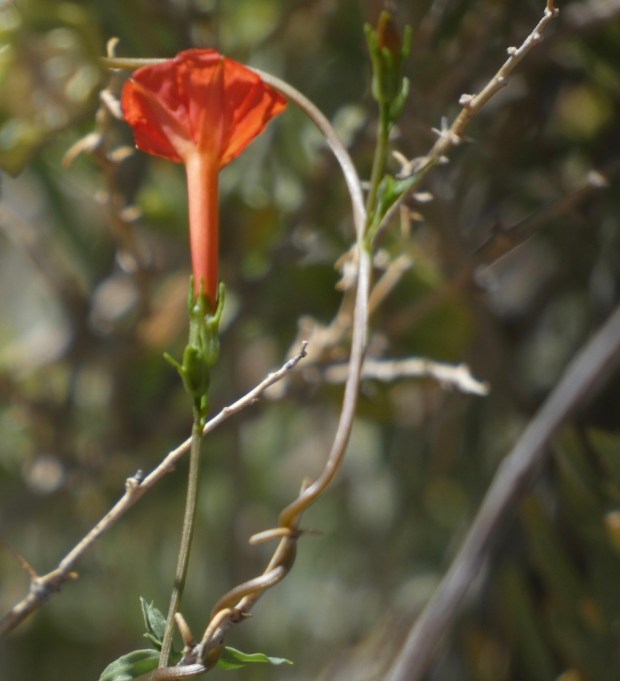
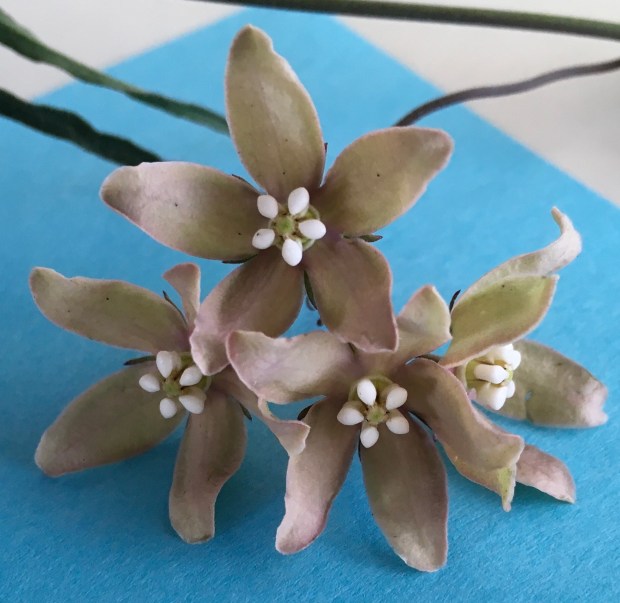
Just when I was feeling confident about the morphology of the milkweed family of plants, a new twist on the familiar leaps out shoutin’ “ Hey, lookie here!” Expecting to see a common vine gracefully twirling its way up a desert shrub, I paused ……. searching for the crimson red trumpet-shaped flowers of Ipomoeacristulata (Trans-Pecos morning glory). But instead there was an umbrella of 5 flowers, each with 5 widely spreading greenish-brownish-mauve colored petals crowned in the center of an unmistakable floral corona, a sure fire characteristic of a milkweed! Could it be?
Trans-Pecos Morning glory
Oh Yes!
This unexpected, undeniable discovery had me puzzled though. It’s been two years since I created a detailed post about the Asclepias genus of milkweed (see Summer Botany: Meet the Milkweeds). At that time and throughout the decades prior, my knowledge of milkweeds was limited to Asclepias, and the specific characteristics of that genus.
Spreading petals of Wavyleaf Twinevine
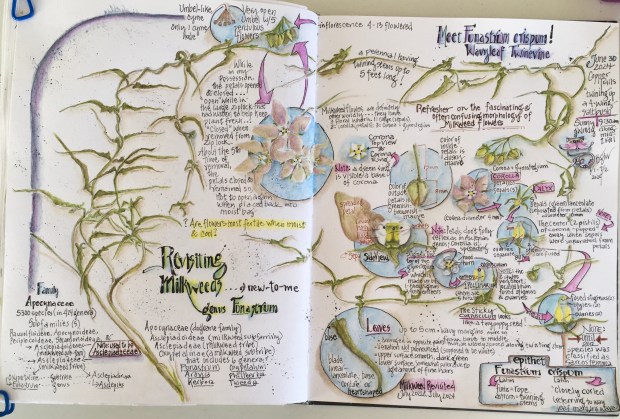
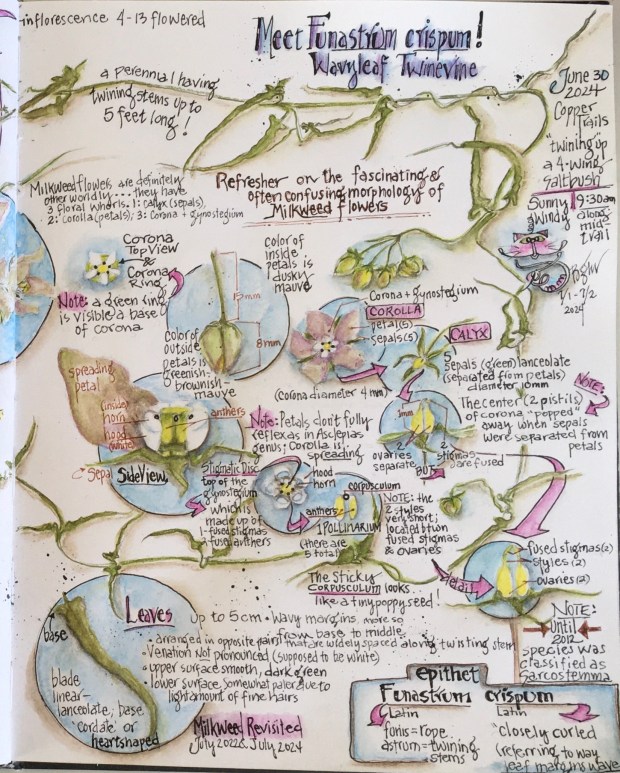
But here was something new-to-me; so worthy of whatever time it might take to learn all about this find in the dogbane family (Apocynaceae), aka the Milkweeds. I quickly confirmed this vine does not belong with the Asclepias species of milkweeds, but is of the genus Funastrum, which is Latin for rope (funis) with twining stems (astrum), commonly referred to as the “twinevines.” And the full name of this plant is Funastrum crispum, commonly called Wavyleaf Twinevine.
Most of what I uncovered about Wavyleaf Twinevine is included on my 2 journal pages, along with some confusing taxonomy involving family and subfamily names, tribe and subtribe names, and how until 2012, this plant was known as Sarcostemmacrispum. Curiosity about the taxonomic history will undoubtedly tempt me to sort through the confusion ……. maybe someday soon!
Have you discovered anything new-to-you in nature lately? What was it, and did it lease to more discoveries?
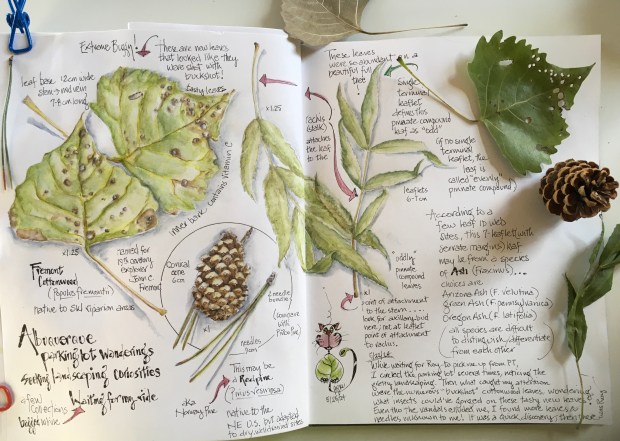
Oops! I was caught without my sketchbook ….. but that didn’t prevent me from making a few interesting collections while waiting for a ride.
My curiosity unleashed, I began by wondering what voracious insect(s) tried to eat 1000x their weight in fresh cottonwood leaves. Then I noticed a very lovely leafy tree growing next to a stately pine, both of which were mysteries to me.
So I spent this afternoon sketching, painting, and looking over ID and reference materials, as much fun as collecting my three parking lot treasures!
If you find yourself “waiting,” how do you pass the time?
After a longer than planned for blog break, I’m glad to be back and sharing a few pages from my nature journal. Beginning in April, the riot of wildflowers popping up everywhere has, and still keeps me scurrying about my backyard, the “back 40,” and local hiking trails just to refresh my memory about familiar plant species while searching for new discoveries. I’ve been sketching daily, learning about new-to-me plants, and growing my knowledge about favorites.
Recording first seasonal sightings, it’s interesting to compare previous years’ emergence and abundance, and wonder why timings vary. For example, last year the white-stemmed evening primrose (Oenotheraalbicaulis) blanketed the hillsides with white; this year those beautiful white blooms have been scarce. Last year the tall crowded flower stems of White Point-Vetch (Oxytropis sericea) were few and far between. This year an explosion of these graceful plants that belong in the pea family (Fabaceae) began blooming in April and are still going strong!
White Point-Vetch, also called white locoweed, whitepoint crazyweed, and silky crazyweed, makes a striking bouquet that glows like a bright light as it blooms along tall flower stalks 15+ inches above bare brown ground. New stems push up through multiple dried stems packed with last year’s empty seedpods. But it’s obvious this species is an aggressive re-seeder; there are so many new plants this year where last year there were none!
It’s been a spectacular show!
Enjoying researching this species, dissecting a few fresh flowers, and searching for remnant seeds in the dried pods, kept me delving deep into the bits and pieces of what defines this group of plants. This large family, which houses well over 10,000 species world-wide, includes peas, acacias, mimosas, and licorice (see the list below for more residents).
The dried stem was drawn and shaded in graphite.
But one species at a time, please! Actually the locoweeds, which fall into the genera Oxytropis (like the White Point-Vetch) and Astragalus, contain over 600 species world-wide, 21 of which grow in the U.S. Many plants in these two genera are toxic, particularly to domestic ungulates. More about the toxin and what happens when these animals ingest even small quantities, along with other interesting facts are described on my two journal pages. ……
There is so much more to learn about this important family of plants, but I’ll save that for another post.
Thanks for stopping by and have a safe and happy Memorial Day weekend!
Thanks for stopping by …… have a safe and happy Happy Memorial Day!
It’s Spring in my neighborhood, and not a day too soon!! Along with gusty winds carrying clouds of yellow pollen come drifts of an outrageously bright yellow ‘sunflower’ named Perky Sue.
How Perky Sue got its common name is a mystery. My best guess is this herbaceous forb, native to New Mexico, has to be the Perky-est, Happiest Spring Flower, Ever!
What is your favorite native flower signaling the arrival of Spring in your world? Does its bloom cause you to smile; perhaps you break out in your happy dance?
Thanks for stopping by …… and Happy Mother’s Day to all!
After years of on-line and email chats, I was delighted when my friend Robin Atkins decided it was finally time we met in person! Bravo!
Robin and her travel buddy Lunnette, drove over 1,800 miles to Tucson to teach a Spirit Doll class to a local beading group. Then after spending 5+ days exploring Tucson and before driving home to Friday Harbor on San Juan Island, WA, they took a “short” scenic 450 mile detour …… to Tijeras, NM. This out-of-the way drive would bring them to our doorstep, and our first face-to-face meeting! While in Tijeras, we were able to spend an evening and full day getting to know each other and spent time hiking, nature sketching, and sharing each other’s art.
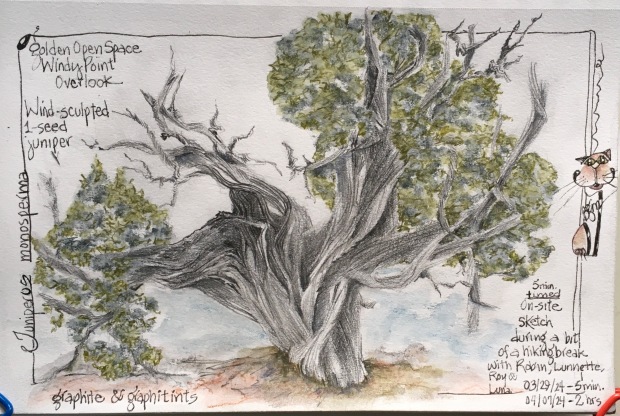
Robin snapped this photo of me sketching out at Golden Open Space. The beautiful wind sculpted juniper trees growing along the precipices of the windy observation areas are absolutely captivating (and tough). Luna thinks they’re tasty!
Meet Robin
Robin, whom I’ve always thought of as an “extreme creative,” is a fascinating, energetic, curious, passionate and bright-eyed adventurer in her early 80s. Her many interests and skills, in addition to creating uniquely designed, hand sewn and beaded Spirit Dolls, include: quilting (many with bead embellishments), thread embroidery, book making, watercolor painting, Zentangle art, nature journaling, making decorative papers, poetry, weaving, collage, crochet, felting and book author. And she shares her skills and techniques by teaching.
This isn’t an exhaustive list by any means! As someone who seems to thrive on learning and developing new skills, Robin never stops seeking artistic challenges to take on.
Check out Robin’s beautiful webpage and blog (http://robinatkins.com) where you can find photos and posts highlighting her current and past creative projects.
A Short-but-Sweet Visit
We had a wonderful time getting to know each other, and what a delight to have also met Robin’s long-time friend and travel buddy, Lunnette. A retired firefighter in her mid 70s, Lunnette is also a nature journaler, calligrapher, quilter, and according to Robin, “she’s a terrific navigator, who always uses her keen sense of direction and map reading skills to keep us on the “right road,” (in both the literal and figurative sense).”
This is my finished graphite drawing of the twisted juniper I spent 5 minutes sketching.
Parting company was hard, but Robin and Lunnette needed to return home. Along their route they visited both Mesa Verde National Park and Arches National Park, soaking in more of the desert southwest sun and culture before taking on the 1,200 mile journey for Friday Harbor.
It’s been a few days now, and the scene continues to replay over and over in my mind’s eye. Somehow my sketch of these two birds …. one the victor, the other the victim ….. came easily and quickly, much like the time it took for the event to unfold.
Returning to our house after photographing snow scenes created by an overnight winter storm, I paused at the door, turning to admire the beautiful white landscape. Faster than an eye blink and just as quiet, a sharp-shinned hawk soared by at top speed, obviously intent on capturing one of our feeder birds!
I’ve seen this small hawk fly by a few times over the past several weeks, but the smaller juncos, finches and titmice always managed to duck for cover in the nick of time, foiling the “sharpy’s” chances of a meal. But the hawk, perhaps better skilled in his timing and approach after some practice runs, wasn’t about to miss on this day.
The spotted towhee must’ve been so focused on scratching for buried seeds that all obvious warning calls eluded him. Out in the open eating seed under one of our feeders, the towhee must’ve been too hard to resist for the sharp-shinned hawk, and fell victim to the expert predator.
Having camera already in hand, I was able to take a half dozen photos after the sharpy snatched the towhee with his long piercing talons, pinning him securely to our brick patio. As sad as it was to watch the towhee struggle against the hawk’s sure grip, it was all over for the towhee in 30-45 seconds. Then as fast as the sharp-shinned hawk had attacked, he regripped the lifeless towhee, lifting him effortlessly and flew away into the trees.
The circle of life.
“You can’t imagine anything like nature as we know it without predators.”
-Dale Jamieson
“Every living creature, big or small, plays such an important role in our ecosystem.”
-Mufasa’s memorable speech to Simba (from The Lion King)
As the Fall season rapidly came and went, and the first snows blanketed the landscape, I focused my hiking time (and some of my drawing hours) on collecting local native seeds. Always careful that plenty of seeds remained available for overwintering birds, I still managed to harvest hundreds from about 25 plant species. All sorted and packaged in separate pill containers, my collection is now stored in the refrigerator at 40 degrees, until growing conditions are optimal for planting. This treatment method is referred to as stratification.**
Why collect native seeds? All throughout the Spring, Summer and Fall, a diverse assortment of pollinators visited our locally blooming wildflowers and shrubs. Along with these butterflies, moths, bees, wasps, beetles and flies, were the insects, spiders, and birds that prey on unwary pollinators. Such an amazing show; a kaleidoscope of colors and shapes! The air was a buzz with activity. My goal is to mimic the native banquet in hopes of attracting these pollinators and predators.
Also, seeds are absolutely fascinating. I like to think of them as gift-wrapped, living plants-to-be. Tucked neatly inside of the seed coat are food stores enough to feed the makings of a complex root system; flowers, leaves, stems, branches and even a trunk. Seeds can be tiny, some microscopic and some as large as a softball. Seeds come in a variety of shapes, colors, textures and decor both inside and out. Some seeds have “wings” to fly; some have silky or puffy “feathers” to float; some are like “lead,” heavy enough to intentionally sink under water.
So I pulled out my 10x hand lens to investigate, drawing most of the seed species in my collection. It was very cool to compare seeds of different species that are in the same family (like the composites of the Aster family and the penstemons of the Plantain family). Until creating this journal page, I’d never held the seeds of 3 different species of yucca in one hand at the same time. Observing the similarities and differences, I finally confirmed in my mind that the genus Herperaloe and Yucca are indeed in the Agave family. And then I found examples of seeds from completely different families that evolved similar dispersal mechanisms (convergent evolution). This phenomenon was visually obvious in the delicate feathery, silky, and poofy hairs or bristles attached to grass, aster, and milkweed seeds, facilitating seed dispersal by wind.
Finally, I felt the need to draw the seeds in case they happened to spill into one big jumble while being planted! Yes, I would be clumsy enough to create chaos out of order. Should that happen, I’ll be able to sort the mess by species by referring to my field guide page.
** Seed-producing plants pass along to their seeds the specific requirements(s) necessary to break dormancy and germinate. These genetic codes determine if optimal conditions exist for seeds to sprout and hopefully grow to maturity. But key to successful germination depends on seed ripeness (in most cases). Knowing the plant species from which a seed is produced; whether the plant is an annual, biennial or perennial; habitat, moisture needs and the type of “treatment” method(s) are all important bits of information tied to successful germination.
I’ll have to create a future post describing the variety of treatment methods (germination patterns) inherent in the seeds.
Are you a seed collector? If so, share your why’s and how’s!
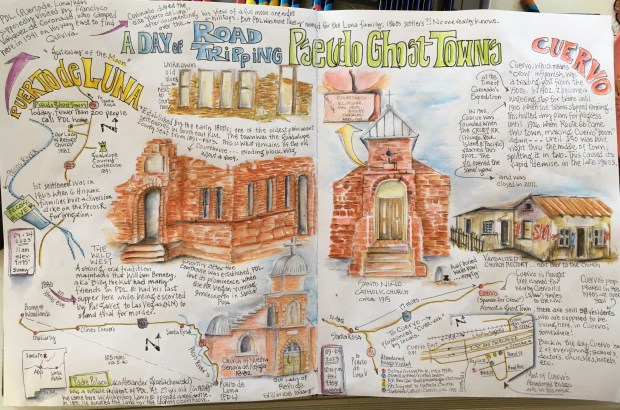
Wow! Time is flying. Here we are already well into the beautiful month of October, and realized my journal pages from our late September road trip fell asleep in the back seat of the car! But I felt my record of this day trip was worth sharing, especially since Halloween is fast approaching, and ghost towns are all the rage!
New Mexico always surprises and delights, and our trip to explore the pseudo ghost town of Cuervo, became two destinations. While in route to Cuervo, we found a curious notation on the highway map referencing the historic village of Puerto de Luna. Only a short, 9.5 mile detour south of Santa Rosa, we decided to check it out.
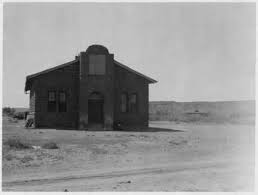
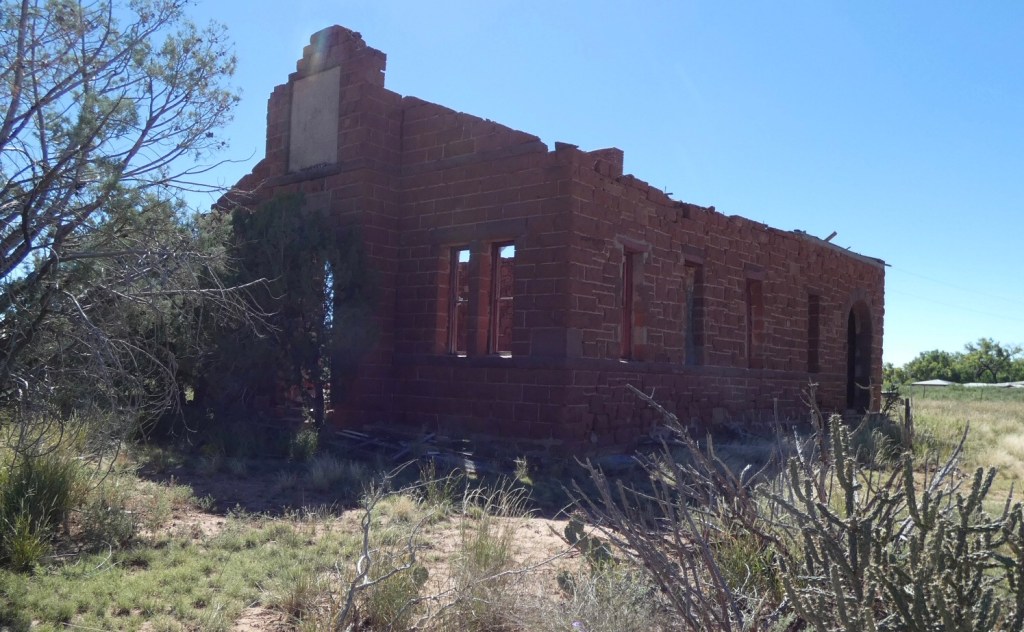
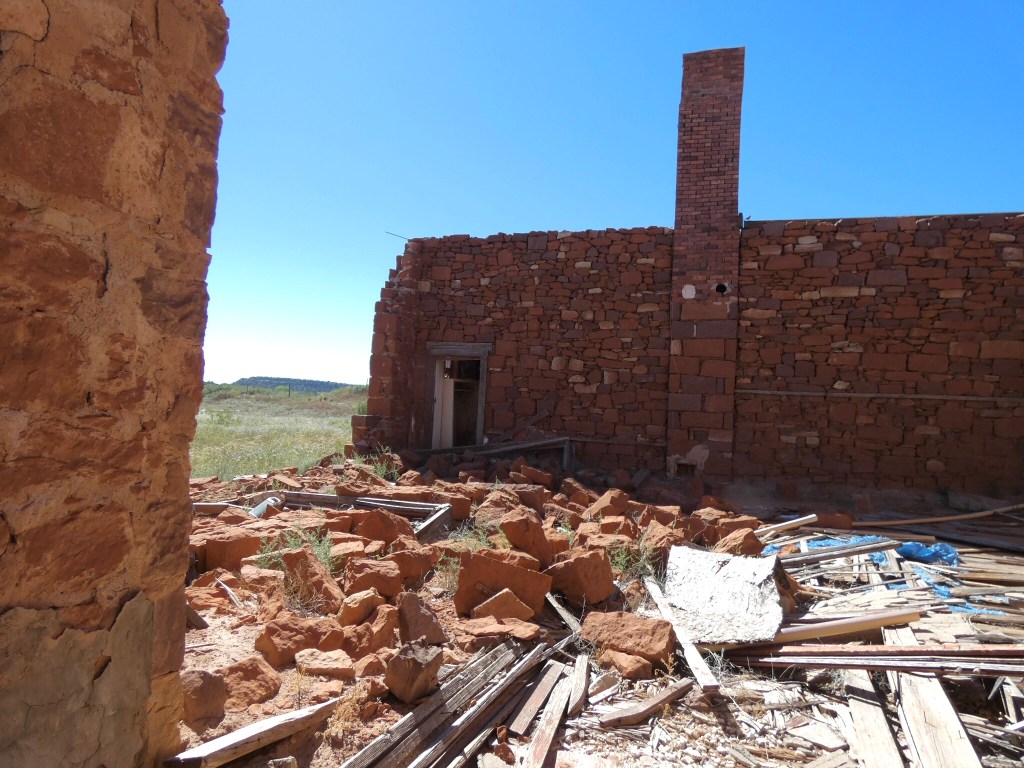
Puerto de Luna, NM The village of Puerto de Luna, Gateway of the Moon, is still inhabited, mostly on the West side of the Pecos River. However there are many wrecked and ruined buildings east of the river; enough to merit the label “Pseudo Ghost Town.” After a scenic ride through country used primarily to grow wheat and for livestock grazing, travelers first encounter the well maintained Church of Nuestra Senora del Refugio. Built in 1882, the church is still in use today. Just SE of the church sits the remains of the original Guadalupe County Courthouse. Constructed in 1891 of sandstone brick and blocks, it was only used for a few years. . Before the county seat was moved to Santa Rosa in 1903, a second, much larger building was constructed on the west side of the Pecos, which today is being used as the senior center. Not much remains of the original courthouse; the roof and half of the walls are piles of rubble lying inside the structure. The photos below show the changes from then to now.
Guadalupe County Courthouse, Puerto de Luna, 1891
Remains of Guadalupe Co Courthouse, Puerto de Luna, 2023
Looking inside the remains of Guadalupe Co Courthouse, 2023
Our brief visit to Puerto de Luna was fun. We learned about some of the pre-village history, like the Spanish explorer Coronado was said to have passed this location in 1541, naming the site Puerto de Luna after seeing a spectacular moon rise. And then there’s the more recent account from 1880, involving Billy the Kid and his last dinner here before being escorted by Pat Garret to Las Vegas, NM to stand trial for murder. After a hour of poking about a few more abandoned buildings, we headed back north to Santa Rosa and east 17 miles to our next pseudo ghost town.
Cuervo, NM ….. don’t blink or you’ll miss it!
If you zoom along on I-40 at 75-80 mph, heading east or west, and happen to blink, you’ll surely miss what remains of the old trading post and railroad town of Cuervo. Spanish for “crow,” Cuervo was officially established in 1902 as a watering stop for the CRI&P railroad. When the trains stopped running in 1910, the population declined, and businesses closed. But things took a turn for the better, when in 1926, Route 66 came through town, and Cuervo boomed again. By the 1940s, the population grew to 300, and had 2 of everything ….. schools, gas stations, hotels, churches, doctors, etc. All was just peachy for Cuervo until the late 1960s when the highway department decided to build I-40 right through town, slicing it in two and causing its rapid demise. Although the post office officially closed in 2011, the 58 permanent residents calling Cuervo home still have and use the old zip code, where they get their mail is anyone’s guess. Oh, and if you exit the highway hoping to fill up your tank, think again. Even though there’s a gas station sign that looks like it’s inviting you to stop, there’s no gas, or snacks …. nothing. Just a bunch of dusty roads, crumbled and weathered buildings, and tumbleweeds blowing in the wind.
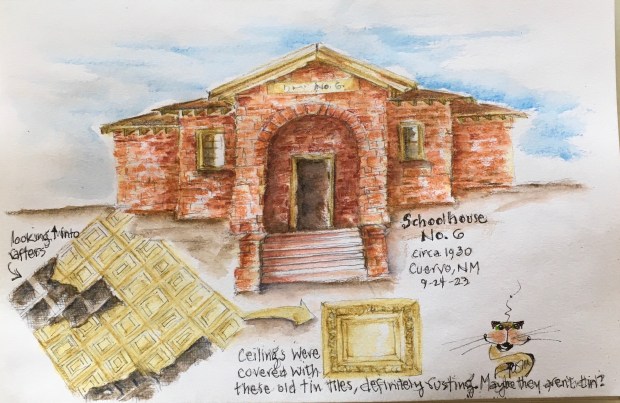
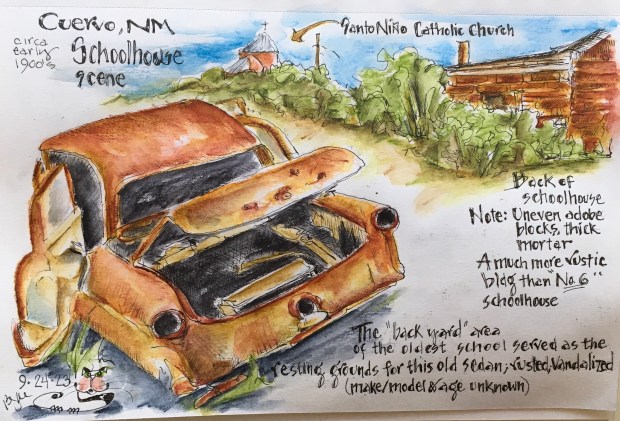
We spent a few hours poking about the old town grid, exploring a handful of abandoned properties. The old 1915 Catholic Church is padlocked, but opened on Sundays for service. The 1930s schoolhouse appears to be undergoing some renovation. And signs of more prosperous times exist when the old steam engines used to run into town to resupply. Actually there’s been very minimal vandalism considering how close Cuervo is to the interstate, but there’s one serious blemish that made headline news a few years back. The Baptist church was the site of some pretty scary satanic rituals; and it’s thought these practices conducted in the church by the perpetrator resulted in the disappearance and murder of a number of people. We chose not to investigate.
The 1930s Schoolhouse, Cuervo, NM
Early 1900s Schoolhouse and abandoned sedan, Cuervo, NM
Old wooden home and water storage bldg, Cuervo, NM
Boxcars, then and now …. which do you prefer? Cuervo, NM
And that concludes my post. Hope you enjoyed reading a bit about life as it was and is today in and around two interesting pseudo ghost towns located in central in New Mexico. I’d be very interested in knowing if you explore ghostly history where you live! Have an awesome day, and remember to be curious!
It’s hard now to imagine how extremely hot and dry the summer was this year. Without even a spittle of rain, the 100+ degree temps for weeks effectively suppressed the usual mid-season bloomers in and around the Albuquerque foothills/East Mountains. Even invasive plants, like goathead and tumbleweed, remained dormant or failed to germinate all together. It looked like winter browns had arrived early.
Then in less than a week, a small rain followed by several long downpours flooded the parched landscape, transforming browns to greens. You’ve heard this from me in a few earlier posts, but it was magical, and a reminder about the resiliency of desert vegetation.
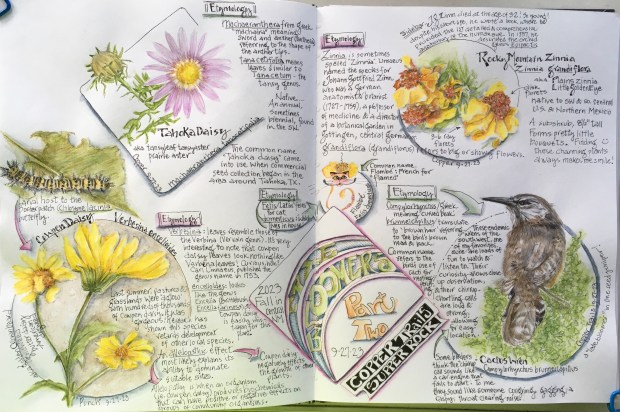
Here’s a few pages highlighting a handful of the Late Bloomers I recorded in only 2 days. More than 2 dozen species had sprung back to life, setting flowers at all stages of accelerated vegetative growth. The landscape seemed wide awake. If plants could talk, I imagined them laughing while excitedly chanting, “hurry, hurry, hurry!” Only their roots prevented them from dancing!
In addition to the species on these journal pages, there are many (more) composites, native grasses, shrubs and sub shrubs, small forbs from Spring and early Summer actively growing and blooming right now, and (of course) the weedy invasives are growing and blooming with wild abandon.
Random thoughts and wonderings ….. are pollinators still hanging around …… or ….. how many of today’s bloomers are self fertile …… are local birds, insects, reptiles and mammals that depend on earlier summer pollen and/or fruit and seed production stressed with this timing change/availability of food sources … will there be noticeable shifts in species composition, including plants, insects, reptiles and animals (including birds) ….. what species can and will adapt to changes, and how quickly ….. etc. The answers to these and many more questions are probably best answered in coming years, if it’s even possible to answer them at all.
Have you observed vegetation anomalies that may be influenced by changes in climate? If so, please share your observations and where these changes are taking place. Meanwhile, keep your eyes wide open.
“Closing your eyes isn’t going to change anything. Nothing’s going to disappear just because you can’t see what’s going on. ……….. Closing your eyes and plugging up your ears won’t make time stand still.” – Haruki Murakami.








 a curious nature