Late Bloomers …. Fall’s Flowery Foothills

September 26 & 27, 2023


It’s hard now to imagine how extremely hot and dry the summer was this year. Without even a spittle of rain, the 100+ degree temps for weeks effectively suppressed the usual mid-season bloomers in and around the Albuquerque foothills/East Mountains. Even invasive plants, like goathead and tumbleweed, remained dormant or failed to germinate all together. It looked like winter browns had arrived early.

Then in less than a week, a small rain followed by several long downpours flooded the parched landscape, transforming browns to greens. You’ve heard this from me in a few earlier posts, but it was magical, and a reminder about the resiliency of desert vegetation.

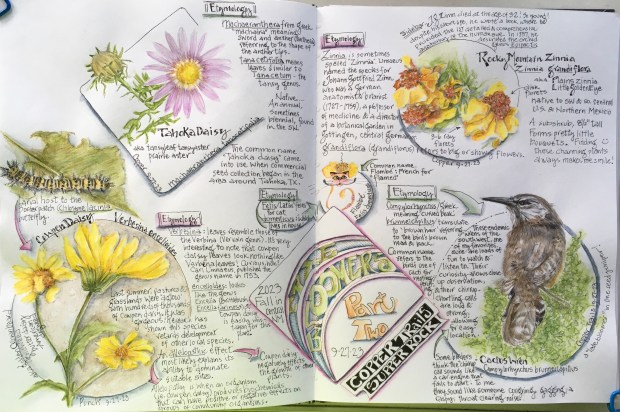
Here’s a few pages highlighting a handful of the Late Bloomers I recorded in only 2 days. More than 2 dozen species had sprung back to life, setting flowers at all stages of accelerated vegetative growth. The landscape seemed wide awake. If plants could talk, I imagined them laughing while excitedly chanting, “hurry, hurry, hurry!” Only their roots prevented them from dancing! 

In addition to the species on these journal pages, there are many (more) composites, native grasses, shrubs and sub shrubs, small forbs from Spring and early Summer actively growing and blooming right now, and (of course) the weedy invasives are growing and blooming with wild abandon.
Random thoughts and wonderings ….. are pollinators still hanging around …… or ….. how many of today’s bloomers are self fertile …… are local birds, insects, reptiles and mammals that depend on earlier summer pollen and/or fruit and seed production stressed with this timing change/availability of food sources … will there be noticeable shifts in species composition, including plants, insects, reptiles and animals (including birds) ….. what species can and will adapt to changes, and how quickly ….. etc. The answers to these and many more questions are probably best answered in coming years, if it’s even possible to answer them at all.

Have you observed vegetation anomalies that may be influenced by changes in climate? If so, please share your observations and where these changes are taking place.  Meanwhile, keep your eyes wide open.

“Closing your eyes isn’t going to change anything. Nothing’s going to disappear just because you can’t see what’s going on. ……….. Closing your eyes and plugging up your ears won’t make time stand still.”  – Haruki Murakami.

published October 2, 2023

September “Littles” …. featuring a “Little” Road Trip Full of Fun Discoveries

September 17, 2023

Ahhhh, September! The month of slowing down, hints of crisp morning air, tree leaves turning ever so slightly from green to golden, a bit of wanderlust satisfied. 

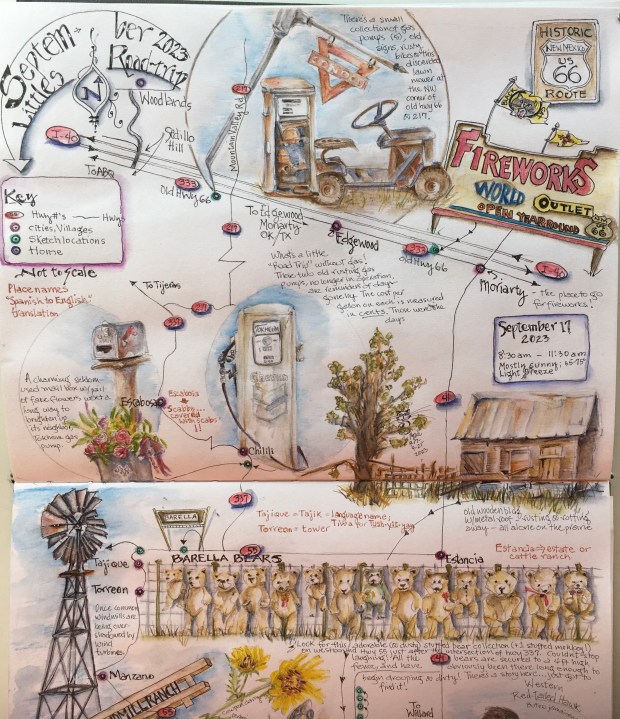
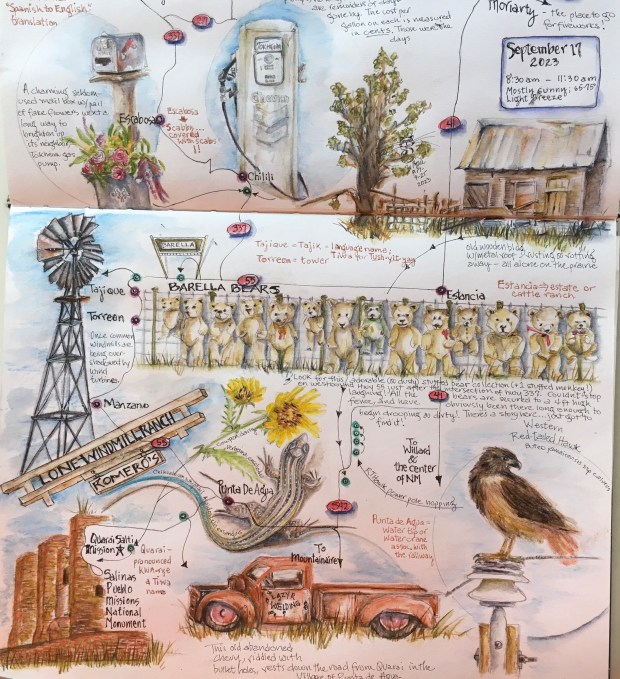
Instead of creating “Little” paintings of a month of highlights, and there have been many, I decided to focus on a single “Little” road-trip down the east side of the Manzano Mountains. My goal was to take a fresh look at, well, everything …….. and watch as the story of rural life unfolded. 

As we wound our way along scenic backroads, I mentally sketched out our route map to depict some of the historic and present day highlights across the landscape.  My imagination envisioned the full, prosperous and peaceful village life of the Tiwa Indians, and their conquest and struggle to survive Spanish occupation. There was evidence of the optimistic outlook of early settlers who came west to build a life centered around dryland farming and ranching.  And today, modern day ranchers live on the land adjacent to land grants where indigenous peoples live a rural lifestyle on their native lands.  I hope you enjoy my route map with some of these highlights, ranging from serious to funny, natural to commercial. 

I’d love to know what story unfolds for you as you travel along on this September “Littles” Road-trip. Be sure to pack a lunch! 


Once again, a big shout-out to “Made by Fay” for the inspiring “Littles” idea! These pages are fun to create, and remind me of monthly highlights and the random road-trip as I revisit my previous “Littles” posts. Hope you’re enjoying them too, along with the ending days of the season.
Stay tuned for the next installment of “Littles.” 

September 26, 2023

August “Littles” …. Horned lizards and Sphinx moths, a sleepy wasp under the Super Full Blue Moon, and nature through the eyes of a 15 year old!

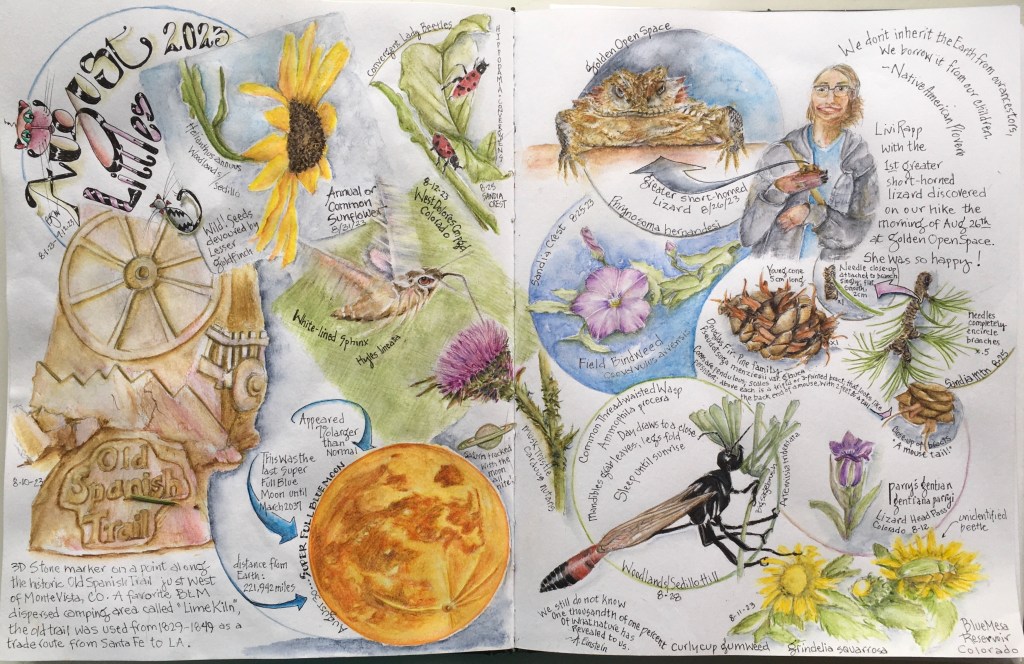
Two-page spread for August Littles

August was a busy month, filled with high elevation camping in Colorado, and a lot of cool mountain hiking back home. Even though the lower elevations took on a hot and parched look, at 9,000 feet and higher the wildflower season was far from over as evidenced along roadways and trails, where fresh, colorful blooms could still be found.

The highlight of the month was a 3-1/2 day visit from my brother Bob and grandniece Livi. At 15 years of age, Livi is already a fine artist, and took to nature journaling like a pro! It was great fun discovering and sketching nature on our daily hikes. She even got a chance to hold one of the adult ornate short-horned lizards we see frequently along various trails, and then found a baby lizard on her own, hiding nearly motionless under a small plant. Her smiles were priceless!

Despite the high temps, it was a month of good days and nights, ending perfectly with the rising of a rare Super Full Blue Moon! If you missed it, there’s plenty of time to prepare for the next …… which occurs in March 2037.

Once again, a big shout-out to “Made by Fay” for the inspiring “Littles” idea! These pages are fun to create, and remind me of monthly highlights as I revisit my previous “Littles” posts. Hope you’re enjoying them too, along with the ending days of the season.
Stay tuned for the next installment of “Littles.” 

September 14, 2023

Fading Flowers Reveal Leafy Greens ….. Cedro Creek

July 14, 2023

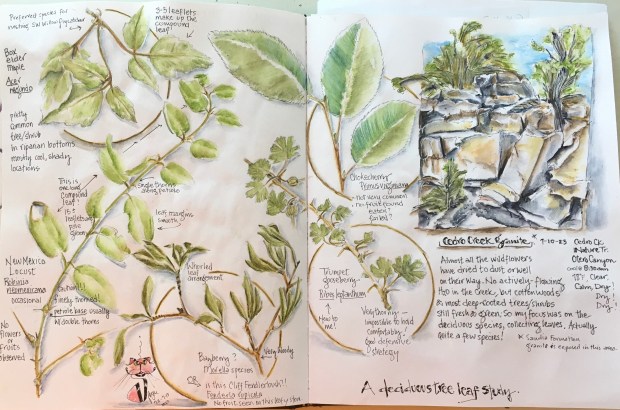
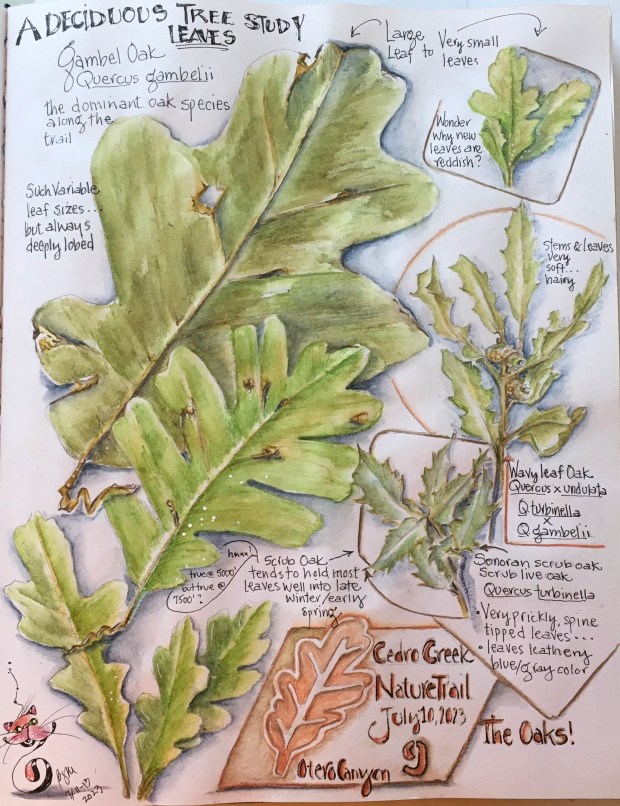
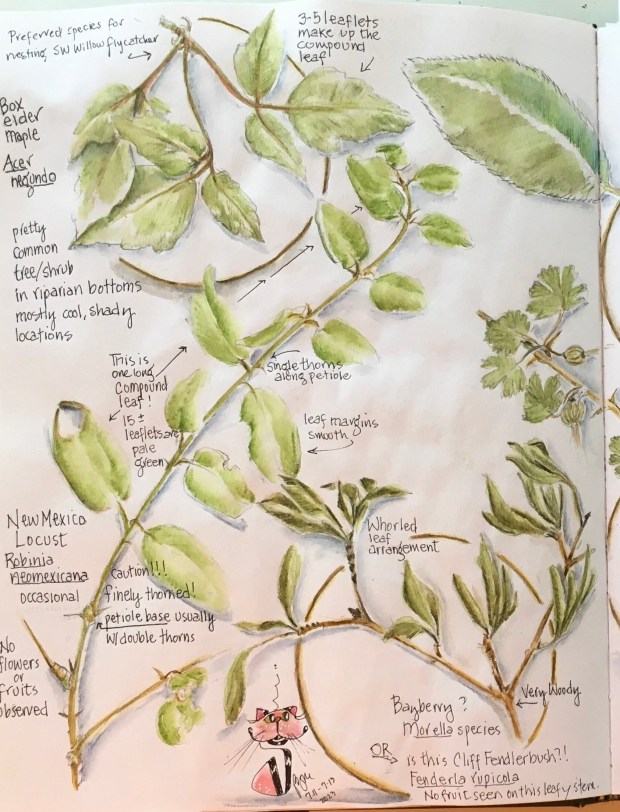
Learning the deciduous Trees and Shrubs shading Cedro Creek Nature Trail ….. Grab n Go Nature Journaling

The timing and location of our daily hikes are being influenced by the extreme summer temperatures we’re experiencing throughout central New Mexico, and throughout the desert southwest. Whew! Even at 7300-8300’ elevation, 95-100F has become the norm, with no relief (or moisture) in sight.  I don’t even want to think about Albuquerque temperatures; over 100F before noon, and soaring. 

Because hiking in the Albuquerque foothills, at any time of the day, is out of the question, we’ve begun revisiting some our favorite mountain trails. But even tho these areas are higher in elevation, and shadier, it’s still plenty hot. That means if we set out between 7-8am, we can still manage a few miles before our water, like all the creeks, runs dry. 

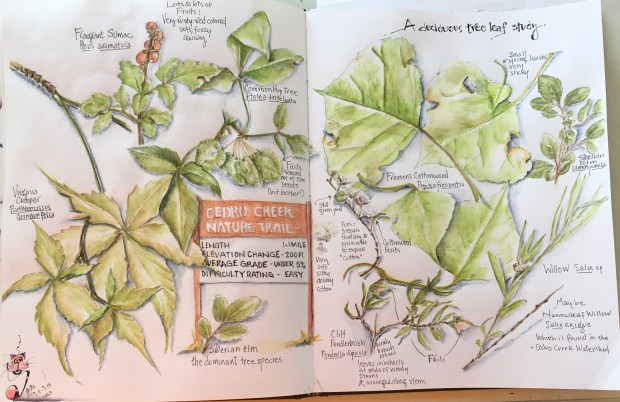
A few mornings ago, we decided to hike Cedro Creek Nature Trail, a rocky but easy dirt path under the shade of big cottonwoods. Expecting to find some water in the creek (there was none), I was hoping to find some interesting wildflowers (which had all withered and dried). The further along the trail we hiked, my focus quickly changed from wildflowers to other natural elements. 

Geology is always interesting in these mountain drainages, and Cedro Creek is no exception. The overlying shales and limestones have long ago eroded to reveal large granite boulders that showed signs of erosion from long ago flowing water. That’s a nice thought!

And then there were so many varieties of deciduous trees and shrubs; their leafy greens not only provided relief from the heat, but became a visual treat as we explored the riparian areas alongside the dry creek bed. 

As my curiosity about the diversity of tree and shrub species began to grow, so did the air temperature. Not wanting to become reduced to a sweaty puddle in the middle of the trail, and sensing a swarm of drooling, biting gnats and flies giving me a hungry eye, I resorted to collecting leaf and branch samples using a Grab n Go technique. By the time we got back to the car, I had 3 large ziplocks stuffed with over a dozen species of tree and shrub leaves and some fruits.  

Back at home, in the comfort of my cool studio, I began my detailed study of these leaves (and the few bugs that managed to hitch a ride). Three days and several gallons of iced tea later, I had completed the 5 journal pages in this post.  

That iced tea was deliciously cool, but not as cool as learning what’s growing overhead along Cedro Creek!

Until next time ……. be curious

“The Felix” 2023: Escapito #1


Come on along with us for 5 days of camping fun in the Land of Enchantment, where we had some weird and close encounters with botanical beauties, a bare-butted gopher, a swarm of bees, and voracious leaf-footed beetles! All this, and more while exploring a National Conservation Area, a Desert National Monument, and a New Mexico State Park, all within the Chihuahuan desert ecosystem.

Continue reading ““The Felix” 2023: Escapito #1”

A “Snow White” Spring Super Bloom … Albuquerque Foothills

April 2023

Oh my goodness! What a brilliant Spring Super Bloom is on display mere steps east of Albuquerque. 

Alas, I found myself lamenting for months over the long and snowy wet winter we just climbed out of here in the East Mountains of central New Mexico. It seemed the back-to-back snowstorms since last November were never ending; snow shoveling every morning became the norm. But I know better than to whine. An abundance of winter moisture always results in a spectacular abundance of spring flowers.  And this Spring has proven that true.

Scrambled Eggs

The last two months we’ve seen a mad splash of sunshine yellow from the blooming of a native winter annual called Golden Corydalis, aka Scrambled Eggs (Corydalis aurea). This member of the poppy family quickly converted the dusty hillsides from brown to a glowing yellow as the many-flowered stalks of this plant seemed to shoot up over last season’s dried grasses. Scrambled Eggs was the plant I thought would be our Spring super bloomer.  

But, oh no!

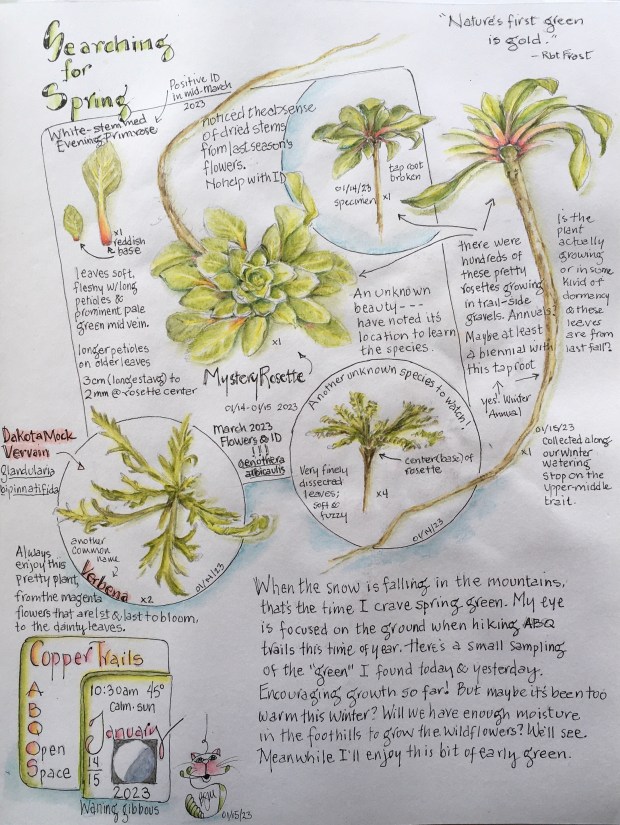
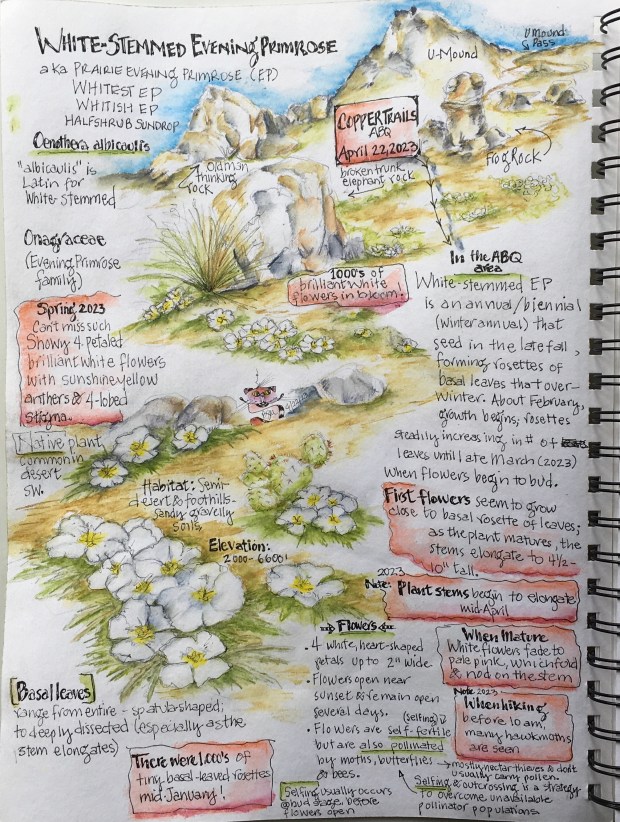
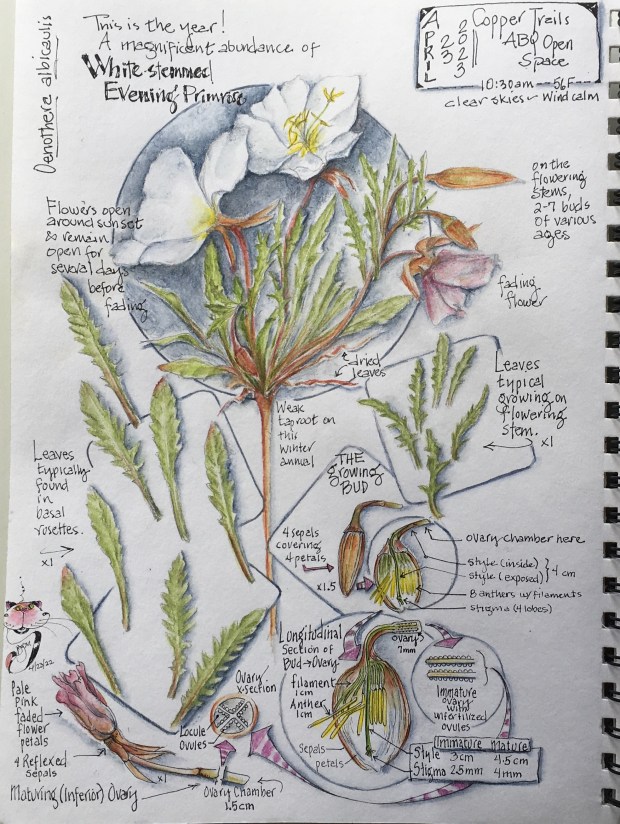
During a full two weeks of being distracted by the glow of all that yellow, all around our feet, 1,000s and 1,000s of blue-gray-green rosettes began to grow. I noticed these rosettes (the very same mystery rosettes I described in my January journal), were rapidly expanding outward to make room for flower stalks heavily laden with little rosy orange buds. And then one day one of those buds unfurled into a brilliantly white 4-petaled flower.  In the center of that flower were 8 lemon-yellow pollen-heavy anthers surrounding a 4-fingered lemon-yellow stigma, ripe for pollination. Of course …… now I knew with certainty ….. the flower blooming atop the pretty winter rosettes is the White-stemmed Evening Primrose (Oenothera albicaulis)!

One of my January posts included this page where I illustrated a mystery rosette (top center) that seemed to be everywhere.

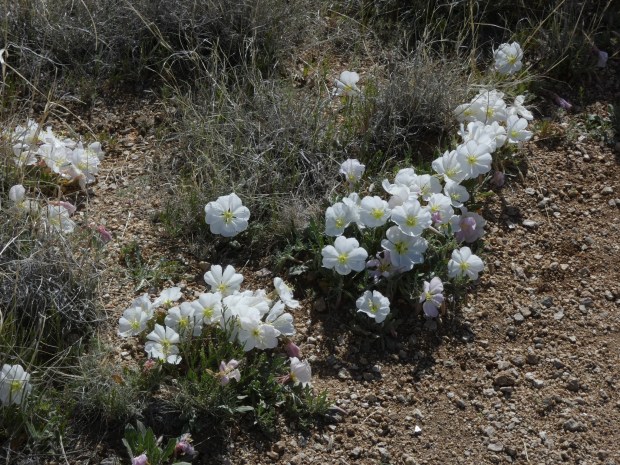
Also known as Whitest Evening Primrose, it wasn’t long until more flowers began to appear. “But, wow, was it possible that all those 1,000s and 1,000s of rosettes would each produce a bouquet of flowers?” Hiking these foothills every day paid of.  As the excitement of possibility steadily unfolded, hundreds of thousands of large 2-4” white flowers unfurled each evening about sunset to greet potential overnight pollinators, and to welcome hikers the following morning. 

My journal page illustrating the abundance of white-stemmed evening primrose
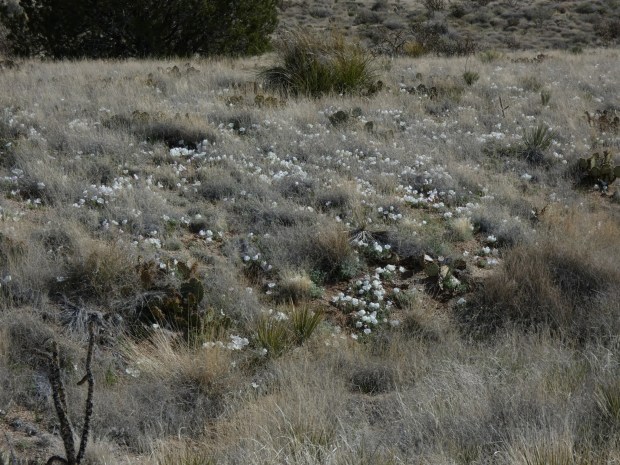
A vista of white
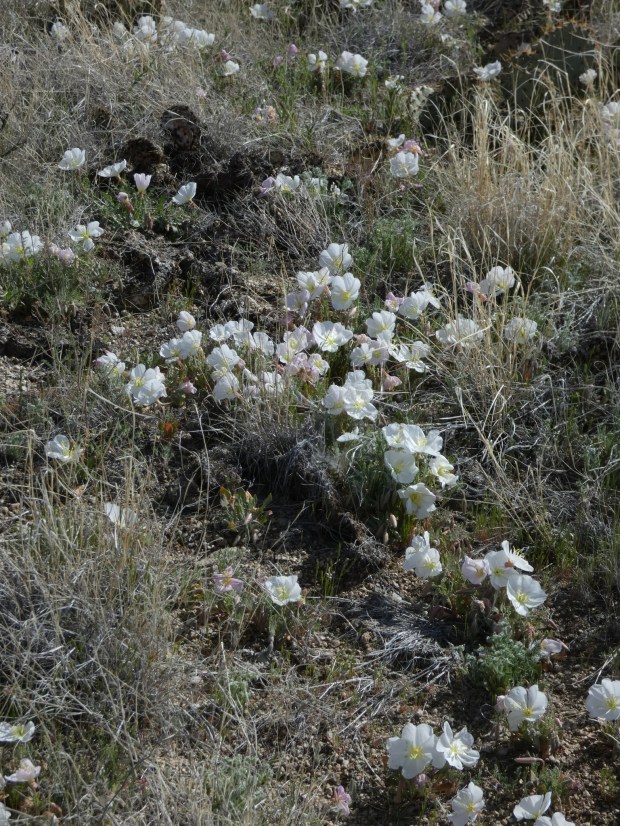
white-stemmed evening primrose

In about a week since I noticed that first open flower, this native Evening Primrose was carpeting the hillsides in white as brilliant and sparkly as newly fallen snow. The ground became “Snow White” with flowers, out-performing the still profusely-blooming Scrambled Eggs. 

white-stemmed evening primrose

And the show won’t end any time soon …. there are still an unbelievable number of White-stemmed Evening Primrose buds awaiting their turn to enter the play from stage right! Now that’s what I call a true Spring Super Bloomer.

A detailed page of my dissection of white-stemmed evening primrose

What marvelous transformations have or are happening outside your world this Spring? 

Meet a Teeth Clacking, Jaw Grinding, Squealing and Woofing Peccary of the Desert Southwest….. the Javelina  

March 21, 2023

Another species we searched for while visiting the Sonoran Desert surrounding Tucson last December, was the javelina. Certainly this elusive little pig-like critter was nearly everywhere we went, as attested to by the thousands of hoof prints echoing their presence. And many of those hoof prints were fresh! Certainly there must’ve been squadrons of javelina hiding behind every mesquite tree around the next countless bend in the trail? 

But alas …. we never saw, heard or even sniffed out a single javelina. All we could do was record (and sketch) the herd of hoof prints, and then research this animal in the following months. Oh boy, did we really miss such a fascinating encounter.

Back at home, several months later, our friend Jim Silva was happy to share one of his javelina skull mounts for study and sketching. I’m thinking we may have been lucky not to have met up with a herd of their clacking canines during our travels! 

Maybe another time?  

Meanwhile …. If you’ve got a thirst for javelina knowledge, or just want to see my journal sketches, read on!

Continue reading “Meet a Teeth Clacking, Jaw Grinding, Squealing and Woofing Peccary of the Desert Southwest….. the Javelina  “

Coues …..Elfin Deer of the Desert Southwest

March 17, 2023

Even though we didn’t see any mammals while visiting the Tucson region last December, we knew they must’ve seen us! But little (pun intended) did we know, a diminutive elfin deer, the Coues Whitetail, was probably among the mix of critters observing us as we explored the area.

This tiny deer, with its oversized ears and flashing tail, is a native species found in the mountainous desert regions of the extreme Southwest and south into Mexico. 

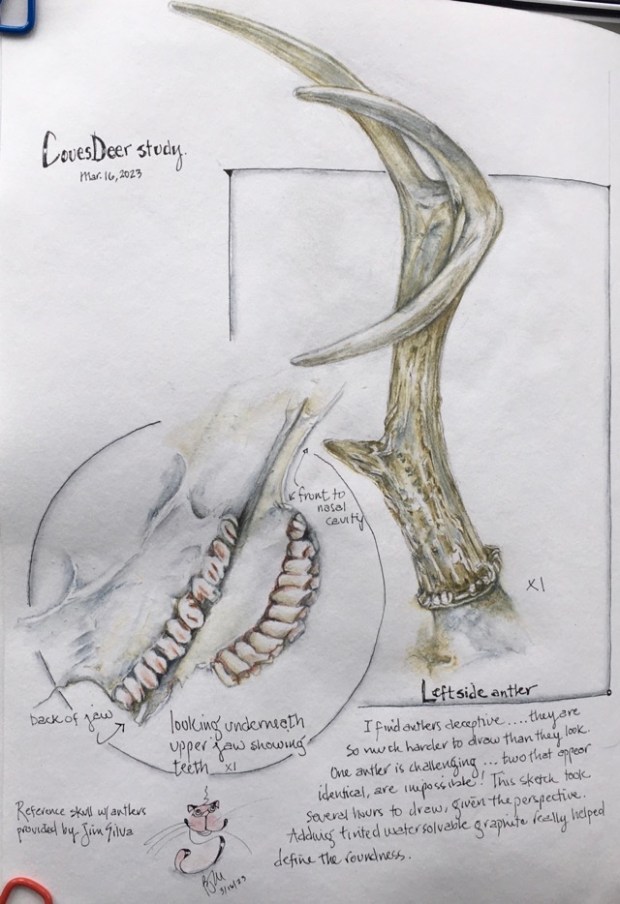
A good friend, Jim Silva, who has hunted this species in southwest New Mexico, shared one of his skull mounts with me. Since sketching the skull and an antler, I’ve learned a bit about the Coues deer, including the highlights included on my journal pages.

“Coues” is most properly pronounced “cows” (but more commonly pronounced “cooz”), is also known as the Arizona Whitetail or Fantail.  Having lived in eastern North Carolina for a number of years, we are well familiar with the Eastern Whitetail, a small enough deer when compared to our local Mule Deer.  But it’s hard to imagine a deer smaller than the Eastern Whitetail.  Now we’re ready to return to the mountains of the Southwest and search for the Coues deer! Maybe late spring when there’s a chance of seeing a few fawns too!

What’s on your nature agenda for this spring? Ours is filling up fast!

Until next time! 


A Festive Anniversary Week in the Sonoran Desert. Part 7: Snowbirds

December 11-17, 2022

The much anticipated finale, Snowbirds, and wrap-up to a grand anniversary week celebration in and around Tucson, AZ, follows!

Despite an unexpected snow the evening of our arrival, we never seemed to slow down, taking in as many sights and good eats as humanly possible. …… Open the full post for a recap of our week, and a bit about some of the birds we found while traveling around.

Continue reading “A Festive Anniversary Week in the Sonoran Desert. Part 7: Snowbirds”

A Festive Anniversary Week in the Sonoran Desert. Part 6: Mt. Lemmon  – Tucson’s Majestic Backdrop and a Cool Summer Retreat

(December 11-17, 2022)

December 16, 2022

We totally get it! Why Mt. Lemmon is nicknamed “Tucson’s Great Escape.” Why the scenic highway is ”Cool!”  From the Lower Sonoran Desert and the Tucson Valley (2,200 feet) to the upper reaches of a Spruce-Fir Forest (topping out at about 9,200 feet), the popular Scenic Highway up Mt. Lemmon offers breathtaking views, plants to discover, geology to learn, recreation opportunities, and temperatures often 30 degrees F lower than the desert below. That means a lot, especially when Tucson’s summer temps are in the triple digits! 

But on the day of our driving adventure we found snow ….. on the highway, at scenic overlooks, and on walking trails.  The storm hit 4 days earlier forcing closure of much of the highway. But on this day, most of the roads were clear and so was the sky.

So come along and learn what there’s to see along the Mt. Lemmon Scenic Highway.

Continue reading “A Festive Anniversary Week in the Sonoran Desert. Part 6: Mt. Lemmon  – Tucson’s Majestic Backdrop and a Cool Summer Retreat”