My search for still-beautiful Autumn leaves, half hanging, half fallen to the ground, took me to Albuquerque where temperatures hadn’t yet dipped below zero. Striking ‘gold’ in a large vacant parking lot next to a Disc Golf course, are at least 30 full-grown Sycamore trees with what looked to be full canopies of foliage still clinging tight. But for all the leaves yet to fall, there must’ve been 50x that number covering the ground. The morning breeze was causing the recently-fallen leaves to skid across the pavement in jerky movements, coming to rest in the parking lot’s gutters.
It was in these ankle deep gutter piles where the range of leaf sizes, colors and patterns were found. These 1” to 10” broad, palmately veined and ragged-toothed leaves appeared locked together like pieces from a newly-opened 5000 piece jigsaw puzzle. And, oh my! The lid to the box just blew away! Now I was faced with a dizzying jumble of multi-colored golden-yellows, burnt oranges, Ruddy duck rust, fading-to-spring greens and saddle browns. It was from these ankle deep gutter piles that I collected Autumn leaves for this project.
Lost in thought, I overlooked the white noise of the city ……. traffic mostly, constantly humming and impatiently honking ……. until a painful ringing in my ears invaded the relative calm of the morning. No longer able to think, I turned around and found an invasion of leaf blowers! Never was there a more loudly screaming, obnoxiously noxious sound. Coming closer and closer, louder and more insistent, their ear-muffled and gas-masked operators approached without hesitation, each blowing away (to where?) every bit of the “unsightly and offending” leaf-litter in their path.
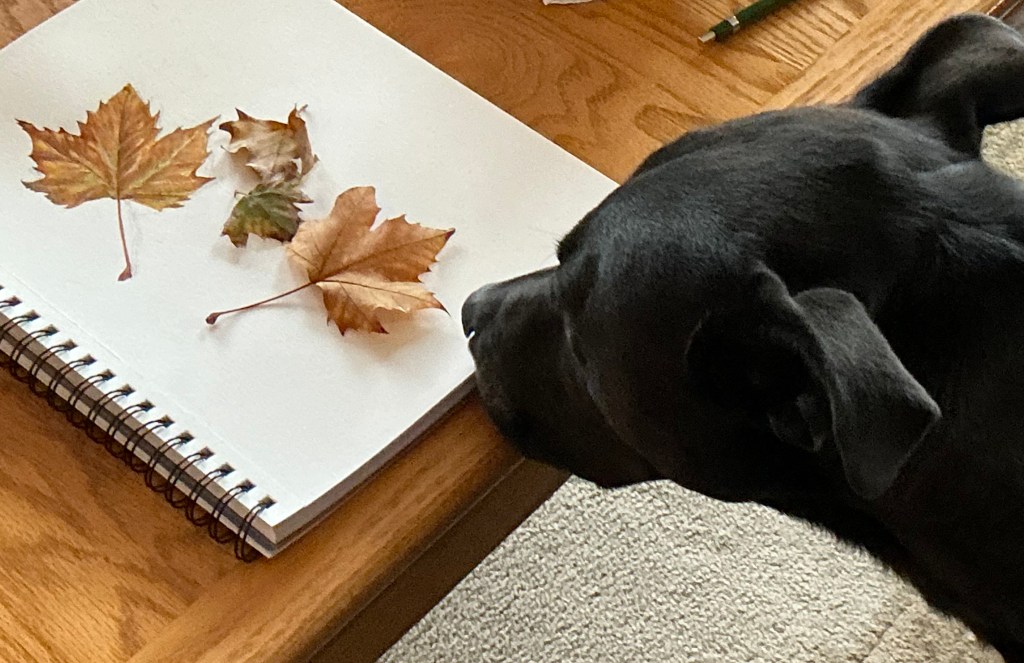
Luna approving of my Sycamore leaf selection
Dang-blasted!
It finally dawned on me this Friday morning that the vacant parking lot only opened for use on Sunday’s. Not agreeable to working weekends, the leaf blower operators were determinedly cleaning up the “messy” lot for the regular Sunday crowd. I was in their way.
Saving as many fallen Sycamore leaves as my collection bags could hold, and silently wishing all remaining leaves a happy landing somewhere on a nutrient-needy plot of land, I ran for the quiet of my car.
My Fallen Leaf Project
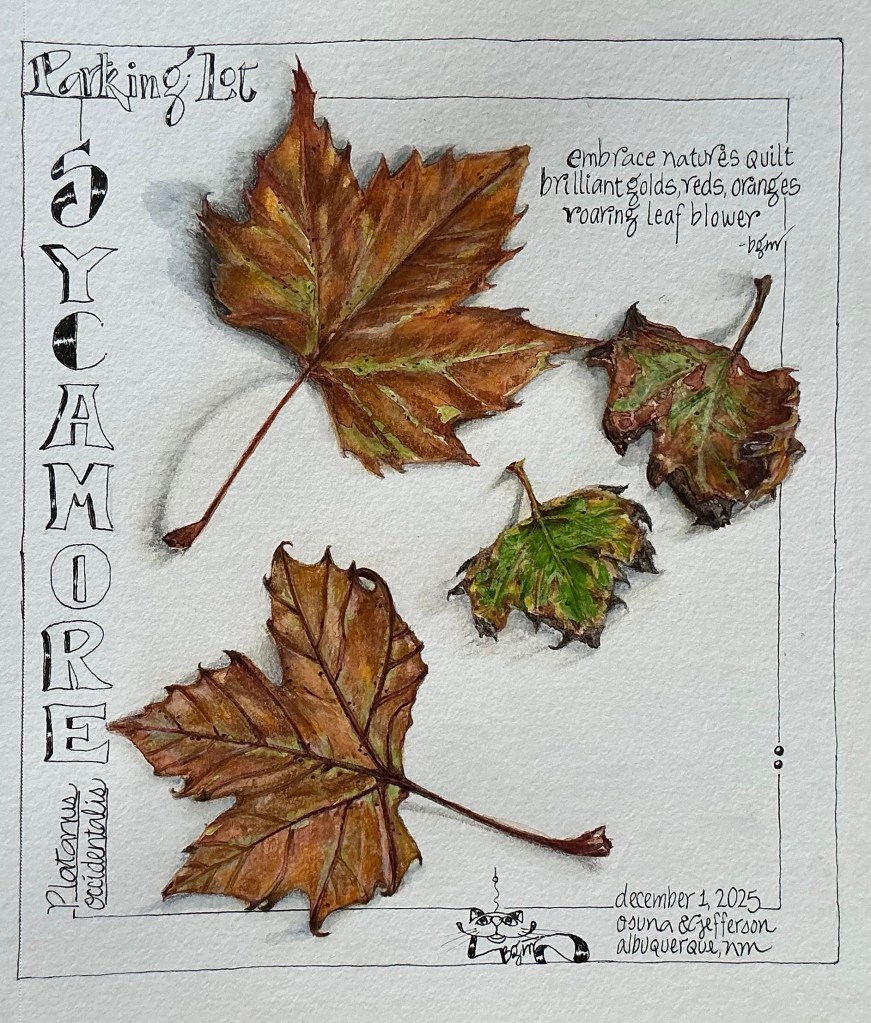
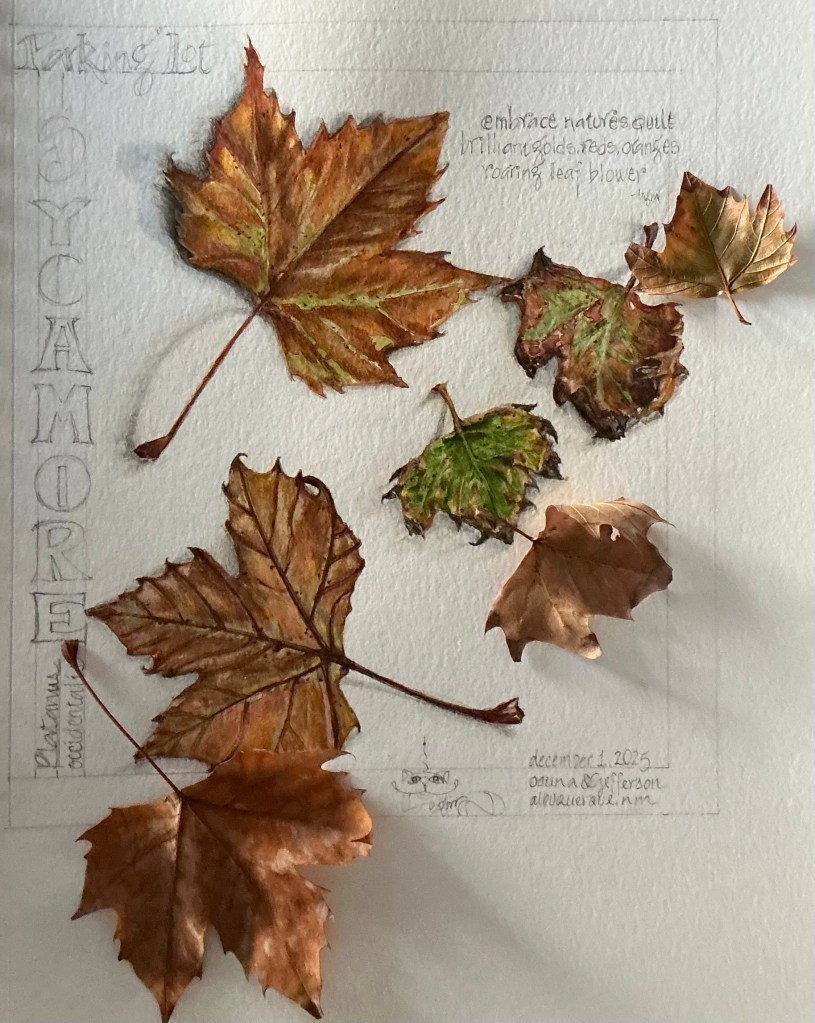
Using Sycamore leaves collected from that vacant Albuquerque parking lot, I tried my hand at a new technique; combining watercolor layers with layers of colored pencil. Using my new set of Van Gogh watercolors, I began each leaf with a layer of plain water followed by a light base layer, mixing Azo yellow medium with a touch of Yellow ochre. The bottom leaf (which was the underside of the top leaf) was duller and lighter in color, calling for a bit of Permanent lemon yellow. Allowing that layer to dry, I used various earthy colors from my set of Faber-Castell Polychromos colored pencils over the watercolor wash, mixing and matching the colors of my pencils with the actual leaf colors. This step tended to leave some areas uncolored with the pencils, so I applied another watercolor wash with Sap green, Burnt Sienna+Yellow ochre, and/or Madder lake deep+Azo yellow medium. I finished each leaf with a Dark sepia colored pencil outline, tipped the leaf margins with Dark sepia, and added shadowing first with Payne’s grey watercolor then Dark sepia colored pencil.
12 half-pan watercolor set and color swatch
The leaves were painted on 140# Canson XL Watercolor paper
Faber-Castell colored pencil set
If you have and questions or comments, please let me know. If you use this combined media technique, any tips you’d like to share would be greatly appreciated too.
…………………………………………………………………………………………
I’d like to send a shout-out and my deep gratitude to Wendy Hollender, botanical artist/illustrator/teacher extraordinaire, who announced in her newsletter free access for over a week to 19 of her bite-sized video lessons. Designed as companions to her book, The Joy of Botanical Drawing, each lesson focused on a different botanical subject and how to artistically render them using watercolor and colored pencil combined. I’ve always wanted to learn this technique and gave it a try with her leaf examples and then mine. Incorporating both media into the same painting was very challenging and way out of my comfort zone.
Thanks so much Wendy, for such wonderful lessons and your fabulous companion book! With lots more practice, my goal is that some day my botanical art looks as natural, skilled and professional as yours.
Were you ever so challenged by something so clever, while at the same time so frustrated with something so beautiful? No, no, wait….. that question may be more complicated than need be. Let me put it this way ……
Were you ever at your wit’s end finding a solution to a seemingly simple problem that you thought was obviously and repeatedly staring you right in the face?
My reply? Yes!
It’s All About the Genes
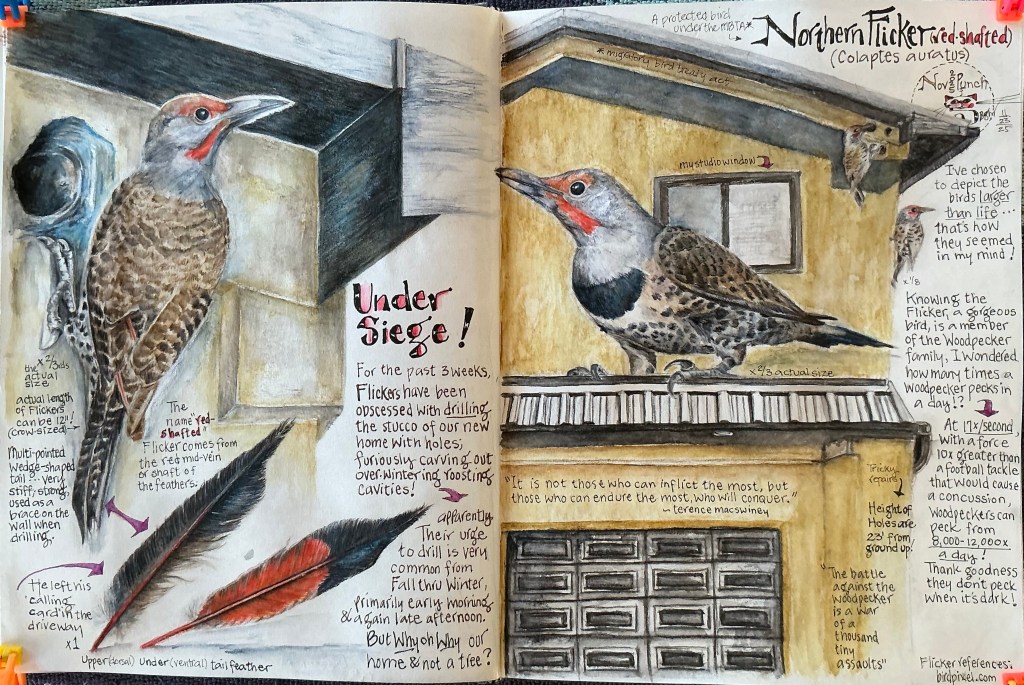
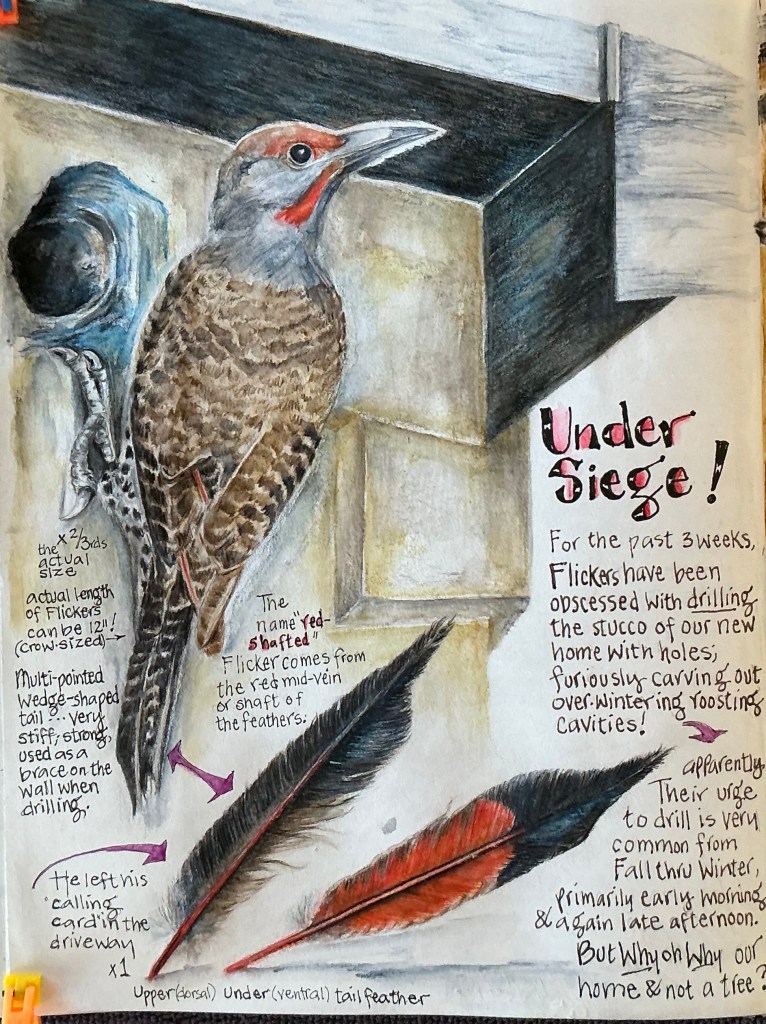
Meet the Northern Flicker (Colaptes auratus) … or more specifically, the Western red-shafted flicker (C. auratus ssp. cafer)*, a gorgeously flamboyant and noisy member of the Woodpecker family, that’s common throughout its western range.** And as woodpeckers do so well, they peck and peck and hammer and drill with the determination and force of a jackhammer*** on nearly any vertical (preferably wooden) surface. They’re single-minded, from start to finish, when it comes to creating a cozy nesting or roosting cavity, whether in a tree trunk or into your home. (More about that in a bit.)
Flicker ID – 101
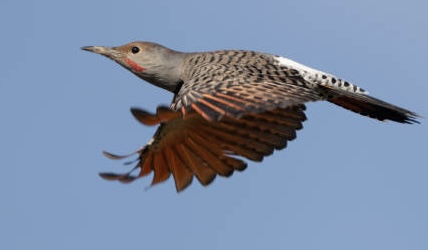
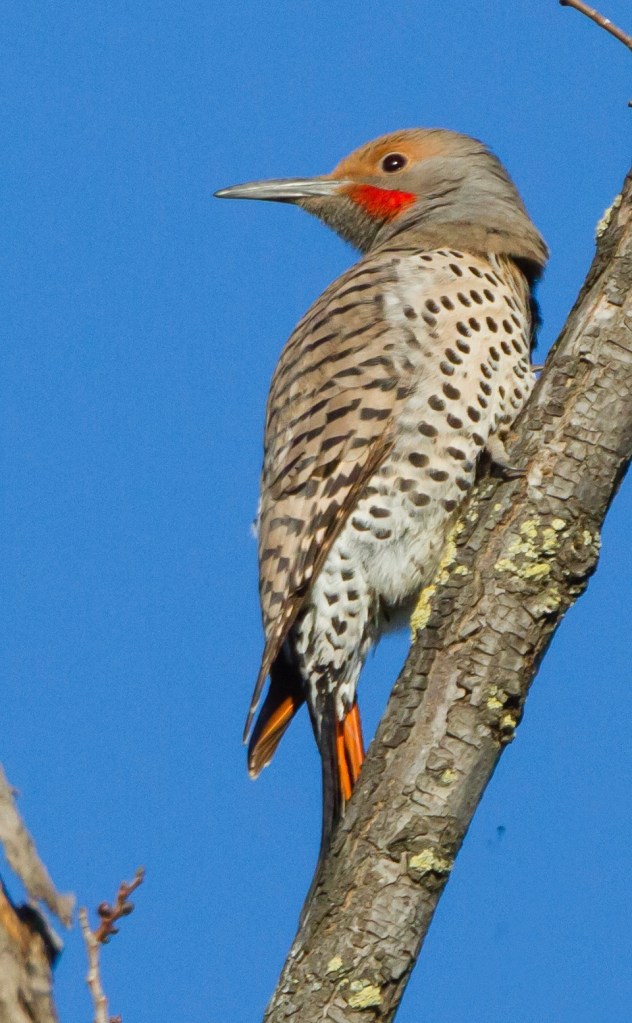
How do you know a Flicker has laid claim to your place? Well, he’s a big, heavy-bodied bird, and when flying overhead, your first thought might be “Crow!” At 12-14” long, with a wingspan of 18”-21”, the size is right. But as he flashes a large showy white rump patch bookended by reddish-orange underwings, you realize he’s not black. Anything but! As his flight slows and dips you notice his brown back is marked with narrow black bars. In preparation for landing, with wings open wide, he vertically aligns his body and feet with the wall, exposing a pale gray belly with bold black spots and a chest-wide black patch. Two strong clawed-toes up, two down (zygodactyl), and a stiff wedge-shaped tail adjusted as a brace, he taps out a few test spots, drawing your attention to his long and heavy bill, on a slate gray head broken by a buff-brown crown, a bright red whisker (male), and light gray cheeks.
Male Western red-shafted flicker in flight. Note white rump patch (unsplash.com)
On a crisp cool Autumn morning, as you watch in horror ……
Before you can declare, “It’s a Male Flicker!” ……
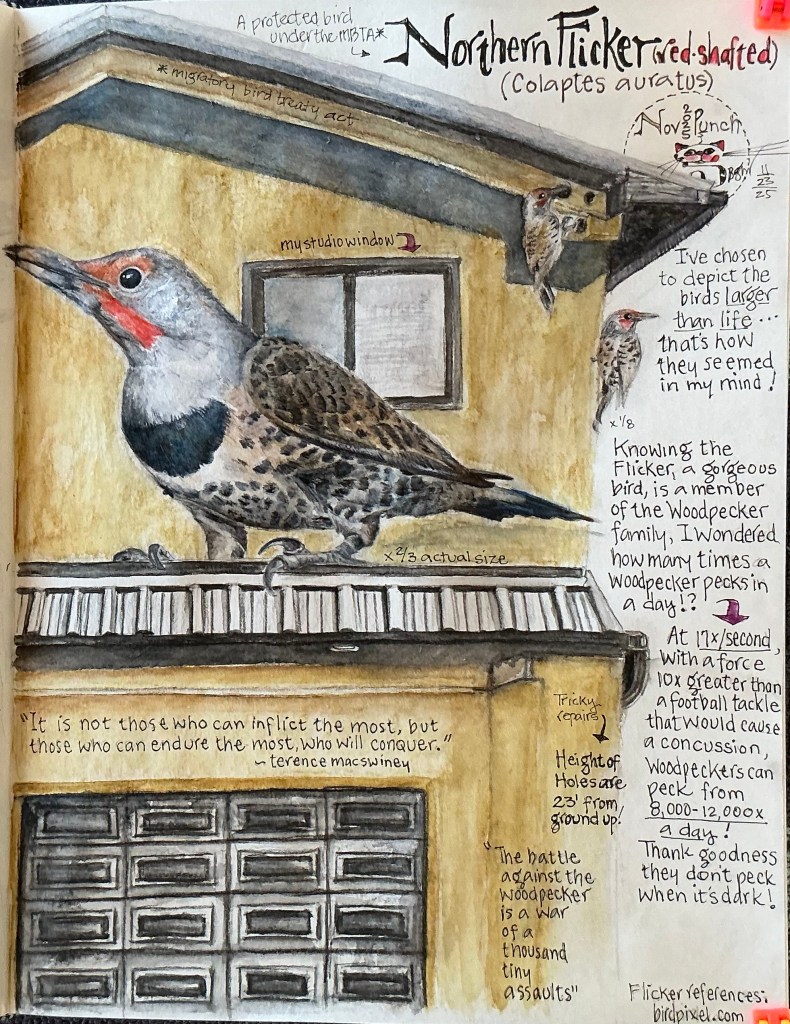
This bigger-than-life bird has landed, tested, and pecked away at his chosen spot 170 times in 10 seconds! He’s created an entry hole about 3” wide, right through the stucco and foam sub layer. This determined Flicker knows winter is coming and he intends to drill into our home, making a cozy roosting cavity in which to hunker down until Spring!
Oh no, No, NO!
We love Flickers and have no wish to harm this beautiful bird.**** But he’s already caused enough damage (23 feet high on the wall) that needs immediate repair. So I clap my hands and holler loudly (something unintelligible), and off he flys to a nearby snag to see how serious my noise-making was.
That’s the story of Flicker hole #1
Oh Not Again, and Again, and Again!
Since early November, our resident Flicker (I call him Jack), has continued to return many times, usually between sunrise and 10am. Sometimes he’ll make a fly-by before sunset. Often his quiet arrival escapes our notice; either we’ve been running errands, we’re out hiking with Luna, or enjoying a short roadtrip. These are the times he’s been able to drill six 3”-wide holes on the initial wall, and another 3”x6” hole just around the corner which was so deep, he almost penetrated the interior of Roy’s woodshop! This gives a whole new meaning to the term “Airbnb!”
After a few weeks up and down our fully-extended extension ladder to make a 2-step/2-day repair job/hole, we were making ZERO headway. Jack, unable to resist the need to drill him a roost cavity, was always one hole ahead of us. And because he didn’t hesitate to redrill newly repaired holes, was there something we were doing wrong?
All Flicker painting are larger than life, because that’s how they seemed to me!
It’s an Education in Biology and Patience
So we learned to listen for his noisy “kerrreee” scream-like call announcing his presence from one of Jack’s many favored perches around the house. Unless we missed it, his territorial call would put us on high alert, ready for action. We also listened for his series of warm-up test pecks that usually sounded inside the house. This “alarm” would catapult one or both of us from a comfy chair and run outside yelling and clapping our hands.
Between listening, running, clapping and yelling (and wondering what the neighbors might be thinking), I discovered a few interesting things on-line…..
Woodpeckers can’t resist drilling holes in synthetic stucco. This product provides the perfect surface for woodpeckers to hammer. When they begin tap pecking, it creates a hollow sound because the synthetic stucco includes a foam layer. The woodpeckers peck through the hard outer surface into the foam where it is easier to create a larger cavity to nest.
#1 …. Our entire home happens to be covered with synthetic stucco! While this might explain Jack’s insatiable desire to drill his roosting cavity into our home and not into one of the surrounding hardwood piñon pines, we’re not going to replace the stucco.
Basil, mint, cinnamon and/or lavender are suggested as natural, non-toxic deterrents for woodpeckers, who dislike strong aromas. The scent of basil, in particular, can be overwhelming and confusing to woodpeckers. Crushing one or a mix of these herbs with adding a bit of water, creates a green slurry that can be filtered and applied with a spray bottle to the affected area(s).
#2 …. This idea was worth a try, especially since there’s still have basil and mint growing in the garden. After collecting several handfuls of each, I popped the mix into the food processor with a bit of water and flipped the on switch. Gathering the resulting slurry, I filtered it through paper towels and collected the liquid for a spray bottle. That was several weeks ago, and with every hole repair, Roy’s been thoroughly soaking first the patch job then follow-up stucco coating with the basil/mint spray. It’s hard to know if it’s actually working, but the initial drilling sites haven’t been redrilled in the past week. It could also be that Jack is gone; pushed out with one of our heavy rainstorms. Or he’s begun drilling more recent holes over the RV garage door. With each repair, Roy continues to spray the basil/mint mix.
The Federal Migratory Bird Treaty Act*** provides protection for Flickers (and all woodpeckers), making it illegal to harm or kill them. But when warranted, migratory birds can be killed under a depredation permit issued by the Law Enforcement Division of the USDI-Fish and Wildlife Service (USFWS). Authorization by the relevant state wildlife agency also may be required before lethal control methods are initiated. Sound justification must be present for the issuance of depredation permits.
#3 …. Applying for a depredation permit may be our last resort, if Jack and his cohorts threaten to turn our brand new home into Swiss cheese.
AGAIN!
That’s the story, almost. This clear Conflict of Interest; an obvious Battle of Wits, continues. Just yesterday, one of the holes Roy patched above the RV garage door was redrilled this morning!
Oh Good Grief!
It’s already been repatched and resprayed, and while writing this story in my studio with window cracked and a clear view of the patched hole, I’m sure to hear and see that gorgeously determined Flicker if he returns to jackhammer away, once again, into a side of our home!
I’d love to know if you or anyone you know has a proven solution to this natural dilemma. Meanwhile …..
Thanks for stopping by, and Happy Thanksgiving!
……………………………………………………………………………………………………………
*Northern Flickers are divided into 2 subspecies, the Western red-shafted flicker (C. auratus ssp. cafer) and the Eastern yellow-shafted Flicker (C. auratus ssp. auratus). The red-shafted subspecies is found throughout Mexico, western and west-central U.S. (where it is common allyearlong), and British Columbia, Canada. The closely related yellow-shafted subspecies, which is highly migratory, is found in eastern and east-central U.S., the Canadian provinces and Territories (except B.C.), and far north into AK.
**Where the range for both subspecies overlaps (in the ‘lower 48’), a lot of hybridization occurs. It’s common to see a red-shafted flicker with more orange feather shafts and/or shades of yellow-orange on the underside of their flight feathers. The same holds true for the yellow-shafted hybrid. Otherwise, appearances differ notably between both subspecies of the Northern Flicker, primarily where the malar (mustache), nape pattern (back of the head below the crown), face color, and tail and flight feathers are concerned. See the table below for non-hybrid subspecies characteristics. For hybrids, any color and pattern variation(s) and combination(s) you can imagine have probably been found!
Northern Flicker subspecies
Red-shafted
Yellow-shafted
Face color
Gray
Buffy to warm, light brown
Malar color
Male: red Female: brown
Male: black Female: brown
Nape color & pattern
Gray, unpatterned
Male: Red crescent on gray Female: gray, unpatterned
Feather shaft/under flight feathers
Pinkish to reddish to red
Yellow
***A woodpecker can peck wood 17x/second, and from 8,000-12,000x/day! Really! And they can drill into wood at a force 10x greater than a football tackle that would cause a concussion. On the November 17, 2025 episode of the Science Friday (SciFri) podcast, biologist Nick Antonson stated that woodpeckers can peck 20-30x their body weight. Now that’s amazing for a Flicker that weighs about 6 ounces!
****Because we had no desire to harm the Flicker(s) drilling into our new home, even when we reached our point of extreme frustration, we wanted to ensure our deterrent efforts aligned with wildlife regulations; especially with the Federal Migratory Bird Treaty Act (Act). Flickers (and all woodpeckers) are considered a migratory non-game bird species, and protected under the Act. It’s illegal, punishable by fine and/or imprisonment, to harm or kill them.
Male Western red-shafted woodpecker with his tail braced against the branch(bird pixels.com)
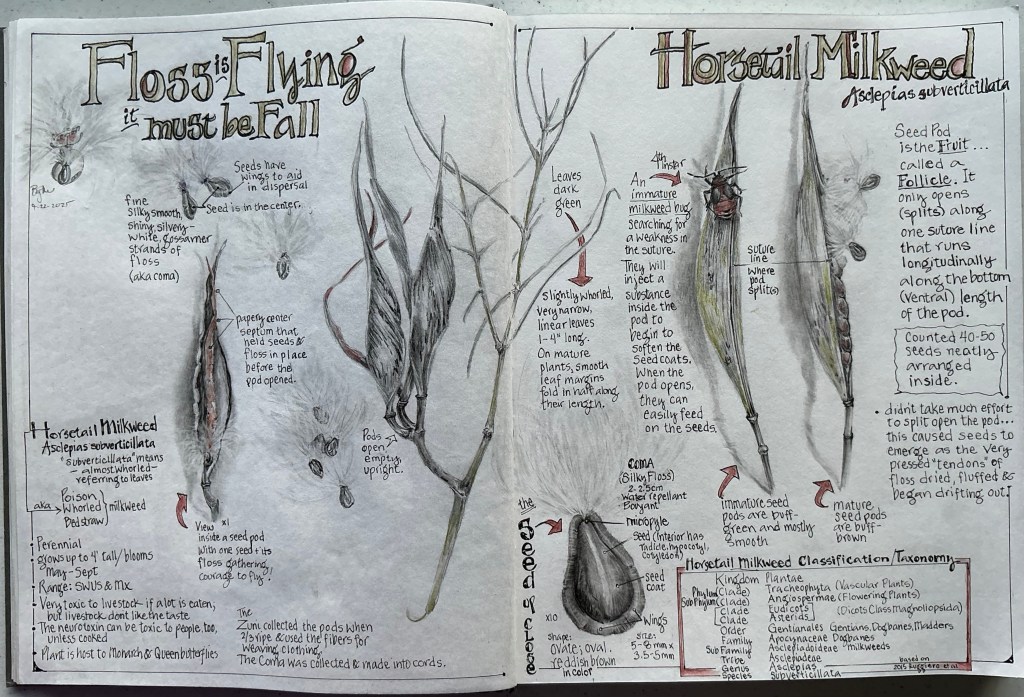
Like soft, fluffy snow! Glistening orbs of silky gossamer are floating about the neighborhood, drifting hither and yon in the gentle breeze. Suspended beneath each orb is a single reddish-brown winged seed that appears to coax its wind-propelled puff in a safe descent to the ground. But the white floss (the Coma) wants to fly, and it becomes a tug of war. As the weight of the seed overwhelms the ability (and the desire) of the floss to carry it, their brief relationship is severed. But both get their wish …. the floss flies free as the seed drops to the ground, hopefully landing in an ideal spot to overwinter and sprout next spring.
Welcome Fall!
When the air is full of Horsetail Milkweed parachutes and their ‘riders,’ I walk along the neighborhood roadways and collect a bounty of their new-crop seeds + floss to set free around our property. If they find the right soil, moisture, and light conditions for spring germination, the seeds will not only form the beginnings of a stand of these beautifully blooming, creamy-white milkweed flowers, but the plants might just play host to Monarch and Queen butterflies!
Now wouldn’t that be dandy!
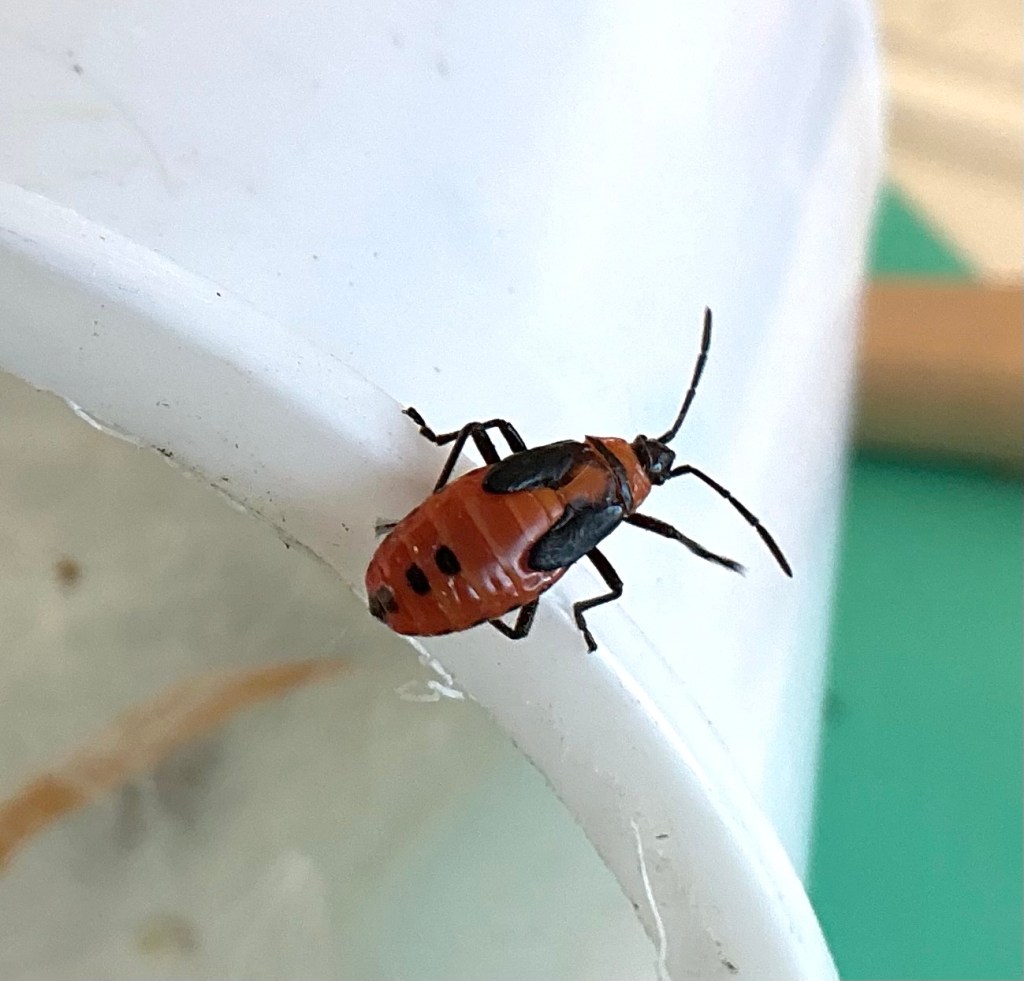
(Of course, mature seeds from new plants will undoubtedly entice a hungry crop of well-dressed Milkweed Bugs next Fall. That’s OK! They have to eat too!)
Before hint of color
My Journal Pages ……
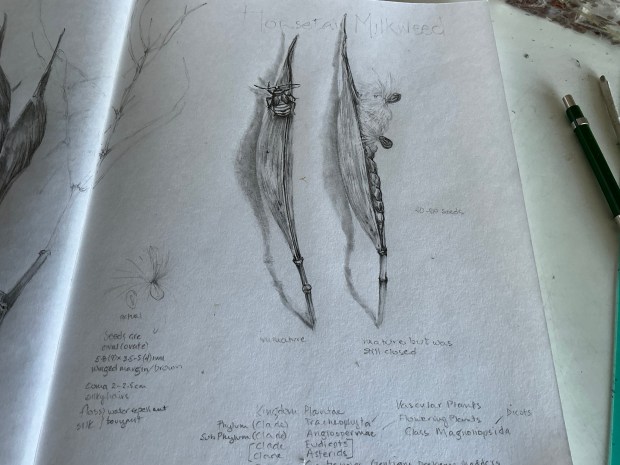
For something different, instead of using ink and watercolor, all sketches on these pages were created in graphite. The pods, seeds and the milkweed bug were sketched from my collected samples using a mechanical pencil loaded with a fine point HB lead. The touches of color were added with water soluble graphite.
Work in Progress #1Work in Progress #2
Thanks for stopping by ….. And Have a Fabulous Fall!
It’s late October, mid-Fall in the Manzano Mountains, perhaps a week before the first snow of the season. The Gambel Oak covering hillsides and mountains somehow sense a change in the air. Seemingly overnight every leaf on every oak shrub and tree magically transformed from their summer greens to royal rusty reds, gleaming golden yellows, and shocking sunset oranges. As I look across the landscape and marvel at the sight, I can’t help wondering, “How do they know?”
The spectacle is short lived. Over the next few weeks, these gorgeously painted leaves slowly change to crispy beige brown, fooling the observer into believing they can’t face another winter; that every single oak shrub and tree just gave up and died! Thinking that was the case my first winter in central New Mexico, I was fooled. But since then I’ve learned a lot about the life cycle of Gambel Oak, and have come to appreciate the persistence of all those crispy browns covering up the otherwise barren nakedness of chaotically jumbled branches.
There’s a lot that can be said about Gambel Oak (Quercusgambelii), but this post focuses on
The Leaves of Quercus gambelii
The most interesting thing about this oak species’ leaves is no two are alike. Even though each leaf looks different from its neighbor, they do all have common characteristics that distinguish its leaves from other oak species. For example, All Gambel Oak Leaves …….
are lobed (but the number of lobes varies from side-to-side of a leaf’s mid-vein; depth of lobes varies on a single leaf and between leaves; lobes can be gently concave to acutely angled).
are flat and leaf margins are smooth (if leaves appear somewhat wavy and/or exhibit some serrated margins and/or points on the lobe tips, this is not a true Q. gambelii, but likely a hybrid of Gambel Oak and Shrub Live Oak (Q. turbinella) resulting in Wavyleaf Oak (Q. undulata), very common where ranges converge).
are different lengths and widths, and leaf sizes are random along each branch, with large leaves adjacent to small ones adjacent to tiny ones adjacent to gigantic ones, etc.
change color in the Fall, eventually becoming beige brown and crispy (but color patterns on individual leaves and throughout a shrub/tree are wildly various; some leaves turn one color, while others become a mixture of greens, reds, yellows and/or oranges).
that are brown/crispy persist on the shrubs/trees throughout late Fall and Winter, then drop all at the same time in Spring when buds begin to open.
that are fresh have little 5-star hairs on the undersides, while the upper surface is smooth and leathery.
are relatively free of insect damage, with the exception of the occasional oak gall or insect nibbles (perhaps due to their leathery texture on the upper surface and hairy texture on the undersides?).
Every Fall I observe and collect Gambel Oak leaves. They make great subjects for my nature journal! Because every leaf looks different, the easiest way to depict the various shapes is to trace their outlines directly onto my journal pages. Then with leaves in hand, I can use my Inktense watercolor pencils to paint within the outlines, spending most of my effort on their beautiful colors.
I hope you’ve enjoyed my page of Gambel Oak leaves. Do you share nature with oaks? If so, which species, and are their leaves all the same or different somehow? Do you record your observations in a nature journal too? I’d love to know!
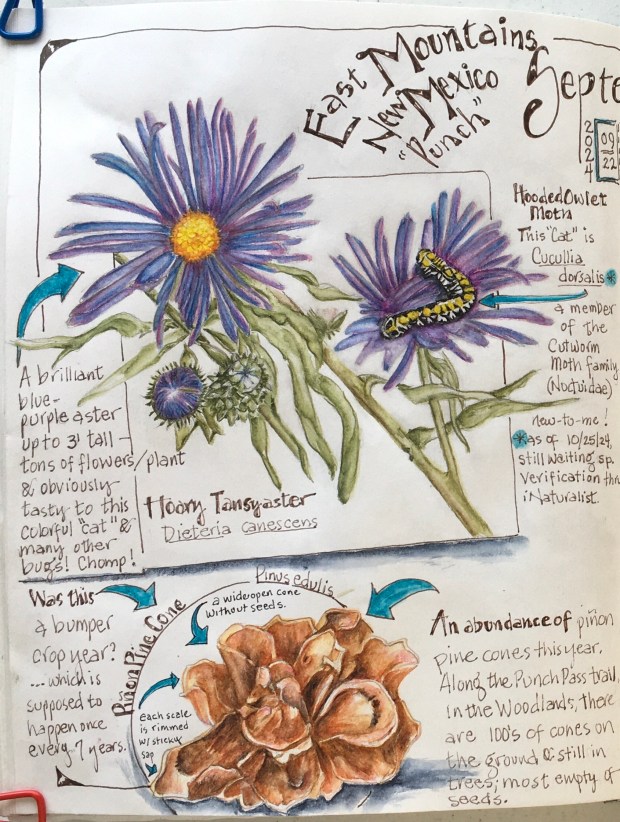
September 22nd was a morning full of new-to-me discoveries in nature. That was more than a month ago; a time when temperatures were still in the upper 80’s and flowers in full bloom.
But plenty of hints of what was to come ….. the inevitable change in seasons ….. existed. There were seeds of spring and summer bloomers blowing in the wind; squirrels stockpiling pine nuts from recently shed cones; darkling beetles mating and laying eggs in the ground to hatch next year’s population; caterpillars feasting on energy-packed flower petals needed to spin their cocoons; the chortling chatter of sandhill cranes high overhead migrating to Bosque del Apache for the winter.
Still it is hard to believe that today, a little more than a month later, everything has turned brown, and our first hard frost is forecasted for tomorrow morning!
In an effort to cling to a not-so-long ago summer, this small selection of the botanical and entomological happenings on the cusp of Fall, is now a part of my nature journal. Enjoy!
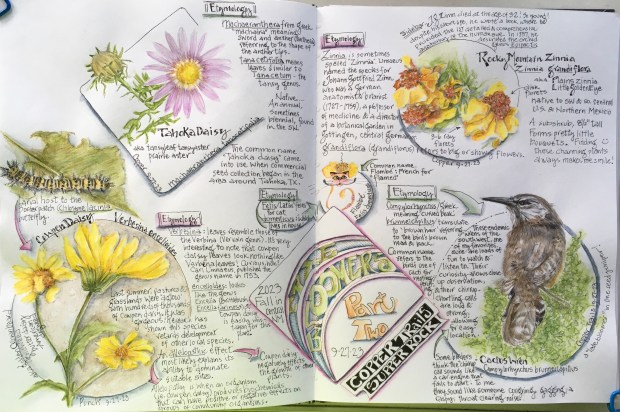
It’s hard now to imagine how extremely hot and dry the summer was this year. Without even a spittle of rain, the 100+ degree temps for weeks effectively suppressed the usual mid-season bloomers in and around the Albuquerque foothills/East Mountains. Even invasive plants, like goathead and tumbleweed, remained dormant or failed to germinate all together. It looked like winter browns had arrived early.
Then in less than a week, a small rain followed by several long downpours flooded the parched landscape, transforming browns to greens. You’ve heard this from me in a few earlier posts, but it was magical, and a reminder about the resiliency of desert vegetation.
Here’s a few pages highlighting a handful of the Late Bloomers I recorded in only 2 days. More than 2 dozen species had sprung back to life, setting flowers at all stages of accelerated vegetative growth. The landscape seemed wide awake. If plants could talk, I imagined them laughing while excitedly chanting, “hurry, hurry, hurry!” Only their roots prevented them from dancing!
In addition to the species on these journal pages, there are many (more) composites, native grasses, shrubs and sub shrubs, small forbs from Spring and early Summer actively growing and blooming right now, and (of course) the weedy invasives are growing and blooming with wild abandon.
Random thoughts and wonderings ….. are pollinators still hanging around …… or ….. how many of today’s bloomers are self fertile …… are local birds, insects, reptiles and mammals that depend on earlier summer pollen and/or fruit and seed production stressed with this timing change/availability of food sources … will there be noticeable shifts in species composition, including plants, insects, reptiles and animals (including birds) ….. what species can and will adapt to changes, and how quickly ….. etc. The answers to these and many more questions are probably best answered in coming years, if it’s even possible to answer them at all.
Have you observed vegetation anomalies that may be influenced by changes in climate? If so, please share your observations and where these changes are taking place. Meanwhile, keep your eyes wide open.
“Closing your eyes isn’t going to change anything. Nothing’s going to disappear just because you can’t see what’s going on. ……….. Closing your eyes and plugging up your ears won’t make time stand still.” – Haruki Murakami.
It’s always a grand idea to save leaves raked up in the Fall into big piles scattered about your yard. These cast leaves provide important habitat for overwintering birds, small mammals and insects. In the Spring they break down forming compost which helps recharge the soil with nutrients and microbes that fertilize new seedlings and build soil structure.
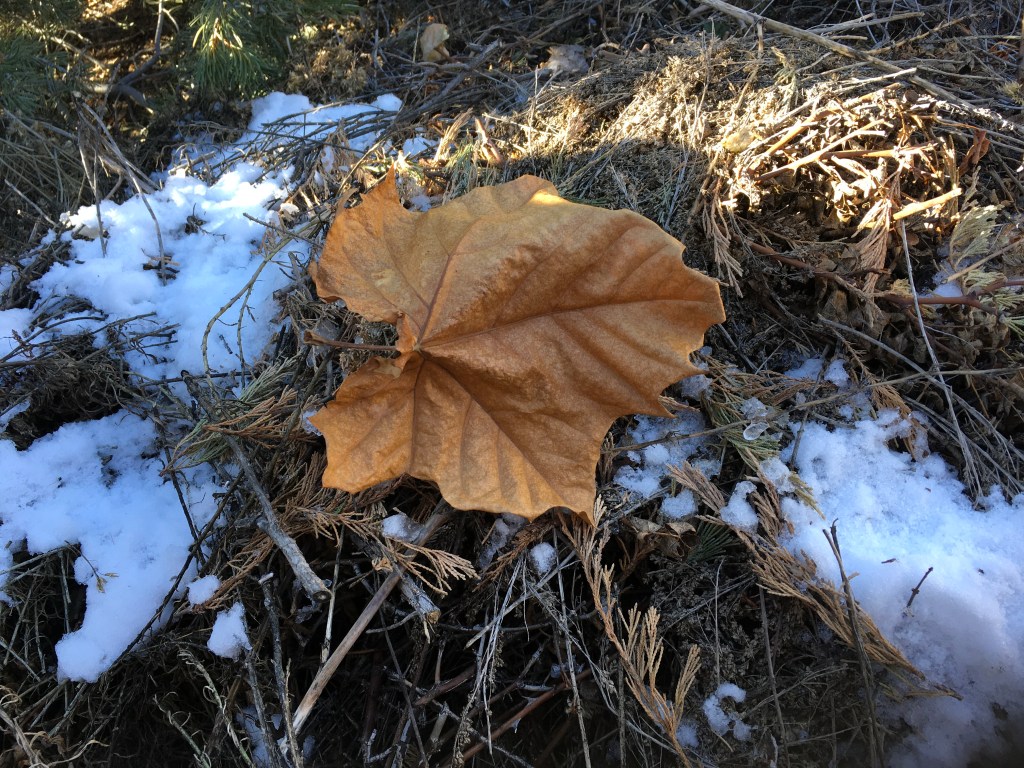
But what about that lone leaf, now brown and crunchy, alone on the ground? That leaf, once part of a network of thousands that once beautifully graced a massive shade tree growing bravely alongside a busy city street? That leaf, now fallen to a surface covered in concrete or pavement, is skittering about in the late morning breeze searching fruitlessly for an organic resting place.
Full journal page
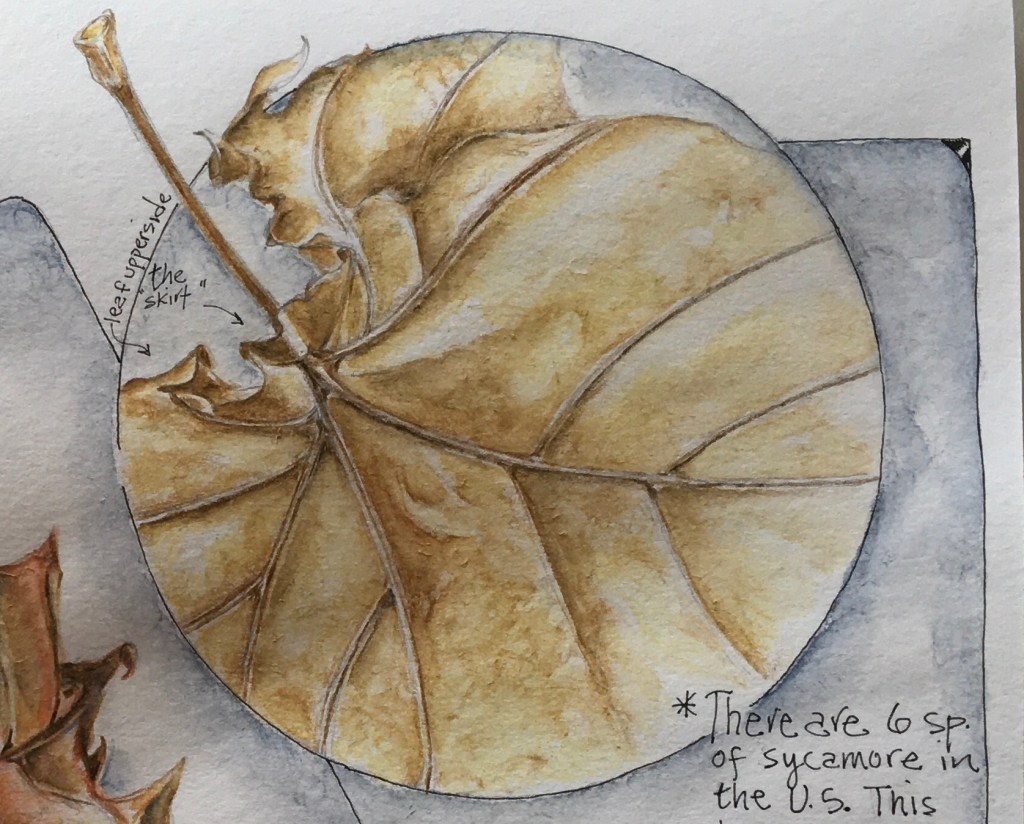
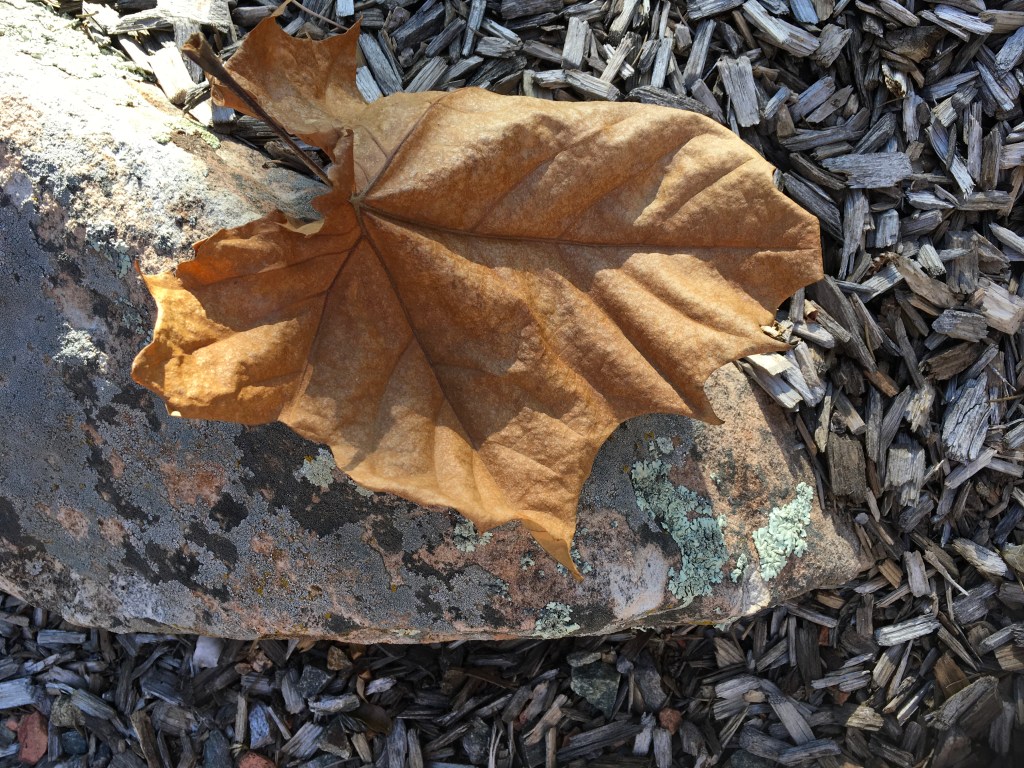
After leaving our favorite Albuquerque Mexican restaurant the other day, I stepped into the parking lot and noticed a giant sycamore leaf scratching and skidding across the pavement. Seconds later, an incoming car full of hungry customers about to park, was on a collision course with this abandoned leaf! Yikes! Quickly playing out the scene out in my mind, I dashed across the pavement and scooped up this big brown leaf, rescuing it from being smashed into bits and pieces.
Close up sketch of the upper leaf surface, showing the “skirt” over the petiole.
Whew! That was a close call. Naturally this leaf deserved better treatment and a chance to contribute to Earth’s complex web of resources. And that’s what would happen ……. after a few sketches in my journal, of course.
The rescued sycamore leaf before being placed in a compost pile
This big, brown, crunchy sycamore leaf is now a part of one of the various compost piles we keep scattered about our yard. If leaves could feel, I’d like to think she’s so much happier being rescued than the alternative. Would you agree?
The compost pile topped with the rescued sycamore leaf. Home at last!
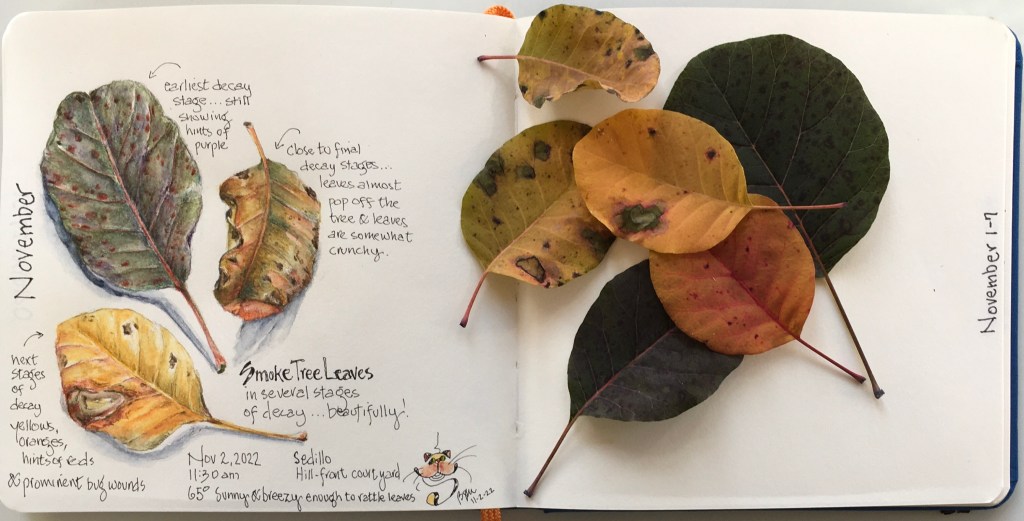
Our Smoke Tree is always one of the last to drop its leaves. While this tree tenaciously clings to its thousands of food makers, the leaves go through many stages of decay. Some remain purple-green but are polka-dotted with rusty red spots. Some more quickly change to brilliant yellow-orange with rusty splatters. Some display hints of green-brown and it’s these leaves that show the most insect spotting and damage.
One day, probably soon, the tree will get tired of the display, and just before a heavy frost or wet snow, it will stand bare with piles of multi-colored leaves lying on the ground, having dropped in one big fall.
Here’s a page from my perpetual journal that I created yesterday from a few leaves plucked from this pretty Smoke Tree.
Enjoy your seasonal changes wherever you may live!









 a curious nature