Piñon or Pinyon, Piñon Seed or Pine Nut

November 11, 2024

A fallen cone from Pinus edulis. Still a few seeds remain, tucked in the lowest scales. Typically there are 2 seeds per scale; 10-30 seeds are common per cone. Seed viability is uncertain until the inside kernel is exposed.

Pine Nuts Come From Where? 

Many years ago, maybe about 45 of them, Roy and I, his sister and her husband, set off on a pine nut safari in the mountains of south central Colorado. They knew of a large stand of a specific pine tree, called Pinyon (Piñon**) heavy with cones and ready to harvest.  This was my first encounter with the Colorado Pinyon Pine (Pinus edulis), and my first taste of the buttery rich tear-drop shaped seeds produced by these trees. I was hooked! After 4-5 hours collecting wide open seed stuffed cones from low hanging branches and off the ground, we had to stop.  Our fingers were impossibly stuck together from the cones’ copious coating of resin, definitely stickier than Super Glue! Without a solvent to dissolve this adhesive pine tar, we were in danger of losing our fingerprints. 

Having made a less-than-minor dent in the harvestable nuts, ample quantities of this energy rich bounty remained for foraging wildlife, such as migrating birds like pinyon jays, deer and squirrels.

For the past 45 years I truly believed pine nuts (which are, botanically speaking, not true nuts but the edible seeds of pinyon pines) only came from stands of Colorado Pinyon Pine. When the popularity of pesto skyrocketed, I thought “wow, you couldn’t pay me enough to harvest the amount of pine nuts necessary to make even one batch!” I honestly thought that was the reason the seeds were so expensive ….. harvesting is such a tedious and labor intensive job. Alas, we never returned to harvest pine nuts, and I never made pesto until years later. 

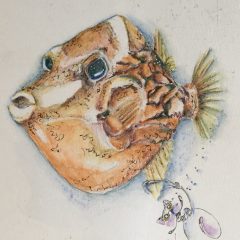
The result of my Pinus edulis cone and seed sketching exercise.

While studying a few dozen pine cones for my sketches, the seeds kept falling out and bouncing across my drawing table. This got me thinking about pine nuts and wondering how the Colorado Pinyon Pine could possibly fill the insatiable global demand! Of course by now I was well aware that this tree species is endemic in the southwest, but still ?……. 

News to Me ….

Of the 126 different species of pine in the world, 29 are considered edible; 20 of which have seeds large enough to be marketed. The biggest producers and exporters are China, Russia, Mongolia, Turkey, and Pakistan, in that order.  I found it interesting that China is also the largest importer of pine nuts, who’s marketing goal is to export 60% of the world’s demand.

What about the US? The pine nuts harvested from Colorado Pinyon Pine (Pinus edulis) is rated the best tasting in the world, with those produced by the One Leaf Pine (Pinus monophylla), harvested primarily from these California trees, comes in a close second. Yet, the US is a major importer of shelled pine nuts, primarily from China. But if China is the largest importer and the largest exporter of shelled pine nuts, then the pine nuts on the shelves of Trader Joe’s and Costco, labeled as imported from China, probably came from a variety of pinyon species from a combination of suppliers importing seeds to China?! 

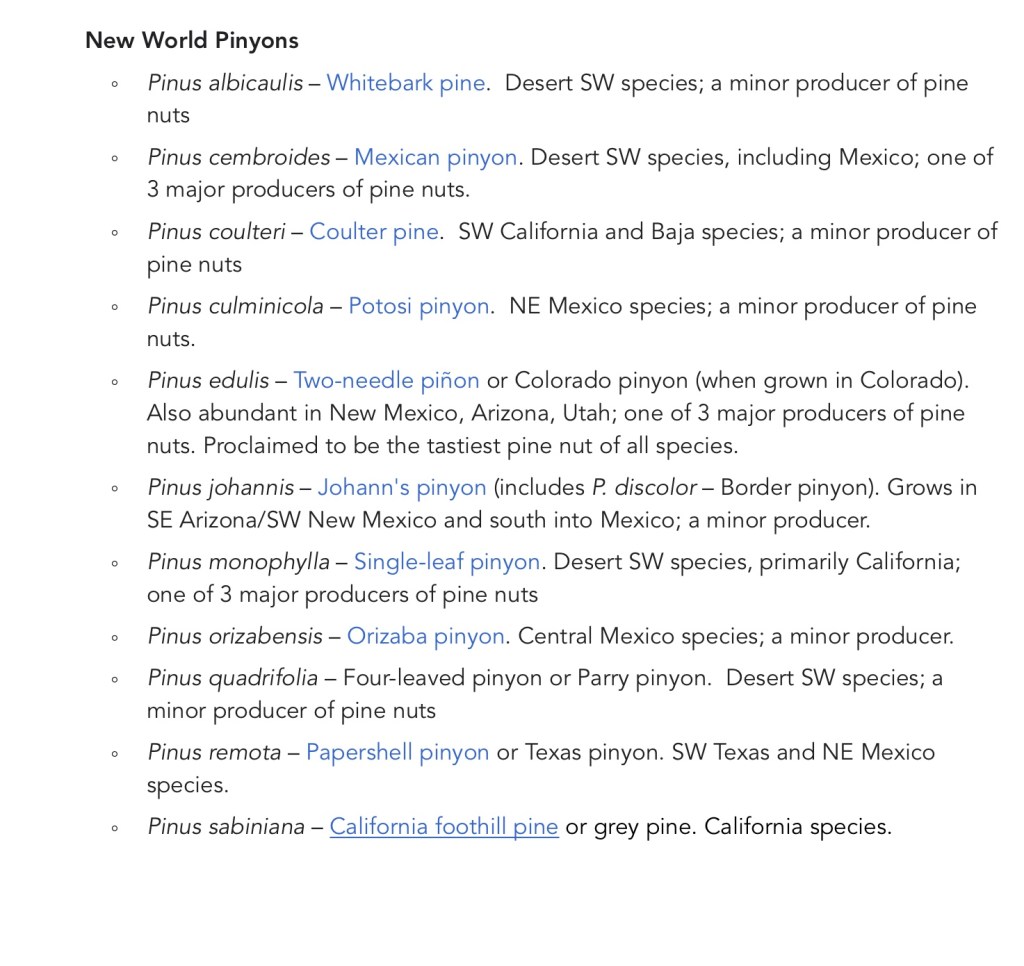
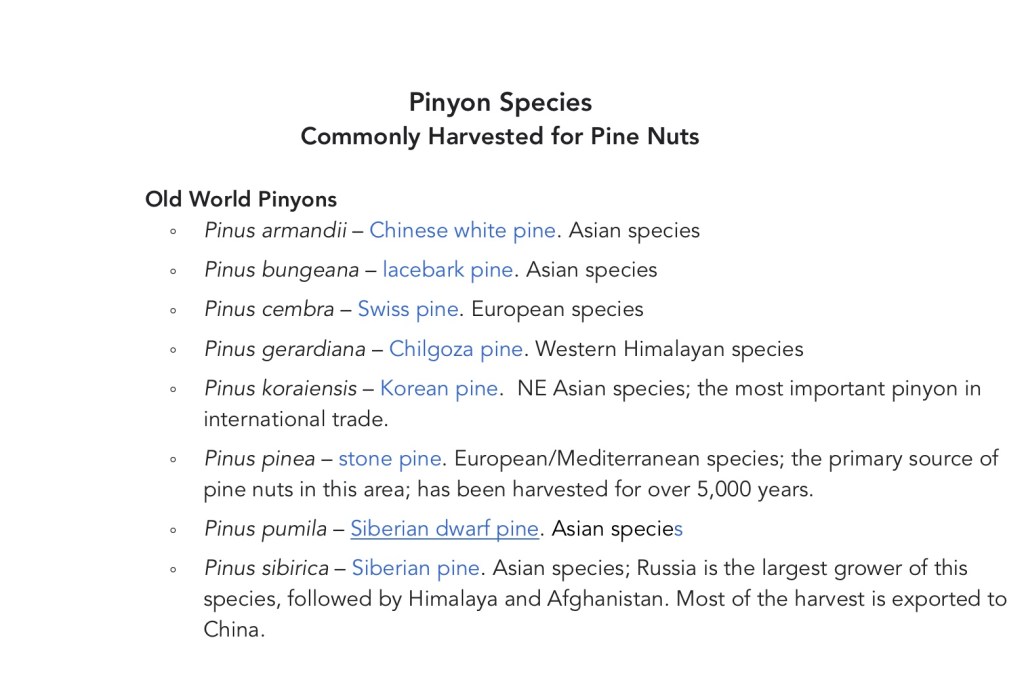
Being naturally curious about the Pinyon species that grow in various countries around the world, I included a list of 16 of the most commonly harvested trees the end of this post.

What’s the Real Reason Pine Nuts are so Expensive?

It’s said that “pine nuts are the most expensive seeds we would never buy!” (**** Check out this footnote for the 2024 costs/pound and my random calculations per serving and for a batch of pesto). Pine nuts are the second most expensive “nut” in the world, second only to the macadamia nut.  But why? While it’s true the seemingly exorbitant price of shelled pine nuts is directly influenced by labor costs, compounded by the annoying sticky factor, other challenges exist.

Harvesting Pine Cones

Cones are harvested by hand, directly gathering those that have fallen on the ground, and from tree branches (where the densest number congregate in the upper 1/4th of 30 foot tall trees). Another common harvesting technique is to whack the branches (which reportedly does not injure the trees [hmmmmm?]).  But a faster method used in many countries is to cut off branches with cones, resulting in a number of detrimental effects  to the trees (open entry points for insects and pathogens; stunted growth; stalled production; tree death).
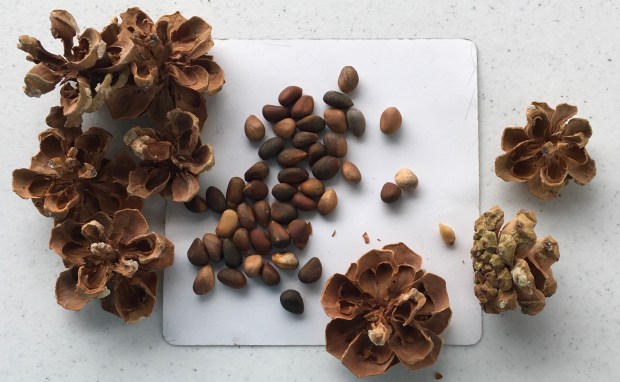
A sampling of Pinus edulis cones with hard coated seeds removed, ready for cracking. There’s a single kernel between the two lower right cones.

Pine Nuts

Once the seeds are taken out of the cones, their hard shells (seed coats) must be removed without damaging the soft edible kernels inside, the “pine nuts.” (And not every seed is viable ….. more about that below.) The shelled pine nuts must now be handled quickly and properly due to their short shelf life. It only takes a few weeks or even days in warm and humid conditions for shelled pine nuts to lose flavor, turn rancid, and completely deteriorate. Until they can be marketed for export, pine nuts must be kept frozen. Ideally, shelled pine nuts should remain frozen during export/import and until consumer purchase and consumption.
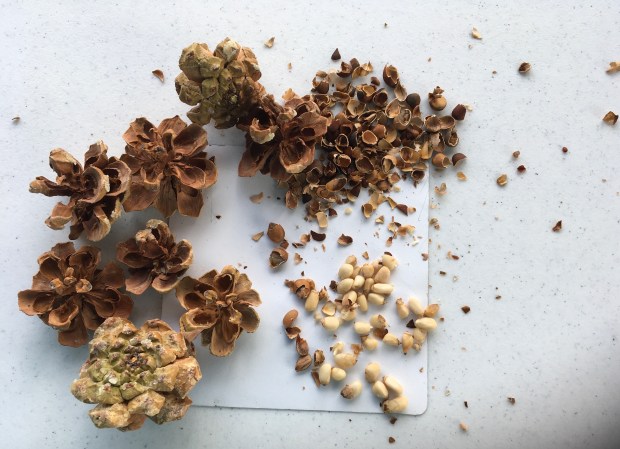
There were the remains of the Pinus edulis seeds extracted from these cones; 30 tasty kernels were viable; 20 were either missing or dried up.


Tree Characteristics

Slow growing trees and inconsistent production are several more reasons pine nuts are so expensive.  Pinyon pines are notoriously slow to grow, mature (10 years) and produce a harvestable crop of cones with viable seeds (75-100 years). But pinyon pines typically live an average 350 years, and have the potential to produce tons of harvestable seeds.  However, all pinyons exhibit a common characteristic called “masting,” where they may produce a bumper (harvestable) crop only once in as many as every eleven years. Good years are not predictable either, as many factors influence growth and production, with local droughts and a changing climate having the biggest impact. 

Gifford Pinchot (1909), U.S. Forest Service Chief said: “Seasons of especially abundant production occur, as a rule, at intervals of from five to seven years, although heavy crops are sometimes produced for two or three consecutive years, and heavy seed years are not the same throughout the range of the tree.”
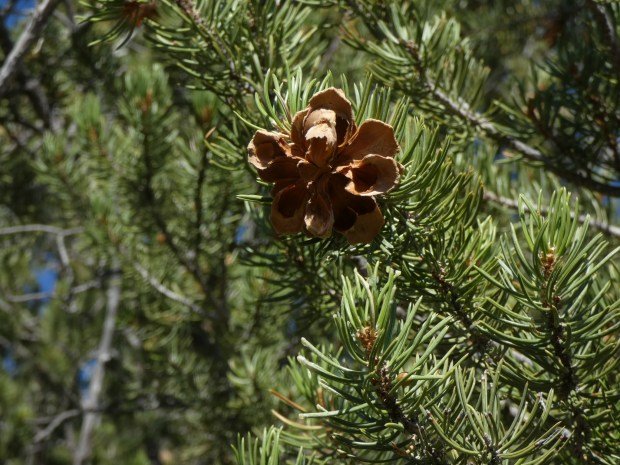
A Pinus edulis tree showing the 2 needles/fascicle densely covering the branches, and a remaining cone ready to fall..

______________________________________________________________
A Few Footnotes

**Piñon or Pinyon?

The most common common name for Pinus edulis is “Colorado” Pinyon Pine, even though the species is widespread in New Mexico, Utah and Arizona as well as Colorado. The words pinyon and piñon are usually considered interchangeable. Use of the word “piñon” (Spanish for pine nut) is tied to the seed (i.e. piñon seed or pine nut seed) and the tree (i.e. piñon pine or pine nut pine) particularly used by Native Americans in the southwest US.  Because references consulted during my research were not consistent in their use of common names for Pinus edulis, to avoid (my) confusion I’ve opted to call the piñon seed (pine nut seed) a “pine nut” and the pine trees with edible seeds “pinyons.” 

**** The 2024 retail market cost (shelled raw or roasted seeds) averages $40/pound

  • 1 pound of seeds = about 4 cups (depending on seed size)
  • 1 cup of seeds weighs about 4 ounces (price $10§)
  • 1 ounce or 1/4 cup of seeds = 1 serving (price $2.50)
  • 1 serving = about 167 seeds (price 1.5 cents/seed)
  • 167 seeds = 191 calories (pine nuts are extremely high in unsaturated, heart-healthy fats and carbohydrates)
  • 1 cup of seeds = about 668 seeds = 764 calories
  • 4 cups of seeds = about 2,672 seeds = 3,056 calories

Number Play

  • Of the 50 seeds I harvested, only 30 were viable (price 45 cents)
  • It took me about 45 minutes to crack open the 50 seeds (this doesn’t include the time it took to collect the resin-coated cones and remove the seeds)
  • It would take me 67 hours to fill a 1 pound bag with 2,672 viable shelled seeds!
  • At $40/pound, a pine nut cracker would be paid only $0.59/hour for their labor, a wage earned back in the 1950’s and 1960’s which didn’t even come close to supporting a family then, let alone today. 
  • Assuming a pine nut cracker makes a minimum wage of $7/hour, it would cost $468 to fill a 1 pound bag.  That’s 1,170% more than the 2024 retail cost of a pound of pine nuts!

Obviously, a professional pine nut cracker is far more efficient than I was, using some form of mechanization to crack the seed coats (requiring more research on my part).
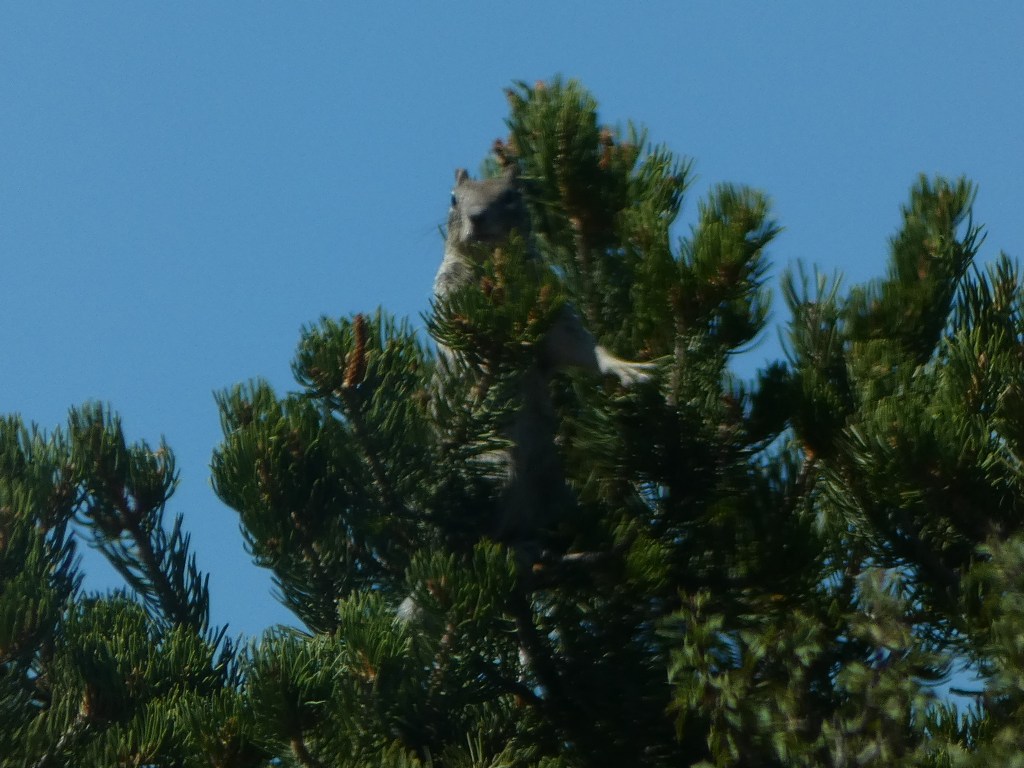
A rock squirrel high in a Pinus edulis tree, keeping watch for red tailed hawks while searching for pine nuts.

§ Pesto ……. most pesto recipes I found call for the addition of 1 cup of shelled pine nuts, or 668 seeds. At 1.5 cents/seed, you’d be adding $10 of pine nuts to make one batch of pesto. Enjoy slowly!

______________________________________________________________

Living in the East Mountains of central New Mexico ensures daily appreciation of hundreds and hundreds of Piñon Pines (Pinus edulis). This iconic pine, the state tree of New Mexico, has been a source of nutrient rich seeds for wildlife and indigenous peoples for millennia. It was fun learning more about this tree and the many Pinyon species that grow around the world.

As always, thanks for stopping by!

______________________________________________________________
On the Cusp ….. Fall Equinox in the East Mountains

October 28, 2024

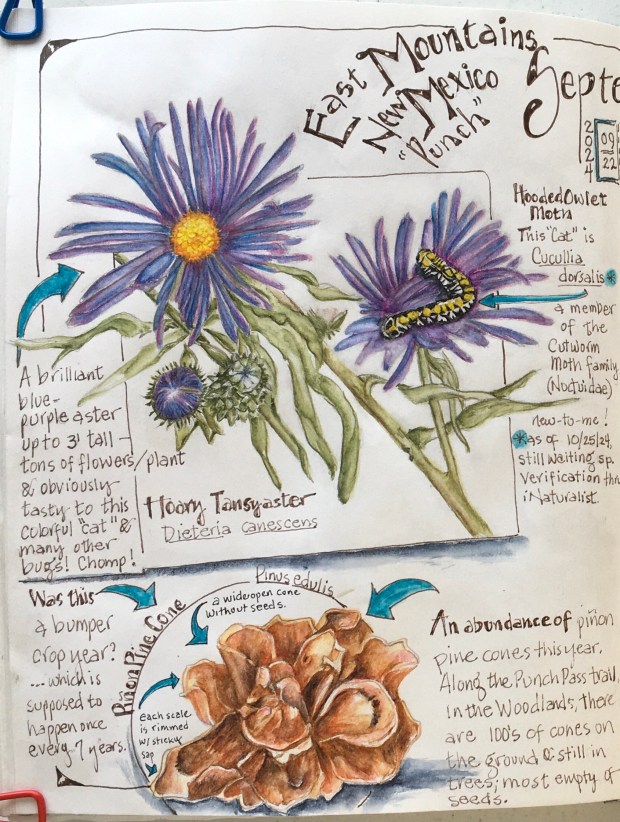
September 22nd was a morning full of new-to-me discoveries in nature. That was more than a month ago; a time when temperatures were still in the upper 80’s and flowers in full bloom. 

But plenty of hints of what was to come ….. the inevitable change in seasons ….. existed. There were seeds of spring and summer bloomers blowing in the wind; squirrels stockpiling pine nuts from recently shed cones; darkling beetles mating and laying eggs in the ground to hatch next year’s population; caterpillars feasting on energy-packed flower petals needed to spin their cocoons; the chortling chatter of sandhill cranes high overhead migrating to Bosque del Apache for the winter.   

Still it is hard to believe that today, a little more than a month later, everything has turned brown, and our first hard frost is forecasted for tomorrow morning! 

In an effort to cling to a not-so-long ago summer, this small selection of the botanical and entomological happenings on the cusp of Fall, is now a part of my nature journal.   Enjoy!

As always, thanks for stopping by!


Random Wanderings; Destination North

August 15-20, 2024

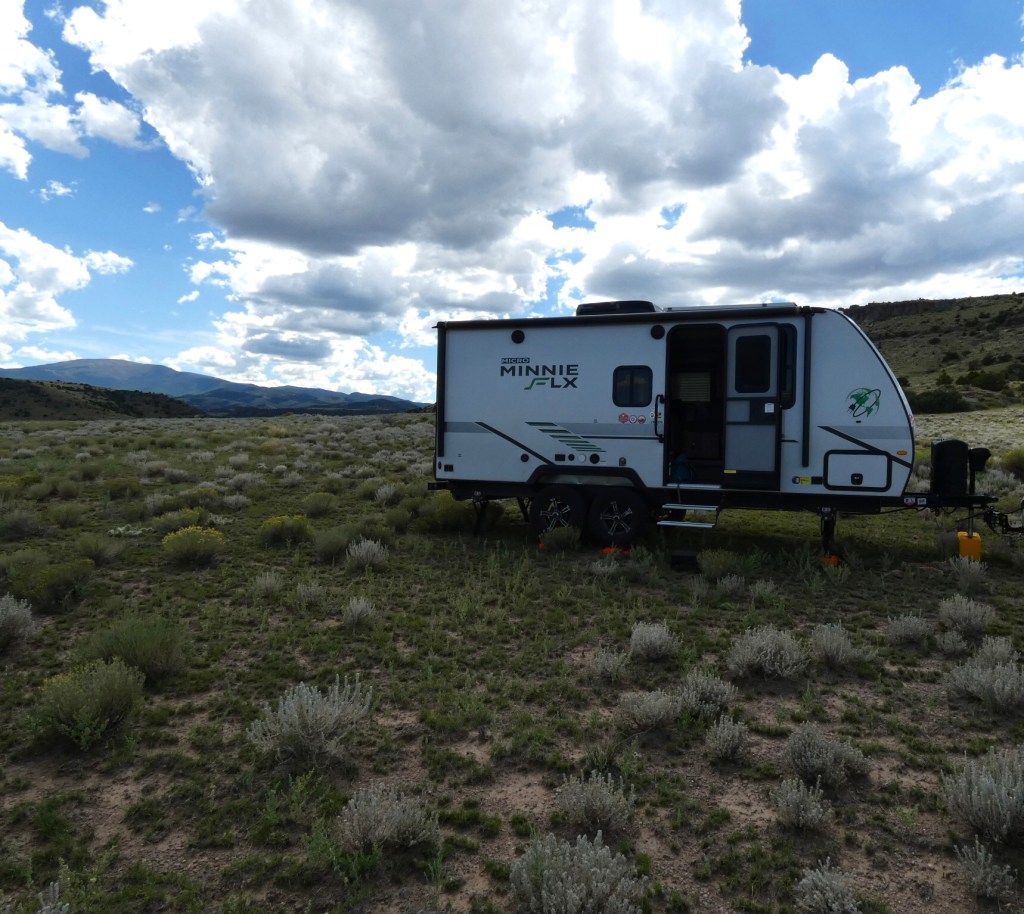
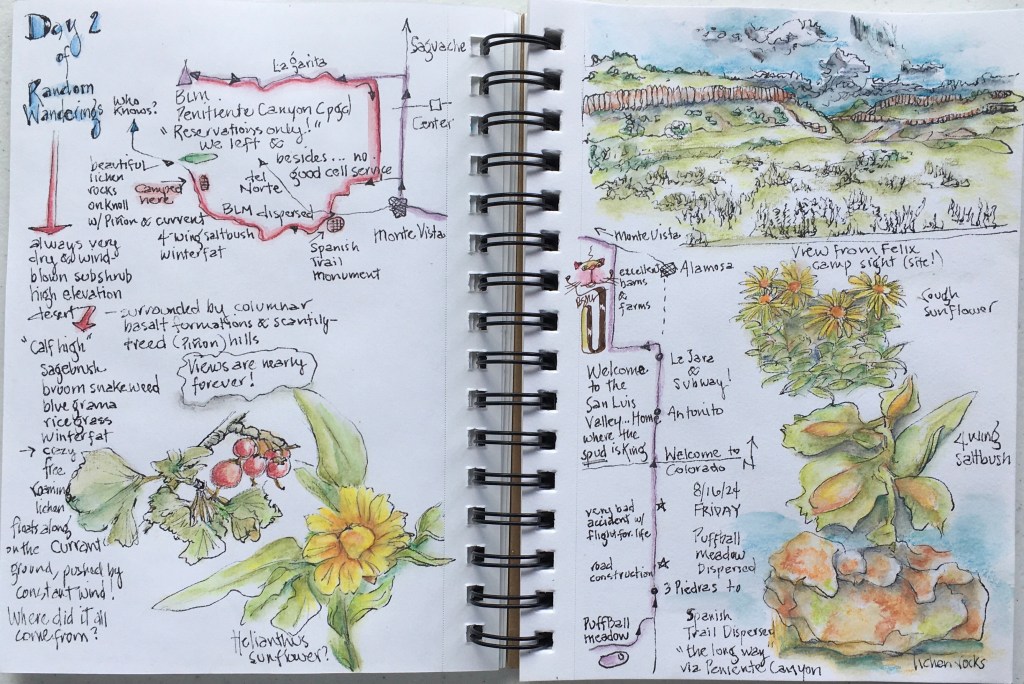
Felix parked along the Old Spanish Trail route, south central Colorado

With no defined route or objective, we decided it was high time we hitch up the trailer (Felix) and tote it north just to see what’s going on in south central Colorado this time of year. As we made our way through the San Luis Valley, we found acres of lush greenery topping almost-ready-to-harvest potatoes. Alfalfa was nearing its second cutting. Carrots had already been shipped to market. The wildlife refuges were patiently awaiting the arrival of migratory birds. And the last of the summer tourists were excitedly boarding the Cumbres and Toltec Scenic Railroad in Antonito, for the 64 mile steam engine journey to Chama, NM.

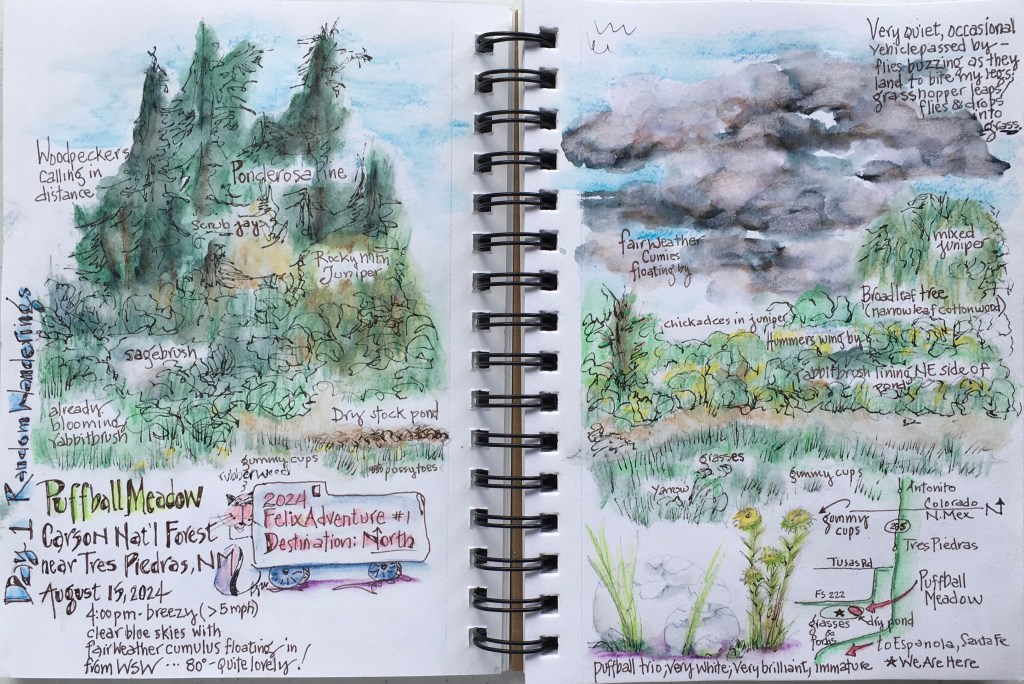
Day 1. Our first stop was in northern New Mexico, just south of Tres Piedras, Carson NF. An unlikely dispersed camping spot that I nicknamed “Puffball Meadow.” A nice level spot adjacent to a dry stock pond. The meadow was full of fist sized puffball fungi, and a coyote paid us a visit during the night.

We enjoy boondocking on our public lands managed by the US Forest Service and Bureau of Land Management.  Having a trailer that’s self-contained, we can easily find lovely off-the-grid areas to set up camp. And thanks to our solar panels (and lots of sunny days) and large water tank, we can stay out for up to 5 days without needing refills. This allows us to explore lesser visited areas, which suits our tastes beautifully!

Day 2. Made it to the San Luis Valley, Colorado. Wandered around until we found a wide open area of dispersed camping in the vicinity of the Old Spanish Trail. Lots of wildflowers blooming, and plenty of hiking opportunities.

But I think one of the best things about random travel is the spare time …… we drive for 3-4 hours, find a place to camp ….. then the rest of the day involves hiking, wildlife watching, nature journaling, collecting drawable items, photography, more sketching, identifying the unknowns, reading, napping, and a bit of ukulele strumming!  Perfection! 

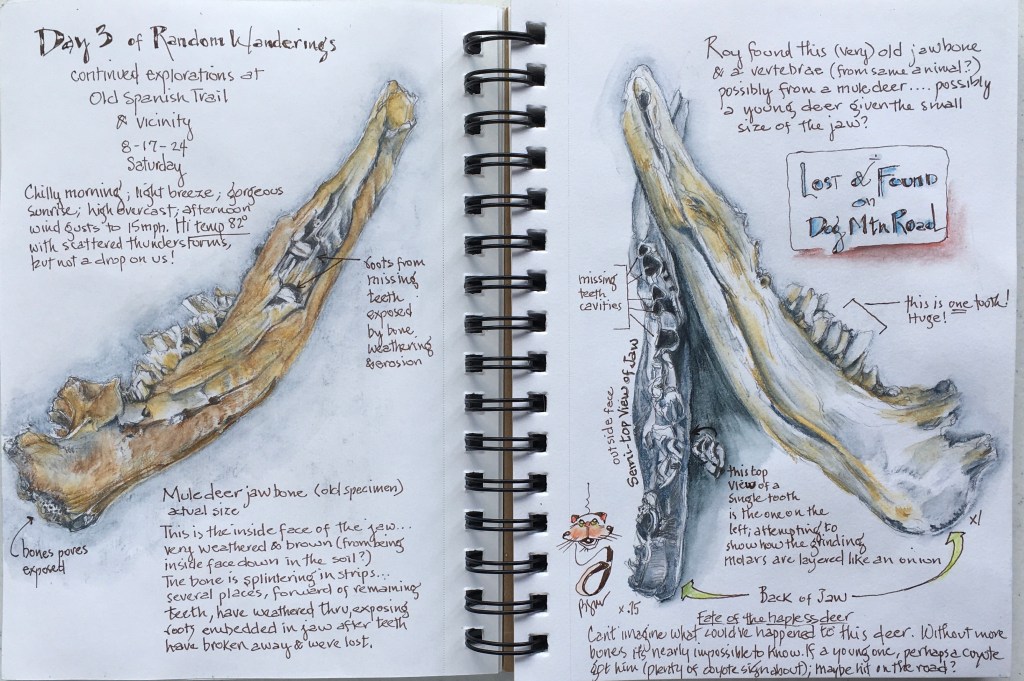
Day 3. We enjoyed the area so much, Roy suggested we stay for another day! And then he found this weathered mule deer jaw bone.
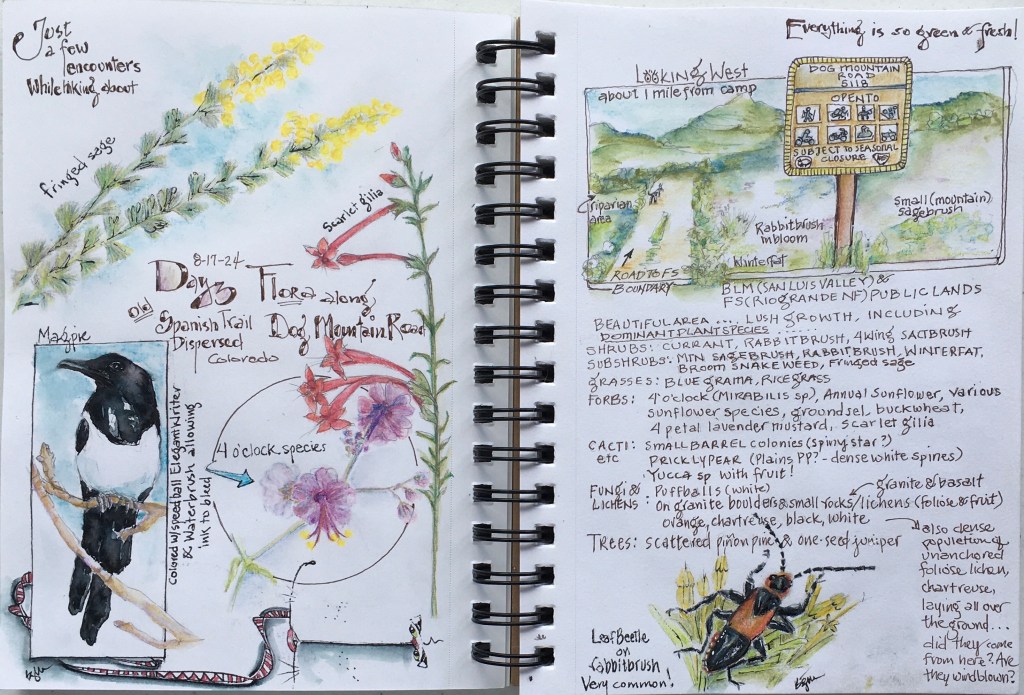
Day 3, continued. Magpies! Can’t understand why these gorgeous birds don’t come south at least as far as Albuquerque and East Mountains.

Although the 6-day trip wasn’t remarkable, it was good to get away. Scattered about this post are my journal pages highlighting Days 1 to 5. 

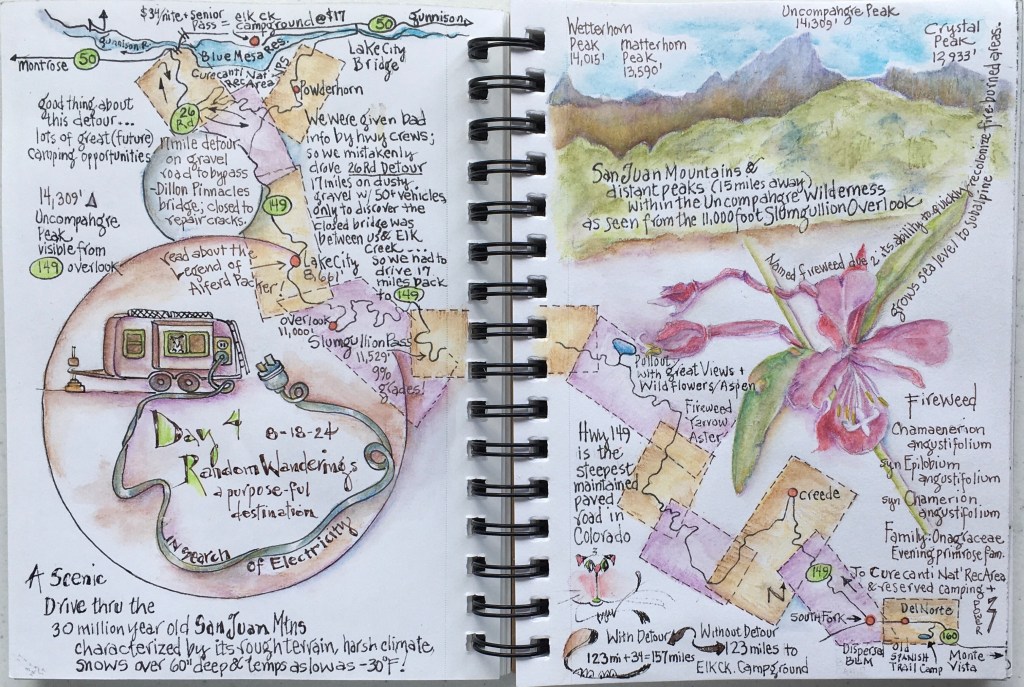
Day 4. Our travel route as we made our way to a campground to charge our battery and top off our water tank. An inconvenient, unplanned for detour led to future camping possibilities.

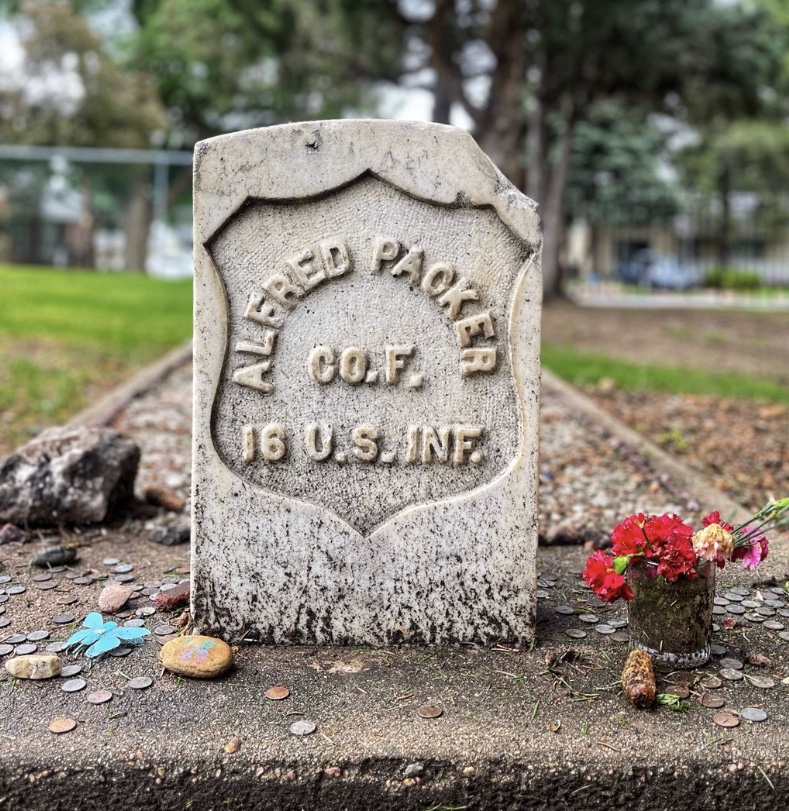
On Day 4, we decided to make our way up and over Slumgullion Pass (11,530 ft) on our way towards Gunnison Country. Not having been this way in years, we really enjoyed the crisp mountain air and spectacular views up and over the Pass. The villages of Creede and Lake City have grown swollen with tourist amenities and summer cabins dotting the once open meadows. As we got closer and closer to Lake City, we couldn’t help recall the story of Colorado’s notorious cannibal, Alferd Packer. Wanting to reread the tale as we passed near Cannibal Plateau and Deadman’s Gulch, the crime scenes, here’s what I found:

Brief Background: Alfred Packer (newspaper misspelling as “Alferd” Packer, which stuck) (1842-1909) was a prospector who set out for Colorado gold fields in 1873. By the winter of 1874, he reached the rugged San Juan Mountains with a party of five men where they became lost and stranded during one of the worst winters on record. The men, with only had 3-4 days provisions quickly consumed and no firearms, were forced to cook their rawhide moccasins. Places where “snow had blown away from patches of wild rose bushes,” ….. they “were gathering buds from these bushes, stewing them and eating them.”

When the snow finally crusted over, Packer, the only man to survive the ill-fated trip, walked out of the mountains after 60 days. He told a story about the demise of his fellow prospectors, and how he managed to survive by eating them. His story involving cannibalism became legend, and continues to be passed down to today! (Whether the story is true or not will never be known, but it makes for colorful history.)

Based on historical records and news reports, Alferd Packer was tried several times for murder and cannibalism (even though the act of cannibalism wasn’t considered illegal in the US). Convicted of these heinous crimes, Judge M.B. Gerry supposedly uttered this famous quote while handing down the sentence in Packer’s first trial …… 

“Stand up yah voracious man-eatin’ sonofabitch and receive yir sintince. When yah came to Hinsdale County, there was siven Dimmycrats. But you, yah et five of ’em, goddam yah. I sintince yah t’ be hanged by th’ neck ontil yer dead, dead, dead, as a warnin’ in reducin’ th’ Dimmycratic populayshun of this county. Packer, you Republican cannibal, I would sintince ya ta hell but the statutes forbid it.”

This is the quote I’d grown up hearing many times, over and over and over! It makes for good reporting, but is a ways from the actual sentence and what Judge Gerry sounded like while reading it (nope, he didn’t talk like Yosemite Sam!).   Here’s what the record shows:

“Alfred Packer, the judgment of this court is that you be removed from hence to the jail of Hinsdale County and there confined until the 19th day of May, A.D. 1883, and that on said 19th day of May, 1883, you be taken from thence by the sheriff of Hinsdale County to a place of execution prepared for this purpose, at some point within the corporate limits of the town of Lake City, in the said country of Hinsdale, and between the hours of 10 A.M. and 3 P.M. of said day, you, then and there, by said sheriff, be hung by the neck until you are dead, dead, dead, and may God have mercy upon your soul.”

Alfred Packer tombstone in Littleton Cemetery where he was originally buried in 1909. Today, he now lies back in Hinsdale County, near Lake City.

Alferd Packer never did hang. It’s quite a detailed story following his first trial, including a jail escape, nine years on-the-lam, and recapture. There was a second trial in 1885 where he was charged for only one murder; after serving only 16 years of his 40-year sentence, he was released and died peacefully one year later at the age of 60. He was buried in Littleton, Colorado where his tombstone properly reads Alfred Packer.

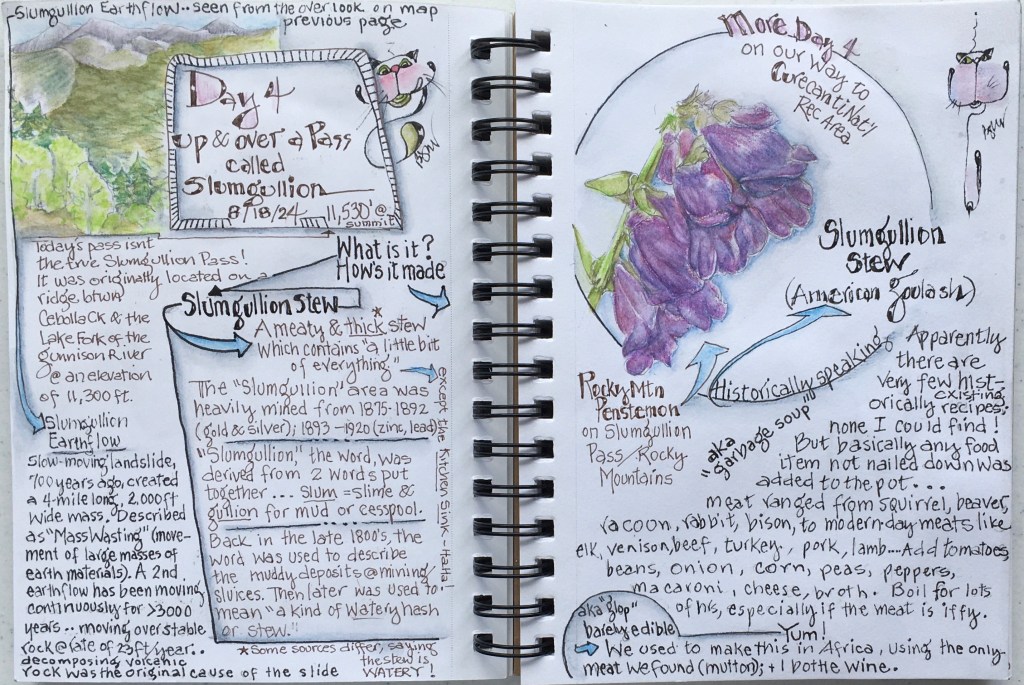
Day 4. Supplemental information about that strange name “Slumgullion.” Is it a stew? Is it a drink? Is it the sludge that puddles below an 1870 sluice box?
Day 5, on our way back to Old Spanish Trail (because we liked it so much). Discovered a new-to-me plant; after a bit of checking with iNaturalist, learned it was Black Henbane, but not before handling all parts of this very poisonous noxious weed!

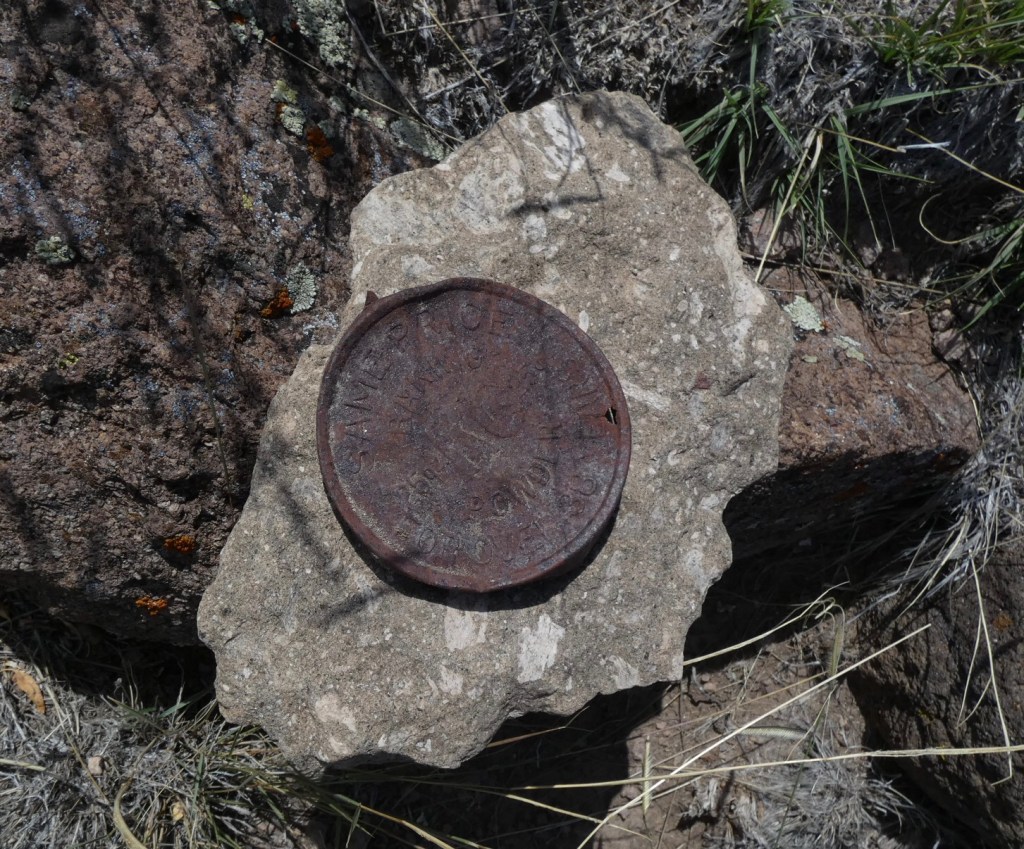
A short comment on the KG Baking Powder tin lid we found near our trailer. It was old and rusted, but very readable. The tin and its contents were probably long gone. Tried to find any information on the KG brand; sure curious about the age of the lid. If you’ve heard of this brand, please let me know.

KG Baking Powder tin lid we found near Old Spanish Trail.

Day 6. Headed for home. Hope you enjoyed my travel journal.

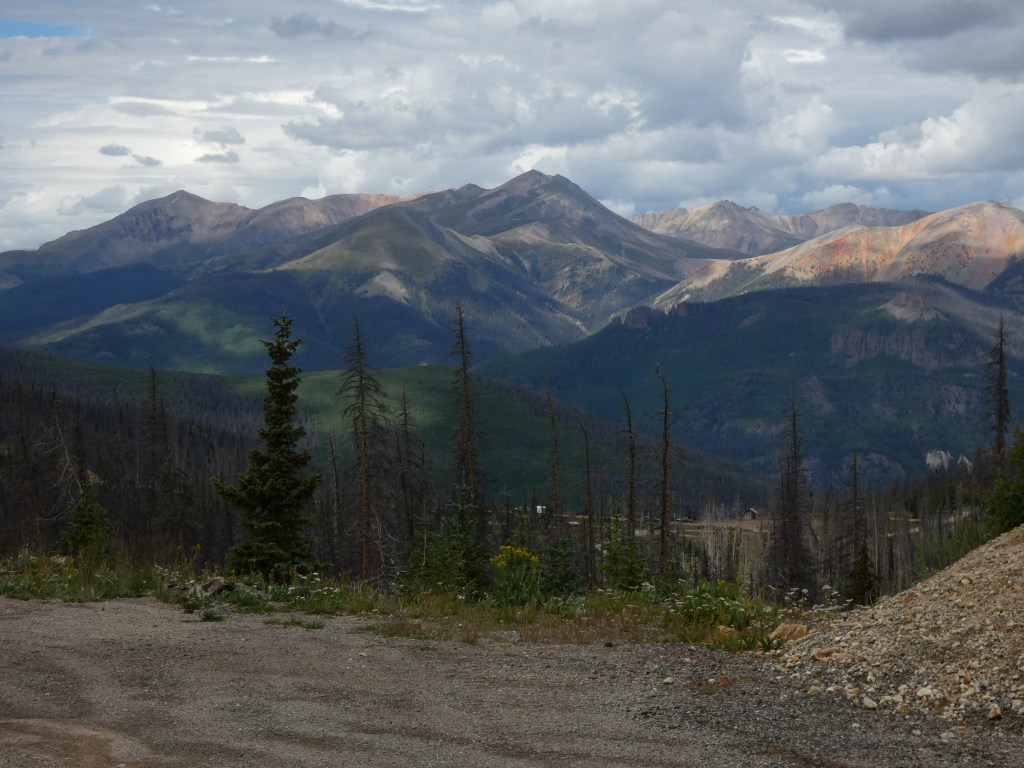
San Juan Mountains …… up and over Slumgullion Pass. The view of the 700 year old earth flow.


As always, thanks for stopping by!

November Littles: Seeds, Pods, Silk, and Wings

December 14, 2023

As the Fall season rapidly came and went, and the first snows blanketed the landscape, I focused my hiking time (and some of my drawing hours) on collecting local native seeds. Always careful that plenty of seeds remained available for overwintering birds, I still managed to harvest hundreds from about 25 plant species.  All sorted and packaged in separate pill containers, my collection is now stored in the refrigerator at 40 degrees, until growing conditions are optimal for planting.  This treatment method is referred to as stratification.**

Why collect native seeds? All throughout the Spring, Summer and Fall, a diverse assortment of pollinators visited our locally blooming wildflowers and shrubs. Along with these butterflies, moths, bees, wasps, beetles and flies, were the insects, spiders, and birds that prey on unwary pollinators. Such an amazing show; a kaleidoscope of colors and shapes! The air was a buzz with activity. My goal is to mimic the native banquet in hopes of attracting these pollinators and predators. 

Also, seeds are absolutely fascinating. I like to think of them as gift-wrapped, living plants-to-be. Tucked neatly inside of the seed coat are food stores enough to feed the makings of a complex root system; flowers, leaves, stems, branches and even a trunk. Seeds can be tiny, some microscopic and some as large as a softball. Seeds come in a variety of shapes, colors, textures and decor both inside and out. Some seeds have “wings” to fly; some have silky or puffy “feathers” to float; some are like “lead,” heavy enough to intentionally sink under water.

So I pulled out my 10x hand lens to investigate, drawing most of the seed species in my collection. It was very cool to compare seeds of different species that are in the same family (like the composites of the Aster family and the penstemons of the Plantain family). Until creating this journal page, I’d never held the seeds of 3 different species of yucca in one hand at the same time. Observing the similarities and differences, I finally confirmed in my mind that the genus Herperaloe and Yucca are indeed in the Agave family. And then I found examples of seeds from completely different families that evolved similar dispersal mechanisms (convergent evolution). This phenomenon was visually obvious in the delicate feathery, silky, and poofy hairs or bristles attached to grass, aster, and milkweed seeds, facilitating seed dispersal by wind. 

Finally, I felt the need to draw the seeds in case they happened to spill into one big jumble while being planted! Yes, I would be clumsy enough to create chaos out of order. Should that happen, I’ll be able to sort the mess by species by referring to my field guide page.

** Seed-producing plants pass along to their seeds the specific requirements(s) necessary to break dormancy and germinate. These genetic codes determine if optimal conditions exist for seeds to sprout and hopefully grow to maturity. But key to successful germination depends on seed ripeness (in most cases). Knowing the plant species from which a seed is produced; whether the plant is an annual, biennial or perennial; habitat, moisture needs and the type of  “treatment” method(s) are all important bits of information tied to successful germination. 

I’ll have to create a future post describing the variety of treatment methods (germination patterns) inherent in the seeds.  

Are you a seed collector? If so, share your why’s and how’s!