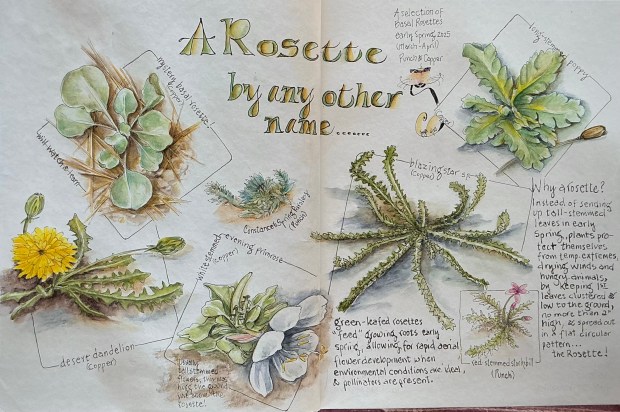
A Rosette by any other name …….

April 23, 2025

A selection of basal rosettes that popped out of the ground this Spring.

Have you ever noticed a dandelion? Oh sure …… you’ve seen hundreds, probably thousands of those ubiquitous sunburst yellow flowers blanketing a lawn or brightening an abandoned field. But before all that brilliance magically appears, have you ever looked below all those flower stalks? Have you ever noticed a dandelion before it blooms?

It’s early Spring in the mountainous areas of central New Mexico, and it seems like the high desert is slow to bloom this year. Anxious to spot even a hint of green during this transition time is always challenging, but if you look closely …….. Tucked beneath dry grasses and piled-high tumbleweed skeletons wedged next to swelling cholla you’ll find the green. Clusters of new leaves hugging the ground no more than an inch high, are beautifully arranged in a circular pattern like the unfolding petals of a rose.  

Rosettes!

Rosette arrangements are found throughout nature,1 but in the flowering plants they are particularly common in the following families: Asteraceae (like dandelions), Brassicaceae (like cabbage), and Bromeliaceae (like pineapple). Many other families display the rosette morphology too. The needle sharp leaves of yucca and the bayonet-shaped leaves of century plant (in the Agave family) form tall rosettes. The intricate leaves of wild spring parsley (a tiny member of the Parsley family) and the petite red-stemmed stork’s bill (Geranium family) both form ground-hugging rosettes. 
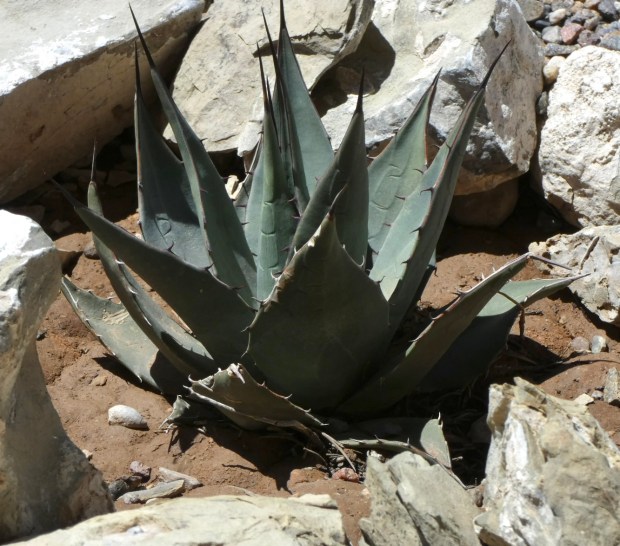
A century plant displaying a beautiful basal rosette.

Where Rosettes Form

Basal Rosettes grow close to the soil at or near the plant’s crown (the thick part of the stem where the roots attach). Their structure is an example of a modified stem in which the internode gaps between the leaves do not expand, ensuring all the leaves stay tightly bunched together and at a similar height.  A protective function of a basal rosette makes it hard to pull from the ground; the leaves come away easily while the taproot is left intact (have you ever tried to pull a dandelion without snapping off the root?). Generally speaking, basal rosettes improve a plant’s odds at survival. For example, overwintering rosettes, like the basal leafy growth produced in year #1 of the 2-year life span of giant mullein, protect the plant and its roots from extreme cold temperatures. Emerging Spring rosettes, like those found in long-stemmed poppy, also protect the plant from late winter frosts. Basal rosettes are also more protected from changes in microclimate, gravity, wind, browsing, and mechanical damage if they are closer to the ground than tall leafy stems would be. help in water balance and conservation, especially important during periods of drought. 
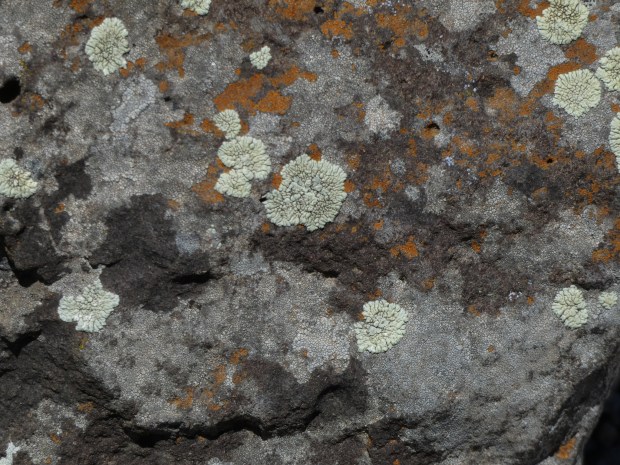
Lichen that has form small rosettes on rock.

But don’t only look down. Another form of rosette occurs when the internodes (those areas between leaves) along a stem are shortened, bringing leaves closer together as in lettuce and some succulents.2. And although not as common as basal rosettes, some plants form rosettes at the terminal or top end of their often naked stems, branches, or even trunks. One plant that does this is the native sedum called wild stonecrop. The top of the plant stems usually terminate in whorls or three fleshy leaves. Another example is the Hawaiian screwpine, which has a terminal rosette of sword-shaped leaves which sits atop an erect trunk, often supported by prop roots.

Know Your Local Rosettes

A number of desirable and undesirable (weedy) plant species produce rosettes, particularly basal rosettes.  Being able to identify a species that pops up in the Spring by its rosette is so helpful in preventing a removal mistake by inadvertently digging them up. Many weedy, non-native plants gaze first at their world through rosette “eyes.” But not all plants with rosettes are undesirable. Do you know your local rosettes by their other names?

………………………………………………………………

1  Rosettes are found throughout nature, not just in the flowering plants.  Here’s some examples you may have seen or heard of:  

In bryophytes and algae, a rosette results from the repeated branching of the thallusas grown by plant, resulting in a circular outline. Lichens also grow rosettes.

Tiny wasps and midges can induce the development of galls that become leafy rosettes.

Jaguars, leopards and other feline species display rose-like markings on their fur, referred to as rosettes.

Malaria parasites are known to form spontaneous rosettes in uninfected red blood cells.

Neural rosettes in the human brain are being studied to learn how new cells are born.

It is unknown why the Rosette-Nosed Pygmy chameleon, at home in the mountains of Tanzania, has evolved a distinctive, rosette-shaped, fleshy protrusion on the end of its nose.

The Rosette nebula, named for its rosette-like appearance, is a beautiful collection of gas and dust 5,200 light-years from Earth in the constellation Monoceros the Unicorn, and stretches about 130 light-years across.
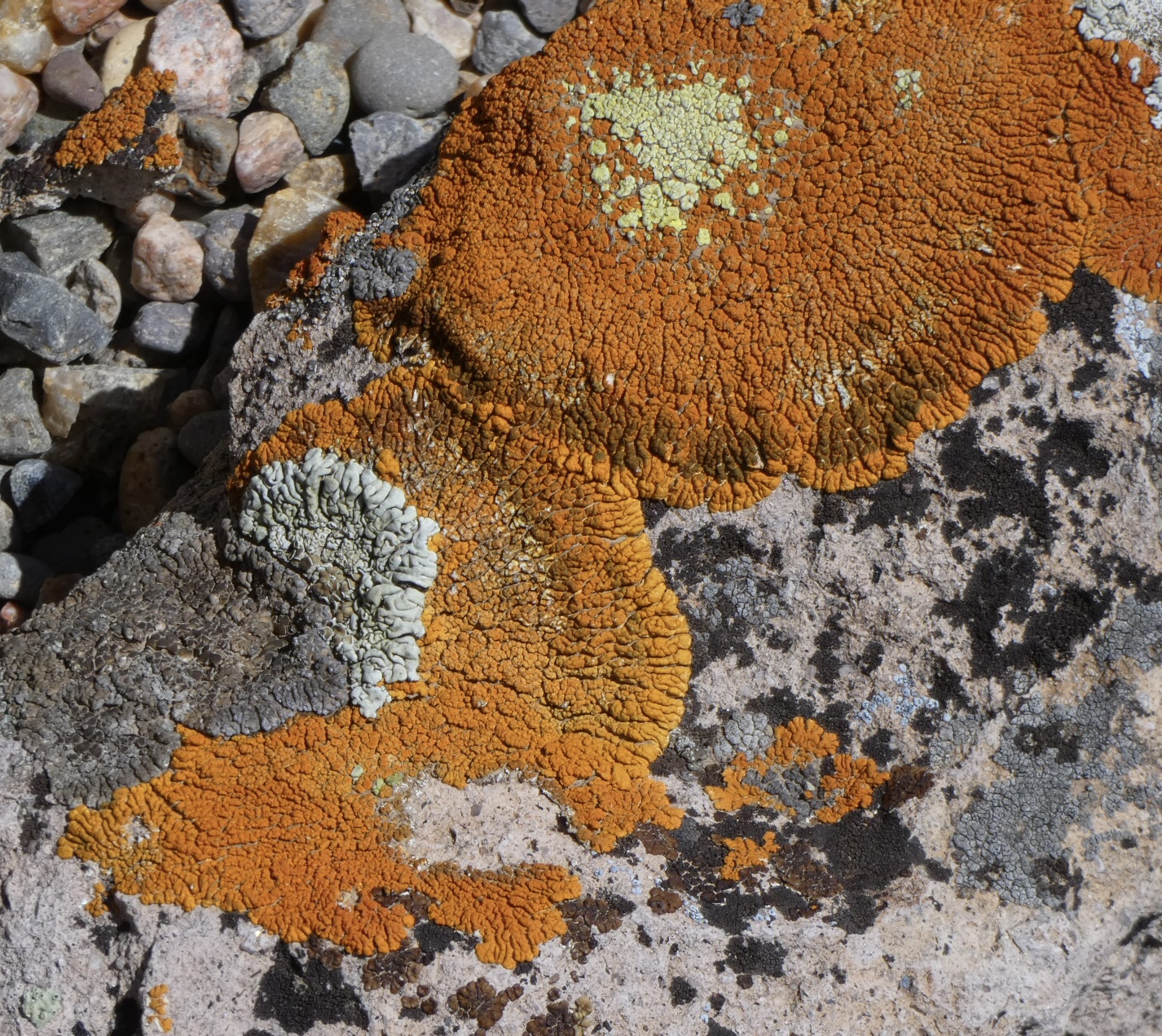
A gorgeous lichen decorated rock from Colorado. Note the rosette patterns of growth (the thallus)

  The horticultural definition of a succulent describes a drought-resistant plant where the leaves, stems, or roots have become fleshy and their tissues are able to store water. Succulents include aloe, euphorbia, sedum, the garden favorite hen-and-chicks, and bromeliads. But horticulturalists do not include cacti in the succulent group. huh? Even though cacti are frequently found in books describing succulents based the definition of a succulent, succulents are not cacti. In agreement with that last statement are many botanical and other scientific experts. (Can this get any more confusing?). So basically some experts are lumpers, while other are splitters.  Which are you? 

Basal rosette of a yucca in the NM foothills.

P.S. Cacti have stems that are thickened fleshy water-storing structures, and are considered to be a stem-succulent group of plants. Are there any cacti species that develop leafy rosettes? Because the spines are the leaves, greatly modified, in all my rabbit-trailing thru the internet and perusal of my collection of botanical references I’ve yet to see any spines forming whorled/rosette-like patterns. If you have, please contact me immediately!

……………………..……………..😂…………………………………………

Are you ready to explore the wide diversity of rosette forming plants in your neighborhood? Get on out there before those circularly-arranged leaves become disguised by an overabundance of gorgeous wildflowers! 

As always, thanks for stopping by!  And Happy Earth Day (week)!
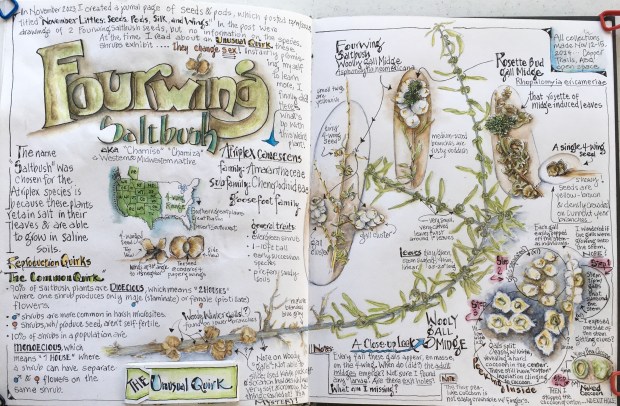
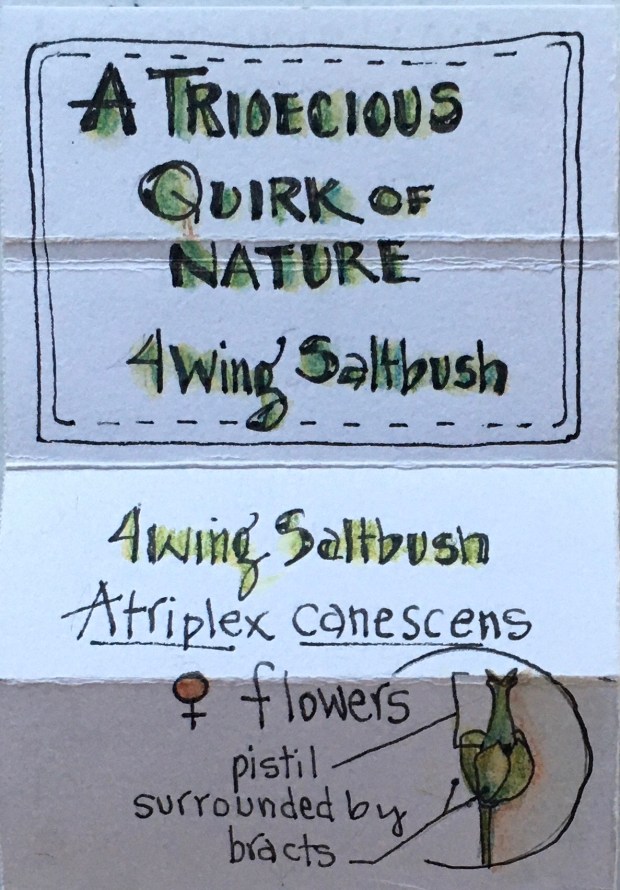
A Quirk of Nature: Fourwing Saltbush

November 25, 2024

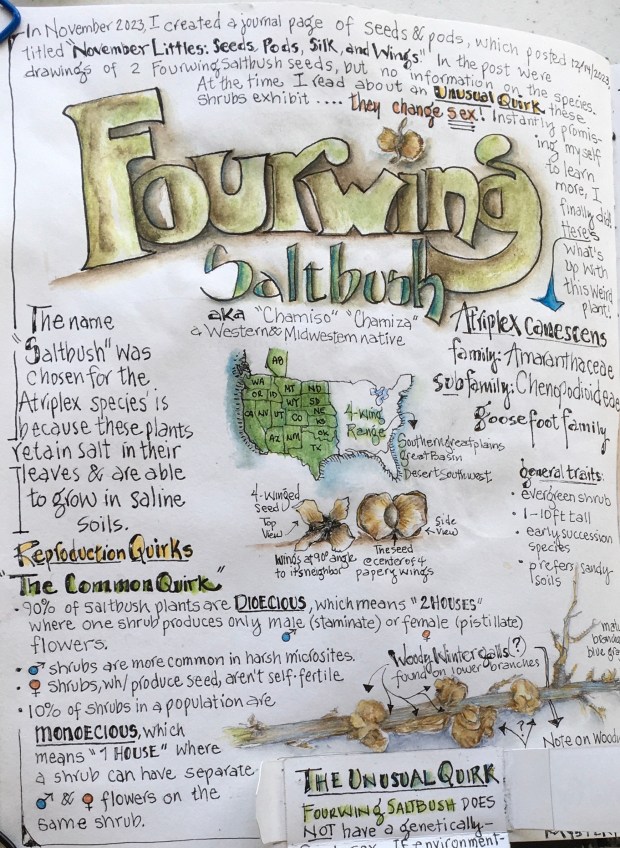
In November 2023, I created a journal page of seeds and seed pods, which posted on 12/14/2023, under the title November Littles: Seeds, Pods, Silk, and Wings. On that page was a small drawing of two Fourwing Saltbush seeds, absent any information about this plant species, Atriplex canescens. At that time I remember finding a wealth of articles and research documents about this widespread shrub, but what really stuck in my mind was a very unusual quirk exhibited by this plant. Finally, a year later and WOW! I discovered Fourwing Saltbush has a reproductive superpower …… this species has the ability to change sex!

An Unusual Quirk

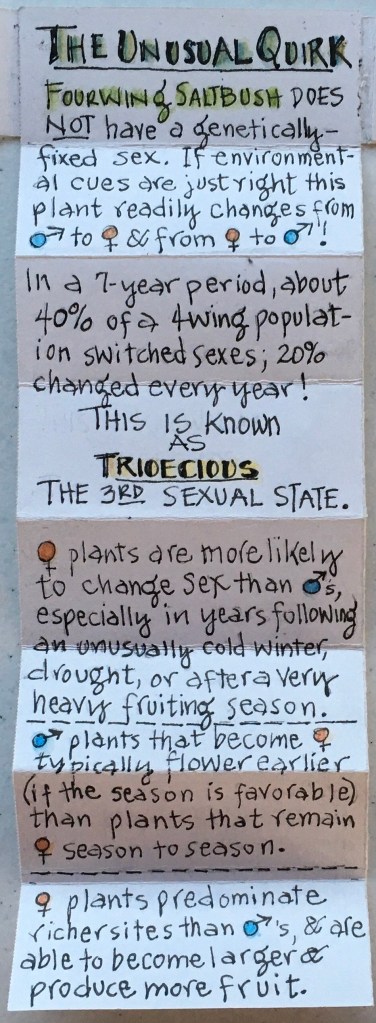
My first dive into the literature revealed that within a 7-year period of time, 40% of a Fourwing population switches sexes with 20% of a population changing sex every year. Botanically, this is known as Trioecious, or the 3rd Sexual State.  

But clearly a bit of back peddling is needed ……. if Trioecious is the 3rd Sexual State in plants, what about the 1st and 2nd sexual states, huh? Yes, they exist …….. but before explaining them, which requires comparison with the more common sexual state in plants, I must describe this sexual norm. 

And now for a little Botany 101 ……..

The Sexual Norm …… Plants with Perfect or Complete Flowers

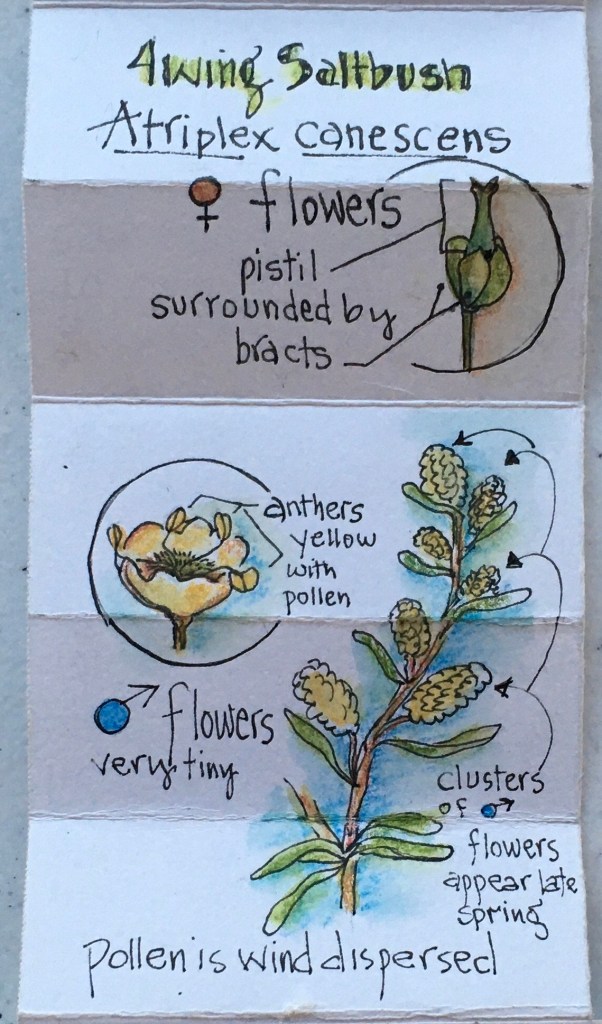
You are likely familiar with plants like roses, tulips, lilies, garden strawberries, beans, peas and cabbage. If you’ve closely examined their flowers while inhaling their fragrant aromas, you may have noticed their centers have both female and male parts. These are known as plants with Perfect or Complete flowers (aka hermaphroditic or bisexual) defined by each individual flower having a fully functional pistil (the female part) and stamens (the male parts). Worldwide, about 90% of flowering plants have Perfect or Complete flowers.

Monoecious ….. the 1st Sexual State

Here again you are likely familiar with many plant species described as Monoecious (moh-NEE-shuhs). These include corn, all of the plants in the gourd family (i.e. cucumber, squash, watermelon), oak, birch, pine, spruce and dogwood. Monoecious, which means “one house” in Greek, describes plants having separate female and male flowers in different places on the same plant, often blooming at different times. Visualize corn growing in a field; the tassels are the male (staminate) flowers, and the corn kernels you eat are the female (pistillate) flowers.  Around 10% of all flowering plant species worldwide are Monoecious.

Not to confuse the matter, but sometimes botanical experts refer to Monoecious species as Perfect or Complete because they have both male and female flowers on the same plant, even though these flowers are separate and considered sexually Incomplete (aka unisexual) by themselves. 

Dioecious ….. the 2nd Sexual State

A plant species with individual plants in a population having only female flowers, and individual plants of the same species in the same population with only male flowers is called Dioecious (dahy-EE-shuhs). This Greek word meaning “two houses,” describes plants such as spinach, asparagus, sumac, currant, box elder, willow, holly, ginkgo, juniper and aspen. Only 5% of all flowering plant species worldwide are Dioecious.

Another confusing matter once again. There are botanical experts that refer to plant species with Perfect or Complete flowers as Dioecious because they require cross-pollination to produce seeds (fruit). Tree fruit species such as apples, pears, cherries and plums are common examples.

Trioecious ….. the 3rd Sexual State

An extremely rare reproductive strategy among flowering plants, Trioecious (aka trimonoecious or “three houses”), is characterized by a species that can have Incomplete (unisexual) male, Incomplete (unisexual) female, and Perfect or Complete (bisexual or hermaphroditic) male/female flowers on separate plants in a population or even all on the same plant! Just over 3% flowering plant species worldwide are Trioecious (trahy-EE-shuhs).

This is where Fourwing Saltbush (Atriplex canescens) enters the story

Primarily a Dioecious species, some Fourwing Saltbush populations have a Monoecious component ranging from entirely male (staminate) or female (pistillate) individuals to those that are Perfect or Complete (hermaphroditic or bisexual). And in this DioeciousMonoeciousHermaphroditic gender system, referred to as Trioecy, switching sexes occurs. To reiterate from an earlier paragraph, on average, in a 7-year period, about 40% of a Fourwing Saltbush population switches sexes with 20% changing from male to female or from female to male every year.

Reasons Behind and Benefits of Fourwing’s Sex Change Phenomenon

Fourwing Saltbush has evolved to be one of the most adaptable plant species found throughout central and the western US. It grows from sea level to 8500 feet elevation, and in a multitude habitats within a wide range of plant communities, no matter the successional stage. Fourwing can adapt to all soil textures, soil depths and all but the wettest of soil conditions. The species is able to tolerate hot (+100F) and dry (6” precipitation annually) summers, and bitter cold (-50F) and dry winters.  

The ability of the species to adapt to such a wide range of physical and climatic conditions is, in part, due to this sex change phenomenon. Environmental stressors seem to be the major triggers resulting in Fourwing plants switching sexes. Female plants are more likely to change sex than male plants, especially following a drought, an extremely cold winter, or after a heavy fruiting season. Because fourwing is so tasty as range forage, overgrazing can also trigger a sex change, with male plants tending to dominate regularly grazed sites. Male plants that change to female typically flower earlier than plants that remain female season after season. And female plants dominate richer sites than do male plants, becoming larger and producing more seed.

Undoubtably there’s more environmental stressors, such as wildfire and other climate change-induced factors, that may result in Fourwing Saltbush to switch sex. I’ll be curious to learn what they are and how these triggers influence the adaptability and survivability of this robust species.  And I’m excited get busy marking this season’s female and male plants that we see nearly every day, and will begin more closely observing these populations for gender changes and possible stressors that may have triggered these switches. 

A Retrospective and Thoughts on Prospective Studies

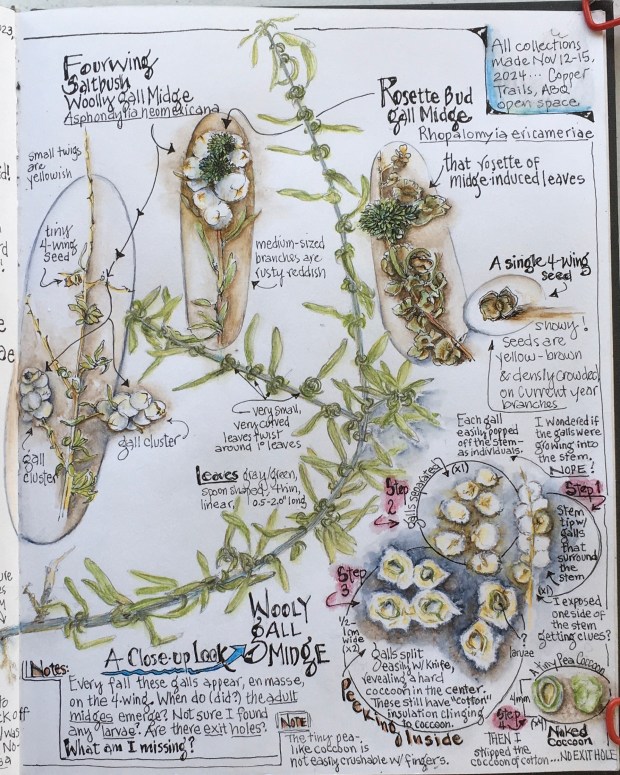
There’s so much to learn about Fourwing Saltbush that it seemed logical to tackle one characteristic at a time. Originally I had planned to discuss both the plant’s reproductive quirk and several of its common galls, but found there would be too much information for one post. While deciphering the complexities of the Fourwing’s sex change abilities, I found it necessary to describe certain key botanical terms in my buildup to the crucial piece of the puzzle ….. the Trioecious reproductive strategy.  So this post focused on the first of my two journal pages; my beginning exploration into this plant.  The galls illustrated on my second journal page, that could not be easily chopped away from the first page, serve as a preview of a future post about the fascinating Fourwing Saltbush. 

And Finally ……….

For a shrub I used to describe as a messy tangle of branches haphazardly cloaked with unremarkable features like dusty little grey-green leaves, nearly invisible flowers, shreddy dull grey trunks and a chaotic canopy, Fourwing Saltbush has captured my imagination, respect, and love as an almost invincible survivor of our changing world!

Hopefully you found this interesting and informative. Bet you never look at flowering plants in casual ways again.  Let me know if you are familiar with Fourwing Saltbush. Where does it grow? Have you ever marveled at the thousands of winged seeds densely crowded at the tops of these shrubs?  And then satisfied an irresistible urge to strip dozens of skinny branches of those ripe seeds, tossing them in the air like confetti? If so, please share.

As always, thanks for stopping by!

Piñon or Pinyon, Piñon Seed or Pine Nut

November 11, 2024

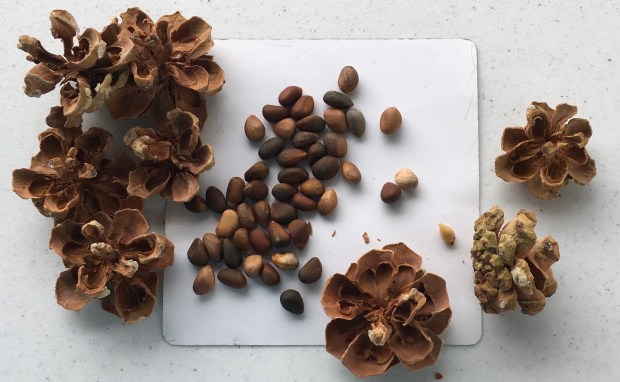
A fallen cone from Pinus edulis. Still a few seeds remain, tucked in the lowest scales. Typically there are 2 seeds per scale; 10-30 seeds are common per cone. Seed viability is uncertain until the inside kernel is exposed.

Pine Nuts Come From Where? 

Many years ago, maybe about 45 of them, Roy and I, his sister and her husband, set off on a pine nut safari in the mountains of south central Colorado. They knew of a large stand of a specific pine tree, called Pinyon (Piñon**) heavy with cones and ready to harvest.  This was my first encounter with the Colorado Pinyon Pine (Pinus edulis), and my first taste of the buttery rich tear-drop shaped seeds produced by these trees. I was hooked! After 4-5 hours collecting wide open seed stuffed cones from low hanging branches and off the ground, we had to stop.  Our fingers were impossibly stuck together from the cones’ copious coating of resin, definitely stickier than Super Glue! Without a solvent to dissolve this adhesive pine tar, we were in danger of losing our fingerprints. 

Having made a less-than-minor dent in the harvestable nuts, ample quantities of this energy rich bounty remained for foraging wildlife, such as migrating birds like pinyon jays, deer and squirrels.

For the past 45 years I truly believed pine nuts (which are, botanically speaking, not true nuts but the edible seeds of pinyon pines) only came from stands of Colorado Pinyon Pine. When the popularity of pesto skyrocketed, I thought “wow, you couldn’t pay me enough to harvest the amount of pine nuts necessary to make even one batch!” I honestly thought that was the reason the seeds were so expensive ….. harvesting is such a tedious and labor intensive job. Alas, we never returned to harvest pine nuts, and I never made pesto until years later. 

The result of my Pinus edulis cone and seed sketching exercise.

While studying a few dozen pine cones for my sketches, the seeds kept falling out and bouncing across my drawing table. This got me thinking about pine nuts and wondering how the Colorado Pinyon Pine could possibly fill the insatiable global demand! Of course by now I was well aware that this tree species is endemic in the southwest, but still ?……. 

News to Me ….

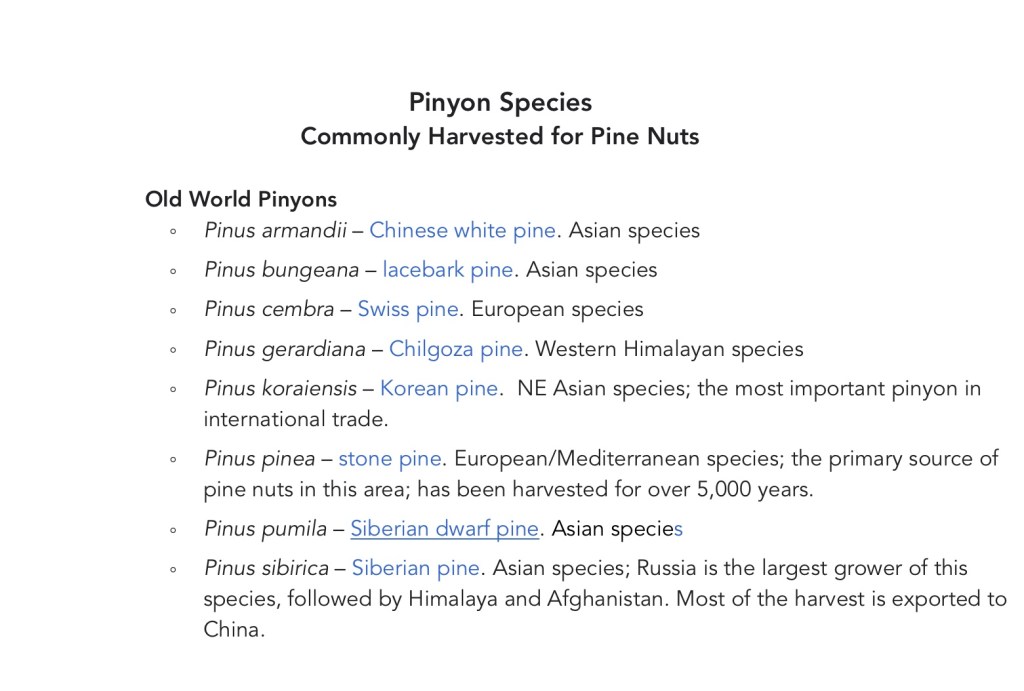
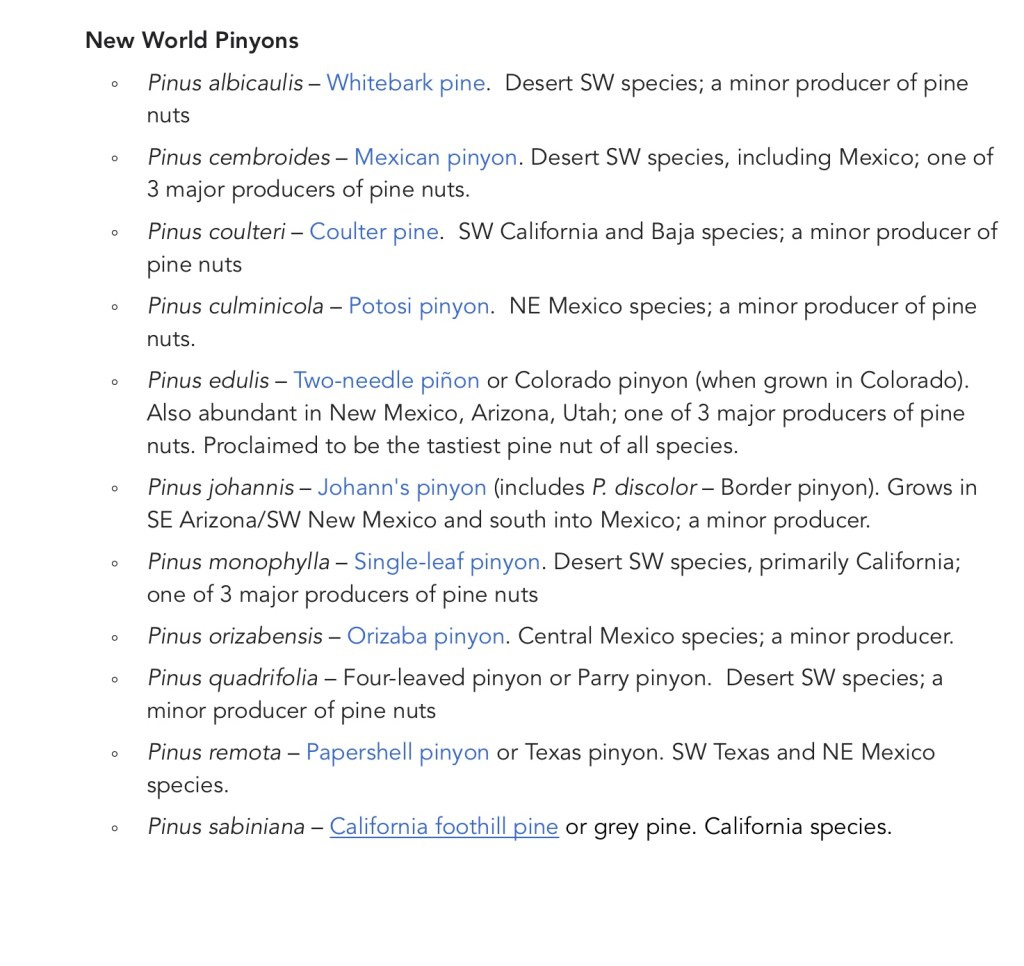
Of the 126 different species of pine in the world, 29 are considered edible; 20 of which have seeds large enough to be marketed. The biggest producers and exporters are China, Russia, Mongolia, Turkey, and Pakistan, in that order.  I found it interesting that China is also the largest importer of pine nuts, who’s marketing goal is to export 60% of the world’s demand.

What about the US? The pine nuts harvested from Colorado Pinyon Pine (Pinus edulis) is rated the best tasting in the world, with those produced by the One Leaf Pine (Pinus monophylla), harvested primarily from these California trees, comes in a close second. Yet, the US is a major importer of shelled pine nuts, primarily from China. But if China is the largest importer and the largest exporter of shelled pine nuts, then the pine nuts on the shelves of Trader Joe’s and Costco, labeled as imported from China, probably came from a variety of pinyon species from a combination of suppliers importing seeds to China?! 

Being naturally curious about the Pinyon species that grow in various countries around the world, I included a list of 16 of the most commonly harvested trees the end of this post.

What’s the Real Reason Pine Nuts are so Expensive?

It’s said that “pine nuts are the most expensive seeds we would never buy!” (**** Check out this footnote for the 2024 costs/pound and my random calculations per serving and for a batch of pesto). Pine nuts are the second most expensive “nut” in the world, second only to the macadamia nut.  But why? While it’s true the seemingly exorbitant price of shelled pine nuts is directly influenced by labor costs, compounded by the annoying sticky factor, other challenges exist.

Harvesting Pine Cones

Cones are harvested by hand, directly gathering those that have fallen on the ground, and from tree branches (where the densest number congregate in the upper 1/4th of 30 foot tall trees). Another common harvesting technique is to whack the branches (which reportedly does not injure the trees [hmmmmm?]).  But a faster method used in many countries is to cut off branches with cones, resulting in a number of detrimental effects  to the trees (open entry points for insects and pathogens; stunted growth; stalled production; tree death).

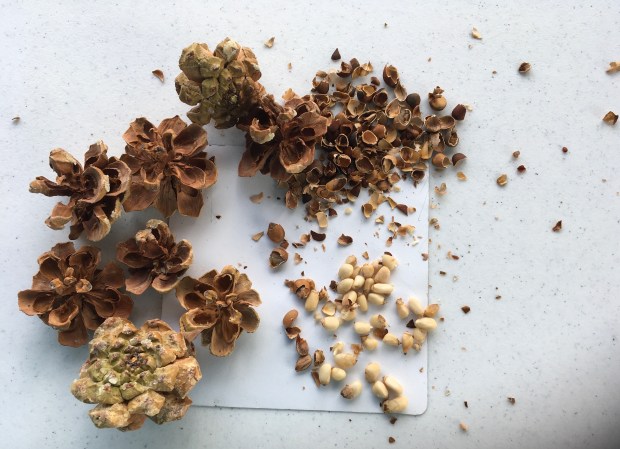
A sampling of Pinus edulis cones with hard coated seeds removed, ready for cracking. There’s a single kernel between the two lower right cones.

Pine Nuts

Once the seeds are taken out of the cones, their hard shells (seed coats) must be removed without damaging the soft edible kernels inside, the “pine nuts.” (And not every seed is viable ….. more about that below.) The shelled pine nuts must now be handled quickly and properly due to their short shelf life. It only takes a few weeks or even days in warm and humid conditions for shelled pine nuts to lose flavor, turn rancid, and completely deteriorate. Until they can be marketed for export, pine nuts must be kept frozen. Ideally, shelled pine nuts should remain frozen during export/import and until consumer purchase and consumption.

There were the remains of the Pinus edulis seeds extracted from these cones; 30 tasty kernels were viable; 20 were either missing or dried up.


Tree Characteristics

Slow growing trees and inconsistent production are several more reasons pine nuts are so expensive.  Pinyon pines are notoriously slow to grow, mature (10 years) and produce a harvestable crop of cones with viable seeds (75-100 years). But pinyon pines typically live an average 350 years, and have the potential to produce tons of harvestable seeds.  However, all pinyons exhibit a common characteristic called “masting,” where they may produce a bumper (harvestable) crop only once in as many as every eleven years. Good years are not predictable either, as many factors influence growth and production, with local droughts and a changing climate having the biggest impact. 

Gifford Pinchot (1909), U.S. Forest Service Chief said: “Seasons of especially abundant production occur, as a rule, at intervals of from five to seven years, although heavy crops are sometimes produced for two or three consecutive years, and heavy seed years are not the same throughout the range of the tree.”

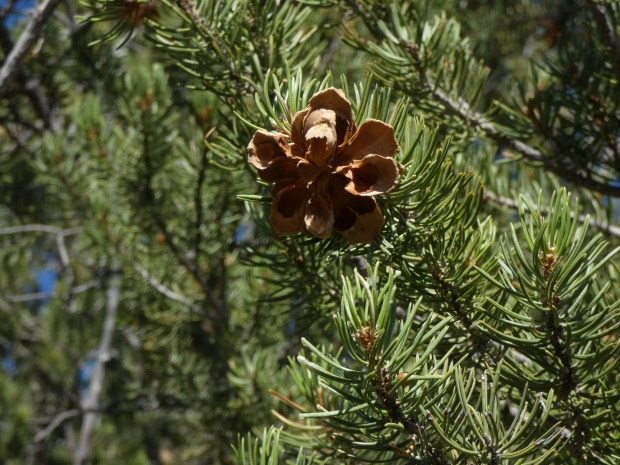
A Pinus edulis tree showing the 2 needles/fascicle densely covering the branches, and a remaining cone ready to fall..

______________________________________________________________
A Few Footnotes

**Piñon or Pinyon?

The most common common name for Pinus edulis is “Colorado” Pinyon Pine, even though the species is widespread in New Mexico, Utah and Arizona as well as Colorado. The words pinyon and piñon are usually considered interchangeable. Use of the word “piñon” (Spanish for pine nut) is tied to the seed (i.e. piñon seed or pine nut seed) and the tree (i.e. piñon pine or pine nut pine) particularly used by Native Americans in the southwest US.  Because references consulted during my research were not consistent in their use of common names for Pinus edulis, to avoid (my) confusion I’ve opted to call the piñon seed (pine nut seed) a “pine nut” and the pine trees with edible seeds “pinyons.” 

**** The 2024 retail market cost (shelled raw or roasted seeds) averages $40/pound

  • 1 pound of seeds = about 4 cups (depending on seed size)
  • 1 cup of seeds weighs about 4 ounces (price $10§)
  • 1 ounce or 1/4 cup of seeds = 1 serving (price $2.50)
  • 1 serving = about 167 seeds (price 1.5 cents/seed)
  • 167 seeds = 191 calories (pine nuts are extremely high in unsaturated, heart-healthy fats and carbohydrates)
  • 1 cup of seeds = about 668 seeds = 764 calories
  • 4 cups of seeds = about 2,672 seeds = 3,056 calories

Number Play

  • Of the 50 seeds I harvested, only 30 were viable (price 45 cents)
  • It took me about 45 minutes to crack open the 50 seeds (this doesn’t include the time it took to collect the resin-coated cones and remove the seeds)
  • It would take me 67 hours to fill a 1 pound bag with 2,672 viable shelled seeds!
  • At $40/pound, a pine nut cracker would be paid only $0.59/hour for their labor, a wage earned back in the 1950’s and 1960’s which didn’t even come close to supporting a family then, let alone today. 
  • Assuming a pine nut cracker makes a minimum wage of $7/hour, it would cost $468 to fill a 1 pound bag.  That’s 1,170% more than the 2024 retail cost of a pound of pine nuts!

Obviously, a professional pine nut cracker is far more efficient than I was, using some form of mechanization to crack the seed coats (requiring more research on my part).

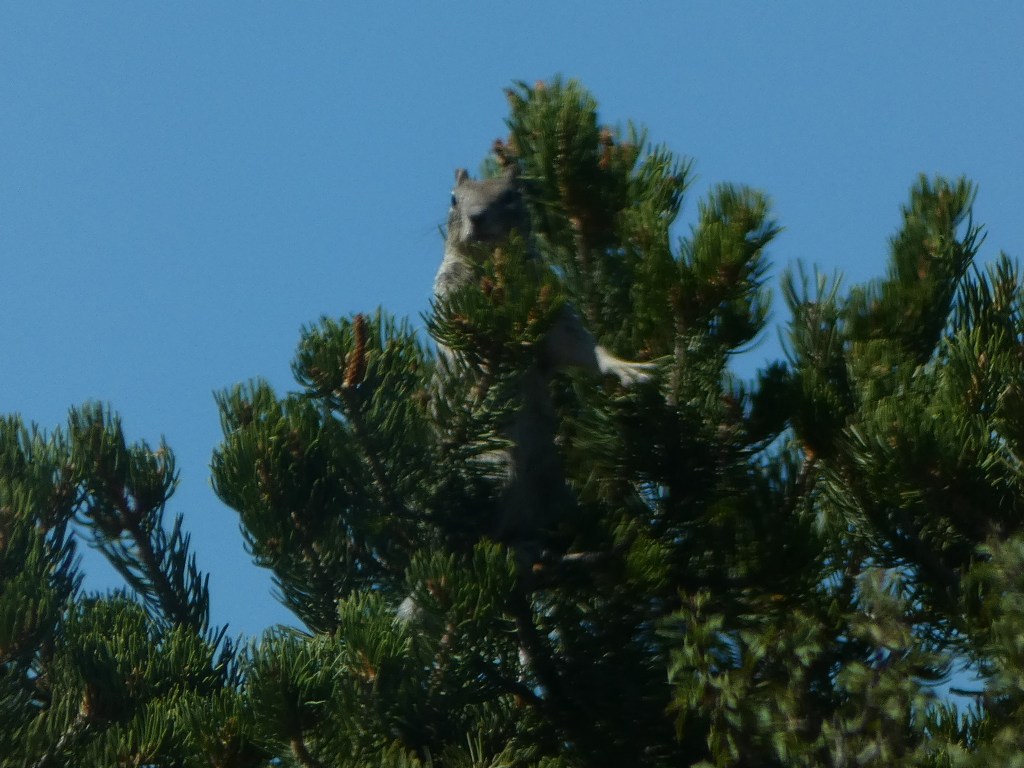
A rock squirrel high in a Pinus edulis tree, keeping watch for red tailed hawks while searching for pine nuts.

§ Pesto ……. most pesto recipes I found call for the addition of 1 cup of shelled pine nuts, or 668 seeds. At 1.5 cents/seed, you’d be adding $10 of pine nuts to make one batch of pesto. Enjoy slowly!

______________________________________________________________

Living in the East Mountains of central New Mexico ensures daily appreciation of hundreds and hundreds of Piñon Pines (Pinus edulis). This iconic pine, the state tree of New Mexico, has been a source of nutrient rich seeds for wildlife and indigenous peoples for millennia. It was fun learning more about this tree and the many Pinyon species that grow around the world.

As always, thanks for stopping by!

______________________________________________________________

On the Cusp ….. Fall Equinox in the East Mountains

October 28, 2024

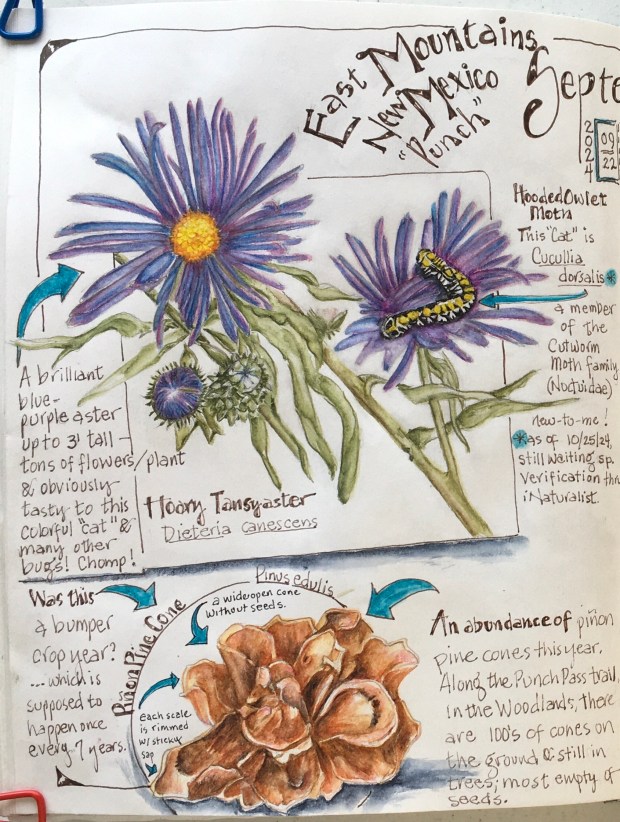
September 22nd was a morning full of new-to-me discoveries in nature. That was more than a month ago; a time when temperatures were still in the upper 80’s and flowers in full bloom. 

But plenty of hints of what was to come ….. the inevitable change in seasons ….. existed. There were seeds of spring and summer bloomers blowing in the wind; squirrels stockpiling pine nuts from recently shed cones; darkling beetles mating and laying eggs in the ground to hatch next year’s population; caterpillars feasting on energy-packed flower petals needed to spin their cocoons; the chortling chatter of sandhill cranes high overhead migrating to Bosque del Apache for the winter.   

Still it is hard to believe that today, a little more than a month later, everything has turned brown, and our first hard frost is forecasted for tomorrow morning! 

In an effort to cling to a not-so-long ago summer, this small selection of the botanical and entomological happenings on the cusp of Fall, is now a part of my nature journal.   Enjoy!

As always, thanks for stopping by!


Always Remember to Explore the Cracks!

Sidewalk Crack Discoveries

October 12, 2024

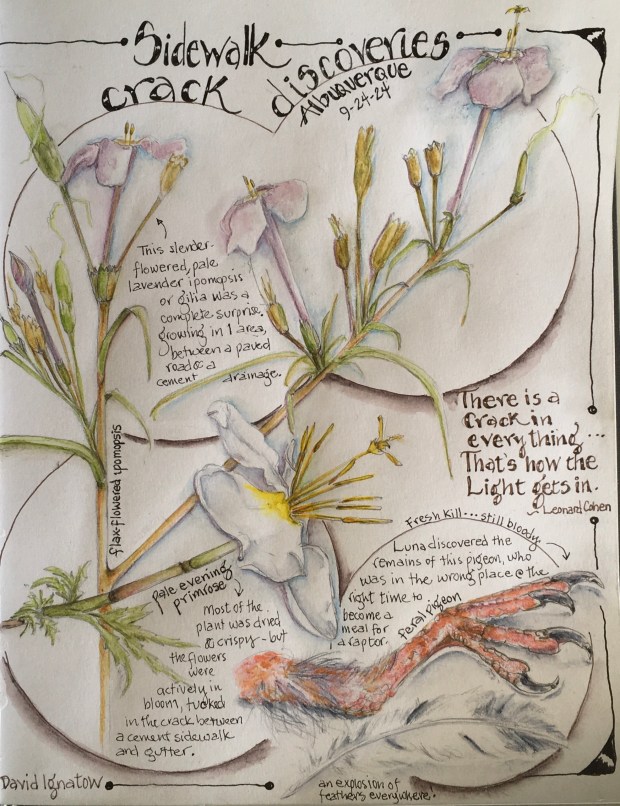
Roy had a doctor’s appointment one morning in late September, at an office right off busy I-25, near the ABQ airport. Instead of hanging out in the sterile waiting room, Luna and I spent our time exploring the areas surrounding the office, just to see if there was anything worth observing.

For 2 miles, we wandered about the not quite urban/suburban/industrial/residential neighborhood ….. me looking for a sketchbook entry; Luna sniffing out messages left just for her by visiting dogs, squirrels, or bunnies. 

Interesting discoveries seemed lacking, until Luna caught whiff of something irresistible. Tugging hard on her end of the leash, she urged me to run with her as she zeroed in on the source of the smell. 

By a parking lot light, on the pavement next to a cement curb was an explosion of feathers, but Luna kept leading me on to something better.  There! Lying on the curb was a still wet and bloody bird foot barely connected to what remained of the thigh. All clues pointed to the very recent drama, where a raptor (possibly a red-tailed hawk) had swooped in and nabbed the hapless victim (a feral pigeon), killed and then ate his prey from the platform atop the parking lot light. The inedible remains fell to the ground as a group of 2 dozen “relieved-it-wasn’t-me” pigeon friends looked on.

Quickly solving most of this puzzle in the time it took to pry the pigeon foot from Luna’s mouth, gave me the idea of sketching not only the foot, but to look for other unlikely nature discoveries in this urban/suburban/industrial/residential neighborhood setting. 

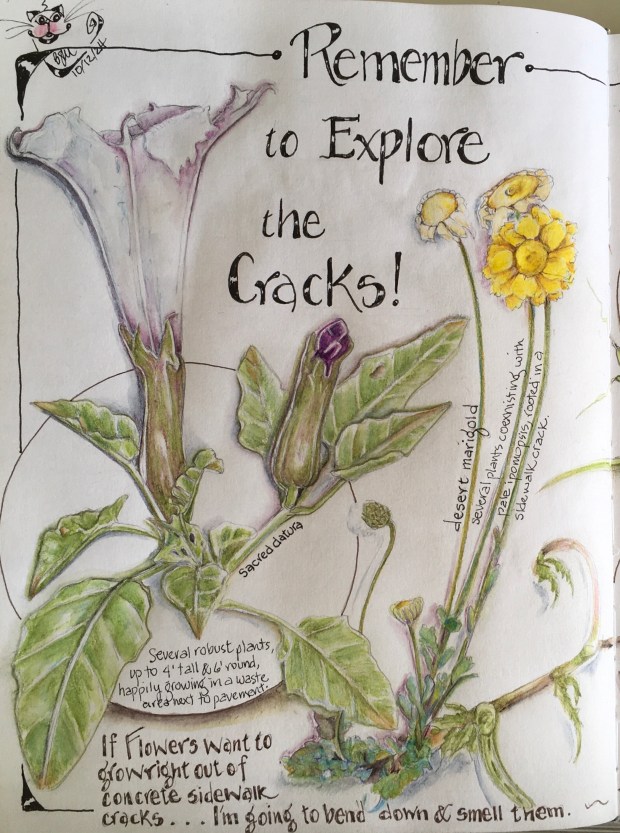
Mentally armed with a keener power of observation and purpose, we retraced our earlier route with excitement!  Now it was obvious an abundance of interesting and beautiful plants were growing from every sidewalk crack and along crumbled pavement edges throughout the ‘hood.  How had I missed seeing these beauties? 

And that’s how my idea for this 2-page layout was born, along with a reminder that finding bits of nature doesn’t have to occur at a botanical garden, wildlife preserve or national park. Nature is everywhere. If you just slow down and really look, even in the most unlikely places like sidewalk cracks, there’s always something to discover. So Remember to Explore the Cracks too and let me know what you find!

As always, thanks for stopping by!

Travel Alert! Rhinos on the Loose …… in New Mexico!???

July 29, 2024

One of our early morning landscaping projects has been keeping us busy shoveling our way through 14 tons of pea gravel, one wheelbarrow load at a time. As each backbreaking load is hauled into our back yard and dumped on miles of weed barrier fabric, we keep reminding ourselves how nice it will be when Luna no longer returns home with muddy paws. 

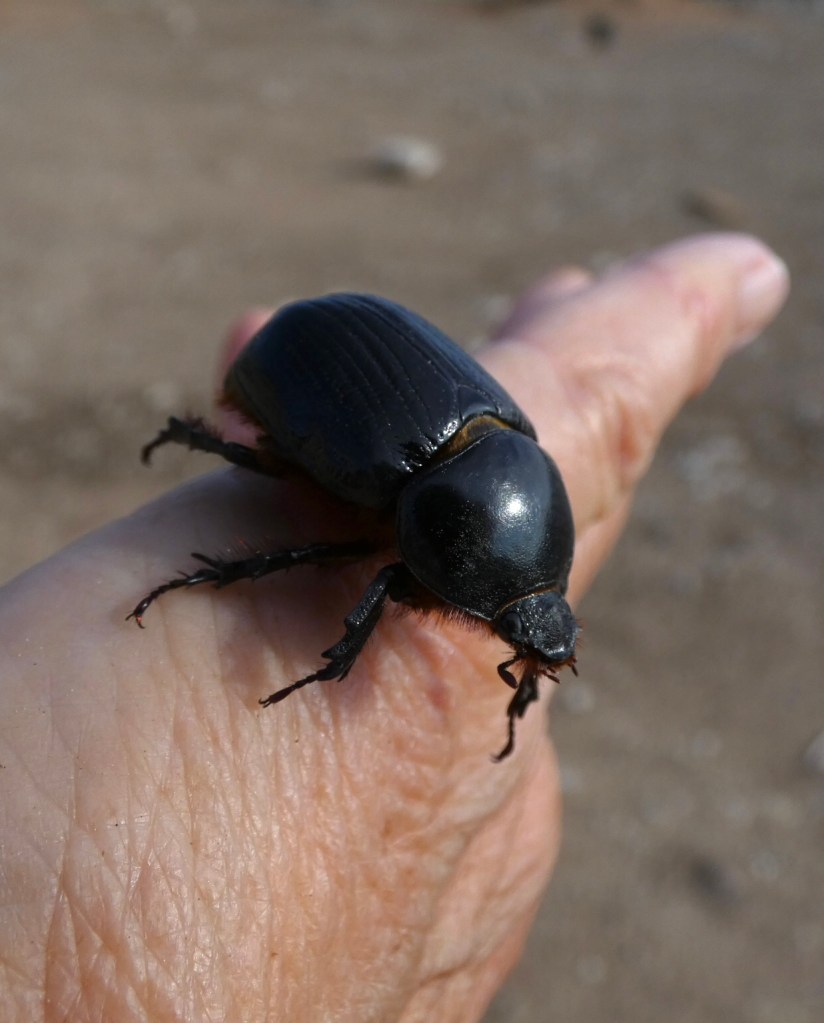
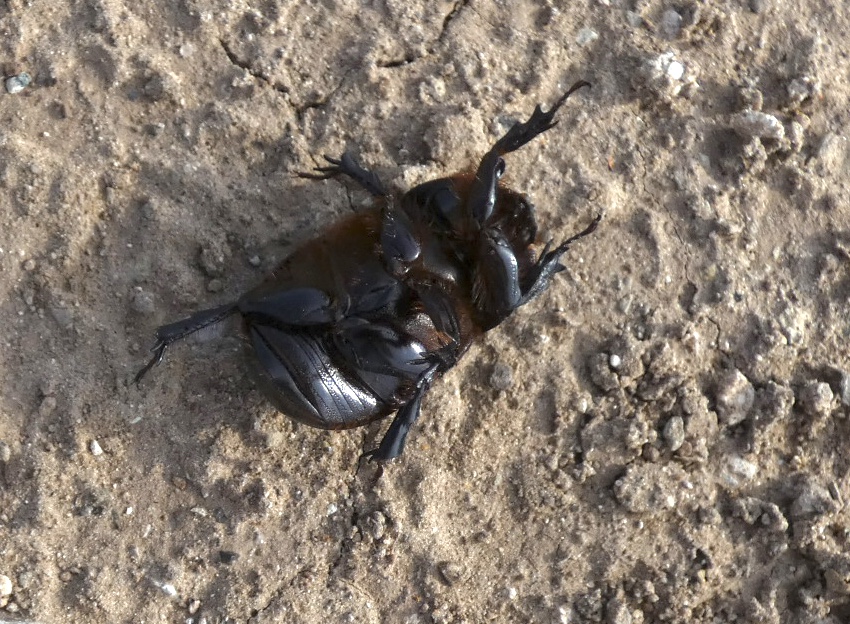
What began as a daunting pile of millions and millions of tiny little stones, by morning #3 the pile still looked impossibly huge, while the only thing diminishing was our enthusiasm. So it wasn’t a big surprise when, after only 15 minutes of scooping, a very large and shiny black beetle was welcome excuse for a break! After all, she was charging across our travel path, and without rescuing would’ve surely been squished flat under a careless wheelbarrow tire! 

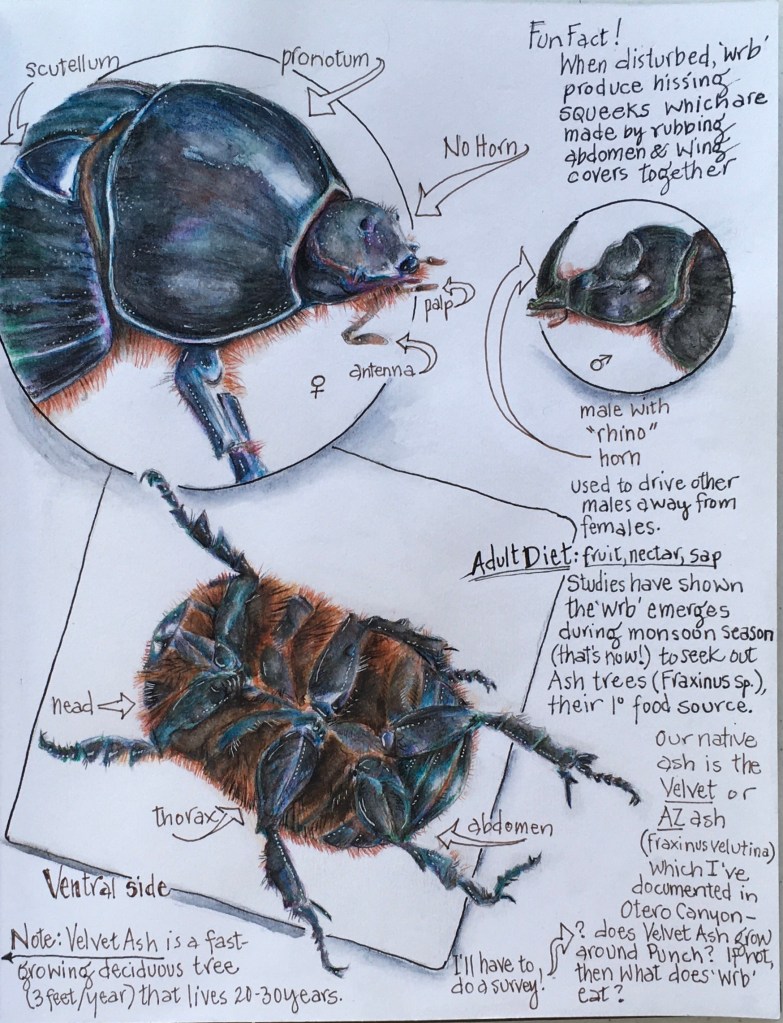
And we paused …… for nearly 45 minutes ….. as we ooohed and aaaahed over such a magnificent beetle, wondering what she could be.  Well over an inch long, we noticed her blue-black head, thorax (pronotum) and hard wing covers (elytra) as shiny as freshly polished paten leather shoes, were ringed by a dense fringe of rusty orange hairs. When she went belly-up, we could see those hairs all over the ventral (lower) side of her head and thorax. 

Not enjoying exposing her undersides to the world, those six flailing, long and powerful, many-segmented claw-tipped legs flipped her body over and she quickly resumed charging across the ground. Roy kept her in sight while I ran for the camera, determined to take lots of photos to get an ID. About a dozen poses later, and with the help of iNaturalist, I learned that our visitor appeared to be a female Western Rhinoceros Beetle (WRB)! 

Yes, apparently there are Rhinos in New Mexico! How cool it would be to find a male or two, and watch how they use their horns (which are as tall or taller than their steeply pitched and somewhat concave pronotums) in battle to win a hornless female.  

Wonderings! Why was our female WRB in such a hurry? Was she running from a male? Two battling males? Had she mated already and was in search of a Velvet Ash Tree (a NM native species and likely her preferred food source) where she could lay her more than 100 eggs in the soil beneath the tree? How does she find these ash trees, because I’ve never seen one on our 2 acres or along any of our neighborhood hiking trails? 

So many unanswered questions! But you can bet I’ll be on the lookout for the next WRB to trek on by. Maybe I’ll drop everything I’m doing (like scooping pea gravel) and follow her or him just to answer a few questions! Do you think Roy will mind being left behind holding the shovel? 

As always, thanks for stopping by!


Exploring the Familiar

July 23, 2024

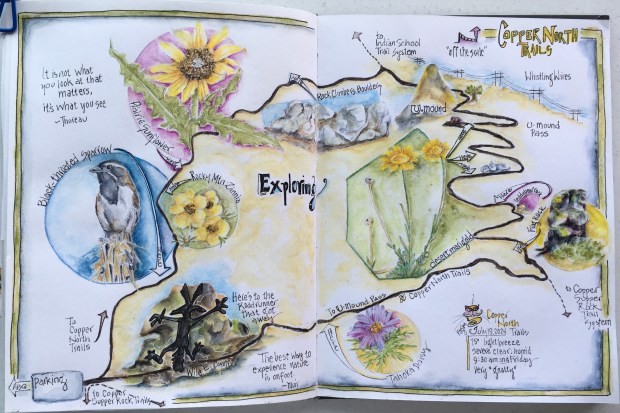
Hiking and rehiking familiar areas always turns up new discoveries. This may be because my eyes skim over the most commonly seen phenomena, allowing me to actively search for anything new or anything out of place. Rarely am I disappointed.

A few days ago, we explored one of our favorite hiking areas. Because birds tend to be more secretive this time of year, the best surprise was to hear a black-throated sparrow sweetly singing from his perch atop a cholla skeleton.

Because it’s monsoon season, many plants that bloomed late spring are making a comeback, and are happily spreading throughout the area. So to keep track of how ranges are expanding, I made note of their locations and transferred this information to a simple trail map. I also noted that the most commonly seen flowers were from the composite family …. the sunflowers.

Oh! Couldn’t resist capturing the silhouette of Wile E. Coyote glued to the back end of a dented vehicle in the parking area. That’s was a perfect discovery for the resident roadrunners!

Do you enjoy exploring familiar areas? What surprises have you discovered?

As always, thanks for stopping by!

Jack

July 16, 2024

While my mind is on the subject of local wildlife residents (see my long-tailed weasel post just a few days ago), I’ve been wondering a bit about the black-tailed jackrabbit (Lepus californicus). Fairly common in our area (and throughout most of New Mexico and the West), it’s always exciting to see one of these swift, long-legged desert “Jacks” bolt and run when spooked. To escape a predator, at the very last moment before discovery, the jackrabbit uses the element of surprise by leaping from his hiding place in the tall grass. The predator, now in hot pursuit, is usually left in the dust as the jackrabbit continues to leap, then leaps/runs until the “Jack” reaches top running speed all the while zig-zagging in an unpredictable manner. And poof! Gone! The predator, now completely baffled, gives up the chase, while the clever jackrabbit lives another day. 

So back to my wonderings.  Just how fast can a “Jack” actually run? How far can he leap? Doesn’t the jackrabbit get its genus name, Lepus, because they “leap?”

What I learned is the top running speed for a jackrabbit is 35-40 mph (Zoom!) and they can leap 15-20 feet in a single bound (super Jack!). Their top speed + their leaping nature allows them to easily escape most predators. But the name Lepus has nothing to do with leaping. Lepus, as translated from the Latin, means rabbit/hare. And one other thing that was news to me …… a jackrabbit is actually a hare, not a rabbit as the common name would imply!   Of course this sparked another wondering.  What’s the difference between a hare and a rabbit?

Various sources cleared up the hare vs rabbit conundrum ….. 

Hares are usually larger than rabbits, have longer ears and black markings on their fur. Hares have 48 chromosomes; rabbits have 44. Hares haven’t been domesticated; rabbits have. Hares live and give birth in shallow depressions in the grass; the young are born fully furred with eyes wide open, able to fend for themselves soon after birth (precocial).  Rabbits usually live and give birth in burrows; the young are born blind and hairless and totally dependent on mom (altricial). Hares usually live alone; rabbits live in large communities called warrens.

There’s so much more to learn, but this will have to do to satisfy my curiosity for now. If you have hares living near you, or perhaps you have a pet rabbit, share your experiences and observations of one or both species.  

P.S. I had fun drawing this jackrabbit (jackhare???), and did so as a gift for a dear friend who happens to love hares/rabbits. Wonder which one is her favorite? I’ll have to ask!

As always, thanks for stopping by!

Never Underestimate this Pint-Sized Carnivore…. The Long-Tailed Weasel!

July 13, 2024

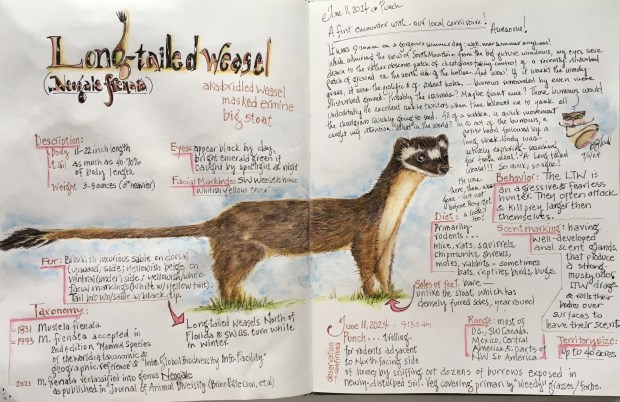
Such a surprise and total delight to find a long-tailed weasel hunting on our property! Busy probing numerous rodent burrows for an easy meal, he was too occupied to notice us staring in awe. What a beautiful little guy ……. from the white mask markings on his head, to his luxurious sable-colored fur draped over creamy buff-colored underparts; from his ground hugging, long, thin and sleek body, to his equally long or longer tail with a dashing black tip ……. the long-tailed weasel is a sight to behold!

long-tailed weasel tracks

Although their range includes southwest Canada, all of the lower “48,”Mexico, Central America and parts of northwest and southwest South America, seeing a long-tailed weasel is rare. Only one animal occupies a territory roughly 40 acres in size, which boundaries are aggressively maintained by frequent scent marking.

Even though the neighborhood pack rat, mole, squirrel and mice populations might suffer within a long-tailed weasel’s territory, we would enjoy and appreciate seeing more of this ferocious, pint-sized carnivore around our home!

Have you ever seen this or any weasel species? If you’ve seen this weasel (aka ermine) during winter, fully cloaked in brilliant white except for a black-tipped tail, ooooooooo! How lucky! Share your weasel observations please.

As always, Thanks for stopping by!

Surprise! A vine-y, twine-y desert milkweed discovery ……

July 9, 2024

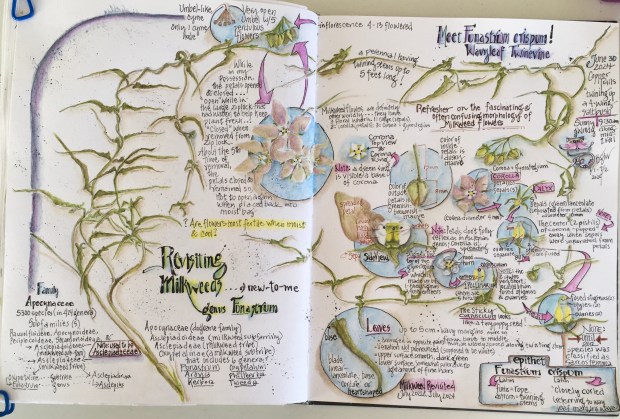
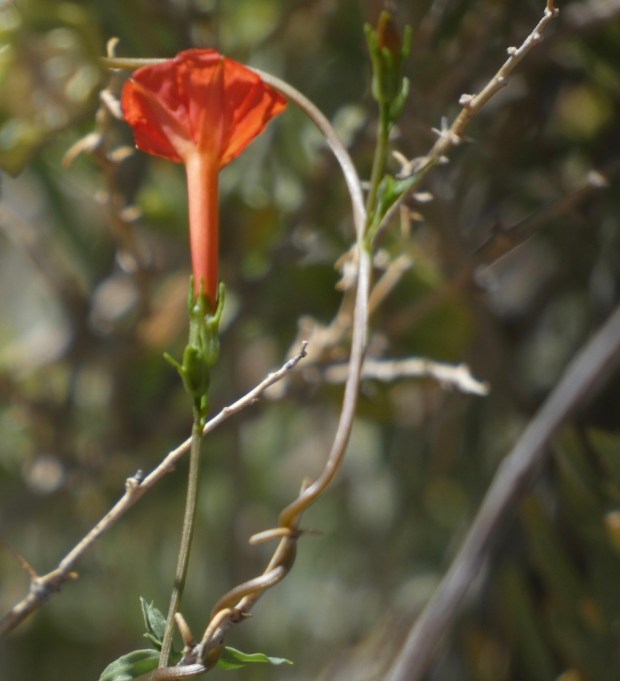
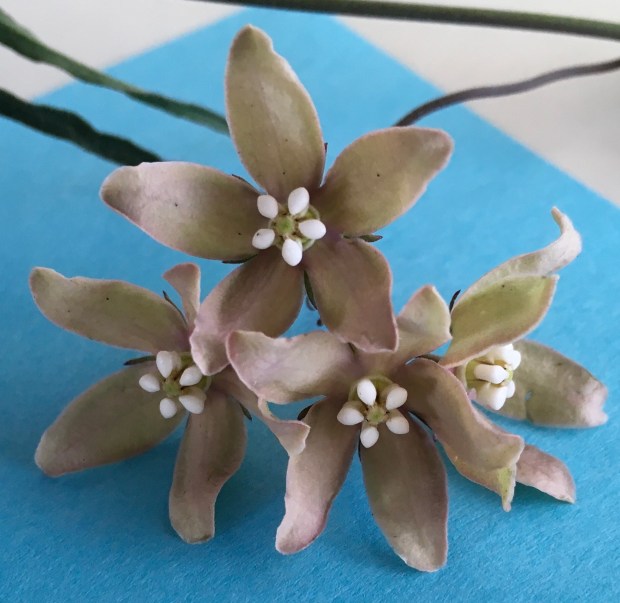
Just when I was feeling confident about the morphology of the milkweed family of plants, a new twist on the familiar leaps out shoutin’ “ Hey, lookie here!”      Expecting to see a common vine gracefully twirling its way up a desert shrub, I paused ……. searching for the crimson red trumpet-shaped flowers of Ipomoea cristulata (Trans-Pecos morning glory). But instead there was an umbrella of 5 flowers, each with 5 widely spreading greenish-brownish-mauve colored petals crowned in the center of an unmistakable floral corona, a sure fire characteristic of a milkweed! Could it be?

Trans-Pecos Morning glory

Oh Yes! 

This unexpected, undeniable discovery had me puzzled though. It’s been two years since I created a detailed post about the Asclepias genus of milkweed (see Summer Botany: Meet the Milkweeds). At that time and throughout the decades prior, my knowledge of milkweeds was limited to Asclepias, and the specific characteristics of that genus. 

Spreading petals of Wavyleaf Twinevine

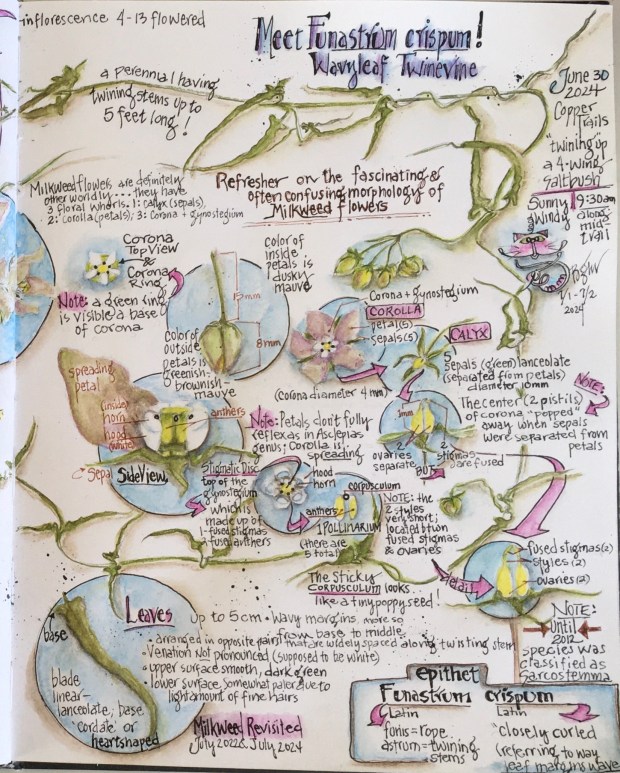
But here was something new-to-me; so worthy of whatever time it might take to learn all about this find in the dogbane family (Apocynaceae), aka the Milkweeds.  I quickly confirmed this vine does not belong with the Asclepias species of milkweeds, but is of the genus Funastrum, which is Latin for rope (funis) with twining stems (astrum), commonly referred to as the “twinevines.” And the full name of this plant is Funastrum crispum, commonly called Wavyleaf Twinevine.

Most of what I uncovered about Wavyleaf Twinevine is included on my 2 journal pages, along with some confusing taxonomy involving family and subfamily names, tribe and subtribe names, and how until 2012, this plant was known as Sarcostemma crispum. Curiosity about the taxonomic history will undoubtedly tempt me to sort through the confusion ……. maybe someday soon!

Have you discovered anything new-to-you in nature lately? What was it, and did it lease to more discoveries?

Thanks for stopping by!