One of the Most Aloof Sunflowers Ever! The Cowpen Daisy

Part 3 ….. An Allelopath Declares Chemical Warfare

August 15, 2025

The more I learn about Cowpen Daisy (Verbesina encelioides), the more the words Intrepid (fearless and bold), Interloping (meddlesome and smothering), and Impertinent (pushy and rude) come to mind. 

Cowpen Daisy is literally a plant at war …..

Its adversaries are neighboring plants …..

Its weapons of choice are chemicals ….. 151 different Allelochemicals2 to be exact. 

Cowpen Daisy shows no mercy to its most susceptible victims, and given the right conditions in the right locations, Cowpen Daisy can cripple ecosystems, and unravel biodiversity.

Oh No! What Have I Done! Have I unleashed a formidable enemy to run amok, bullying its way through our mostly intact biodiverse high desert ecosystem?      

Maybe not!  (Spoiler alert…… Allelopathy3can be bad, but I still love this happy Daisy)

On August 6th, I received an excellent question from one of my blog followers, based on my first Cowpen Daisy post :

“Do you have any concerns about this becoming an invasive plant? Best wishes, Nancy”

In reply, I expressed my concern about the number of “seedlings coming up late spring,” and how “I was definitely alarmed and wondered about the need for early control.”  Fortunately, “as the season advanced, it became clear the density of plants seemed self-controlling.”  Based on my limited experience with Cowpen Daisy, I explained how during the summer of 2023 “the plant completely covered an extremely large field near our home,” causing me concern about its invasive tendencies. But upon “[R]eturning the following year (2024) and again this past spring (2025) to see if the same field was blanketed again in these plants, “I couldn’t find a single Cowpen Daisy anywhere! So no, this annual [doesn’t appear to be] “invasive, at least not in central New Mexico.”

But Nancy’s question prompted me to dig deeper into on-line research.  I wondered: Is Cowpen Daisy invasive outside of its native range, particularly where conditions are ideal for its aggressive growth?  Yes, it is! And its invasiveness is further enhanced where neighboring plants are susceptible to the impacts of the allelochemicals released by Cowpen Daisy’s leaves, roots and decaying leaf matter in the soil.

One example where Cowpen Daisy is an introduced species and has become invasive is in India. Fields of mung bean, corn, chickpeas, and sweet melon are being outcompeted by invasive stands of Cowpen Daisies.  These food crops are severely impacted by two allelochemicals released by the both roots and leaves of the Daisy; steroids and phenols. Studies of these four crops demonstrated not only “the suppression of germination and growth in these plants” but “also revealed an antagonistic effect on [their] chlorophylls, carotenoids and protein levels.” In other words, Cowpen Daisy is winning the war against India’s mung bean, corn, chickpea and melon crops, and farmers are currently engaged in a battle to develop a strategy of control and run this biological enemy out of their country.

Cowpen Daisy is only considered a native species to the Southwest U.S. and Northern Mexico. However, it has been introduced (either intentionally or by accident) and is considered naturalized in parts of Eastern North America, the Middle East, Spain, Argentina, Australia and the Pacific islands. As such, Cowpen Daisy’s nature to drop allelochemicals everywhere it grows allows it to behave like an invasive plant in countries where it is naturalized.  Without diligent management (via herbicide application or mechanical control), it can thrive to the detriment of their desirable plant species’ survival.

Have I defeated my goal of reestablishing a diverse native plant community in disturbed areas surrounding our new home? “Not likely,” says I, optimistically!  In addition to Cowpen Daisy, the variety of native plant species I intentionally seeded last fall and early this past spring, have germinated, grown, flowered and seeded or are in the process of flowering and seeding, most of which are adjacent to a Daisy. Of course time will tell. Meanwhile, I’ve declared this to be a happy ending to this post and my stand of happy Cowpen Daisies! However ……. next spring, if germination rates from my reseeders are low or zero, but Cowpen Daisy returns with renewed vigor, then I have a control job waiting for me. And the best advice I’ve read is to “pull out old plants and roots and selectively remove new seedlings.” That’s acceptable! That I can do!

Until then!

Do you struggle with weedy, invasive plant species in your garden or yard? Have you seen fields of blooming weeds and wondered …… “what weed is that?” Do you know the names of those pesty plants and do they seem to keep your favorite variety of cucumbers from growing? It might be interesting to learn if your local invasives are one of the many Allelopaths happily growing in our world! Let me know!

As always, thanks for dropping by!

1Cowpen Daisy is known to release up to 15 different allelochemicals2 from its leaves and roots, such as guanidine, phytosterols, phenolic acids, tripertenes, flavonoids, dicarboxylic acids, phytophenols, steroids, phenols, and others. Fresh and decaying leaf litter leach 14 of those allelochemicals into the soil.

2,3Allelopathy is a biological phenomenon by which an organism produces one or more biochemicals that influence the germination, growth, survival, and reproduction of other organisms. These biochemicals are known as allelochemicals and can have beneficial (positive allelopathy) or detrimental (negative allelopathy) effects on the target organisms and the community. Allelopathy is often used narrowly to describe chemically-mediated competition between plants. Allelopathic interactions are an important factor in determining species distribution and abundance within plant communities, and are also thought to be important in the success of many invasive plants. (source: Wikipedia)
The Cowpen Daisy ….. One of the Happiest Sunflowers Ever!

Part 1 ….. Can There Be Too Many Sunflowers?

August 5, 2025


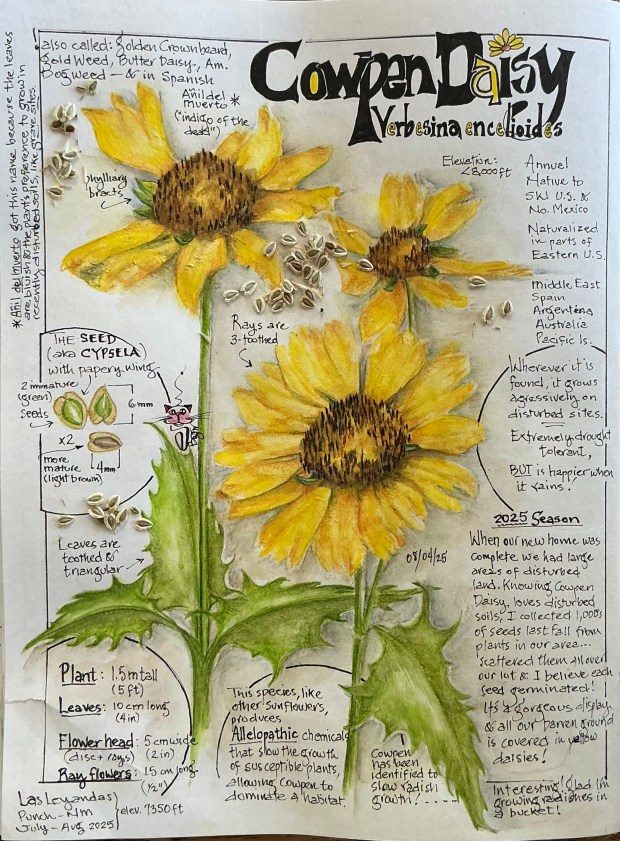
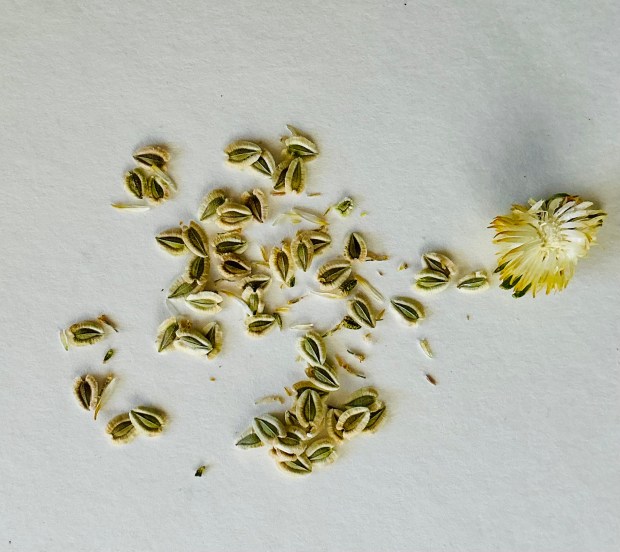
It was the Fall of 2024. A small cluster of Cowpen Daisies (Verbesina encelioides) flourishing on the severely disturbed ground surrounding our new home was going to seed. Waiting several weeks until the migratory birds ate their fill, I spent an hour or so collecting as many remaining dried seeds (cypselas) as possible, stuffing full two quart-sized ziplock bags. About 1/3 of the seeds I scattered around the house where they would overwinter on the ground.  The rest were poured into large pill vials that were labeled with species name, location, and date, then placed in the refrigerator to simulate cold storage until Spring.

Cowpen Daisy cypselas (seeds) 08/04/2025 at Punch

It was late April 2025. The chances of heavy frost seemed a distant memory. My fingers crossed, I chose a sunny 42 degree morning to liberate those refrigerated seeds from 6 months of cold storage, and scattered them in disturbed areas not seeded last Fall. Then I waited like an expectant parent, watching for signs of germination, worrying that runoff from late season snows might wash away my scattered seeds, expecting that flocks of migratory birds would gobble them all up, and hoping for gentle rain showers to swell those thousands of seed coats to aid those tiny embryos in growing their first roots (radicles) and first leaves (cotyledons). 

Then early June 2025. Success! Cotyledons were literally popping up everywhere, which meant the radicles were already expanding into the soil. They were especially crowded where I’d scattered all the cold storage seeds, and germination was obvious where seeds had been scattered the Fall of 2024. By early July, those Cowpen daisies were crowding out many of the other native species I’d also seeded in the same areas. 

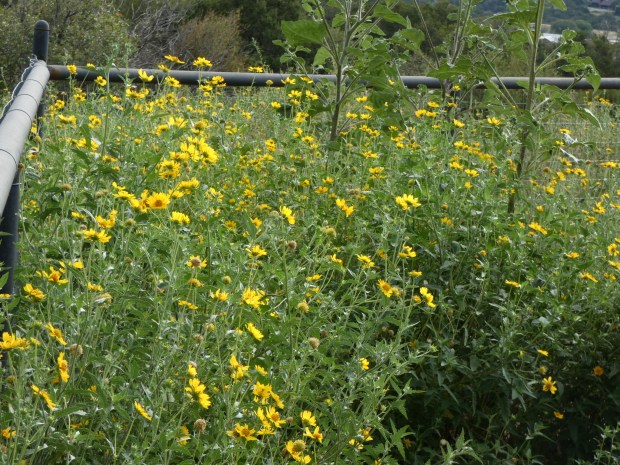
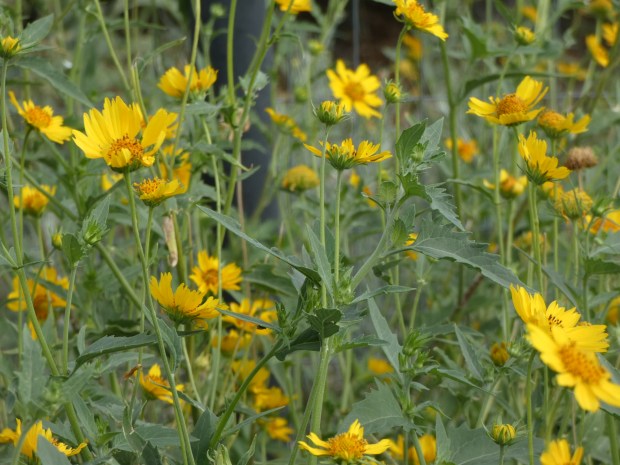
Backyard and overflow Cowpen Daisies, robust growth after Fall 2024 seeding (08/03/2025)

And now it’s early August 2025, and what a dazzling show! Even though the sunflower yellow flowers of Cowpen Daisy are small (2” wide), there are up to 75 long-stemmed flowers on each plant that can grow from 4-5’ tall! They are so dense, the backyard fence is hardly visible, our walking paths are totally draped with 4” long leaves, and if there’s a rattlesnake lurking around under our massive Cowpen Daisy canopy, we’d probably (hopefully) hear him well before he slithered into view! 

Goals and Lessons Learned

I’ve learned a lot by parenting these Daisies; from the best time to scatter seed (in the late Spring following cold storage) and where (not so close to other desirable natives or pathways), to managing the mass of growth (by organizing through selective removal). Our initial goal of seeding and growing native plant species was to attract and help feed wildlife (pollinators, reptiles, rodents, birds and mammals), and we are optimistic that achieving this goal long-term seems realistic with the success we’ve had to date. However, because so many of our native plants are losing the battle against habitat loss caused by invasive species encroachment and takeover, land development, and climate change, we will continue to explore ideas to expand our initial goal to address the habitat situation. As we gain insight about the best native plants to grow to help restore our disturbed soils, we will learn and share with our neighbors those species that: are drought tolerant; aid in building soils; are effective at invasive weed suppression; provide wildlife benefits; and increase plant diversity. 

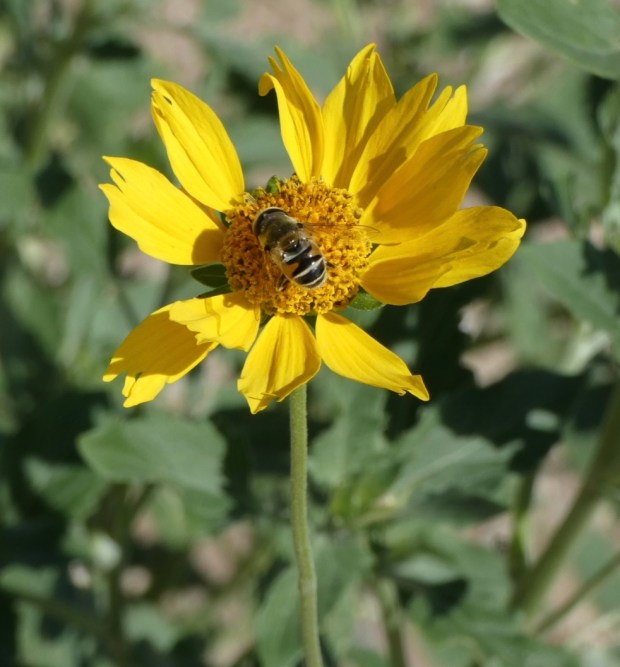
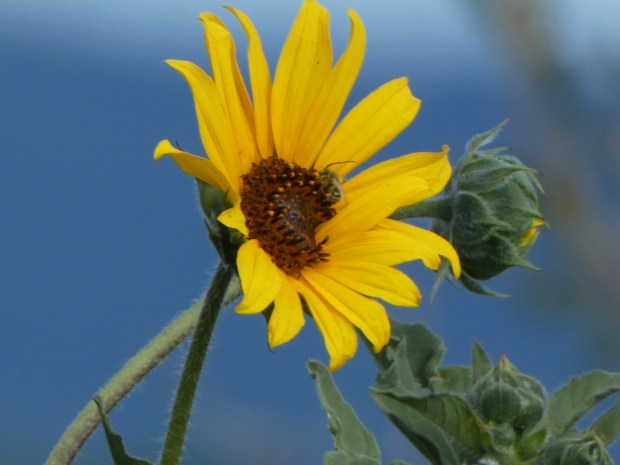
Cowpen Daisy and pollinator 08/01/2025 at Punch

Happy – Happy – Happy!  Will I be collecting Cowpen Daisy seed again this Fall? You bet! Having all that sunshine yellow around our home is thrilling. Every morning all those thousands of sunflower faces looking East towards a new day are about the happiest sight ever! And having such wild, uninhibited growth of a native annual out our back door has been ideal for observing the pollinators that benefit from the abundant nectar and pollen, enjoying the aerial acrobatics of several phoebe families that have been feasting on those pollinators, and promises to be a perfect spot for bird watching this Fall when all those cypselas ripen into high protein food.

Can’t wait!

Do you ‘know’ a special native plant? How about a native butterfly garden? Are you a bird watcher? Maybe you enjoy the occasional deer, coyote, or bobcat wander through your yard? Please share your favorite wildlife encounter!

As always, thanks for stopping by!

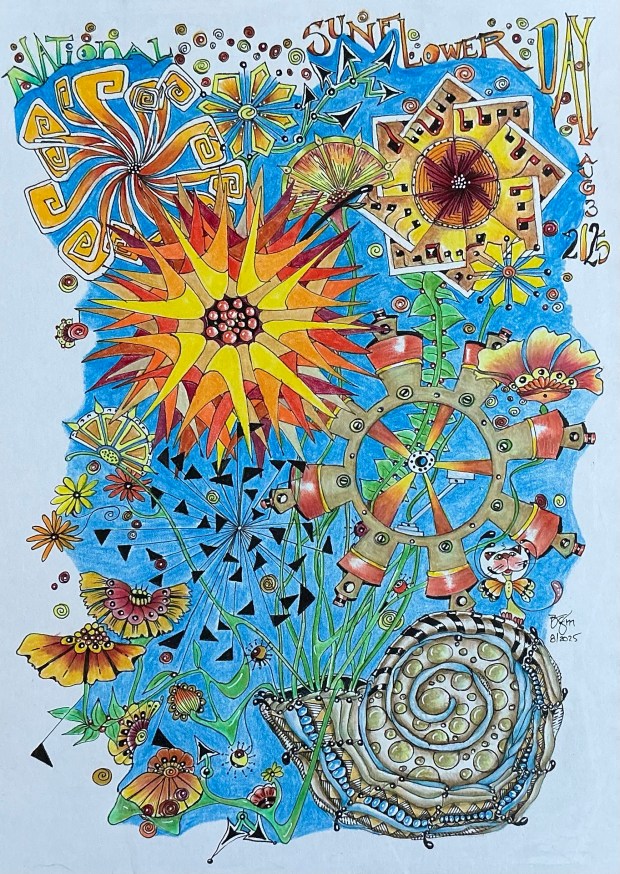
National Sunflower Day

August 2, 2025

Zentangle patterns: Eeric, Dollpin, Alla, Citrus, Snowflower, Fancy Flower, Crizzy, Suru, KGI, Maryhill, Xplode, Lilyeyes, Odee, Sooflowers, Peaceout, Bulb Lantern, Arrowtree, Adobe

Sunflowers!🌻 Absolutely the happiest flower on Earth. Wouldn’t you agree?

Sunflowers, a symbol of adoration, loyalty, and longevity, represent happiness, friendship, and intelligence. Much like the sun, sunflowers reflect vibrancy and an energy of life. While National Sunflower Day is the official day to celebrate these beautiful flowers, why not declare the entire growing season reason a-plenty to radiate your inner sunshine and mirror the smiling faces of every sunflower encountered! 

Then and Now

Did you know sunflowers have been around since about 1000 BCE? In the U.S. indigenous peoples used sunflowers as a valuable food source, for oil, paint, and textiles, and during ceremonies. Some archaeologists even believe sunflowers may have been cultivated before corn. Today, sunflowers are still used for food (seeds, salad mixes) and beverages (tea), cooking oil, in beauty and skin care treatments, for medicinal purposes, and for hobbies and crafts.

Annual Sunflower over 6 feet tall!

The sunflower crop

The U.S. is a mass producer of sunflowers, particularly in the plains states, and is a major crop in both North Dakota and South Dakota. The average cultivated sunflower plant is five to six feet tall, and the central face of disc flowers can grow bigger than a human head. As the weight of the sunflower head becomes heavy, it begins to fall forward causing the petals to fall off. Shortly after the harvest begins. On average, one sunflower can produce up to 2,000 seeds per head. In 2022, North Dakota produced 762 billion pounds of sunflower seeds!

The Happiest and the most Intelligent flower

Have you ever noticed sunflowers track the sun, from sunrise to sunset? It’s true! Sunflowers follow the sun’s movements throughout the day. You may notice that before sunrise, a sunflower is in sort of a sleeping position with its head slightly down. As the sun comes over the horizon, the flower awakens and slowly lifts its face to ‘look’ directly at the rising sun. As the day progresses and we observe the sun moving from east to west, so too does the sunflower by turning its face in sync with the sun’s apparent movements until sunset.1  When the sun sets in the evening, sunflowers nod off to sleep, but not before untwisting themselves and slowly return to face the east. Ingenious!  

This charmer is called Cowpen Daisy

1 However, on very hot days, sunflowers tend to avoid looking directly at the sun to keep from overheating. And I’ve noticed on cloudy days, sunflowers may appear confused about the sun’s location, seeming to make their best guess on which way to face.

A season of yellows and oranges

Although you can find flowers in the Aster (sunflower) family in the Spring, August is the peak growing and blooming season for these cheerful plants. Brilliant displays of yellow flowers welcoming the morning sun can be found wherever sunflowers grow. Witnessing fields of sunflowers is guaranteed to lift your spirits as you oooooh and aaaaaaaah at their breathtaking beauty. 

A trio of cowpen daisies

Ideas to celebrate a day, week, month or year of sunflowers

  1. Spend a day with a wild sunflower and watch its face track the sun.
  2. Take a drive to view fields of sunflowers to see their true beauty in mass.
  3. Give a bouquet of sunflowers to a friend to brighten their day.
  4. Add sunflower petals and seeds to your salad.
  5. Create a painting of your favorite sunflower and frame it to enjoy year-round.
  6. Try your hand at a Zentangled sunflower bouquet ….. there are as many pattern possibilities as there are blooming sunflowers! 
  7. Plan a road trip to North Dakota in August and coordinate places to stop to visit sunflower fields and get updates from local farmers who cultivate sunflowers. 
A collection of cowpen daisies in my backyard.

If you missed celebrating this year’s National Sunflower Day, no worries! Every time you come across any sunflower, of any size, anywhere, pause and hold a personal celebration in honor of its splendiferous magnificence!

As always, thanks for stopping by!

Sunflower photos were taken in our backyard ….. all volunteers too!

Pick Me! Pick Me!

January 20, 2025

Winter can be challenging for nature journalers. Getting outside when it’s cold and windy, cloudy and dreary, snowy, icy or wet, are not ideal weather under any circumstances.  And when everything looks brown and crispy and pretty much the same, the challenge to nature journal in the great outdoors grows exponentially. While these conditions make it difficult for spontaneous observing, I try to remember there’s always something remarkable to be discovered in nature, even in winter.

 Who knew a little whack on the head would be just the thing to reawaken my curiosity?

Bundled in layers, leash in hand, Luna led me on her early morning walk around suburban Albuquerque. Having been along this route before, we’ve both made some interesting discoveries in the past.  And as usual, this time was no exception for Luna. For me though, everything appeared brown, crispy and familiar. But I was inspired by  and enjoying Luna’s sense of curiosity, and her encouraging tug on the leash. 

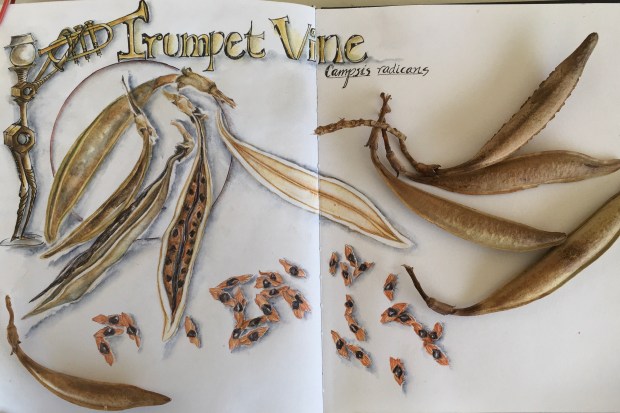
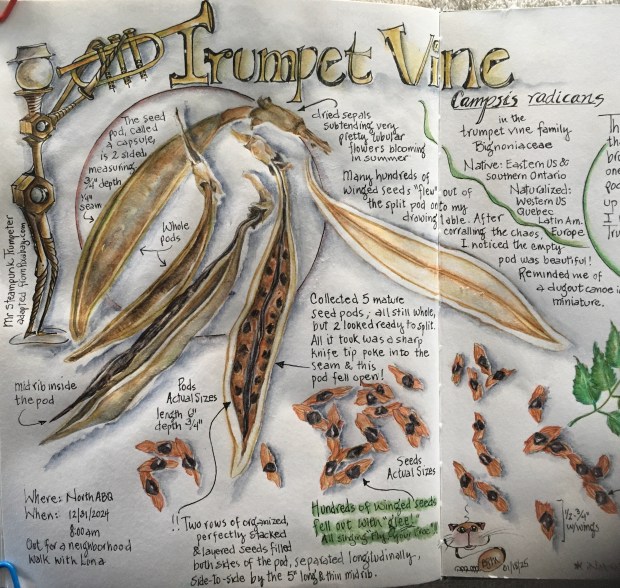
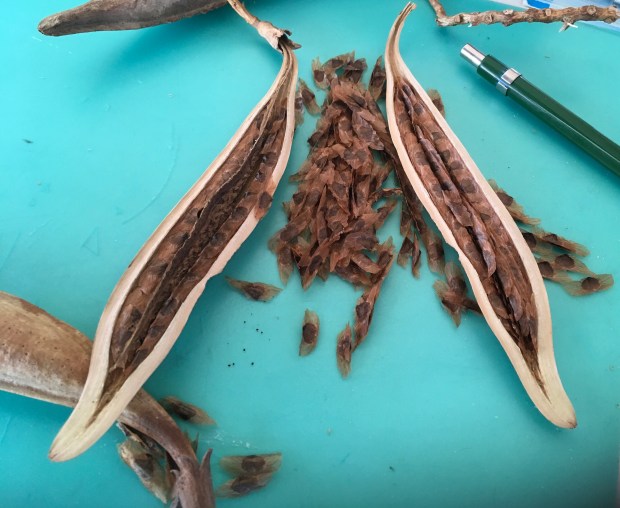
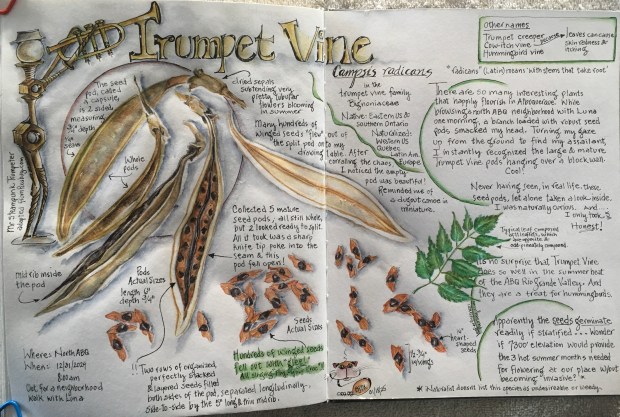
Nearing the end of our 2-1/2 mile walk, and mightily concerned I’d go home empty handed, we turned our last corner. It wasn’t 100 feet down the cement block-lined sidewalk that I abruptly stopped in my tracks. Something had lightly whacked me in the head! While the sound of rhythmic clacking rang out, I looked up, and to my surprise spotted the accidental assailant. Draped over the 6 foot wall, suspended from a hearty Trumpet Vine (Campsis radicans) growing in the hidden yard beyond was a string of pods resembling brown green beans. Long and plump and full of seeds, one of these pods had reached down low enough to make contact with to my head. (I say “reached” because that’s what my imagination said had happened.) Quickly awaking my sleepwalking brain, the effort made by the seed pod to get my attention paid off too. Silently whispering, “Pick me! Pick me!” it was as if the seed pod and its adjacent buddies either wanted to be harvested, or wanted to be featured in my nature journal (or both). 

So I did ………… both!

I loved learning about and sketching these fascinating Trumpet Vine seed pods, while my mind was filled with the muffled notes of a trumpet. Tooo-too-too-toooooom!

Hope you enjoyed reading this story and browsing around my journal pages.

As always, thanks for stopping by!

Exploring the Familiar

July 23, 2024

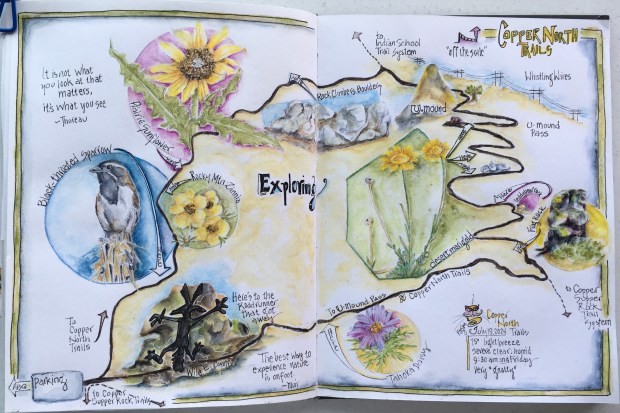
Hiking and rehiking familiar areas always turns up new discoveries. This may be because my eyes skim over the most commonly seen phenomena, allowing me to actively search for anything new or anything out of place. Rarely am I disappointed.

A few days ago, we explored one of our favorite hiking areas. Because birds tend to be more secretive this time of year, the best surprise was to hear a black-throated sparrow sweetly singing from his perch atop a cholla skeleton.

Because it’s monsoon season, many plants that bloomed late spring are making a comeback, and are happily spreading throughout the area. So to keep track of how ranges are expanding, I made note of their locations and transferred this information to a simple trail map. I also noted that the most commonly seen flowers were from the composite family …. the sunflowers.

Oh! Couldn’t resist capturing the silhouette of Wile E. Coyote glued to the back end of a dented vehicle in the parking area. That’s was a perfect discovery for the resident roadrunners!

Do you enjoy exploring familiar areas? What surprises have you discovered?

As always, thanks for stopping by!

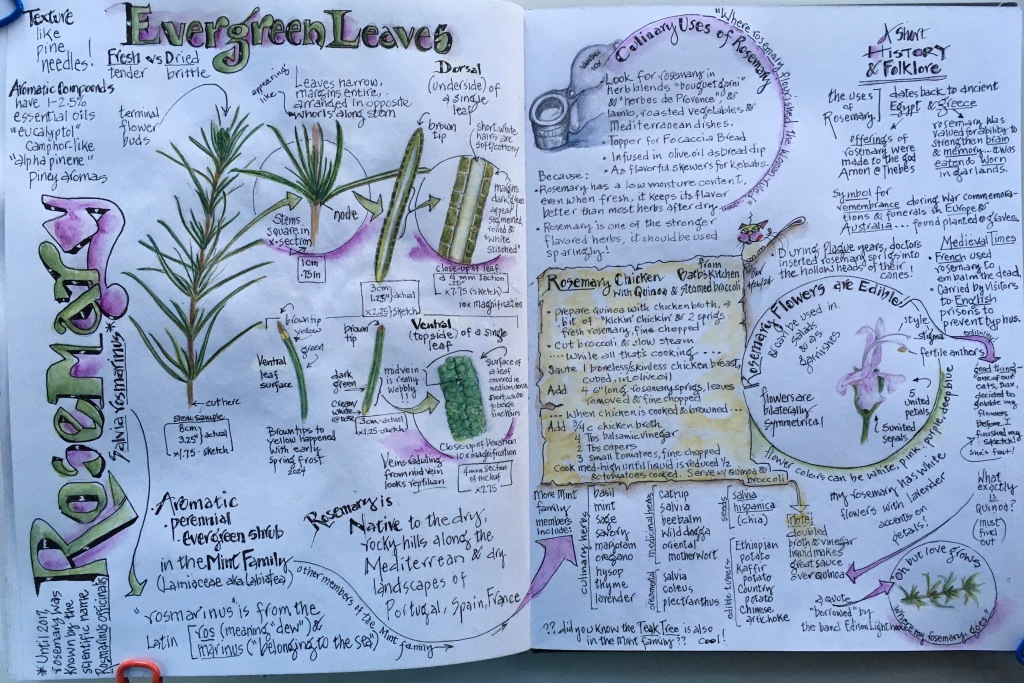
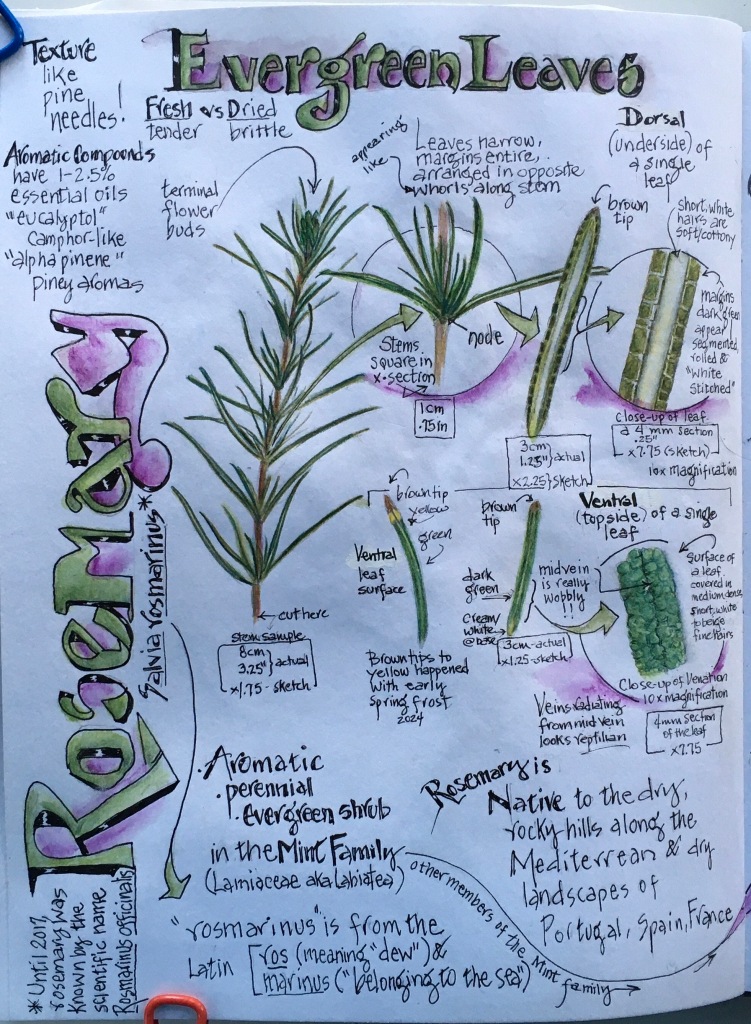
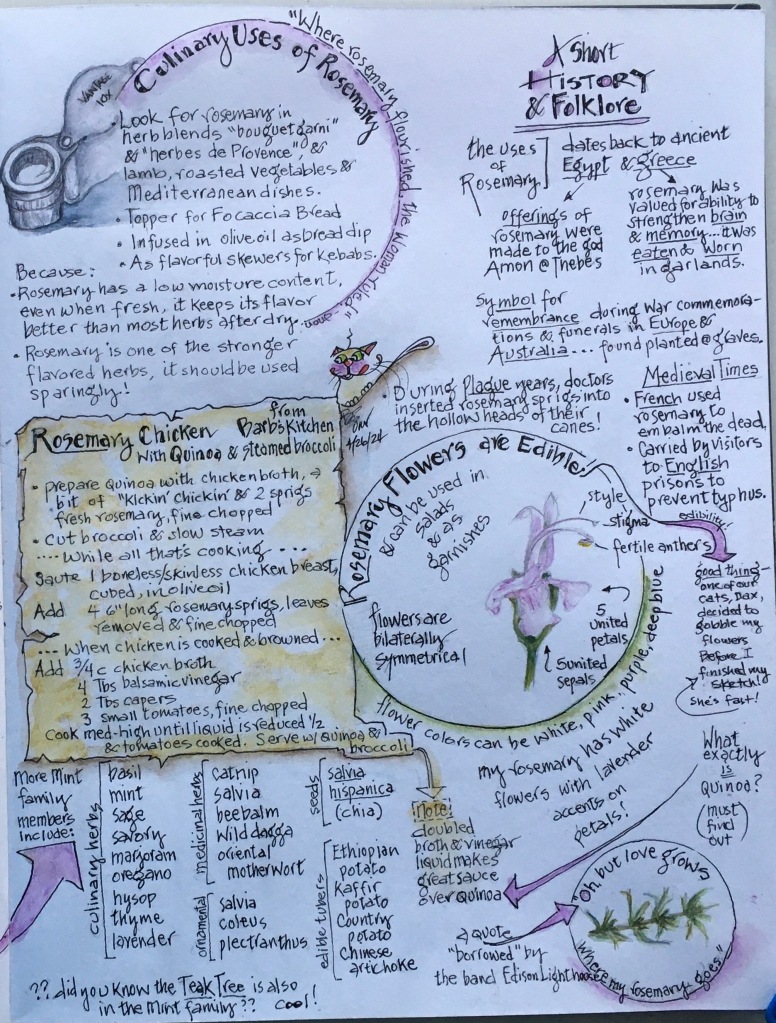
Rosemary …. Next Up in my Herb Series


April 27, 2024


When trying to pin down exactly what’s so special about Herbs, a deliciously aromatic group of plants, I was stumped.  Well, maybe not stumped, exactly. There are so many reasons to fall in love with Herbs, and picking one feature or even one Herb that’s especially special is nearly impossible. Best known for their culinary flavor enhancements, can you imagine pickles without Dill, pesto without Basil, salsa without Cilantro? What’s a dark chocolate circular pattie without Peppermint, or a cookie cutter man without Ginger?  


Herbs excite memories, calm the mind, reduce inflammation. Does the aroma of sage conjur thoughts of Thanksgiving? Does a sprig of lavender make you sleepy? Does bold yellow turmeric soothe arthritic joints?


And many Herbs are decorative and lovely to look at, form beautiful shrubs, have gorgeous flowers

But I keep coming back to the aroma. It’s hard to resist crushing the leaves of herbs like thyme or mint between my fingers. The essential oils released into the air and lingering on my fingers causes me to take a deep breath, inhaling the fragrance, embedding the aroma in my brain, resulting in a memory I can recall over and over again. 

Herbs are Special!

The Rosemary plant (actually a mini shrub) in my yard always invites my attention, and just this week it welcomed spring by coming into full bloom!

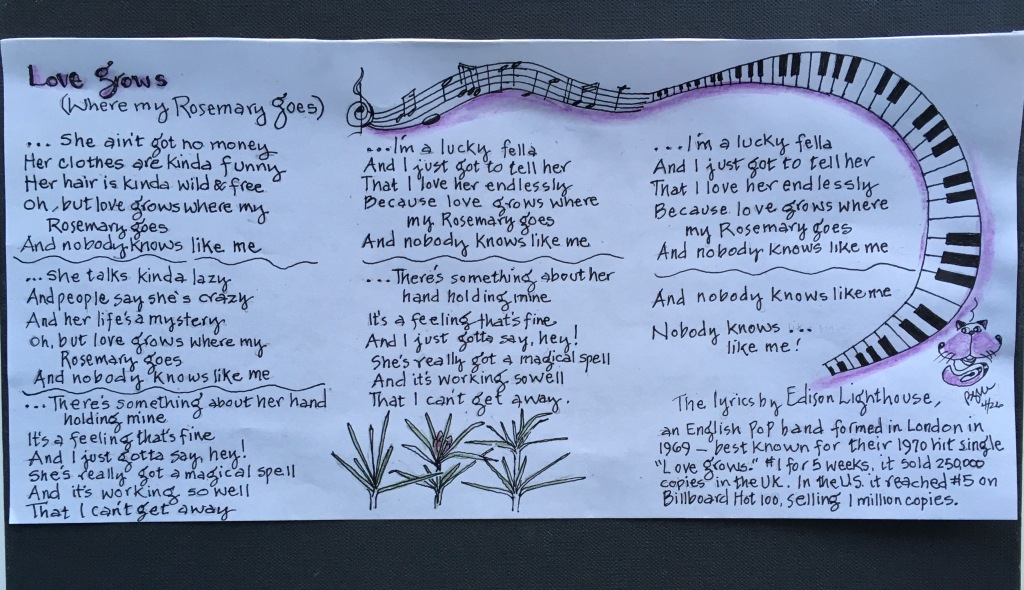
Who remembers this?! Now I can’t get it out of my head!

Do you have a favorite Herb? Why is it special? How do you use it?
Please share! And thanks for stopping by!