Of all the hummingbirds migrating through central New Mexico, the male Rufous ‘hummer’ (Selasphorusrufous) is the most spectacular. Showing up when our hot Summer temps begin to soar, he has two things on his mind ……. #1. find the best patch of nectar-rich tubular flowers, and #2. keeping that patch all to himself to refuel before completing his 4,000 mile migration from southern Mexico to southern Alaska. Upon arriving from Mexico, the flashy 2-1/2” long Rufous, garbed in a feathery cloak of flame colored oranges and reds, quickly lays claim to an area of sweetly blooming flowers that may include penstemon, columbine, scarlet gilia, Indian paintbrush, mint, lily, fireweed, larkspur, currant, and heath. Determined to defend his patch against all invaders, he performs a quick flower flyover. If satisfied the coast is clear (for now), he takes up a strategic observational post by perching on a nearby tree branch to watch for rival hummers.
Ever alert and constantly in motion, his perch gives him a great vantage point to scan the area by looking right and left/up and down, all the while making quiet chittering and chipping noises. If another hummer, and especially a male Rufous dares to enter his territory and sip from his flowers, oh no! Becoming highly agitated, the perched bird spreads his tail while flashing his colorful gorget (throat feathers) seconds before dive bombing his competitor, loudly screaming his alert call while attempting scare off the thief. If this tactic doesn’t work, i.e. the rival is determined to hold his piece of air space, a duel is declared.
Rufous hummers are well known for their aerial acrobatics. Perhaps you’ve witnessed their display, which likely put you in awe of this little powerhouse. If not, what you’ve missed is their incredible speed of initial attack, their precision, the cacophony of noise coming from such a tiny blur of a bird, the maneuverability of numerous aerial loop-de-loops and J-pattern sky displays allowing them to dive repeatedly at their foe, and their tireless determination in defending their rights to their flowers. It’s a spectacle you have to see to believe!
The Rufous will attack not only males and females of their species, but hummingbirds of all species, and even large insects, all with the audacity to steal precious nectar from his prized flowers.
And never, ever sit near or below a hummingbird feeder when there’s a Rufous in the neighborhood. I learned the hard way after being attacked over and over again by a surprisingly intimidating Rufous hummer. Despite being thankful I chose to wear a hat that afternoon, a large dose of common sense had me backing away from his feeder for fear he might have a stroke before drawing blood. My heart still races when recalling this thrilling yet scary encounter.
While reading about the Rufous, I learned that all ages and both sexes of this species are aggressive, even during their brief 1-2 week migration stopovers. This is certainly very good information to know about, having only witnessed males launch themselves at intruders, myself included!
Can’t wait for Rufous migration season!
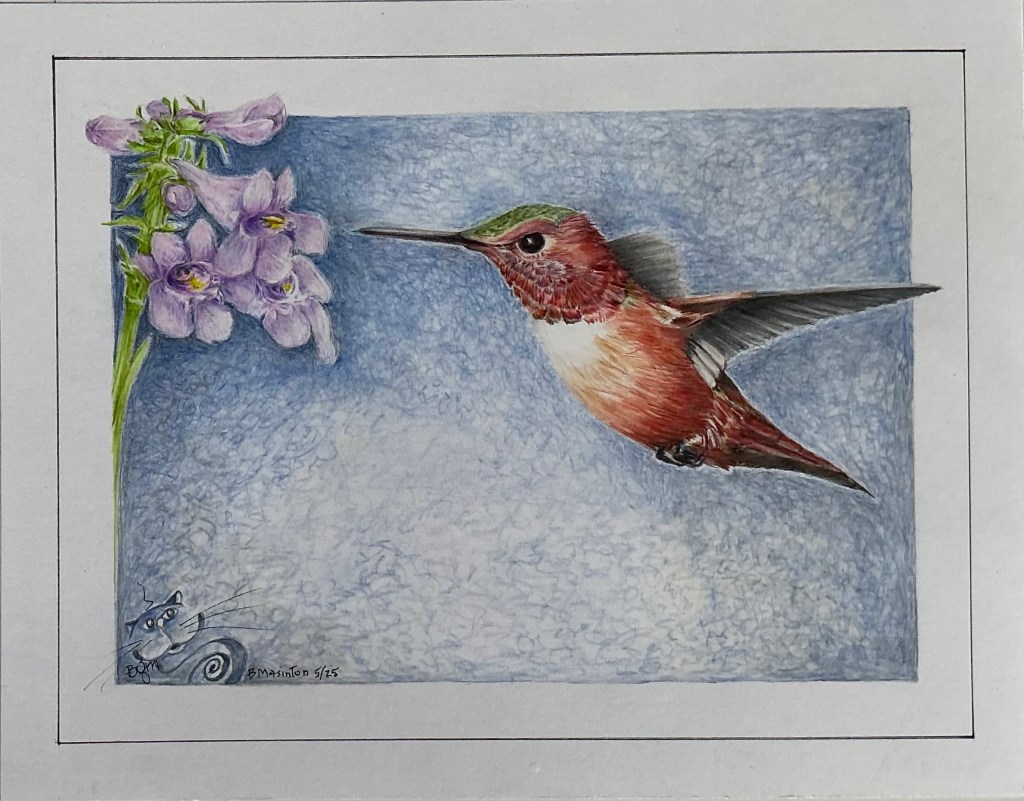
Have you learned something new about this wildly fascinating and fiery hot hummer of southern Mexico, the Western US, Canada and southern Alaska? If you have a Rufous or any hummingbird story to share, please do! Oh, I also hope you’ve enjoyed my colored pencil artwork of a male Rufous about to sip nectar from a freshly blooming penstemon.
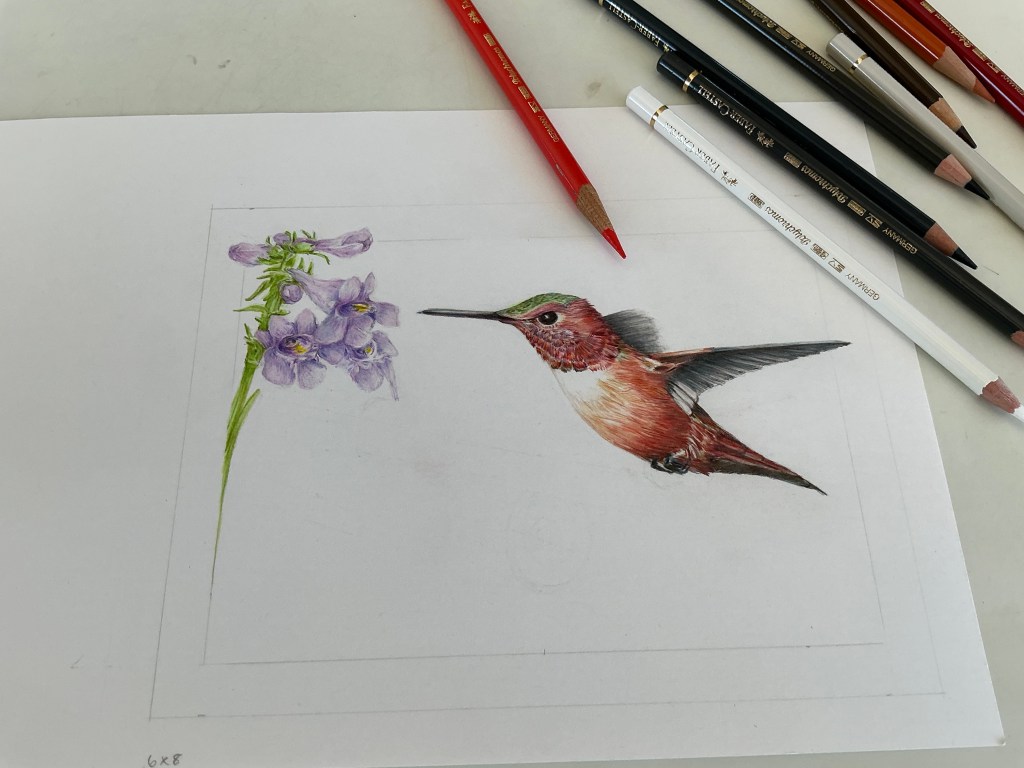
Work in Progress …… showing an almost completed composition on smooth Bristol paper and a few of the Faber-Castell Polychromos colored pencils used in creating this Rufous hummer and penstemon.
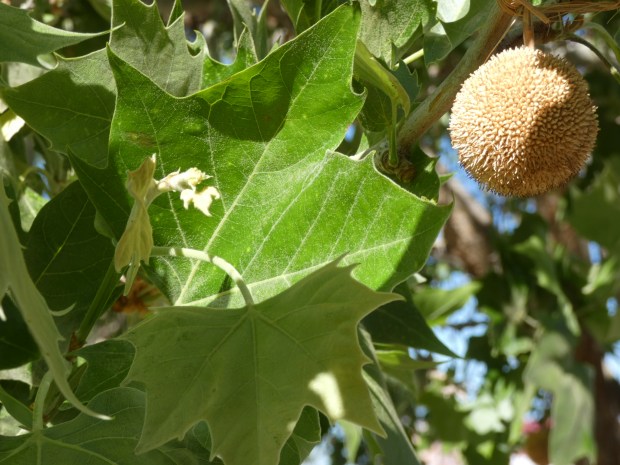
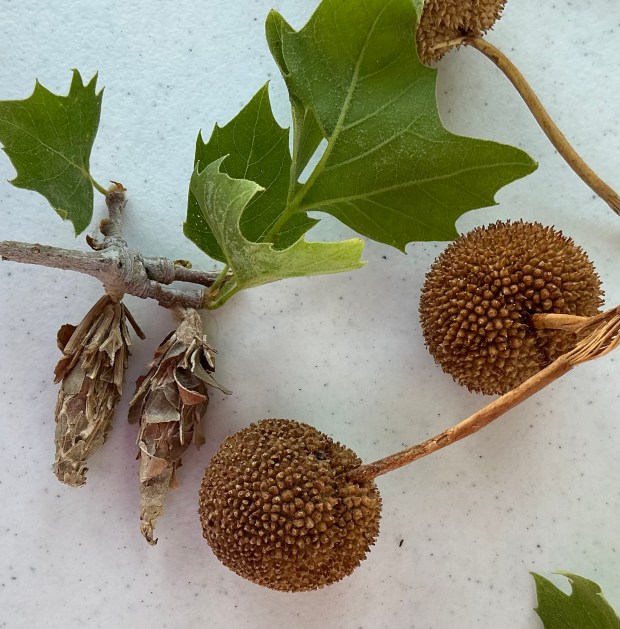
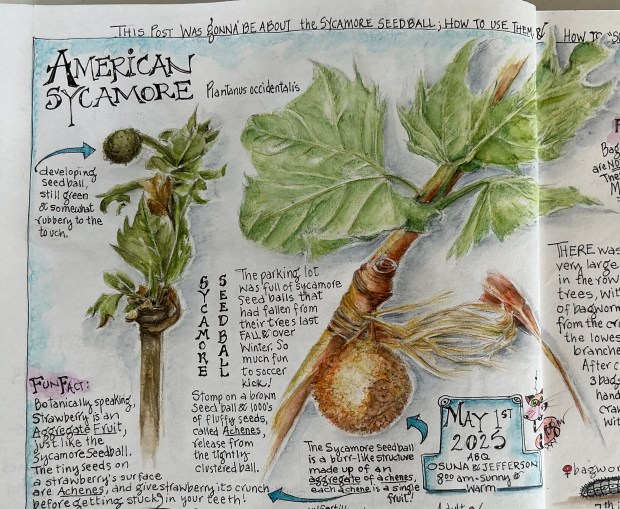
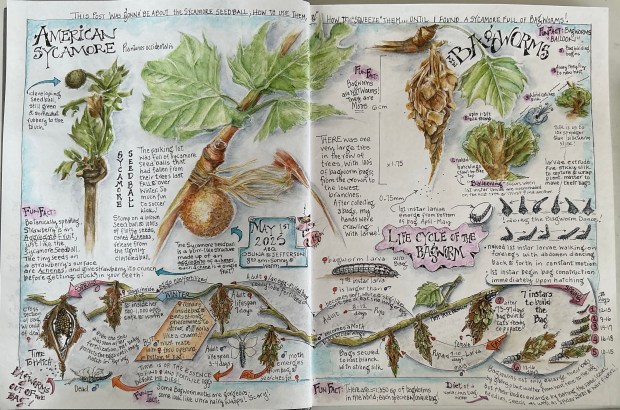
On a warm Spring morning, wandering around a grove of American Sycamore, I became curious about these magnificent trees: where in the US are they native; why are some leaves larger than the palm of my hand and some half the size; what about those odd pingpong sized seedballs lying on the ground everywhere you look ….. why don’t they roll away in search of an ideal spot to pop open so the seeds can germinate …… when the seedballs are kicked, stepped on or crushed beneath a car tire, do the 1,000’s of seeds inside blow away to sprout ….. are the seeds (all or some of them) even viable ….. do the seedballs make a good ink or dye or maybe they’re edible or even medicinal……. what, if any wildlife species eat the seedballs or seeds; and ooooohhhhhhh, sycamore bark! Why does this tree’s bark flaunt a pastel palette of greens, yellows and pinks. These and many more questions came to mind that it seemed about time the American Sycamore became a subject for my nature journal, until ……………..
There! In the tree above my head, I spotted a most curious thing. Parting a few of that sycamore’s beautiful Spring green palmate-shaped leaves was a bundle of dead brown and beige leafy bits and sticks all haphazardly glued together. Wishing to get a closer look at that elongated ornament shaped “thing,” I found it was securely suspended from a branch. Trying to puzzle out this fascinating mystery while searching for my pen knife, a stiff breeze blew through the tree. It was then a I noticed hundreds of those 2-3” long bundles all over the tree; from the base to its crown!
Curiosity is the Essence of Nature Journaling
What continues to draw me to nature and nature journaling after so many years are the surprises in the familiar and in the unknown. I know well enough that new encounters in nature are infinite; you just have to open your eyes and look. Having learned by carefully observing what appears to be familiar, often leads to new discoveries. That’s when my curiosity kicks into high gear ….. when it’s time to engage in some serious poking around to figure something out; to learn what the “thing” is.
Curiosity, for me, is the very heart and soul of nature journaling. The ‘art’ of curiosity even precedes skill in observation. It’s what drives me out the door in the morning and fuels my exploration. Curiosity fills the mind with countless questions if for no other reason but to develop a deeper understanding of the natural world.
But I “wax philosophical.” Needless to say, my curious discovery on that warm and breezy Spring morning prompted an abrupt change of mind for my next blog post (this post). Anxious to learn about the “thing” suspended from a tree branch, probably minding its own business, I proceeded to cut it down (along with two more) and popped them in a bag along with a few sycamore leaves and seedballs.
Later that same day …….
Upon completing my journal sketches of sycamore leaves and seedballs, and posting a few photos to iNaturalist for an initial ID, it was time to take a closer look at my discovery. Reaching into the bag for one of the “things” (wiping my hand free of spider webbing?), I placed it on my examination table surrounded by several hand lenses, a larger magnifying glass, a penknife, and 2 pairs of tweezers. Before beginning the dissection, I noticed about a dozen black pepper-sized bits moving about the “thing.” Thinking tiny spiders had come from the bag, I didn’t give them a second thought (should’ve been curious!).
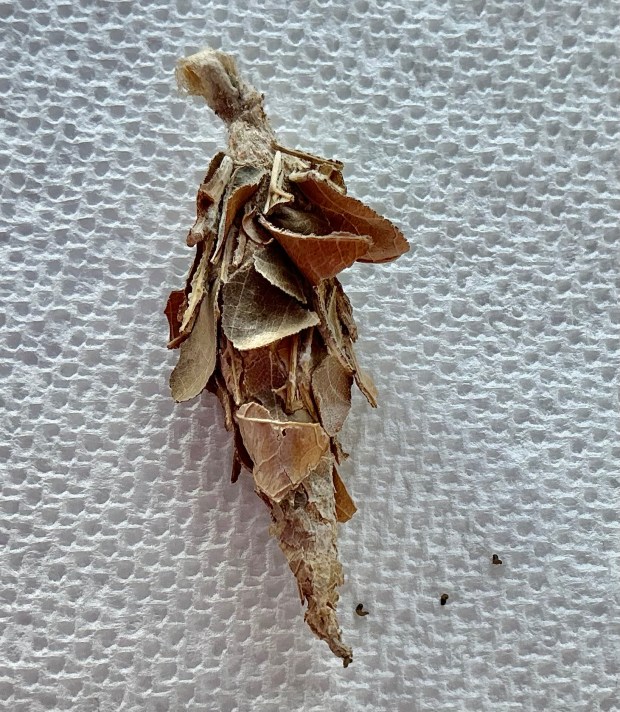
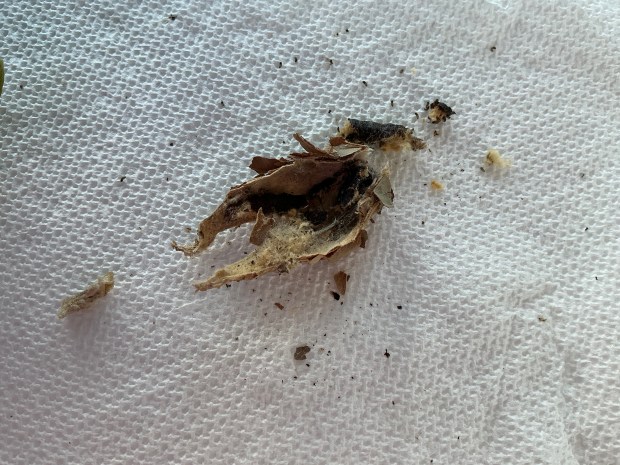
This bagworm bag was the subject of my dissection. Notice the pepper-sized black dots next to the bag ….. those are wiggling 1st instar larva.
iNaturalist ID Pick :::::::::::::: BAGWORM MOTH ::::::::::::::: iNaturalist ID Pick
(awaiting genus/species ID)
A Bagworm Moth!
How cool is that!?!
The opened bag of a female Bagworm moth. She’s very dead, but her progeny are escaping as fast as they can.
Dissection resumes ……
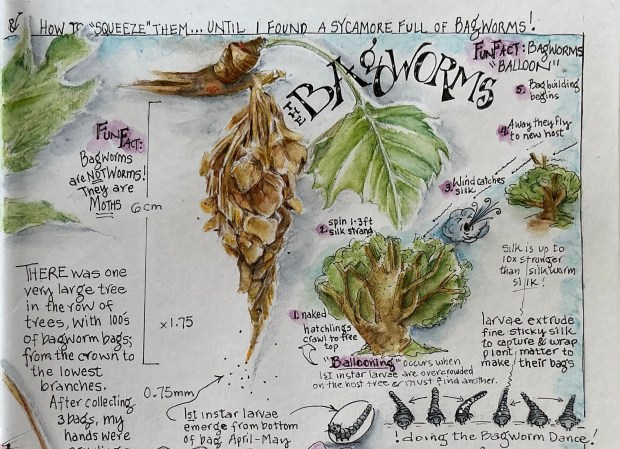
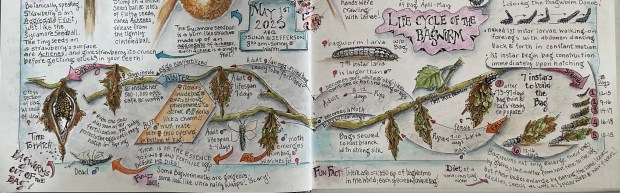
After finding out the “thing” I’ve been pondering over is the Bag of a bagwormmoth, I learned the Bag was built during last Spring, Summer and Fall by either a male or female bagworm moth. If a male, the Bag would be empty; if a female, the Bag would contain her remains …. she would’ve died last fall after a male fertilized 500-1,000+ eggs she overwintered inside her body until Spring when newly-hatched larvae would emerge from the bottom of the Bag and begin the species’ life cycle all over again.
The Bag, that took about 10 minutes and all my dissection tools to open, contained the black and mushy remains of a female and 100’s of wiggling/dancing larvae! They were on the move; escaping from the now wide open Bag, and quickly covering my examination table like a pepper grinder out of control.
And my effort to open the Bag? This made sense after reading about the high tensile strength of the silk they produce. These thin strands of silk, 10x stronger than that produced by silkworms, is used in abundance to construct their Bags.
The coolest thing ever! Notice the either late 2nd or early 3rd instar larva, no longer naked, but swaddled in very chewed up leafy bits glued together with strong silk. This dude was hiking up a sycamore branch, continually chewing, wiggling, and gluing.
After disposing of all the naked 1st instar larvae waggling and dancing across my examination table, I placed the dissected Bag, the two whole Bags, and collected leaf material into a clear plastic ziplock to observe what would happen. Over 10 days, the number of larvae multiplied and the naked 1st instar caterpillars grew in size (at least to 2nd instar) while building their individual Bags from tiny bits of leaf litter! Their wiggling dance seemed to be the way their silk strands wrapped and secured leafy bits around their bodies. It’s been fun to watch all the activity.
Have you ever encountered one or more of the 1,350+ species of bagworm moths? What materials were their Bags made from? Please share your experience with these fascinating members of the butterfly/moth family of insects.
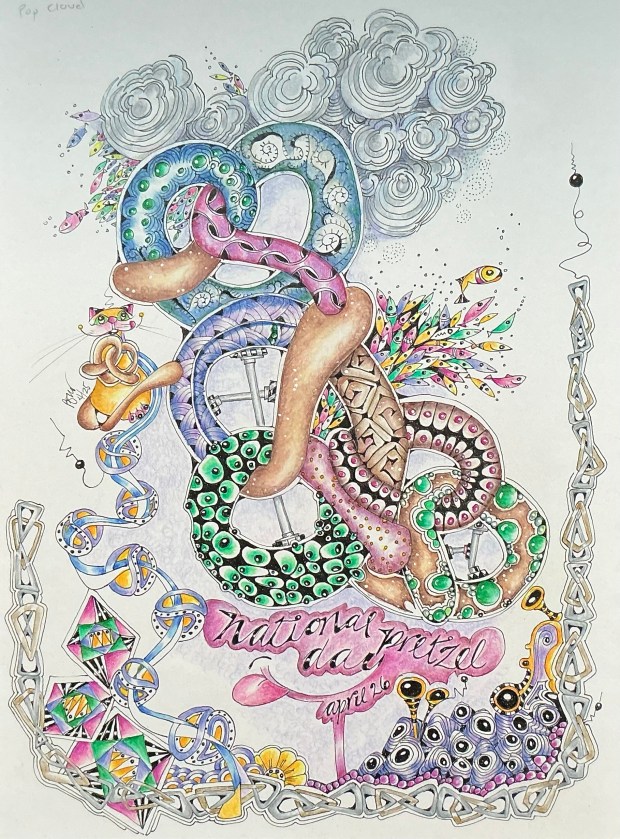
Put down that can of chips or box of square crackers and show your love for one of the most versatile snacks ever …… the Pretzel! Whether you like the snap of crispy twists or prefer them soft and chewy, grab your favorite and join the National Pretzel Day celebration today, April 26th.
Pretzel historians offer a few origin stories, but usually share the most likely and often told legend from the Roman Empire. Apparently in 610 A.D., an Italian monk wanted a way to reward his child students for memorizing their prayers. Instead of baking loaves of morning bread, the Monk twisted thin strips of the dough into symmetrical loops by intertwining or knotting the two ends before folding them back on each other (today’s familiar “pretzel loop”). The shape he made was said to resemble a child with his arms crossed in prayer. The Monk called his invention ‘pretiola’ meaning ‘little rewards’.
From then on, these soft ‘little rewards’ became popular in Austrian bakeries and in all of Germany, and so on throughout the world.
Not being satisfied with baking only soft pretzels, in 1850, Julius Sturgis bought a hard pretzel recipe from a local tramp (wonder why a tramp would have such a recipe? Thoughts?). After baking and baking, and perfecting the recipe, it was clear to Julius the hard pretzel was a success. The pretzel’s popularity quickly spread, inspiring many other bakers in central Pennsylvania to make their own versions of the hard pretzel. But the original ‘Sturgis’ hard pretzel was a keeper. In 1861, the Julius Sturgis Pretzel Bakery, located in Lititz, Pennsylvania in the heart of Pennsylvania Dutch Country, became the first commercial pretzel bakery in America.
Naturally, die-hard fans of the warm/soft pretzel weren’t won over by the overwhelming appeal of the hard/crispy version. With the soft pretzel market still alive and growing, by the 20th century soft pretzels became very popular not only in Philadelphia, but in Chicago and New York as well.
The Pretzel of Today
How many shapes and flavors of pretzels can you think of? Here’s my lists …….
Hard pretzel shapes: traditional loop, thick and thin; stick shapes, both thin and in thick rods; twisted, clockwise and counterclockwise; round rings with and without knots; thick stumpy bite-sized nuggets, filled and unfilled; chip shaped and waffle shaped.
Hard pretzel flavors: salted, cinnamon sugar, peanut butter, peanut butter and jelly, honey mustard, cheese, honey wheat, honey butter, ranch, ranch and jalapeño, garlic, sea salt caramel, sour cream and onion, and buffalo wing.
And for soft pretzels …… it’s all about the dipping sauces and coatings: Of course there’s yellow mustard, garlic mustard, melty cheese, melty beer cheese. But there’s also chocolate dipped, aioli, truffle hot sauce, buffalo ranch, cinnamon sugar, and marinara.
Can you add more?
Pretzel Fun Factz!
Pennsylvania is the center of American pretzel production for both hard and soft pretzels, producing 80% of the nation’s pretzels.
Today, the average Philadelphian consumes about twelve times as many pretzels as the national average.
Philadelphia opened a privately run “Pretzel Museum” in 1993.
The annual United States pretzel industry is worth over $550 million.
The average American consumes about 1.5 pounds of pretzels per year.
How will you celebrate National Pretzel Day 2025? Here’s a few ideas …..
Enjoy a bag of your favorite hard pretzels, and gift one to a friend.
Visit your local bakery or even the mall to sample their selection of warm soft pretzels.
Try a game of “Toss the Ring” with ring-shaped pretzels.
Go on a pretzel scavenger hunt.
Host a pretzel and beer party for your neighborhood.
Bake a batch of soft pretzels for the party and have everyone bring their favorite dipping sauce.
And now ………
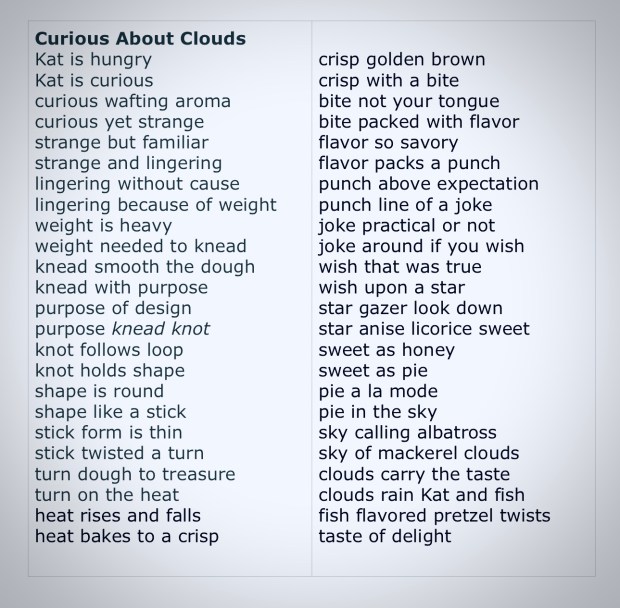
Curiously, Flambé has been following my post with fascination. Always hungry, could it be she’s developing pretzel cravings? What baker, in their right mind, would ever scent a batch with eau de fish? If a pretzel maker thought mackerel flavored twists would ever be popular, they might just be crazy (or not?). Becoming more famished by the minute, Kat insisted on explaining her ‘irrational’ excitement in a “Blitz” poem (a style created by Robert Keim.1). She felt this poem style not only suited all the twists and turns found in a properly-constructed pretzel loop, it best expressed the twisting and turning pathway her mind took to explain herself and help us “get it!” What do you think?
1 Shout out to Michele Lee, My Inspired Life blog post dated 04/05/2025, for sharing her amazing Blitz poem and providing the rules to create one too. Thanks Michele!
As always. Thanks for stopping by!
Here are the guidelines for the Blitz poem, created by Robert Keim:
Line 1 should be one short phrase or image (like “build a boat”)
Line 2 should be another short phrase or image using the same first word as the first word in Line 1 (something like “build a house”)
Lines 3 and 4 should be short phrases or images using the last word of Line 2 as their first words (so Line 3 might be “house for sale” and Line 4 might be “house for rent”)
Lines 5 and 6 should be short phrases or images using the last word of Line 4 as their first words, and so on until you’ve made it through 48 lines
Line 49 should be the last word of Line 48
Line 50 should be the last word of Line 47
The title of the poem should be three words long and follow this format: (first word of Line 3) (preposition or conjunction) (first word of line 47)
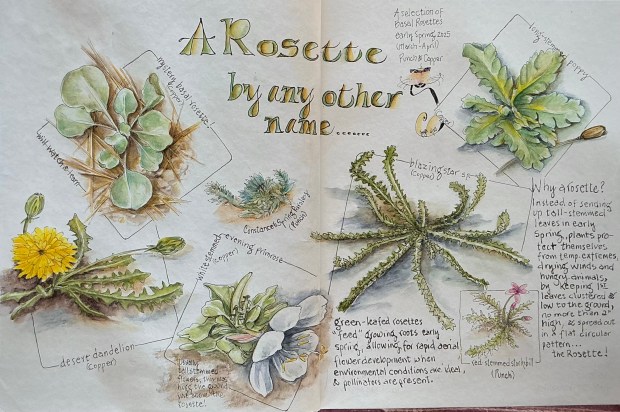
A selection of basal rosettes that popped out of the ground this Spring.
Have you ever noticed a dandelion? Oh sure …… you’ve seen hundreds, probably thousands of those ubiquitous sunburst yellow flowers blanketing a lawn or brightening an abandoned field. But before all that brilliance magically appears, have you ever looked below all those flower stalks? Have you ever noticed a dandelion before it blooms?
It’s early Spring in the mountainous areas of central New Mexico, and it seems like the high desert is slow to bloom this year. Anxious to spot even a hint of green during this transition time is always challenging, but if you look closely …….. Tucked beneath dry grasses and piled-high tumbleweed skeletons wedged next to swelling cholla you’ll find the green. Clusters of new leaves hugging the ground no more than an inch high, are beautifully arranged in a circular pattern like the unfolding petals of a rose.
Rosettes!
Rosette arrangements are found throughout nature,1 but in the flowering plants they are particularly common in the following families: Asteraceae (like dandelions), Brassicaceae (like cabbage), and Bromeliaceae (like pineapple). Many other families display the rosette morphology too. The needle sharp leaves of yucca and the bayonet-shaped leaves of century plant (in the Agave family) form tall rosettes. The intricate leaves of wild spring parsley (a tiny member of the Parsley family) and the petite red-stemmed stork’s bill (Geranium family) both form ground-hugging rosettes.
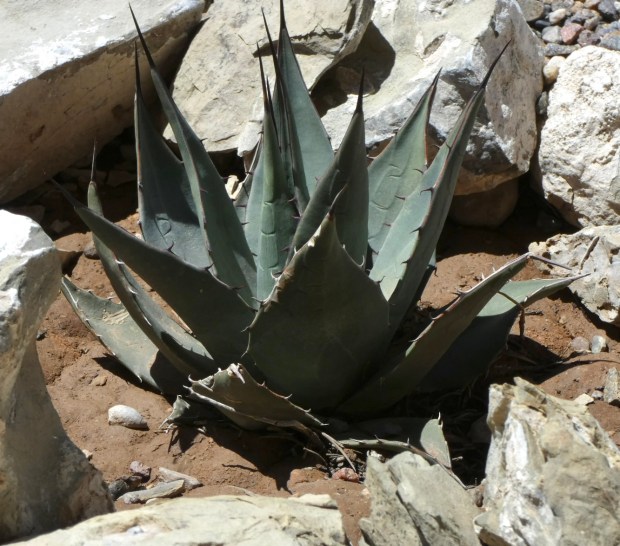
A century plant displaying a beautiful basal rosette.
Where Rosettes Form
Basal Rosettes grow close to the soil at or near the plant’s crown (the thick part of the stem where the roots attach). Their structure is an example of a modified stem in which the internode gaps between the leaves do not expand, ensuring all the leaves stay tightly bunched together and at a similar height. A protective function of a basal rosette makes it hard to pull from the ground; the leaves come away easily while the taproot is left intact (have you ever tried to pull a dandelion without snapping off the root?). Generally speaking, basal rosettes improve a plant’s odds at survival. For example, overwintering rosettes, like the basal leafy growth produced in year #1 of the 2-year life span of giant mullein, protect the plant and its roots from extreme cold temperatures. Emerging Spring rosettes, like those found in long-stemmed poppy, also protect the plant from late winter frosts. Basal rosettes are also more protected from changes in microclimate, gravity, wind, browsing, and mechanical damage if they are closer to the ground than tall leafy stems would be. help in water balance and conservation, especially important during periods of drought.
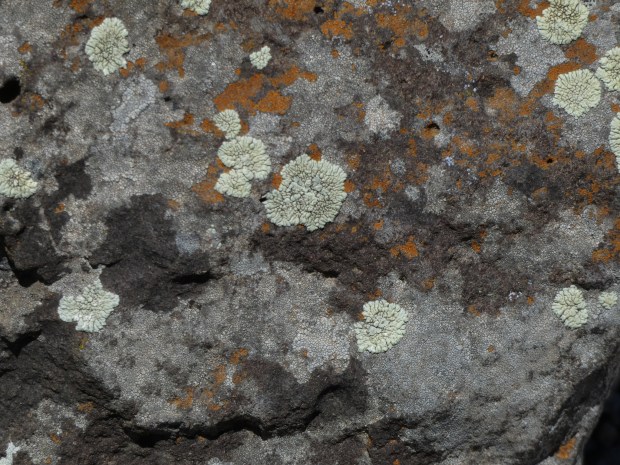
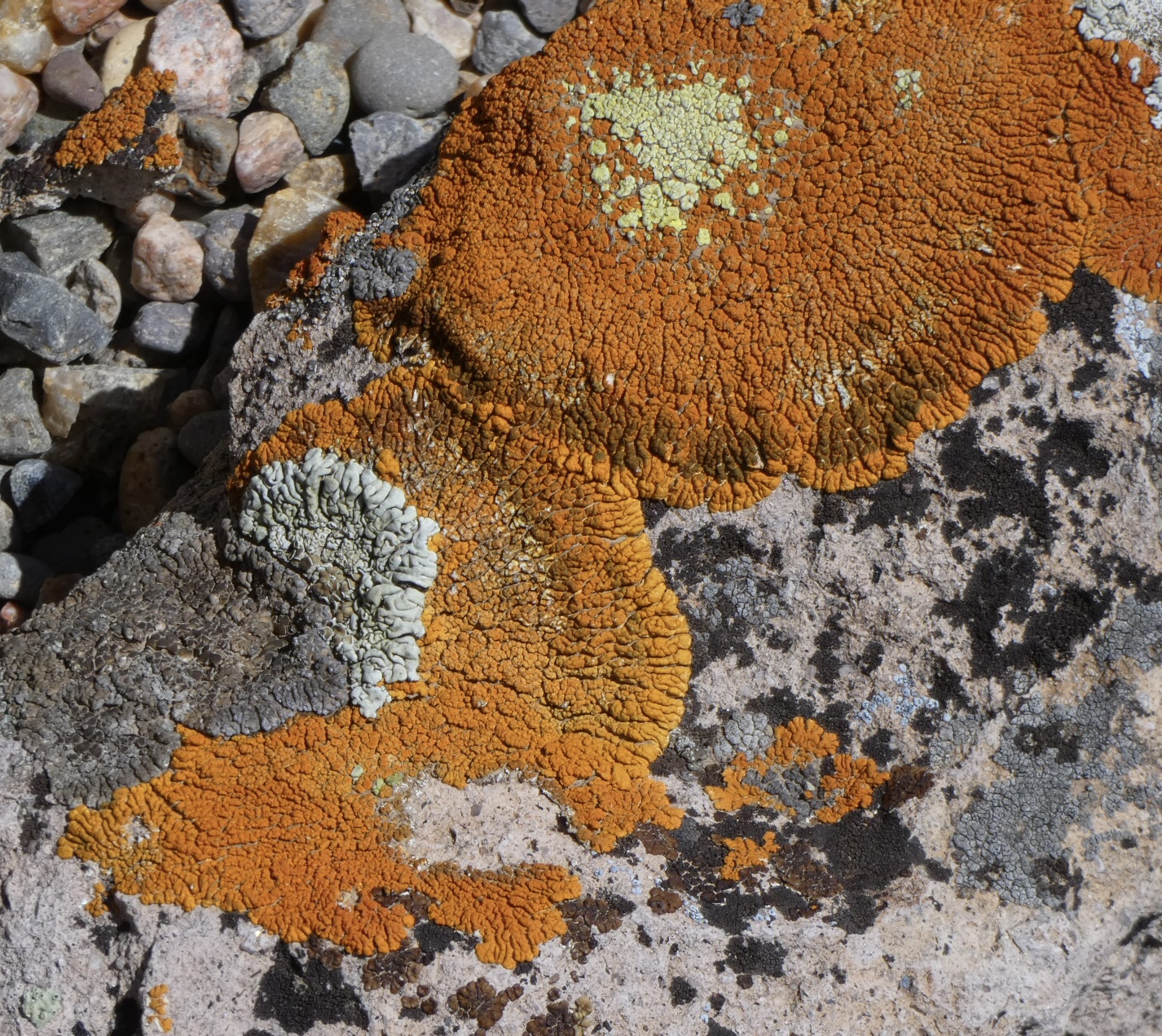
Lichen that has form small rosettes on rock.
But don’t only look down. Another form of rosette occurs when the internodes (those areas between leaves) along a stem are shortened, bringing leaves closer together as in lettuce and some succulents.2. And although not as common as basal rosettes, some plants form rosettes at the terminal or top end of their often naked stems, branches, or even trunks. One plant that does this is the native sedum called wild stonecrop. The top of the plant stems usually terminate in whorls or three fleshy leaves. Another example is the Hawaiian screwpine, which has a terminal rosette of sword-shaped leaves which sits atop an erect trunk, often supported by prop roots.
Know Your Local Rosettes
A number of desirable and undesirable (weedy) plant species produce rosettes, particularly basal rosettes. Being able to identify a species that pops up in the Spring by its rosette is so helpful in preventing a removal mistake by inadvertently digging them up. Many weedy, non-native plants gaze first at their world through rosette “eyes.” But not all plants with rosettes are undesirable. Do you know your local rosettes by their other names?
………………………………………………………………
1Rosettes are found throughout nature, not just in the flowering plants. Here’s some examples you may have seen or heard of:
In bryophytes and algae, a rosette results from the repeated branching of the thallusas grown by plant, resulting in a circular outline. Lichens also grow rosettes.
Tiny wasps and midges can induce the development of galls that become leafy rosettes.
Jaguars, leopards and other feline species display rose-like markings on their fur, referred to as rosettes.
Malaria parasites are known to form spontaneous rosettes in uninfected red blood cells.
Neural rosettes in the human brain are being studied to learn how new cells are born.
It is unknown why the Rosette-Nosed Pygmy chameleon, at home in the mountains of Tanzania, has evolved a distinctive, rosette-shaped, fleshy protrusion on the end of its nose.
The Rosette nebula, named for its rosette-like appearance, is a beautiful collection of gas and dust 5,200 light-years from Earth in the constellation Monoceros the Unicorn, and stretches about 130 light-years across.
A gorgeous lichen decorated rock from Colorado. Note the rosette patterns of growth (the thallus)
2 The horticultural definition of a succulent describes a drought-resistant plant where the leaves, stems, or roots have become fleshy and their tissues are able to store water. Succulents include aloe, euphorbia, sedum, the garden favorite hen-and-chicks, and bromeliads. But horticulturalists do not include cacti in the succulent group. huh? Even though cacti are frequently found in books describing succulents based the definition of a succulent, succulents are not cacti. In agreement with that last statement are many botanical and other scientific experts. (Can this get any more confusing?). So basically some experts are lumpers, while other are splitters. Which are you?
Basal rosette of a yucca in the NM foothills.
P.S. Cacti have stems that are thickened fleshy water-storing structures, and are considered to be a stem-succulent group of plants. Are there any cacti species that develop leafy rosettes? Because the spines are the leaves, greatly modified, in all my rabbit-trailing thru the internet and perusal of my collection of botanical references I’ve yet to see any spines forming whorled/rosette-like patterns. If you have, please contact me immediately!
……………………..……………..😂…………………………………………
Are you ready to explore the wide diversity of rosette forming plants in your neighborhood? Get on out there before those circularly-arranged leaves become disguised by an overabundance of gorgeous wildflowers!
As always, thanks for stopping by! And Happy Earth Day (week)!
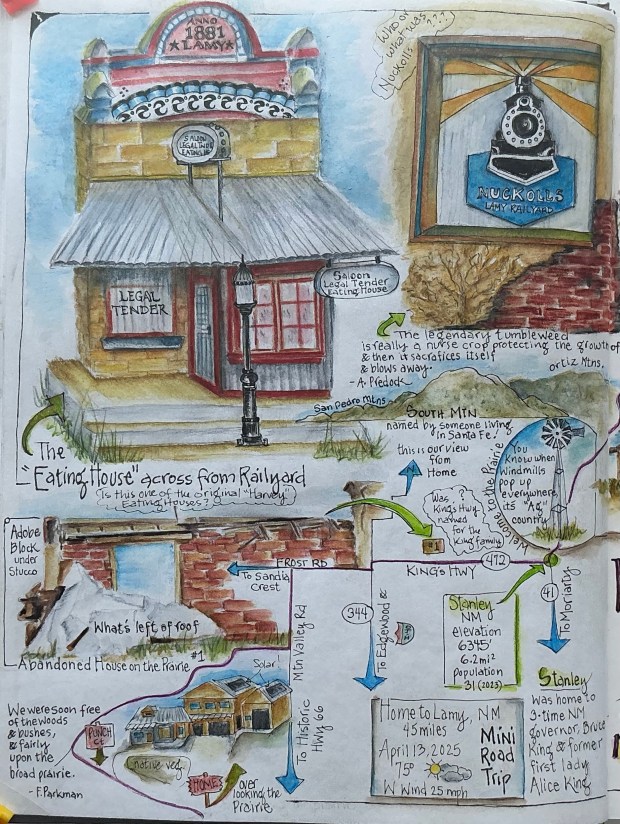
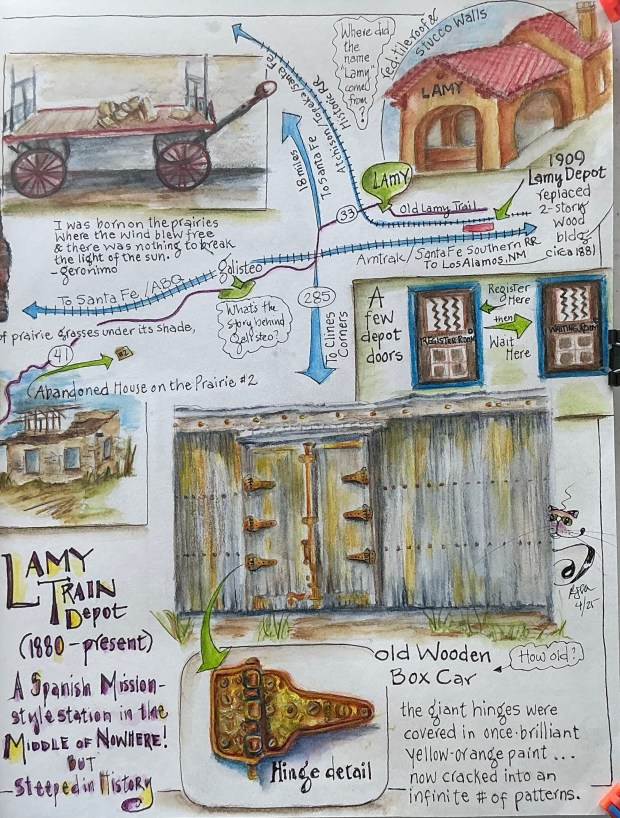
Woke one windy Spring morning about a week ago and decided it was time for a mini roadtrip …. 45 miles NNE, to visit the historic village of Lamy, New Mexico. Years ago (1991) when we lived in El Dorado (a sprawling subdivision southeast of Santa Fe), Lamy was a short 8 mile drive away. As seems true to our nature, we hardly ever visit someplace so close to home. So we didn’t. (Go figure.) But last Fall, the ABQ Urban Sketchers spent a morning exploring and sketching in and around Lamy. Unable to join them then, I promised myself that Roy and I would definitely make our own trip Lamy. So we did ….. and had a great time! Here’s a collection of my sketches and a lot of present day and historic facts about this little railroad community, many discoveries were anticipated; a few were complete surprises!
Lamy, New Mexico, preface: What’s in a Name?
Sometime during the last half of the 19th century, Galisteo Junction was renamed “Lamy” to honor the first archbishop of Santa Fe (1853). Jean-Baptiste Lamy played a major role in the development of the region, including establishment of educational and medical facilities.
Lamy, part 1: Today
….. Location, Location, Location: Such a quaint little village, we found Lamy properly nestled in the foothills of the Sangre de Cristo Mountains, a beautiful range of mountains within the southernmost reach of the Rockies. Primarily a railroad town, Lamy boasted a population of 329 at its peak in the 1930s. Today, Lamy has a mere 93 residents, and continues to experience an annual population decline. With an “Eating House,” Saloon and a Museum, not to mention the historical Train Station, Lamy makes for a fine tourist destination and twice-daily Amtrak stop with shuttle service to and from Santa Fe, only 18 miles away.
….. The Lamy Railroad and History Museum: Dedicated to preserving local history and heritage, this museum emphasizes the railroads and their impact on the area. The museum is housed in the historic “Legal Tender” building, formerly the “Legal Tender Saloon and Restaurant.” But before that, it was the Pflueger General Merchandise Store (built in 1881) and attached Annex Saloon (built in 1884). Because this building complex is quite old, it has been listed on the National Register of Historic Places. If you’re planning a trip to Lamy, note the restaurant and museum are only open Thursday through Sunday, are run as a non-profit, and the waitstaff are volunteers.
Lamy, part 2: The Way-Back Yesteryears
….. Pre-Columbian Inhabitants: An archaeological site known today as The Lamy Junction Community, consists of 14 small Coalition Period1 (AD 1200-1325) pueblos and other structures. Occupying the SE facing slope, northwest and above the Rio Galisteo, the site was discovered by Adolph Bandelier on June 29,1882. Bandelier noted in his journal “a group of small house ruins” west of the depot at Lamy. Excavation of the area began in 1915, resuming in the 1930s and again in August 1981. Archaeologists reported almost all of the pueblos and other structures were similar to each other, having 10-20 rooms each and built of adobe and some stone. The largest structure, however, was probably 60 rooms in size and two or even three stories tall in places.
Today this historic site is located near the junction of US Highway 285 and Santa Fe County Road 33, the dead end spur road that passes through Lamy. The location of these roadways makes sense. Over the last century, or probably longer, Lamy Junction has been a crossroads for several roadbeds that crisscross the site: between Lamy and Galisteo, Lamy and Clines Corners, Galisteo/Clines Corners and Santa Fe. Although the history of these roads and their associated artifacts have yet to be studied, it’s clear from archaeological excavations of The Lamy Junction Community, the disturbance from construction, frequent use, and maintenance of these old roadbeds impacted artifacts from the prehistoric site and surrounding area. Also, when the tracks were laid in the early 1880s for the Atchison, Topeka and Santa Fe Railway, the ideal grade ran within the bed of the Rio Galisteo southeast of the Community. Railroad construction required relocating the river to the east, placing it on the far side of the railroad grade; actions impacting prehistoric artifacts in these areas.
Note to self: Because we came to Lamy to learn about the 1880s train station, I only discovered the area was occupied more than 1800 years ago during my follow-up research into Lamy! Yes ….. we will return and try to find this prehistoric Community, now owned by Santa Fe County.
1Coalition Period (AD 1200-1325) was a time of significant changes in the Pueblo culture of the Rio Grande Valley, which included The Lamy Junction Community of the Galisteo Basin. During this time of increasing population and intensified agriculture, expansion into new areas like the Pecos River Valley occurred. In addition, the growing population began living in larger pueblos.
Lamy, part 3: The Not So Way-Back Yesteryears
….. The Lamy Railroad and Train Station (aka Depot): When plans were made for the Atchison, Topeka, and Santa Fe railroad (aka the “Santa Fe”) to run from Atchison, KS to Santa Fe, NM, and then west to California, civil engineers didn’t take into account the challenging terrain surrounding Santa Fe. A direct run to and stop at Santa Fe was not going to happen. So about 145 years ago the line was built through Lamy. But because rail transport was still desired by Santa Feans, a spur line was built north of the Lamy Railroad Junction that could carry freight and passengers into the city. Now Plan “B” logically placed the train station in Lamy, and in 1881 a two-story wood frame building was constructed for that purpose. For 28 years that structure served as the official train station for the “Santa Fe” until a freight depot was needed. This prompted the construction of a new train station, allowing the original 1881 station to be converted into the much needed freight depot, which was in operation into the 1940s. The new train station, a one-story Mission-style red tile roofed/stucco sided structure, built in 1909, was opened to passengers upon completion. This station is still in operation, and is the one we visited.
Lamy, part 4: Growing a Railroad Town
….. El Ortiz: East of the depot, the famed Fred Harvey Company constructed a hotel named El Ortiz in 1910. Started by English immigrant Fred Harvey in the 1870s, the company that took his name ran a series of highly efficient Eating Houses along the “Santa Fe” rail lines, guaranteeing quick, quality meals. These eateries at set stations were necessary stops because dining cars on passenger trains were uncommon west of the Mississippi. The eateries were so successful, that a partnership was formed between Fred Harvey and the “Santa Fe” to branch out into the hotel business. Many hotels were located in trade and business centers, but other Harvey Houses like El Ortiz were built to develop tourism in Lamy. Hotel El Ortiz no longer exists. After a 1930s fire destroyed partial sections of the building, it was completely brought down in them1940s.
Note to self: when we revisit Lamy, must find the original location of El Ortiz. Is there anything remaining?
….. A secret destination: Lamy was commonly the first stop for staff and their families arriving to New Mexico on their way to the secret city of Los Alamos.
Lamy, part 5: Flashbacks of Yesterday
….. the Santa Fe Detour: Today, Amtrak Southwest Chief passengers headed to the state capital still detrain at the 1909 Lamy Station, where they can read interpretive displays about the past, visit historic buildings and the museum, walk around old train cars and engines, and maybe have a bite to eat at the Legal Tender, before catching the shuttle transporting them the remaining 18 miles to Santa Fe.
Well, that’s about all for now. Hope you enjoyed this virtual tour of Lamy, NM
Many Hearty Thanks, Sharing Creative Ideas, Answering the ‘Kat’ Kwestion
April 1, 2025
Completing my 15th sketchbook, and beginning the next one is always cause for celebration! To do so, Kat and I thought it would be especially fitting to shout-from-the-treetops enthusiastically, THANK YOU! Thank you all, my loyal subscribers, for coming along on my interesting, hopefully educational, sometimes crazy, always curious nature journaling adventure.
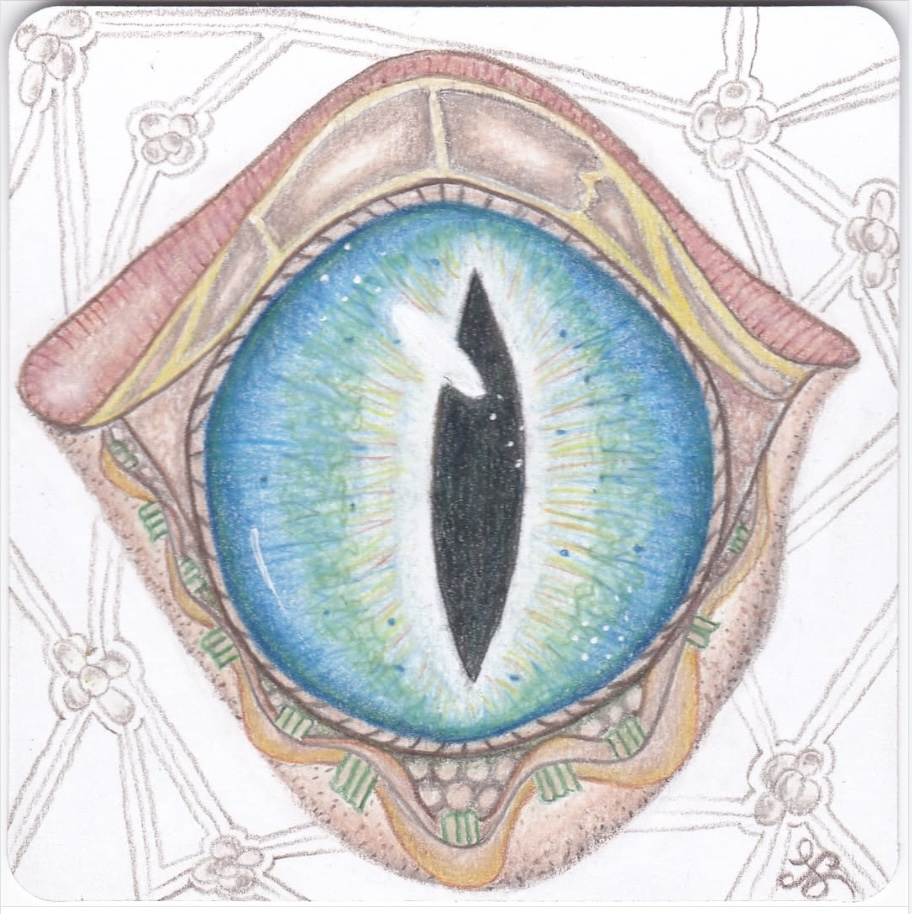
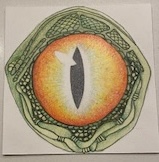
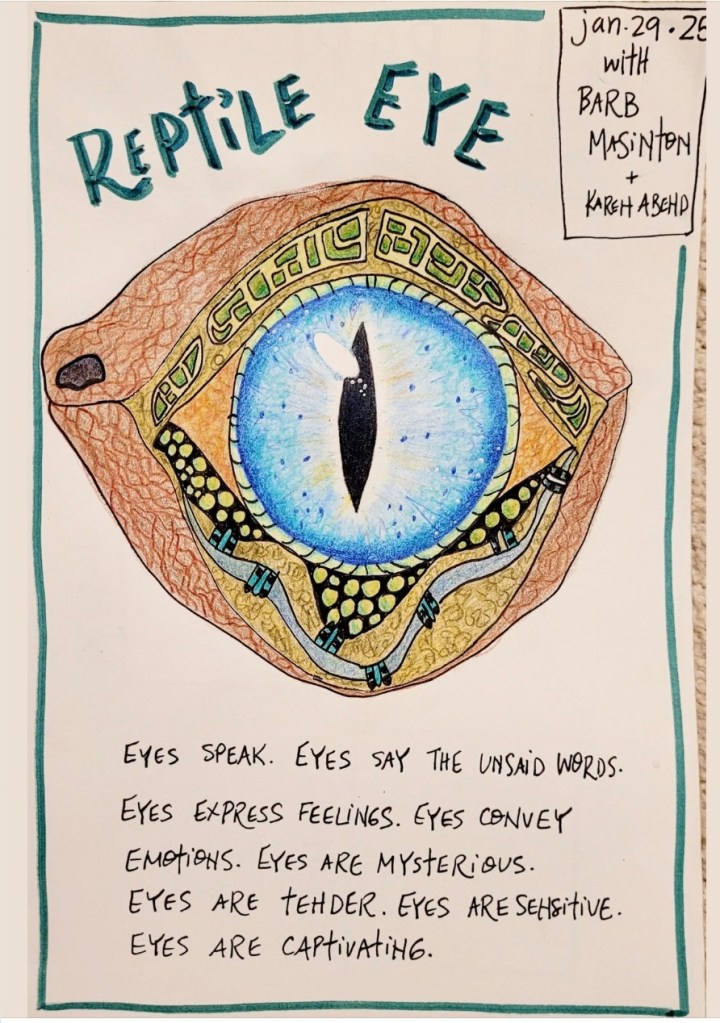
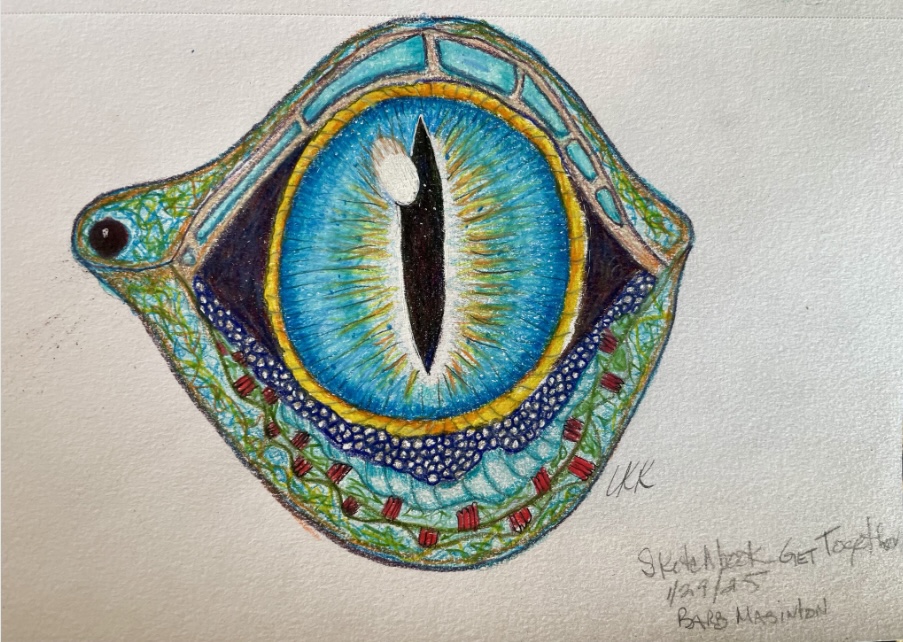
My recent webinar class, “Create a Colorful Reptile Eye1,” sponsored by Host Karen Abend (of Sketchbook Revival fame), generated many new subscribers to my web page and blog, “A Curious Nature.” Wow! And Thanks so much. A special thanks to those who attended the live and/or recorded class. I loved seeing so many colorful lizard eyes (a sampling below). They were incredible!
Sharing the Wonder of Nature
With all the past and current activity on my blog, I feel so fortunate and very encouraged to carry on. Even though new postings have been random lately, there’s lots of works-in-progress soon to be shared. Meanwhile, comments including what you like about my posts and what you’d like to see more of, are always appreciated. What inspired you to subscribe to this blog? If it’s just enjoy, that’s perfect! Or maybe you’d like tips to develop a regular or even a daily creative practice, how can I be more encouraging? I’d love to know if you are an active nature journaler or tangler, or express yourself by creating art in other ways, such as through music, poetry, or storytelling. Send me your ideas by commenting on this or any future posts. I’ve created my webpage and blog because of my insatiable curiosity about the natural world. It’s extraordinarily fun to go beyond learning what the names of flowers, animals, rocks, and clouds are. The excitement of wondering and discovering answers for all the why’s, who’s, when’s, and how’s is so rewarding. Sharing is my joy!
Explaining Kat
Thinking new subscribers may be puzzled by my constantly mentioning Flambé or Kat or both, now might be a good time for explanation and background (and perhaps provide a refresher for those who’ve been following along from day 1 of my blog):
In 2014, a young stray calico cat showed up one day on our doorstep when we (Roy and I) lived in Oriental, North Carolina (U.S.A.). This little wild miss seemed to magically appear from our backyard woods, perhaps in search of a meal or a friend. She sat and meowed for a few minutes, but when we opened the door, she ran away. Efforts to get close to her when she returned several times during the week were futile. Then one day she vanished and never returned. Not knowing what may have happened to this pretty kitty, Roy thought a nice remembrance of her visit would be to add a small cat sketch to my next drawing. A dandy idea!“But only one drawing,” I thought? It was at that moment that Flambé appeared on my creative doorstep, and has never left!
Flambé, aka Kat, is always smiling, popping in and out of all my art, regardless if the piece is imaginatively & whimsically tangled or a serious nature study. Along with forming the best part of my signature “chop,” she’s the heroine of some pretty wild and crazy tangled misadventures, sometimes pushing Kat’s 9-lives threshold to satisfy her insatiably curious nature (and appetite). Flambé adores being noticed, whether she hides inside the story, or shows up front and center. She makes everything creative more fun. Flambé may be just “Kat,” but she’s my inspiration for and reminder about the value of komic relief, and makes the perfect konstant kompanion!
Whew! That’s all for now. Hopefully your questions about this blog, inspiration and Kat have been answered. If you’re craving to learn answers to other related topics, let me know. Meanwhile, Flambé and I wish you an exciting and creative remainder of the year ….. have times full of happiness, creativity, and memorable adventures, but most of all laughter and fun!
Hope to hear from you soon, and as always, thanks for stopping by!
Meow!
1Unfortunately, the class or recording are no longer available for viewing. But I may have another live demo class some day in the future. If so, you can be sure the announcement will show up on my blog.
Every year on March 20th, the International Day of Happiness is celebrated by promoting the idea that part of humanity’s progress should include how to increase happiness and wellbeing. Wow! What a great idea.
Just where did this great idea come from?
The year was 2011. The members of the UN General Assembly collectively brainstormed ideas on how to recognize happiness as a fundamental human goal. From these exciting talks a resolution was born, calling for a more inclusive and balanced approach to economic growth promoting happiness as an essential part of progress.
The following year (2012) the General Assembly held the very first UN Conference on Happiness. From this event another resolution was adopted declaring International Happiness Day be celebrated annually on March 20th.
Inspired to find ways of enhancing human progress through happiness, in 2013 the world celebrated the first ever International Day of Happiness! 😃
The “pursuit of happiness,” a phrase found in the Declaration of Independence, is an ideal upon which America is based. Merriam-Webster defines happiness as having “a sense of well-being, joy, or contentment. When people are successful, or safe, or lucky, they feel happiness.” But reasons for feeling happy vary from person to person. Are you happy when delighted or glad? Do you experience happiness when sipping a cup of good coffee or tea? What about when your dog greets you at the door after a long day, or when your cat purrs in your face …. do these signs of affection make you happy?
Research has shown people feel happy if they have good quality relationships, are passionate about their job and/or hobbies, and by helping others through volunteer work or random acts of kindness. Other factors influencing happiness might include your overall satisfaction with life, your mood at the moment, and your ability to meet basic needs related to health, work, and finances (although having extra money does not necessarily make people happier).
Have you ever considered what things in life make you happy? Do these things just seem to happen randomly or do you intentionally seek out ways to experience happiness? Have you taken the pulse of your happiness meter lately?
When there are large numbers of happy people, it can make communities and even entire countries happier places to live. Some of the happiest countries in the world include Finland, Denmark, Norway, and Iceland. Switzerland, New Zealand, Canada, and Australia also rank in the top 10 for the happiest countries. The United States ranked 19th.
Prismacolor pencil colors used: white, cream, yellowed-orange, goldenrod, crimson lake, dahlia purple, mulberry, violet, violet blue, non-photo blue, true blue, peacock blue, apple green, peacock green. Inking created with Sakura Pigma Micron archival ink pen, size 01.
Looking for ways to observe this year’s International Day of Happiness?
If the daily grind, never ending politics, or hearing about or even experiencing one natural disaster after another have got you down, I know the feeling. It’s high time to regain control of our inner selves and set free the happiness within. It may not be easy, but what better day to take on this challenge than March 20th, the official International Day of Happiness!
How to start? There’s probably as many ways to promote, create and achieve happiness as there are people in this world. If you already know what to do, great! But if you’re seeking ways to become a happier person and share your happiness with others, here’s some ideas I thought make good sense:
To become a happier you: Be kind to yourself, not overly self-critical or perfectionistic. Really savor your life experiences because this will intensify and prolong their enjoyment. Set meaningful goals for yourself that provide structure and purpose, give a sense of identity and increase self-esteem. Seek healthy challenges, stretching your abilities just a bit beyond your comfort zone to realize your potential. Build intrinsic motivation, rather than just relying upon doing things to please others. (‘Intrinsic motivation’ refers to the drive to engage in activities that are inherently interesting or enjoyable without external incentives or rewards.) Practice gratitude. Appreciate and make note of all the ‘ups’ (the good things) in your life rather than focusing only on the ‘downs’ or what you still desire. Be a problem-solver; avoid the temptation to vent, complain and reinforce negativity; instead, cultivate optimism and practice positivity regardless of circumstances. And last but not least, engage in random acts of kindness.
To promote happiness in others: Take time to build and improve the quality of relationships with supportive people. Respond actively and constructively, celebrating when others share good news. Listen to others with 100% of your attention. Practice mindfulness, compassion and empathy. Maybe you can volunteer or help someone in need. And this is worth repeating ….. Take time to engage in random acts of kindness.
*************************************
For far too long, progress in the world has been all about the economy. But more people are realizing that happiness is also an essential part of progress. And come to find out, Flambé agrees! Especially when she can improve her relationships with the birds, bunnies, fish and frogs. Now if I can only teach her to sing instead of all that katter-walling she seems so fond of! Guess I’d better brush up on my constructive criticism? Hahahaha-Lalalalalalala-Hahahahaha!
Whatever you do on this day (and into the future), be sure to spread the happiness!
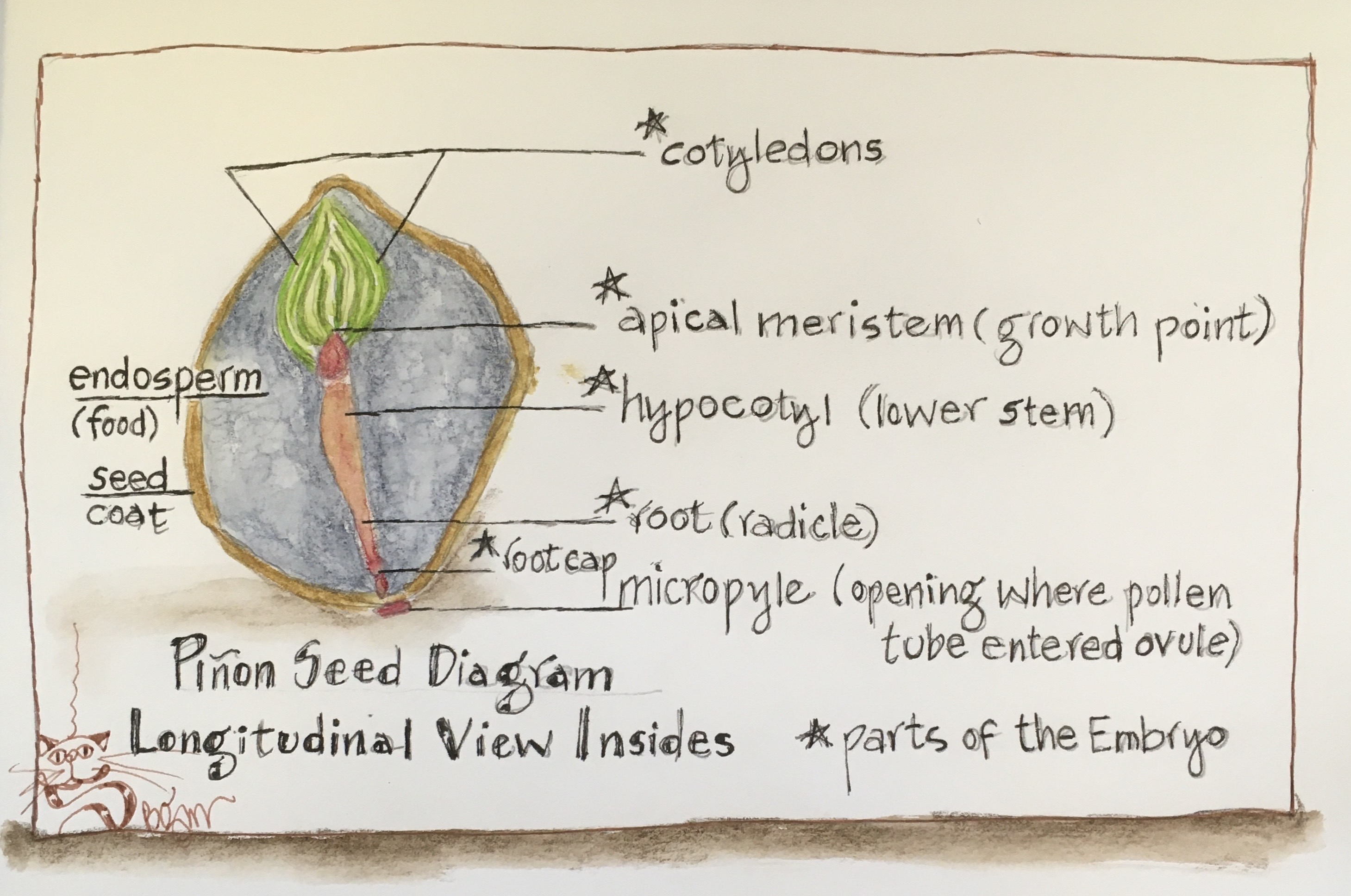
Give a seed the right conditions ……. enough water, sunlight, the perfect temperature ….. and this small package cannot resist emerging from its protective coat to grow into a full grown plant.
Seeds are tiny marvels of nature.
Looking inside the seed reveals a miniature pine tree!
Think about it ……. a seed is really a living baby plant (the embryo) surrounded by a cozy blanket (the endosperm) that cradles and nourishes the embryo while tucked inside the seed coat. When the coat unzips, freeing the “baby” as it begins to grow, it continues to be nourished by the endosperm until the first true leaves appear. Witnessing the process is so cool!
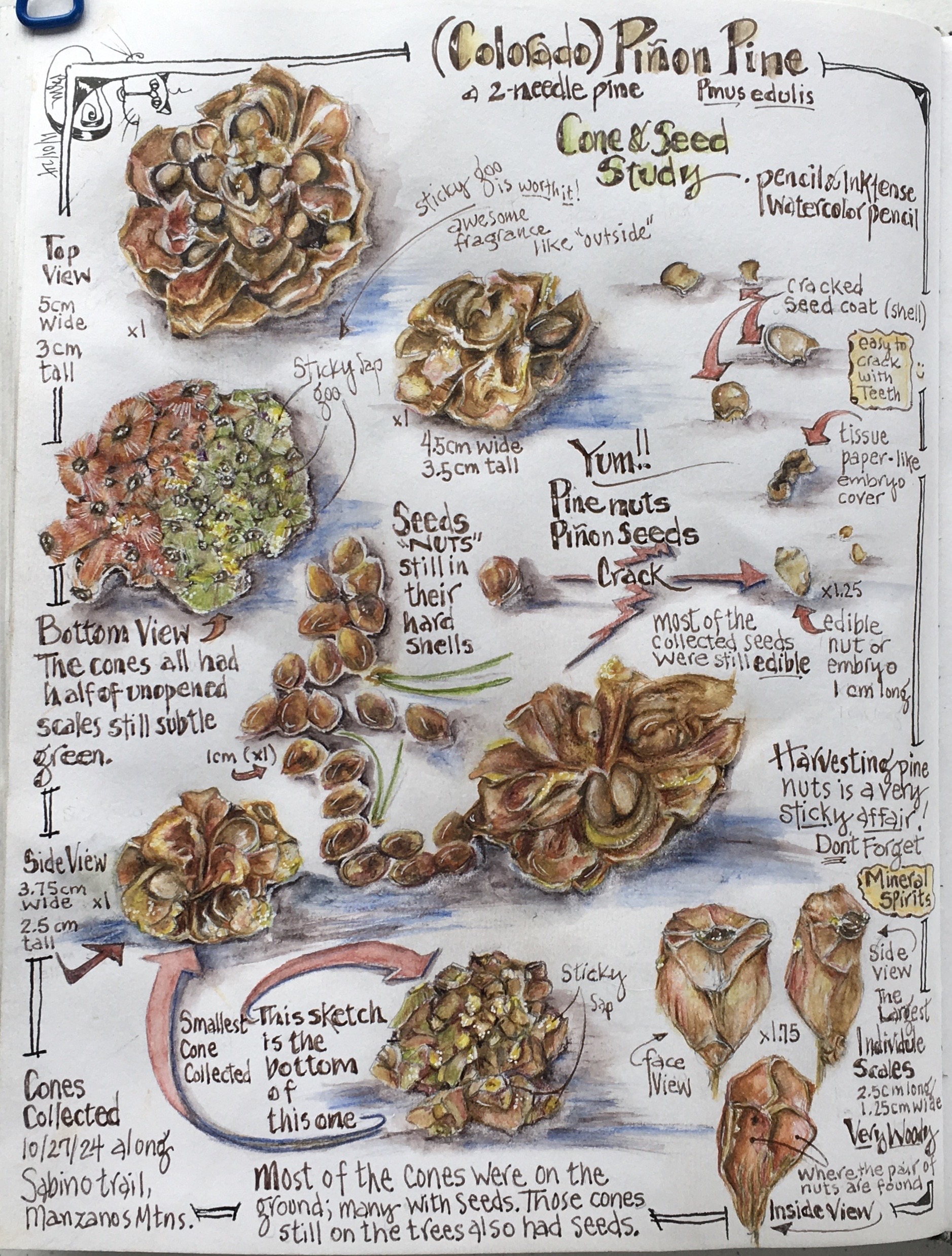
After collecting piñon seeds from last November’s foraging expedition, (Piñon or Pinyon, Piñon Seed or Pine Nut), we decided to treat a dozen or so to conditions just right to stimulate germination. But first the seeds required a short period of stratification (moisture) to help soften and crack the seed coats. Introducing moisture was done by lining a clear glass jar with damp paper towels and placing the seeds between the towels and glass to watch the action.
Post from November 2024 Seed Foraging Expedition
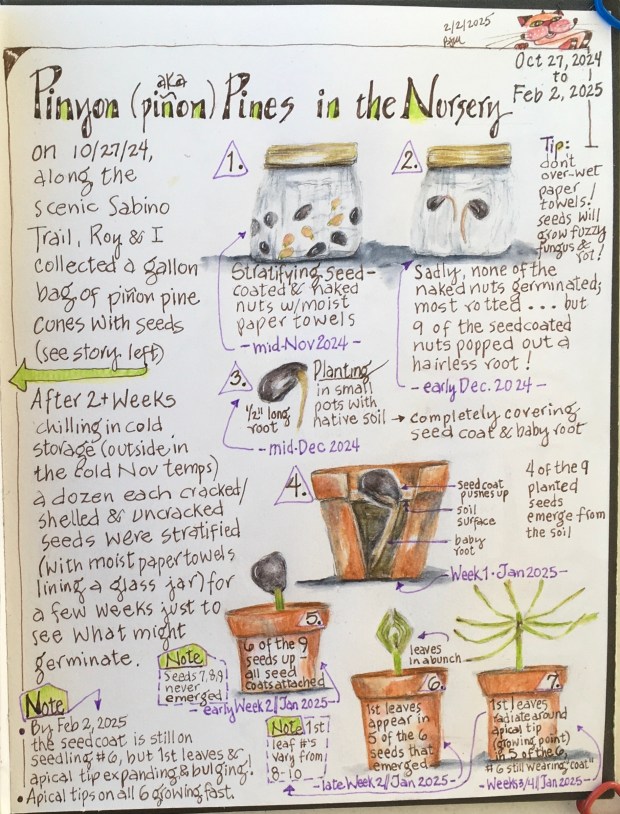
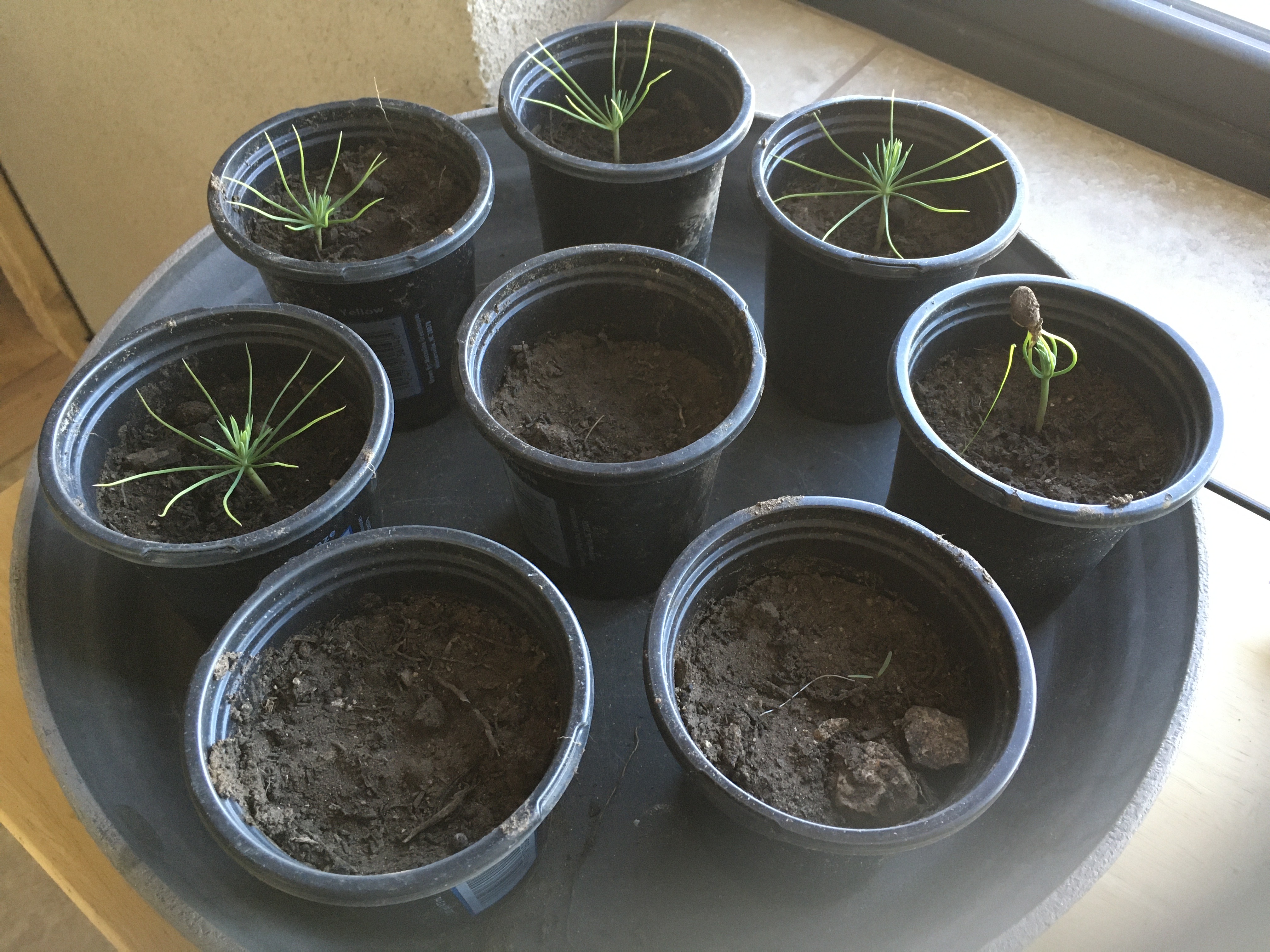
Soon embryonic roots (the radicles) successfully cracked the seed coats of nine seeds and began growing downward, as roots tend to do. In a week or so, before the embryonic leaves (cotyledons) appeared, all of the germinating embryos were planted. Six of the nine then sprouted their whorled cotyledons, followed by a growth spurt of the first true leaves, initiating the process of food manufacturing (photosynthesis).
Steps to Germination
All of the germination and seedling development details of these piñon seeds, to date, can be found in my update illustrations.
Seed germination is a fascinating process, and like the seed itself, is also a marvel of nature. Have you ever tried to germinate a seed? If not, give it a go. It’s fun, educational, and imagination provoking ….. from such a small seed comes a full-grown flowering plant!
Wandering about the neighborhood one warm summer morning in 2018, I noticed a dense stand of plants lining a 20 foot section of road. What caught my eye were the umbrella-like clusters of pearly white flowers topping each slender stem. From a distance these plants resembled our native white-flowering yarrow. But I soon realized the narrow dark green leaves were not fuzzy; the tiny exotic-looking flowers were not daisy shaped. Unmistakably, this plant was a species of milkweed! And the flowers of more than 50 individual plants in this population were a-flutter and a-buzz and a-crawling with hungry insects!
What was this milkweed species?
This is the Winter Botany portion of this post. All that remains of last summer’s Horsetail Milkweed are stems and mostly empty seed pods clinging to short branches. But some of the seed pods still hold silky tailed seeds clinging to their open pods. Hundreds of seed pods line the roadways in our neighborhood.
It didn’t take long to confirm this plant as Horsetail Milkweed (Asclepiassubverticillata), a species commonly found along roadsides in pinyon-juniper woodlands. Knowing what to look for on future walks, over the next several years I was excited to find 30+ more populations of various sizes along neighborhood roadways! From 2018 until early summer 2024, I continued to monitor these seemingly abundant populations. The small numbers of seeds I collected in the Fall were planted in our yard, and every year I checked for the presence, variety and numbers of insects busy feeding on nectar as they pollinated the flowers.
During June 2024, when we moved only a few miles to the northeast, I was happy to see Horsetail Milkweed grew abundantly in our new subdivision. This prompted me to dig deeper into researching this species. Its been exciting to discover how important this milkweed is to native insects, including monarch and queen butterflies.
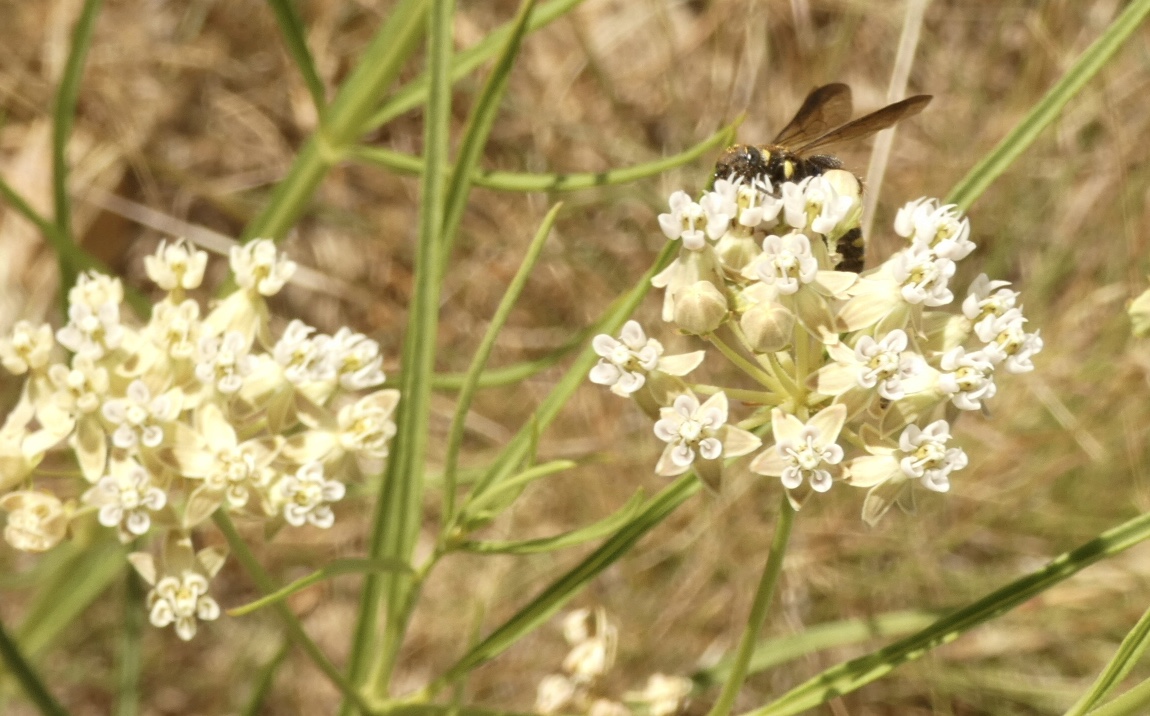
Photo (mine) taken in July 2022 of a blooming Horsetail Milkweed being enjoyed by a feeding wasp.
According to pollination ecologists, Horsetail Milkweed is especially valuable to large numbers of native bees. This plant species also supports conservation biological control by attracting predatory or parasitoid insects that prey upon pest insects.
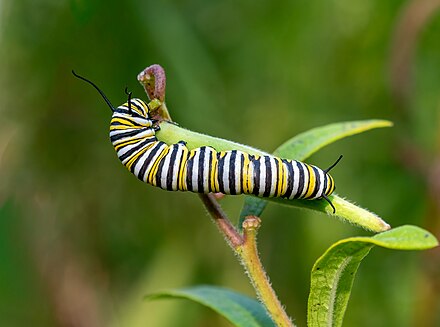
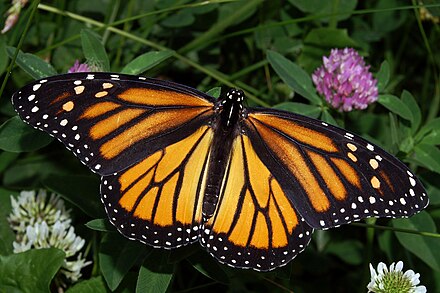
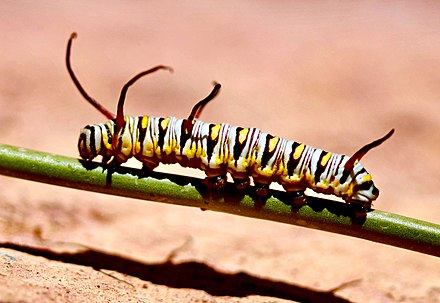
And Horsetail Milkweed is one of the favorite host plants for monarch and queen butterflies, all because it’s toxic! Producing an especially nasty tasting and potent neurotoxin strong enough to kill livestock, the caterpillars of these two butterflies have evolved to benefit from such a poisonous substance. Voraciously ingesting a diet of only milkweed leaves, obviously tasty to the larvae, makes them unpalatable to would-be predators, such as birds. The toxin from milkweed leaves has become their primary means of defense; definitely a benefit for such chubby, slow little caterpillars.
Monarch caterpillar (source: open commons)
Although central New Mexico isn’t in any of the major migratory routes of these butterflies, I have observed both species in our previous neighborhood. Since learning more about Horsetail Milkweed and it’s favored roadside habitat close to home, my hope is to provide actively growing plants throughout the summer (a safe distance away from roadside easements) for both the monarch and queen adult butterflies and their caterpillars ……. especially important when governing covenants of our previous and new subdivisions require the roadways be groomed (mowed down like a butch haircut!) on a monthly basis by subdivision landscape crews.
Because milkweeds are among my favorite of all plant species, mainly due to their complex flowers and the clever trickery they’ve developed to ensure pollination, I wrote about and illustrated two in-depth blog posts on this subject. Believe me when I say, “It’s overboard fascinating!”
Summer Botany: Meet the Milkweeds from July 2022. This is my first comprehensive look at milkweed flower structure, how pollination takes place, and the genus Asclepias.
Read on to learn more botanical information about Horsetail Milkweed AND how to find out if you live in Spring and/or the Fall Migration routes of the monarch butterfly AND where queen butterflies migrate to and from.
Characteristics and habitat requirements of Horsetail Milkweed
Horsetail Milkweed is a perennial species with a stout, woody rootstock. Plants readily spread by rhizomes (underground stems) producing dense communities. Cold-hardy to at least 0℉, this milkweed bounces right back in the Spring. Plants are also drought-tolerant once established, thriving in well-drained, sandy soil under full to partial sun.
Able to thrive in a variety of habitats and plant communities from 2500 – 8000 feet in elevation, Horsetail Milkweed grows among grasses, on sandy or rocky flats, on slopes, roadsides, and along trails in Chaparral, Semidesert Grasslands, Pinyon-Juniper Woodlands, Montane Conifer Forests, and in disturbed areas.
All of these characteristics and its adaptability to a wide range of habitats make Horsetail Milkweed one of the easiest milkweed species to grow.
Monarch butterfly (source: open commons)
Monarch Butterfly
To learn if you live within the path of or close to spring and/or fall monarch butterfly migration routes, you can view a map or these route here:
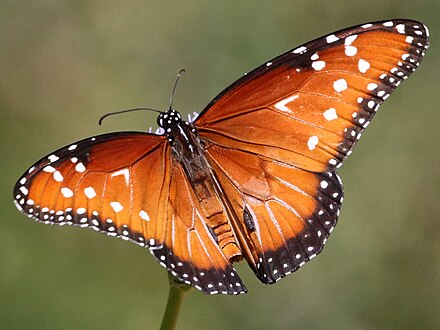
The queen is chiefly a tropical species. In the US, it is usually confined to the southern portion of the country. It can be found regularly in peninsular Florida and southern Georgia, as well as in the southern portions of Texas, New Mexico, Arizona, and California. Occasionally, the subspecies of the queen can be found somewhat north, in Kansas, Colorado and Utah.
Queen butterflies do not migrate as dramatically as monarch butterflies, but they do move short distances in tropical regions with dry seasons to higher elevations.
Date: January 29, 2025 ….. Time: 10:00 am Mountain Standard Time
January 23, 2025
Yes! You read that right. In less than a week I will be sharing my colored pencil secrets for creating a glowing, jump-off-the-page, reptile eye. During a live 2 hour workshop, hosted by Karen Abend – founder of Sketchbook Revival – you’ll be drawing along with me while learning colored pencil techniques and some cool facts about reptile eyes. But to play along you must register to join the fun.

















 a curious nature