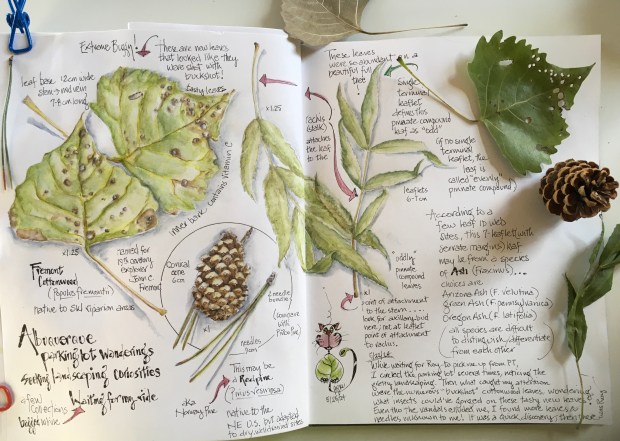
Oops! I was caught without my sketchbook ….. but that didn’t prevent me from making a few interesting collections while waiting for a ride.
My curiosity unleashed, I began by wondering what voracious insect(s) tried to eat 1000x their weight in fresh cottonwood leaves. Then I noticed a very lovely leafy tree growing next to a stately pine, both of which were mysteries to me.
So I spent this afternoon sketching, painting, and looking over ID and reference materials, as much fun as collecting my three parking lot treasures!
If you find yourself “waiting,” how do you pass the time?
After a longer than planned for blog break, I’m glad to be back and sharing a few pages from my nature journal. Beginning in April, the riot of wildflowers popping up everywhere has, and still keeps me scurrying about my backyard, the “back 40,” and local hiking trails just to refresh my memory about familiar plant species while searching for new discoveries. I’ve been sketching daily, learning about new-to-me plants, and growing my knowledge about favorites.
Recording first seasonal sightings, it’s interesting to compare previous years’ emergence and abundance, and wonder why timings vary. For example, last year the white-stemmed evening primrose (Oenotheraalbicaulis) blanketed the hillsides with white; this year those beautiful white blooms have been scarce. Last year the tall crowded flower stems of White Point-Vetch (Oxytropis sericea) were few and far between. This year an explosion of these graceful plants that belong in the pea family (Fabaceae) began blooming in April and are still going strong!
White Point-Vetch, also called white locoweed, whitepoint crazyweed, and silky crazyweed, makes a striking bouquet that glows like a bright light as it blooms along tall flower stalks 15+ inches above bare brown ground. New stems push up through multiple dried stems packed with last year’s empty seedpods. But it’s obvious this species is an aggressive re-seeder; there are so many new plants this year where last year there were none!
It’s been a spectacular show!
Enjoying researching this species, dissecting a few fresh flowers, and searching for remnant seeds in the dried pods, kept me delving deep into the bits and pieces of what defines this group of plants. This large family, which houses well over 10,000 species world-wide, includes peas, acacias, mimosas, and licorice (see the list below for more residents).
The dried stem was drawn and shaded in graphite.
But one species at a time, please! Actually the locoweeds, which fall into the genera Oxytropis (like the White Point-Vetch) and Astragalus, contain over 600 species world-wide, 21 of which grow in the U.S. Many plants in these two genera are toxic, particularly to domestic ungulates. More about the toxin and what happens when these animals ingest even small quantities, along with other interesting facts are described on my two journal pages. ……
There is so much more to learn about this important family of plants, but I’ll save that for another post.
Thanks for stopping by and have a safe and happy Memorial Day weekend!
Thanks for stopping by …… have a safe and happy Happy Memorial Day!
It’s Spring in my neighborhood, and not a day too soon!! Along with gusty winds carrying clouds of yellow pollen come drifts of an outrageously bright yellow ‘sunflower’ named Perky Sue.
How Perky Sue got its common name is a mystery. My best guess is this herbaceous forb, native to New Mexico, has to be the Perky-est, Happiest Spring Flower, Ever!
What is your favorite native flower signaling the arrival of Spring in your world? Does its bloom cause you to smile; perhaps you break out in your happy dance?
Thanks for stopping by …… and Happy Mother’s Day to all!
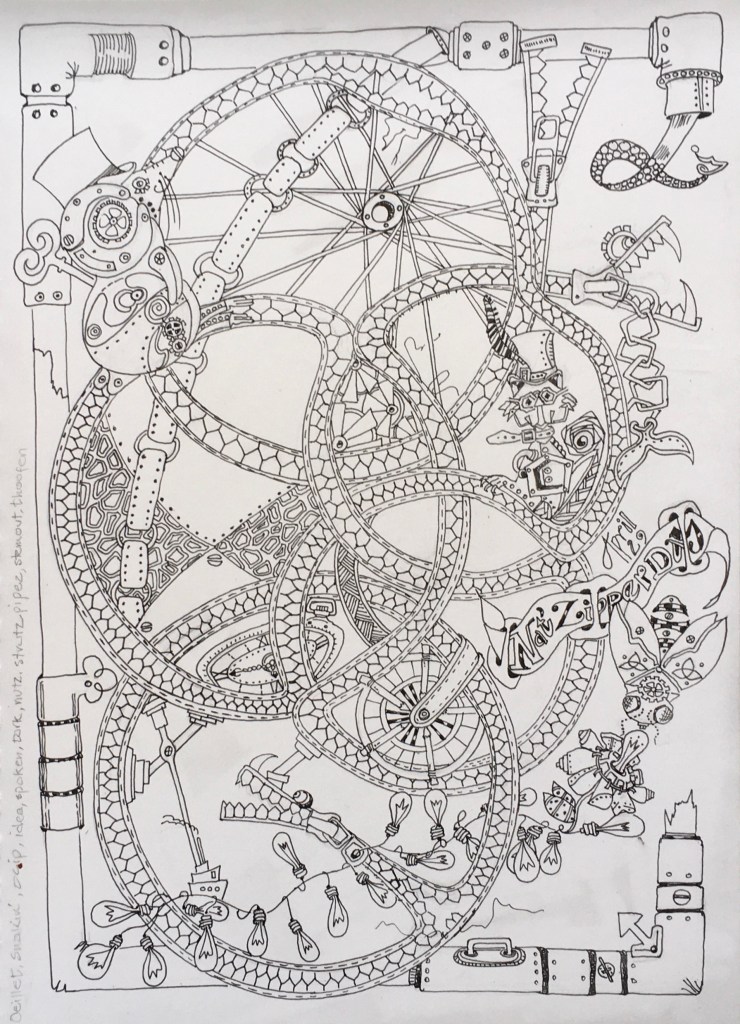
While you’re having fun (or going crazy) chasing Flambé’s maze of zippers, here’s some very cool facts about the world’s largest Zipper manufacturer ….. YKK.
The initials YKK stand for Yoshida Kōgyō Kabushiki (Kabushibibaisha), a Japanese business that owns the most popular zipper brand in the world. Because of its cutting-edge technology and reliable materials, YKK continues to dominate the fastener market worldwide.
Today, YKK produces more than 50% of zips worldwide. Zips may be easy to make; they may have not seen much innovation in the last fifty years, and they may be simple but (so far) no other zipper company can compete against the YKK monopoly.
YKK, founded in 1934, manufactures and produces about 10 billion zippers a year. The YKK Group consists of two main operations – 1) the fastening business, and 2) the architectural products business. The fastening business, includes zippers made for the apparel industry, comprises about 40% of its global business. The architectural products business, includes products for windows, doors, curtain walls, and even bridges and ocean clean-up products for the oil and gas industry, comprises the other 60%.
The largest zipper factory in the world! The YKK factory in Macon, Georgia has earned that label. This mega factory boasts 14 modern plants and over 900 employees, producing 7 million zippers a day. These zips, which come in more than 427 standard colors, total over 1,500 styles including a luxury style called Excella, where all of the parts are highly polished!
What’s so special about YKK Zippers? They are amazing in their ability to self-lubricate the more you use them. Have you ever had a zipper that becomes sticky and gritty over time? If you check the brand on the pull, it will always be some lesser make of zipper. “Sticky and gritty” are nasty characteristics experienced with a YKK. As a matter of fact, the YKK brand zips up and down more smoothly the more you use them!
After learning a bit about YKK (my curiosity at last satisfied), I immediately ran around to all of our closets checking for the brand …….. hey, they’re all YKK! Now it’s your turn …… Check your zipper pull tabs! Are they YKK? I’ll anxiously await your full report!
On and on and up and down! Because I put so much detail and time into my Steampunked Zentangle tangle, I was going to make Flambé’s post to commemorate National Zipper Day short and sweet. But because there’s so much information about Zippers, my fascination grew exponentially, much like my Zipper maze!
Line work before color.
Hope you enjoy this abbreviated overview about Zippers! If you’re heading outdoors to ponder this fascinating technology, don’t forget to Zip Up!
After years of on-line and email chats, I was delighted when my friend Robin Atkins decided it was finally time we met in person! Bravo!
Robin and her travel buddy Lunnette, drove over 1,800 miles to Tucson to teach a Spirit Doll class to a local beading group. Then after spending 5+ days exploring Tucson and before driving home to Friday Harbor on San Juan Island, WA, they took a “short” scenic 450 mile detour …… to Tijeras, NM. This out-of-the way drive would bring them to our doorstep, and our first face-to-face meeting! While in Tijeras, we were able to spend an evening and full day getting to know each other and spent time hiking, nature sketching, and sharing each other’s art.
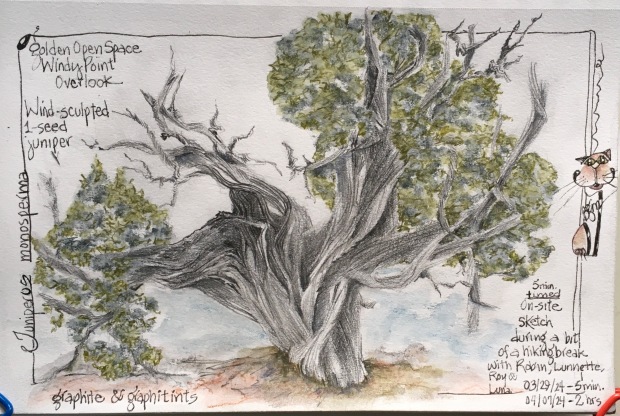
Robin snapped this photo of me sketching out at Golden Open Space. The beautiful wind sculpted juniper trees growing along the precipices of the windy observation areas are absolutely captivating (and tough). Luna thinks they’re tasty!
Meet Robin
Robin, whom I’ve always thought of as an “extreme creative,” is a fascinating, energetic, curious, passionate and bright-eyed adventurer in her early 80s. Her many interests and skills, in addition to creating uniquely designed, hand sewn and beaded Spirit Dolls, include: quilting (many with bead embellishments), thread embroidery, book making, watercolor painting, Zentangle art, nature journaling, making decorative papers, poetry, weaving, collage, crochet, felting and book author. And she shares her skills and techniques by teaching.
This isn’t an exhaustive list by any means! As someone who seems to thrive on learning and developing new skills, Robin never stops seeking artistic challenges to take on.
Check out Robin’s beautiful webpage and blog (http://robinatkins.com) where you can find photos and posts highlighting her current and past creative projects.
A Short-but-Sweet Visit
We had a wonderful time getting to know each other, and what a delight to have also met Robin’s long-time friend and travel buddy, Lunnette. A retired firefighter in her mid 70s, Lunnette is also a nature journaler, calligrapher, quilter, and according to Robin, “she’s a terrific navigator, who always uses her keen sense of direction and map reading skills to keep us on the “right road,” (in both the literal and figurative sense).”
This is my finished graphite drawing of the twisted juniper I spent 5 minutes sketching.
Parting company was hard, but Robin and Lunnette needed to return home. Along their route they visited both Mesa Verde National Park and Arches National Park, soaking in more of the desert southwest sun and culture before taking on the 1,200 mile journey for Friday Harbor.
My notes taken and sketches/watercolor paintings created during the workshop
April 6, 2024
Each Spring, Winslow Art Center of Seattle organizes and hosts their Spring Fling! For four days, back-to-back live Zoom workshops are offered, featuring artists skilled in a wide range of media. Each workshop is free, a full hour long, and may include talks, demos, or a work-along. And all of the workshops are recorded for unlimited playback in case you miss one or all of the live sessions or want to watch one or more over and over again!
Each workshop is fascinating; there’s always something new to learn from all of the professional artists. But one work-along session presented by artist, educator and naturalist, Jean Mackay, I look forward to with exuberant excitement! Jean has been actively observing, illustrating and sharing, through her blog, stunning watercolor paintings of her daily encounters with nature for the past 20 years. Jean’s knowledge of wildlife and the many wonders found in nature are reflected in her illustrations. But there’s more! She always provides helpful tips and techniques pertinent to the development of her pages. For Spring Fling! 2024, Jean’s workshop was all about creating realistic looking bird eggs. I’m not sure how she managed to cover so much material in a very short hour, but she did. Beginning with a bit of bird egg natural history (just enough to whet the appetite for more), Jean jumped right in by describing 3 basic techniques for sketching egg shapes. Defining edges, shadowing, coloring and marking eggs came next, and before I knew it, time was up!
Somehow during the excellent, well organized presentation, I felt compelled to try a sketch of my favorite nature journaler, Jean Mackay. Perhaps not as good as my eggs turned out, but a pretty recognizable likeness, even if I do say so myself!
Thank you so much Jean! Every minute was a joy!
You too can follow Jean’s artistic journey! Check out her webpage and subscribe to her blog at: http://www.jeanmackayart.com
And if you’d like to give egg painting a try, for free, the Winslow Art Center’s webpage at: http://www.winslowartcenter.com
National Crayon Day is a day dedicated to celebrating the beloved colorful drawing tool. Observed annually on March 31st, it encourages people of all ages to embrace their creativity and express themselves through art using crayons.
So much history ….. So much enjoyment!
But where to begin? Because I’ve posted about crayons in the past and didn’t wish to repeat myself (too much) … I dug deeper this time and learned something new … there’s a “place” called The Crayola® Hall of Fame!
Since 1904, when cousins Edwin Binney and C. Harold Smith sold their first box of 8 “Gold Medal” Crayola® crayons, colors have come and gone. There’s been an assortment of reasons for changing out colors such as unpopularity, social, racial or politically incorrect names, or discovery of a new pigment. The fate of colors also varies:
they may be renamed to better represent current trends or social acceptability (e.g. the color Chestnut replaced Indian Red and Peach is now the new name for Flesh),
they may be temporarily discontinued to make way for a new promotion or contest (e.g. plain colors have made way for a naming contest for sparkly or neon colors),
they may be permanently retired (e.g. Dandelion lost out to Bluetiful, to introduce the latest pigment discovery of blue)
And once a color is discontinued or retired (even temporarily) gaps are left in the box where each color lived, whether that be the small box of 8 Crayola crayons, all the way up to the box of 120!
One of my many rainbow-colored rabbit trails led me down the path to The Crayola Hall of Fame. I had no idea! Apparently there is such a place, established in 1990, populated with crayon colors that have been retired as far back as 1910. Most of these colors are now permanent residents in Easton, PA, where The Crayola Hall of Fame is located. There they are (re)learning the joys of coloring outside the lines, golf cart decorating, and marathon rolling. But some of the retired colors, having a taste of the easy life, have decided to rejoin the active ranks of worker-writers, painters, and scribblers, as re-employed annuitants.
The Short but Brilliant Story of Dandelion
Doesn’t look like annuitant status will happen any time soon for the self-retired, extremely happy-cheerful and brilliantly radiant Dandelion yellow Crayola. From 1990 through 2017, a short 27-year blip on the Crayola history timeline, Dandelion was the color lighting up the boxes of 24+. But when he heard a gorgeous new blue hue had been discovered, Dandelion graciously checked into The Crayola Hall of Fame allowing the exciting new Bluetiful to take center stage! What a guy!
Being honored with permanent residency in The Crayola Hall of Fame also means the retired color has gone out of production permanently. How lucky to have found two brand new, never before used Dandelions in my stash of crayons! And a single Dandelion is worth as much as $20!
$20 is also the value of each of the four recently retired (2003) Crayola crayons: Magic Mint, Mulberry, Teal Blue, and Blizzard Blue. I also own these four colors! You can do the math, but instead of cashing in on any of the 5 colors in my possession, I’ve decided to keep them, then created this floral page using only these colors for my post, showing off their beauty in celebration of this year’s ………………………………..
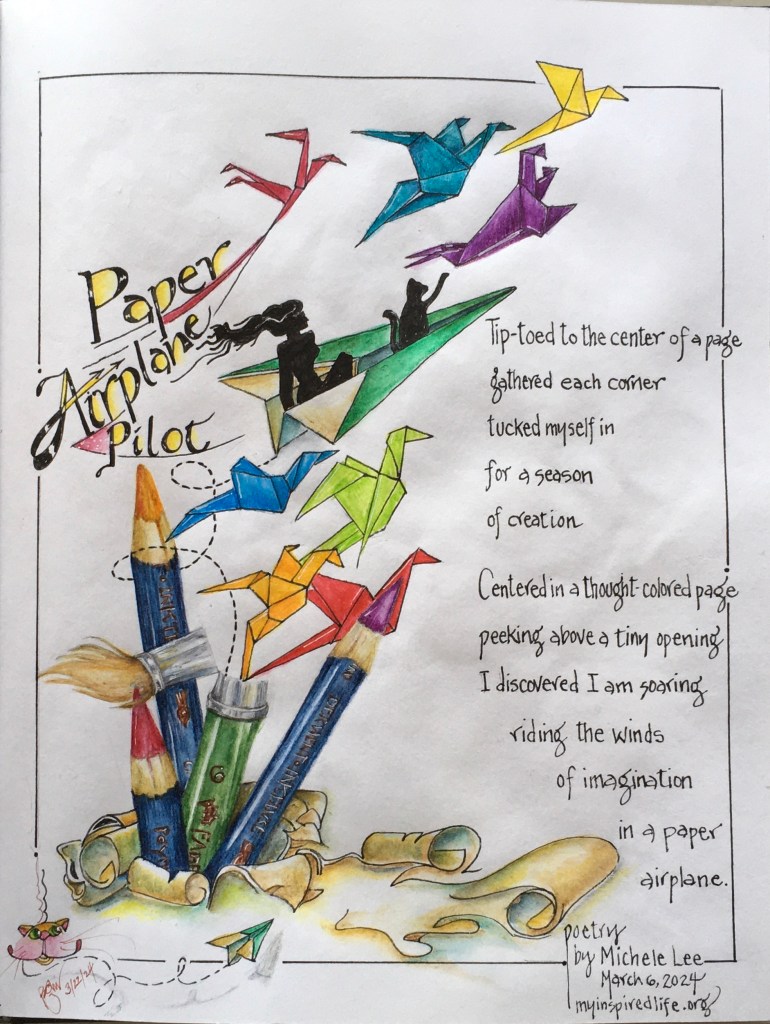
Reading this poem not only gave me the “lift” I was seeking on a dreary winter day…….. it was clear I wanted to design an illustration to further heighten the “lift” in anticipation of Spring and the new season of imaginative creation that was fast approaching!
Thanks to Michele Lee for allowing me permission to reprint her wonderful poem, Paper Airplane Pilot (March 6, 2024). Michele is a talented and prolific writer of poetry and prose, and a published author who lives in the heart of the Sonoran Desert. I look forward to her almost daily posts featuring something new and inspired on her widely-followed blog.
If you enjoyed Paper Airplane Pilot, your sure to enjoy her regular posts by becoming a subscriber to her blog, myinspiredlife.org
There are a number of different woodpecker and closely related species (sapsuckers and flickers) that frequent our Piñon-Juniper woodlands in the East Mountains of central New Mexico. These include the downy, hairy, Lewis’s, red-naped, Northern flicker, and Williamson’s sapsucker. They are always such a joy to observe, unless they’re drilling a hole in the side of the house. Their stiff tails allow them to ‘walk’ up and down tree trunks and other vertical surfaces that house insects or exude sticky sap. Their sharp bills are ideal for creating nest holes and sapwells in tree trunks. Their sharp calls, drumming, and stiff-winged flight make them easy to recognize as a member of the woodpecker group of birds.
Until mid-March we’ve never seen a Williamson’s sapsucker. Then one morning Roy was trying to catch a glimpse of a strange woodpecker on one of our old growth piñon pines. Immediately recognizing the markings of this bird were unlike any we’ve seen before, he excitedly fetched me from my studio to have a look.
Sure enough! Realizing this was likely a life list sighting for us both, the markings looked just like those illustrated in our numerous field guides. Indubitably, dear Watson! This was a Williamson’s Sapsucker (Sphyrapicusthyroideus) and he was treating us to a visit. We watched him (definitely a male, as females look completely different than the males, which is unusual for woodpecker species) working his way up and down the tree trunk. As he walked and hopped up and down the tree, he would circle the trunk and pause to lick up actively flowing tree sap from rows and rows of sapwells! Why had we never noticed so many sapwells on this tree before? Did this or other Williamson’s sapsuckers drill these shallow sapwells? Maybe another woodpecker species created them and the Williamson’s was stealing the nutritious sap? Are these new sapwells or have woodpeckers been drilling this tree for many years? Countless questions, but this handsome fellow wasn’t giving up his secrets. So we enjoyed his antics for about 30 minutes until he flew off, maybe to another piñon to lap its sap?
The next day, as we were about to pull into the garage, we spotted the Williamson’s again …… again working the sapwells up and down the piñon tree. We sat in the car and watched him while mulling over new questions, like “isn’t this the same time he was here yesterday?” “Why yes!” We closely observed his feeding pattern, beginning at about 5 feet above the ground, walking and hopping up the tree while circling the trunk, and when he reached the needled branches about 25 feet high, he would make a diving flight back down to the 5 foot height and again work his way up. This went on repeatedly for about 5 times before he flew away. Hmmmm! Why did he stop when he did? Had he licked up all the available sap for the day, and had to wait until the sap began flowing again? (I showed up later to see if he returned ….. he didn’t. Maybe my timing was off? Maybe the sap flow still wasn’t worth his trip?).Day 3, and same time/same place. This hungry bird was back lapping sap! Same up and down behaviors; same departure time.
Day 3, and same time/same place. This hungry bird was back lapping sap! Same up and down behaviors; same departure time.
Day 4, ditto
Day 5, ditto
Day 6 ……. We arrived at the same mid-morning time, and waited. And waited. And waited. The Williamson’s sapsucker was a no show. And we haven’t seen him since.
Was he only migrating through, just long enough to stock up on high energy meals? Apparently this species is widespread and fairly common throughout the Rocky Mountain West, but their breeding range begins just north of us and extends into Canada. However, we are well within the Williamson’s sapsucker’s winter range. Hope he returns again next year!
Meanwhile we’ll be watching that old growth piñon to see if the sapwells draw in other hungry birds!
Now, a few fun facts about the Williamson’s sapsucker and sapsuckers in general.
While the male Williamson’s sapsucker is silky black with a cherry-red throat, a brilliant lemon-yellow belly and bright white wing patches, the female looks totally different. This is very unusual for birds in the woodpecker group. The female has a mousy brown head, banded back and small patches of black and yellow on the belly.
The difference is so striking between the male and female, they were originally thought to be different species entirely. It wasn’t until 1873 that ornithologists realized they were the same species. Naturalist Henry Henshaw located a pair at their nest in Colorado and published his observations, thus putting an end to the confusion.
Sapsuckers get their name from their habit of drilling rows of shallow holes in tree bark. The birds come back to these holes to lick the sap that flows from these holes and to eat insects that have become caught in the sticky residue.
Early ornithologists in the West reported seeing Williamson’s Sapsuckers at sapwells in aspen trees; however, in the past 100 years, observers have seen their sapwells only in conifers, never in deciduous trees. The early reports might have been of Williamson’s stealing sap from wells made by Red-naped Sapsuckers.
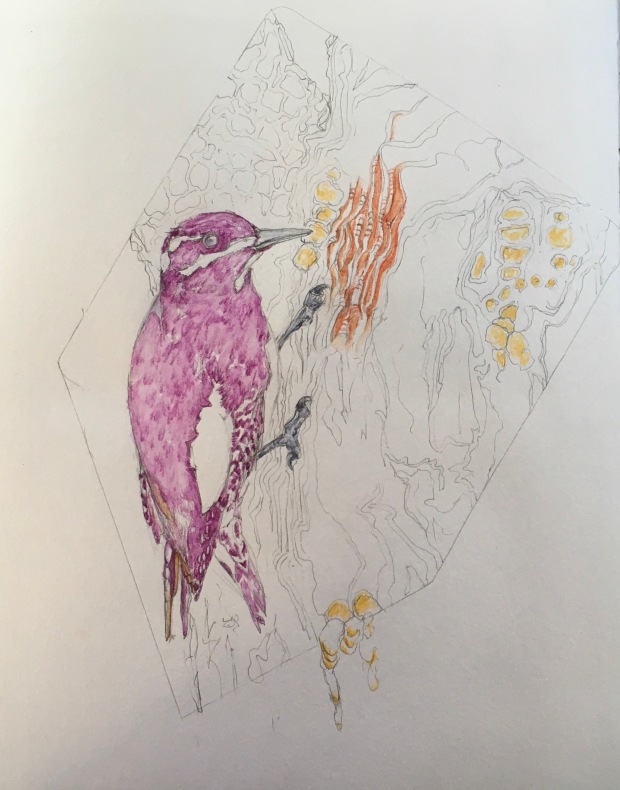
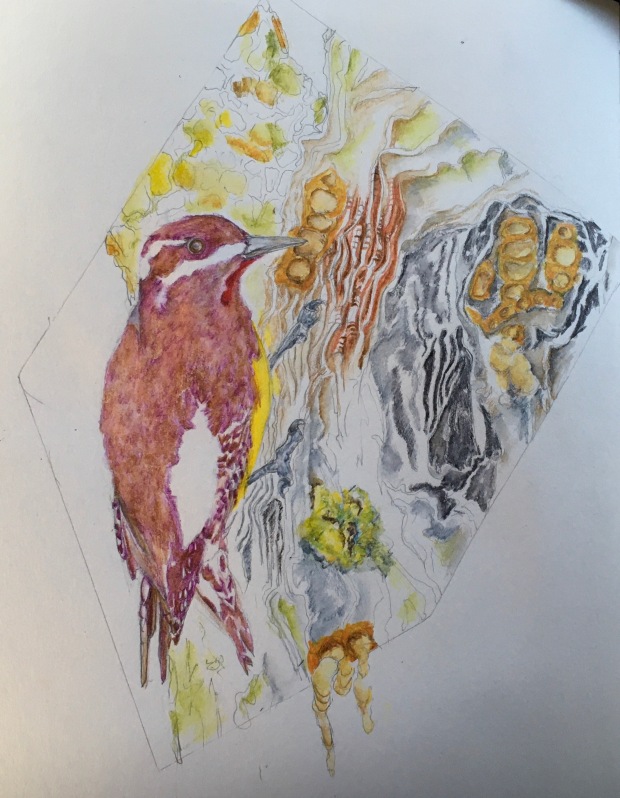
Here’s a few progress shots I remembered to capture while creating the Williamson’s clinging to the tree
Earliest coloring stages …. Laying down base colors to build up to the Williamson’s silky black back
Adding more base colors, sapwell and tree bark furrowing details
Close to final image. The black was achieved by using purples, browns, blues and greens to achieve the iridescence of his black coloring.
It’s been a few days now, and the scene continues to replay over and over in my mind’s eye. Somehow my sketch of these two birds …. one the victor, the other the victim ….. came easily and quickly, much like the time it took for the event to unfold.
Returning to our house after photographing snow scenes created by an overnight winter storm, I paused at the door, turning to admire the beautiful white landscape. Faster than an eye blink and just as quiet, a sharp-shinned hawk soared by at top speed, obviously intent on capturing one of our feeder birds!
I’ve seen this small hawk fly by a few times over the past several weeks, but the smaller juncos, finches and titmice always managed to duck for cover in the nick of time, foiling the “sharpy’s” chances of a meal. But the hawk, perhaps better skilled in his timing and approach after some practice runs, wasn’t about to miss on this day.
The spotted towhee must’ve been so focused on scratching for buried seeds that all obvious warning calls eluded him. Out in the open eating seed under one of our feeders, the towhee must’ve been too hard to resist for the sharp-shinned hawk, and fell victim to the expert predator.
Having camera already in hand, I was able to take a half dozen photos after the sharpy snatched the towhee with his long piercing talons, pinning him securely to our brick patio. As sad as it was to watch the towhee struggle against the hawk’s sure grip, it was all over for the towhee in 30-45 seconds. Then as fast as the sharp-shinned hawk had attacked, he regripped the lifeless towhee, lifting him effortlessly and flew away into the trees.
The circle of life.
“You can’t imagine anything like nature as we know it without predators.”
-Dale Jamieson
“Every living creature, big or small, plays such an important role in our ecosystem.”
-Mufasa’s memorable speech to Simba (from The Lion King)