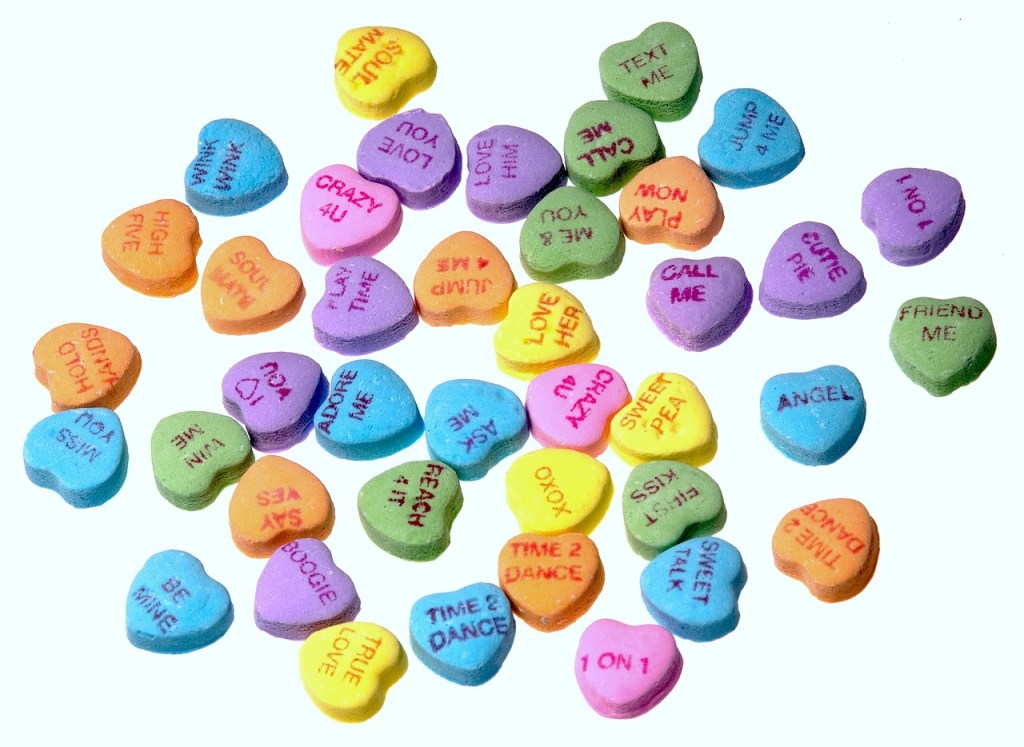
Burro-ito Jack galloped by our place this morning to wish y’all a Happy Valentine’s Day! And then he excitedly ‘brayed’ — in Conversation Heart 💜 style — BE MINE! …. KOOL KAT! … MARRY ME! … CRAZY 4 U! … BUY N BULK! … QT PIE! … U ROCK! … XOXO! … SAY YES! … HEE HAW! …… (knowing what a sweet tooth he has, I finally offered him a box full of those sugary hearts just to hush him up)
Since Jack brought up such a sweet subject, did you know ………………….
Conversation Candies got their start as medical lozenges?
Weirdly enough, the story began in 1847 when a Boston pharmacist named Oliver Chase invented a machine that simplified the way sore throat lozenges could be made. Then Ollie had another great idea. Instead of making lozenges, why not use the machine to make candy? Why not, indeed! And just like that, his invention became America’s first candy-making machine. Soon after, Oliver founded the New England Confectionery Company, or NECCO, and the candy ‘lozenges’ soon became what we know today as NECCO wafers. (I didn’t know that’s what NECCO stands for! Did you?)
But that’s not the end of the story.
Conversation Candies get sentimental!
For almost 20 years, the pharmacist-turned-candymaker kept cranking out sweet NECCO wafers. But when 1866 rolled around, and fascination with those lozenge-shaped candies waned, it was Oliver’s brother, Daniel Chase who had a brilliant idea. “Let’s print sentimental messages on each wafer!” And that’s what he did. Because the candies were larger than today’s versions, printed sayings and phrases could be long. While Dan was busy creating witty messages that could stoke the flames of love or warn off flaky suitors, big brother Ollie redesigned his candy-making machine to “pretty up” the wafers. So sayings like “Married in white you have chosen right” and “How long shall I have to wait? Please be considerate” were now emblazoned on a pastel, scalloped NECCOs. It seemed everyone had fallen in love with these redesigned Conversation Candies.
Conversation Candies Evolve
Sales skyrocketed over the next 36 years, but before long, the brothers Chase decided one more key innovation was needed. In the winter of early 1902, just in time for Valentine’s Day, they transformed those pretty pastel colored, scalloped wafers into heart-shapes. Perfect!
Conversation Hearts Today
More than 8 billion Conversation Hearts are manufactured each year by NECCO. Their size may be smaller, and the sentiments much shorter, but each packed-full box has approximately 45 sayings like “True Love,” “Hug Me” and “You Rock.” NECCO even let’s you can personalize your own sayings, too. And in case you need to know …. that secret supply of Conversation Hearts you stashed away last year are still “fresh” as they have a shelf life of five years. Oh goody!
Happy Valentine’s Day! Hope you enjoy your box of Conversation Hearts (but don’t forget to make a dentist appointment!).
Go ahead and ‘Zip,’ ‘Lace,’ or ‘Snap,’ but don’t forget to ‘Button,’ for today we celebrate National Button Day! And not just Button, the noun ….. that often round, oval, and curiously odd-shaped fastener useful for bravely closing shirts and blouses, trousers, and shorts, skirts, jackets …… but Button-ing, the verb …. the ubiquitous and organized hobby of button collecting officially recognized by the National Button Society. Don’t you think it’s about time to Honor the Button!?
Throughout history, buttons have been mostly functional – used to fasten pieces of cloth together. But their intentional use as decoration is well documented.
The oldest known button was found in the Indus Valley, a region of modern Pakistan. Estimated to be around 5,000 years old, it was made from a curved shell and has a flat face that fits into a loop. This unbelievably old button is believed to have been used solely as decoration. (Wonder who the button artist was?)
Ancient Romans, who lived from the 8th century B.C.E. To the 5th century C.E., also made and used buttons. Because they wore loose-fitting garments made of heavy material, their buttons were thick and made of horn, wood, and bronze.
But the button didn’t serve as a functional fastener until the Middle Ages (5th to 15th centuries C.E), when buttons were used for more fitted clothing for men and women.
Button makers didn’t become popular until the 1600s. During that time, buttons could only be afforded by wealthy men and women, becoming a symbol of prosperity and prestige.
In the 1890s, in response to the fast-growing ready-to-wear industry, freshwater pearl button manufacturing exploded. In factories from Wisconsin to Iowa to Arkansas, workers used tubular saws to cut round blanks from mussel and clam shells, which were ground to standard thickness, then faced, drilled, and polished.
But it wasn’t until the 1920s, that button prices became more affordable and could be worn by everyone. This was primarily because buttons were made of inexpensive synthetic materials and could be made in larger sizes, in a rainbow of colors. Becoming increasingly common, ready-to-wear fashions began featuring buttons that were not only functional but decorative.
Today, buttons can be simple disks with two to four holes, and are made of metals, plastics, resins, and acrylics. But button makers still create more elaborate designs. If you can imagine it, there’s probably a button like it. From animals and food to iconic buildings and famous people, button makers make them. They’re colorful and fun and designed to be decorative. While the fun ones may be less practical, they’re still made to function.
What Makes a Button?
Over the millennia, people have made buttons from a variety of materials. In ancient times, buttons were formed from natural and readily available substances such as stone, shell, bone, clay, or wood. Some rare antique buttons (those more than 100 years old) made of early plastics like celluloid or Bakelite are highly collectible, as are those made from bone, stone or wood, glass or metal, and shells such as mother of pearl or tortoiseshell. (Note: if your grandma left you her button jar, look for buttons made from just about anything but modern plastic ….. they may be considered collectibles and might demand a hefty price! (Do I see an Antiques Roadshow in your future?)In more modern times, metals, plastics, resins, and acrylics have been used.
The Art of Buttoning
Did your grandma or mom snip the buttons off clothes headed for the rag bag? So many buttons collected in jars or tins. One day I discovered a decorative fruitcake tin high on a closet shelf. Afraid a waxed paper-wrapped brick of cake might still be ‘mulling’ inside, I held my breath and took a look. Instead of a dense cake, the tin was heavy with the weight of hundreds of colorful orphaned buttons! Running my hand through the collection, it was easy to imagine I’d stumbled upon a treasure chest of gold as the buttons fell between my fingers back into the tin! That ‘treasure’ continued to feed my imagination for years. They became great substitutes for missing Jax pieces; strung together, buttons made draped garlands, tree ornaments, a bracelet and necklace; even a stuffed bear who was ‘blind’ in one eye, regained his ‘sight’ after receiving a button transplant.
Today, the National Button Society (NBS), with a membership of over 3,000, reports there are thousands of button collectors in the United States (are you one of them?). Also, more than 70% of states have their own button societies (now that’s just ‘cute as a button’), and countless smaller, local clubs exist across the country.
Did You Know ………
As of May of 2001, Guinness World Records certified that Dalton Stevens, from South Carolina, had the largest collection of buttons in the world. With a total of 439,900 unique buttons, he was also known as the “Button King.” His collection is housed in a museum in Bishopville, South Carolina, and features numerous objects covered with his unique buttons, including a car, an outhouse, and a coffin.
Another large button collection can be experienced at the The Waterbury Button Museum, located on the top floor of the Mattatuk Museum in Waterbury, CT. This collection of over 20,000 buttons was donated by the Waterbury Companies in December 1999, and includes buttons from around the world. From mass-produced military buttons to handmade fashion buttons, the display includes buttons made from glass, bone, jade, porcelain, plastic, and metal. The buttons represent the history of Waterbury, which became synonymous with button manufacturing, particularly for military uniforms, since 1812.
HOW TO OBSERVE NATIONAL BUTTON DAY
Do you have a fun button collection? Are you a member of a local button group? Have you joined The Official Button Lovers Group on Facebook? If you’re intrigued by buttons after reading this post, or want to be, here’s some ideas to pique your curiosity and cultivate a budding love of buttons:
Start a button collection
Make a button necklace or bracelet
Design a craft using buttons
Make an ornament using buttons
Play a game with buttons, like Tic Tac Toe or Checkers
……………………………………………………………………………………………………………………
Did you ever imagine you would be thinking twice (or more times) about buttons today? I certainly didn’t! So why not come along with me and jump on that button-covered Band Wagon to celebrate and pay homage to the hard-working button, the “fossil of the sartorial world.”
But more than anything, have a fun National Button Day, because as J.D. Barber once said, “Trying to make the presidency work these days is like trying to sew buttons on a custard pie.”
As always, thanks for clicking on your email button today, and stopping by!
Zentangle patterns: Spanders, Footlites, Diver, Lewe, Fifolia, Sprave, Qurtuba, Cloudy Day, Fission, Icantoo, Marbles, Soutache, Strutz, RowRow, Ping, FITA (Flies in the Air), Ease, Antique, Barberpole, ArcFlower, & Arrow Tree
Did you notice World Ampersand Day was more than a week ago? No worries! Although September 8th is the official day for this World celebration, such a fun & functional, curly & quirky little character, know as the “Ampersand,” deserves a party every day of the year! Don’t you agree?
The Symbol we use today for the ampersand is more than 2,000 years old! Designed by an Ancient Roman scribe around 63 CE, it served as the shorthand version of the Latin word “et,” meaning “and.” This ingenious calligrapher created the Symbol by combining the letters “e” & “t” into a single ligature or glyph, for the purpose of saving valuable time, space, & parchment while writing the voluminous & tediously-penned documents of the day.
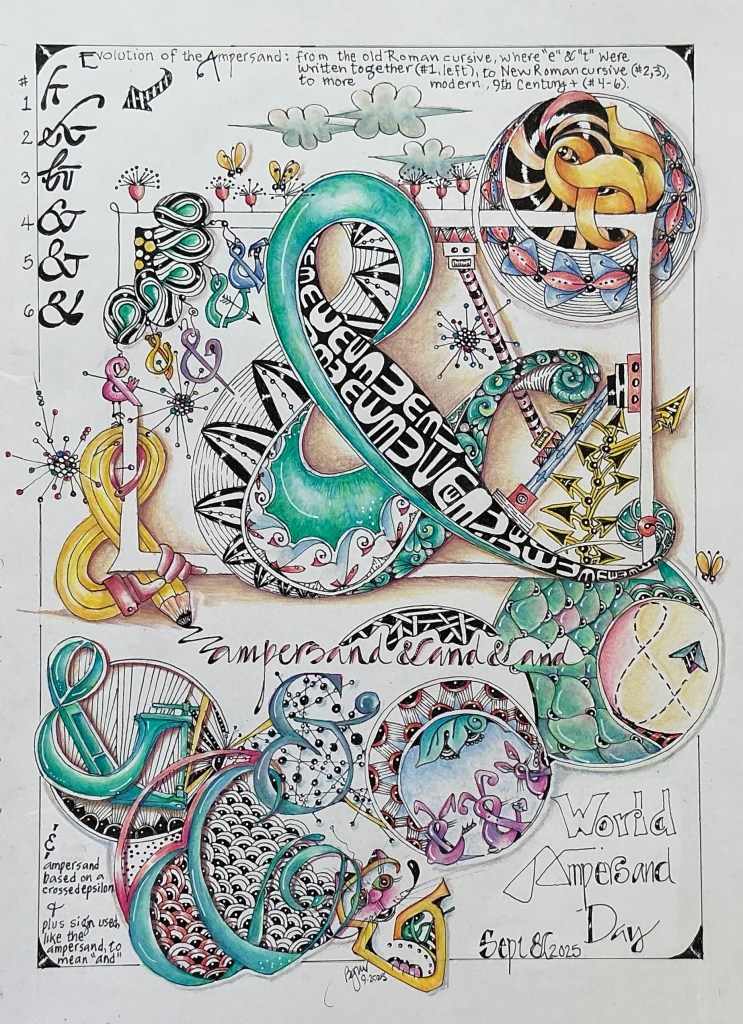
Observation #1: if you refer to my drawing, top left, you’ll see how the evolution of the ampersand symbol changed over the course of a few thousand years, beginning with Figure #1, the 2,000 year old design.
Observation #2: unless the old Roman cursive “et” included exaggerated negative space before, after, and/or within, I’m uncertain how the symbol in Fig. #1 saved space? What are your thoughts?
The Word “Ampersand” didn’t emerge until the early 19th century (1837) as the shortcut to the commonly used phrase “and per se and.” Now that phrase-to-pronunciation of “Ampersand” may seem intuitive, the eventual slurring of the four words follows a more complex explanation that’s pretty interesting. Based upon a traditional English custom that involved spelling out loud, “any letter that could also be used as a word in itself (“A”, “I”, & “O“) was referred to by the Latin expression per se(‘by itself’), as in “per se A” or “A per se A” or “A by itself = A.” Following that tradition of verbal spelling, the single Ampersand glyph was verbally spelled aloud like this: “and per se and,” “& per se &,” or (much more helpful) “& by itself = and.” This clarification of “& by itself” was necessary so as not to confuse the more extended forms of the “&” in use, such as “&c.” which is one of the abbreviations for the Latin phrase “et cetera,” which, of course, means “the rest.”
Today’s Stylistic Ampersand Symbols
Today, it seems there are hundreds and hundreds of unique ways of symbolizing the Ampersand. A quick internet search of font styles reveals a different twist on the symbol for each font. Can you imagine what an extensive search of fonts would uncover?! But there’s one criteria that must be met, somehow, in designing each “&” …… it must be a ligature (a combination) of the letters “e” & “t” into a single glyph (character), & if not readily recognizable, the artist must be able to demonstrate the presence of both letters, no matter how abstract.
Used to be ……
Did you know the Ampersand used to be the last letter of the English alphabet? It’s true! The “&” was added as the 27th letter in the alphabet in the 19th century &, as such, was taught to children learning their ABCs. Primers written for ‘little folks,’ some novels, & even nursery rhymes recognized the “&” as an official character. One especially popular nursery rhyme, Apple Pie ABC1, finishes with the lines “X, Y, Z, and ampersand, All wished for a piece in hand.” But sometimes good things come to an end. By the late 19th century, the “&” was accepted as a ligature it truly is, rather than a letter, & lost its place in the alphabet.
.
Celebrate every day by having fun with the Ampersand:
Use lots & lots of ampersands!
Substitute “&” for “and” in everything you write
Think of syllable replacements in words such as: &roid, c&elabra, b&
Send friends whose names contain “and” a special note — &y, &rea, Alex&er, Br&don, Gr&ma
Design new styles of ampersands being sure they represent the letters “et”
Count the number of ampersands in my drawing2
Well, Flambé doesn’t know about you, but she certainly had lots of fun learning about the Ampersand, & is kicking-off a campaign to have it restored as the 27th letter of the alphabet. After all, we lost Pluto as the 9th planet in the solar system, the Ampersand has almost been around as long as Pluto, & most importantly the “&” has the shape of her long lost best cat friend & lover, Cognac, who’s been on a planetary exploration for years, and has probably reached Pluto by now. Kat says, “Let’s bring back the Ampersand! All in favor, say, “and & and & and & and …..!’”
As always thanks for stopping by, & for voting because Flambé believes all voices must be heard on the issue of the deported Ampersand.
1“ApplePie ABC” is a simple rhyme written to teach children the order of the alphabet by relating the various ways children react to an apple pie. After the first line, A was an apple pie, the rest of the letters refer to verbs.
“A was an Apple pie; B bit it; C cut it; D dealt it; E eat it; F fought for it; G got it; H had it; J joined it; K kept it; L longed for it; M mourned for it; N nodded at it; O opened it; P peeped in it; Q quartered it; R ran for it; S stole it; T took it; V viewed it; W wanted it; X, Y, Z, and &, All wished for a piece in hand”.
Note the absence of two letters; the vowels I & U. When the rhyme was originally written (sometime in the 18th century), there was no differentiation between the capital letters I & J, & between U & V. But in 19th century versions, when the I & U were accepted as distinct letters, the rhyme was updated to include these two lines:
“I inspected it” & “U upset it.”
2 Spoiler Alert: Flambé & I each counted twice & agree …. you should come up with a total of 29 Ampersands in my drawing. If you also agree, Bravo! If you found fewer than 29, try again! If you found more than 29, send a message PDQ, letting us know how many there actually are & that we must’ve been sniffing too much catnip to count higher than 29! Then I’ll have Kat begin the scavenger hunt anew!
Zentangle patterns: Spanders, Footlites, Diver, Lewe, Fifolia, Sprave, Qurtuba, Cloudy Day, Fission, Icantoo, Marbles, Soutache, Strutz, RowRow, Ping, FITA (Flies in the Air), Ease, Antique, Barberpole, ArcFlower, & Arrow Tree
Such an awesome-inspiring place to spend a Spring week in New Mexico!
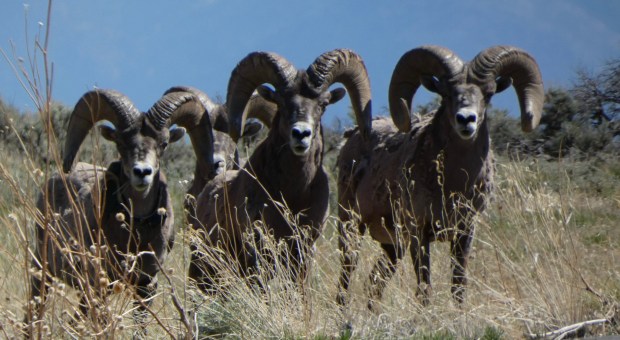
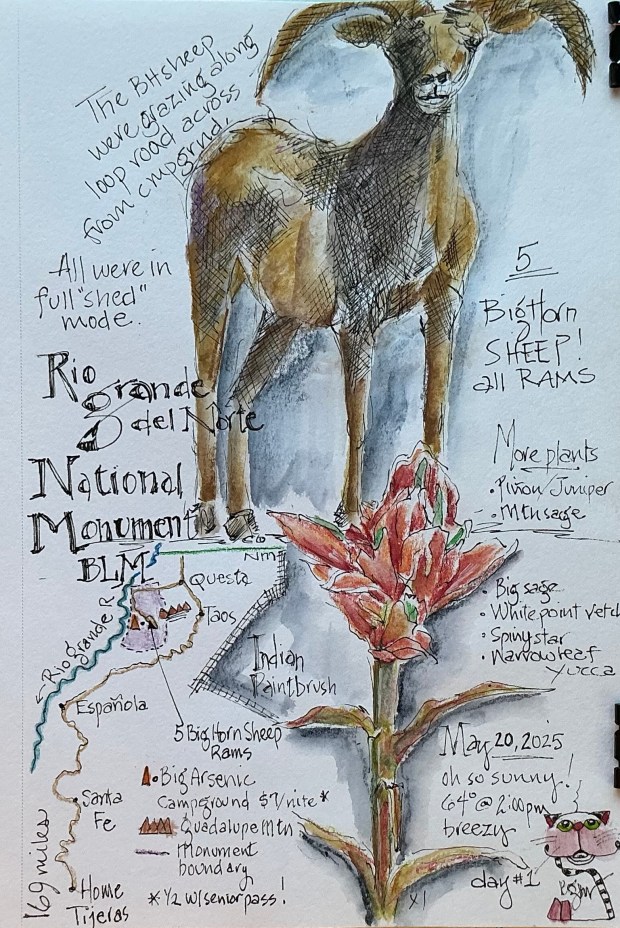
Three of the five big boys! Rocky Mountain Big Horn Sheep.
Rio Grande del Norte National Monument …..
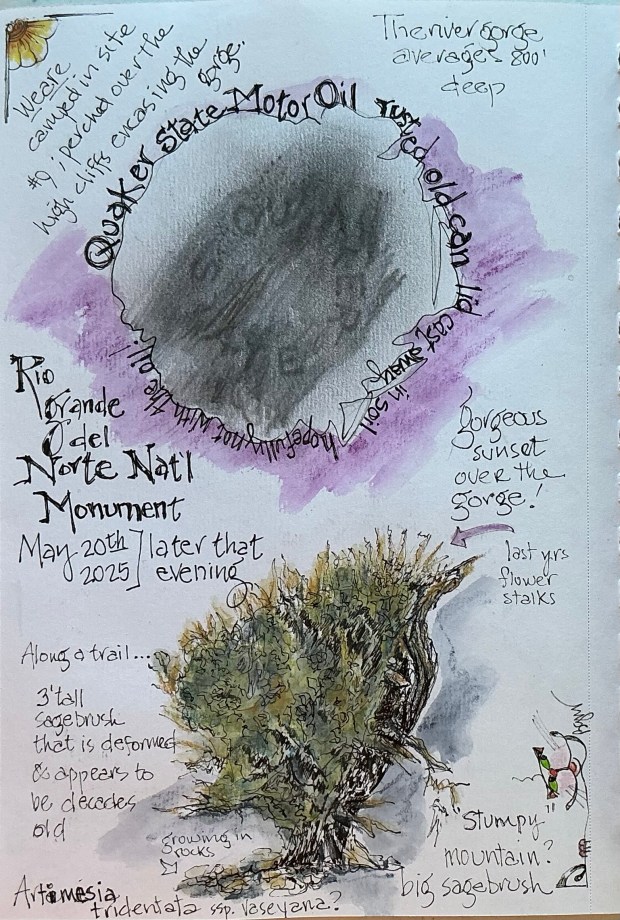
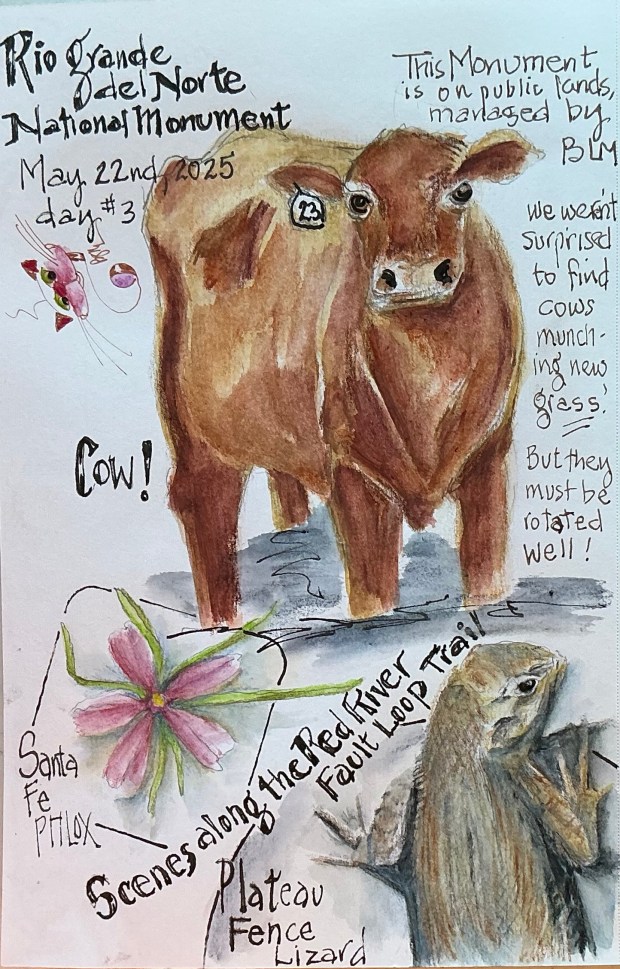
comprises a breathtaking 245,000 acre area of the northern Rio Grande rift valley in north central New Mexico. Established as a Bureau of Land Management (BLM) national monument in 2013, the rugged wide-open plains average 7,000 feet in elevation before dropping into steep narrow canyons carved into the landscape by rivers that have been flowing for millennia.
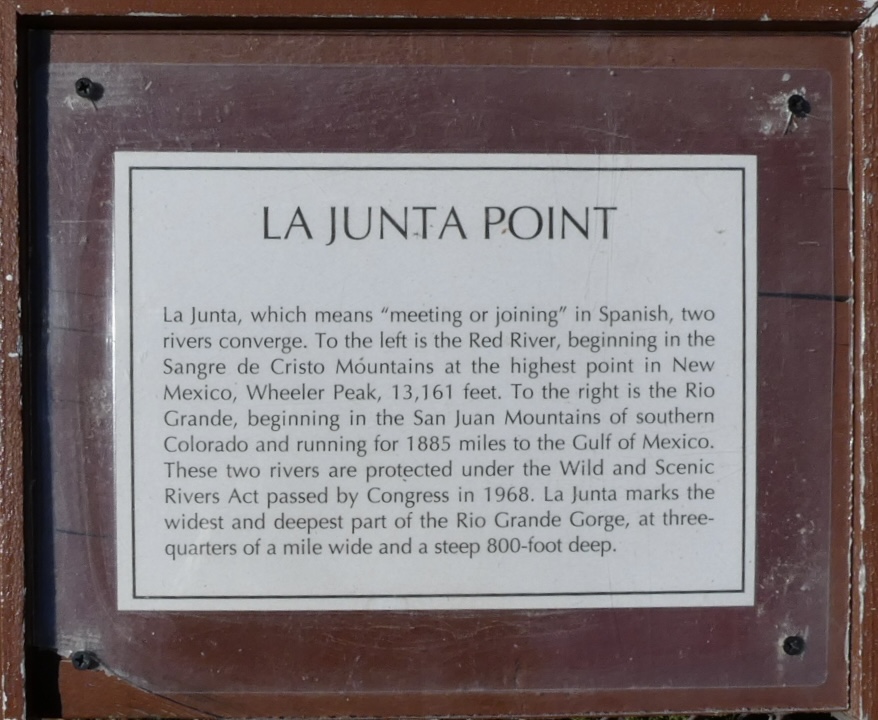
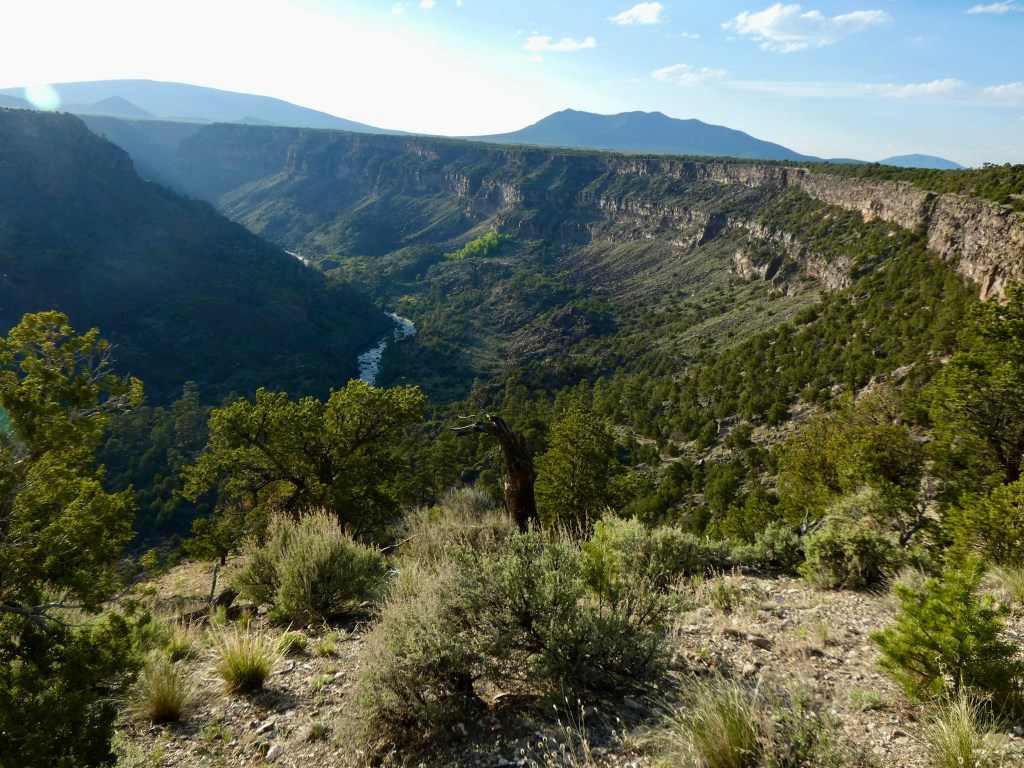
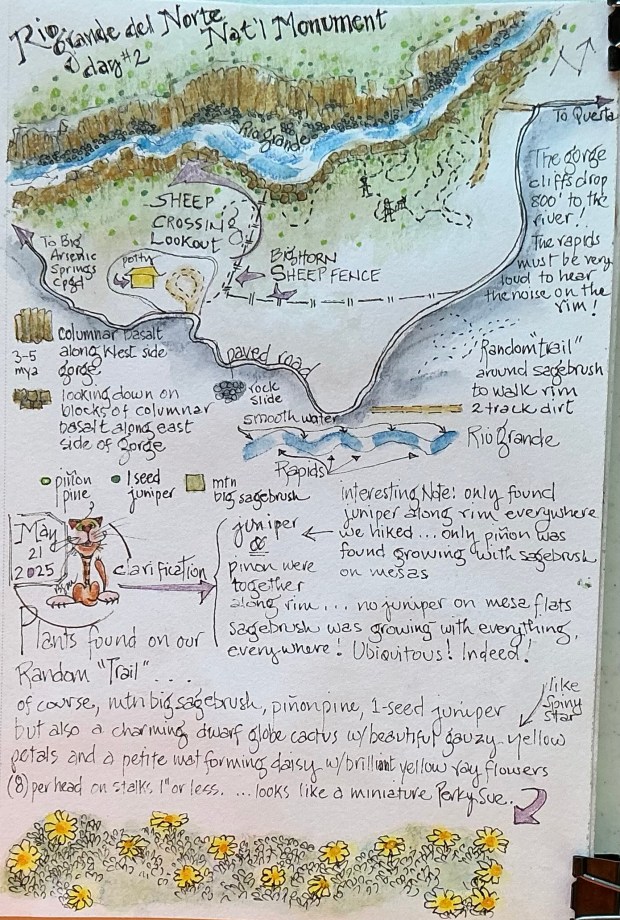
The confluence of two of these rivers, the Rio Grande and the Red River, occurs in the northern Wild Rivers area of the Monument. It’s at this confluence where the gorge is its deepest at 800 feet, and its widest from rim to rim measuring 3/4 mile. It’s an impressive view from the la Junta (“the Meeting”) Overlook. All of the views from anywhere along the rim are impressive.
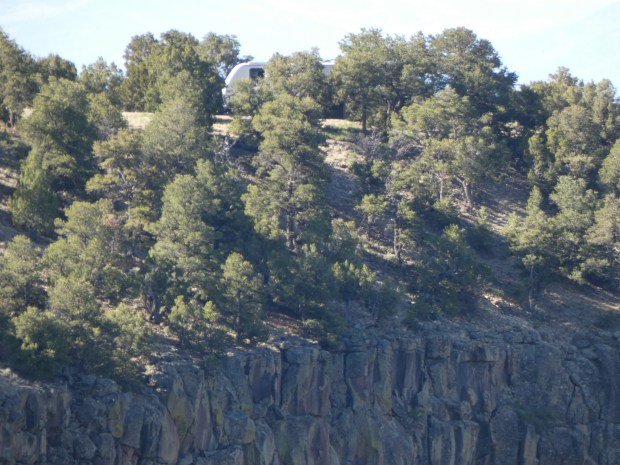
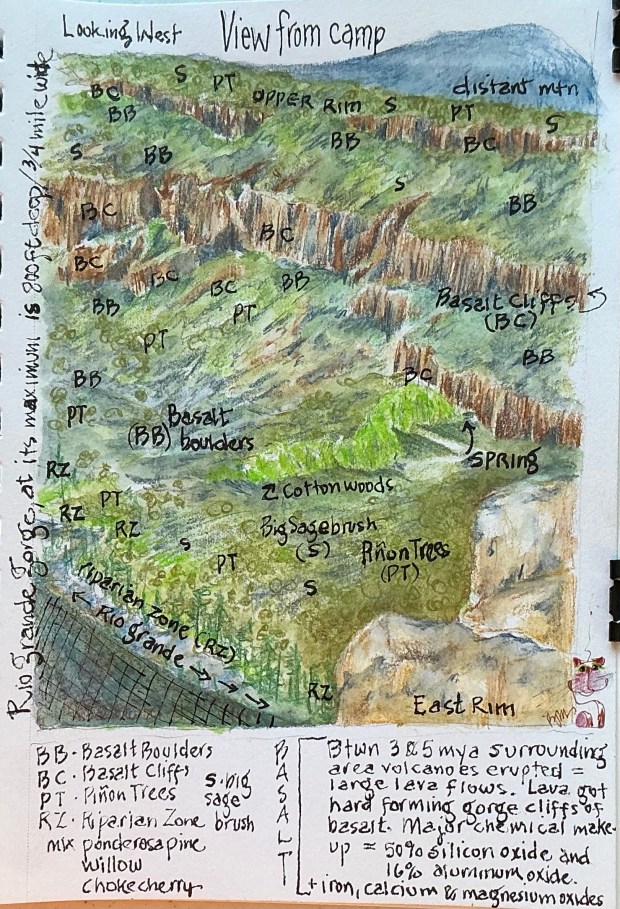
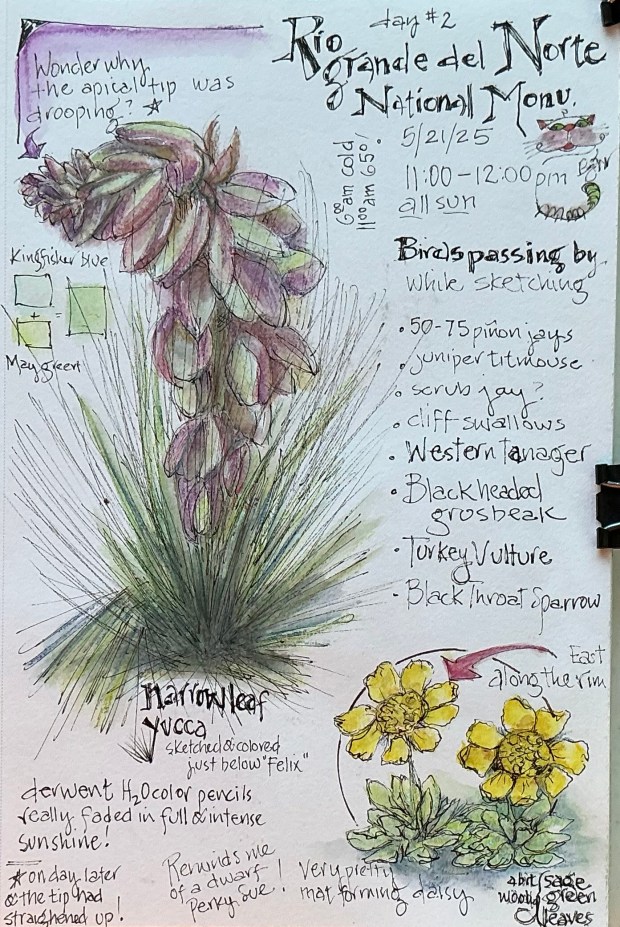
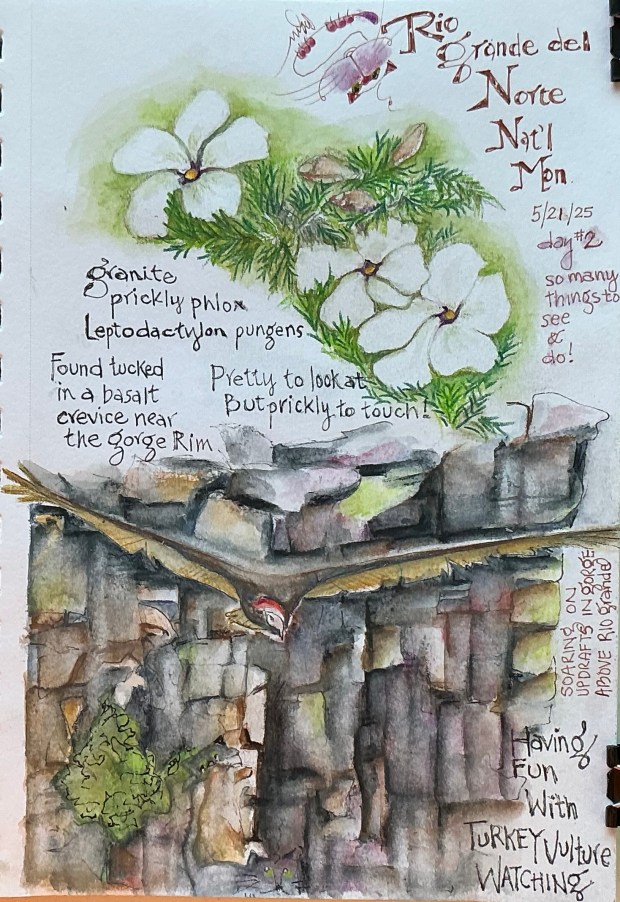
We backed our RV (‘Felix’) into what must’ve been the best designated camping site ever ….. #9 on the southern loop in Big Arsenic Springs Campground. After setting up, we discovered that Felix rested only a few steps west was the rim and the long plunge down to the Rio Grande! But immediately south of us, the rim formed a small peninsula where nearly every afternoon I could be found sketching the plants growing from the basalt cliffs, or the swifts and turkey vultures soaring along the cliffs and over the river aided by the canyon’s updrafts. This skinny little peninsula quickly became my favorite sit spot; then late one morning it became priceless …….
Can you spot our RV? We were precariously perched above the Rio Grande, right on the rim of the gorge!
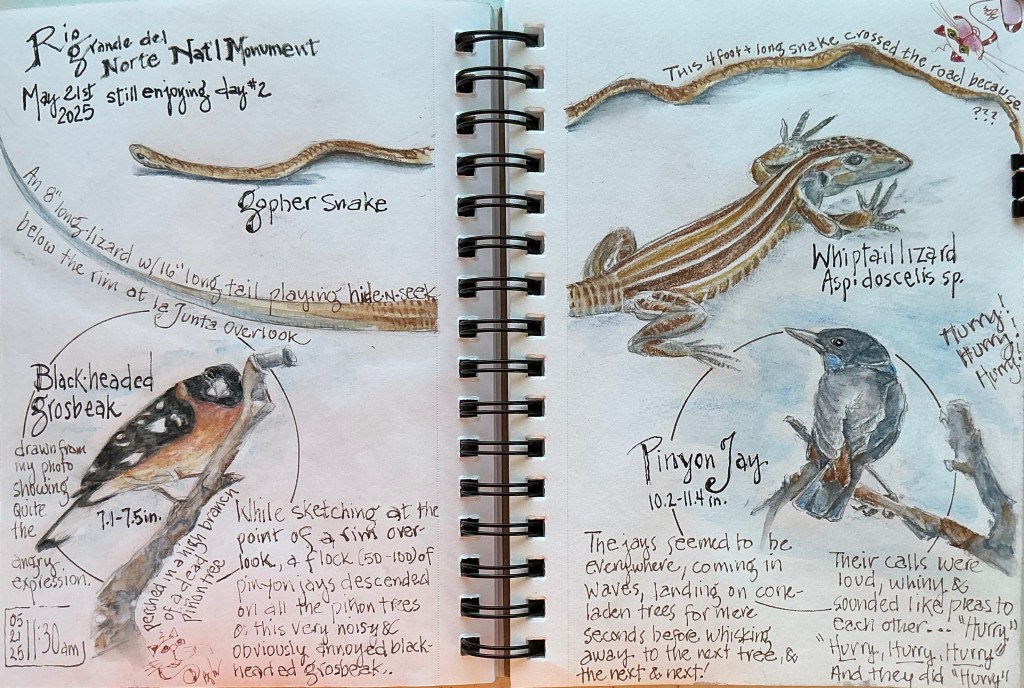
I could hear them approaching, like a swarm of bees. In a matter of seconds I was witnessing a cacophonous chorus of 100’s of pinyon jays. These noisy birds quickly moved in and onward while descending, like they were famished, on this year’s piñon pine cone-laden trees in large erratic groups, all the while screaming, “Hurry, Hurry, Hurry, Hurry!” Where exactly they came from or where they went remains a mystery. All I know was the spectacle must’ve lasted a good 10 minutes or more, as I watched wave after wave of these birds pass by. I still get goosebumps (jaybumps?) recalling those exciting moments.
We had planned to spend only one day camping in the Monument, but every morning we decided to stay at least another and then another day. We hiked every rim and interior trail (sometimes more than once), spent hours at all of the Overlooks getting ‘High on the Views,” were thrilled with our chance encounters of five (5) Rocky Mountain Big Horn Sheep rams (twice in one day), and marveled at how the forces of nature* collaborated to carve the narrow and steep 800 foot deep gorge within the Monument.
But alas, it became time to pack up our home away from home. Even tho a string of completely clear days allowed sun to shine on our solar panels from sunup to sundown, keeping Felix’s battery purring happily our entire stay, it did nothing to recharge our potable water tank. So the morning we found the water indicator light teetering on ‘Empty,’ was the day we headed for home (after enjoying a farewell hike, of course) with my nature journal full of sketches and memories for a lifetime!
Do you have an especially special place where you can spend time in nature? Please share your discovery and what makes it so awesome!
As always, thanks for stopping by!
*Geology 101
From the overlooks throughout the Monument, we could see stacks and stacks of basalt and ash lining the narrow canyon walls of the Rio Grande Gorge. It’s hard to imagine the volume of material deposited during two very active periods of volcanic activity that occurred 5 and 3 million years ago. Soon after these events, water moving through the major drainage in the area (today’s Red River) began eroding pathways into these deposits as it flowed downstream into the 10-16 million year old rift valley. Geologists refer to the ancient Red River drainage as the ‘original Rio Grande’ because the still-closed San Luis Basin to the north (in south central Colorado) would not overflow for a few million years. Then 400,000 years ago, coinciding with a change in climate resulting in an overabundance of snow and rain, the San Luis Basin filled and spilled. As water does so well, this new and powerful river, today’s Rio Grande, moved ‘downhill’ towards the ‘original Rio Grande’, cutting through everything in its path (including the ancient volcanic deposits). When it converged with the ‘original Rio Grande,’ the erosive force of both rivers became enough to eventually carve out an 800-foot deep gorge in the Rift.
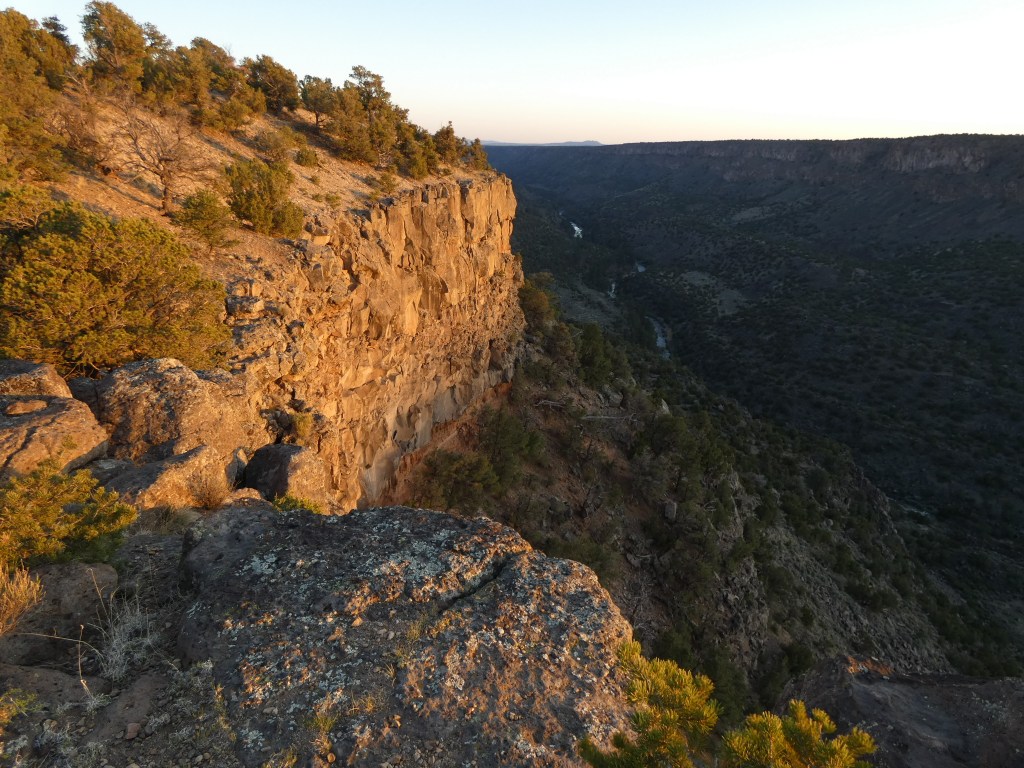
Confluence of the Rio Grande and Red RiverSunset on basalt cliff
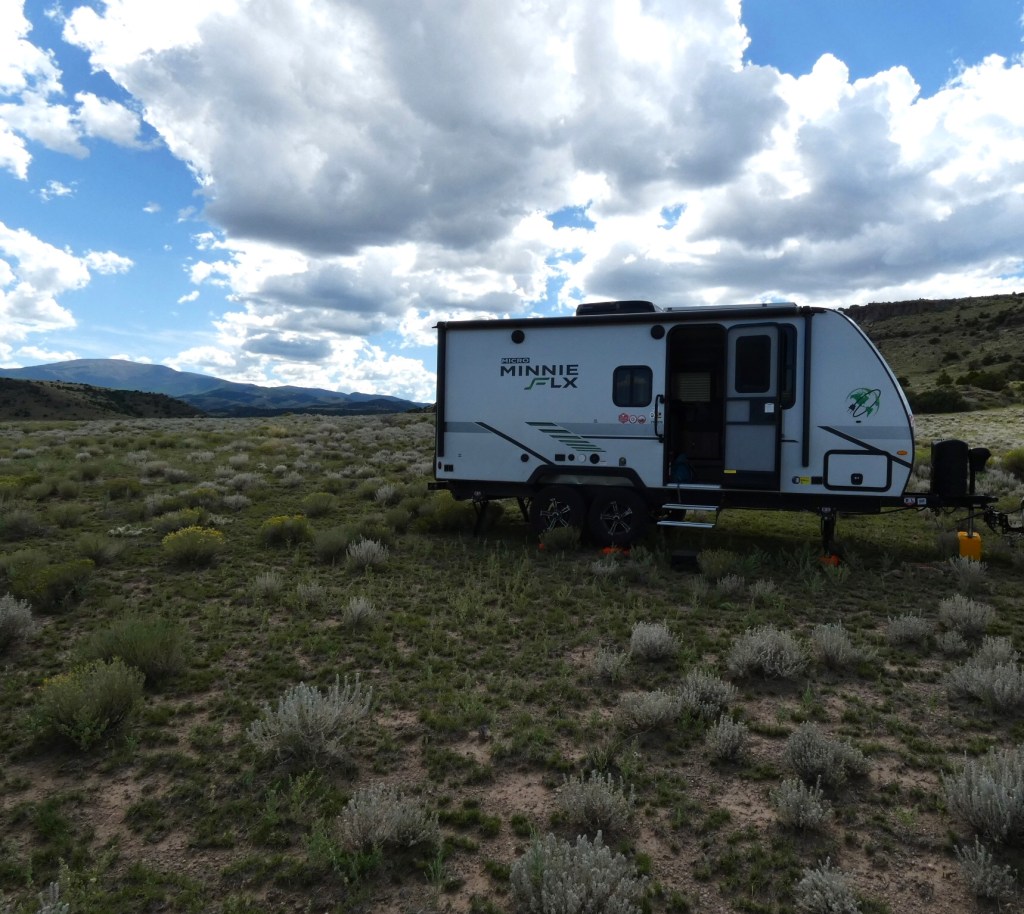
Felix parked along the Old Spanish Trail route, south central Colorado
With no defined route or objective, we decided it was high time we hitch up the trailer (Felix) and tote it north just to see what’s going on in south central Colorado this time of year. As we made our way through the San Luis Valley, we found acres of lush greenery topping almost-ready-to-harvest potatoes. Alfalfa was nearing its second cutting. Carrots had already been shipped to market. The wildlife refuges were patiently awaiting the arrival of migratory birds. And the last of the summer tourists were excitedly boarding the Cumbres and Toltec Scenic Railroad in Antonito, for the 64 mile steam engine journey to Chama, NM.
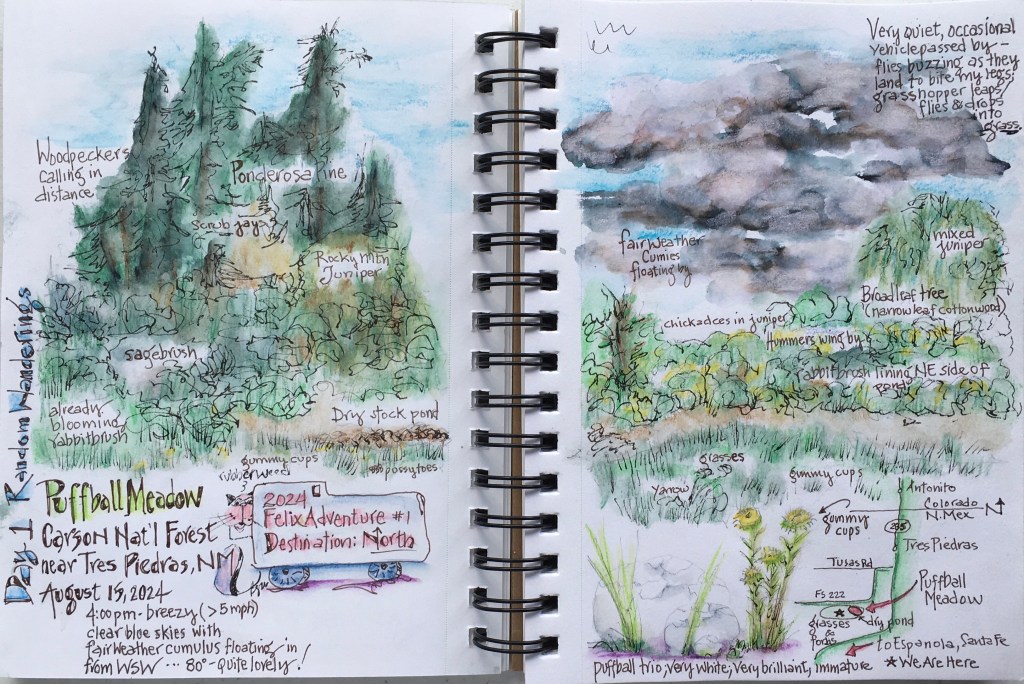
Day 1. Our first stop was in northern New Mexico, just south of Tres Piedras, Carson NF. An unlikely dispersed camping spot that I nicknamed “Puffball Meadow.” A nice level spot adjacent to a dry stock pond. The meadow was full of fist sized puffball fungi, and a coyote paid us a visit during the night.
We enjoy boondocking on our public lands managed by the US Forest Service and Bureau of Land Management. Having a trailer that’s self-contained, we can easily find lovely off-the-grid areas to set up camp. And thanks to our solar panels (and lots of sunny days) and large water tank, we can stay out for up to 5 days without needing refills. This allows us to explore lesser visited areas, which suits our tastes beautifully!
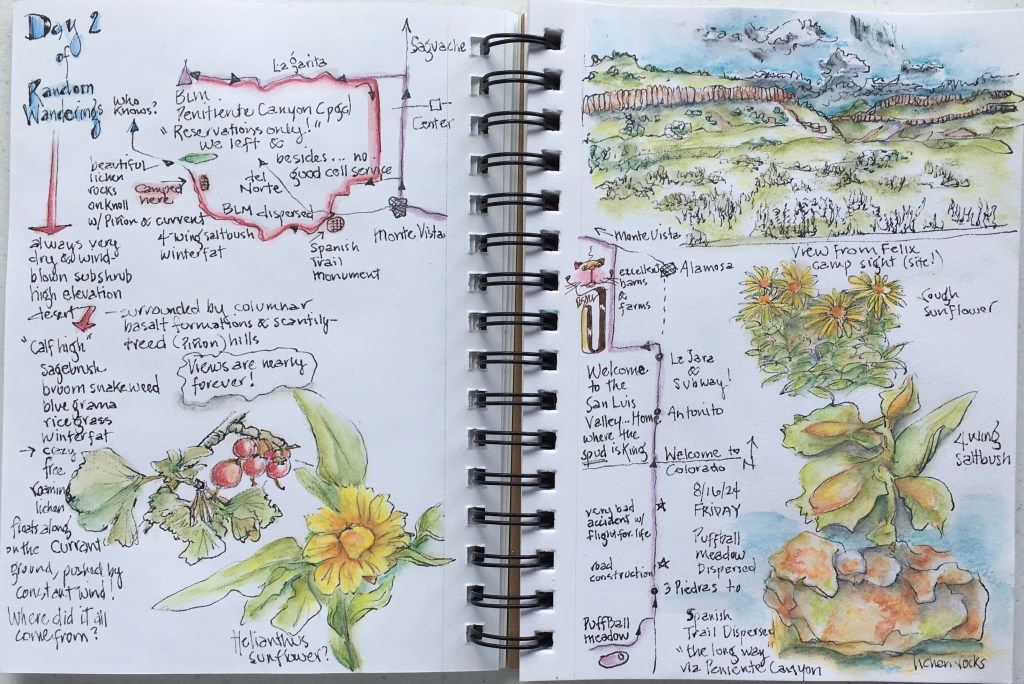
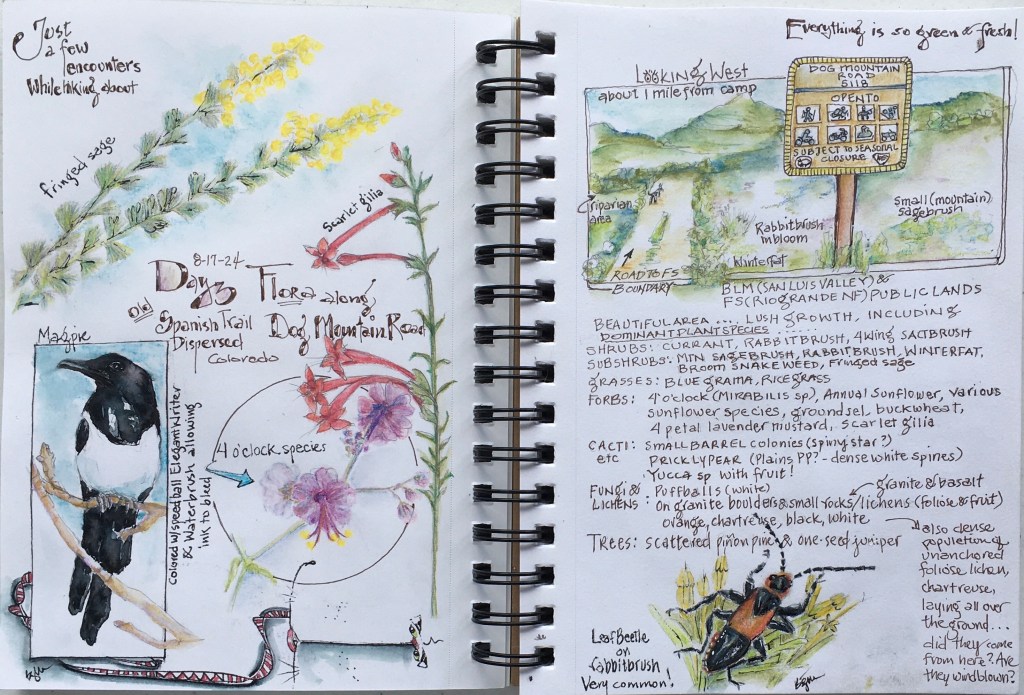
Day 2. Made it to the San Luis Valley, Colorado. Wandered around until we found a wide open area of dispersed camping in the vicinity of the Old Spanish Trail. Lots of wildflowers blooming, and plenty of hiking opportunities.
But I think one of the best things about random travel is the spare time …… we drive for 3-4 hours, find a place to camp ….. then the rest of the day involves hiking, wildlife watching, nature journaling, collecting drawable items, photography, more sketching, identifying the unknowns, reading, napping, and a bit of ukulele strumming! Perfection!
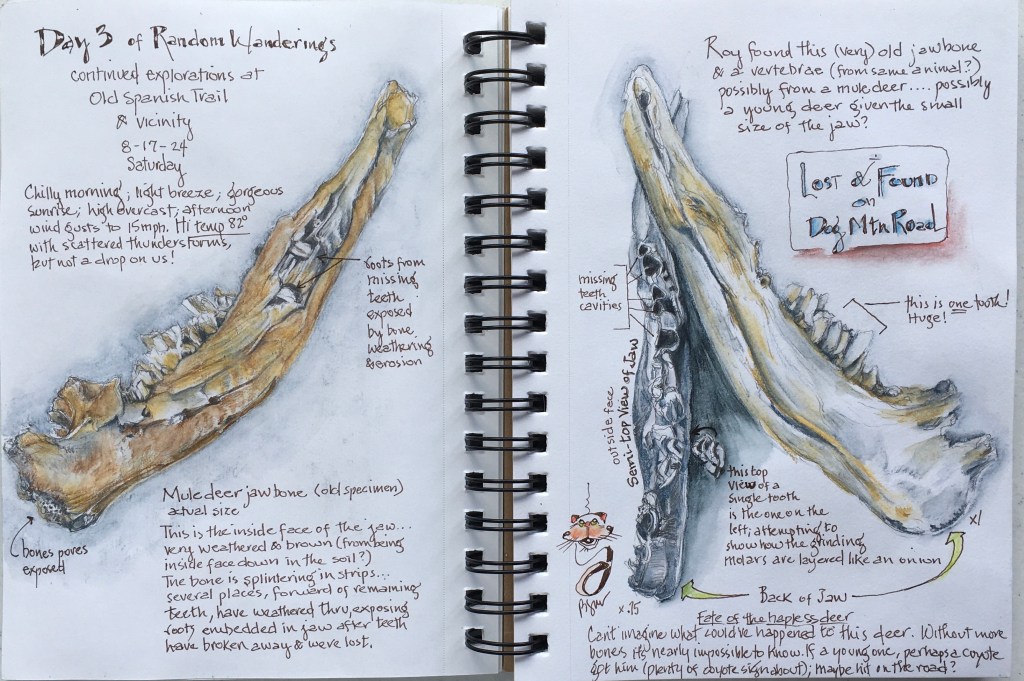
Day 3. We enjoyed the area so much, Roy suggested we stay for another day! And then he found this weathered mule deer jaw bone. Day 3, continued. Magpies! Can’t understand why these gorgeous birds don’t come south at least as far as Albuquerque and East Mountains.
Although the 6-day trip wasn’t remarkable, it was good to get away. Scattered about this post are my journal pages highlighting Days 1 to 5.
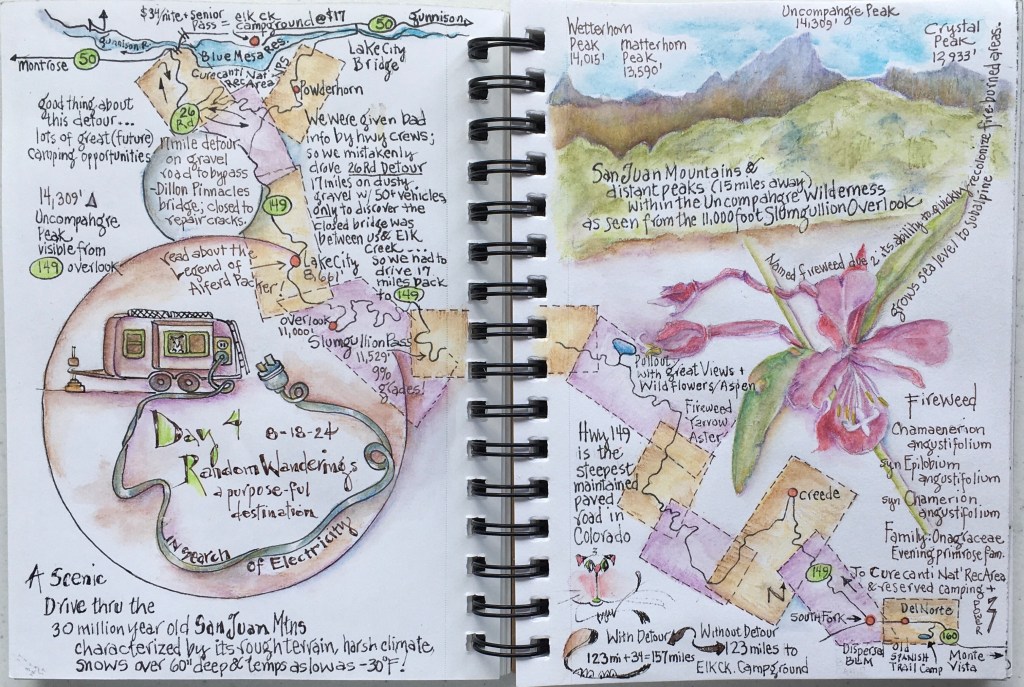
Day 4. Our travel route as we made our way to a campground to charge our battery and top off our water tank. An inconvenient, unplanned for detour led to future camping possibilities.
On Day 4, we decided to make our way up and over Slumgullion Pass (11,530 ft) on our way towards Gunnison Country. Not having been this way in years, we really enjoyed the crisp mountain air and spectacular views up and over the Pass. The villages of Creede and Lake City have grown swollen with tourist amenities and summer cabins dotting the once open meadows. As we got closer and closer to Lake City, we couldn’t help recall the story of Colorado’s notorious cannibal, Alferd Packer. Wanting to reread the tale as we passed near Cannibal Plateau and Deadman’s Gulch, the crime scenes, here’s what I found:
BriefBackground: Alfred Packer (newspaper misspelling as “Alferd” Packer, which stuck) (1842-1909) was a prospector who set out for Colorado gold fields in 1873. By the winter of 1874, he reached the rugged San Juan Mountains with a party of five men where they became lost and stranded during one of the worst winters on record. The men, with only had 3-4 days provisions quickly consumed and no firearms, were forced to cook their rawhide moccasins. Places where “snow had blown away from patches of wild rose bushes,” ….. they “were gathering buds from these bushes, stewing them and eating them.”
When the snow finally crusted over, Packer, the only man to survive the ill-fated trip, walked out of the mountains after 60 days. He told a story about the demise of his fellow prospectors, and how he managed to survive by eating them. His story involving cannibalism became legend, and continues to be passed down to today! (Whether the story is true or not will never be known, but it makes for colorful history.)
Based on historical records and news reports, Alferd Packer was tried several times for murder and cannibalism (even though the act of cannibalism wasn’t considered illegal in the US). Convicted of these heinous crimes, Judge M.B. Gerry supposedly uttered this famous quote while handing down the sentence in Packer’s first trial ……
“Stand up yah voracious man-eatin’ sonofabitch and receive yir sintince. When yah came to Hinsdale County, there was siven Dimmycrats. But you, yah et five of ’em, goddam yah. I sintince yah t’ be hanged by th’ neck ontil yer dead, dead, dead, as a warnin’ in reducin’ th’ Dimmycratic populayshun of this county. Packer, you Republican cannibal, I would sintince ya ta hell but the statutes forbid it.”
This is the quote I’d grown up hearing many times, over and over and over! It makes for good reporting, but is a ways from the actual sentence and what Judge Gerry sounded like while reading it (nope, he didn’t talk like Yosemite Sam!). Here’s what the record shows:
“Alfred Packer, the judgment of this court is that you be removed from hence to the jail of Hinsdale County and there confined until the 19th day of May, A.D. 1883, and that on said 19th day of May, 1883, you be taken from thence by the sheriff of Hinsdale County to a place of execution prepared for this purpose, at some point within the corporate limits of the town of Lake City, in the said country of Hinsdale, and between the hours of 10 A.M. and 3 P.M. of said day, you, then and there, by said sheriff, be hung by the neck until you are dead, dead, dead, and may God have mercy upon your soul.”
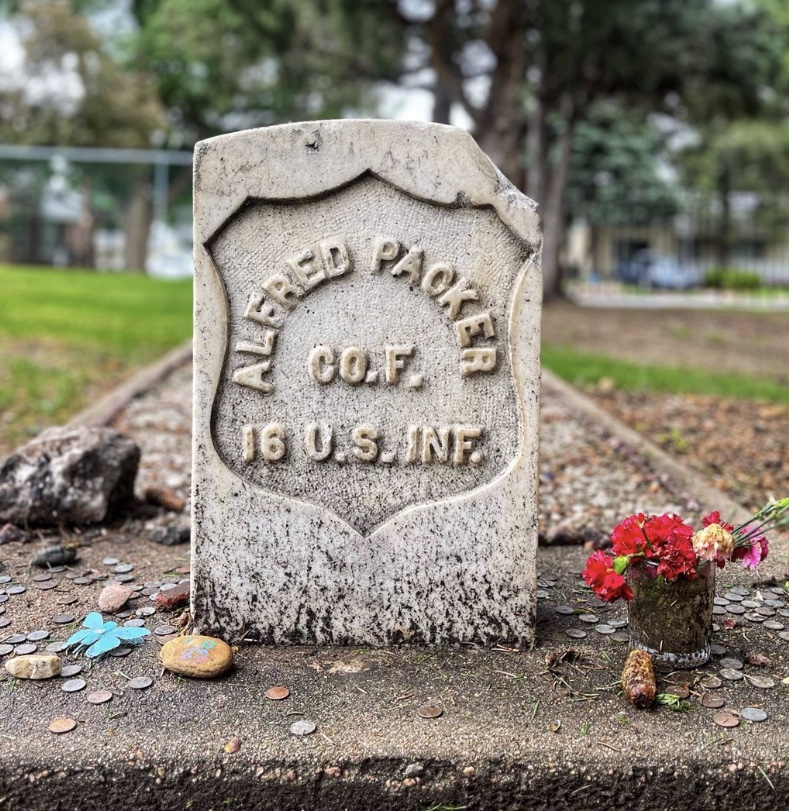
Alfred Packer tombstone in Littleton Cemetery where he was originally buried in 1909. Today, he now lies back in Hinsdale County, near Lake City.
Alferd Packer never did hang. It’s quite a detailed story following his first trial, including a jail escape, nine years on-the-lam, and recapture. There was a second trial in 1885 where he was charged for only one murder; after serving only 16 years of his 40-year sentence, he was released and died peacefully one year later at the age of 60. He was buried in Littleton, Colorado where his tombstone properly reads Alfred Packer.
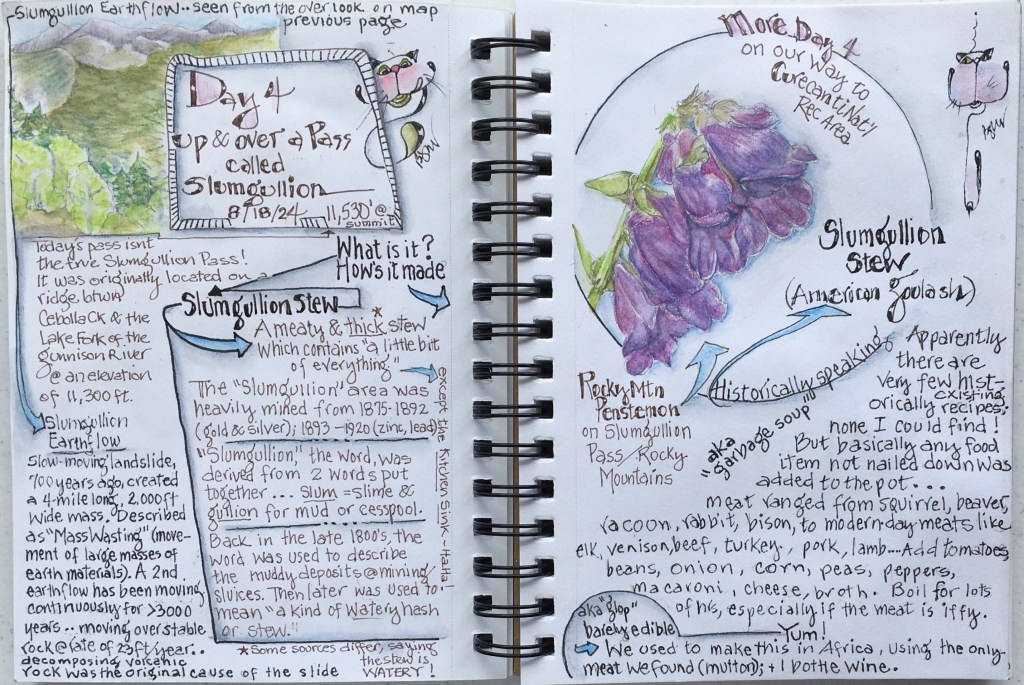
Day 4. Supplemental information about that strange name “Slumgullion.” Is it a stew? Is it a drink? Is it the sludge that puddles below an 1870 sluice box? Day 5, on our way back to Old Spanish Trail (because we liked it so much). Discovered a new-to-me plant; after a bit of checking with iNaturalist, learned it was Black Henbane, but not before handling all parts of this very poisonous noxious weed!
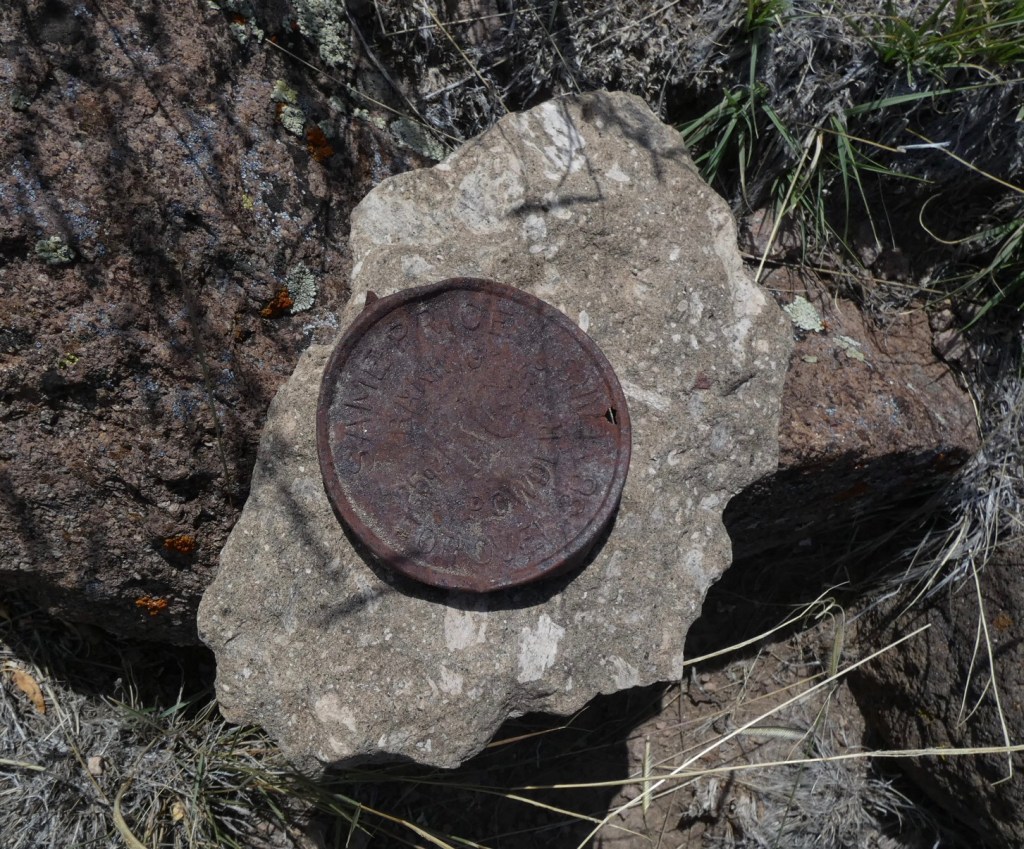
A short comment on the KG Baking Powder tin lid we found near our trailer. It was old and rusted, but very readable. The tin and its contents were probably long gone. Tried to find any information on the KG brand; sure curious about the age of the lid. If you’ve heard of this brand, please let me know.
KG Baking Powder tin lid we found near Old Spanish Trail.
Day 6. Headed for home. Hope you enjoyed my travel journal.
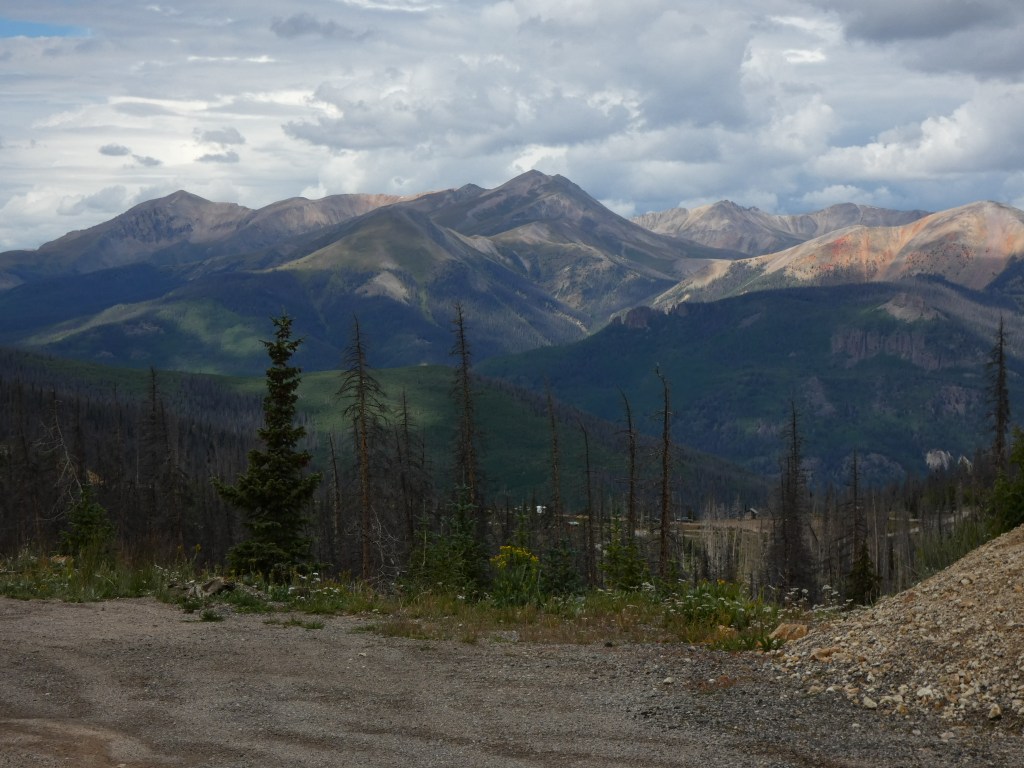
San Juan Mountains …… up and over Slumgullion Pass. The view of the 700 year old earth flow.
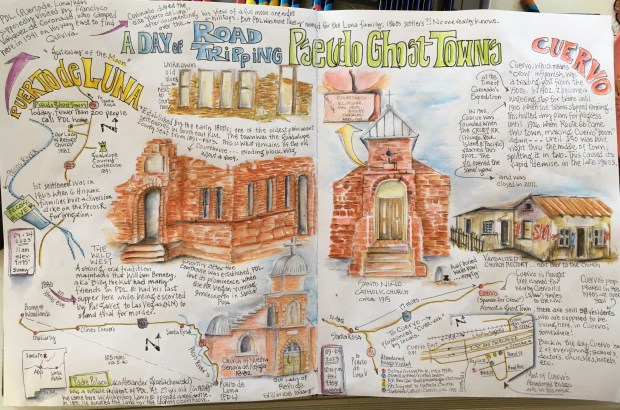
Wow! Time is flying. Here we are already well into the beautiful month of October, and realized my journal pages from our late September road trip fell asleep in the back seat of the car! But I felt my record of this day trip was worth sharing, especially since Halloween is fast approaching, and ghost towns are all the rage!
New Mexico always surprises and delights, and our trip to explore the pseudo ghost town of Cuervo, became two destinations. While in route to Cuervo, we found a curious notation on the highway map referencing the historic village of Puerto de Luna. Only a short, 9.5 mile detour south of Santa Rosa, we decided to check it out.
Puerto de Luna, NM The village of Puerto de Luna, Gateway of the Moon, is still inhabited, mostly on the West side of the Pecos River. However there are many wrecked and ruined buildings east of the river; enough to merit the label “Pseudo Ghost Town.” After a scenic ride through country used primarily to grow wheat and for livestock grazing, travelers first encounter the well maintained Church of Nuestra Senora del Refugio. Built in 1882, the church is still in use today. Just SE of the church sits the remains of the original Guadalupe County Courthouse. Constructed in 1891 of sandstone brick and blocks, it was only used for a few years. . Before the county seat was moved to Santa Rosa in 1903, a second, much larger building was constructed on the west side of the Pecos, which today is being used as the senior center. Not much remains of the original courthouse; the roof and half of the walls are piles of rubble lying inside the structure. The photos below show the changes from then to now.
Guadalupe County Courthouse, Puerto de Luna, 1891
Remains of Guadalupe Co Courthouse, Puerto de Luna, 2023
Looking inside the remains of Guadalupe Co Courthouse, 2023
Our brief visit to Puerto de Luna was fun. We learned about some of the pre-village history, like the Spanish explorer Coronado was said to have passed this location in 1541, naming the site Puerto de Luna after seeing a spectacular moon rise. And then there’s the more recent account from 1880, involving Billy the Kid and his last dinner here before being escorted by Pat Garret to Las Vegas, NM to stand trial for murder. After a hour of poking about a few more abandoned buildings, we headed back north to Santa Rosa and east 17 miles to our next pseudo ghost town.
Cuervo, NM ….. don’t blink or you’ll miss it!
If you zoom along on I-40 at 75-80 mph, heading east or west, and happen to blink, you’ll surely miss what remains of the old trading post and railroad town of Cuervo. Spanish for “crow,” Cuervo was officially established in 1902 as a watering stop for the CRI&P railroad. When the trains stopped running in 1910, the population declined, and businesses closed. But things took a turn for the better, when in 1926, Route 66 came through town, and Cuervo boomed again. By the 1940s, the population grew to 300, and had 2 of everything ….. schools, gas stations, hotels, churches, doctors, etc. All was just peachy for Cuervo until the late 1960s when the highway department decided to build I-40 right through town, slicing it in two and causing its rapid demise. Although the post office officially closed in 2011, the 58 permanent residents calling Cuervo home still have and use the old zip code, where they get their mail is anyone’s guess. Oh, and if you exit the highway hoping to fill up your tank, think again. Even though there’s a gas station sign that looks like it’s inviting you to stop, there’s no gas, or snacks …. nothing. Just a bunch of dusty roads, crumbled and weathered buildings, and tumbleweeds blowing in the wind.
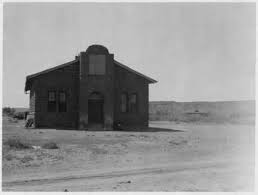
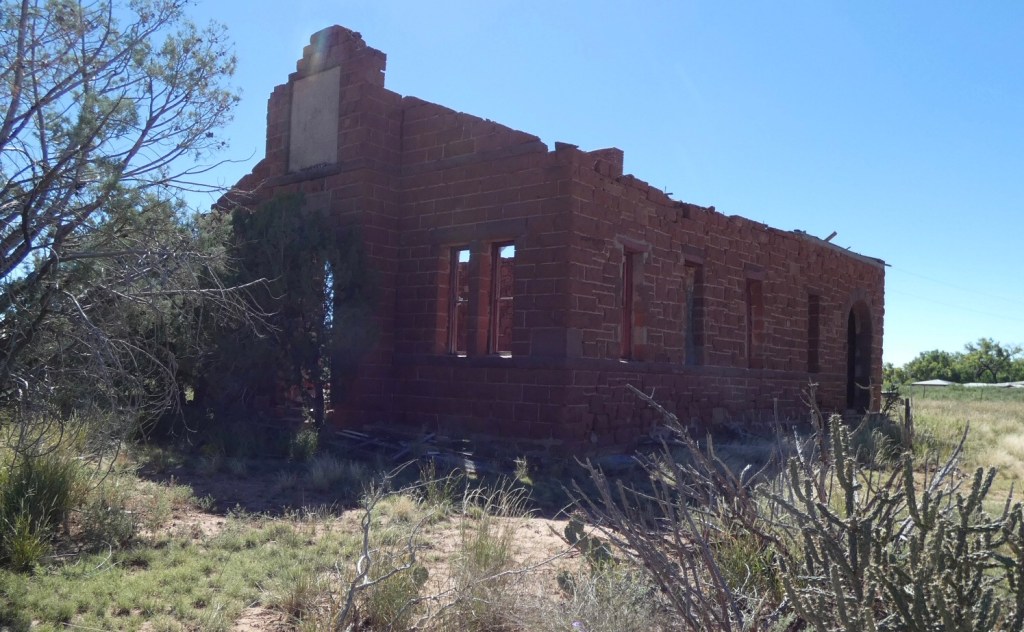
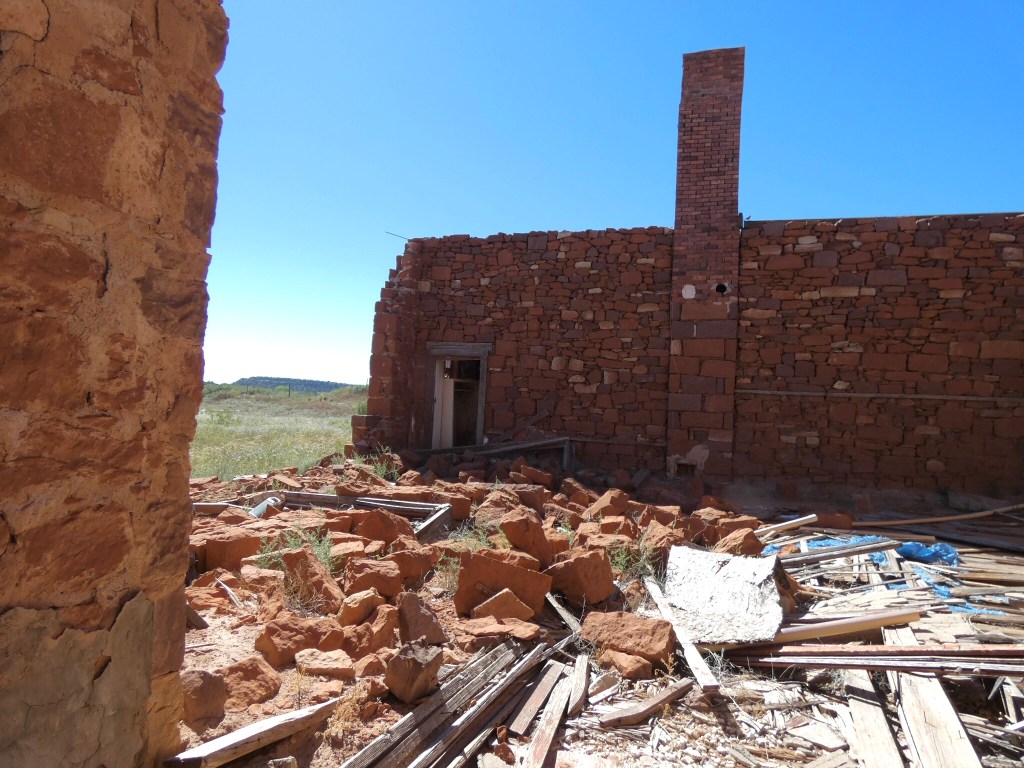
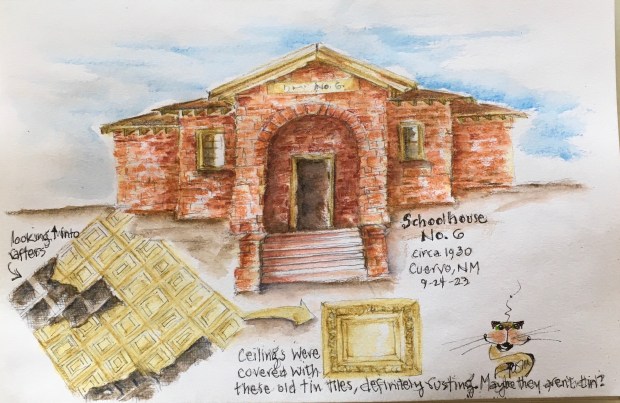
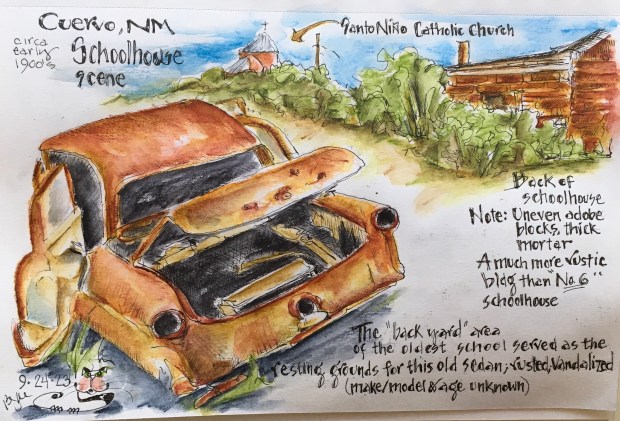
We spent a few hours poking about the old town grid, exploring a handful of abandoned properties. The old 1915 Catholic Church is padlocked, but opened on Sundays for service. The 1930s schoolhouse appears to be undergoing some renovation. And signs of more prosperous times exist when the old steam engines used to run into town to resupply. Actually there’s been very minimal vandalism considering how close Cuervo is to the interstate, but there’s one serious blemish that made headline news a few years back. The Baptist church was the site of some pretty scary satanic rituals; and it’s thought these practices conducted in the church by the perpetrator resulted in the disappearance and murder of a number of people. We chose not to investigate.
The 1930s Schoolhouse, Cuervo, NM
Early 1900s Schoolhouse and abandoned sedan, Cuervo, NM
Old wooden home and water storage bldg, Cuervo, NM
Boxcars, then and now …. which do you prefer? Cuervo, NM
And that concludes my post. Hope you enjoyed reading a bit about life as it was and is today in and around two interesting pseudo ghost towns located in central in New Mexico. I’d be very interested in knowing if you explore ghostly history where you live! Have an awesome day, and remember to be curious!
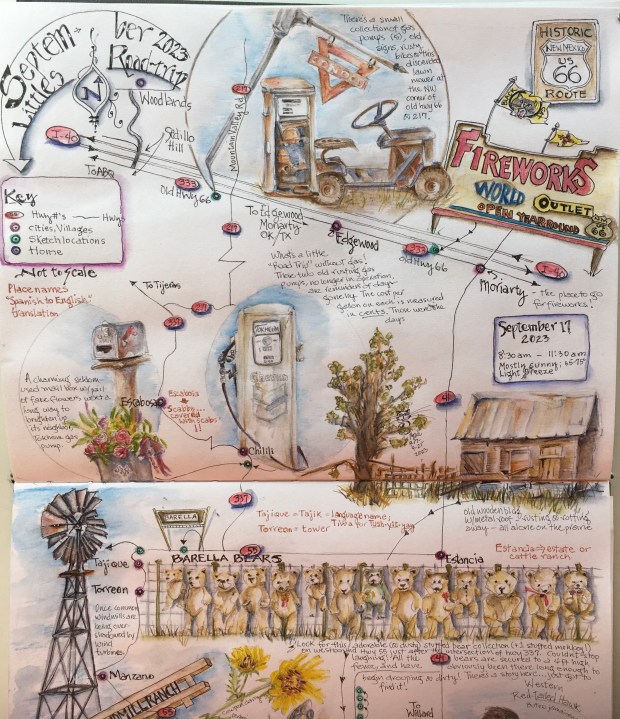
Ahhhh, September! The month of slowing down, hints of crisp morning air, tree leaves turning ever so slightly from green to golden, a bit of wanderlust satisfied.
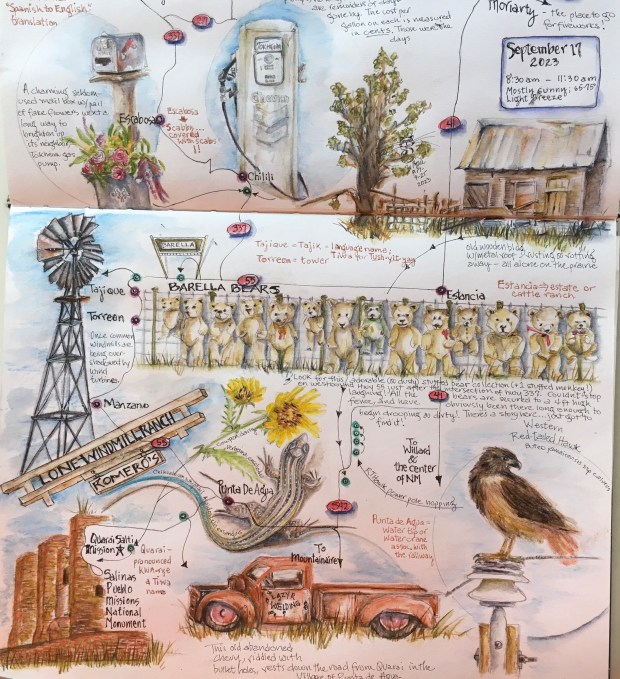
Instead of creating “Little” paintings of a month of highlights, and there have been many, I decided to focus on a single “Little” road-trip down the east side of the Manzano Mountains. My goal was to take a fresh look at, well, everything …….. and watch as the story of rural life unfolded.
As we wound our way along scenic backroads, I mentally sketched out our route map to depict some of the historic and present day highlights across the landscape. My imagination envisioned the full, prosperous and peaceful village life of the Tiwa Indians, and their conquest and struggle to survive Spanish occupation. There was evidence of the optimistic outlook of early settlers who came west to build a life centered around dryland farming and ranching. And today, modern day ranchers live on the land adjacent to land grants where indigenous peoples live a rural lifestyle on their native lands. I hope you enjoy my route map with some of these highlights, ranging from serious to funny, natural to commercial.
I’d love to know what story unfolds for you as you travel along on this September “Littles” Road-trip. Be sure to pack a lunch!
Once again, a big shout-out to “Made by Fay” for the inspiring “Littles” idea! These pages are fun to create, and remind me of monthly highlights and the random road-trip as I revisit my previous “Littles” posts. Hope you’re enjoying them too, along with the ending days of the season. Stay tuned for the next installment of “Littles.”
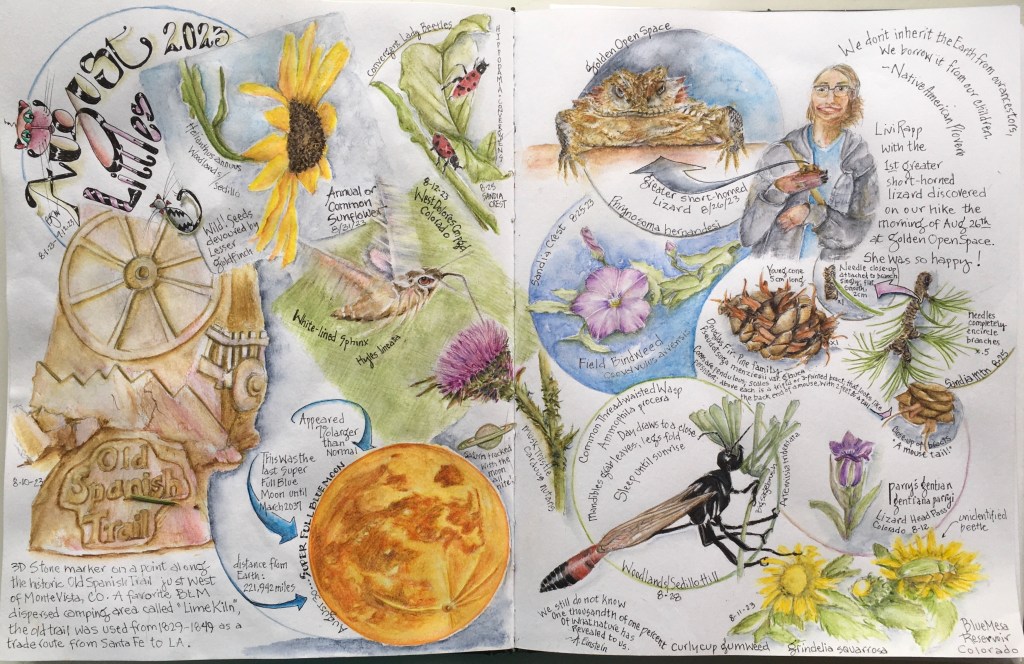
August was a busy month, filled with high elevation camping in Colorado, and a lot of cool mountain hiking back home. Even though the lower elevations took on a hot and parched look, at 9,000 feet and higher the wildflower season was far from over as evidenced along roadways and trails, where fresh, colorful blooms could still be found.
The highlight of the month was a 3-1/2 day visit from my brother Bob and grandniece Livi. At 15 years of age, Livi is already a fine artist, and took to nature journaling like a pro! It was great fun discovering and sketching nature on our daily hikes. She even got a chance to hold one of the adult ornate short-horned lizards we see frequently along various trails, and then found a baby lizard on her own, hiding nearly motionless under a small plant. Her smiles were priceless!
Despite the high temps, it was a month of good days and nights, ending perfectly with the rising of a rare Super Full Blue Moon! If you missed it, there’s plenty of time to prepare for the next …… which occurs in March 2037.
Once again, a big shout-out to “Made by Fay” for the inspiring “Littles” idea! These pages are fun to create, and remind me of monthly highlights as I revisit my previous “Littles” posts. Hope you’re enjoying them too, along with the ending days of the season. Stay tuned for the next installment of “Littles.”
After sitting idle for many months, The Felix was begging for a short adventure! So we loaded up and off we headed …… north into high elevation Colorado, to enjoy some cool temps and breathtaking scenery.
A quick 822 mile loop in 4-1/2 days met all of our goals plus we enjoyed afternoon thunderstorms and a few rain showers.
Follow the link below to read about our trip as I narrate my daily journal pages.
Sabino Canyon Open Space, a scenic area for a hike, is found just south of the town of Tijeras in the Manzano Mountains. with less than 120 acres of gently sloping meadows, surrounded by piñon pine and juniper trees, the area has been inhabited since 5500 B.C.
Needless to say, Sabino Canyon has “history,” some of which is on display by walking a short distance uphill from the parking area.
Between the 1600s and 1800s, the meadows of today were actively farmed for pinto beans and potatoes to support the small village of Sabino, of which little is known. However, the area became map worthy when in the 1920s, the Riedling family of musical fame, owned and operated the Riedmont Silver Fox Farm located within the west half of today’s Sabino Canyon Open Space property. Fur coats and capes were all the rage in the 1920s, and the farm raised between 300-500 silver fox, along with minx and rabbit to help supply the demand. When the fur market crashed in the late 1930s, the fox farm was abandoned. What remains are the fox, minx and rabbit enclosures, a water tower, and several outbuildings, all of which seem to be melting back into the landscape.
Visiting this historic area, it was hard to think about such beautiful animals living their lives out in small cages, only to be killed for their fur.
As we walked around the rapidly deteriorating farm buildings (it doesn’t appear any effort is being made to restore the structures), I unwittingly plowed through large patches of gnarly dried out cheatgrass hiding thickets of heavily seeded forget-me-nots. Ouch! When looking down at my socks, boots and boot laces, I wasn’t surprised to find hundreds of seeds had seemingly “jumped” and clamped snugly aboard! So for the next 30 minutes, I plucked and pulled enough of those pesky hitchhikers to allow me to hike on out of there!
A memorable hike back into history….. one I won’t soon “Forget!”








 a curious nature