Ohhhhhh, what a sweet month …… August. It almost got away from me without sharing a small collection of Littles1 that reflect the inevitable shifts in nature that occur during the month. It’s always hard to imagine summer winding down; where did the time go? But as surely as butter melts on freshly baked bread, undeniably, August forms a reliable bridge between summer and autumn. It’s a time of change and transition; abundance and harvest; transformation and a period of letting go.
So before I “let go” and before the snow flies (and it will), here’s a handful of little discoveries during the month of August:
-A female Wheel Bug gone slightly astray while searching for a protected place to overwinter the eggs she’s about to lay.
-A female Soldier Beetle doing her best to attract a mate by sending out pheromones while munching late season pollen from the disk flowers of a brilliant yellow Showy Goldeneye.
-An acorn that made it to maturity, ready to drop beneath a still green-leaved Gambel Oak soon to be decked out in radiant fall colors.
-Some hot red trumpet-shaped Scarlet Gilia flowers, still irresistible to hummingbirds until migration, will all be pollinated in time for seed set and mature.
-The snowy white fruit dangling from the draping branches of Roundleaf Snowberry shrubs are ripe and ready for plucking by hungry birds flying south for the winter.
-And plump purple-black Chokecherry berries that will become a juicy dietary supplement for black bears needing to bulk up for hibernation.
Enjoy!
And as always, thanks for dropping by!
1“Littles” is part of a blog series I began posting several years ago, beginning in January 2023. The concept was inspired by Fay (thanks again Fay!) who came up with the idea for her blog madebyfay.wordpress.com
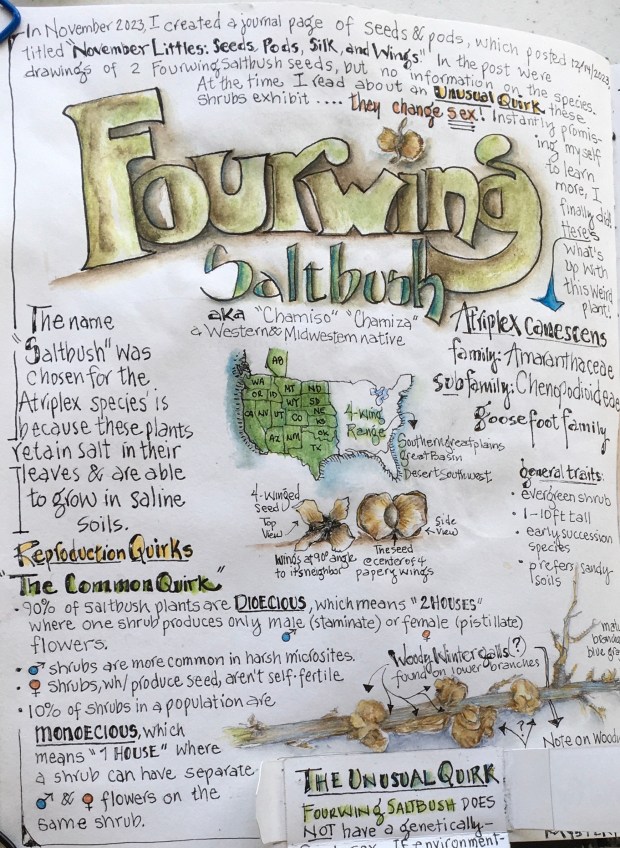
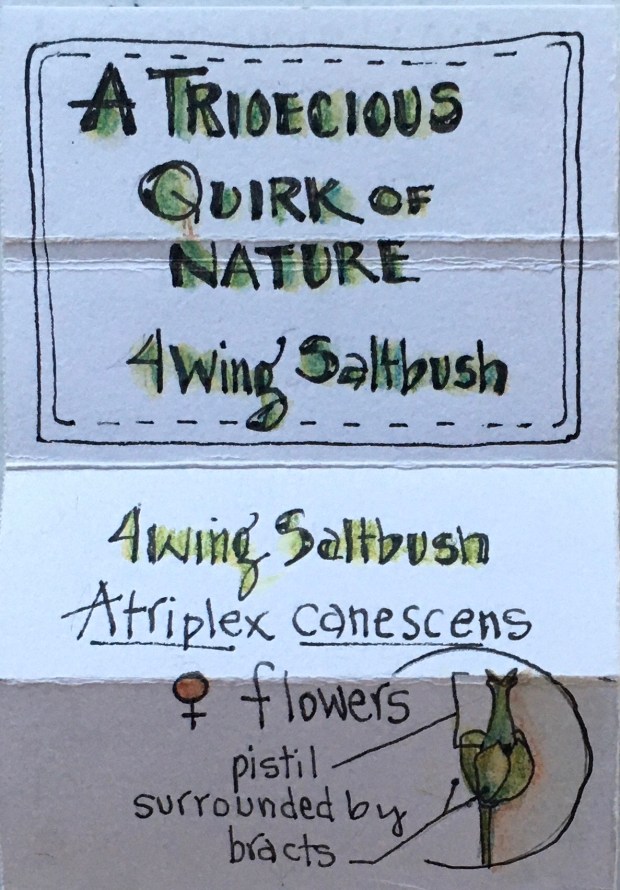
In November 2023, I created a journal page of seeds and seed pods, which posted on 12/14/2023, under the title November Littles: Seeds, Pods, Silk, and Wings. On that page was a small drawing of two Fourwing Saltbush seeds, absent any information about this plant species, Atriplexcanescens. At that time I remember finding a wealth of articles and research documents about this widespread shrub, but what really stuck in my mind was a very unusual quirk exhibited by this plant. Finally, a year later and WOW! I discovered Fourwing Saltbush has a reproductive superpower …… this species has the ability to change sex!
An Unusual Quirk
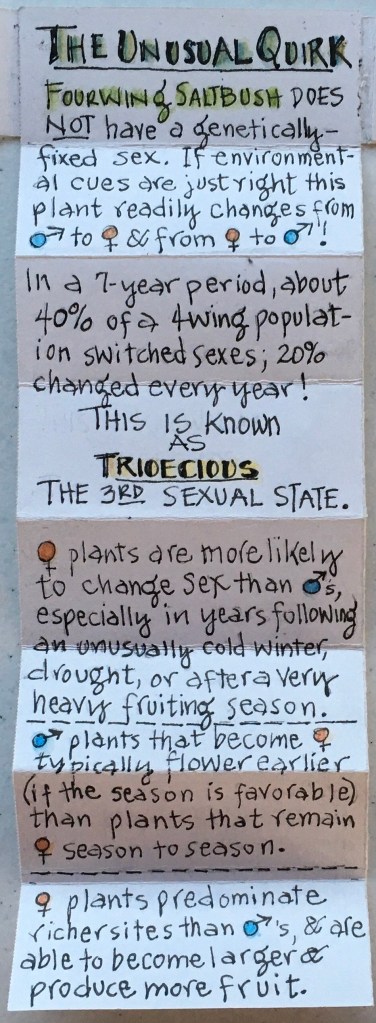
My first dive into the literature revealed that within a 7-year period of time, 40% of a Fourwing population switches sexes with 20% of a population changing sex every year. Botanically, this is known as Trioecious, or the 3rd Sexual State.
But clearly a bit of back peddling is needed ……. if Trioecious is the 3rd Sexual State in plants, what about the 1st and 2nd sexual states, huh? Yes, they exist …….. but before explaining them, which requires comparison with the more common sexual state in plants, I must describe this sexual norm.
And now for a little Botany 101 ……..
The Sexual Norm …… Plants with Perfect or Complete Flowers
You are likely familiar with plants like roses, tulips, lilies, garden strawberries, beans, peas and cabbage. If you’ve closely examined their flowers while inhaling their fragrant aromas, you may have noticed their centers have both female and male parts. These are known as plants with Perfect or Complete flowers (aka hermaphroditic or bisexual) defined by each individual flower having a fully functional pistil (the female part) and stamens (the male parts). Worldwide, about 90% of flowering plants have Perfect or Complete flowers.
Monoecious ….. the 1st Sexual State
Here again you are likely familiar with many plant species described as Monoecious (moh-NEE-shuhs). These include corn, all of the plants in the gourd family (i.e. cucumber, squash, watermelon), oak, birch, pine, spruce and dogwood. Monoecious, which means “one house” in Greek, describes plants having separate female and male flowers in different places on the same plant, often blooming at different times. Visualize corn growing in a field; the tassels are the male (staminate) flowers, and the corn kernels you eat are the female (pistillate) flowers. Around 10% of all flowering plant species worldwide are Monoecious.
Not to confuse the matter, but sometimes botanical experts refer to Monoecious species as Perfect or Complete because they have both male and female flowers on the same plant, even though these flowers are separate and considered sexually Incomplete (aka unisexual) by themselves.
Dioecious ….. the 2nd Sexual State
A plant species with individual plants in a population having only female flowers, and individual plants of the same species in the same population with only male flowers is called Dioecious (dahy-EE-shuhs). This Greek word meaning “two houses,” describes plants such as spinach, asparagus, sumac, currant, box elder, willow, holly, ginkgo, juniper and aspen. Only 5% of all flowering plant species worldwide are Dioecious.
Another confusing matter once again. There are botanical experts that refer to plant species with Perfect or Complete flowers as Dioecious because they require cross-pollination to produce seeds (fruit). Tree fruit species such as apples, pears, cherries and plums are common examples.
Trioecious ….. the 3rd Sexual State
An extremely rare reproductive strategy among flowering plants, Trioecious (aka trimonoecious or “three houses”), is characterized by a species that can have Incomplete (unisexual) male, Incomplete (unisexual) female, and Perfect or Complete (bisexual or hermaphroditic) male/female flowers on separate plants in a population or even all on the same plant! Just over 3% flowering plant species worldwide are Trioecious (trahy-EE-shuhs).
This is where Fourwing Saltbush (Atriplexcanescens) enters the story
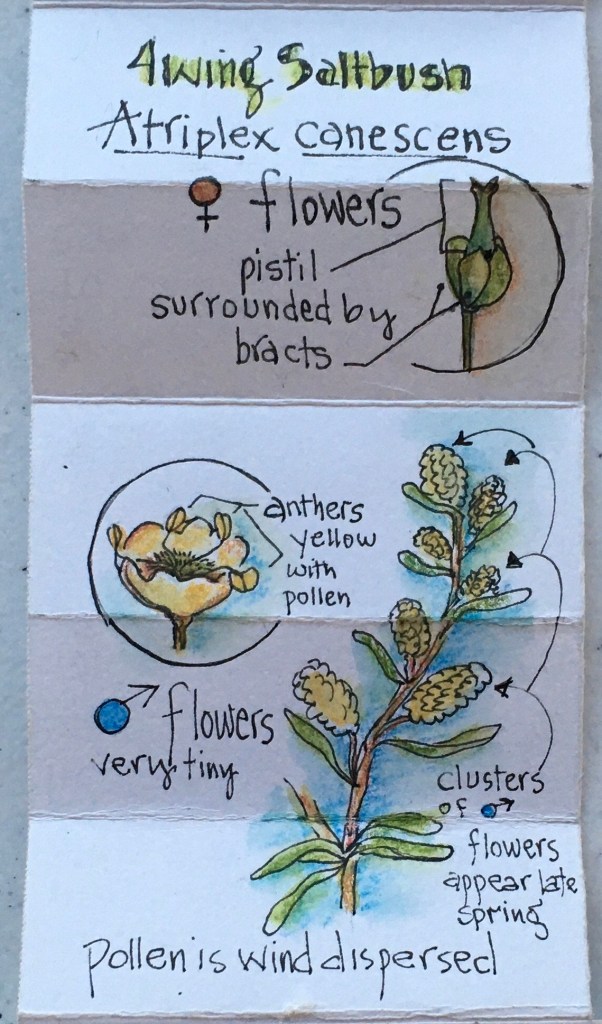
Primarily a Dioecious species, some Fourwing Saltbush populations have a Monoecious component ranging from entirely male (staminate) or female (pistillate) individuals to those that are Perfect or Complete (hermaphroditic or bisexual). And in this Dioecious–Monoecious–Hermaphroditic gender system, referred to as Trioecy, switching sexes occurs. To reiterate from an earlier paragraph, on average, in a 7-year period, about 40% of a Fourwing Saltbush population switches sexes with 20% changing from male to female or from female to male every year.
Reasons Behind and Benefits of Fourwing’s Sex Change Phenomenon
Fourwing Saltbush has evolved to be one of the most adaptable plant species found throughout central and the western US. It grows from sea level to 8500 feet elevation, and in a multitude habitats within a wide range of plant communities, no matter the successional stage. Fourwing can adapt to all soil textures, soil depths and all but the wettest of soil conditions. The species is able to tolerate hot (+100F) and dry (6” precipitation annually) summers, and bitter cold (-50F) and dry winters.
The ability of the species to adapt to such a wide range of physical and climatic conditions is, in part, due to this sex change phenomenon. Environmental stressors seem to be the major triggers resulting in Fourwing plants switching sexes. Female plants are more likely to change sex than male plants, especially following a drought, an extremely cold winter, or after a heavy fruiting season. Because fourwing is so tasty as range forage, overgrazing can also trigger a sex change, with male plants tending to dominate regularly grazed sites. Male plants that change to female typically flower earlier than plants that remain female season after season. And female plants dominate richer sites than do male plants, becoming larger and producing more seed.
Undoubtably there’s more environmental stressors, such as wildfire and other climate change-induced factors, that may result in Fourwing Saltbush to switch sex. I’ll be curious to learn what they are and how these triggers influence the adaptability and survivability of this robust species. And I’m excited get busy marking this season’s female and male plants that we see nearly every day, and will begin more closely observing these populations for gender changes and possible stressors that may have triggered these switches.
A Retrospective and Thoughts on Prospective Studies
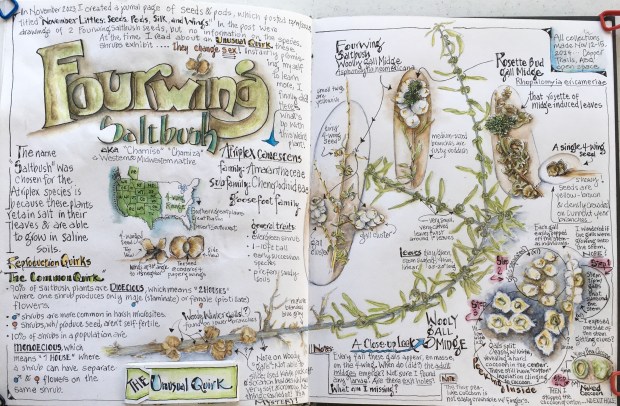
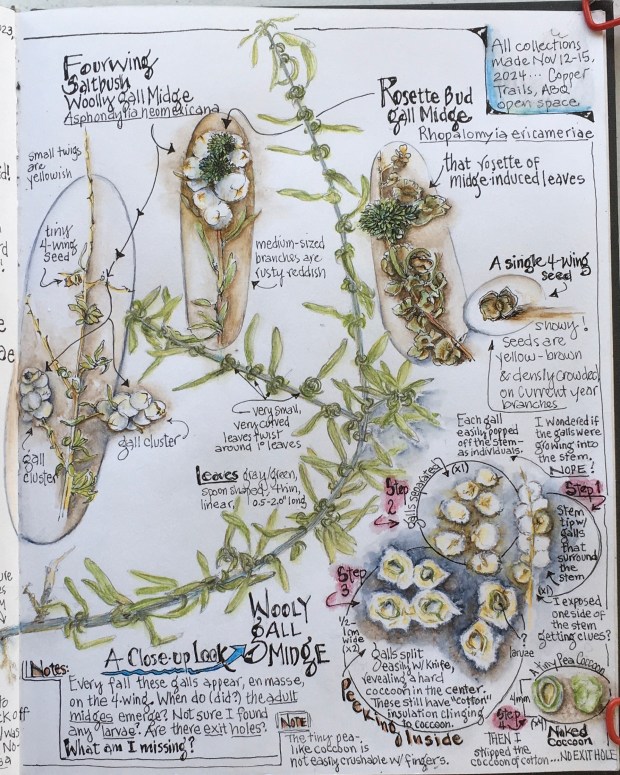
There’s so much to learn about Fourwing Saltbush that it seemed logical to tackle one characteristic at a time. Originally I had planned to discuss both the plant’s reproductive quirk and several of its common galls, but found there would be too much information for one post. While deciphering the complexities of the Fourwing’s sex change abilities, I found it necessary to describe certain key botanical terms in my buildup to the crucial piece of the puzzle ….. the Trioecious reproductive strategy. So this post focused on the first of my two journal pages; my beginning exploration into this plant. The galls illustrated on my second journal page, that could not be easily chopped away from the first page, serve as a preview of a future post about the fascinating Fourwing Saltbush.
And Finally ……….
For a shrub I used to describe as a messy tangle of branches haphazardly cloaked with unremarkable features like dusty little grey-green leaves, nearly invisible flowers, shreddy dull grey trunks and a chaotic canopy, Fourwing Saltbush has captured my imagination, respect, and love as an almost invincible survivor of our changing world!
Hopefully you found this interesting and informative. Bet you never look at flowering plants in casual ways again. Let me know if you are familiar with Fourwing Saltbush. Where does it grow? Have you ever marveled at the thousands of winged seeds densely crowded at the tops of these shrubs? And then satisfied an irresistible urge to strip dozens of skinny branches of those ripe seeds, tossing them in the air like confetti? If so, please share.
As the Fall season rapidly came and went, and the first snows blanketed the landscape, I focused my hiking time (and some of my drawing hours) on collecting local native seeds. Always careful that plenty of seeds remained available for overwintering birds, I still managed to harvest hundreds from about 25 plant species. All sorted and packaged in separate pill containers, my collection is now stored in the refrigerator at 40 degrees, until growing conditions are optimal for planting. This treatment method is referred to as stratification.**
Why collect native seeds? All throughout the Spring, Summer and Fall, a diverse assortment of pollinators visited our locally blooming wildflowers and shrubs. Along with these butterflies, moths, bees, wasps, beetles and flies, were the insects, spiders, and birds that prey on unwary pollinators. Such an amazing show; a kaleidoscope of colors and shapes! The air was a buzz with activity. My goal is to mimic the native banquet in hopes of attracting these pollinators and predators.
Also, seeds are absolutely fascinating. I like to think of them as gift-wrapped, living plants-to-be. Tucked neatly inside of the seed coat are food stores enough to feed the makings of a complex root system; flowers, leaves, stems, branches and even a trunk. Seeds can be tiny, some microscopic and some as large as a softball. Seeds come in a variety of shapes, colors, textures and decor both inside and out. Some seeds have “wings” to fly; some have silky or puffy “feathers” to float; some are like “lead,” heavy enough to intentionally sink under water.
So I pulled out my 10x hand lens to investigate, drawing most of the seed species in my collection. It was very cool to compare seeds of different species that are in the same family (like the composites of the Aster family and the penstemons of the Plantain family). Until creating this journal page, I’d never held the seeds of 3 different species of yucca in one hand at the same time. Observing the similarities and differences, I finally confirmed in my mind that the genus Herperaloe and Yucca are indeed in the Agave family. And then I found examples of seeds from completely different families that evolved similar dispersal mechanisms (convergent evolution). This phenomenon was visually obvious in the delicate feathery, silky, and poofy hairs or bristles attached to grass, aster, and milkweed seeds, facilitating seed dispersal by wind.
Finally, I felt the need to draw the seeds in case they happened to spill into one big jumble while being planted! Yes, I would be clumsy enough to create chaos out of order. Should that happen, I’ll be able to sort the mess by species by referring to my field guide page.
** Seed-producing plants pass along to their seeds the specific requirements(s) necessary to break dormancy and germinate. These genetic codes determine if optimal conditions exist for seeds to sprout and hopefully grow to maturity. But key to successful germination depends on seed ripeness (in most cases). Knowing the plant species from which a seed is produced; whether the plant is an annual, biennial or perennial; habitat, moisture needs and the type of “treatment” method(s) are all important bits of information tied to successful germination.
I’ll have to create a future post describing the variety of treatment methods (germination patterns) inherent in the seeds.
Are you a seed collector? If so, share your why’s and how’s!
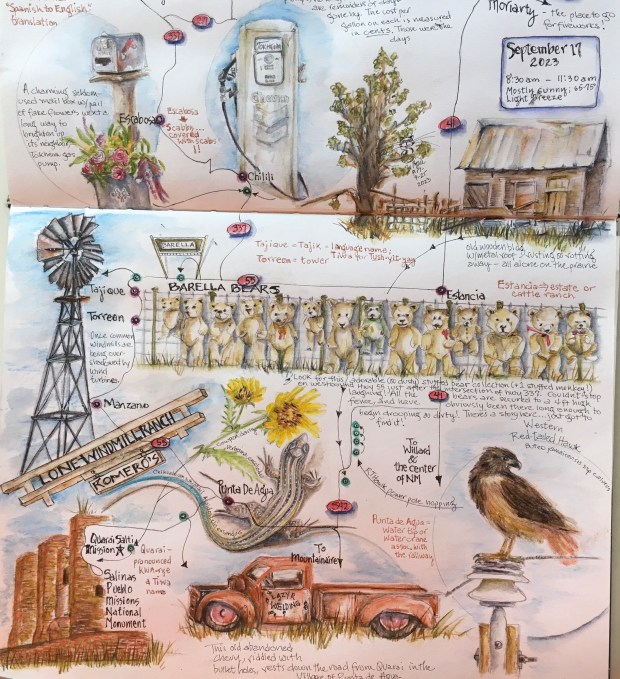
Ahhhh, September! The month of slowing down, hints of crisp morning air, tree leaves turning ever so slightly from green to golden, a bit of wanderlust satisfied.
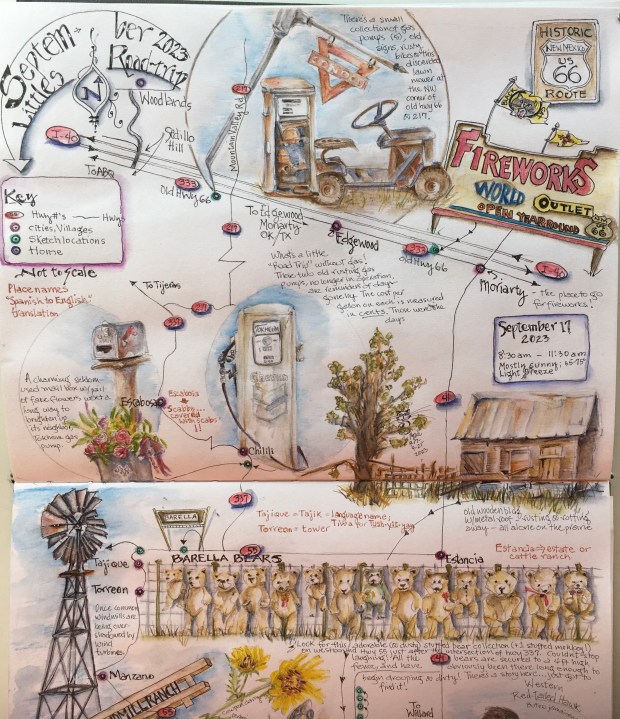
Instead of creating “Little” paintings of a month of highlights, and there have been many, I decided to focus on a single “Little” road-trip down the east side of the Manzano Mountains. My goal was to take a fresh look at, well, everything …….. and watch as the story of rural life unfolded.
As we wound our way along scenic backroads, I mentally sketched out our route map to depict some of the historic and present day highlights across the landscape. My imagination envisioned the full, prosperous and peaceful village life of the Tiwa Indians, and their conquest and struggle to survive Spanish occupation. There was evidence of the optimistic outlook of early settlers who came west to build a life centered around dryland farming and ranching. And today, modern day ranchers live on the land adjacent to land grants where indigenous peoples live a rural lifestyle on their native lands. I hope you enjoy my route map with some of these highlights, ranging from serious to funny, natural to commercial.
I’d love to know what story unfolds for you as you travel along on this September “Littles” Road-trip. Be sure to pack a lunch!
Once again, a big shout-out to “Made by Fay” for the inspiring “Littles” idea! These pages are fun to create, and remind me of monthly highlights and the random road-trip as I revisit my previous “Littles” posts. Hope you’re enjoying them too, along with the ending days of the season. Stay tuned for the next installment of “Littles.”
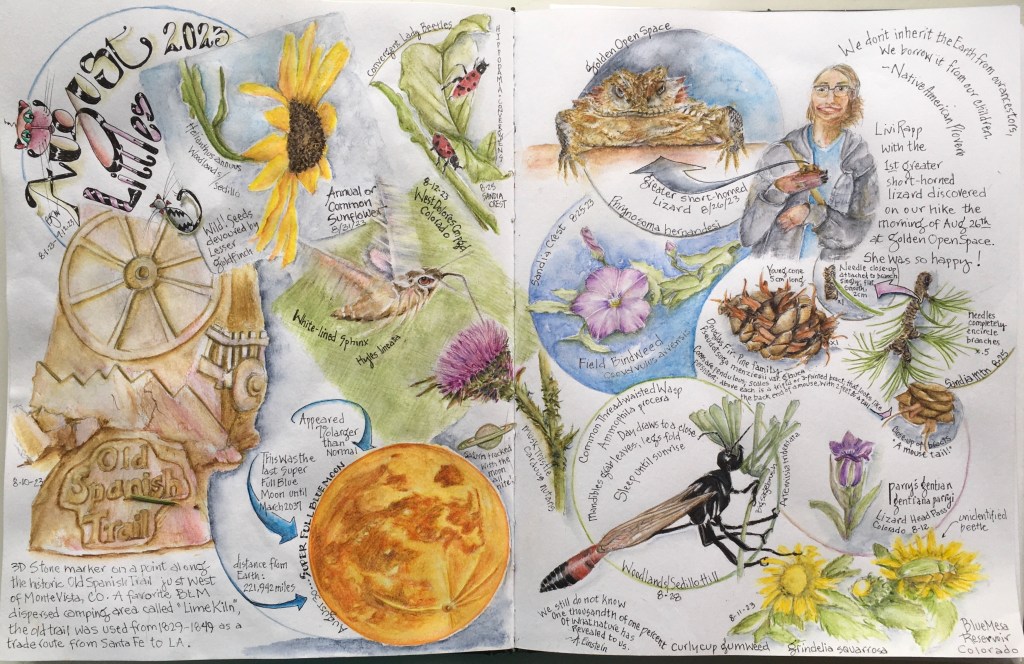
August was a busy month, filled with high elevation camping in Colorado, and a lot of cool mountain hiking back home. Even though the lower elevations took on a hot and parched look, at 9,000 feet and higher the wildflower season was far from over as evidenced along roadways and trails, where fresh, colorful blooms could still be found.
The highlight of the month was a 3-1/2 day visit from my brother Bob and grandniece Livi. At 15 years of age, Livi is already a fine artist, and took to nature journaling like a pro! It was great fun discovering and sketching nature on our daily hikes. She even got a chance to hold one of the adult ornate short-horned lizards we see frequently along various trails, and then found a baby lizard on her own, hiding nearly motionless under a small plant. Her smiles were priceless!
Despite the high temps, it was a month of good days and nights, ending perfectly with the rising of a rare Super Full Blue Moon! If you missed it, there’s plenty of time to prepare for the next …… which occurs in March 2037.
Once again, a big shout-out to “Made by Fay” for the inspiring “Littles” idea! These pages are fun to create, and remind me of monthly highlights as I revisit my previous “Littles” posts. Hope you’re enjoying them too, along with the ending days of the season. Stay tuned for the next installment of “Littles.”
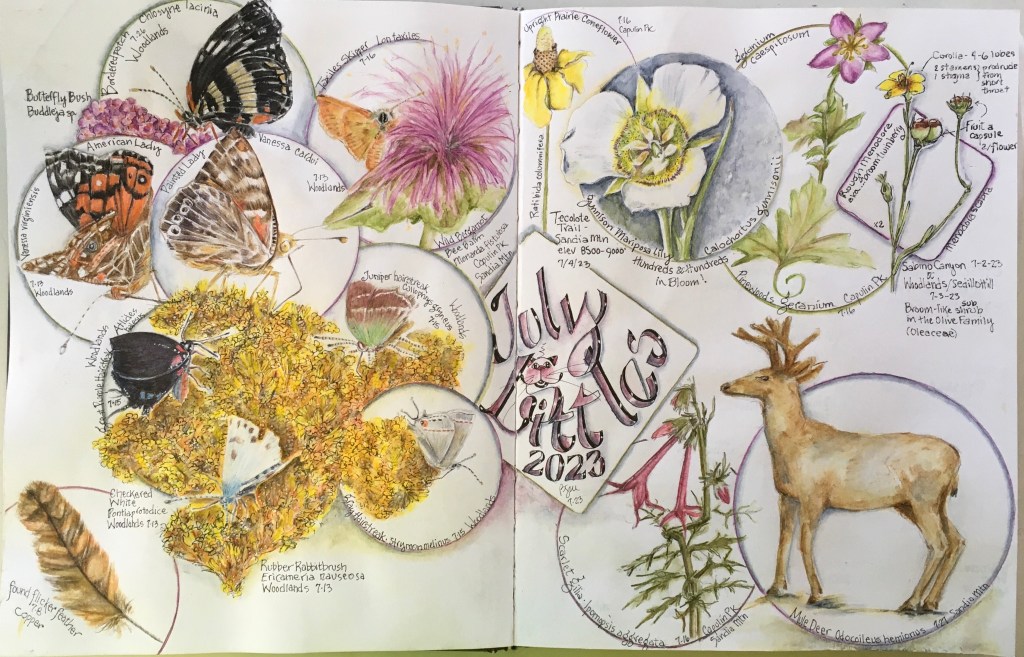
June’s hot, dry weather slipped stealthily into July as we became mired in one of those infamous heat domes for weeks. Our rabbitbrush shrubs, usually late summer bloomers, burst into piles of brilliant yellow flowers a full month before normal, and for the first week of their premature bloom, not a single pollinator was in sight. I was so concerned the over abundance of nectar would dry up, pollen would blow haphazardly away, and seeds wouldn’t form. Then one morning I woke to find hundreds of butterflies, weevils, flies and bees flitting, crawling and buzzing about, nearly covering the shrubs completely in a pollination frenzy! How did they know? Where did they come from? What a relief for me, but it must’ve been an unimaginable relief for all of those pollinators that happened upon our oasis in the desert.
And so it went, all month…. bursts of early blooms rapidly completing their floral life cycles, thanks to urgently feeding pollinators.
This is how I remember July, with everything in bloom at once, the air full of pollen and pollinators. It was quite a sight!
Once again, a big shout-out to “Made by Fay” for the inspiring “Littles” idea! Stay tuned for the next installment of “Littles.”
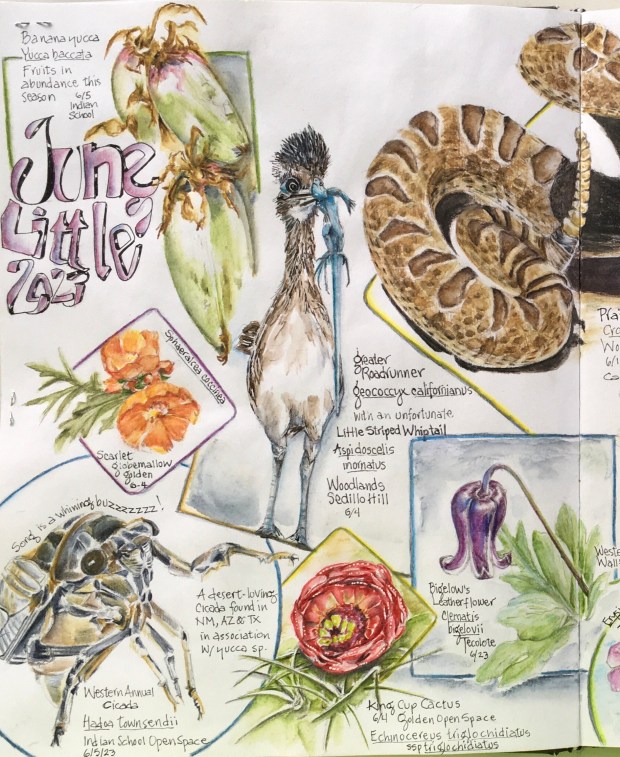
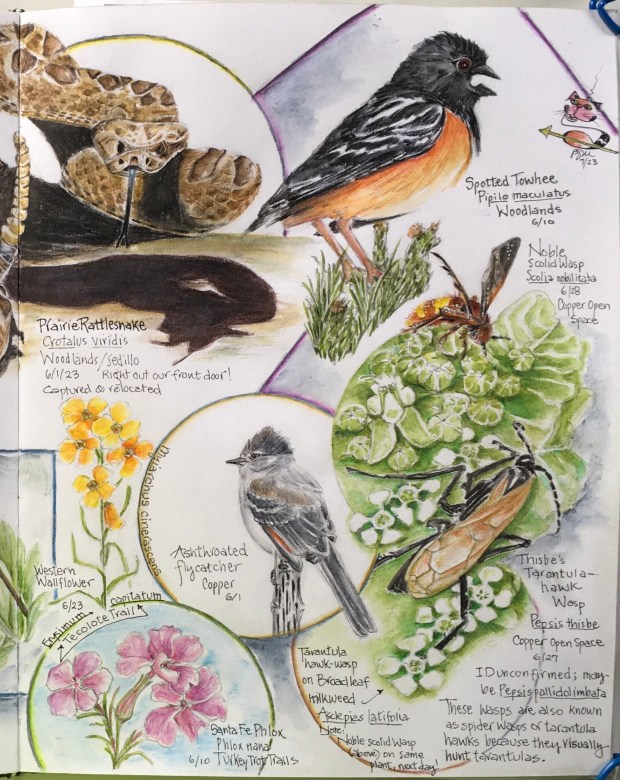
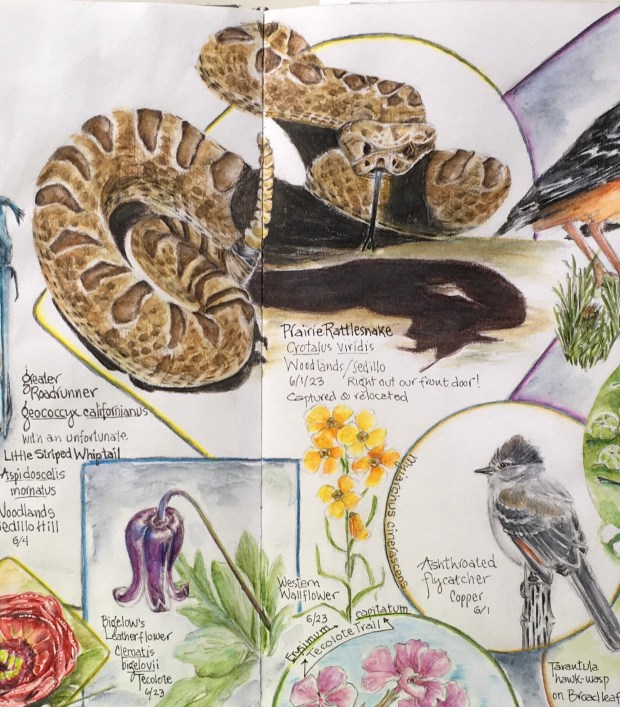
June was the month of bugs (from the big tarantula hawk wasps, to the microscopic gnats), withering flowers, disappearing birds, and snakes! We seemed to encounter an extraordinary number of snakes this month, including gopher (bull) snakes, diamondback rattlesnakes, patch nose snakes, garter snakes, and one very scary prairie rattlesnake. Read on for that story.
Another close-up
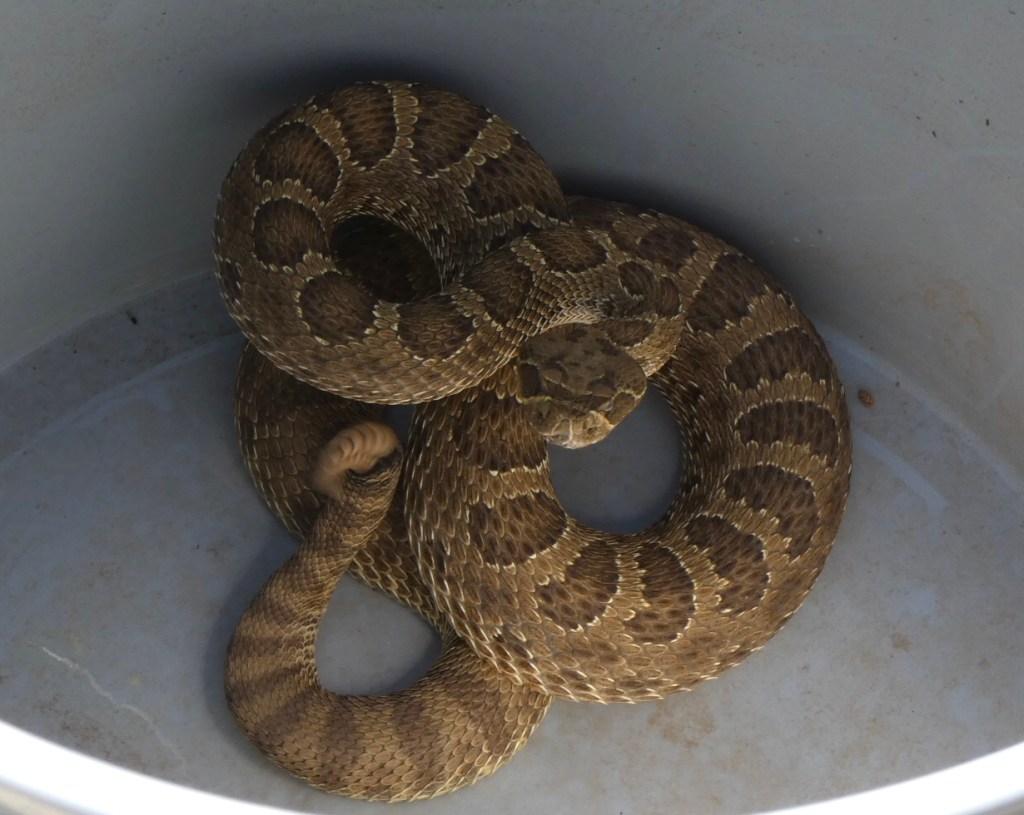
Luna and the Prairie Rattler! Our scariest encounter was with a 3-foot prairie rattlesnake right in our front courtyard. One day he had crawled out from the shade of a blue spruce to warm up in the morning sun. It was Luna that had changed his demeanor from placid to pissed off. Prairie rattlers don’t typically alert trespassers; that’s the secret to their hunting success, and Luna didn’t recognize the danger. She began sniffing around and unintentionally violated his personal space. The snake responded by instantly coiling and violently rattling his tail. The noise seemed deafening and was definitely alarming. As I came running to Luna’s rescue, Roy noticed the commotion and quickly arrived with snake stick and bucket in hand. By this time the snake had backed into a corner, furiously rattling, but was relatively easy to capture. Snake temporarily out of the way, we then carefully checked Luna for signs of snake bite (none detected! Lucky Luna).
Another close-up
Another close-up
Now back to the snake in bucket. It had taken less than 30 seconds for Roy to capture and slip him into the 5 gallon bucket. It was then that I was able to take my first photos, from a respectable distance just in case the snake decided to leap clear of the bucket!. If looks could kill, well ………….. About 15-20 photos later, the bucket lid was secured in place, and we took the snake for a little ride about a mile from home where he was carefully released in an uninhabited area, unharmed.
After release
Again, a big shout-out to “Made by Fay” for the inspiring “Littles” idea! Stay tuned for the next installment of “Littles.”
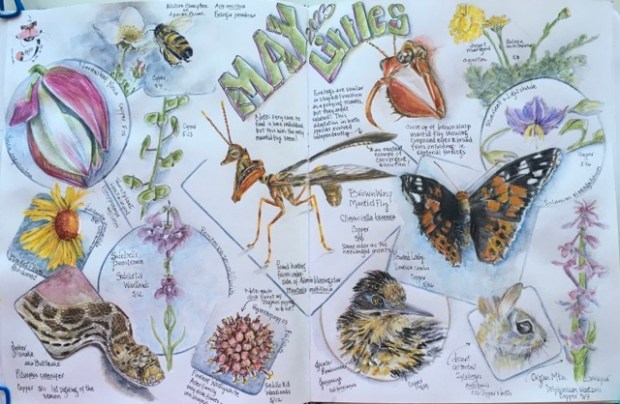
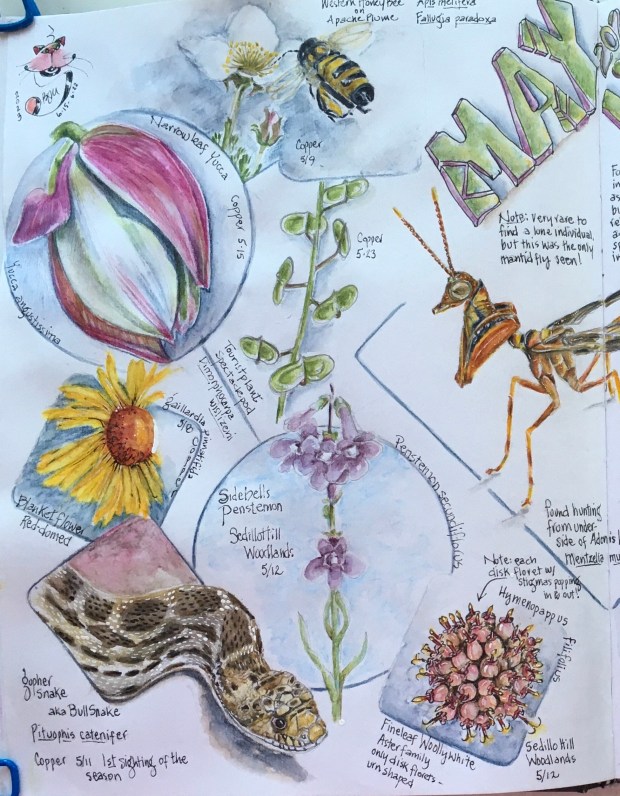
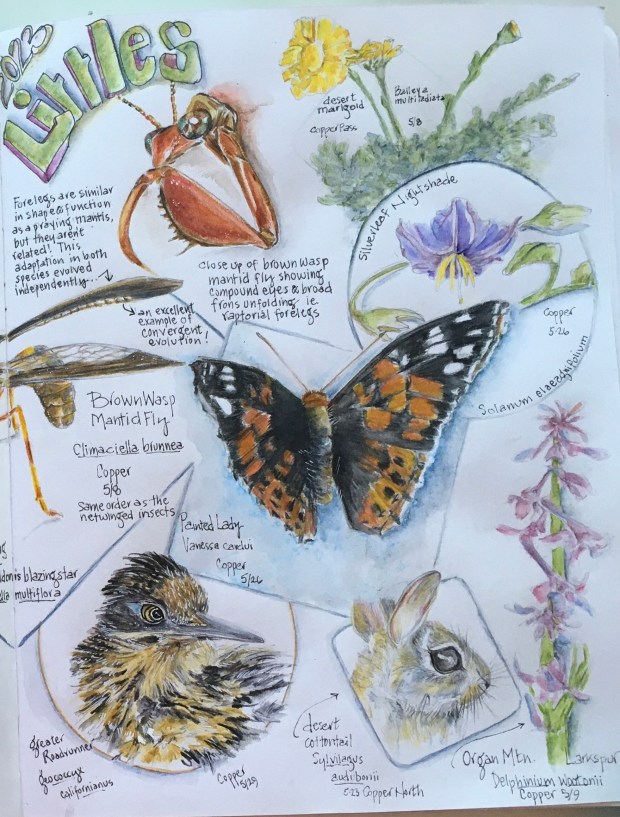
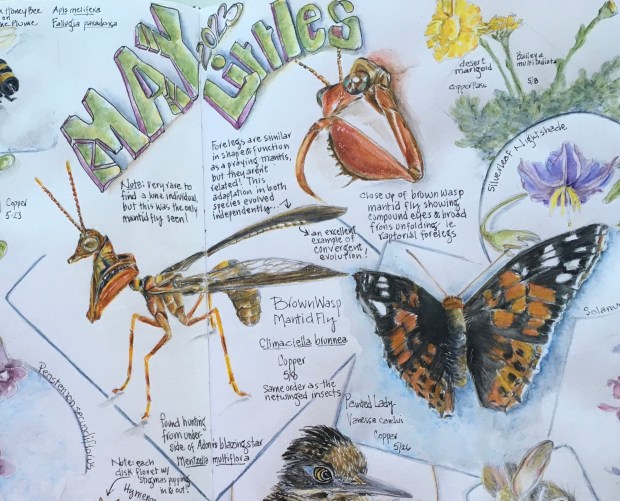
April may have been amazing, but it was nothing compared to the explosion of life during May. My 2-page spread doesn’t even come close to representing all that we encountered throughout the month. And the 15 species I chose as “picks” aren’t even a third of those making an appearance …… enter stage left and right!
Noticeably missing was the black chinned hummingbird. They arrived mid-May, and began defending breeding territories. One of these years, I hope to find one of their miniature nests to see what building materials the hummers use. Until then, their aerial performance is always breathtaking!
Close-up
Then there was the morning Luna nearly stepped right in the middle of a really upset, hissing and striking prairie rattlesnake, practically right out our front door! It was a scary few moments until we determined Luna did not get bit! Whew. Roy expertly wrangled up the guy, herding him into a 5-gallon bucket, and relocated him a safe distance away. (I may cheat and add him to my June “Littles,” if you don’t mind, along with the first rattlesnake encounter of the season! Gotta love the desert.)
Another close-up
Included in the long list of flowering plants, was prickly pear cactus. Several species began opening their buds to reveal 20-30 delicate waxy yellow to apricot colored petals per bloom. It didn’t take long for the pollinators to find these delicacies!
And Another close up
Blooming in the foothills (5,000’ up to 7300’ elevation), there was milkwort, fleabane, scarlet globemallow, banana yucca, sundrops, milkweed, paintbrush, golden weed, common hoptree, puccoon, several species of pink-flowered hedgehog cactus, blazingstars, bee blossom, tahoka daisy, NM thistle, ……. etc. I could go on and on! And even at nearly 9,000’ elevation, rock jasmine, valerian, creeping mahonia, prairie bluebells, pasque flower and dwarf lousewort were all in bloom.
All in all, a bountiful full-on Spring bloom!
A big shout-out to “Made by Fay” for the inspiring “Littles” idea! Stay tuned for the next installment of “Littles.”
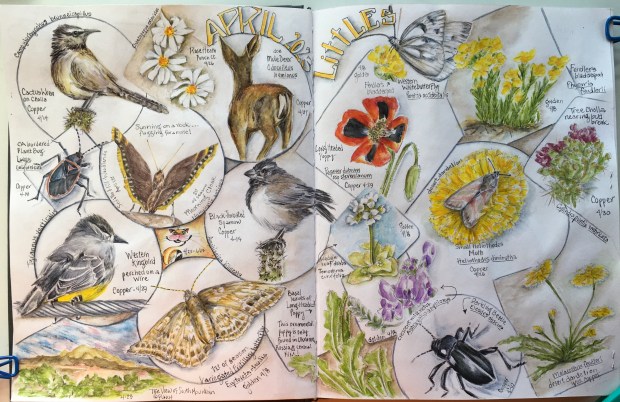
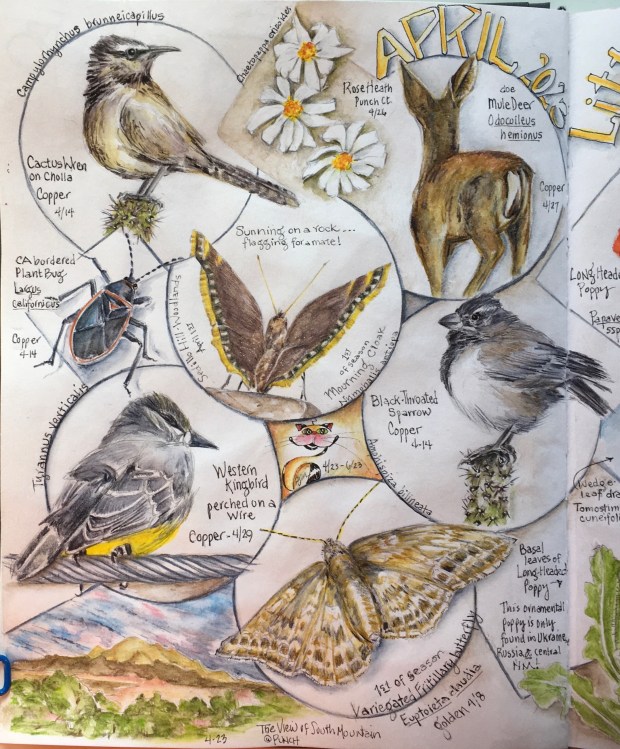
In the blink of an eye …… April! The dusty browns of late winter gave way to landscapes full of color! Movement was everywhere ….. Flower buds began opening as emerging insects smacked their lips in anticipation. Birds, flocking to their breeding grounds, had hungry eyes on the growing bug population. Hibernating reptiles began to stir as the earth warmed; lizards stretching sleepy legs in their underground burrows, that will help them flee slithering snakes; snakes wriggling and coiling and hissing, perhaps thinking about a breakfast of juicy lizard or a baby bird. Mule deer moved down from the surrounding hills to nibble fresh plant growth. Coyotes hunted desert cottontails as they snacked on prickly pear pads.
April was amazing! There was so much happening, that it was all I could do to take in so many changes. It was such a challenge just to slow hike the hills every day, observing and taking photos, that keeping up with my “Littles” pages seemed impossible!
Close up
So here it is mid-June, and I’ve finally put the finishing touches on my April “Littles.” While creating my tiny framed discoveries, I questioned my desire and/or the need to continue with this project. But then I quickly dismissed those thoughts. After seeing these pages finished, I realized it was not only great fun, but an important reminder of what happens in nature during April.
Another close up
Again, many thanks to “Made by Fay” for the inspiring “Littles” idea!
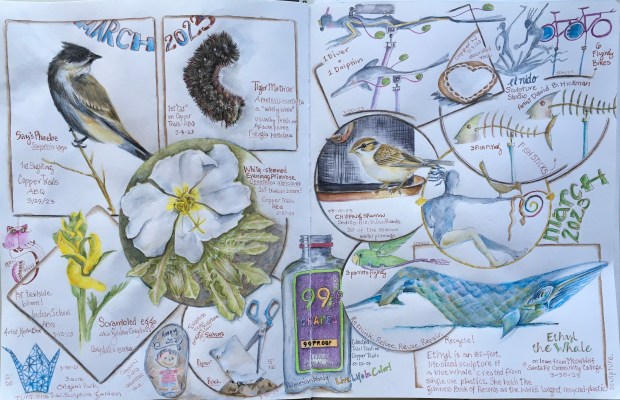
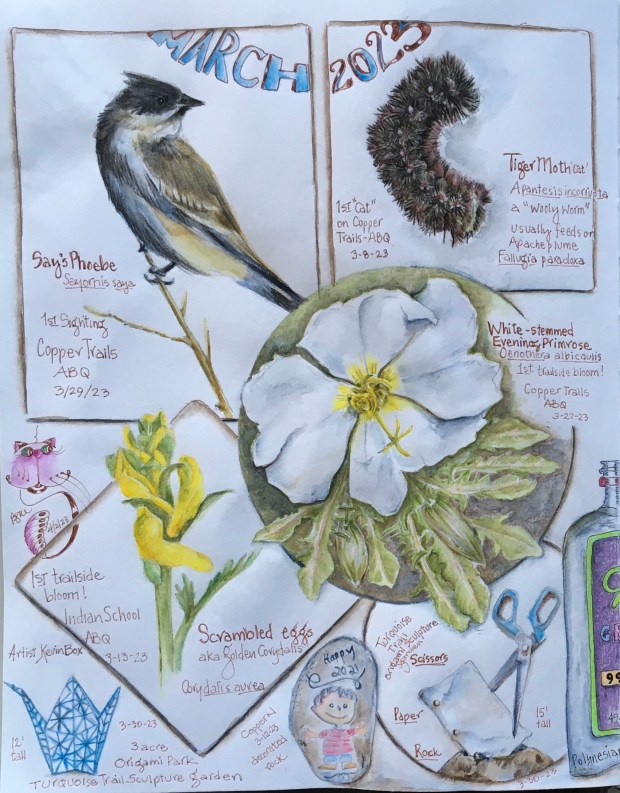
March came in like a passive lion, allowing a few signs of Spring to peek through. My collection of nature snippets and decorative trail rocks was going well, until ……. Before long we were once again shoveling drifts and piles of snow, dumped on New Mexico thanks to California’s 13 atmospheric rivers that flowed from coast to coast. This was looking like the winter that would never end.
It was truly and literally “March Madness” out there. So, in the spirit of the crazy seasonal weather, an emergency road trip became necessary to search for some “Littles” filler. And I knew the perfect route to take …..
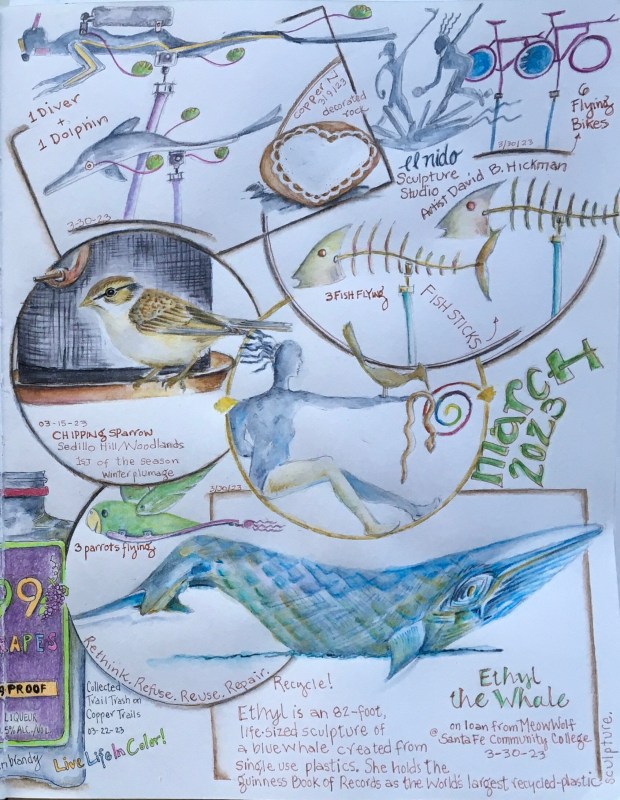
The Turquoise Trail Scenic Byway winds around the Ortiz Mountains and Cerrillos Hills, while passing through the historic mining towns of Golden, Madrid (MAH-drid) and Cerrillos (sir-REE-yoose). Today, there’s minimal mining taking place in them there hills. Today it’s all about art, and there’s some really weird stuff on display out there.
From Golden to just north of Cerrillos, the hillsides are adorned with metal sculptures like a Trojan horse, three boned fish on sticks, a scuba diver fleeing a curious dolphin, two-story tall origami made of folded metal, butterflies as big as pterodactyls, a squadron of green parrots, and a fleet of racing bicycles. You have to look around every bend in the road ….. they’re all there, and more!
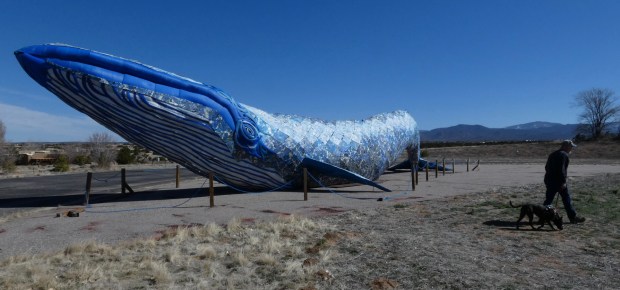
It was fun “collecting” these images for my March “Littles” collection, but I needed one more. We had heard the story of Ethyl the Whale somehow living out of water, somewhere in Santa Fe. Sounded like the perfect weird addition to that blank spot on my page.
And there she was! Around the back side of the Santa Fe Community College, in a large, flat field was Ethyl, the 82-foot long blue whale sculpted out of single use plastics. Ethyl is HUGE! She not only holds the Guinness Book of Records for the World’s largest recycled plastic sculpture, she also delivers an important message about the health of our oceans.
Well, there you have it; my eclectic assortment of “Littles” to remember this March of 2023. Let me know what you think! I’m already looking forward to true Spring in April. Wildflowers should be popping up everywhere and maybe a few more bugs will make an appearance for my April “Littles.”
Thanks again to “Made by Fay” for the “Littles” inspiration!






 a curious nature