It’s late October, mid-Fall in the Manzano Mountains, perhaps a week before the first snow of the season. The Gambel Oak covering hillsides and mountains somehow sense a change in the air. Seemingly overnight every leaf on every oak shrub and tree magically transformed from their summer greens to royal rusty reds, gleaming golden yellows, and shocking sunset oranges. As I look across the landscape and marvel at the sight, I can’t help wondering, “How do they know?”
The spectacle is short lived. Over the next few weeks, these gorgeously painted leaves slowly change to crispy beige brown, fooling the observer into believing they can’t face another winter; that every single oak shrub and tree just gave up and died! Thinking that was the case my first winter in central New Mexico, I was fooled. But since then I’ve learned a lot about the life cycle of Gambel Oak, and have come to appreciate the persistence of all those crispy browns covering up the otherwise barren nakedness of chaotically jumbled branches.
There’s a lot that can be said about Gambel Oak (Quercusgambelii), but this post focuses on
The Leaves of Quercus gambelii
The most interesting thing about this oak species’ leaves is no two are alike. Even though each leaf looks different from its neighbor, they do all have common characteristics that distinguish its leaves from other oak species. For example, All Gambel Oak Leaves …….
are lobed (but the number of lobes varies from side-to-side of a leaf’s mid-vein; depth of lobes varies on a single leaf and between leaves; lobes can be gently concave to acutely angled).
are flat and leaf margins are smooth (if leaves appear somewhat wavy and/or exhibit some serrated margins and/or points on the lobe tips, this is not a true Q. gambelii, but likely a hybrid of Gambel Oak and Shrub Live Oak (Q. turbinella) resulting in Wavyleaf Oak (Q. undulata), very common where ranges converge).
are different lengths and widths, and leaf sizes are random along each branch, with large leaves adjacent to small ones adjacent to tiny ones adjacent to gigantic ones, etc.
change color in the Fall, eventually becoming beige brown and crispy (but color patterns on individual leaves and throughout a shrub/tree are wildly various; some leaves turn one color, while others become a mixture of greens, reds, yellows and/or oranges).
that are brown/crispy persist on the shrubs/trees throughout late Fall and Winter, then drop all at the same time in Spring when buds begin to open.
that are fresh have little 5-star hairs on the undersides, while the upper surface is smooth and leathery.
are relatively free of insect damage, with the exception of the occasional oak gall or insect nibbles (perhaps due to their leathery texture on the upper surface and hairy texture on the undersides?).
Every Fall I observe and collect Gambel Oak leaves. They make great subjects for my nature journal! Because every leaf looks different, the easiest way to depict the various shapes is to trace their outlines directly onto my journal pages. Then with leaves in hand, I can use my Inktense watercolor pencils to paint within the outlines, spending most of my effort on their beautiful colors.
I hope you’ve enjoyed my page of Gambel Oak leaves. Do you share nature with oaks? If so, which species, and are their leaves all the same or different somehow? Do you record your observations in a nature journal too? I’d love to know!
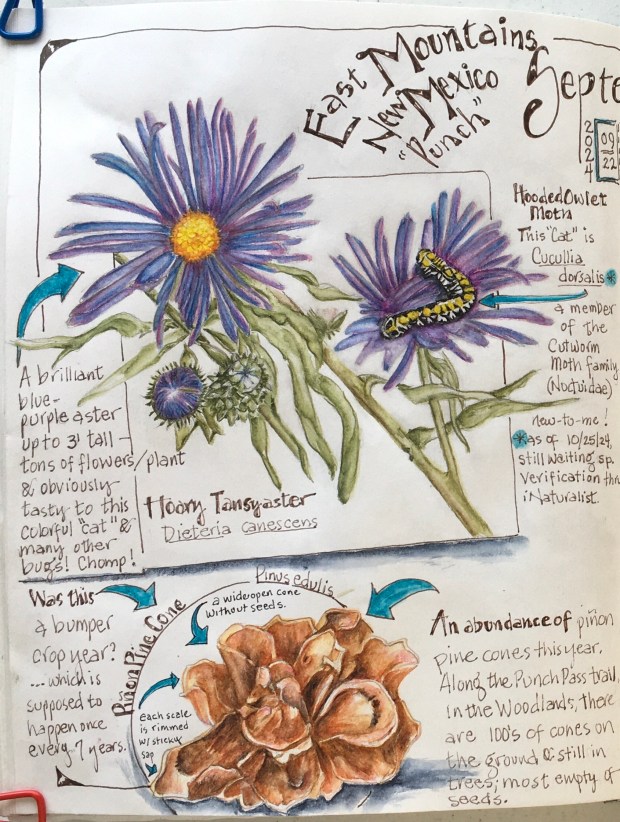
A fallen cone from Pinus edulis. Still a few seeds remain, tucked in the lowest scales. Typically there are 2 seeds per scale; 10-30 seeds are common per cone. Seed viability is uncertain until the inside kernel is exposed.
Pine Nuts Come From Where?
Many years ago, maybe about 45 of them, Roy and I, his sister and her husband, set off on a pine nut safari in the mountains of south central Colorado. They knew of a large stand of a specific pine tree, called Pinyon (Piñon**) heavy with cones and ready to harvest. This was my first encounter with the Colorado Pinyon Pine (Pinus edulis), and my first taste of the buttery rich tear-drop shaped seeds produced by these trees. I was hooked! After 4-5 hours collecting wide open seed stuffed cones from low hanging branches and off the ground, we had to stop. Our fingers were impossibly stuck together from the cones’ copious coating of resin, definitely stickier than Super Glue! Without a solvent to dissolve this adhesive pine tar, we were in danger of losing our fingerprints.
Having made a less-than-minor dent in the harvestable nuts, ample quantities of this energy rich bounty remained for foraging wildlife, such as migrating birds like pinyon jays, deer and squirrels.
For the past 45 years I truly believed pine nuts (which are, botanically speaking, not true nuts but the edible seeds of pinyon pines) only came from stands of Colorado Pinyon Pine. When the popularity of pesto skyrocketed, I thought “wow, you couldn’t pay me enough to harvest the amount of pine nuts necessary to make even one batch!” I honestly thought that was the reason the seeds were so expensive ….. harvesting is such a tedious and labor intensive job. Alas, we never returned to harvest pine nuts, and I never made pesto until years later.
The result of my Pinus edulis cone and seed sketching exercise.
While studying a few dozen pine cones for my sketches, the seeds kept falling out and bouncing across my drawing table. This got me thinking about pine nuts and wondering how the Colorado Pinyon Pine could possibly fill the insatiable global demand! Of course by now I was well aware that this tree species is endemic in the southwest, but still ?…….
News to Me ….
Of the 126 different species of pine in the world, 29 are considered edible; 20 of which have seeds large enough to be marketed. The biggest producers and exporters are China, Russia, Mongolia, Turkey, and Pakistan, in that order. I found it interesting that China is also the largest importer of pine nuts, who’s marketing goal is to export 60% of the world’s demand.
What about the US? The pine nuts harvested from Colorado Pinyon Pine (Pinus edulis) is rated the best tasting in the world, with those produced by the One Leaf Pine (Pinus monophylla), harvested primarily from these California trees, comes in a close second. Yet, the US is a major importer of shelled pine nuts, primarily from China. But if China is the largest importer and the largest exporter of shelled pine nuts, then the pine nuts on the shelves of Trader Joe’s and Costco, labeled as imported from China, probably came from a variety of pinyon species from a combination of suppliers importing seeds to China?!
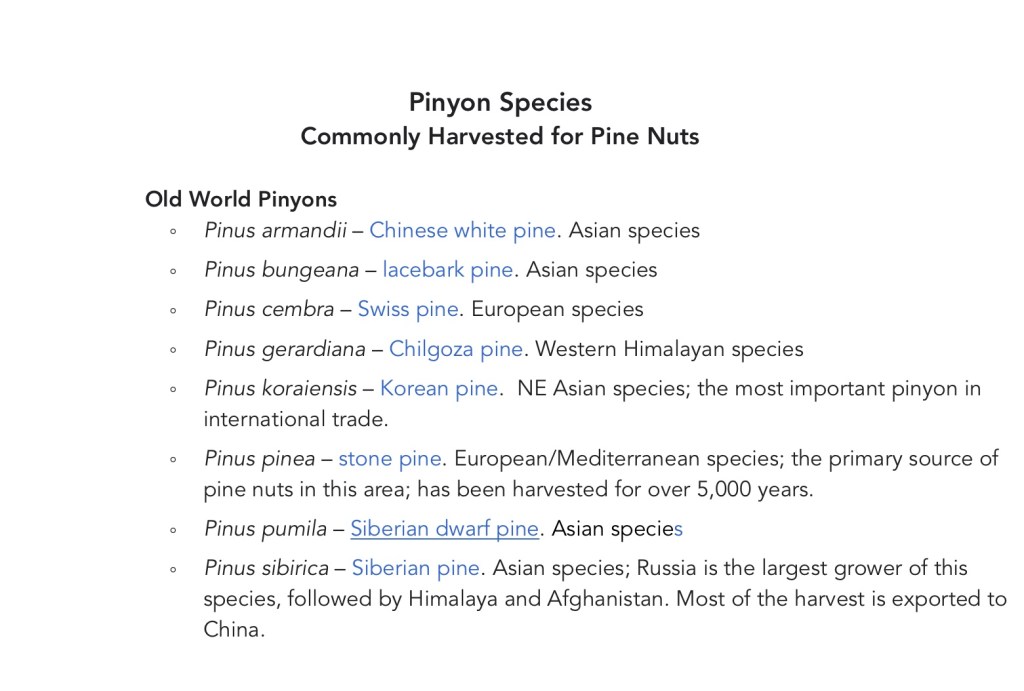
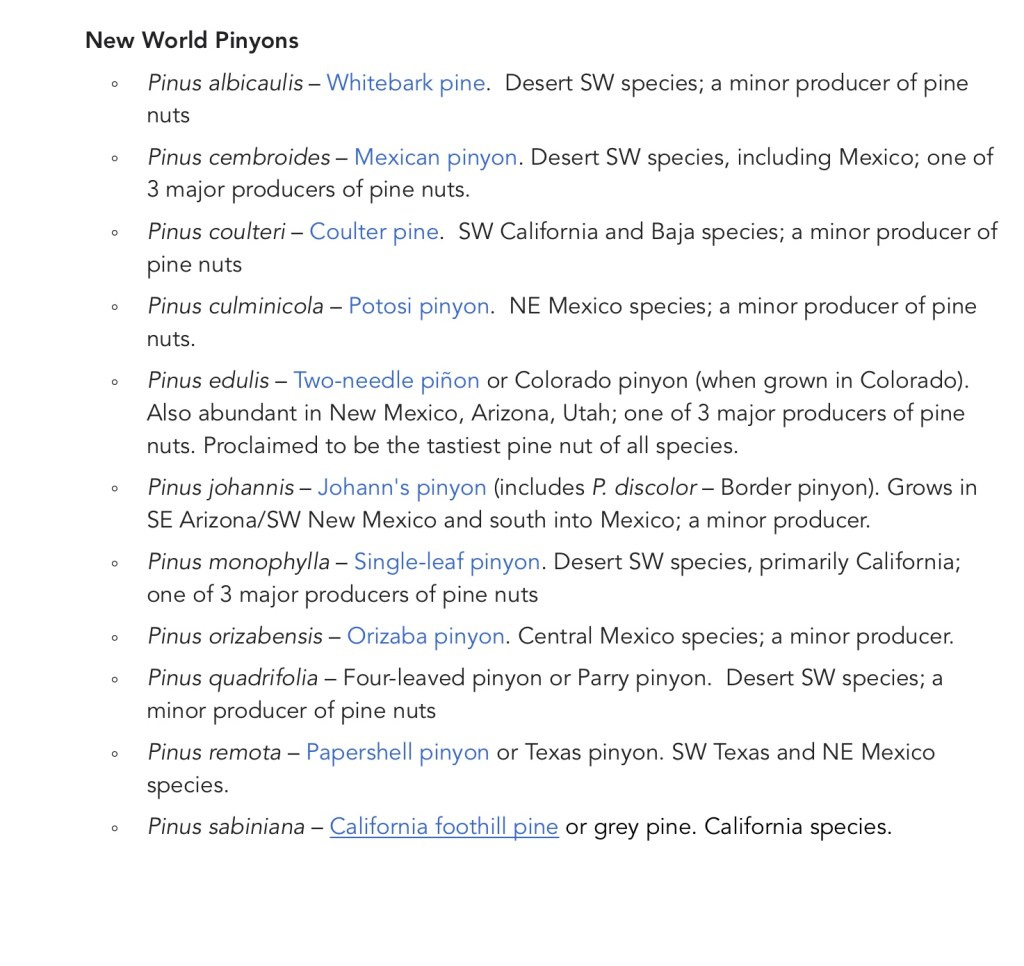
Being naturally curious about the Pinyon species that grow in various countries around the world, I included a list of 16 of the most commonly harvested trees the end of this post.
What’s the Real Reason Pine Nuts are so Expensive?
It’s said that “pine nuts are the most expensive seeds we would never buy!” (**** Check out this footnote for the 2024 costs/pound and my random calculations per serving and for a batch of pesto). Pine nuts are the second most expensive “nut” in the world, second only to the macadamia nut. Butwhy? While it’s true the seemingly exorbitant price of shelled pine nuts is directly influenced by labor costs, compounded by the annoying sticky factor, other challenges exist.
Harvesting Pine Cones
Cones are harvested by hand, directly gathering those that have fallen on the ground, and from tree branches (where the densest number congregate in the upper 1/4th of 30 foot tall trees). Another common harvesting technique is to whack the branches (which reportedly does not injure the trees [hmmmmm?]). But a faster method used in many countries is to cut off branches with cones, resulting in a number of detrimental effects to the trees (open entry points for insects and pathogens; stunted growth; stalled production; tree death).
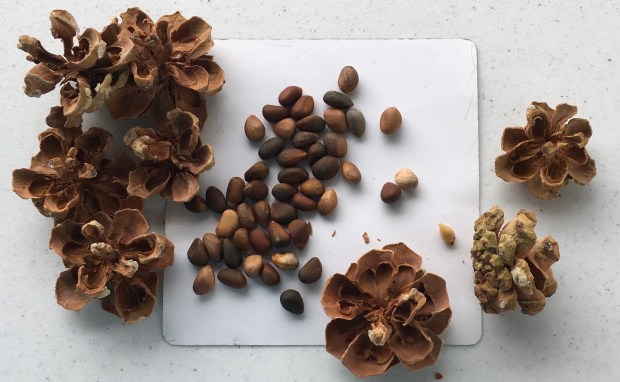
A sampling of Pinus edulis cones with hard coated seeds removed, ready for cracking. There’s a single kernel between the two lower right cones.
Pine Nuts
Once the seeds are taken out of the cones, their hard shells (seed coats) must be removed without damaging the soft edible kernels inside, the “pine nuts.” (And not every seed is viable ….. more about that below.) The shelled pine nuts must now be handled quickly and properly due to their short shelf life. It only takes a few weeks or even days in warm and humid conditions for shelled pine nuts to lose flavor, turn rancid, and completely deteriorate. Until they can be marketed for export, pine nuts must be kept frozen. Ideally, shelled pine nuts should remain frozen during export/import and until consumer purchase and consumption.
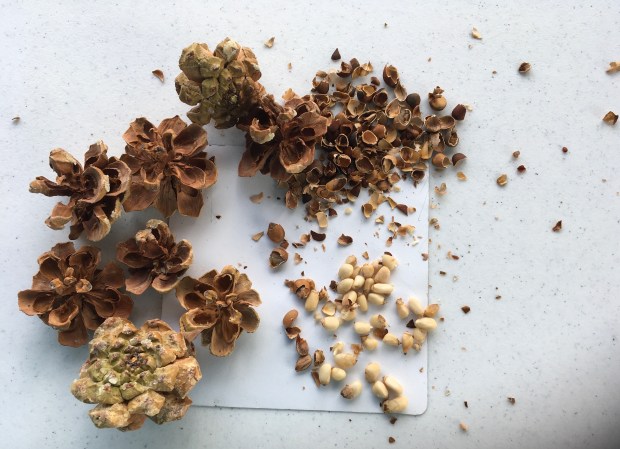
There were the remains of the Pinus edulis seeds extracted from these cones; 30 tasty kernels were viable; 20 were either missing or dried up.
Tree Characteristics
Slow growing trees and inconsistent production are several more reasons pine nuts are so expensive. Pinyon pines are notoriously slow to grow, mature (10 years) and produce a harvestable crop of cones with viable seeds (75-100 years). But pinyon pines typically live an average 350 years, and have the potential to produce tons of harvestable seeds. However, all pinyons exhibit a common characteristic called “masting,” where they may produce a bumper (harvestable) crop only once in as many as every eleven years. Good years are not predictable either, as many factors influence growth and production, with local droughts and a changing climate having the biggest impact.
Gifford Pinchot (1909), U.S. Forest Service Chief said: “Seasons of especially abundant production occur, as a rule, at intervals of from five to seven years, although heavy crops are sometimes produced for two or three consecutive years, and heavy seed years are not the same throughout the range of the tree.”
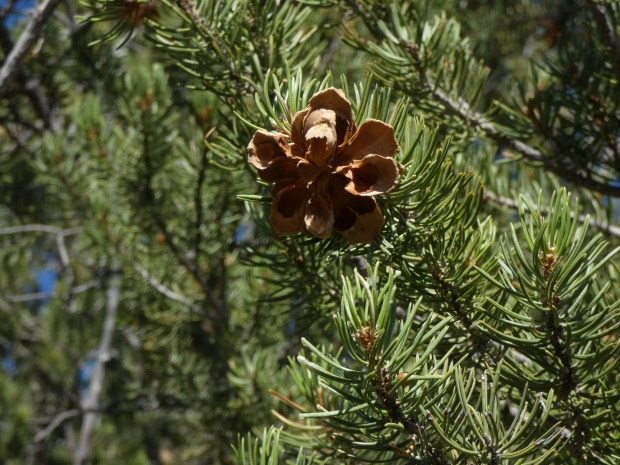
A Pinus edulis tree showing the 2 needles/fascicle densely covering the branches, and a remaining cone ready to fall..
______________________________________________________________ A Few Footnotes
**Piñon or Pinyon?
The most common common name for Pinus edulis is “Colorado” Pinyon Pine, even though the species is widespread in New Mexico, Utah and Arizona as well as Colorado. The words pinyon and piñon are usually considered interchangeable. Use of the word “piñon” (Spanish for pine nut) is tied to the seed (i.e. piñon seed or pine nut seed) and the tree (i.e. piñon pine or pine nut pine) particularly used by Native Americans in the southwest US. Because references consulted during my research were not consistent in their use of common names for Pinus edulis, to avoid (my) confusion I’ve opted to call the piñon seed (pine nut seed) a “pine nut” and the pine trees with edible seeds “pinyons.”
**** The 2024 retail market cost (shelled raw or roasted seeds) averages $40/pound
1 pound of seeds = about 4 cups (depending on seed size)
1 cup of seeds weighs about 4 ounces (price $10§)
1 ounce or 1/4 cup of seeds = 1 serving (price $2.50)
1 serving = about 167 seeds (price 1.5 cents/seed)
167 seeds = 191 calories (pine nuts are extremely high in unsaturated, heart-healthy fats and carbohydrates)
1 cup of seeds = about 668 seeds = 764 calories
4 cups of seeds = about 2,672 seeds = 3,056 calories
Number Play
Of the 50 seeds I harvested, only 30 were viable (price 45 cents)
It took me about 45 minutes to crack open the 50 seeds (this doesn’t include the time it took to collect the resin-coated cones and remove the seeds)
It would take me 67 hours to fill a 1 pound bag with 2,672 viable shelled seeds!
At $40/pound, a pine nut cracker would be paid only $0.59/hour for their labor, a wage earned back in the 1950’s and 1960’s which didn’t even come close to supporting a family then, let alone today.
Assuming a pine nut cracker makes a minimum wage of $7/hour, it would cost $468 to fill a 1 pound bag. That’s 1,170% more than the 2024 retail cost of a pound of pine nuts!
Obviously, a professional pine nut cracker is far more efficient than I was, using some form of mechanization to crack the seed coats (requiring more research on my part).
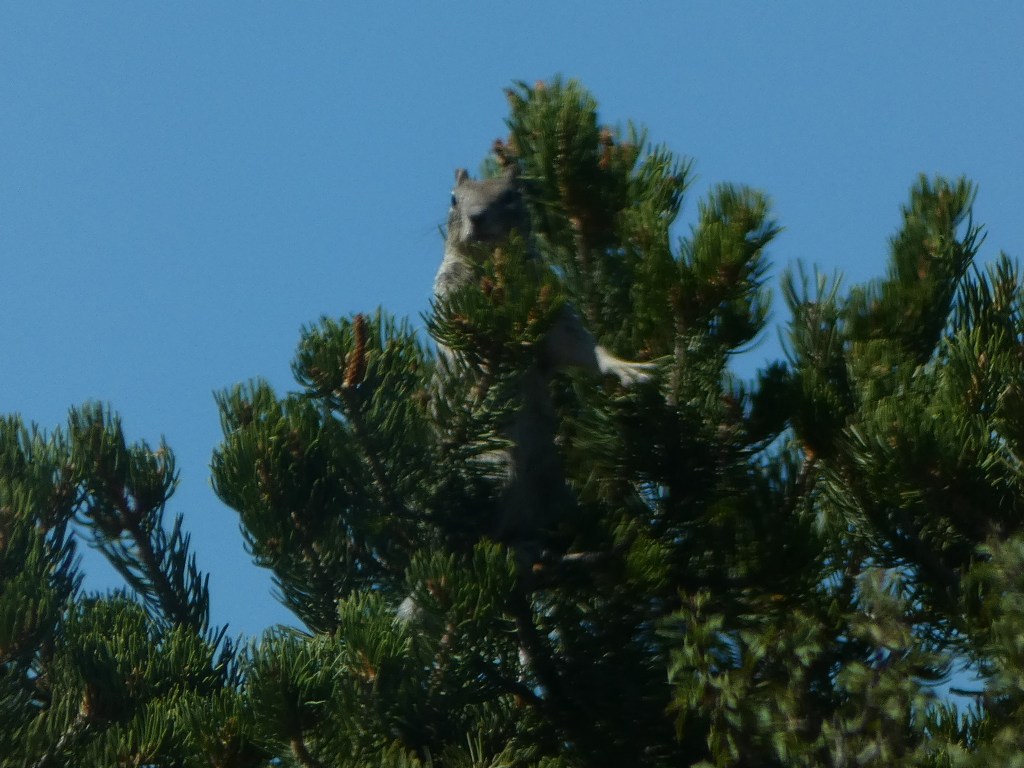
A rock squirrel high in a Pinus edulis tree, keeping watch for red tailed hawks while searching for pine nuts.
§Pesto ……. most pesto recipes I found call for the addition of 1 cup of shelled pine nuts, or 668 seeds. At 1.5 cents/seed, you’d be adding $10 of pine nuts to make one batch of pesto. Enjoy slowly!
Living in the East Mountains of central New Mexico ensures daily appreciation of hundreds and hundreds of Piñon Pines (Pinusedulis). This iconic pine, the state tree of New Mexico, has been a source of nutrient rich seeds for wildlife and indigenous peoples for millennia. It was fun learning more about this tree and the many Pinyon species that grow around the world.
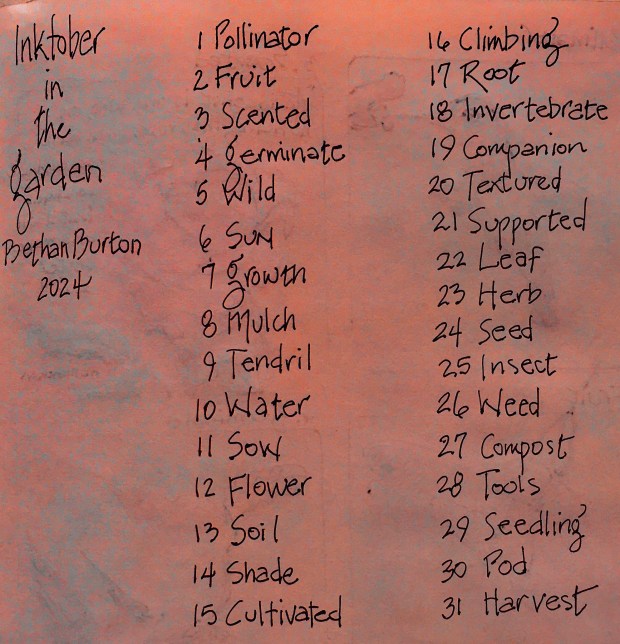
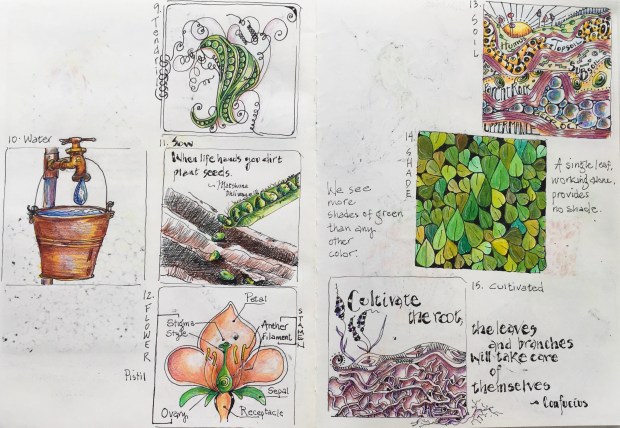
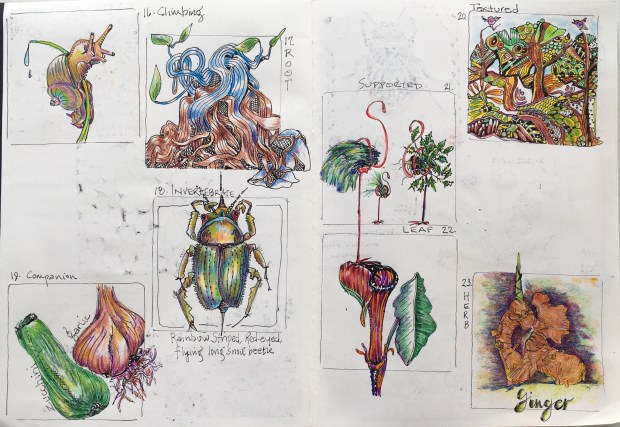
Searching for a theme to follow during Inktober 2024, I was delighted to learn one of my favorite podcasters and nature journal educators, Bethan Burton, shared her original list of 31 prompts. Named “Inktober in the Garden,” she cleverly chose each word to represent a different phase or activity encountered while gardening. To quote Bethan, the prompts are “aimed to get us thinking in different ways about the beauty of our cultivated space.”
Living in Brisbane, Queensland, Australia, where it’s now Spring, Bethan’s garden theme was very timely for her. However, October in central New Mexico where I live, is smack dab in the middle of Fall, so I relied on past gardening experience to create my daily ink drawings.
I hope you enjoy my 31 Inktober2024 tiles, inspired by Bethan Burton’s “Inktober in the Garden” prompts. I decided to only complete one tile/day; in the morning while sipping a cup of tea, I’d sketch a drawing with only ink (using a Pilot Varsity nib pen). Then later in the evening I added the color coaxing pigment from my limited number of Venus Spectracolor colored pencils (the remains of a 40+ year old set which constantly break and refuse to blend).
A big thanks to Bethan for sharing her Inktober2024 prompt list, and for being a constant inspiration through her podcast Journaling with Nature, and for bringing the world-wide nature journaling community together for her annual International Nature Journaling Week, where we can explore, share and celebrate a passion for nature. To learn more about Bethan and nature journaling through her podcast, participating in future International Nature Journaling Week, sign up for her Blog and Newsletter, follow her YouTube Channel and Instagram account, visit her website at: https://www.journalingwithnature.com
Here’s a bit more about this thing called Inktober
Inktober was originally created by Jake Parker in 2009, and since then has been deemed an annual event that takes place throughout the month of October. The rules devised for participants were, and still are, pretty simple …… Every day 1) make a drawing in ink; 2) post or share it; 3) hashtag it with #inktober; and 4) repeat.
Since 2009, there’s been an official prompt list shared every year by Jake and his Inktober group (https://inktober.com). But there are also many alternate lists generated, which participants can follow if they wish, or they can choose to work from their own prompts. Also since 2009, participants have not only worked in only ink, but have created colored drawings. Actually any media is fair game (wonder if anyone uses collage?), as bending the simple rules seems to be the norm. As Jake notes on the Inktober webpage, “you can do it [Inktober] daily, or go the half-marathon route and post every other day, or just do the 5K and post once a week. What ever you decide, just” remember “Inktober is about growing and improving and forming positive habits, so the more you’re consistent the better.”
And if you’re interested in participating in future Inktober events, just do it! Find a prompt list or create your own, and join the month-long party beginning each year in October!
This concludes my 9th year of Inktober! As always, thanks for stopping by!
September 22nd was a morning full of new-to-me discoveries in nature. That was more than a month ago; a time when temperatures were still in the upper 80’s and flowers in full bloom.
But plenty of hints of what was to come ….. the inevitable change in seasons ….. existed. There were seeds of spring and summer bloomers blowing in the wind; squirrels stockpiling pine nuts from recently shed cones; darkling beetles mating and laying eggs in the ground to hatch next year’s population; caterpillars feasting on energy-packed flower petals needed to spin their cocoons; the chortling chatter of sandhill cranes high overhead migrating to Bosque del Apache for the winter.
Still it is hard to believe that today, a little more than a month later, everything has turned brown, and our first hard frost is forecasted for tomorrow morning!
In an effort to cling to a not-so-long ago summer, this small selection of the botanical and entomological happenings on the cusp of Fall, is now a part of my nature journal. Enjoy!
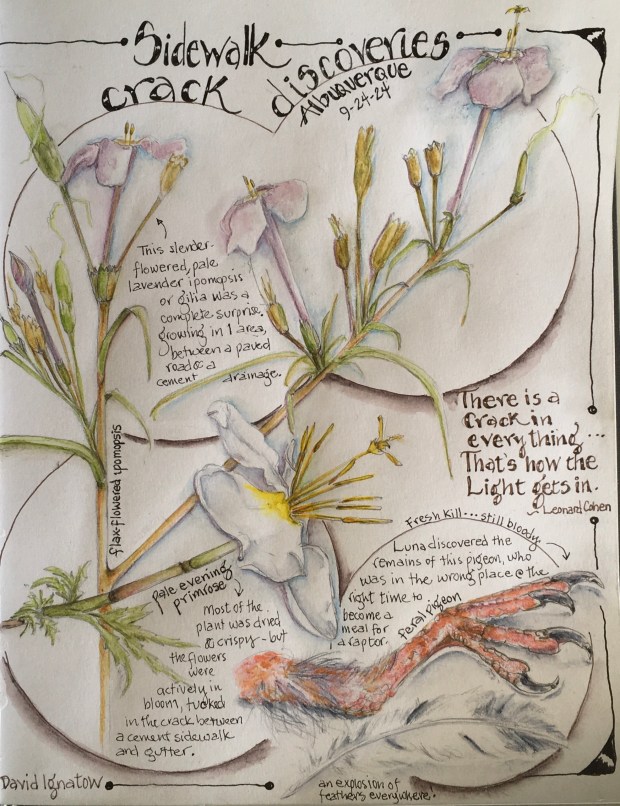
Roy had a doctor’s appointment one morning in late September, at an office right off busy I-25, near the ABQ airport. Instead of hanging out in the sterile waiting room, Luna and I spent our time exploring the areas surrounding the office, just to see if there was anything worth observing.
For 2 miles, we wandered about the not quite urban/suburban/industrial/residential neighborhood ….. me looking for a sketchbook entry; Luna sniffing out messages left just for her by visiting dogs, squirrels, or bunnies.
Interesting discoveries seemed lacking, until Luna caught whiff of something irresistible. Tugging hard on her end of the leash, she urged me to run with her as she zeroed in on the source of the smell.
By a parking lot light, on the pavement next to a cement curb was an explosion of feathers, but Luna kept leading me on to something better. There! Lying on the curb was a still wet and bloody bird foot barely connected to what remained of the thigh. All clues pointed to the very recent drama, where a raptor (possibly a red-tailed hawk) had swooped in and nabbed the hapless victim (a feral pigeon), killed and then ate his prey from the platform atop the parking lot light. The inedible remains fell to the ground as a group of 2 dozen “relieved-it-wasn’t-me” pigeon friends looked on.
Quickly solving most of this puzzle in the time it took to pry the pigeon foot from Luna’s mouth, gave me the idea of sketching not only the foot, but to look for other unlikely nature discoveries in this urban/suburban/industrial/residential neighborhood setting.
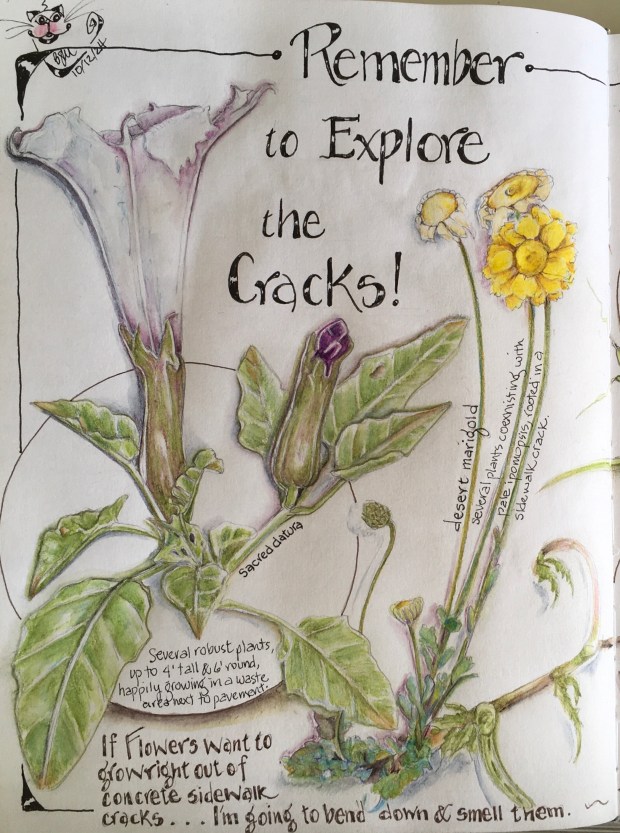
Mentally armed with a keener power of observation and purpose, we retraced our earlier route with excitement! Now it was obvious an abundance of interesting and beautiful plants were growing from every sidewalk crack and along crumbled pavement edges throughout the ‘hood. How had I missed seeing these beauties?
And that’s how my idea for this 2-page layout was born, along with a reminder that finding bits of nature doesn’t have to occur at a botanical garden, wildlife preserve or national park. Nature is everywhere. If you just slow down and really look, even in the most unlikely places like sidewalk cracks, there’s always something to discover. So Remember to Explore the Cracks too and let me know what you find!
Sometimes short adventures become the most memorable.
After pouring over our NM map, looking for new places to camp, based on a recommendation from good friends we decided to visit Charette Lakes. Located within the grasslands of NE New Mexico, this would be our kind of country. About time to check out the Shortgrass Prairie.
Planning to be gone 4-5 days, and as long as we were headed to Charette, why not also visit Clayton Lake State Park and Kiowa National Grasslands! The weather certainly looked good for a week, allowing easy access on backcountry 2-track dirt roads.
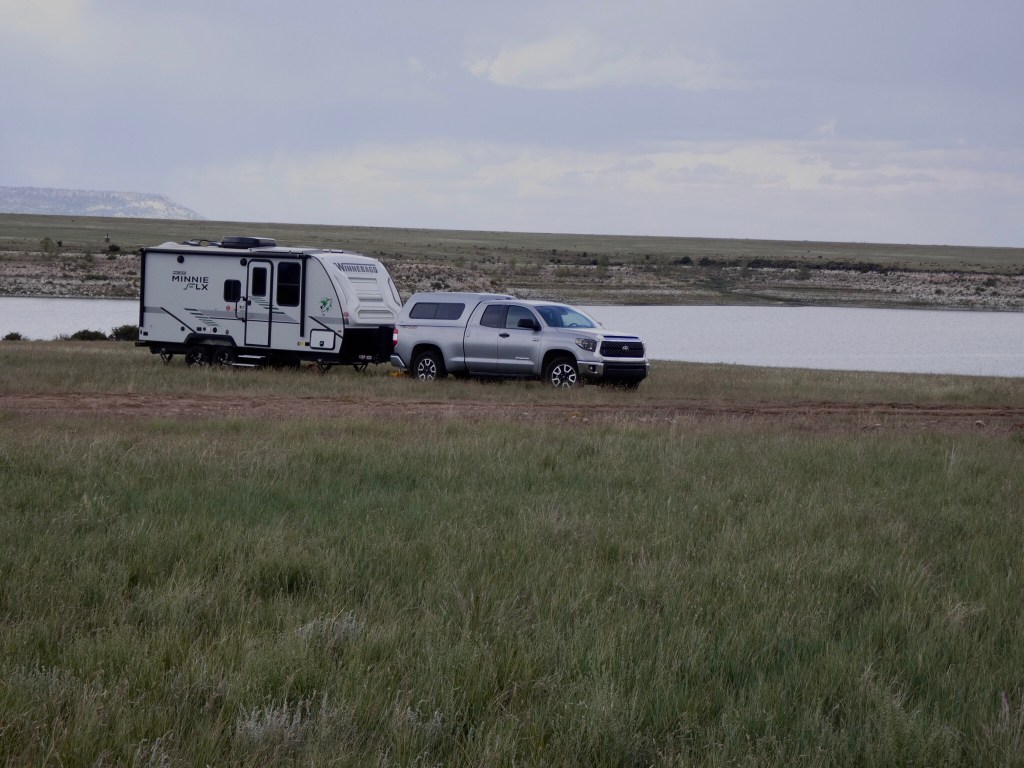
Felix at home just west of Lower Charette Lake
Charette Lakes
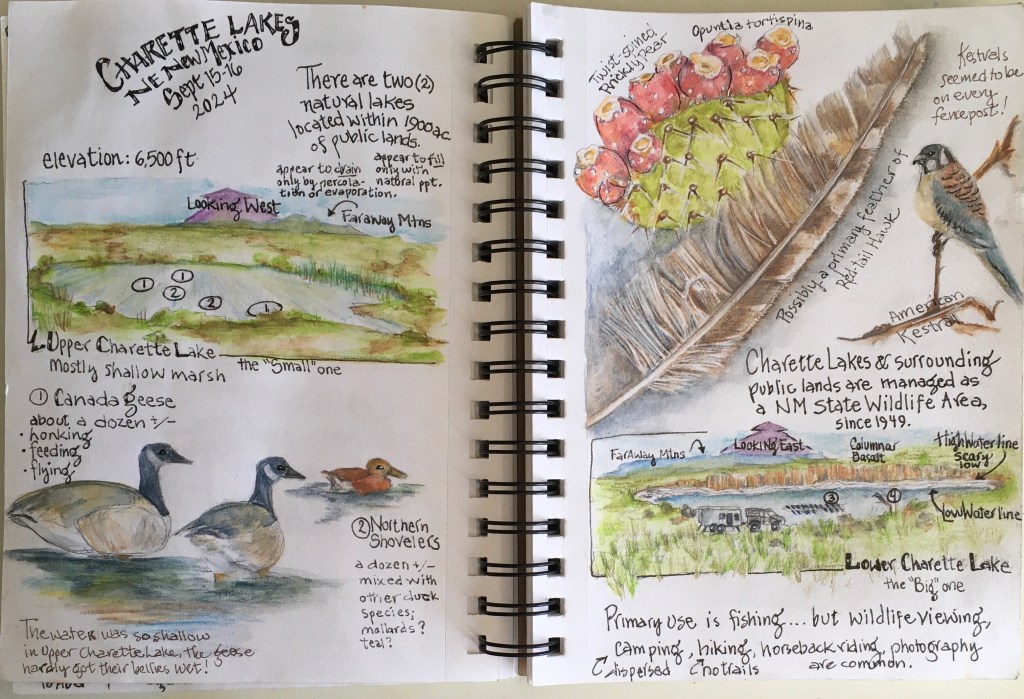
Arriving at Charette Lakes mid-day allowed plenty of time to set up camp with a view of the Lower (larger) lake, before heading off, on foot, to wander these lush grasslands. It seemed like Spring ….. so many wildflowers in bloom! Late afternoon saw a mass exodus of fisherpeople, and by 5:30 pm we pretty much had the entire area to ourselves! Hiking about some more, we encountered a small group of pronghorn, gazed skyward as hungry migratory ducks and Canada geese flew in to Upper Charette Lake, observed a number of beautiful kestrels, and enjoyed the antics of a coot flotilla on the lower lake.
The wind blew, the rains poured, but we managed several hikes across the short grass prairie surrounding Charette Lakes
By 6:00 pm we got caught in a downpour! Wait! This wasn’t supposed to happen! But the rain and gusty winds persisted until morning, as heavy gray clouds continued to roll by.
We found most of the migratory birds on and feeding at Upper Charette Lake. Mostly marshy and shallow, this small lake had more food for hungry birds than the larger and deeper Lower Charette a lake.
After rechecking the weather forecast, it seemed like this storm was headed north, well out of the area we planned to visit next ….. Clayton Lake State Park, in the extreme NE corner of NM, bordering TX.
We shook out our rain gear, toweled off the dog, packed up Felix and headed out, dropping down the basalt escarpment we ascended yesterday, thankful this section of steep decline was paved.
Clayton Lake State Park
Excited to see more of the grasslands and the famous Dinosaur Trackways, a historic landmark site managed by the State Park, we approached from Raton, NM, very close to the Colorado border. Traveling about 50+/- miles SE (leaving the rain behind), the surrounding shortgrass prairie was dotted with a number of resting volcanoes, including Capulin (managed by the National Park Service).
Our route from Charette Lakes to Clayton Lake State Park and Dinosaur Trackways passed through more shortgrass prairie habitat adjoining a cluster of Forest Service-managed grasslands (Kiowa in NM; Rita Blanca in TX; Cimarron in KS; Comanche in CO), remnants of the vast “sea” of grasslands that used to be.
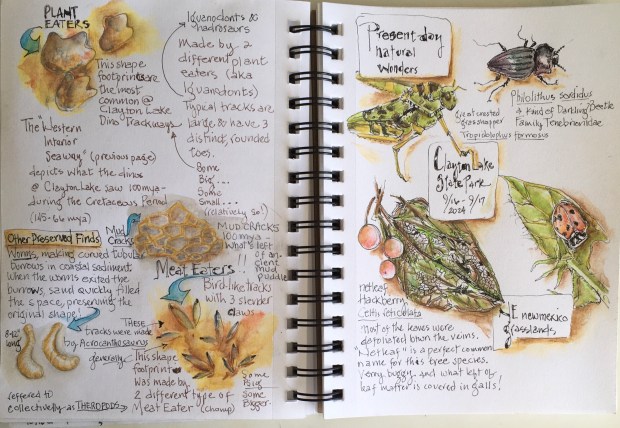
Arriving at Clayton Lake SP about noon, we quickly parked Felix, then walked the 1/4 mile to the Dino Trackways! Very, very cool. It’s hard to imagine that 100 million years ago this area of NM/TX was a beach along the western side of a great inland sea! Paleontologists believe the dinosaur tracks were made by both plant and meat eaters that migrated north and south along this sandy beach. The tracks showed the plant eaters likely moved about in herds as they foraged for food. There were also foot long tube worm tunnels and some pretty interesting mud cracks preserved in today’s hard sandstone.
At Clayton Lake State Park we learned about the 100 million years old dinosaur tracks uncovered during the construction of the Clayton Lake emergency spillway, found some wind-stunted and deformed plants lining the the earthen dam, discovered a new grasshopper and beetle, and enjoyed watching terns perform aerobatic stunts over the lake.
Dinner time and it began raining (what!), varying from drizzle to deluge, we started to have second thoughts about tomorrow’s access into Mills Canyon on the Kiowa National Grasslands. But the radar showed this area wasn’t getting rain, and we felt it was worth a try (as long as we were so close!).
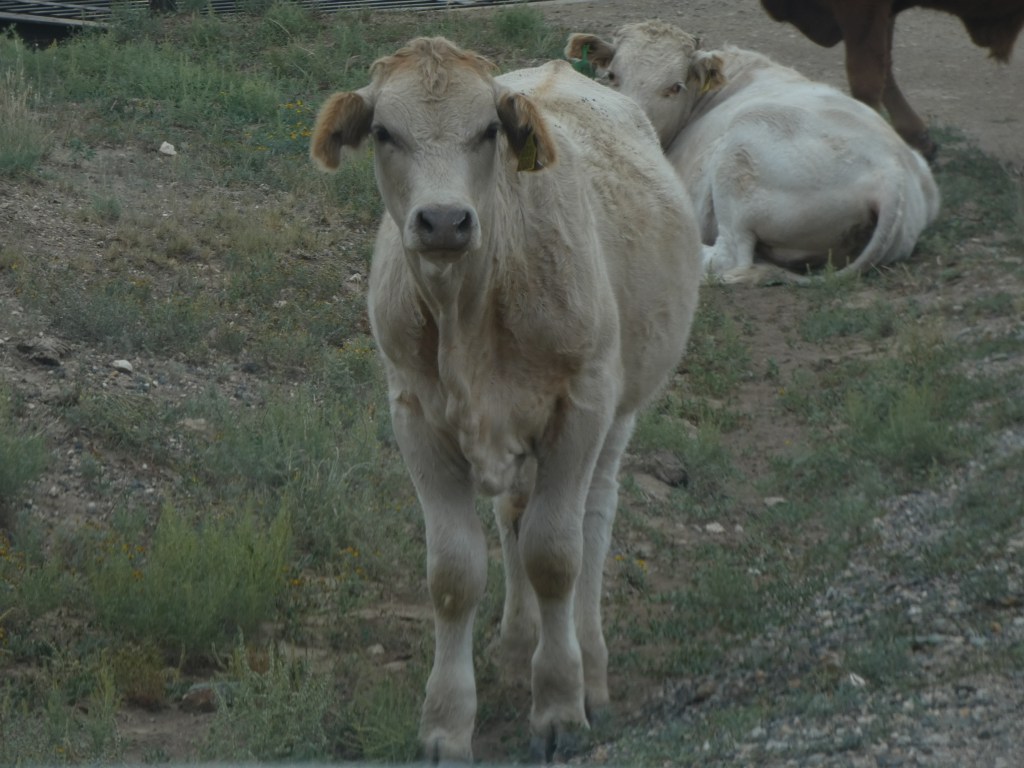
One of many cows that graze the grasslands on allotments that often span private, State and Federal lands.
Clayton Lake to Mills Canyon (Kiowa NG)
Early morning sunrise was gorgeous, then from who-knows-where, storm clouds rumbled in, and kept coming nearly the entire way to the Kiowa. But nearing our arrival, the clouds cleared out and things looked promising; so much so that we agreed to try our luck.
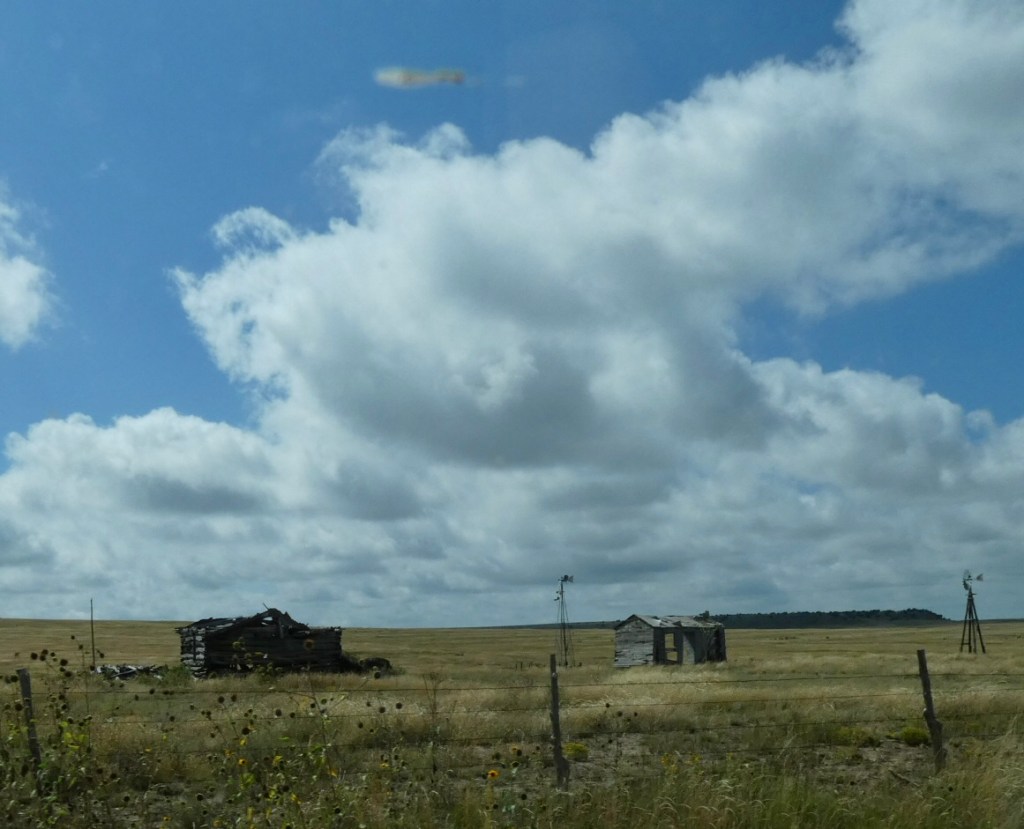
Long abandoned and “melting” into the soil, the shortgrass prairie saw its share of homesteaders back in the middle to late 1800s.
The Grasslands boundary was six miles off the pavement, on dirt and gravel ranch roads. Once on the Grasslands 2-track access to the campground our luck nearly ran out. Down down down the road went, saturated with the last several days of pouring rain. But we didn’t really know this, and began the descent. It wasn’t 200 slippery yards later, Roy’s executive decision to reverse course probably saved us being stranded somewhere for days! As he began backing Felix up the sloppy slick road, conditions somehow felt worse. Felix had a mind of his own and began weaving all over the place, half the time getting stuck in the ruts we made during our descent.
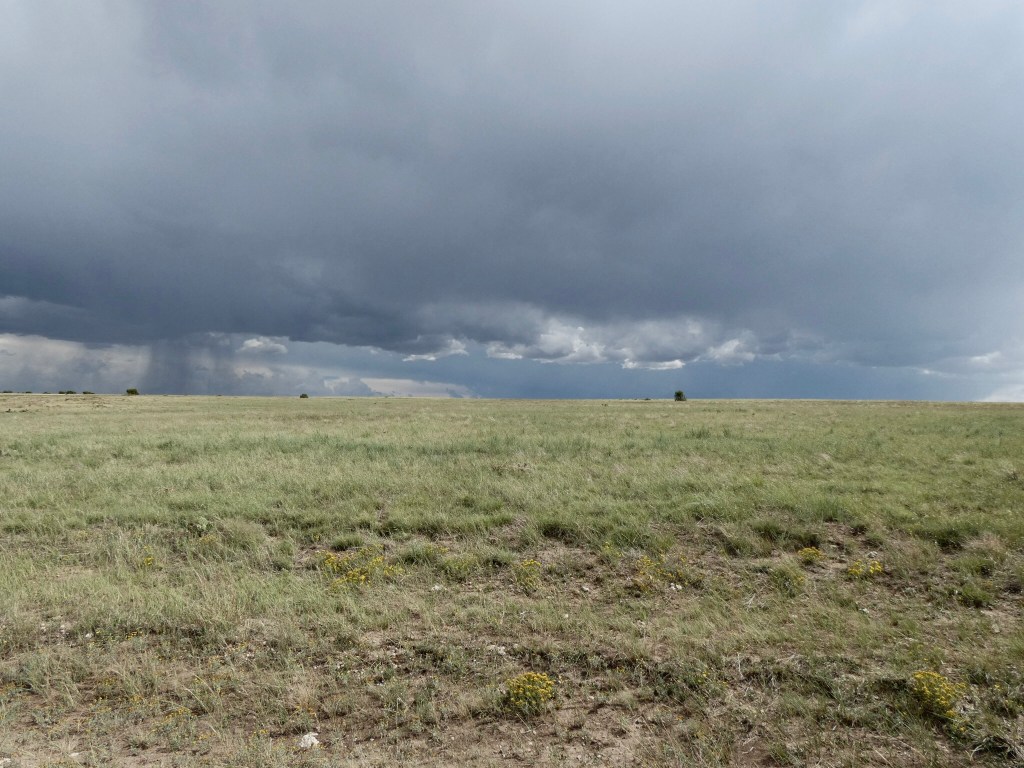
What looks like a lonely landscape is actually lush and thriving grasslands thanks, in part, to an abundance of rain this year. And Wow! Did it ever rain!
Finally after 30 minutes of careful maneuvering, Roy managed to coax the RV back to the Grasslands boundary. Our relief to be back on somewhat solid ground overshadowed our disappointment in not being able to visit this dramatic canyon area. But we were safe even though both the truck and Felix were coated above the axles with 6-8 inches of mucky sticky clay.
So, with this area and any other likely destinations soaking wet, and only being 3 hours from home, we agreed to end this crazy camping trip, promising ourselves to return another day. Turns out the decision was wise, as we drove through one downpour after another on the way home! (The rain was so hard at times, visibility was zip! But the good news was it rained so hard that most of that mucky sticky clay got washed away.)
The End…..
And that was the ending to a short, yet memorable trip. Of course by the time we got home, the clouds had cleared totally, and we haven’t had a drop of rain since! Go figure!
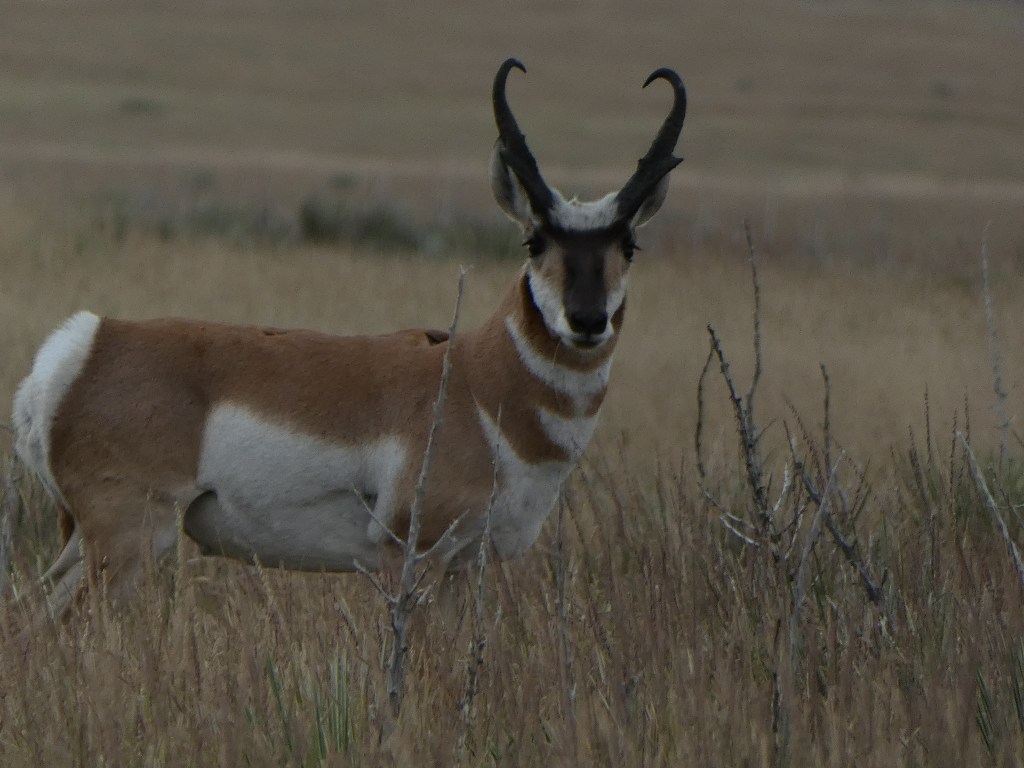
A pronghorn wary of our presence, passing with a herd between Upper and Lower Charette Lakes.
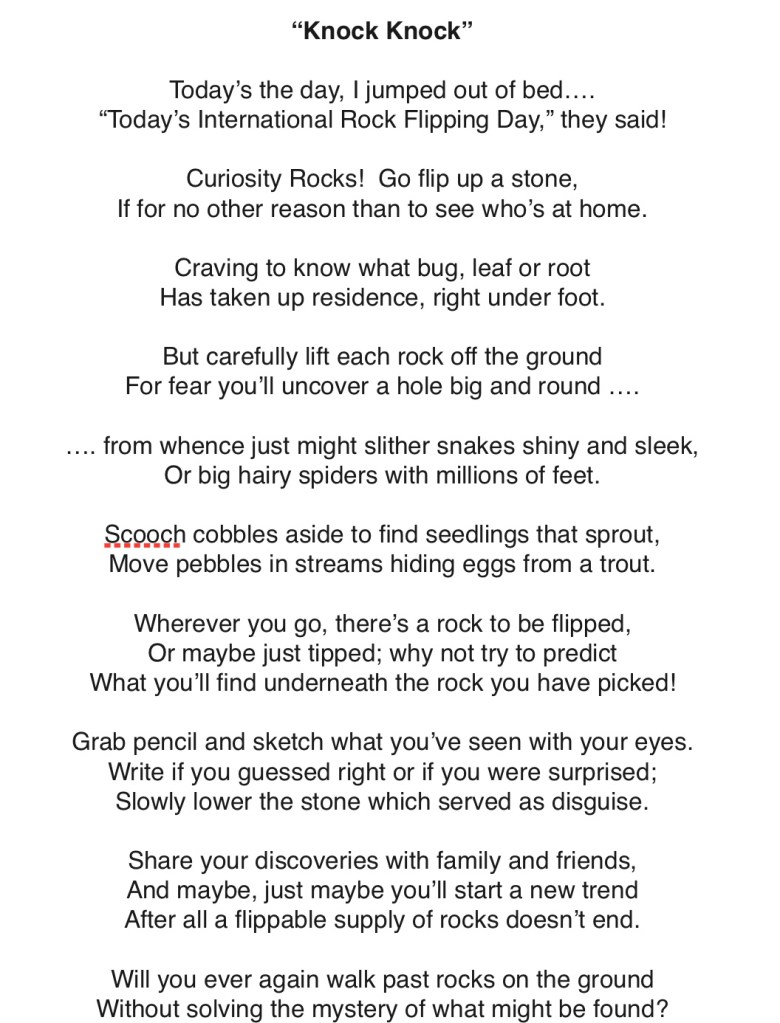
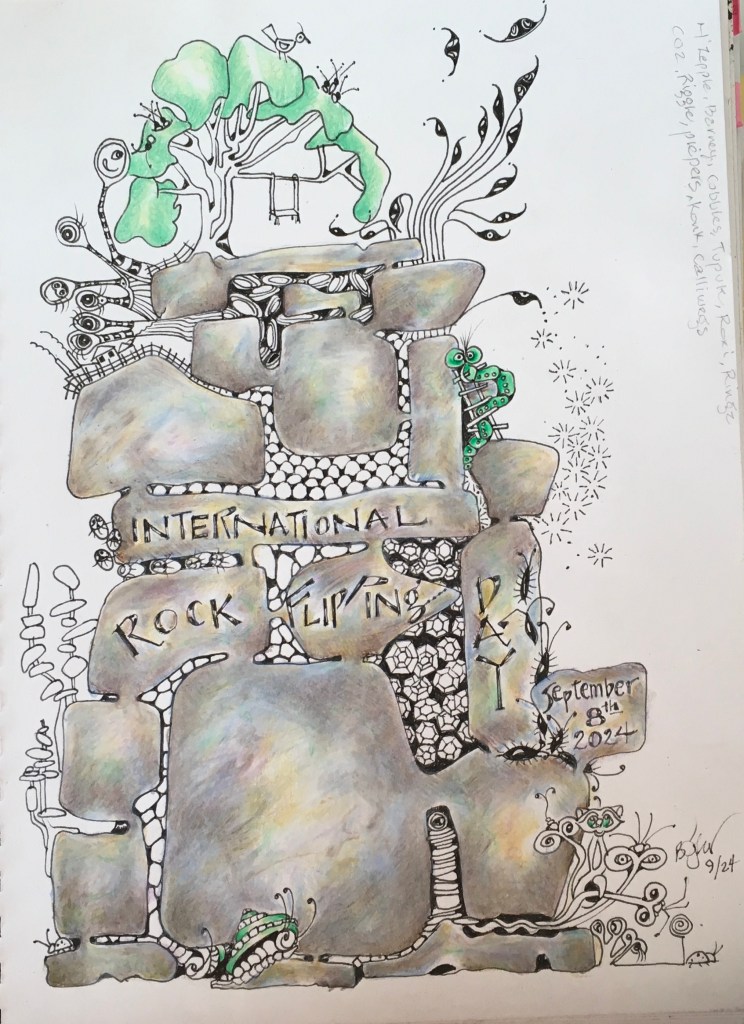
Unbeknownst to me …… until right now! Hitting me like a ton of rocks, I just learned that every second Sunday in September each year marks a worldwide celebration known as
International Rock Flipping Day
Today is a day to encourage people to explore and learn about the natural world by flipping over rocks to see what creatures and other organisms live underneath them. Participants share their findings and observations with others to promote curiosity and appreciation for the environment.
If no one was at home, tell me about your flipped rock(s)!
Bring out your Inner Child!
I don’t care what town you’re born in, what city, what country. If you’re a child, you are curious about your environment. You’re overturning rocks. You’re plucking leaves off of trees and petals off of flowers, looking inside, and you’re doing things that create disorder in the lives of the adults around you. – Neil deGrasse Tyson
A few more …..
As with other phases of nature, I have probably loved the rocks more than I have studied them. – John Burroughs
If it weren’t for the rocks in its bed, the stream would have no song. – Carl Perkins
The problem is not scientifically illiterate kids; it is scientifically illiterate adults. Kids are born curious about the natural world. They are always turning over rocks, jumping with two feet into mud puddles and playing with the tablecloth and fine china. – Neil deGrasse Tyson
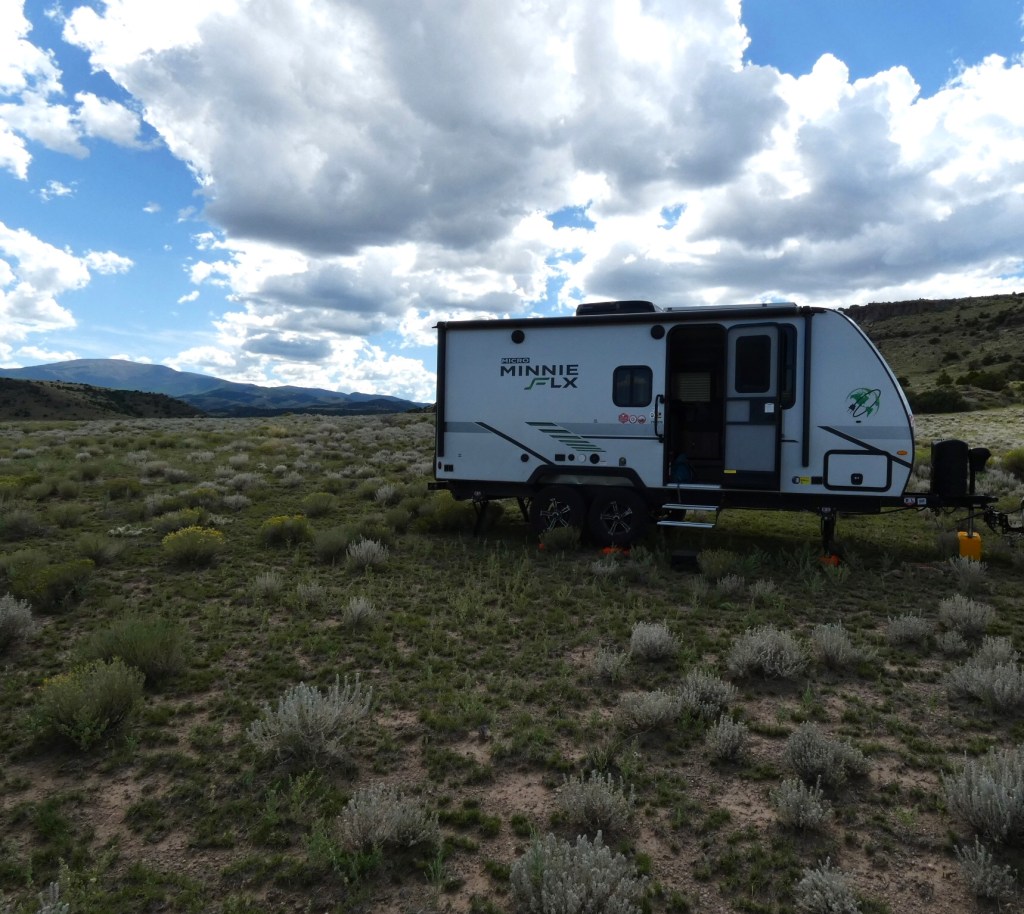
Felix parked along the Old Spanish Trail route, south central Colorado
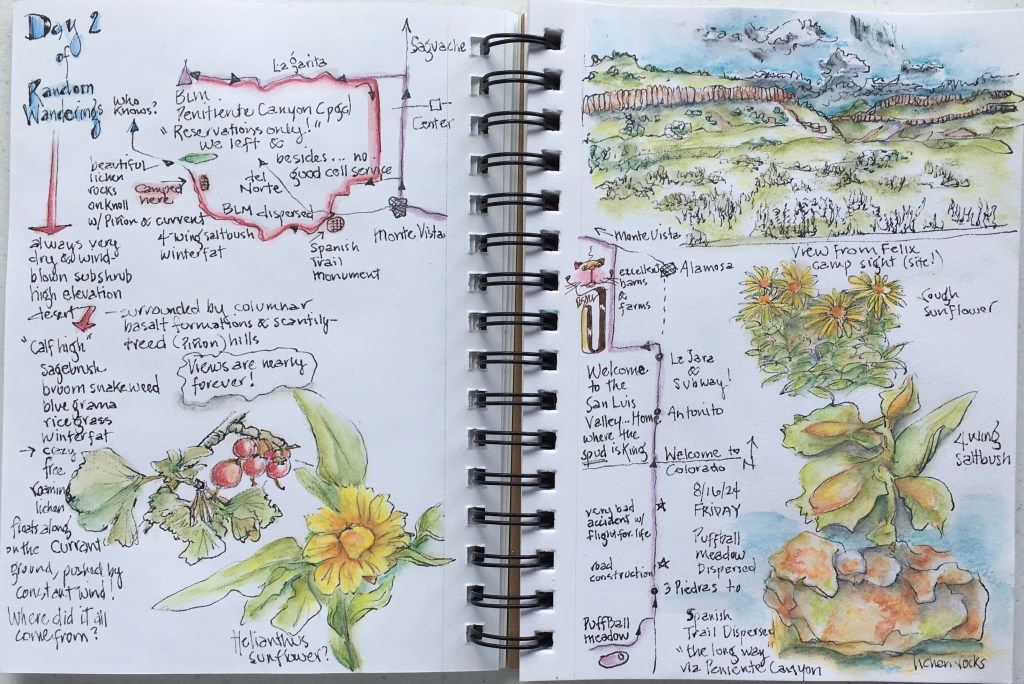
With no defined route or objective, we decided it was high time we hitch up the trailer (Felix) and tote it north just to see what’s going on in south central Colorado this time of year. As we made our way through the San Luis Valley, we found acres of lush greenery topping almost-ready-to-harvest potatoes. Alfalfa was nearing its second cutting. Carrots had already been shipped to market. The wildlife refuges were patiently awaiting the arrival of migratory birds. And the last of the summer tourists were excitedly boarding the Cumbres and Toltec Scenic Railroad in Antonito, for the 64 mile steam engine journey to Chama, NM.
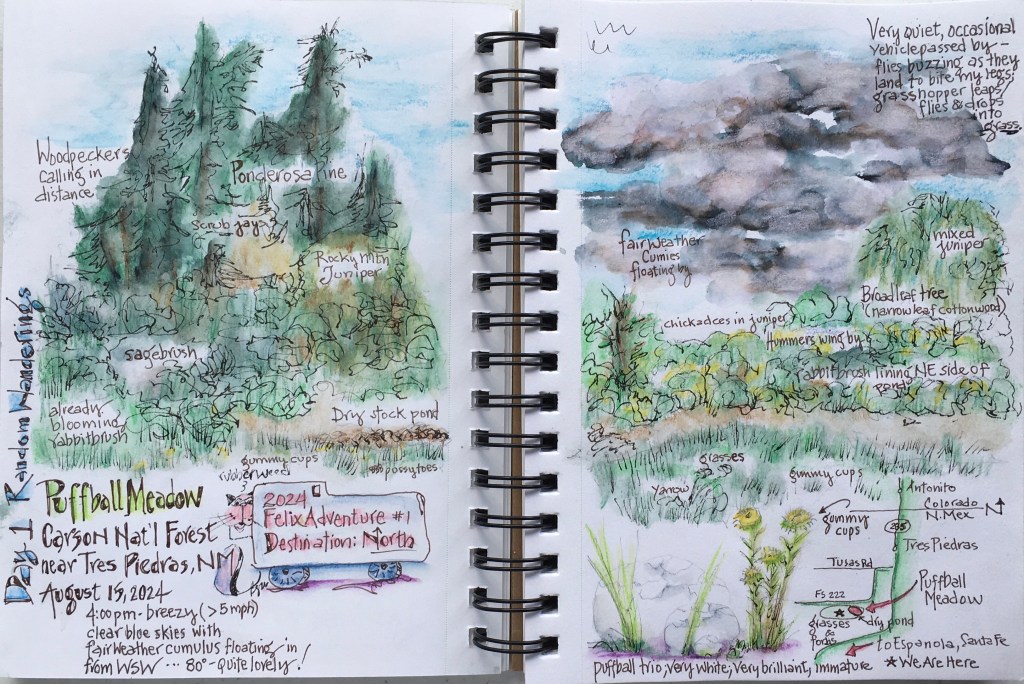
Day 1. Our first stop was in northern New Mexico, just south of Tres Piedras, Carson NF. An unlikely dispersed camping spot that I nicknamed “Puffball Meadow.” A nice level spot adjacent to a dry stock pond. The meadow was full of fist sized puffball fungi, and a coyote paid us a visit during the night.
We enjoy boondocking on our public lands managed by the US Forest Service and Bureau of Land Management. Having a trailer that’s self-contained, we can easily find lovely off-the-grid areas to set up camp. And thanks to our solar panels (and lots of sunny days) and large water tank, we can stay out for up to 5 days without needing refills. This allows us to explore lesser visited areas, which suits our tastes beautifully!
Day 2. Made it to the San Luis Valley, Colorado. Wandered around until we found a wide open area of dispersed camping in the vicinity of the Old Spanish Trail. Lots of wildflowers blooming, and plenty of hiking opportunities.
But I think one of the best things about random travel is the spare time …… we drive for 3-4 hours, find a place to camp ….. then the rest of the day involves hiking, wildlife watching, nature journaling, collecting drawable items, photography, more sketching, identifying the unknowns, reading, napping, and a bit of ukulele strumming! Perfection!
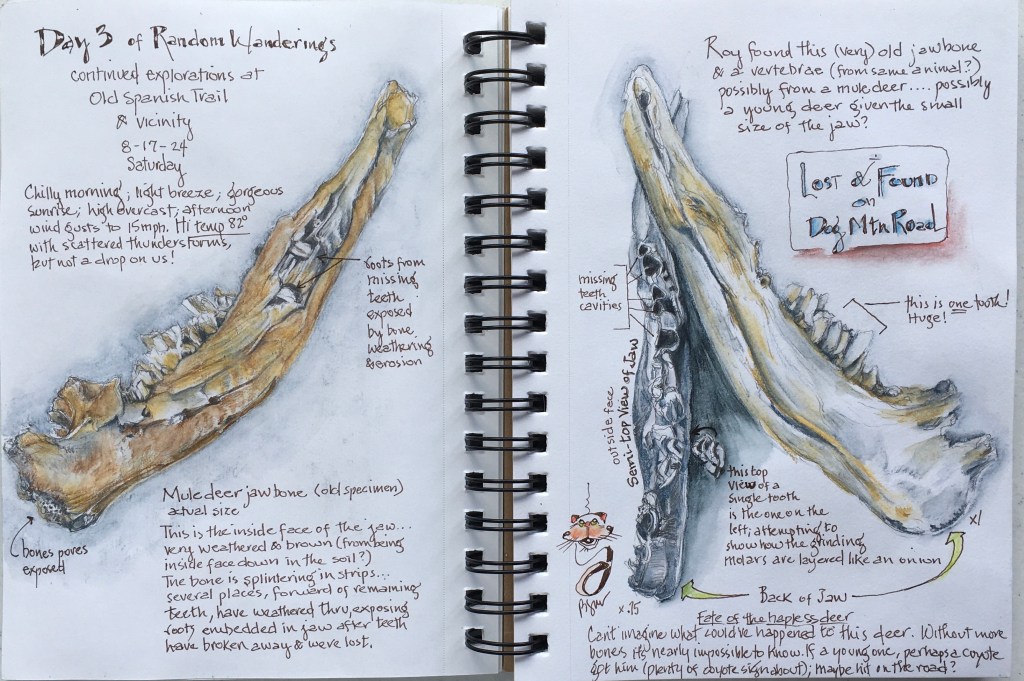
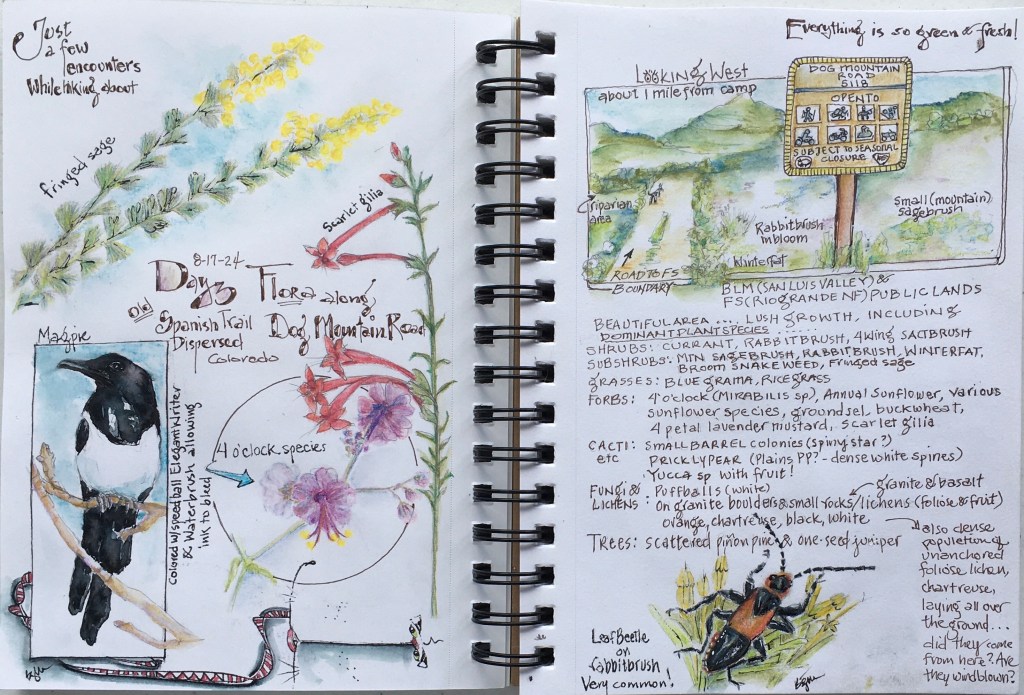
Day 3. We enjoyed the area so much, Roy suggested we stay for another day! And then he found this weathered mule deer jaw bone. Day 3, continued. Magpies! Can’t understand why these gorgeous birds don’t come south at least as far as Albuquerque and East Mountains.
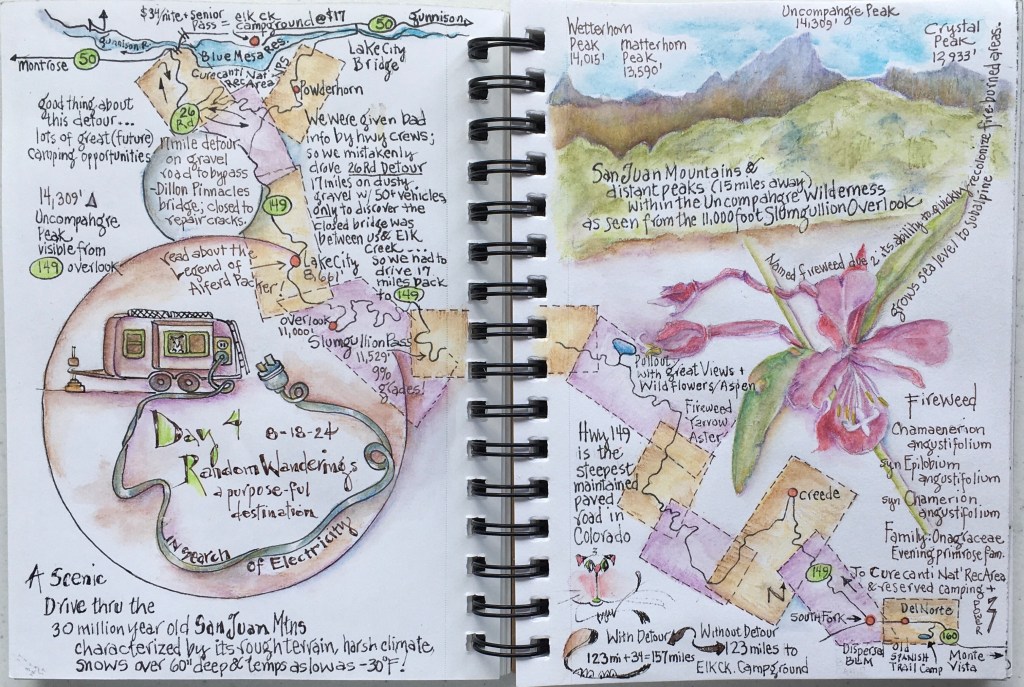
Although the 6-day trip wasn’t remarkable, it was good to get away. Scattered about this post are my journal pages highlighting Days 1 to 5.
Day 4. Our travel route as we made our way to a campground to charge our battery and top off our water tank. An inconvenient, unplanned for detour led to future camping possibilities.
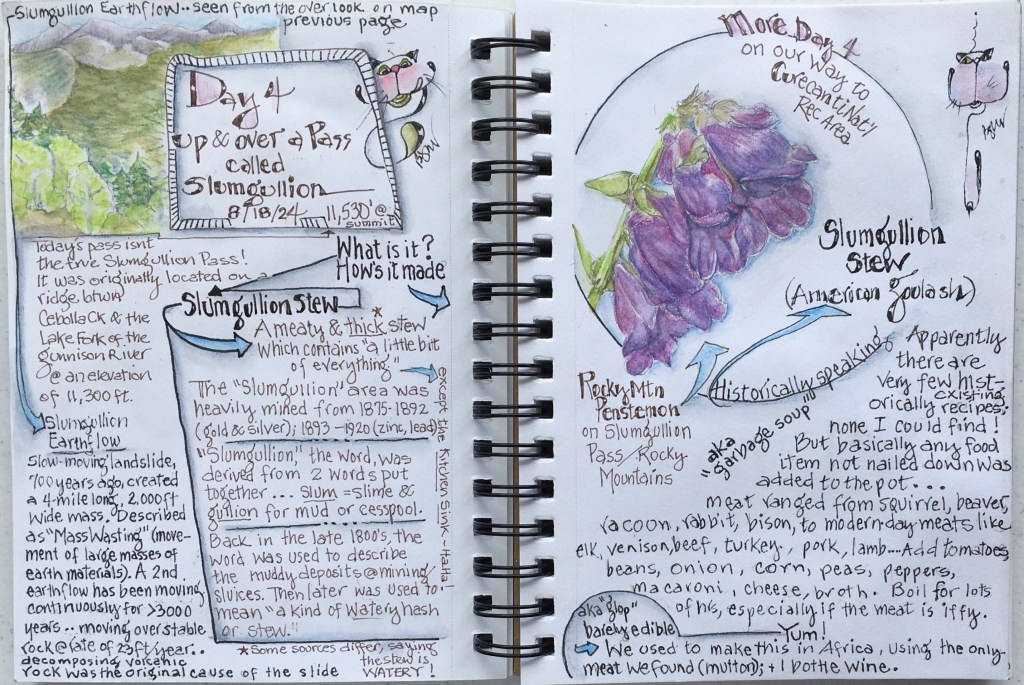
On Day 4, we decided to make our way up and over Slumgullion Pass (11,530 ft) on our way towards Gunnison Country. Not having been this way in years, we really enjoyed the crisp mountain air and spectacular views up and over the Pass. The villages of Creede and Lake City have grown swollen with tourist amenities and summer cabins dotting the once open meadows. As we got closer and closer to Lake City, we couldn’t help recall the story of Colorado’s notorious cannibal, Alferd Packer. Wanting to reread the tale as we passed near Cannibal Plateau and Deadman’s Gulch, the crime scenes, here’s what I found:
BriefBackground: Alfred Packer (newspaper misspelling as “Alferd” Packer, which stuck) (1842-1909) was a prospector who set out for Colorado gold fields in 1873. By the winter of 1874, he reached the rugged San Juan Mountains with a party of five men where they became lost and stranded during one of the worst winters on record. The men, with only had 3-4 days provisions quickly consumed and no firearms, were forced to cook their rawhide moccasins. Places where “snow had blown away from patches of wild rose bushes,” ….. they “were gathering buds from these bushes, stewing them and eating them.”
When the snow finally crusted over, Packer, the only man to survive the ill-fated trip, walked out of the mountains after 60 days. He told a story about the demise of his fellow prospectors, and how he managed to survive by eating them. His story involving cannibalism became legend, and continues to be passed down to today! (Whether the story is true or not will never be known, but it makes for colorful history.)
Based on historical records and news reports, Alferd Packer was tried several times for murder and cannibalism (even though the act of cannibalism wasn’t considered illegal in the US). Convicted of these heinous crimes, Judge M.B. Gerry supposedly uttered this famous quote while handing down the sentence in Packer’s first trial ……
“Stand up yah voracious man-eatin’ sonofabitch and receive yir sintince. When yah came to Hinsdale County, there was siven Dimmycrats. But you, yah et five of ’em, goddam yah. I sintince yah t’ be hanged by th’ neck ontil yer dead, dead, dead, as a warnin’ in reducin’ th’ Dimmycratic populayshun of this county. Packer, you Republican cannibal, I would sintince ya ta hell but the statutes forbid it.”
This is the quote I’d grown up hearing many times, over and over and over! It makes for good reporting, but is a ways from the actual sentence and what Judge Gerry sounded like while reading it (nope, he didn’t talk like Yosemite Sam!). Here’s what the record shows:
“Alfred Packer, the judgment of this court is that you be removed from hence to the jail of Hinsdale County and there confined until the 19th day of May, A.D. 1883, and that on said 19th day of May, 1883, you be taken from thence by the sheriff of Hinsdale County to a place of execution prepared for this purpose, at some point within the corporate limits of the town of Lake City, in the said country of Hinsdale, and between the hours of 10 A.M. and 3 P.M. of said day, you, then and there, by said sheriff, be hung by the neck until you are dead, dead, dead, and may God have mercy upon your soul.”
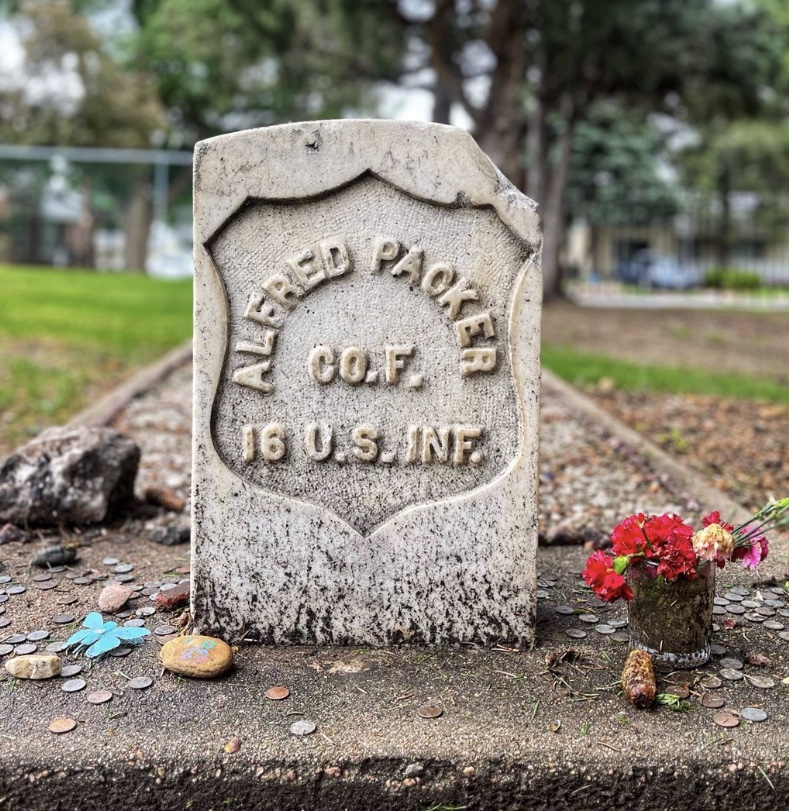
Alfred Packer tombstone in Littleton Cemetery where he was originally buried in 1909. Today, he now lies back in Hinsdale County, near Lake City.
Alferd Packer never did hang. It’s quite a detailed story following his first trial, including a jail escape, nine years on-the-lam, and recapture. There was a second trial in 1885 where he was charged for only one murder; after serving only 16 years of his 40-year sentence, he was released and died peacefully one year later at the age of 60. He was buried in Littleton, Colorado where his tombstone properly reads Alfred Packer.
Day 4. Supplemental information about that strange name “Slumgullion.” Is it a stew? Is it a drink? Is it the sludge that puddles below an 1870 sluice box? Day 5, on our way back to Old Spanish Trail (because we liked it so much). Discovered a new-to-me plant; after a bit of checking with iNaturalist, learned it was Black Henbane, but not before handling all parts of this very poisonous noxious weed!
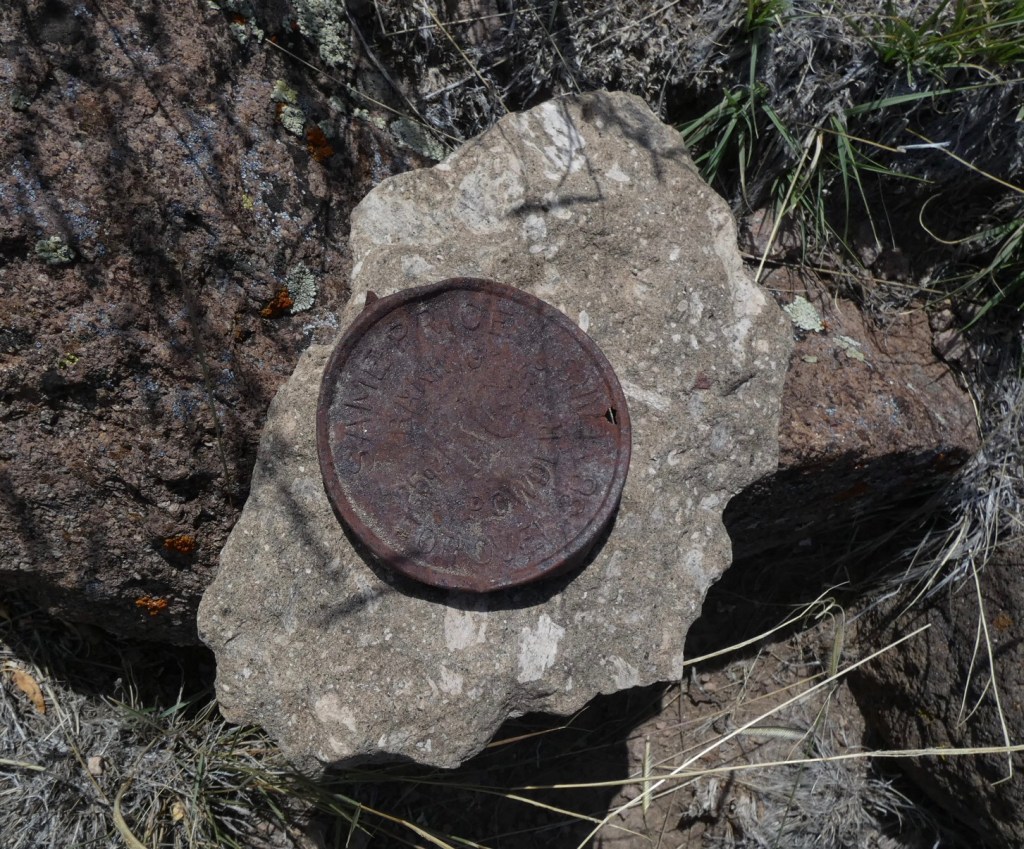
A short comment on the KG Baking Powder tin lid we found near our trailer. It was old and rusted, but very readable. The tin and its contents were probably long gone. Tried to find any information on the KG brand; sure curious about the age of the lid. If you’ve heard of this brand, please let me know.
KG Baking Powder tin lid we found near Old Spanish Trail.
Day 6. Headed for home. Hope you enjoyed my travel journal.
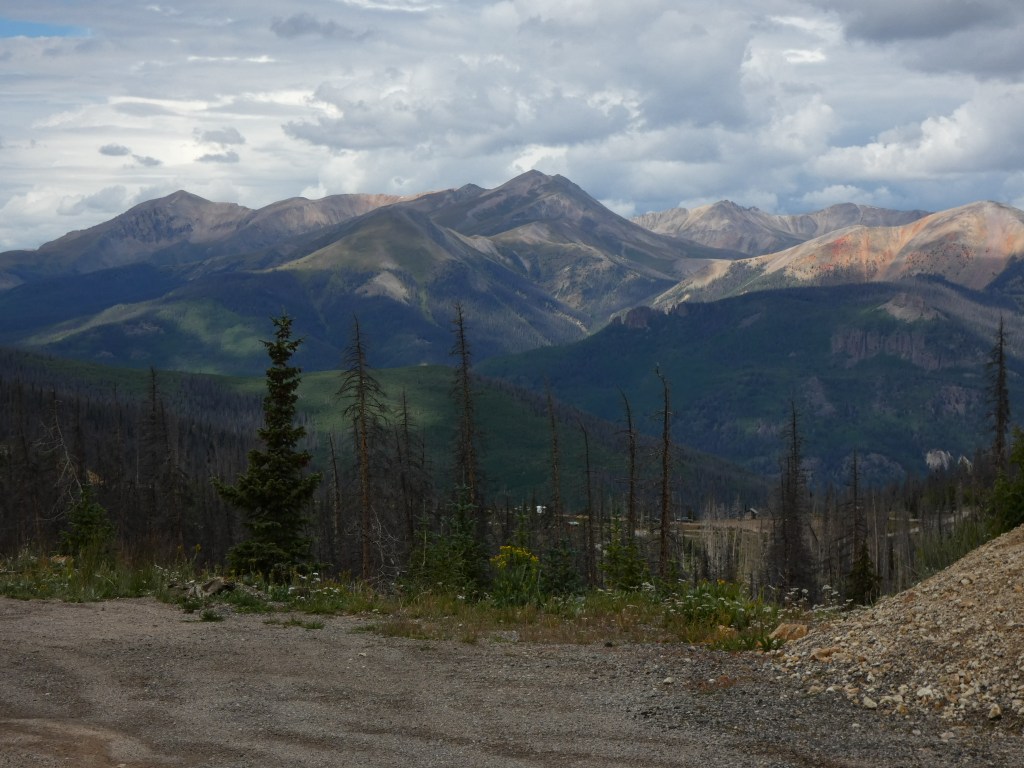
San Juan Mountains …… up and over Slumgullion Pass. The view of the 700 year old earth flow.
Webster’s had it “right on” when describing the Ubiquitous Plant Gall!
gall /ga:l/ 1. something irritating; rude. 2. not able to understand a behavior is unacceptable.
—-the boldness of these guys; the sheer gall and effrontery; the chutzpah; the unmitigated gall; What gall!
“Yeah ….. What Gall is This?!”
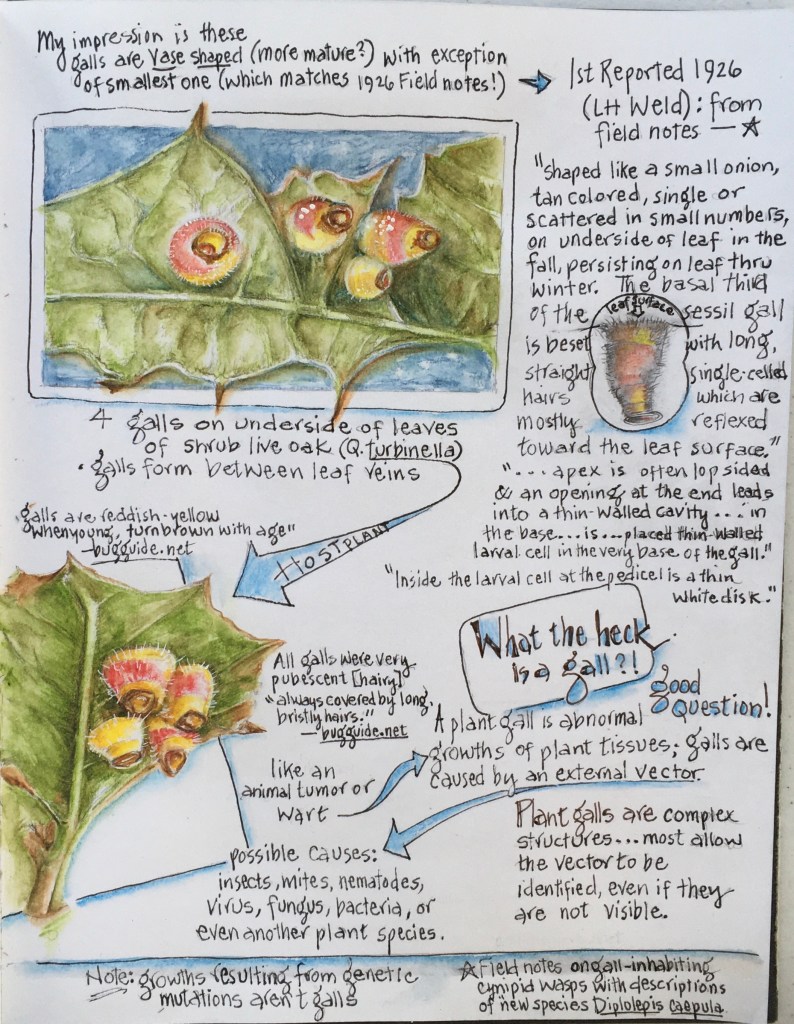
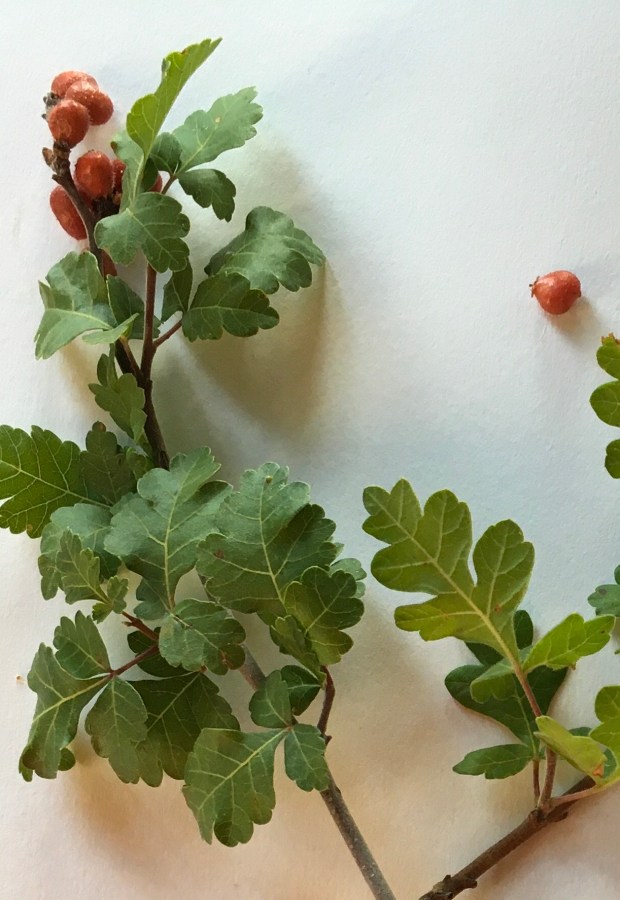
That was the question uppermost on my mind when a slight breeze wafting down the trail lifted a fresh oak leaf revealing four slightly wonky vase-shaped growths. One was squatty and pale; three were colored with alternating bands of cadmium yellow and deep vermillion. All four galls were attached to the underside of the leaf, hanging upside down, so whatever might’ve been inside is out.
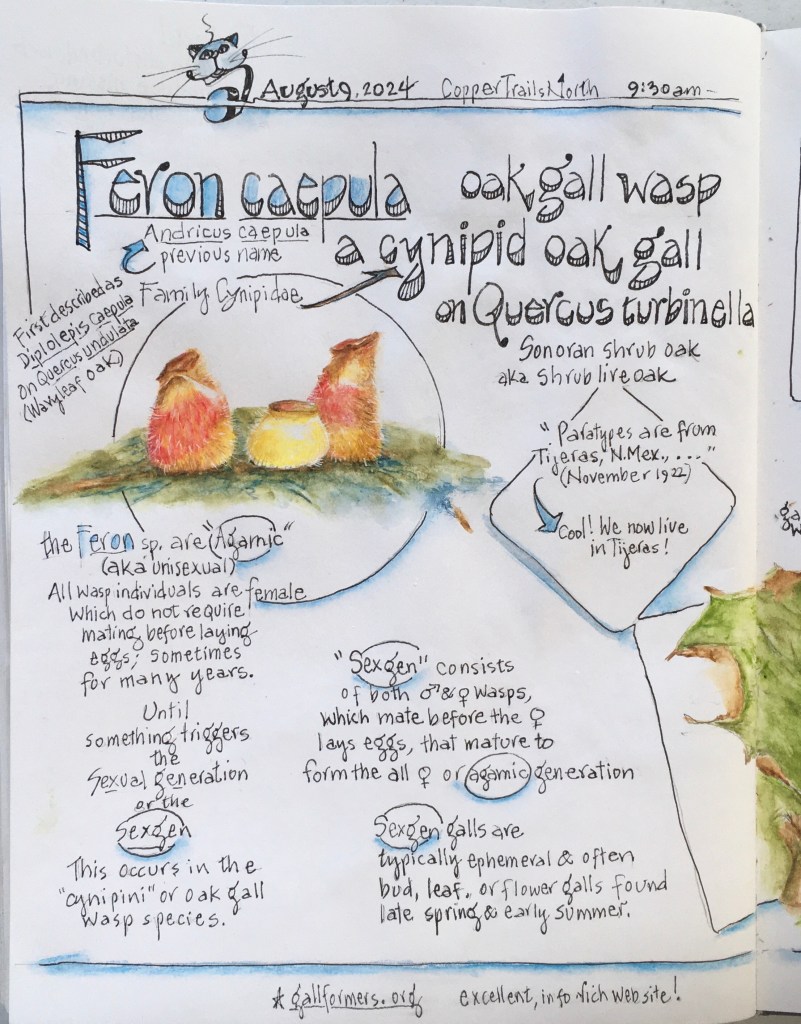
After 5 minutes of inspection ….. poking and prodding, and peering inside the tiny vases ….. I took some photos to post on iNaturalist to figure out this little mystery. It didn’t take long before my discovery was identified! These are galls of the parasitic cynipid wasp called Feroncaepula, formedthis Spring on a new leaf of Shrub Live Oak (Quercusturbinella).
Originally identified in a 1926 field report as a new species, Diplolepisundulata, this species’ name was reestablished as Feron caepula in a report published in 2023. Ordinarily I choose to only cite a field report, but decided to make an exception in this case for several reasons…… the description of this new species was helpful in better understanding my specimens, and……. one of the paratypes used to describe the new species came from Tijeras, NM (which happens to be my home!). So the entire 1926 field report* (surprisingly short) by LH Weld is added below.
Supplement to the Nature Journal Pages
A Curiosity of Oak Galls, Revisited …… Part III
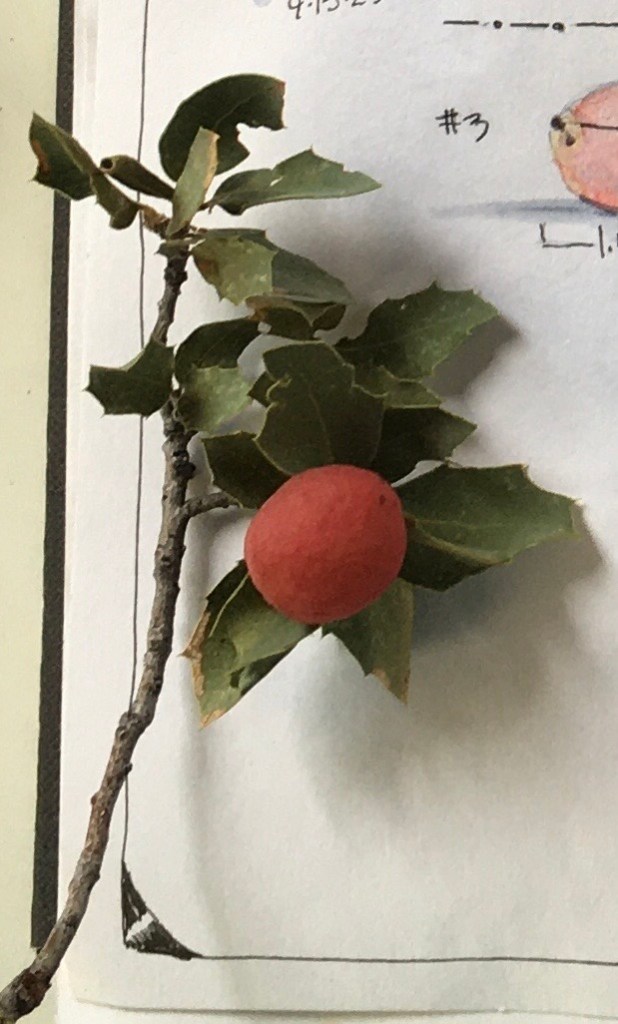
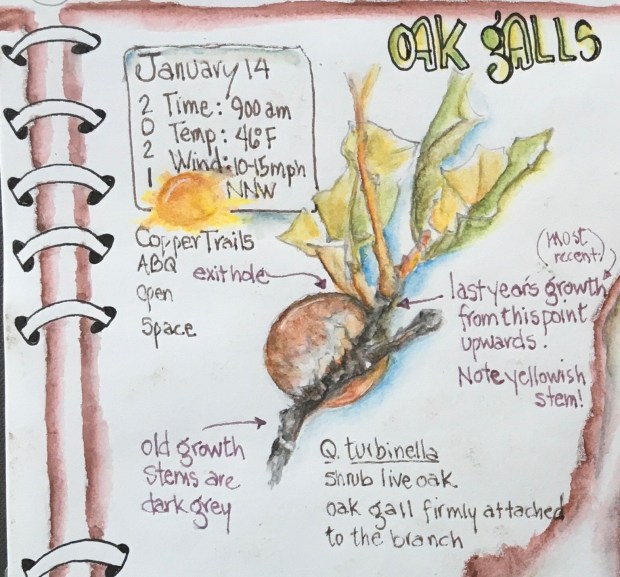
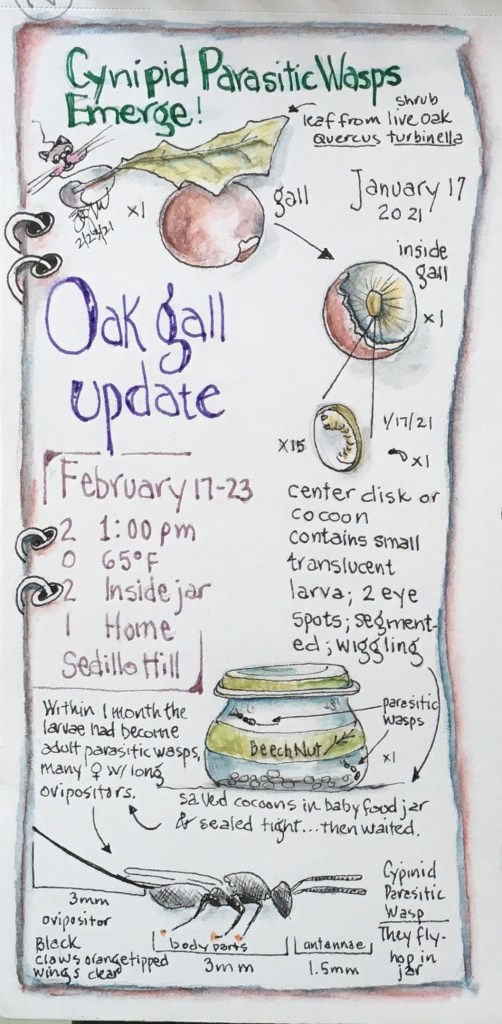
Curious about plant galls for decades, I finally began reading and experimenting to learn a bit about the inner world of oak galls. Throughout the winter of 2020-2021, I enlisted Roy’s help to collect about 100 nickel diameter, reddish-brown galls hanging on oak leaves like holiday decorations. Not knowing what to expect, I cut into a bunch of these galls and found tiny squirming grubs (larvae) – one/gall. The grubs seemed to be suspended by a complex network of stringy plant tissue radiating from each larva at the center to the inner gall shell. It reminded me of a snow globe frozen in time! Of course I had to know what these guys would become. So I placed about half of the galls into glass jars, and the other half went into jars without their protective gall home. In a few weeks the jars were full of the smallest wasps ever! Wasps! Little parasitic cynipid gall wasps active and ready to be released back into the wild to do what these wasps do! (Rest assured, they were releases in the same area where the galls were collected.)
A few years later, I was once again smitten by these tiny wasps and their galls, and learned more about their life cycle and other facts about galls in general. You can read all about my earlier experiences (and my efforts with experiments) in 2021 and 2023 at this post “No Small Galls this Fall! Oak galls, then and now, the sequel”.
Back to the Present
Here it is 2024, and while hiking the Albuquerque foothills, a new (to me) and colorful gall form appeared hanging beneath an oak leaf. My curiosity piqued. It was high time I gained some insight about the life cycle of cynipid gall wasps. Paraphrasing numerous expert sources, my attempt to interpret and understand what has been described the one of the most complicated life cycles known in the animal kingdom, still seems confusing. Maybe it’s been hard to wrap my mind around Parthenogenesis (asexual reproduction)***….. a key component of a cynipid gall wasp’s life cycle. By taking my time (over a month), and after many written and diagrammatic iterations, I stitched together a description that works. If you’re curious, read on!
One of the oak galls collected late 2020 …. On Shrub Live Oak (aka Sonoran Live Oak)
Where do Oak Galls Come From, and Why?
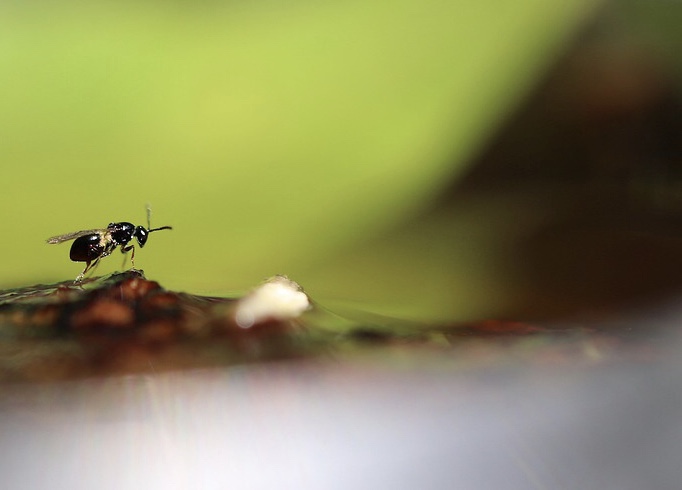
Every year in late-Spring and through early Summer our shrub live oaks (Quercusturbinella) are a-buzz with a cloud of nearly microscopic cynipid gall wasps that have emerged from a hundreds and hundreds of leaf galls. These often weird looking abnormalities begin forming during an oaks’ accelerated growth period in the Spring. “But where do galls come from and why?”
It’s Complicated!
In the case of cynipid gall wasps, the majority of more than 1400 known species* parasitize oaks, while a much smaller number favor rose and chestnut as host plants. Where and how a gall forms on a host plant, along with the gall’s size, shape and coloring is vector-specific. This gall uniqueness makes it possible to identify what species of insect, such as a cynipid gall wasp (or other external vector like a mite or virus or nematode or fungus or virus or bacteria) was responsible for each gall.
The life cycle of cynipid gall wasps alternate between asexual and sexual generations. This process, called Cyclical Parthenogenesis, is both fascinating and baffling. Typically, the gall formed by the females of the sexual generation (sexgen) shows itself in late winter/early spring, and is on a different part of the oak (such as a twig or stem) than the later asexual (or agamic) generation (agamic galls usually appear on actively growing plant tissues). The following is what appears to happen during the ………………
Photo of Cynipid gall wasp (courtesy Pixabay)
Lifecycle of a Cynipid Gall Wasp
The Asexual (Agamic) Generation
When the weather warms in late winter, an all-female generation of cynipid gall wasps emerge from galls which developed and became dormant the previous year, well before the cold and snow set in. This asexual generation of wasps initiates late Spring/early Summer gall development by inserting (with its ovipositor) an egg along with a maternal secretion from the venom gland, into a swollen leaf bud of the host oak. Egg laying takes place as the growing (meristematic) tissues inside the bud rapidly develop. The egg quickly hatches, and the larva begins feeding, all the while exuding specialized growth hormones that stimulate exaggerated tissue growth resulting in structures (the galls) that are visibly different from normal plant tissues. It’s during the Spring/Summer that developing galls are readily seen, often on the undersides of new leaves.
Portion of journal page from 2021
The safely hidden larva continues to eat the nutrient-rich plant tissues forming inside the gall and grows quickly until it develops into a pupa. After a few weeks in this pupal stage, an adult cynipid gall wasp has formed. Still tucked away, the adult (which is either a male or female) chews a small hole in the gall and emerges to mate.
Another journal page from 2021
The Sexual Generation (aka “Sexgen”)
With the business of mating taken care of, and with no mouth parts to eat, the males quickly die, followed soon by the females. However, before the females die, they deposit one or more eggs on a leaf or within a twig or stem of the host plant. Before the plant’s growing season concludes, the eggs have hatched, larvae have eaten and grown within their individual galls, and have pupated in preparation for over-wintering. Depending on the length and/or severity of winter where these cynipid gall wasps live (and they can live nearly anywhere worldwide), the dormancy period may last from three-five months.
And now …. back to the emergence of the Asexual or agamic generation (the females), in an on-going cyclic loop that is the life cycle of the cynipid gall wasp.
A Supplement to the Supplement!
Types of Galls
Leaf galls
Form on leaf blades or petioles (leaf stems)
Most common galls appear on the upper or lower leaf surface, on or between leaf veins.
Galls may look like leaf curls, blisters, nipples or hairy, felt-like growths.
Oak galls on Gambel Oak
Stem and Twig Galls
Deformed growth on stems and twigs.
Range from slight swelling to large knot-like growth.
When seen, may be peppered with many tiny holes where the adult gall wasps have emerged.
Bud or Flower Galls
Deformed size and shape of buds or flowers.
Fun Facts
Galls are growing plant parts and require nutrients just like other plant parts.
A gall keeps growing as the gall former feeds and grows inside the gall.
Once galls start to form, they continue to grow even if larvae die.
Most galls remain on plants for more than one season.
Galls are usually not numerous enough to harm the plant and control is not warranted.
Gall numbers vary from season to season.
Typically, plant galls become noticeable only after they are fully formed.
The asexual generation (agamic) galls are reported more often because they are larger and persist longer than the sexual generation (sexgen) galls.
Mature plant tissues are usually not affected by gall-inducing organisms.
Iron gall ink, which was the most common ink used from the Middle Ages to the 19th century, was used in line drawings by DaVinci, Van Gogh, and Rembrandt, and in the writing of many historical documents like the US Declaration of Independence.
It’s been so helpful to study the life cycle of these tiny parasitic cynipid wasps, if for no other reason than to admit my understanding remains basically rudimentary, and I must keep my Curiosity alive!
As always, thanks for stopping by!
………………………………………………………………………………………………………………
*Field report from 1926 by LH Weld
Diplolepis caepula, new species
Host. — Quercus undulata [Wavyleaf oak, Quercus x undulata]
Gall. — Shaped like a small onion, tan-colored, single or scattered in small numbers on under side of leaf in the fall, persisting on the leaf through the winter. The basal third of the sessile gall is beset with long straight single-celled hairs which are mostly reflexed toward the leaf surface. The conical apex is often lop sided and an opening at the end leads into a thin-walled cavity in which are a few scattered hairs and in the base of which is the transversely placed thin-walled larval cell in the very base of the gall. Inside the larval cell at the pedicel is a thin white disk.
Habitat. — The type is selected from a series from galls collected November 14, 1921, near Hillsboro, N. Mex., the flies emerging April 5-25, 1922. Paratypes are from Tijeras, N. Mex., and of the adults cut out of the galls on November 1 some lived in a pill box until December 28. Other paratypes are from Blue Canyon west of Socorro, adults being cut out of the galls on January 2. ….. Similar galls were seen on Q. grisea at Magdalena, N. Mex.
LH Weld: (1926) Field notes on gall-inhabiting cynipid wasps with descriptions of new species”
**The 1400 known species of cynipid gall wasps have been identified worldwide, with an estimated total of more than 6,000 species. In the U.S. there are over 2,000 known species of gall-inducing insects, including 750+ cynipid wasps (500 of which are found in just the West). Worldwide, entomologists have estimated that there are over 210,000 gall-inducing insects yet to be identified!
*** Parthenogenesis is a form of asexual reproduction where an egg develops into a complete individual without being fertilized. The resulting offspring can be either haploid or diploid, depending on the process and the species. Parthenogenesis occurs in invertebrates such as water fleas, rotifers, aphids, stick insects, some ants, wasps, and bees. Bees use parthenogenesis to produce haploid males (drones) and diploid females (workers).
Some vertebrate animals, such as certain reptiles, amphibians, and fish, also reproduce through parthenogenesis. Although more common in plants, parthenogenesis has been observed in animal species that were segregated by sex in terrestrial or marine zoos. Two Komodo dragons, a bonnethead shark, and a blacktip shark have produced parthenogenic young when the females have been isolated from males.
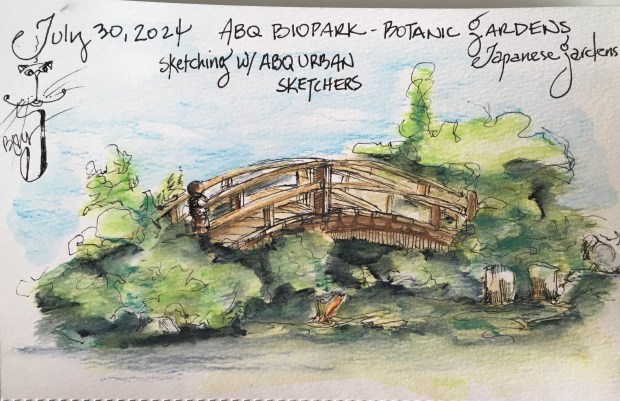
On July 30th, six of us Albuquerque (ABQ) Urban Sketchers gathered for an impromptu morning of exploring and sketching at the ABQ Biopark/Botanic Gardens. It’s always so much fun seeing what’s blooming any time of the year, even during the heat of summer. Despite the morning’s toasty hot temperatures, the plentiful shade and water features provided many “cool” locations for sketching and exploring.
Since the Japanese Gardens section of the park was new to me, I decided to make my way there to sketch, while enjoying summer flowers and many interesting seed pods from what must’ve been an outrageous, overly abundant Spring bloom. After a slow 15 minute stroll, I had arrived at the 4-acre Japanese Gardens, complete with a waterfall, koi pond, pagodas, wooden bridges, many stone statues, and many many ducks.
Walking bridge over the koi pond
My first sketch was of a pretty pagoda that served as a shady spot for one of the ABQ Plein Air members to paint the scene behind me.
Then, wandering deeper into the garden, past the waterfall, I found the koi pond with a few interesting features ….. a walking bridge bisecting the pond where parents brought their children to feed the ducks. Adjacent to the walking bridge was a weathered wooden bridge which crossed the inlet to the pond. As I sketched and painted while sitting on a large flat rock a foot back from the pond’s edge, many large dragonflies hovered nearby, several koi rolled in the water, mallards paddled about, and a bullfrog sounded his loud and low stuttering ru-ru-ruuuuummmmmmm. A few park visitors even stopped behind me to watch my sketches develop!
Small weathered, wooden bridge and rolling koi
It was so calming and peaceful sketching in the gardens, and before I knew it the morning had flown by. Quickly I packed up my supplies and scurried back towards the entrance to the Biopark where I met up with my small group for our “throw down” and photos.
Such a great morning!
As always, thanks for stopping by!
Supplies: Faber-Castell Pitt Artist Pen fineliner 0.3 (black) was used first to create quick sketches; Derwent watercolor pencils and Pentel waterbrush were used for the color














 a curious nature