Like soft, fluffy snow! Glistening orbs of silky gossamer are floating about the neighborhood, drifting hither and yon in the gentle breeze. Suspended beneath each orb is a single reddish-brown winged seed that appears to coax its wind-propelled puff in a safe descent to the ground. But the white floss (the Coma) wants to fly, and it becomes a tug of war. As the weight of the seed overwhelms the ability (and the desire) of the floss to carry it, their brief relationship is severed. But both get their wish …. the floss flies free as the seed drops to the ground, hopefully landing in an ideal spot to overwinter and sprout next spring.
Welcome Fall!
When the air is full of Horsetail Milkweed parachutes and their ‘riders,’ I walk along the neighborhood roadways and collect a bounty of their new-crop seeds + floss to set free around our property. If they find the right soil, moisture, and light conditions for spring germination, the seeds will not only form the beginnings of a stand of these beautifully blooming, creamy-white milkweed flowers, but the plants might just play host to Monarch and Queen butterflies!
Now wouldn’t that be dandy!
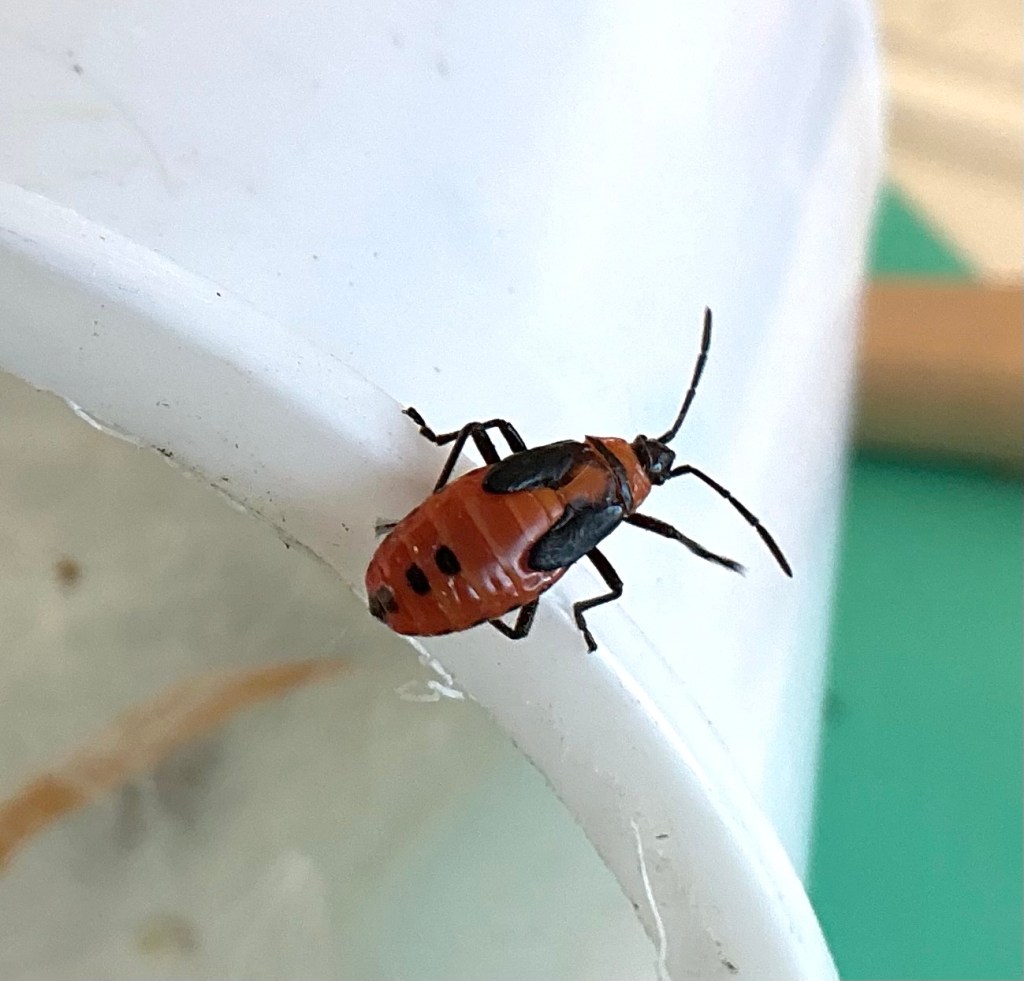
(Of course, mature seeds from new plants will undoubtedly entice a hungry crop of well-dressed Milkweed Bugs next Fall. That’s OK! They have to eat too!)
Before hint of color
My Journal Pages ……
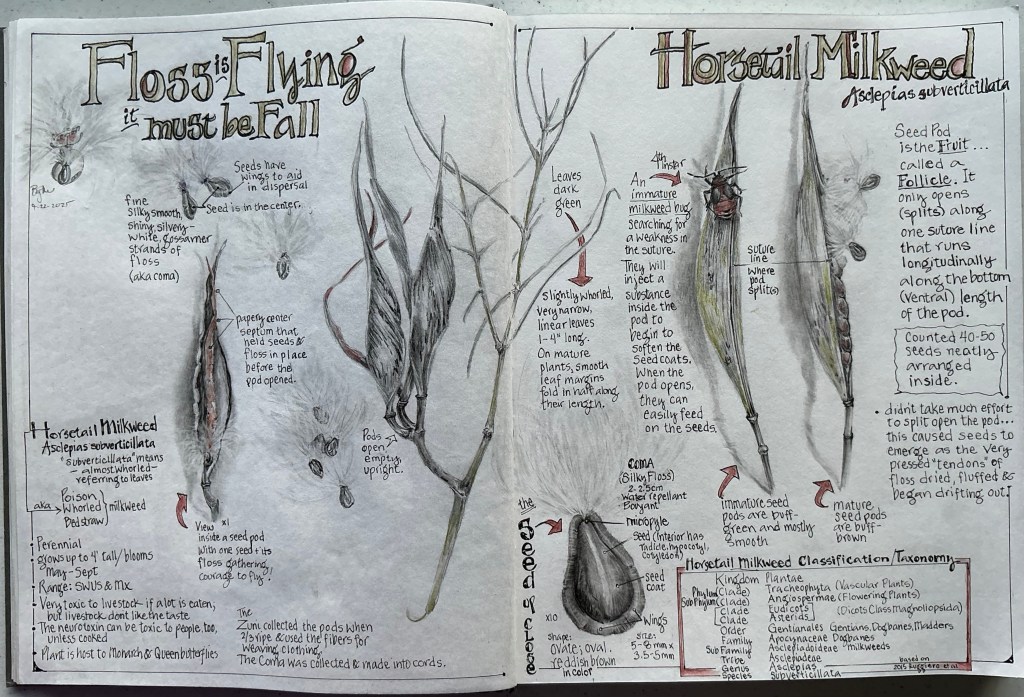
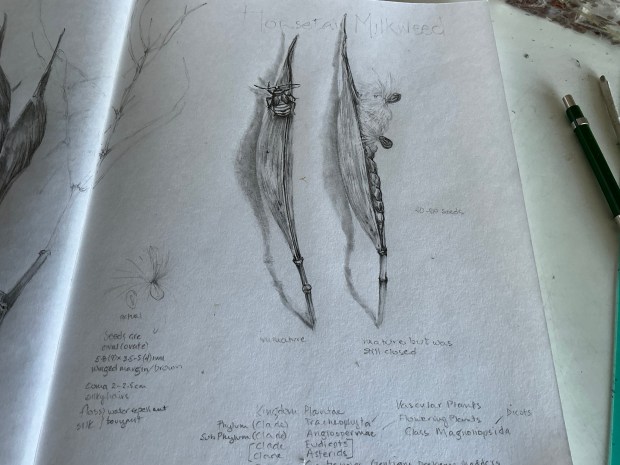
For something different, instead of using ink and watercolor, all sketches on these pages were created in graphite. The pods, seeds and the milkweed bug were sketched from my collected samples using a mechanical pencil loaded with a fine point HB lead. The touches of color were added with water soluble graphite.
Work in Progress #1Work in Progress #2
Thanks for stopping by ….. And Have a Fabulous Fall!
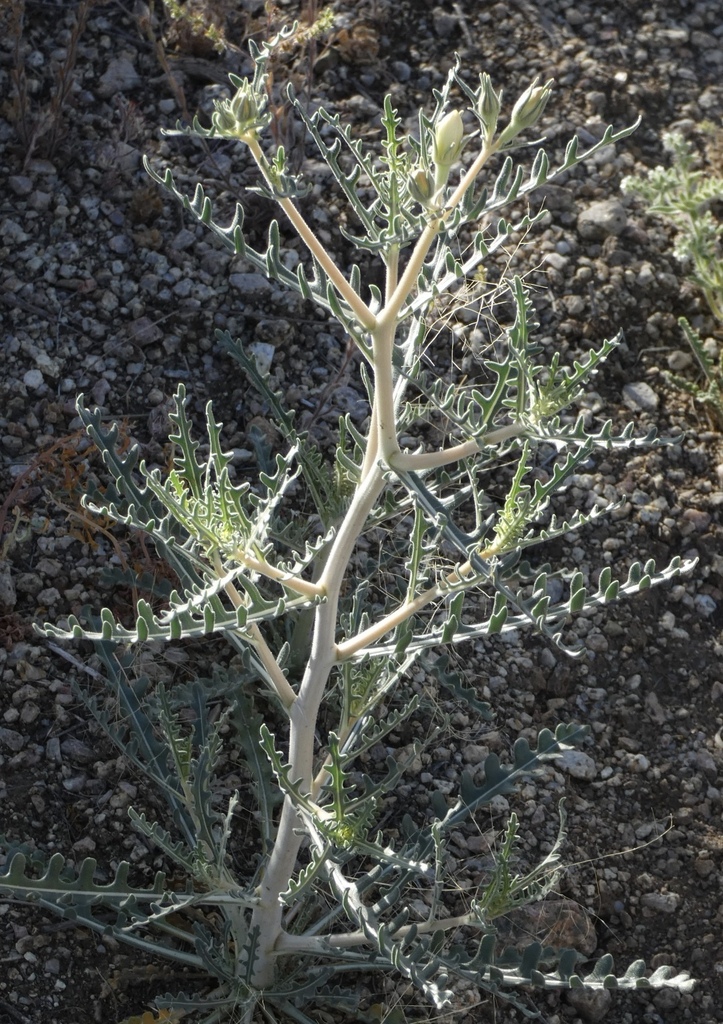
You must awake when the first rooster crows to enjoy the floral beauty of a fully flaired Blazingstar blossom. Appropriately named, these gorgeous flowers display a radiant combination of spoon-shaped petals, petal-like stamens, and hundreds of thread-like stamens, all colored in bold sulfur yellows, distinctive pale orange-yellows, brilliant star whites, or fluorescent blues, based on species. These superbly showy flowers unfurl overnight atop tall white, branching stems that resemble candelabras with narrow lobed green leaves. These large, 2” diameter flowers belong to the Mentzelia genus, plants that are all native to the Americas, and represented by 60-80 species, most found in the desert southwest.
In 1753, Carl Linneaus gave this plant its genus name, Mentzelia, after German botanist and sinologist Christian Mentzel. (Did you know a Sinologist is a specialist in the study of Chinese language, literature, and civilization? Huh!) But perhaps more fascinating and what’s always ‘captured’ my complete attention (and blue jeans) is that the Mentzelia genus fits perfectly in the Loasaceae family ….. commonly referred to as the Stickleafs.
About those leaves ……
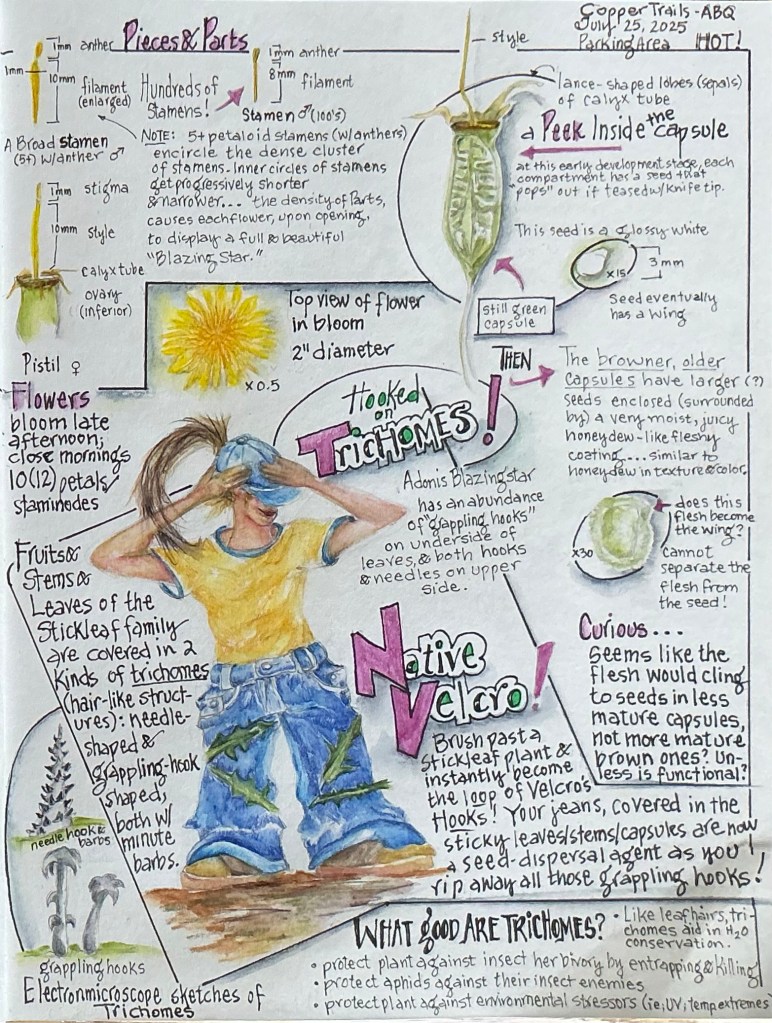
Being primarily a day-time hiker, my first encounter with a Blazingstar occurred simultaneously with a misstep into the plant. Noticing some resistance in making my escape, I looked down at the ground and discovered my jeans had a collection of stuck leaves from my boots on up. And the leaves were really stuck tight along their entire length! Removing those leaves was like peeling a banana, only tougher. Wait! Forget the banana peel. Removing those sticky leaves sounded like and felt like tugging on and separating Velcro! I was reminded of the familiar ‘ripping’ noise made when Velcro hooks are forcibly released from their loops!
Eureka!!
Nature is full of surprises. Were the Stickleafs the source of accidental inspiration for today’s handy hook-n-loop fastener, called Velcro? Almost, but not quite! As it turns out, the tiny hooks on Cocklebur seedpods inspired a Swiss engineer to develop Velcro in 1941. But not to change subjects too much …….The reasons Stickleafs could’ve been the inspiration for Velcro, is similar to the Cocklebur story, but, I think, even better. Here’s why ……
The seedpods of both plants have tiny hooks that readily adhere to clothing and fur. And it was the hooks’ tenacity for stick-to-it-tiv-ness that grew the original Velcro idea. But Stickleafs go even further in ‘reinforcing’ the fastener concept. Not only does the seed pod (capsule) of Stickleafs have a covering of tiny hooks, but both leaf surfaces and even the stems of plants in this family can have multiple types of minuscule grappling-hooks and barbed needles, called Trichomes, visible only with an electron microscope. I summarize that if the Swiss engineer was visiting America in 1941, and had the good fortune to walk into a Mentzelia plant, he undoubtedly would’ve been super inspired to develop Velcro. After all, it’s the leaves that stick fast to clothing, resemble a strip of Velcro, and hold tight, mimicking an ideal hook-n-loop fastener.
Hooked on Trichomes
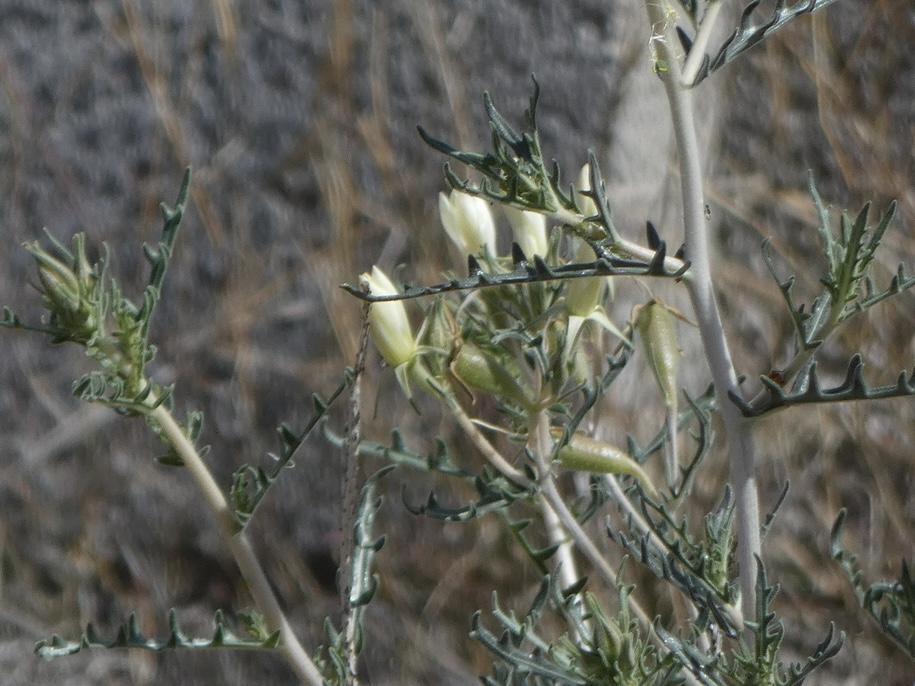
And now for the curious nature of the Mentzelia genus. When coming across the Adonis Blazingstar (Mentzeliamultiflora) over the past 8 years, it’s been fun to inspect the leaves, remove one and intentionally stick it to Roy’s jeans or mine. I’ve then wondered how this plant ‘sticks’ so well, and why. The time for answers arrived this month, and what I learned was fascinating. It’s all about Trichomes.
Trichome is a botanical term used to describe the small hair-like structures that occur somewhere on a plant; typically on plant leaves. Trichomes can be found throughout the plant kingdom (like on Cannabis sativa); they aren’t unique to the Stickleaf family, and are found on all species of the the Mentzelia genus. Some Mentzelia species have one type or shape of trichome; some have several types. Adonis Blazingstar has two types of trichomes – one is shaped like a grappling hook; one is shaped like a barbed needle. It’s the trichomes that grab on and hold tight. But what possible function do they serve the plant? Surely a leaf sticking to the fur of a passing animal or a person’s pant leg, while decorative, is otherwise pointless?
What Good are Mentzelia Trichomes?
Like plant hairs, trichomes aid a plant in water conservation in times of drought by reducing transpiration, and in situations of other environmental stressors, such as excessive UV light and extreme temperatures. The trichomes serve as a protective barrier between the leaf, stem, or other part of the plant, and the environment.
Trichomes can function as water collection, retention and funneling structures during a rainstorm.
The grab-and-hold nature of trichomes when they attach to fur or clothing can cause enough vibration of mature seed capsules to shake loose seeds ready for dispersal.
Trichomes are the plant’s primary defense against herbivory; not from livestock or rodents intent on munching leaves, but from insects that attempt crawling amongst the grappling hooks and barbed needles intent on causing damage. As can be seen in electron microscope images, insects have been photographed speared and hooked and killed because they were unable to escape their entrapment by trichomes.
But not all insects succumb to the fate of trichomes. Aphids are able to navigate the dense forest of hooks and needles without capture, allowing them to wreak havoc on vulnerable and tasty leaves, stems and seed capsules.
And that’s why the Mentzelia genus of the Stickleaf family is one of the natural curiosities of the plant kingdom. Maybe now, you too, are Hooked on Trichomes?
I hope you’ve enjoyed this post, and do thank you for stopping by!
And if you’re curious about how Trichomes contribute to the enjoyment and/or medicinal benefits of marijuana (Cannabis sativa), here’s what I found:
Trichomes are the primary site for cannabinoid production (i.e. compounds like THC & CBD responsible for the plant’s psychoactive/therapeutic effects.
Trichomes are the site of terpene production which gives different Cannabis strains their unique aromas/flavors.
Trichomes are the site of flavonoids known for antioxidant and medicinal properties.
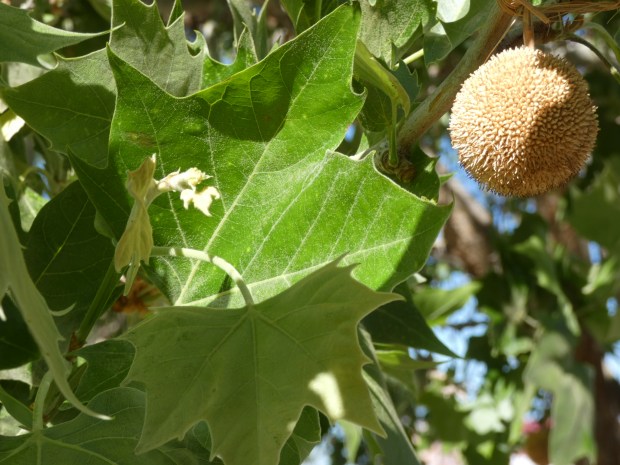
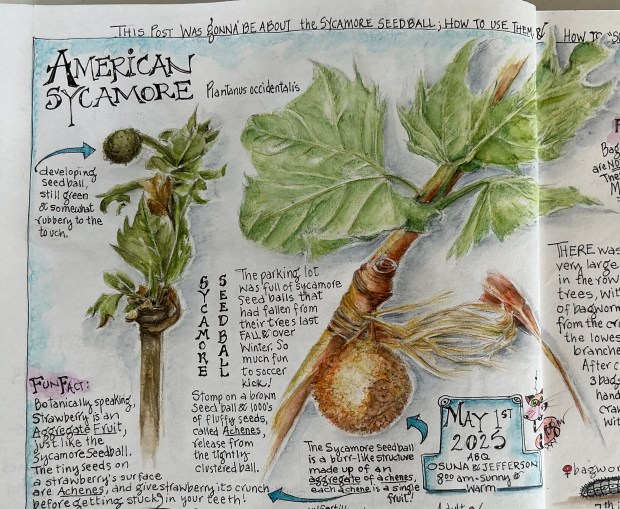
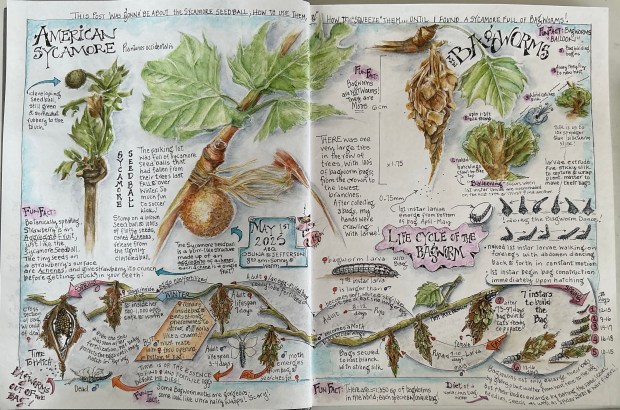
On a warm Spring morning, wandering around a grove of American Sycamore, I became curious about these magnificent trees: where in the US are they native; why are some leaves larger than the palm of my hand and some half the size; what about those odd pingpong sized seedballs lying on the ground everywhere you look ….. why don’t they roll away in search of an ideal spot to pop open so the seeds can germinate …… when the seedballs are kicked, stepped on or crushed beneath a car tire, do the 1,000’s of seeds inside blow away to sprout ….. are the seeds (all or some of them) even viable ….. do the seedballs make a good ink or dye or maybe they’re edible or even medicinal……. what, if any wildlife species eat the seedballs or seeds; and ooooohhhhhhh, sycamore bark! Why does this tree’s bark flaunt a pastel palette of greens, yellows and pinks. These and many more questions came to mind that it seemed about time the American Sycamore became a subject for my nature journal, until ……………..
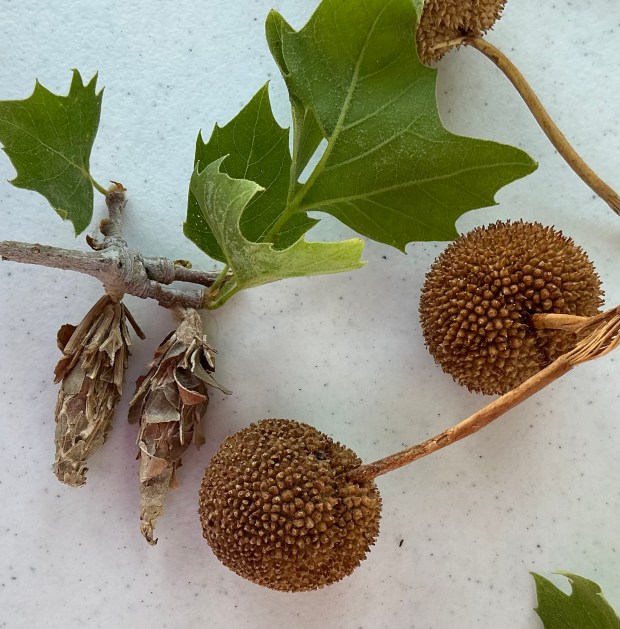
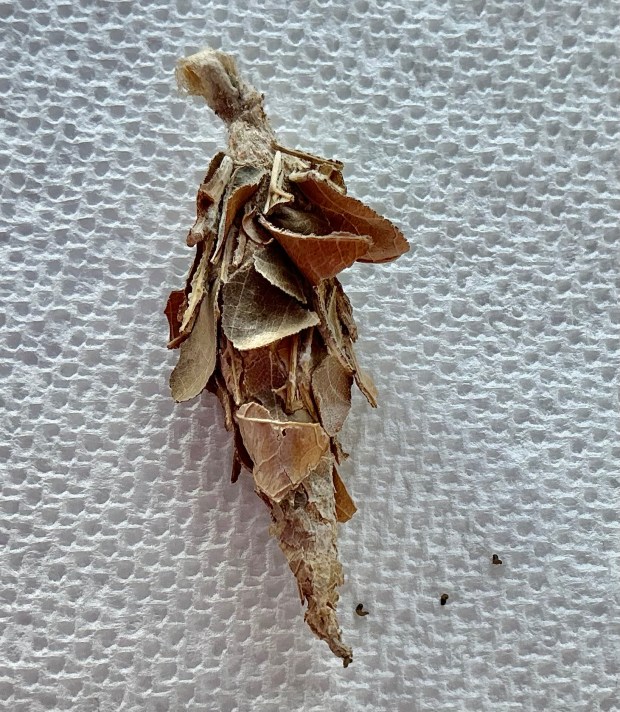
There! In the tree above my head, I spotted a most curious thing. Parting a few of that sycamore’s beautiful Spring green palmate-shaped leaves was a bundle of dead brown and beige leafy bits and sticks all haphazardly glued together. Wishing to get a closer look at that elongated ornament shaped “thing,” I found it was securely suspended from a branch. Trying to puzzle out this fascinating mystery while searching for my pen knife, a stiff breeze blew through the tree. It was then a I noticed hundreds of those 2-3” long bundles all over the tree; from the base to its crown!
Curiosity is the Essence of Nature Journaling
What continues to draw me to nature and nature journaling after so many years are the surprises in the familiar and in the unknown. I know well enough that new encounters in nature are infinite; you just have to open your eyes and look. Having learned by carefully observing what appears to be familiar, often leads to new discoveries. That’s when my curiosity kicks into high gear ….. when it’s time to engage in some serious poking around to figure something out; to learn what the “thing” is.
Curiosity, for me, is the very heart and soul of nature journaling. The ‘art’ of curiosity even precedes skill in observation. It’s what drives me out the door in the morning and fuels my exploration. Curiosity fills the mind with countless questions if for no other reason but to develop a deeper understanding of the natural world.
But I “wax philosophical.” Needless to say, my curious discovery on that warm and breezy Spring morning prompted an abrupt change of mind for my next blog post (this post). Anxious to learn about the “thing” suspended from a tree branch, probably minding its own business, I proceeded to cut it down (along with two more) and popped them in a bag along with a few sycamore leaves and seedballs.
Later that same day …….
Upon completing my journal sketches of sycamore leaves and seedballs, and posting a few photos to iNaturalist for an initial ID, it was time to take a closer look at my discovery. Reaching into the bag for one of the “things” (wiping my hand free of spider webbing?), I placed it on my examination table surrounded by several hand lenses, a larger magnifying glass, a penknife, and 2 pairs of tweezers. Before beginning the dissection, I noticed about a dozen black pepper-sized bits moving about the “thing.” Thinking tiny spiders had come from the bag, I didn’t give them a second thought (should’ve been curious!).
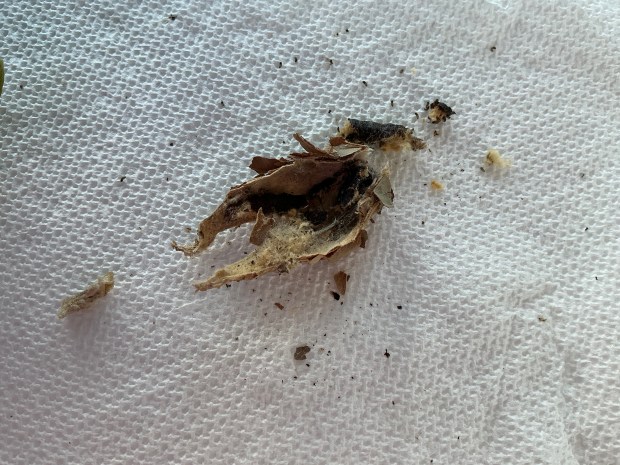
This bagworm bag was the subject of my dissection. Notice the pepper-sized black dots next to the bag ….. those are wiggling 1st instar larva.
iNaturalist ID Pick :::::::::::::: BAGWORM MOTH ::::::::::::::: iNaturalist ID Pick
(awaiting genus/species ID)
A Bagworm Moth!
How cool is that!?!
The opened bag of a female Bagworm moth. She’s very dead, but her progeny are escaping as fast as they can.
Dissection resumes ……
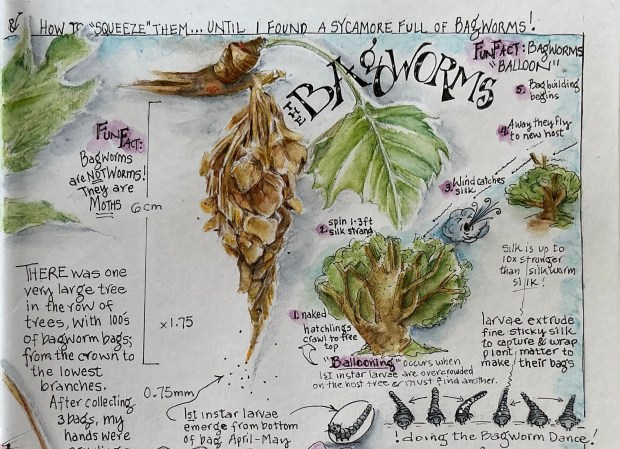
After finding out the “thing” I’ve been pondering over is the Bag of a bagwormmoth, I learned the Bag was built during last Spring, Summer and Fall by either a male or female bagworm moth. If a male, the Bag would be empty; if a female, the Bag would contain her remains …. she would’ve died last fall after a male fertilized 500-1,000+ eggs she overwintered inside her body until Spring when newly-hatched larvae would emerge from the bottom of the Bag and begin the species’ life cycle all over again.
The Bag, that took about 10 minutes and all my dissection tools to open, contained the black and mushy remains of a female and 100’s of wiggling/dancing larvae! They were on the move; escaping from the now wide open Bag, and quickly covering my examination table like a pepper grinder out of control.
And my effort to open the Bag? This made sense after reading about the high tensile strength of the silk they produce. These thin strands of silk, 10x stronger than that produced by silkworms, is used in abundance to construct their Bags.
The coolest thing ever! Notice the either late 2nd or early 3rd instar larva, no longer naked, but swaddled in very chewed up leafy bits glued together with strong silk. This dude was hiking up a sycamore branch, continually chewing, wiggling, and gluing.
After disposing of all the naked 1st instar larvae waggling and dancing across my examination table, I placed the dissected Bag, the two whole Bags, and collected leaf material into a clear plastic ziplock to observe what would happen. Over 10 days, the number of larvae multiplied and the naked 1st instar caterpillars grew in size (at least to 2nd instar) while building their individual Bags from tiny bits of leaf litter! Their wiggling dance seemed to be the way their silk strands wrapped and secured leafy bits around their bodies. It’s been fun to watch all the activity.
Have you ever encountered one or more of the 1,350+ species of bagworm moths? What materials were their Bags made from? Please share your experience with these fascinating members of the butterfly/moth family of insects.
Wandering about the neighborhood one warm summer morning in 2018, I noticed a dense stand of plants lining a 20 foot section of road. What caught my eye were the umbrella-like clusters of pearly white flowers topping each slender stem. From a distance these plants resembled our native white-flowering yarrow. But I soon realized the narrow dark green leaves were not fuzzy; the tiny exotic-looking flowers were not daisy shaped. Unmistakably, this plant was a species of milkweed! And the flowers of more than 50 individual plants in this population were a-flutter and a-buzz and a-crawling with hungry insects!
What was this milkweed species?
This is the Winter Botany portion of this post. All that remains of last summer’s Horsetail Milkweed are stems and mostly empty seed pods clinging to short branches. But some of the seed pods still hold silky tailed seeds clinging to their open pods. Hundreds of seed pods line the roadways in our neighborhood.
It didn’t take long to confirm this plant as Horsetail Milkweed (Asclepiassubverticillata), a species commonly found along roadsides in pinyon-juniper woodlands. Knowing what to look for on future walks, over the next several years I was excited to find 30+ more populations of various sizes along neighborhood roadways! From 2018 until early summer 2024, I continued to monitor these seemingly abundant populations. The small numbers of seeds I collected in the Fall were planted in our yard, and every year I checked for the presence, variety and numbers of insects busy feeding on nectar as they pollinated the flowers.
During June 2024, when we moved only a few miles to the northeast, I was happy to see Horsetail Milkweed grew abundantly in our new subdivision. This prompted me to dig deeper into researching this species. Its been exciting to discover how important this milkweed is to native insects, including monarch and queen butterflies.
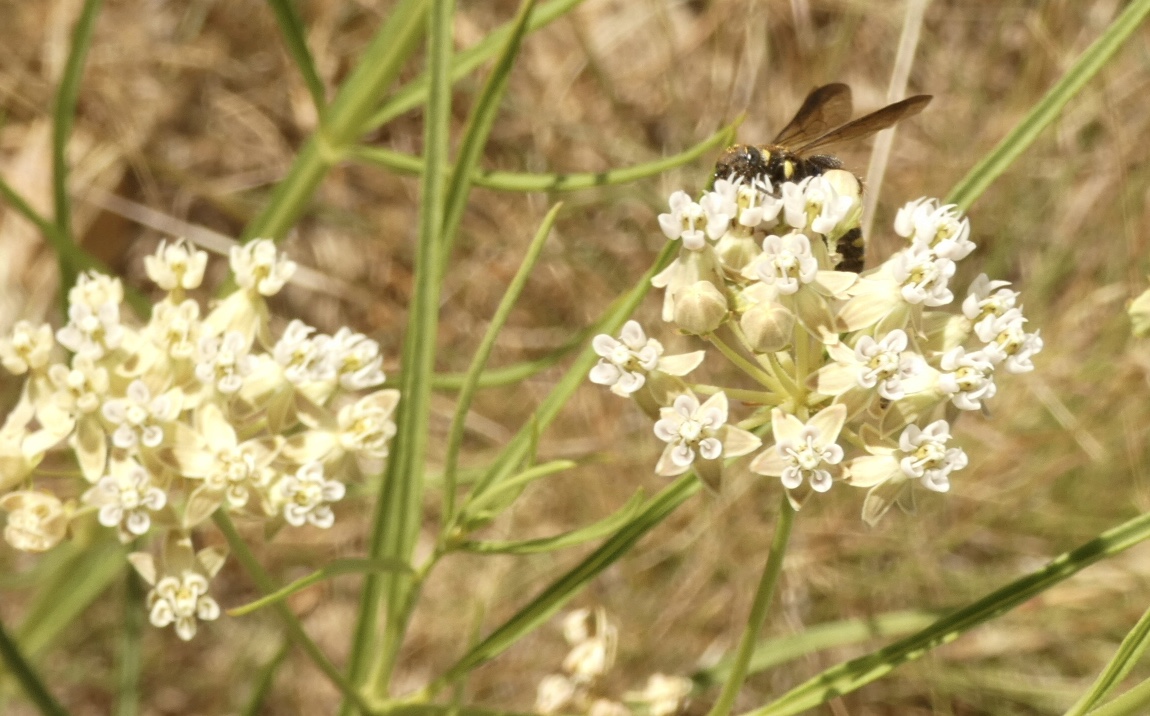
Photo (mine) taken in July 2022 of a blooming Horsetail Milkweed being enjoyed by a feeding wasp.
According to pollination ecologists, Horsetail Milkweed is especially valuable to large numbers of native bees. This plant species also supports conservation biological control by attracting predatory or parasitoid insects that prey upon pest insects.
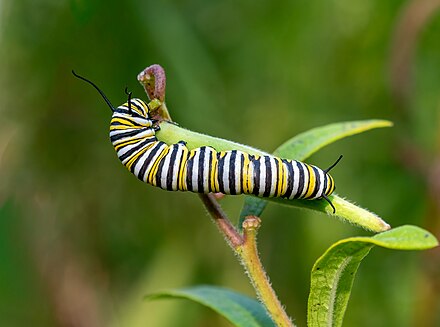
And Horsetail Milkweed is one of the favorite host plants for monarch and queen butterflies, all because it’s toxic! Producing an especially nasty tasting and potent neurotoxin strong enough to kill livestock, the caterpillars of these two butterflies have evolved to benefit from such a poisonous substance. Voraciously ingesting a diet of only milkweed leaves, obviously tasty to the larvae, makes them unpalatable to would-be predators, such as birds. The toxin from milkweed leaves has become their primary means of defense; definitely a benefit for such chubby, slow little caterpillars.
Monarch caterpillar (source: open commons)
Although central New Mexico isn’t in any of the major migratory routes of these butterflies, I have observed both species in our previous neighborhood. Since learning more about Horsetail Milkweed and it’s favored roadside habitat close to home, my hope is to provide actively growing plants throughout the summer (a safe distance away from roadside easements) for both the monarch and queen adult butterflies and their caterpillars ……. especially important when governing covenants of our previous and new subdivisions require the roadways be groomed (mowed down like a butch haircut!) on a monthly basis by subdivision landscape crews.
Because milkweeds are among my favorite of all plant species, mainly due to their complex flowers and the clever trickery they’ve developed to ensure pollination, I wrote about and illustrated two in-depth blog posts on this subject. Believe me when I say, “It’s overboard fascinating!”
Summer Botany: Meet the Milkweeds from July 2022. This is my first comprehensive look at milkweed flower structure, how pollination takes place, and the genus Asclepias.
Read on to learn more botanical information about Horsetail Milkweed AND how to find out if you live in Spring and/or the Fall Migration routes of the monarch butterfly AND where queen butterflies migrate to and from.
Characteristics and habitat requirements of Horsetail Milkweed
Horsetail Milkweed is a perennial species with a stout, woody rootstock. Plants readily spread by rhizomes (underground stems) producing dense communities. Cold-hardy to at least 0℉, this milkweed bounces right back in the Spring. Plants are also drought-tolerant once established, thriving in well-drained, sandy soil under full to partial sun.
Able to thrive in a variety of habitats and plant communities from 2500 – 8000 feet in elevation, Horsetail Milkweed grows among grasses, on sandy or rocky flats, on slopes, roadsides, and along trails in Chaparral, Semidesert Grasslands, Pinyon-Juniper Woodlands, Montane Conifer Forests, and in disturbed areas.
All of these characteristics and its adaptability to a wide range of habitats make Horsetail Milkweed one of the easiest milkweed species to grow.
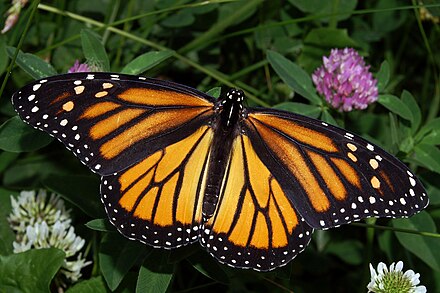
Monarch butterfly (source: open commons)
Monarch Butterfly
To learn if you live within the path of or close to spring and/or fall monarch butterfly migration routes, you can view a map or these route here:
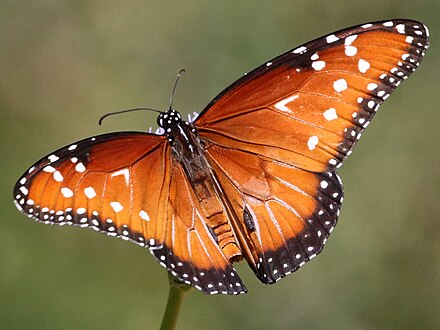
The queen is chiefly a tropical species. In the US, it is usually confined to the southern portion of the country. It can be found regularly in peninsular Florida and southern Georgia, as well as in the southern portions of Texas, New Mexico, Arizona, and California. Occasionally, the subspecies of the queen can be found somewhat north, in Kansas, Colorado and Utah.
Queen butterflies do not migrate as dramatically as monarch butterflies, but they do move short distances in tropical regions with dry seasons to higher elevations.
Winter can be challenging for nature journalers. Getting outside when it’s cold and windy, cloudy and dreary, snowy, icy or wet, are not ideal weather under any circumstances. And when everything looks brown and crispy and pretty much the same, the challenge to nature journal in the great outdoors grows exponentially. While these conditions make it difficult for spontaneous observing, I try to remember there’s always something remarkable to be discovered in nature, even in winter.
Who knew a little whack on the head would be just the thing to reawaken my curiosity?
Bundled in layers, leash in hand, Luna led me on her early morning walk around suburban Albuquerque. Having been along this route before, we’ve both made some interesting discoveries in the past. And as usual, this time was no exception for Luna. For me though, everything appeared brown, crispy and familiar. But I was inspired by and enjoying Luna’s sense of curiosity, and her encouraging tug on the leash.
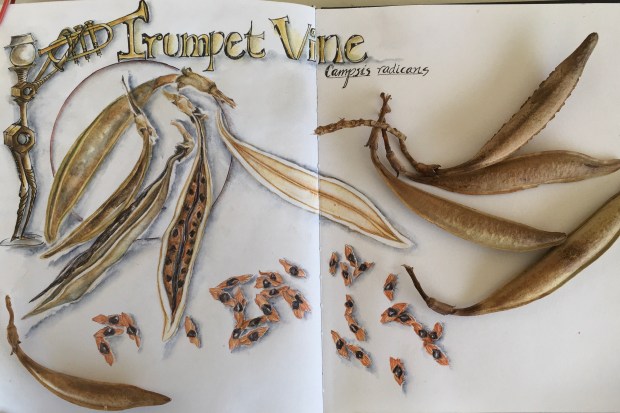
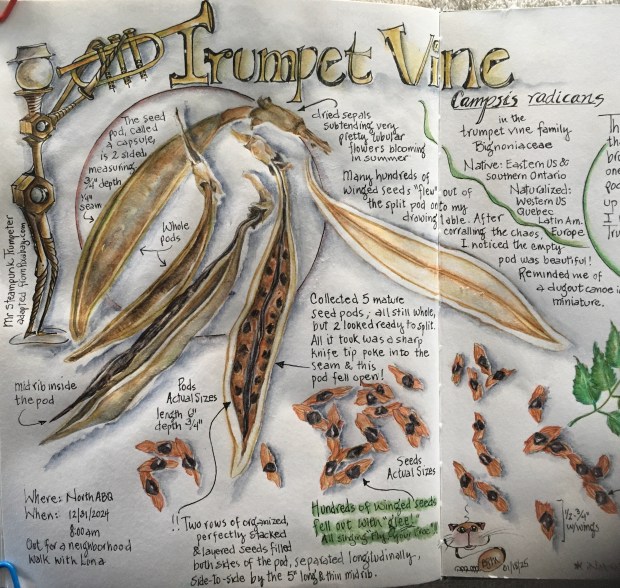
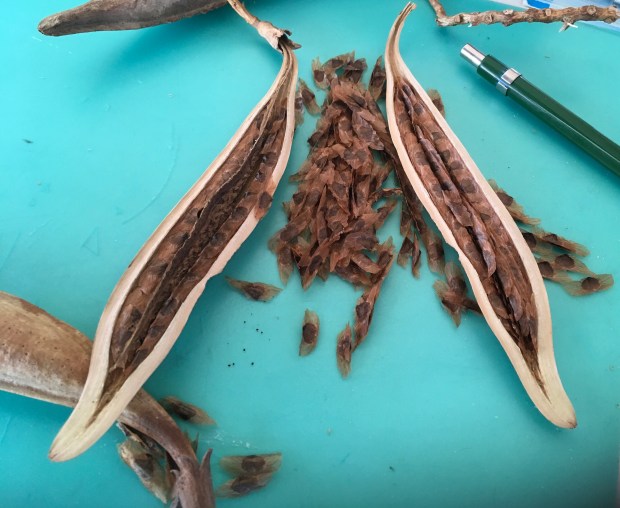
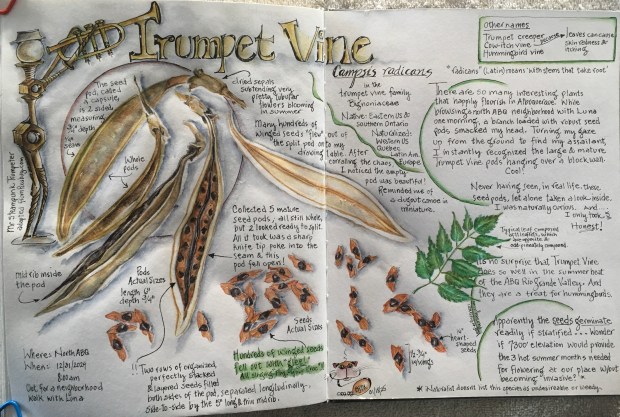
Nearing the end of our 2-1/2 mile walk, and mightily concerned I’d go home empty handed, we turned our last corner. It wasn’t 100 feet down the cement block-lined sidewalk that I abruptly stopped in my tracks. Something had lightly whacked me in the head! While the sound of rhythmic clacking rang out, I looked up, and to my surprise spotted the accidental assailant. Draped over the 6 foot wall, suspended from a hearty Trumpet Vine (Campsis radicans) growing in the hidden yard beyond was a string of pods resembling brown green beans. Long and plump and full of seeds, one of these pods had reached down low enough to make contact with to my head. (I say “reached” because that’s what my imagination said had happened.) Quickly awaking my sleepwalking brain, the effort made by the seed pod to get my attention paid off too. Silently whispering, “Pick me! Pick me!” it was as if the seed pod and its adjacent buddies either wanted to be harvested, or wanted to be featured in my nature journal (or both).
So I did ………… both!
I loved learning about and sketching these fascinating Trumpet Vine seed pods, while my mind was filled with the muffled notes of a trumpet. Tooo-too-too-toooooom!
Hope you enjoyed reading this story and browsing around my journal pages.
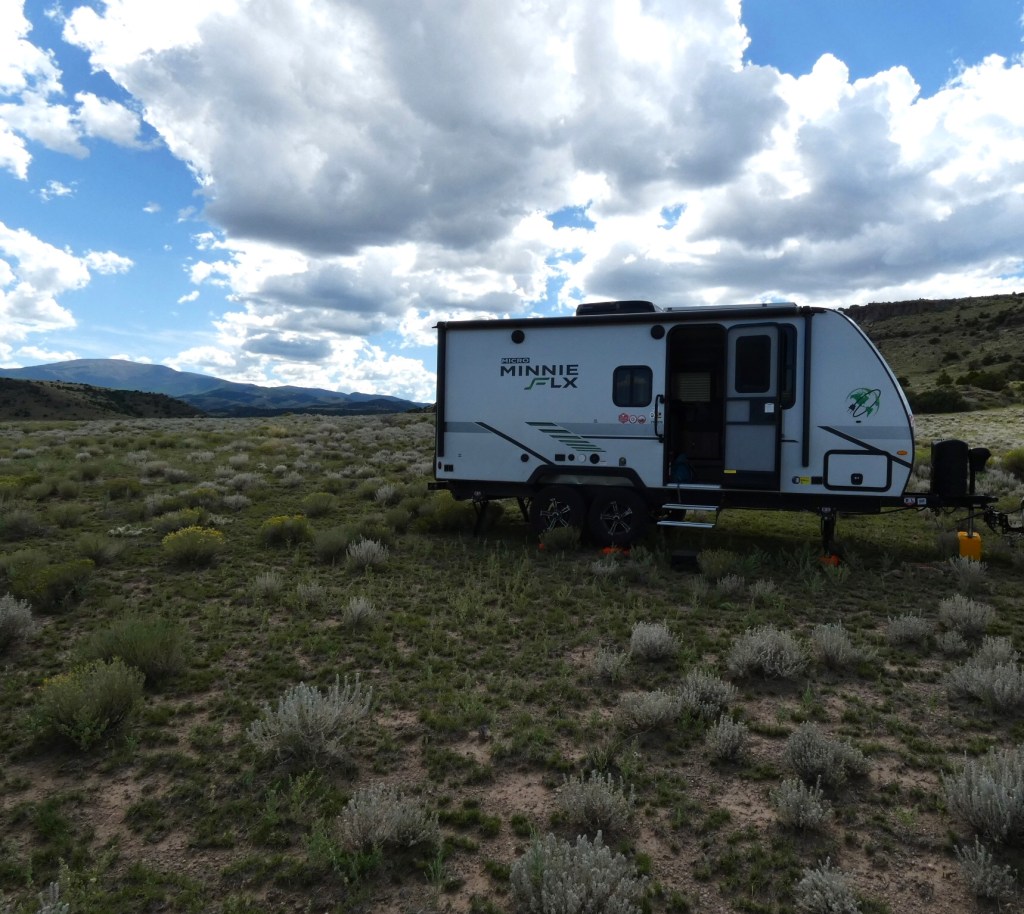
Felix parked along the Old Spanish Trail route, south central Colorado
With no defined route or objective, we decided it was high time we hitch up the trailer (Felix) and tote it north just to see what’s going on in south central Colorado this time of year. As we made our way through the San Luis Valley, we found acres of lush greenery topping almost-ready-to-harvest potatoes. Alfalfa was nearing its second cutting. Carrots had already been shipped to market. The wildlife refuges were patiently awaiting the arrival of migratory birds. And the last of the summer tourists were excitedly boarding the Cumbres and Toltec Scenic Railroad in Antonito, for the 64 mile steam engine journey to Chama, NM.
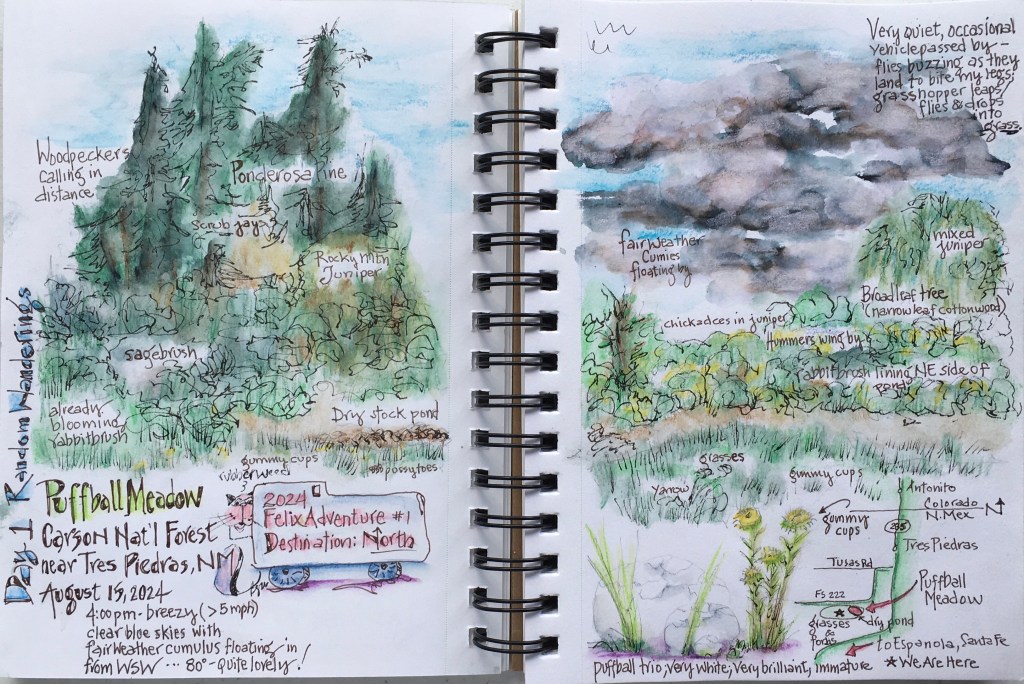
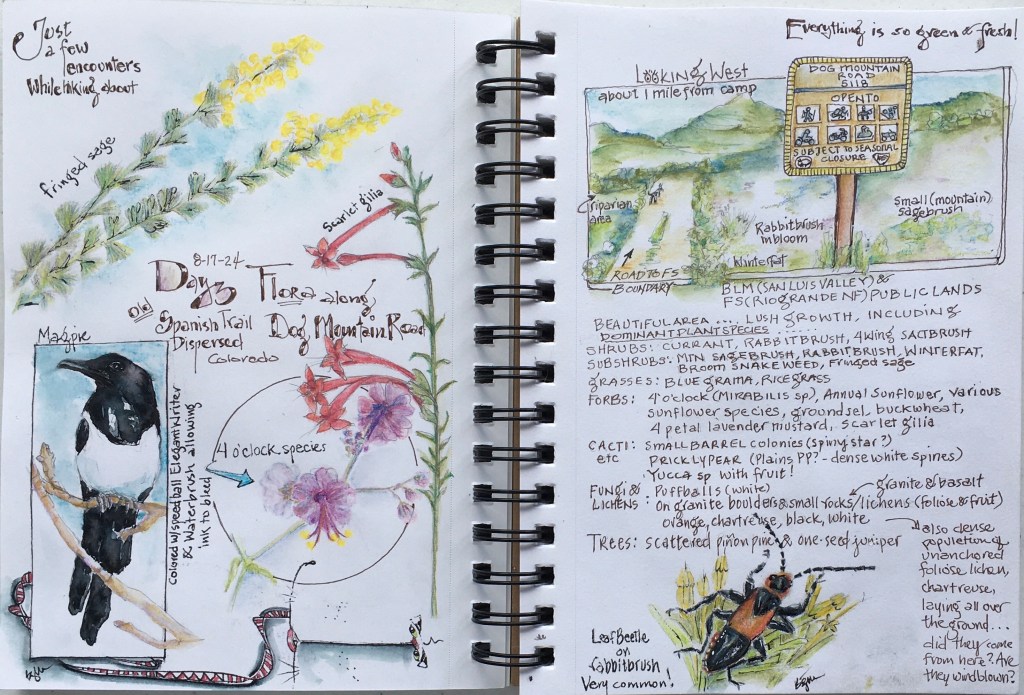
Day 1. Our first stop was in northern New Mexico, just south of Tres Piedras, Carson NF. An unlikely dispersed camping spot that I nicknamed “Puffball Meadow.” A nice level spot adjacent to a dry stock pond. The meadow was full of fist sized puffball fungi, and a coyote paid us a visit during the night.
We enjoy boondocking on our public lands managed by the US Forest Service and Bureau of Land Management. Having a trailer that’s self-contained, we can easily find lovely off-the-grid areas to set up camp. And thanks to our solar panels (and lots of sunny days) and large water tank, we can stay out for up to 5 days without needing refills. This allows us to explore lesser visited areas, which suits our tastes beautifully!
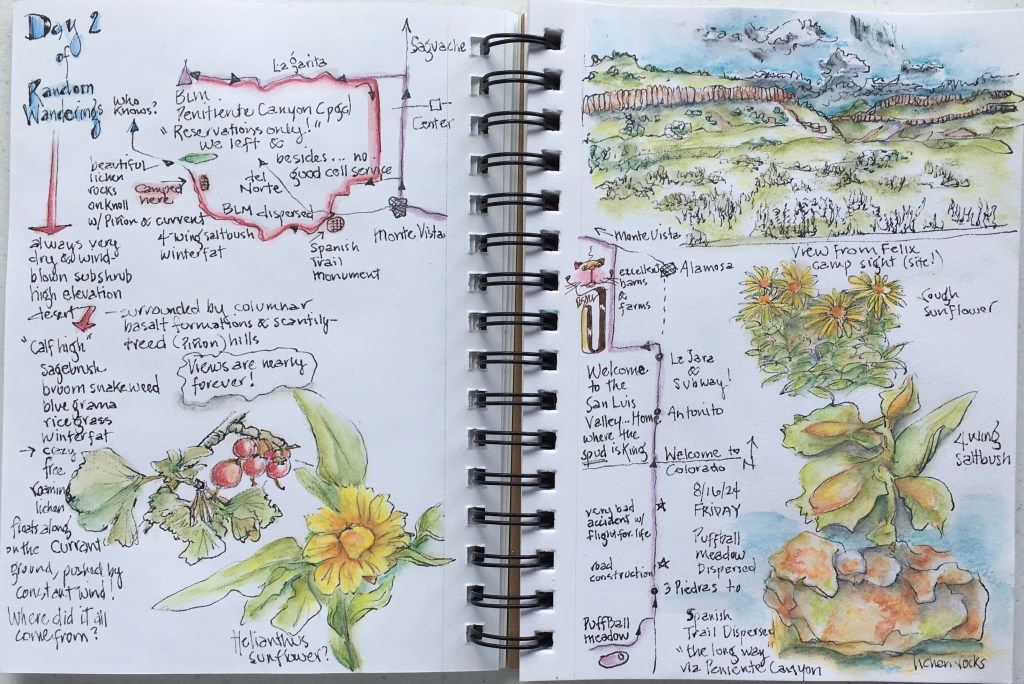
Day 2. Made it to the San Luis Valley, Colorado. Wandered around until we found a wide open area of dispersed camping in the vicinity of the Old Spanish Trail. Lots of wildflowers blooming, and plenty of hiking opportunities.
But I think one of the best things about random travel is the spare time …… we drive for 3-4 hours, find a place to camp ….. then the rest of the day involves hiking, wildlife watching, nature journaling, collecting drawable items, photography, more sketching, identifying the unknowns, reading, napping, and a bit of ukulele strumming! Perfection!
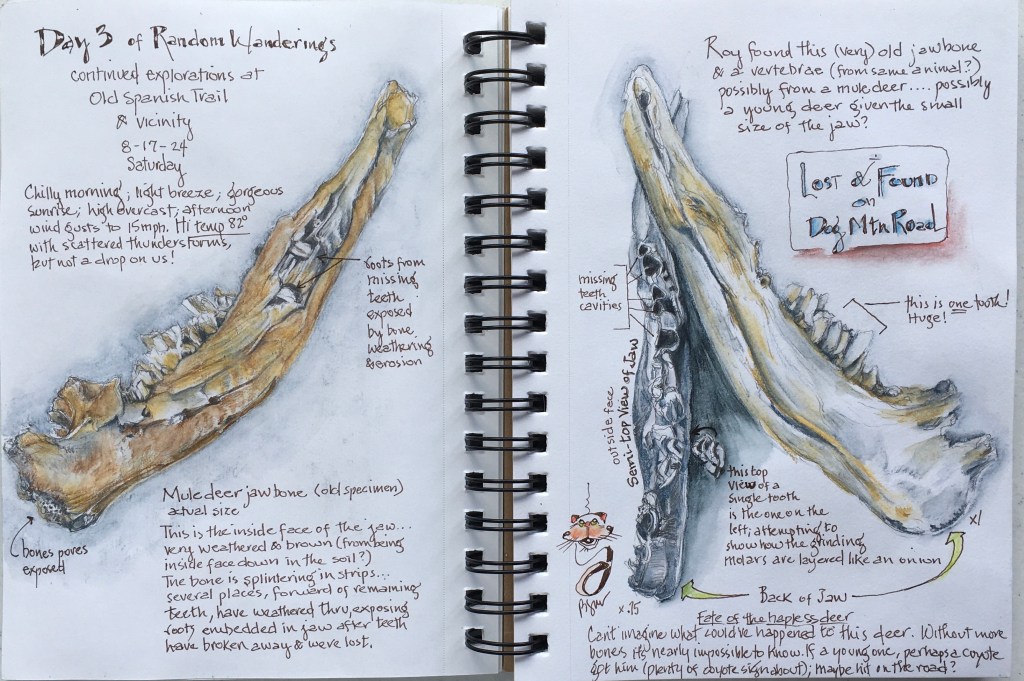
Day 3. We enjoyed the area so much, Roy suggested we stay for another day! And then he found this weathered mule deer jaw bone. Day 3, continued. Magpies! Can’t understand why these gorgeous birds don’t come south at least as far as Albuquerque and East Mountains.
Although the 6-day trip wasn’t remarkable, it was good to get away. Scattered about this post are my journal pages highlighting Days 1 to 5.
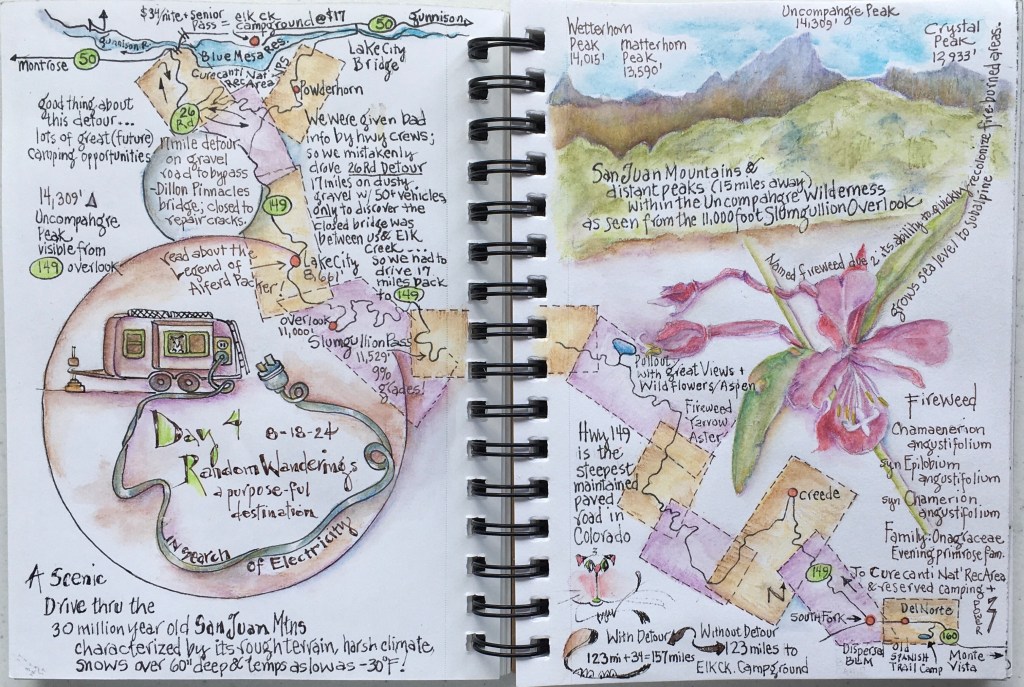
Day 4. Our travel route as we made our way to a campground to charge our battery and top off our water tank. An inconvenient, unplanned for detour led to future camping possibilities.
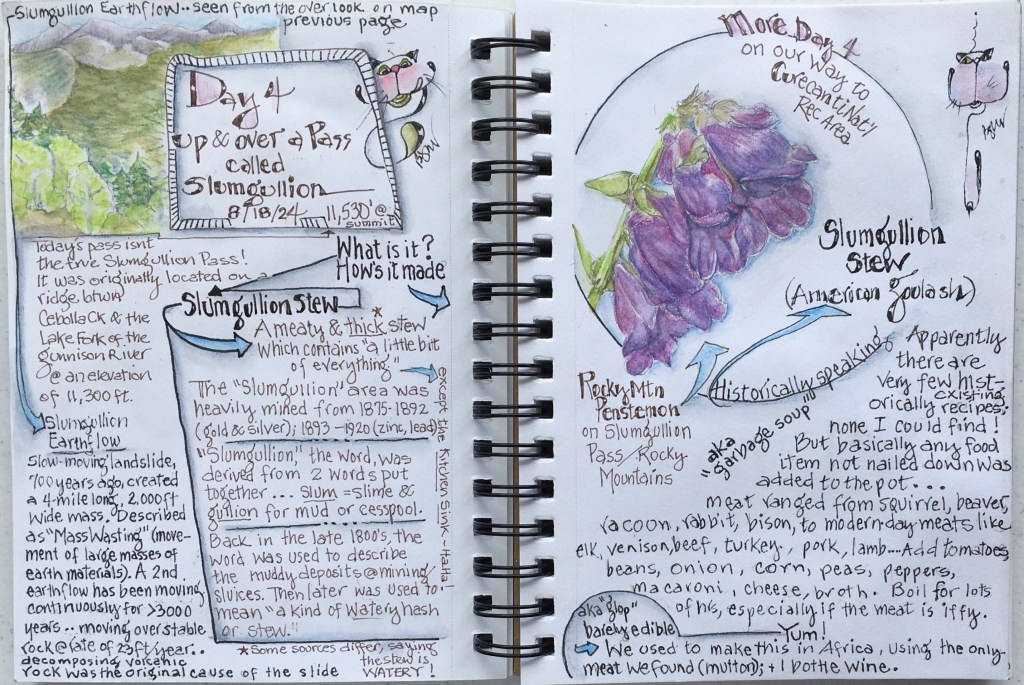
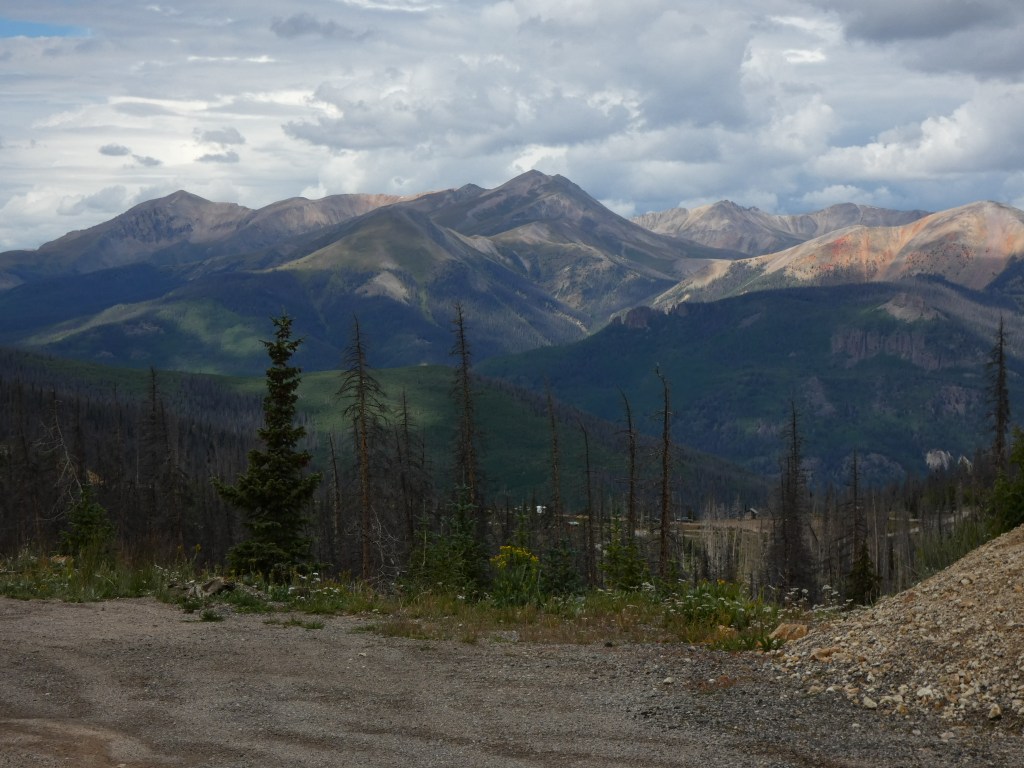
On Day 4, we decided to make our way up and over Slumgullion Pass (11,530 ft) on our way towards Gunnison Country. Not having been this way in years, we really enjoyed the crisp mountain air and spectacular views up and over the Pass. The villages of Creede and Lake City have grown swollen with tourist amenities and summer cabins dotting the once open meadows. As we got closer and closer to Lake City, we couldn’t help recall the story of Colorado’s notorious cannibal, Alferd Packer. Wanting to reread the tale as we passed near Cannibal Plateau and Deadman’s Gulch, the crime scenes, here’s what I found:
BriefBackground: Alfred Packer (newspaper misspelling as “Alferd” Packer, which stuck) (1842-1909) was a prospector who set out for Colorado gold fields in 1873. By the winter of 1874, he reached the rugged San Juan Mountains with a party of five men where they became lost and stranded during one of the worst winters on record. The men, with only had 3-4 days provisions quickly consumed and no firearms, were forced to cook their rawhide moccasins. Places where “snow had blown away from patches of wild rose bushes,” ….. they “were gathering buds from these bushes, stewing them and eating them.”
When the snow finally crusted over, Packer, the only man to survive the ill-fated trip, walked out of the mountains after 60 days. He told a story about the demise of his fellow prospectors, and how he managed to survive by eating them. His story involving cannibalism became legend, and continues to be passed down to today! (Whether the story is true or not will never be known, but it makes for colorful history.)
Based on historical records and news reports, Alferd Packer was tried several times for murder and cannibalism (even though the act of cannibalism wasn’t considered illegal in the US). Convicted of these heinous crimes, Judge M.B. Gerry supposedly uttered this famous quote while handing down the sentence in Packer’s first trial ……
“Stand up yah voracious man-eatin’ sonofabitch and receive yir sintince. When yah came to Hinsdale County, there was siven Dimmycrats. But you, yah et five of ’em, goddam yah. I sintince yah t’ be hanged by th’ neck ontil yer dead, dead, dead, as a warnin’ in reducin’ th’ Dimmycratic populayshun of this county. Packer, you Republican cannibal, I would sintince ya ta hell but the statutes forbid it.”
This is the quote I’d grown up hearing many times, over and over and over! It makes for good reporting, but is a ways from the actual sentence and what Judge Gerry sounded like while reading it (nope, he didn’t talk like Yosemite Sam!). Here’s what the record shows:
“Alfred Packer, the judgment of this court is that you be removed from hence to the jail of Hinsdale County and there confined until the 19th day of May, A.D. 1883, and that on said 19th day of May, 1883, you be taken from thence by the sheriff of Hinsdale County to a place of execution prepared for this purpose, at some point within the corporate limits of the town of Lake City, in the said country of Hinsdale, and between the hours of 10 A.M. and 3 P.M. of said day, you, then and there, by said sheriff, be hung by the neck until you are dead, dead, dead, and may God have mercy upon your soul.”
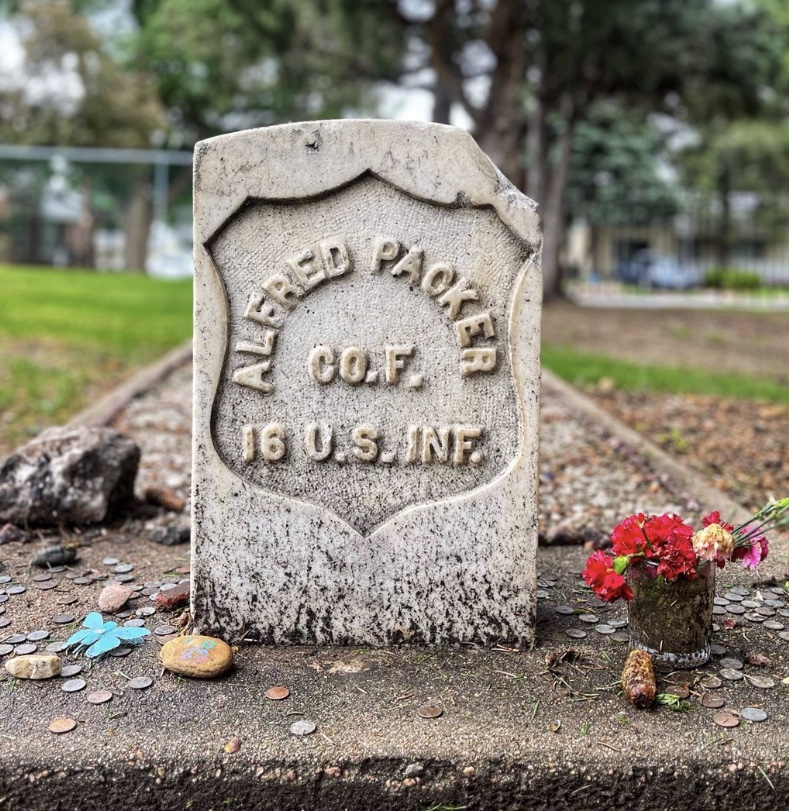
Alfred Packer tombstone in Littleton Cemetery where he was originally buried in 1909. Today, he now lies back in Hinsdale County, near Lake City.
Alferd Packer never did hang. It’s quite a detailed story following his first trial, including a jail escape, nine years on-the-lam, and recapture. There was a second trial in 1885 where he was charged for only one murder; after serving only 16 years of his 40-year sentence, he was released and died peacefully one year later at the age of 60. He was buried in Littleton, Colorado where his tombstone properly reads Alfred Packer.
Day 4. Supplemental information about that strange name “Slumgullion.” Is it a stew? Is it a drink? Is it the sludge that puddles below an 1870 sluice box? Day 5, on our way back to Old Spanish Trail (because we liked it so much). Discovered a new-to-me plant; after a bit of checking with iNaturalist, learned it was Black Henbane, but not before handling all parts of this very poisonous noxious weed!
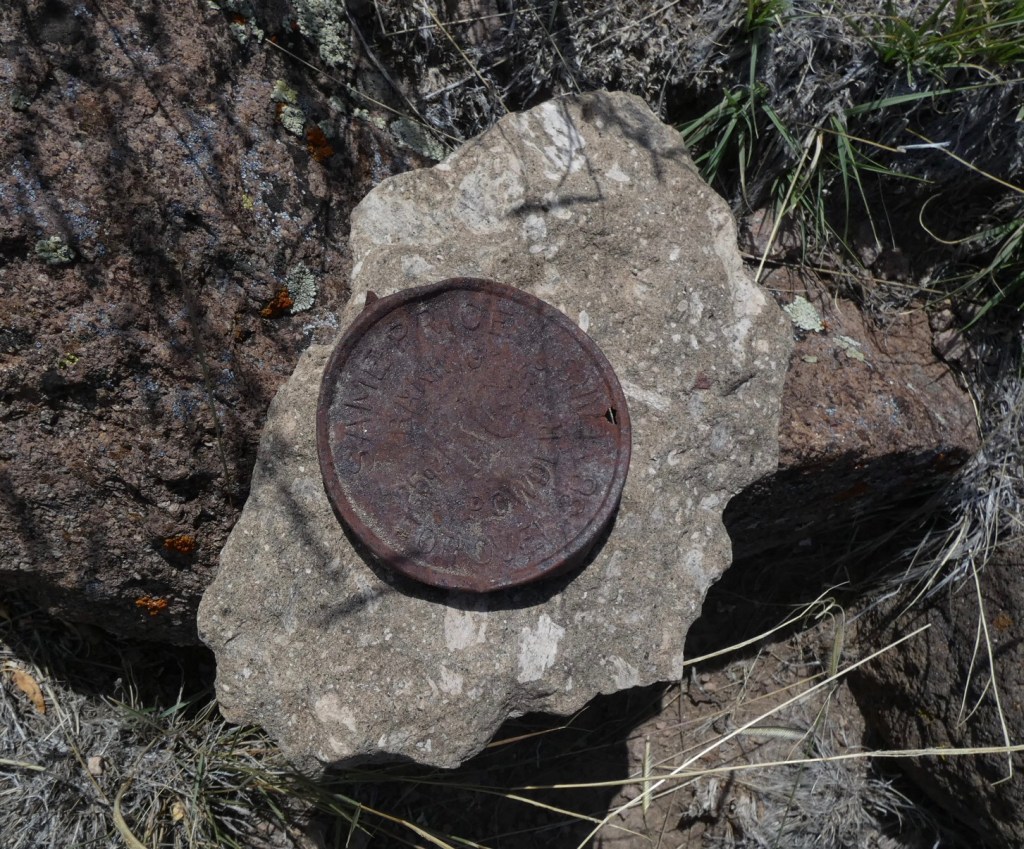
A short comment on the KG Baking Powder tin lid we found near our trailer. It was old and rusted, but very readable. The tin and its contents were probably long gone. Tried to find any information on the KG brand; sure curious about the age of the lid. If you’ve heard of this brand, please let me know.
KG Baking Powder tin lid we found near Old Spanish Trail.
Day 6. Headed for home. Hope you enjoyed my travel journal.
San Juan Mountains …… up and over Slumgullion Pass. The view of the 700 year old earth flow.
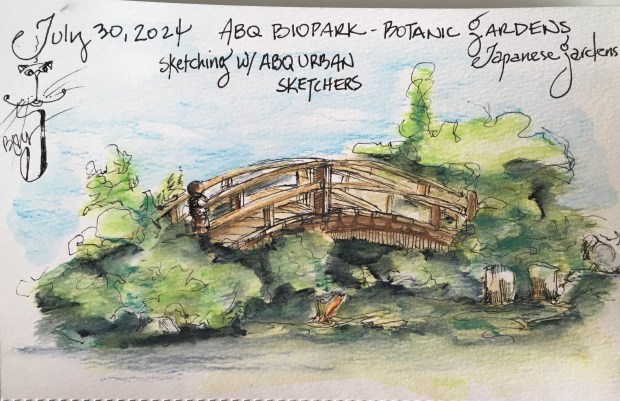
On July 30th, six of us Albuquerque (ABQ) Urban Sketchers gathered for an impromptu morning of exploring and sketching at the ABQ Biopark/Botanic Gardens. It’s always so much fun seeing what’s blooming any time of the year, even during the heat of summer. Despite the morning’s toasty hot temperatures, the plentiful shade and water features provided many “cool” locations for sketching and exploring.
Since the Japanese Gardens section of the park was new to me, I decided to make my way there to sketch, while enjoying summer flowers and many interesting seed pods from what must’ve been an outrageous, overly abundant Spring bloom. After a slow 15 minute stroll, I had arrived at the 4-acre Japanese Gardens, complete with a waterfall, koi pond, pagodas, wooden bridges, many stone statues, and many many ducks.
Walking bridge over the koi pond
My first sketch was of a pretty pagoda that served as a shady spot for one of the ABQ Plein Air members to paint the scene behind me.
Then, wandering deeper into the garden, past the waterfall, I found the koi pond with a few interesting features ….. a walking bridge bisecting the pond where parents brought their children to feed the ducks. Adjacent to the walking bridge was a weathered wooden bridge which crossed the inlet to the pond. As I sketched and painted while sitting on a large flat rock a foot back from the pond’s edge, many large dragonflies hovered nearby, several koi rolled in the water, mallards paddled about, and a bullfrog sounded his loud and low stuttering ru-ru-ruuuuummmmmmm. A few park visitors even stopped behind me to watch my sketches develop!
Small weathered, wooden bridge and rolling koi
It was so calming and peaceful sketching in the gardens, and before I knew it the morning had flown by. Quickly I packed up my supplies and scurried back towards the entrance to the Biopark where I met up with my small group for our “throw down” and photos.
Such a great morning!
As always, thanks for stopping by!
Supplies: Faber-Castell Pitt Artist Pen fineliner 0.3 (black) was used first to create quick sketches; Derwent watercolor pencils and Pentel waterbrush were used for the color
As the Fall season rapidly came and went, and the first snows blanketed the landscape, I focused my hiking time (and some of my drawing hours) on collecting local native seeds. Always careful that plenty of seeds remained available for overwintering birds, I still managed to harvest hundreds from about 25 plant species. All sorted and packaged in separate pill containers, my collection is now stored in the refrigerator at 40 degrees, until growing conditions are optimal for planting. This treatment method is referred to as stratification.**
Why collect native seeds? All throughout the Spring, Summer and Fall, a diverse assortment of pollinators visited our locally blooming wildflowers and shrubs. Along with these butterflies, moths, bees, wasps, beetles and flies, were the insects, spiders, and birds that prey on unwary pollinators. Such an amazing show; a kaleidoscope of colors and shapes! The air was a buzz with activity. My goal is to mimic the native banquet in hopes of attracting these pollinators and predators.
Also, seeds are absolutely fascinating. I like to think of them as gift-wrapped, living plants-to-be. Tucked neatly inside of the seed coat are food stores enough to feed the makings of a complex root system; flowers, leaves, stems, branches and even a trunk. Seeds can be tiny, some microscopic and some as large as a softball. Seeds come in a variety of shapes, colors, textures and decor both inside and out. Some seeds have “wings” to fly; some have silky or puffy “feathers” to float; some are like “lead,” heavy enough to intentionally sink under water.
So I pulled out my 10x hand lens to investigate, drawing most of the seed species in my collection. It was very cool to compare seeds of different species that are in the same family (like the composites of the Aster family and the penstemons of the Plantain family). Until creating this journal page, I’d never held the seeds of 3 different species of yucca in one hand at the same time. Observing the similarities and differences, I finally confirmed in my mind that the genus Herperaloe and Yucca are indeed in the Agave family. And then I found examples of seeds from completely different families that evolved similar dispersal mechanisms (convergent evolution). This phenomenon was visually obvious in the delicate feathery, silky, and poofy hairs or bristles attached to grass, aster, and milkweed seeds, facilitating seed dispersal by wind.
Finally, I felt the need to draw the seeds in case they happened to spill into one big jumble while being planted! Yes, I would be clumsy enough to create chaos out of order. Should that happen, I’ll be able to sort the mess by species by referring to my field guide page.
** Seed-producing plants pass along to their seeds the specific requirements(s) necessary to break dormancy and germinate. These genetic codes determine if optimal conditions exist for seeds to sprout and hopefully grow to maturity. But key to successful germination depends on seed ripeness (in most cases). Knowing the plant species from which a seed is produced; whether the plant is an annual, biennial or perennial; habitat, moisture needs and the type of “treatment” method(s) are all important bits of information tied to successful germination.
I’ll have to create a future post describing the variety of treatment methods (germination patterns) inherent in the seeds.
Are you a seed collector? If so, share your why’s and how’s!
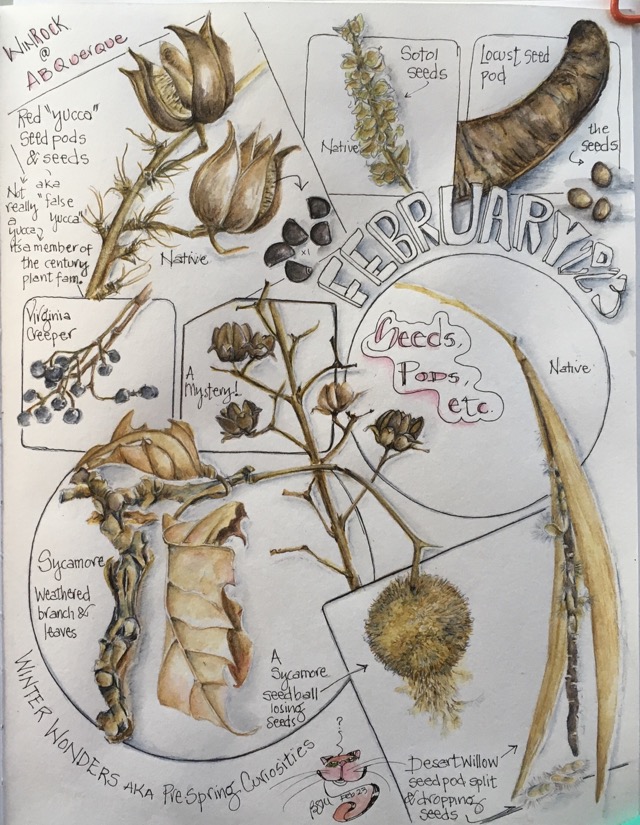
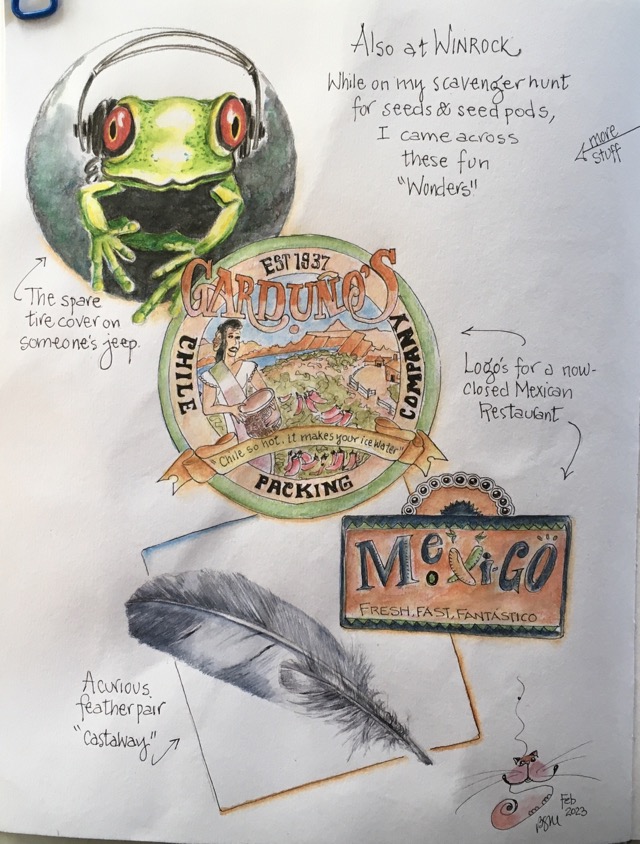
Like my January “Littles” page of the bird species that visit our feeders in winter, here’s another “Littles” to commemorate the not-quite-winter-or-spring month of February ….. Seeds and Seed Pods. As a way to pass the time while waiting for Roy to finish up with a doctor visit, Luna and I conducted a focused scavenger hunt along a 2 mile circuit surrounding a large Albuquerque shopping mall. In no time at all, my collection bag was full. But knowing my pages would need some local flavor and color too, I scavenged a bit longer and turned up a few more curiosities.
Like with January’s page of birds, sketches of the species of seed pod and seeds (if collected) took less than 5 minutes each; my watercolor pencil paintings took about 10 minutes each. The restaurant logo and the frog design took a bit longer, and were done using my photos as reference.
I’m not sure why it took nearly the entire month to decide what to do for my February “Littles.” In hindsight, the decision should have been obvious, because I love seeds and the seemingly unlimited variety of pods. Now I have a record of a few city seeds that will soon germinate, helping change the landscape from brown to spring green!
Let me know what you think! I’m looking forward to March, when wildflower seedlings will be popping up which may appear in a few “Littles” boxes as well!
Thanks to “Made by Fay” for the “Littles” inspiration!
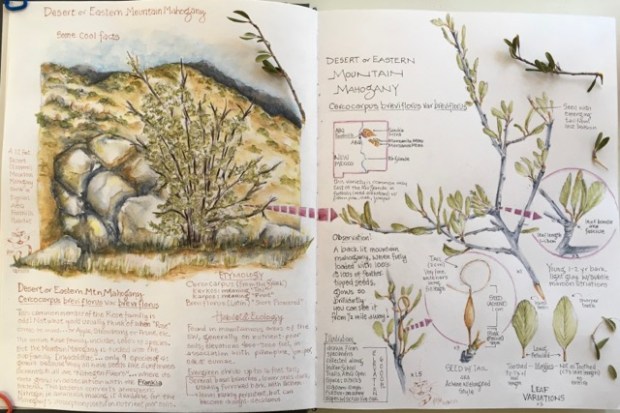
The Desert (Eastern) Mountain Mahogany is a very branchy shrub commonly found in the mid-elevation foothills of the Sandia, Manzanita, and Manzano Mountains east of the Rio Grande River in central New Mexico. This species’ formal and very appropriate name, Cercocarpusbreviflorus variety breviflorus, comes from both Greek (kerkos: tail; karpos: fruit) and Latin (brevi: short; florus: flowered). As a matter of fact, the 9 species of the genus Cercocarpus all have long feathery tails that twist and turn from the tip of a single fruit, called an achene (like a sunflower seed).
So why is this species odd?
Well, the fruit, for one reason. Most of the thousands of rose family members have fruits called a hip (rose), pome (apple), drupe (prune), or aggregate (strawberry). And even though the strawberry is composed of numerous miniature achenes, it’s the single achene found in the mountain mahoganies that’s unusual to the family.
To further emphasize the oddness of the Cercocarpus genera, all of its 9 species has a symbiotic relationship with a bacteria called Frankia. And that’s an unusual characteristic of the rose family, which moved Cercocarpus and 4 other genera into the subfamily Dryadoideae. That’s all a bit technical when it comes to plant classification, and kind of skips the real reason why the Frankia bacteria is important to the survival of Desert Mountain Mahogany. Nitrogen Fixation!















 a curious nature