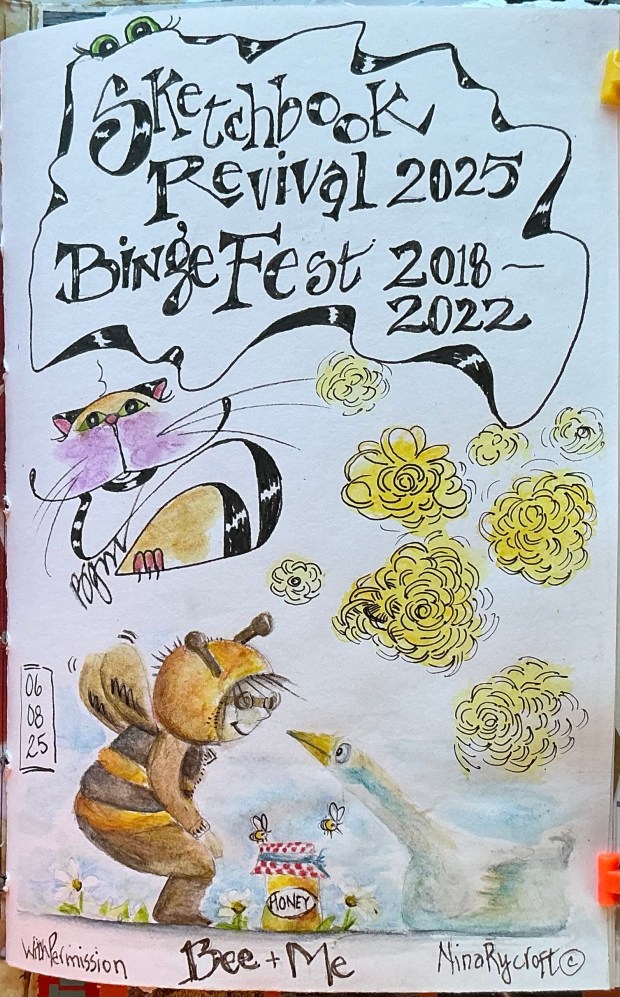
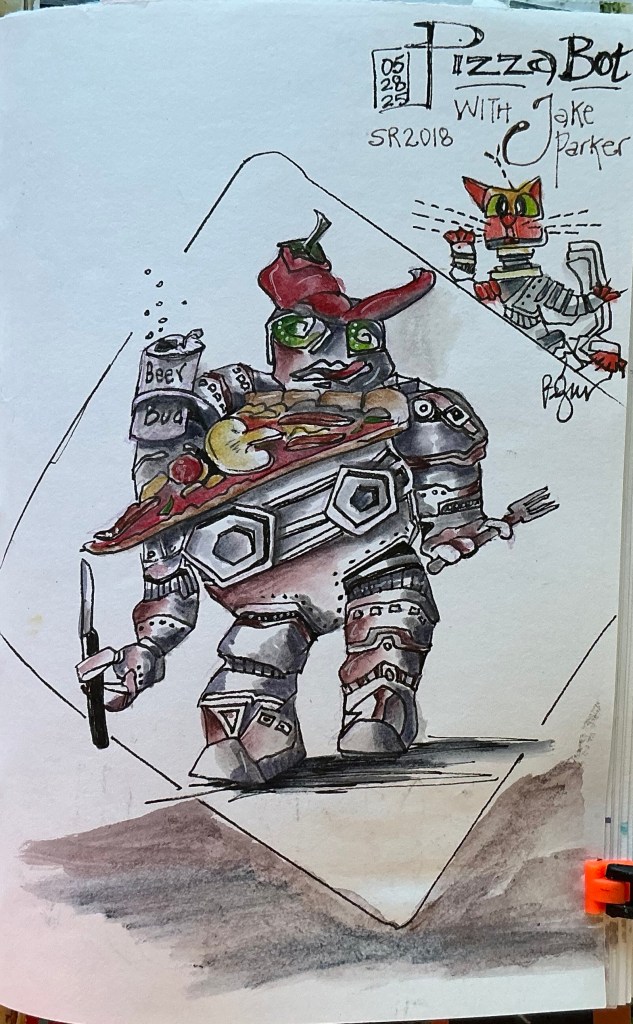
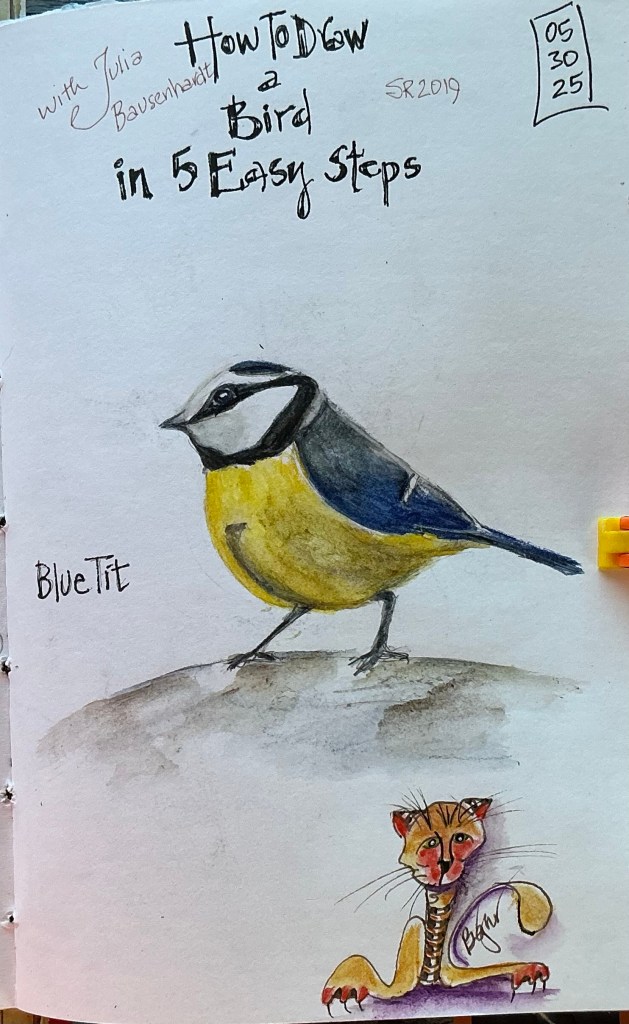
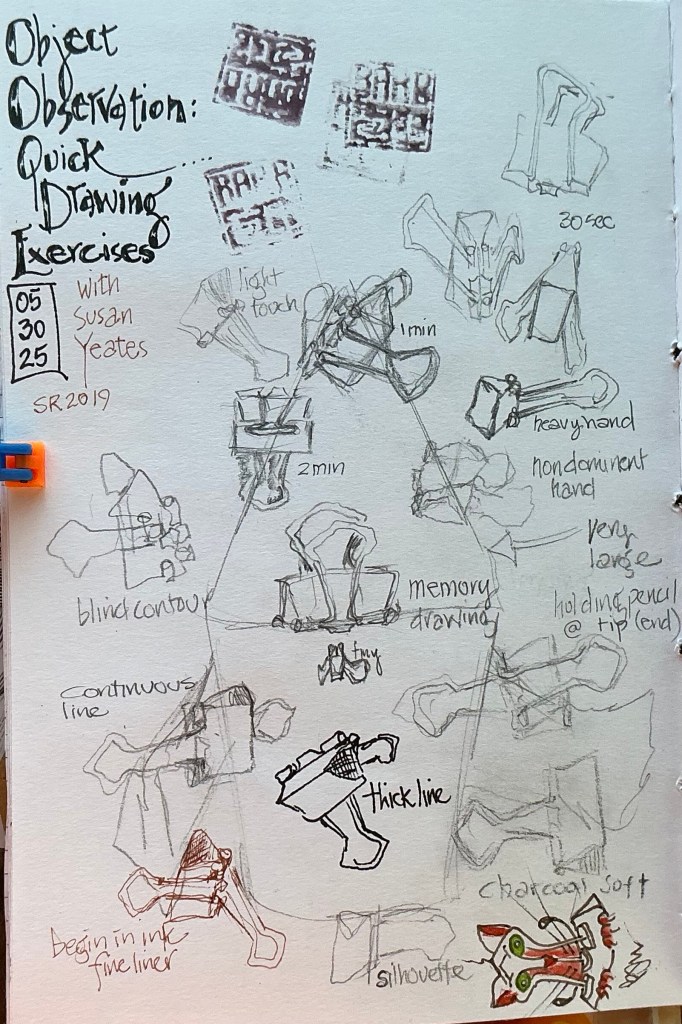
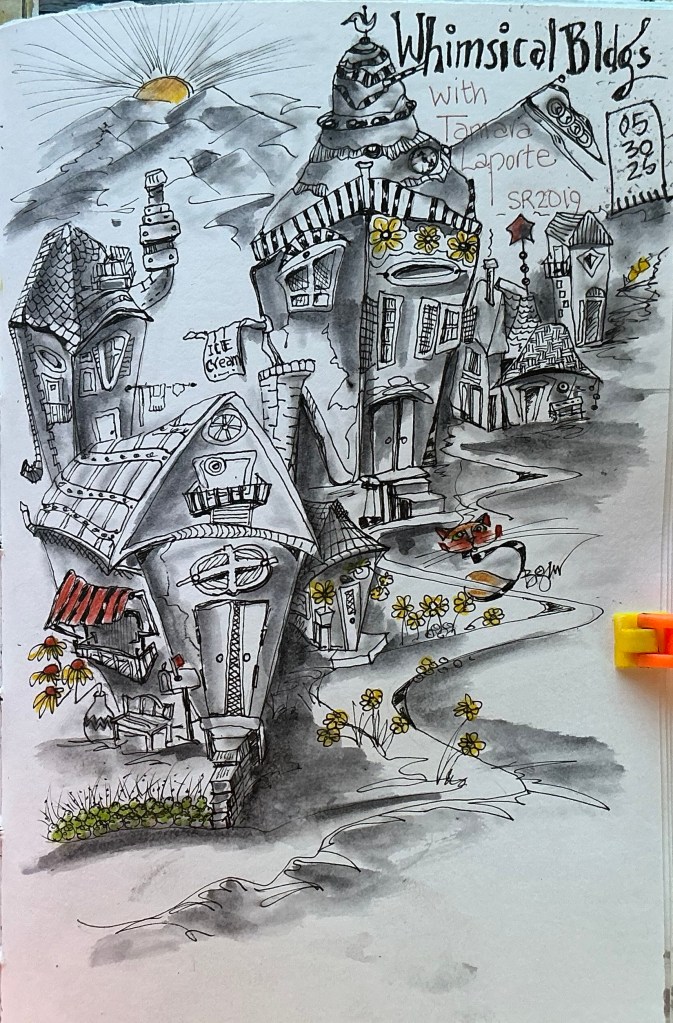
What a whirlwind celebration! Sketchbook Revival (SR) 2025 Binge Fest was so much fun. And Wow! Two jam packed weeks of creativity was over in the blink of an eye!
Karen Abend, SR creator, host extraordinaire, and wonderful artist, came up with a brilliant idea for the SR 2025 session. I would swear the creative gears inside her head were spinning with delight as she declared, “Yureka! I’ve got it!”
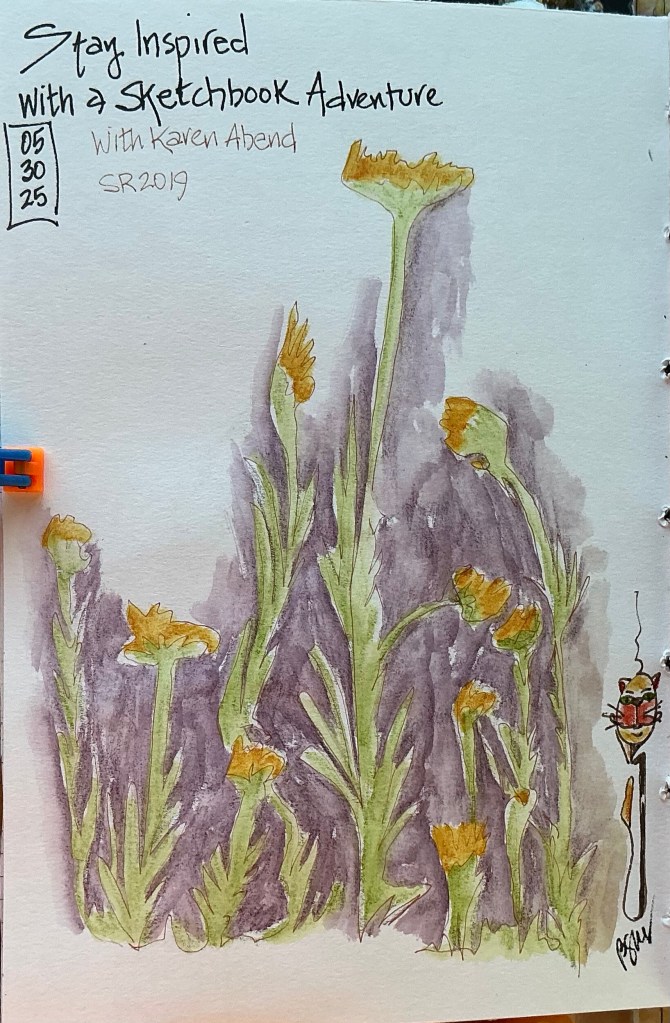
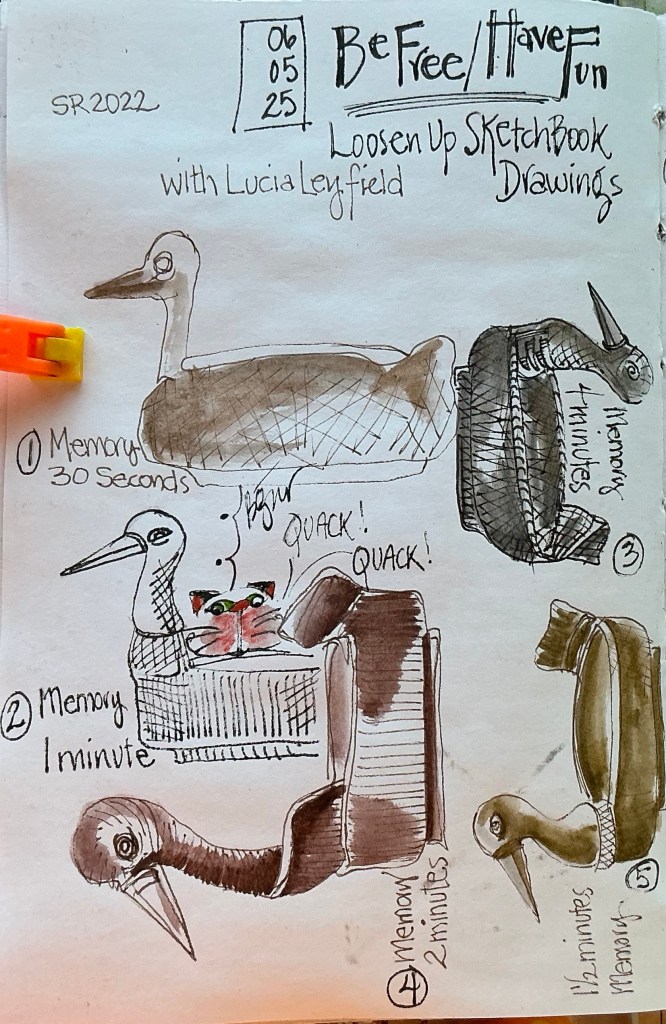
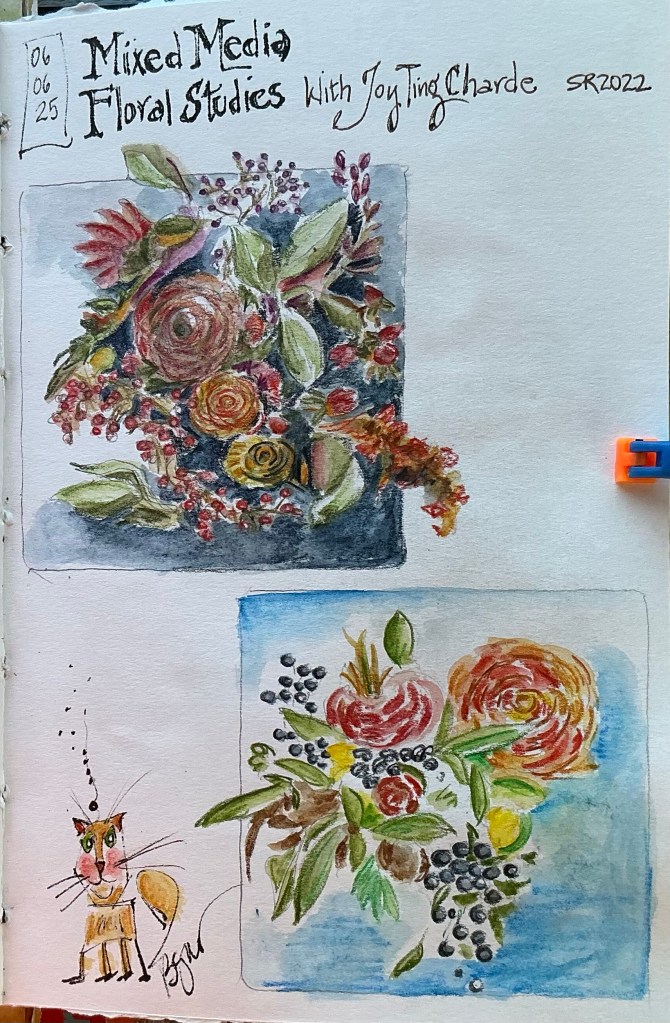
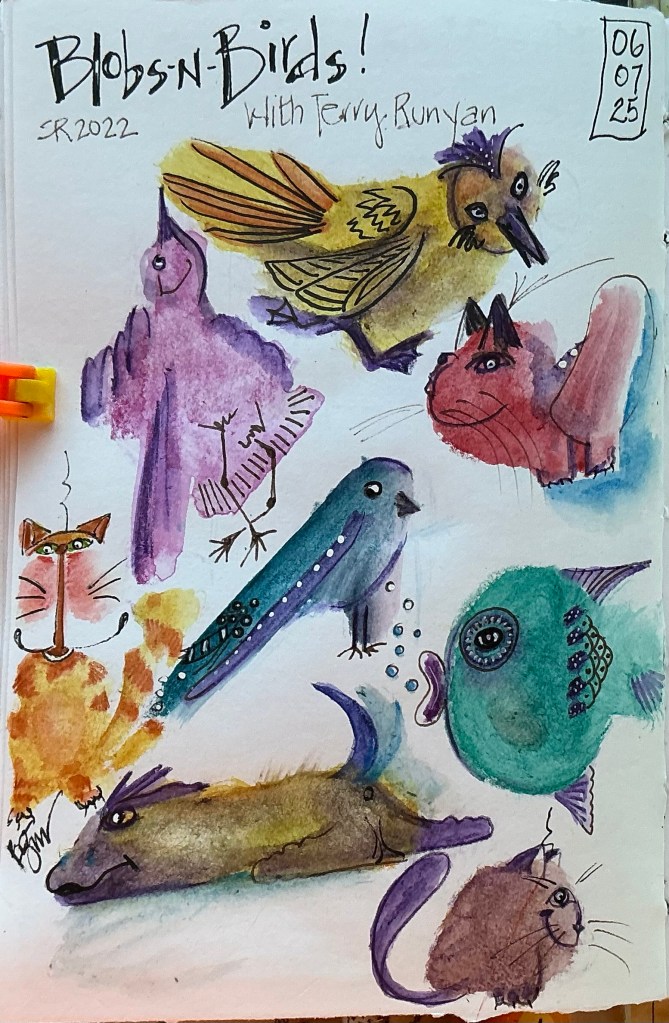
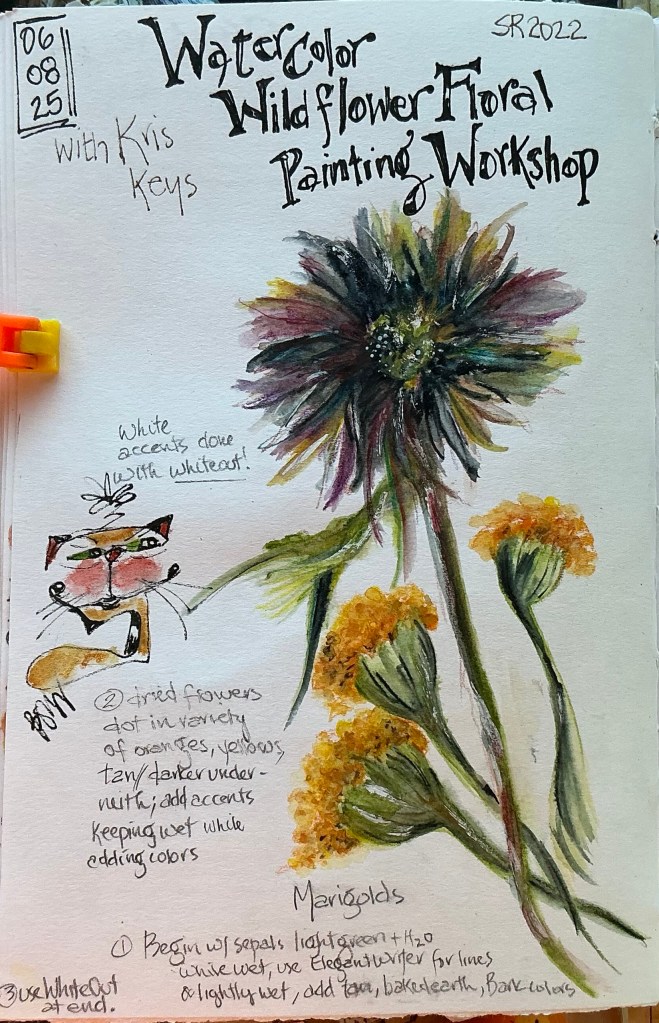
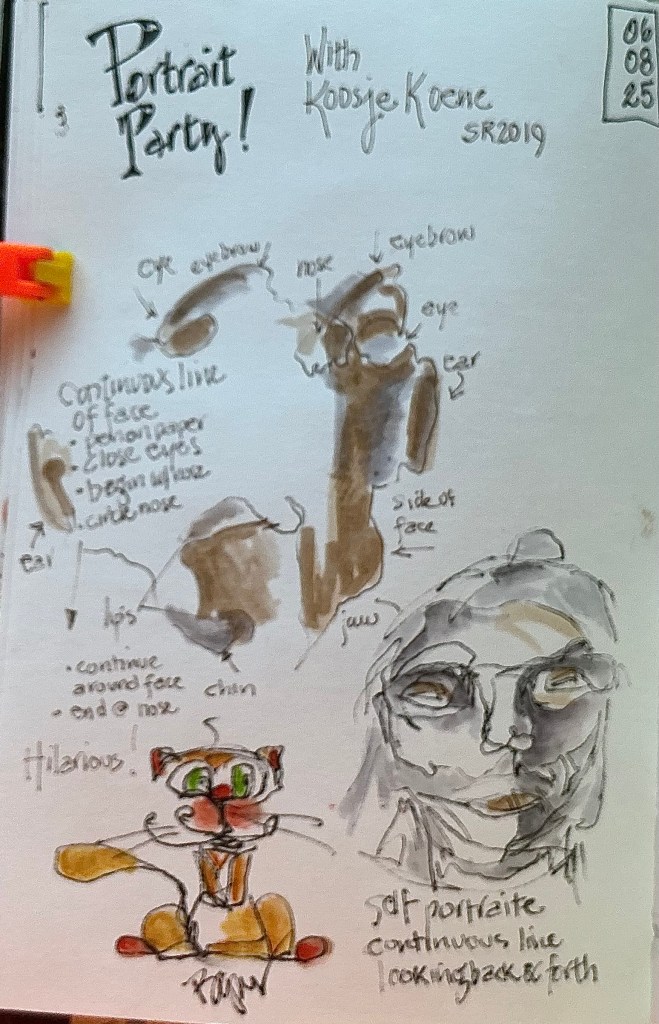
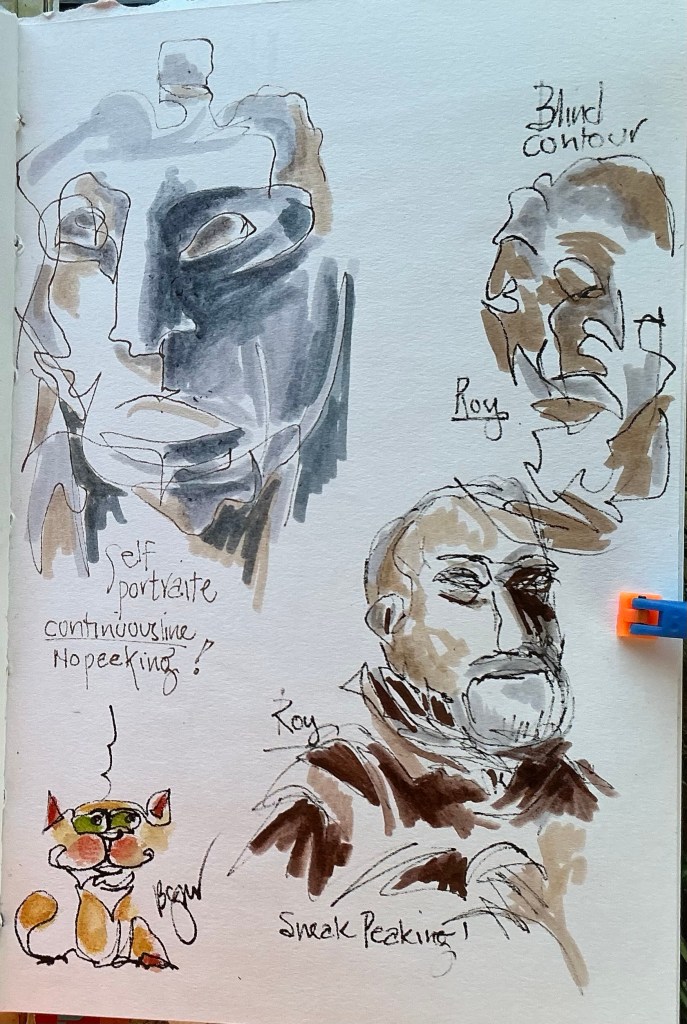
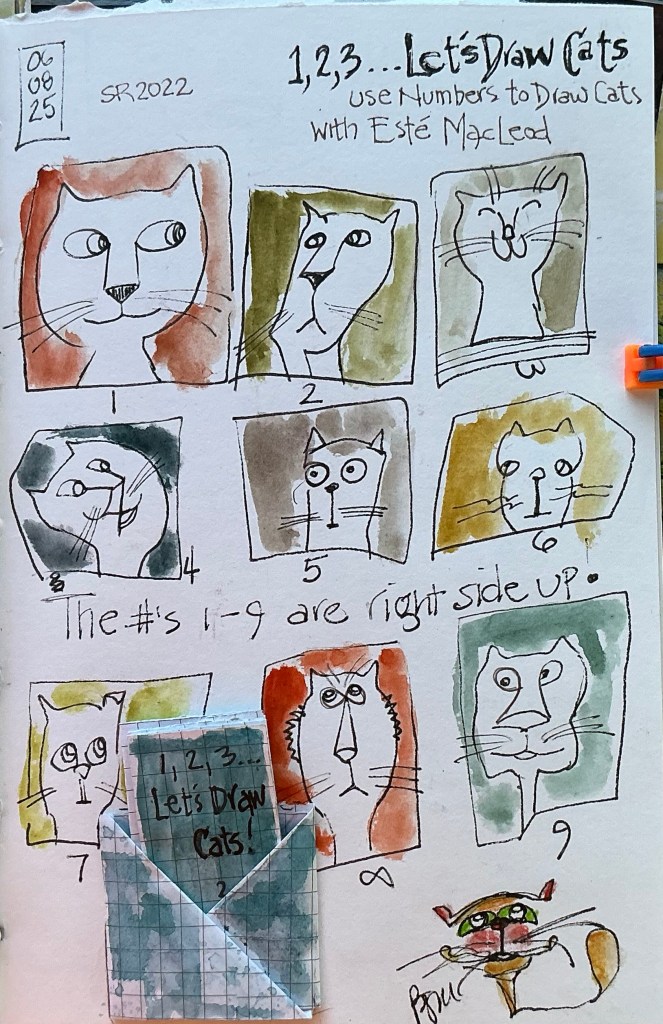
Beginning on May 27th thru June 9th, Karen generously opened up the SR historic vault and set free all of the workshops conducted the first 5 years of SR (2018-2022)! That unbelievable offering came to more than 130 one-hour-long workshops of inspiring, hands-on, and creative play time all instructed by well-known experts in artistic fields associated with Sketchbook Journaling.
Challenge presented ……. Challenge accepted.
Since I’ve been participating in SR each year since 2018, and attended most of these workshops in the past, my goals and strategies to tackle the challenge were these:
Complete a minimum of 4 workshops daily;
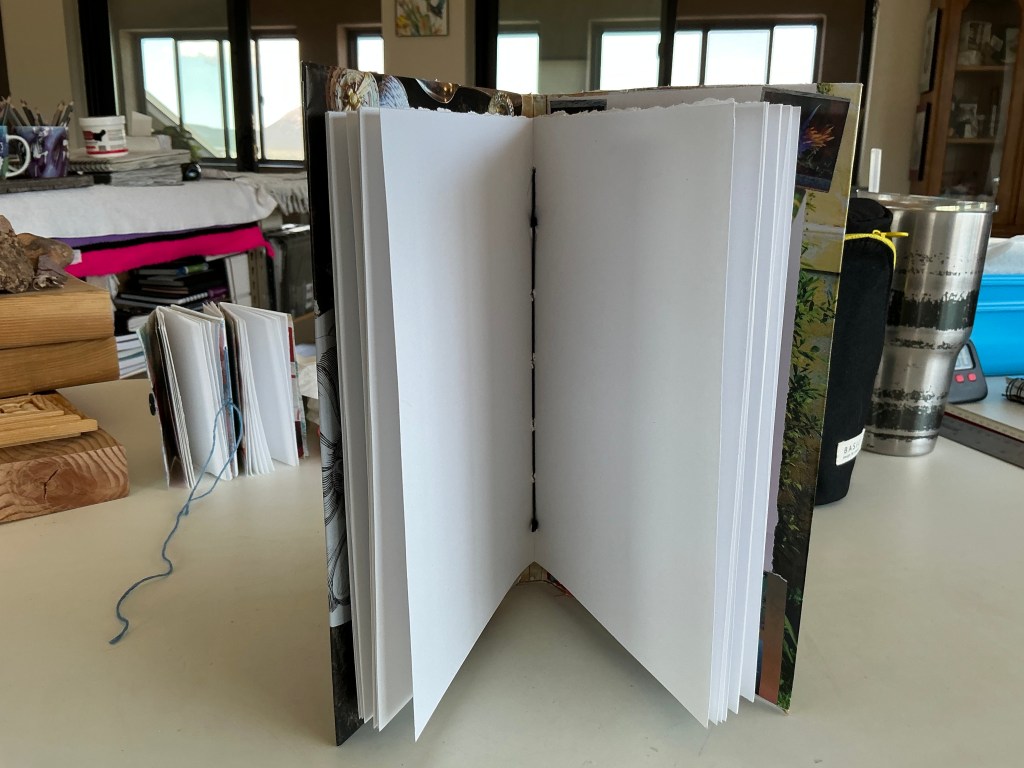
Two workshops should involve a project outside of my comfort zone, such as portrait drawing, fantasy, word play, collage, and properly stitching my own SR sketchbook so it wouldn’t fall apart during the 2-week challenge, etc.;
Two workshops should involve projects within my comfort zone, such nature subjects, urban sketching, whimsey, and lettering, and those using watercolor pencils, graphite, and ink;
Develop fresh, interesting, and imaginative sketches during the workshops;
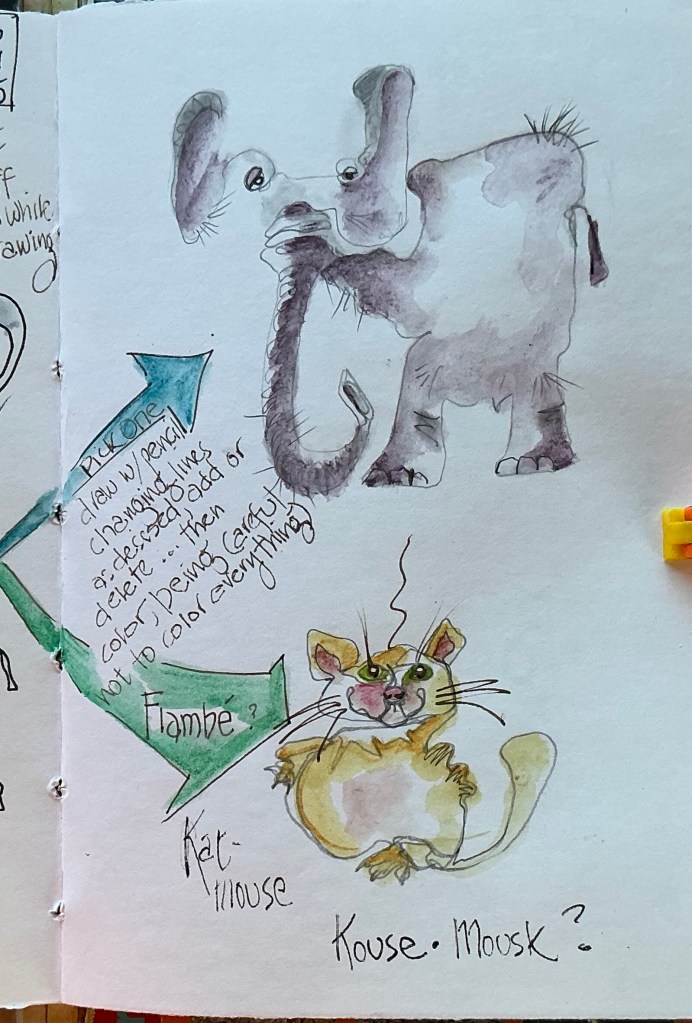
Allow Flambé to play along;
Slow down, breathe, and enjoy the 2-week marathon without becoming overwhelmed;
Recognize and gather take-away tips and techniques to bring into my Nature Journaling practice and Zentangle storytelling.
Keep sketching and sharing.
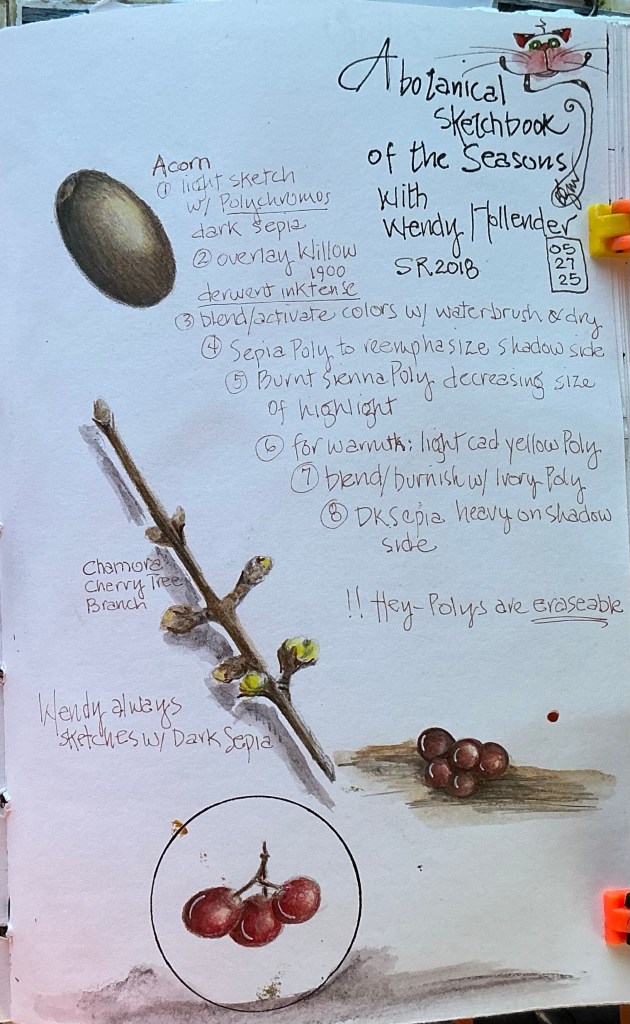
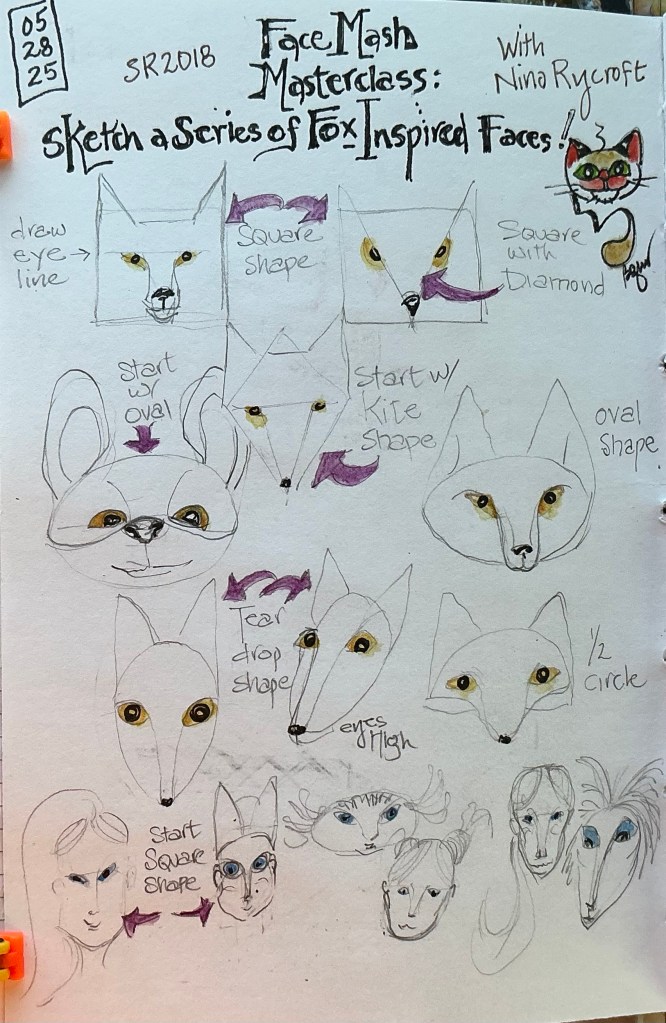
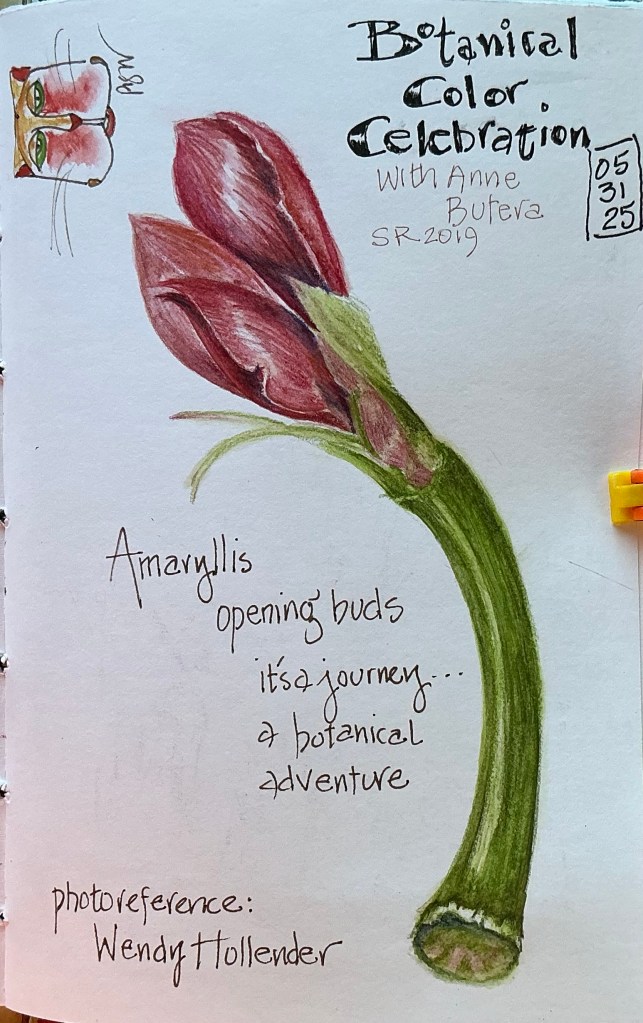
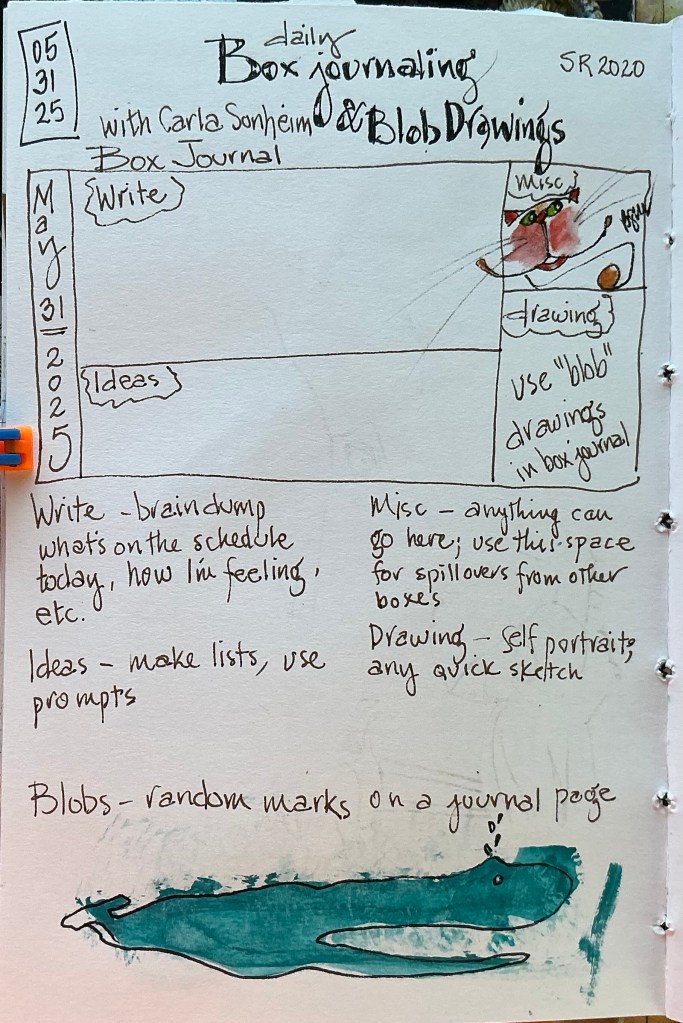
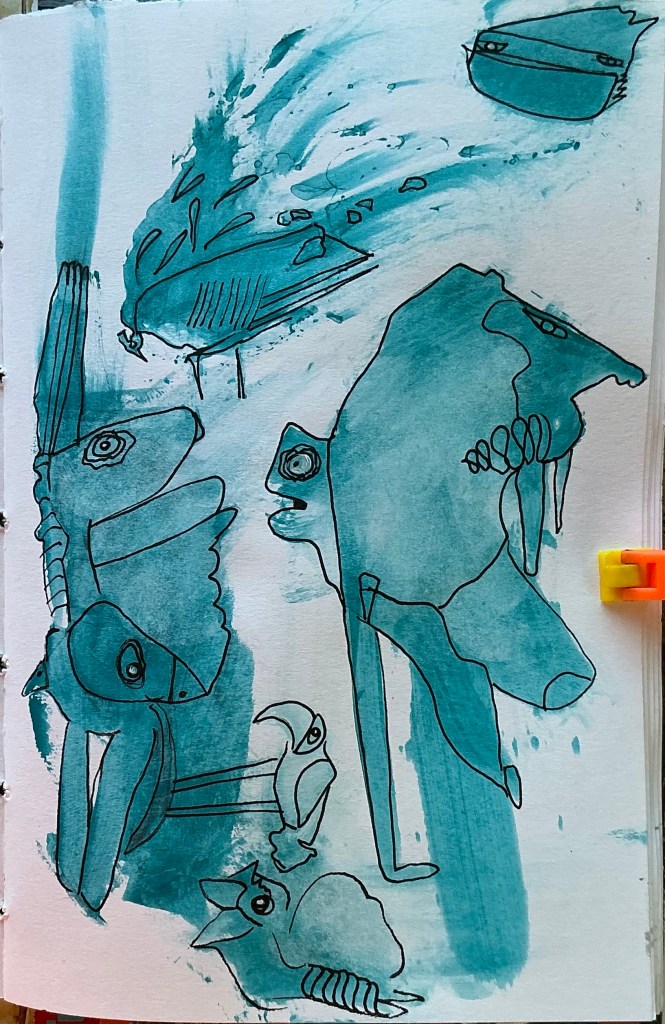
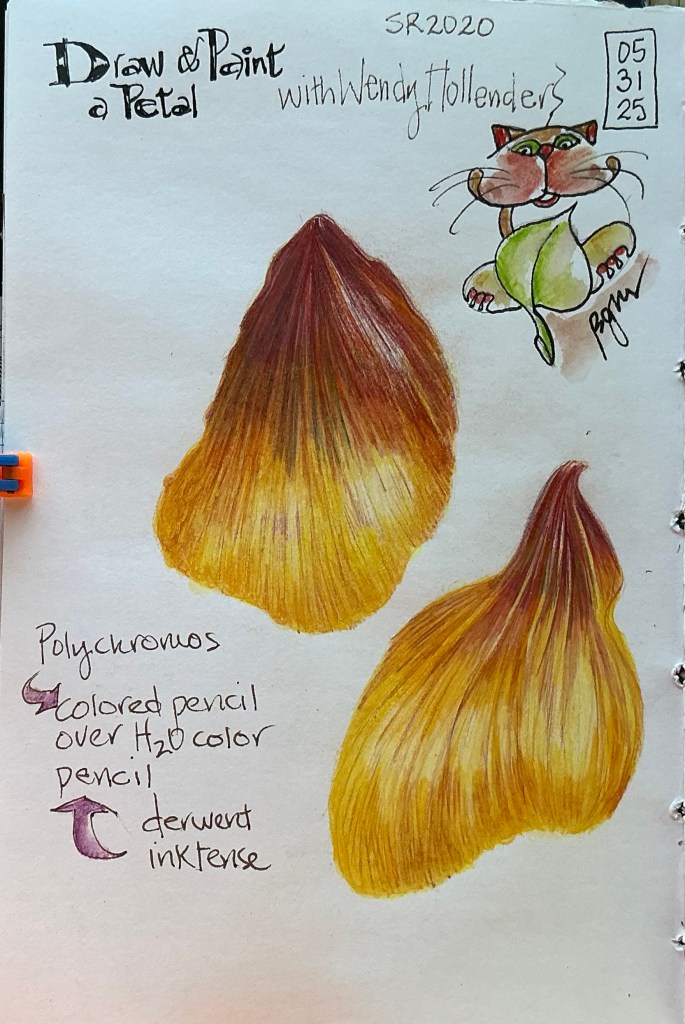
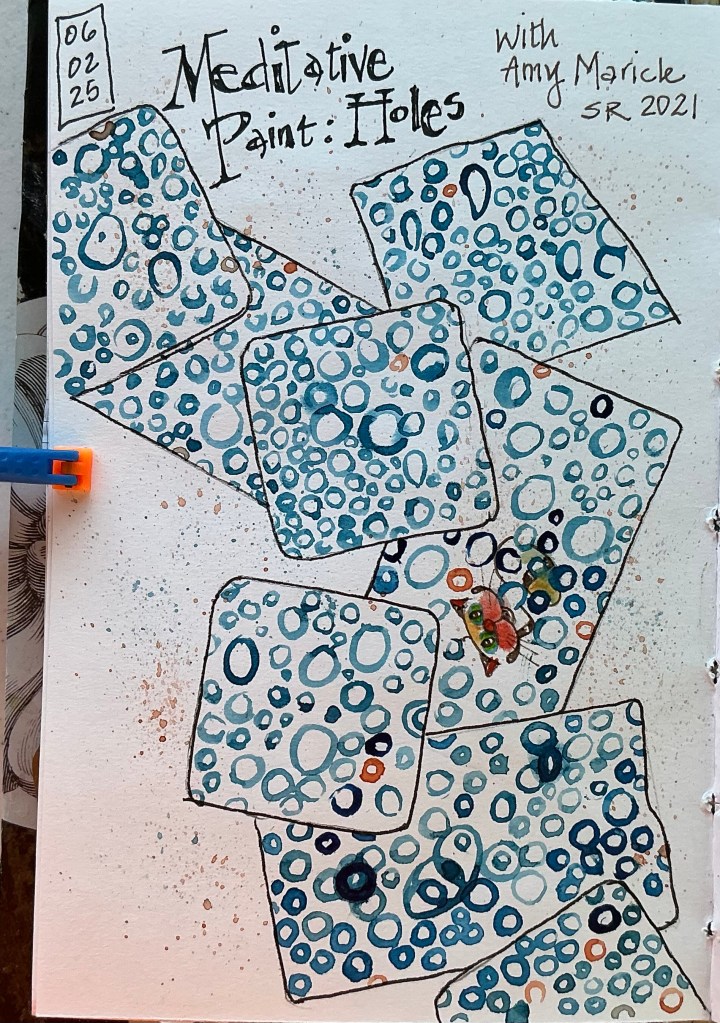
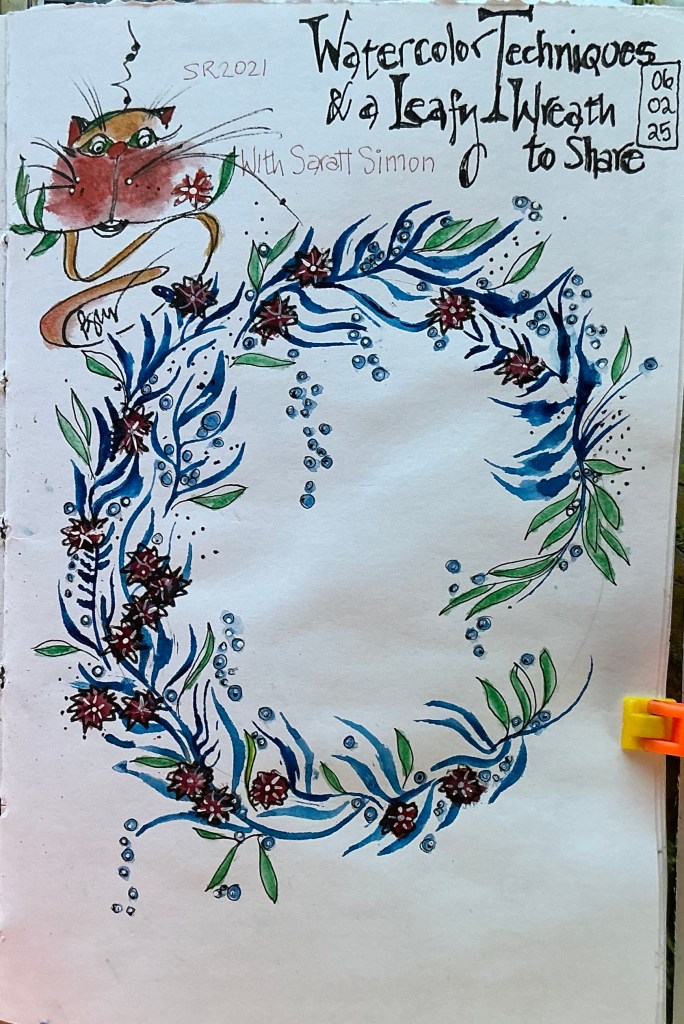
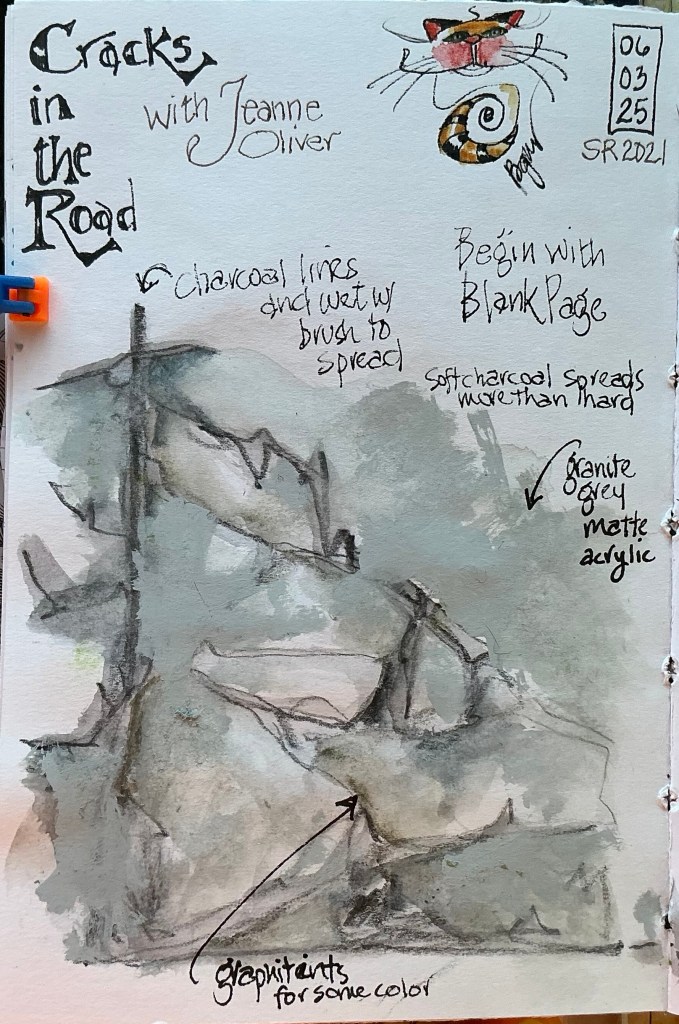
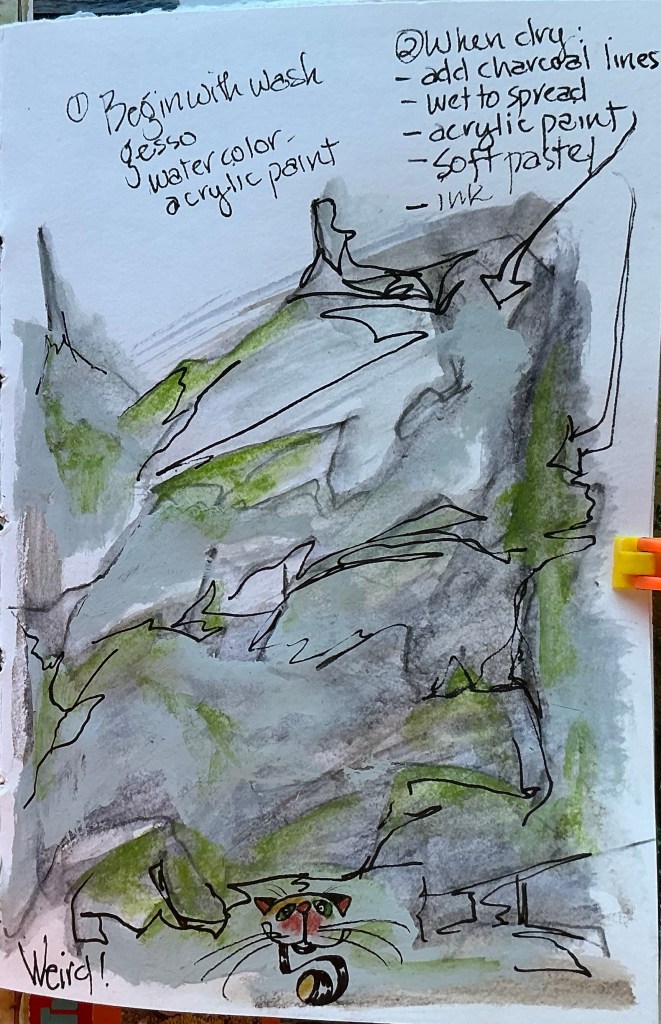
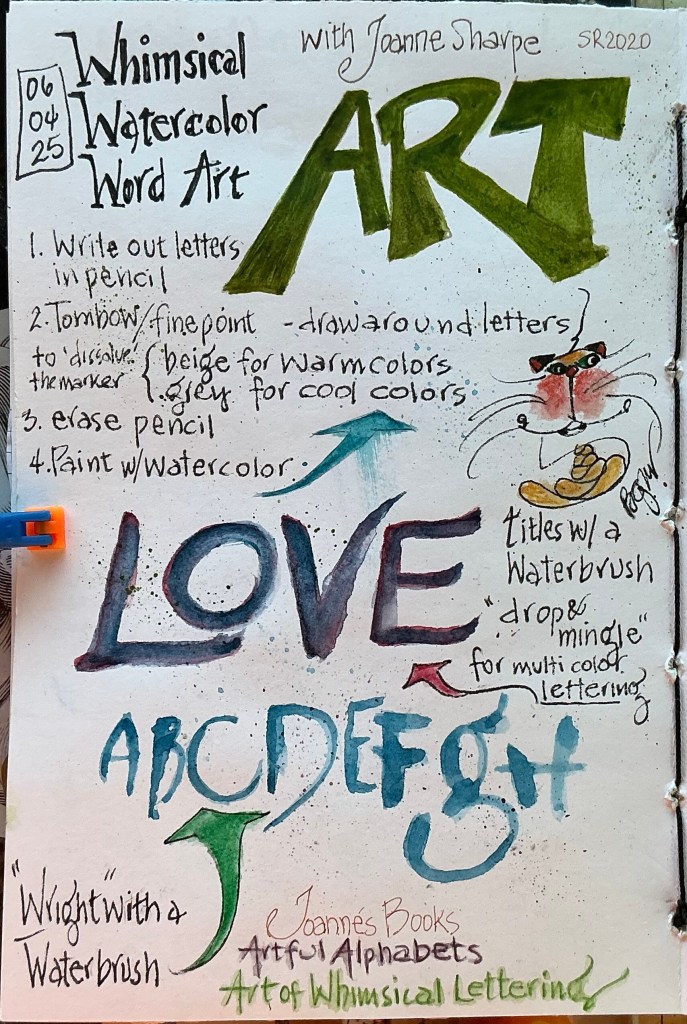
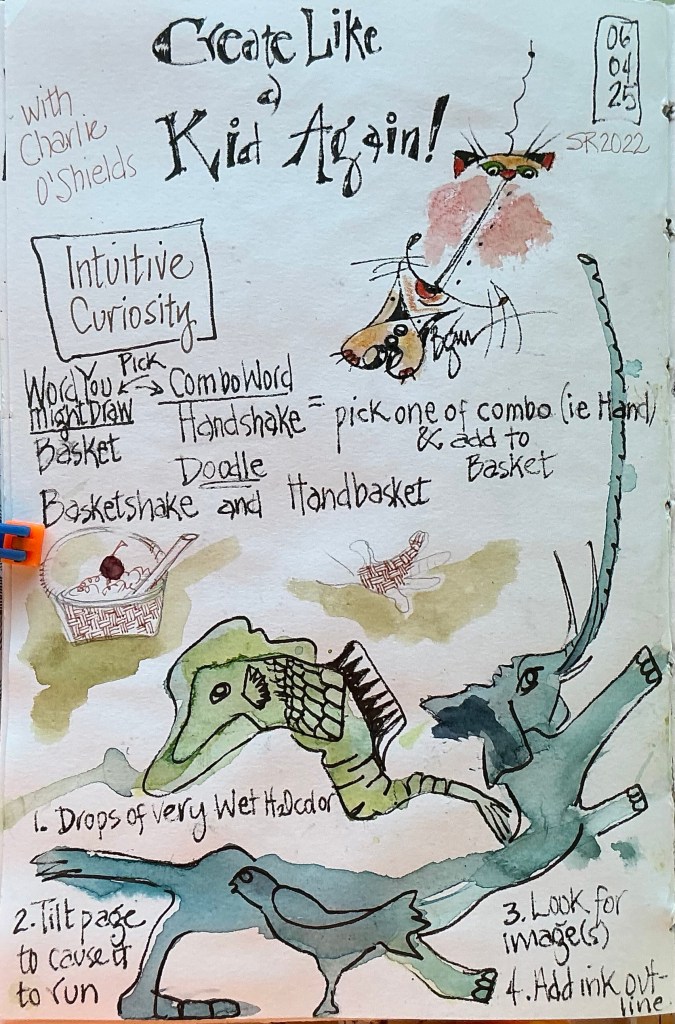
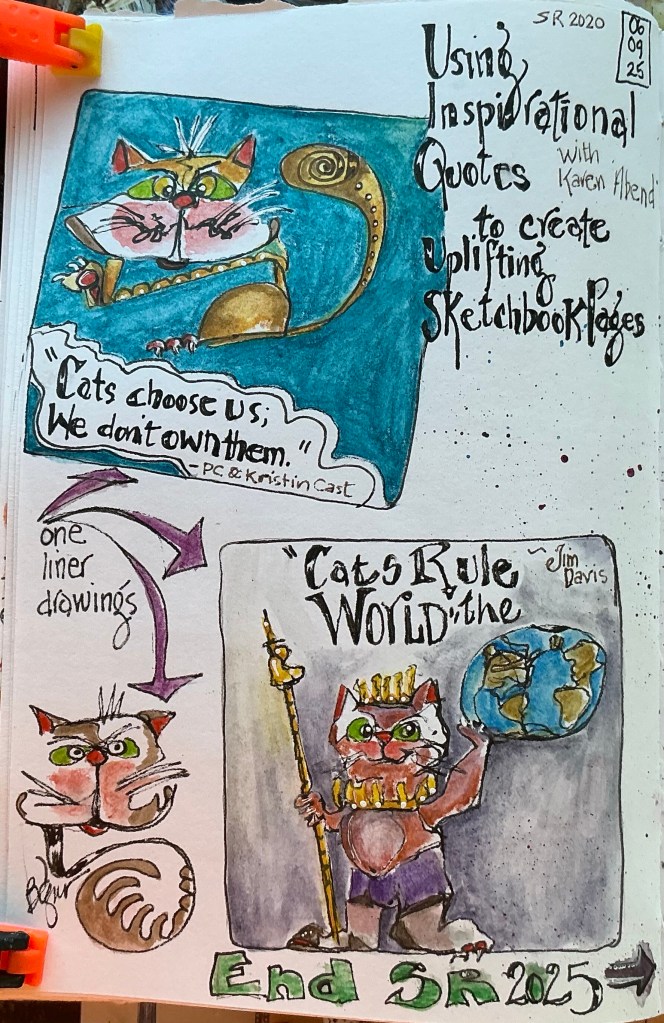
After two weeks of play, I was able to fill up my handmade and successfully stitched SR 2025 sketchbook! With a total of 46 pages completed (doubling up workshop projects on a handful of pages), including several pockets with inserts, I was pretty happy (and a bit exhausted).
If you’ve participated in SR in the past, or maybe took on the 2025 challenge as your first time, you know how intense (in an exhilarating way) it can become. If not, and would like to learn more, check out this link
This link will take you to Karen Abend’s website where you can ask for more information about Sketchbook Revival. https://karenabend.com
Hope my collection made you smile and laugh! I certainly got a kick out of the experience.
Well, until Sketchbook Revival next year, thanks for coming along!
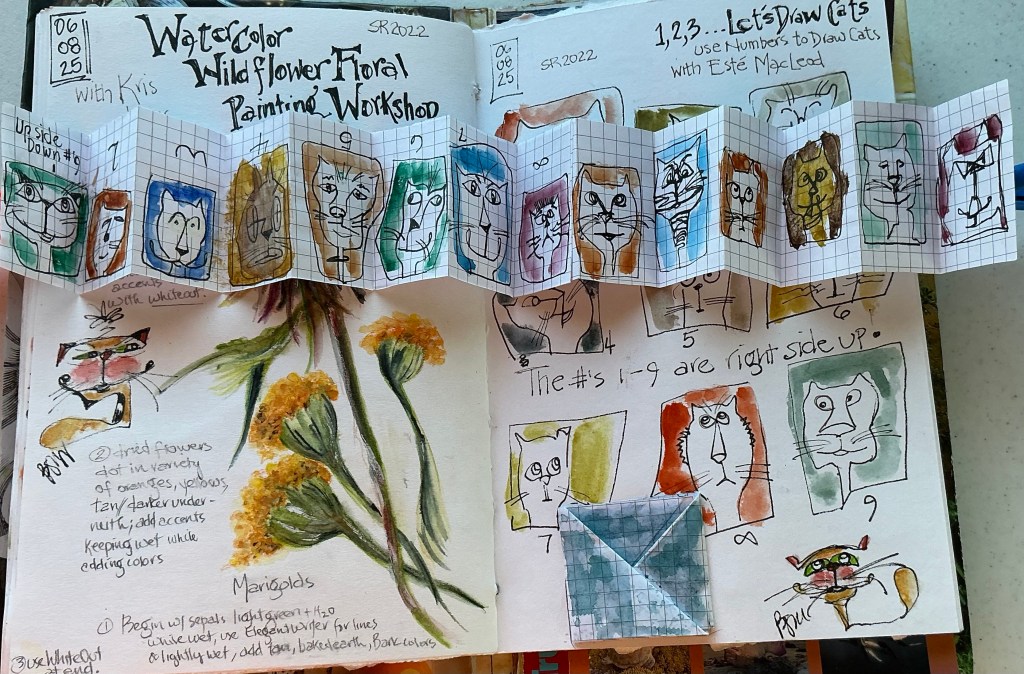
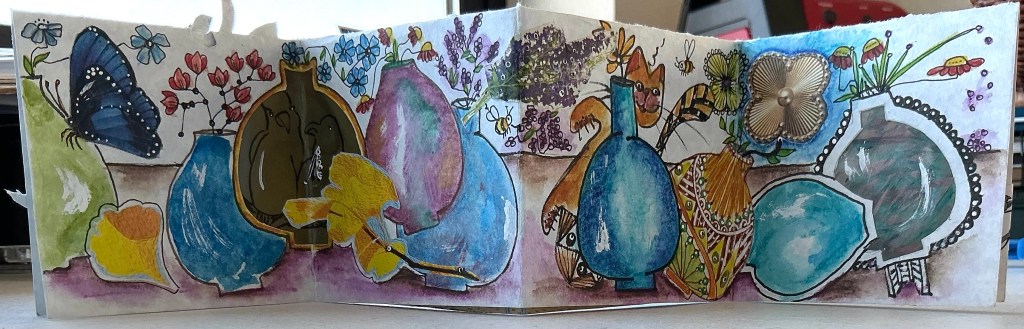
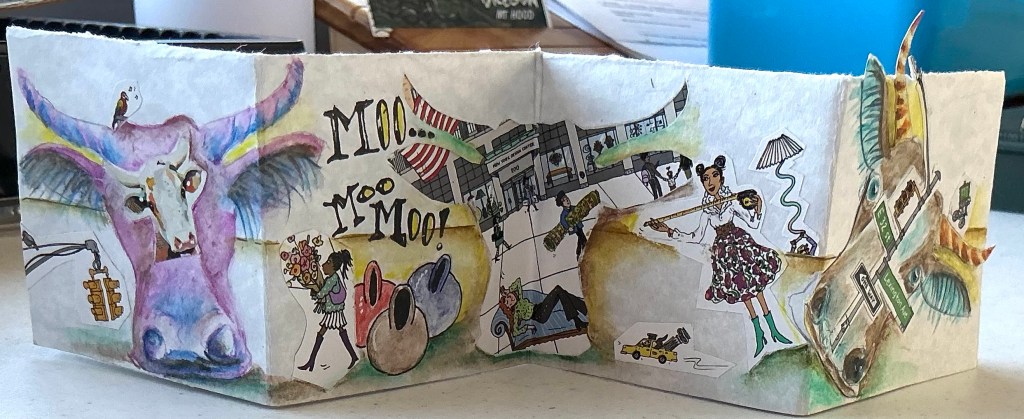
Front and back of the concertina book that tucks into the pocket above.My hand sewn, one signature SR 2025 Sketchbook.
Such an awesome-inspiring place to spend a Spring week in New Mexico!
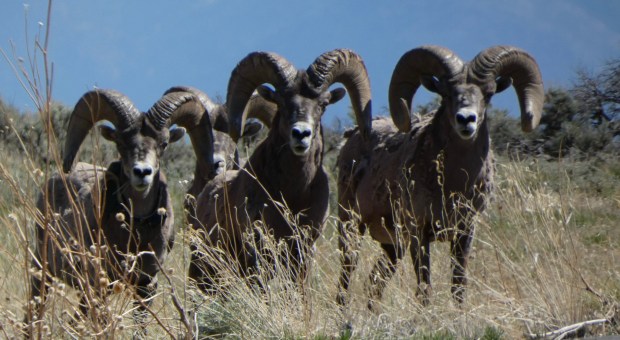
Three of the five big boys! Rocky Mountain Big Horn Sheep.
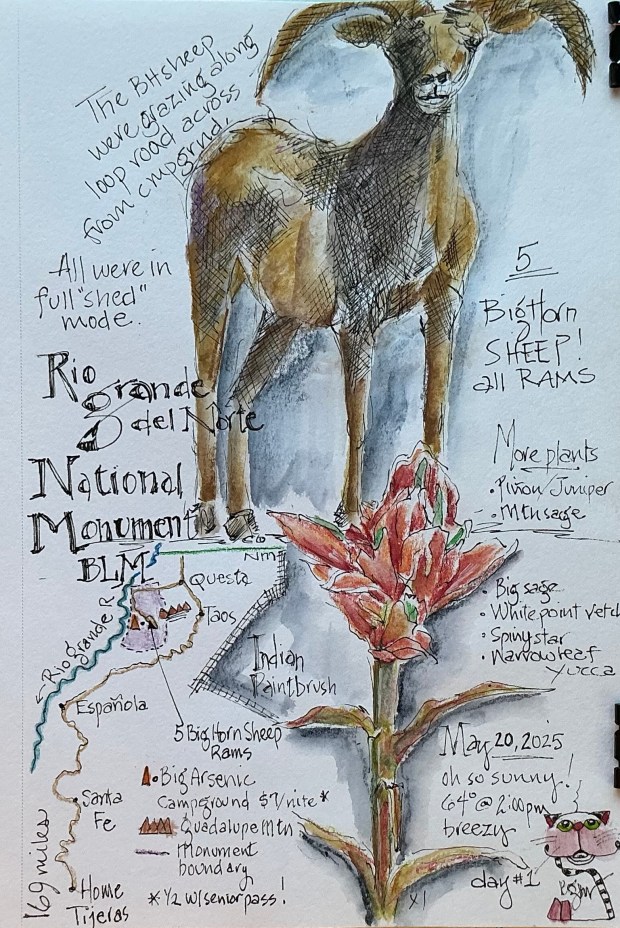
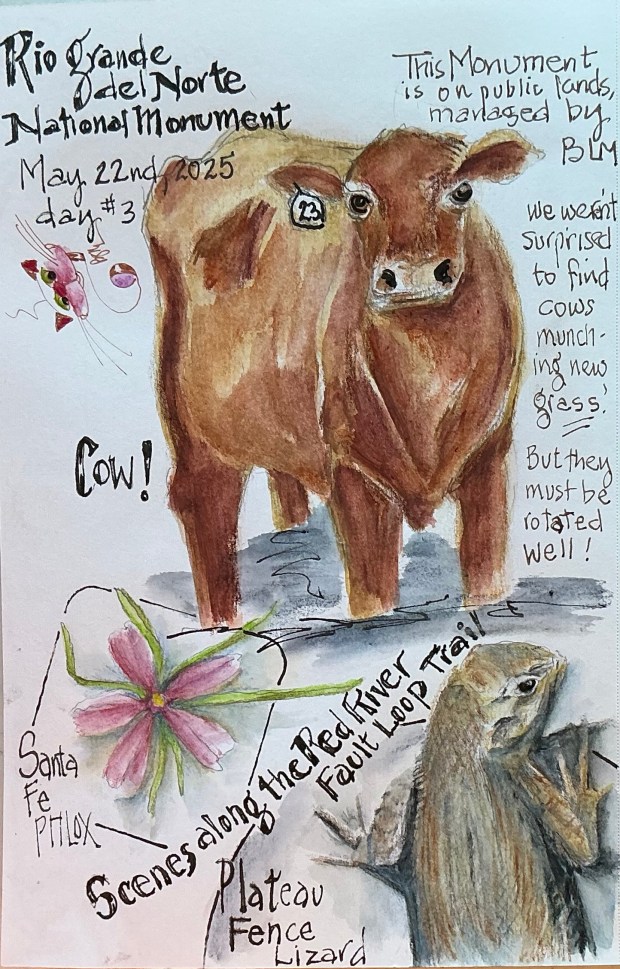
Rio Grande del Norte National Monument …..
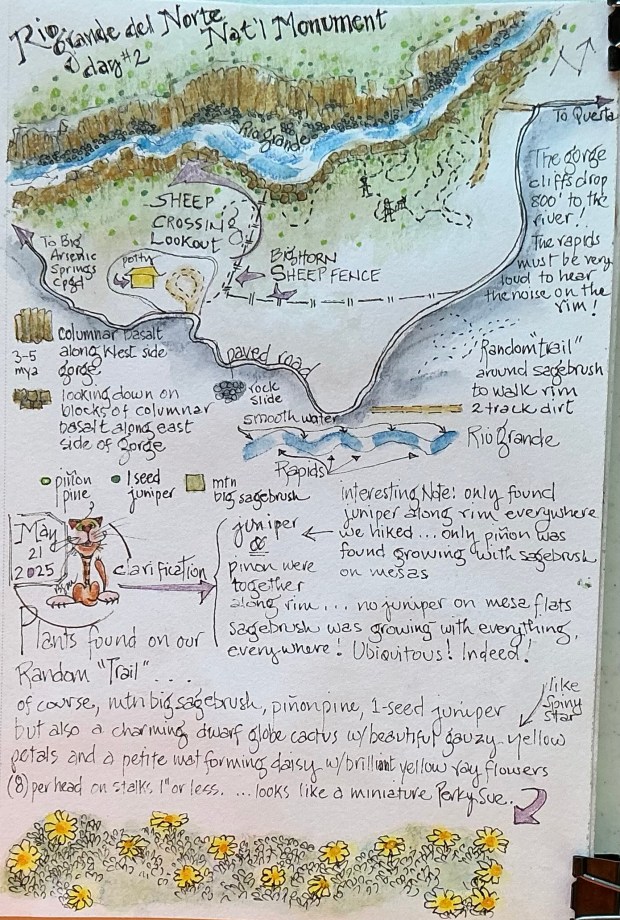
comprises a breathtaking 245,000 acre area of the northern Rio Grande rift valley in north central New Mexico. Established as a Bureau of Land Management (BLM) national monument in 2013, the rugged wide-open plains average 7,000 feet in elevation before dropping into steep narrow canyons carved into the landscape by rivers that have been flowing for millennia.
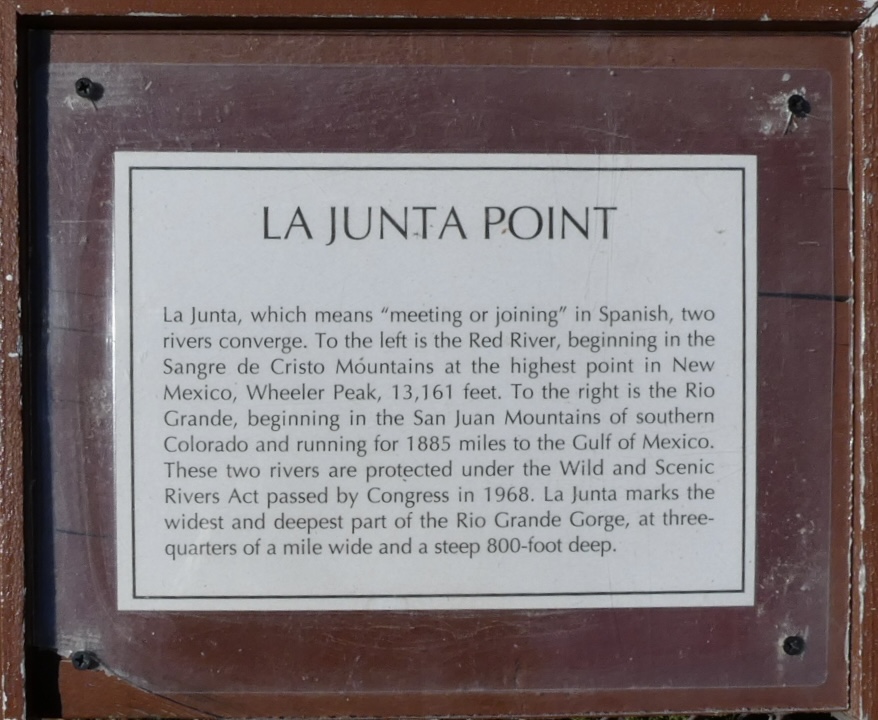
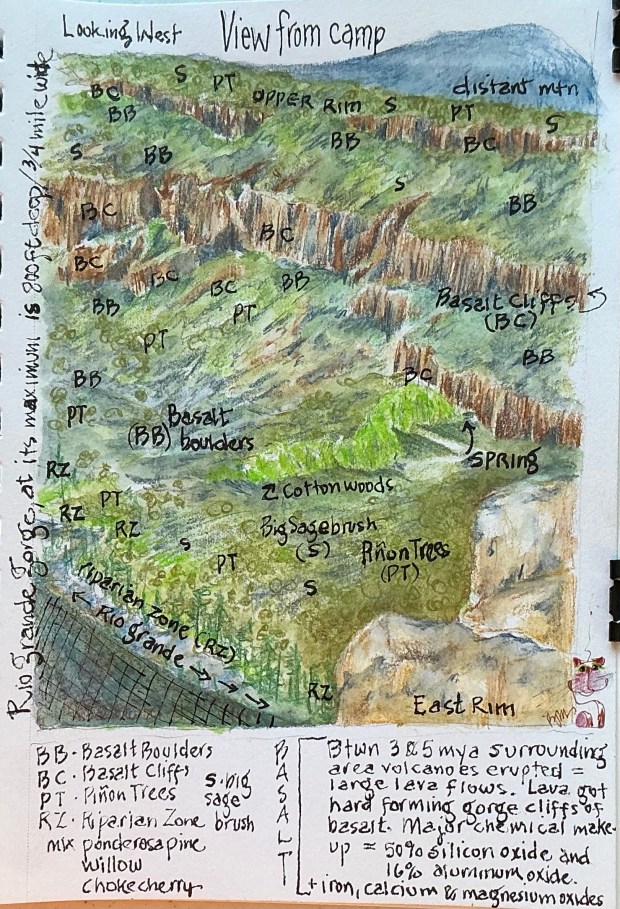
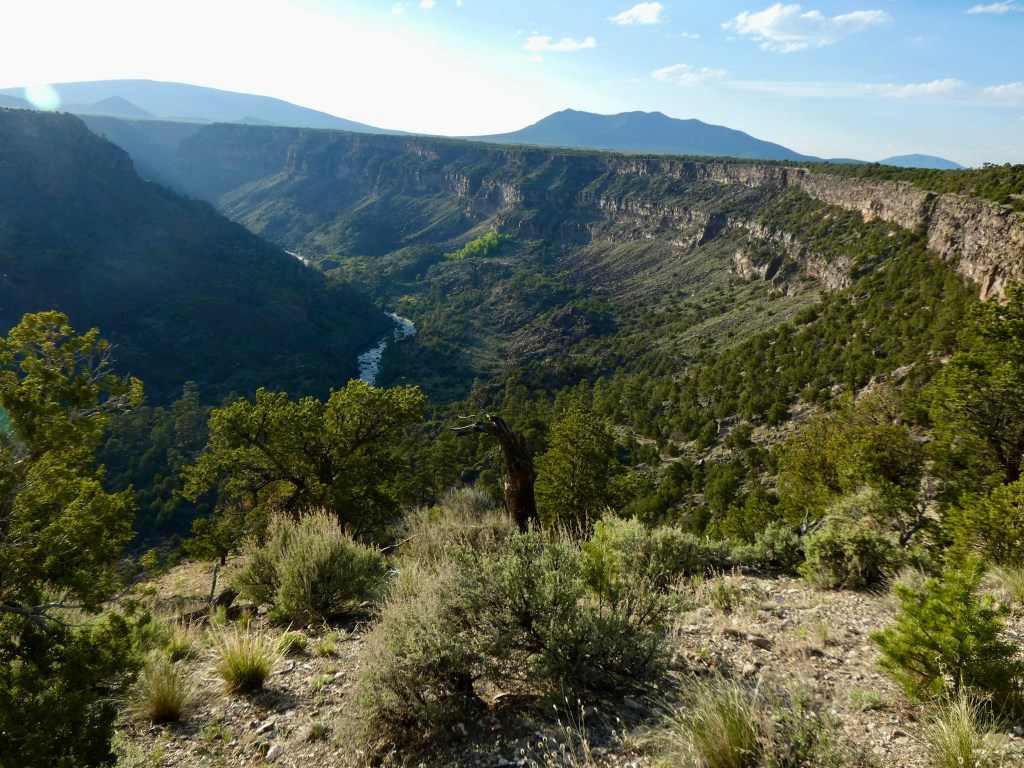
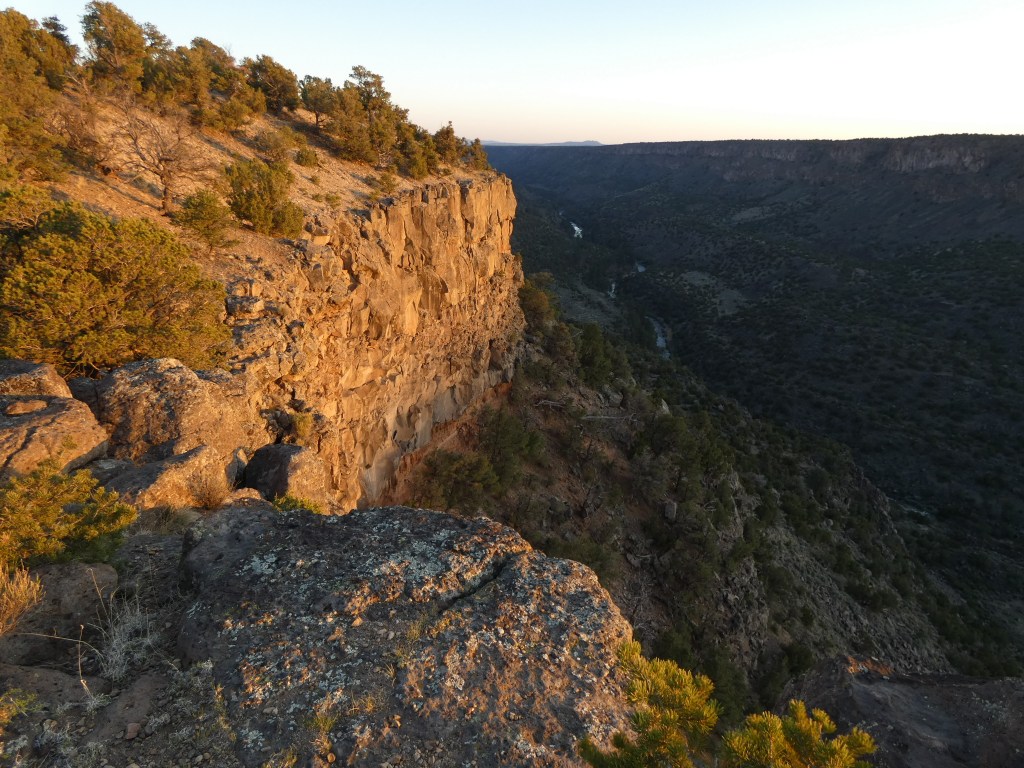
The confluence of two of these rivers, the Rio Grande and the Red River, occurs in the northern Wild Rivers area of the Monument. It’s at this confluence where the gorge is its deepest at 800 feet, and its widest from rim to rim measuring 3/4 mile. It’s an impressive view from the la Junta (“the Meeting”) Overlook. All of the views from anywhere along the rim are impressive.
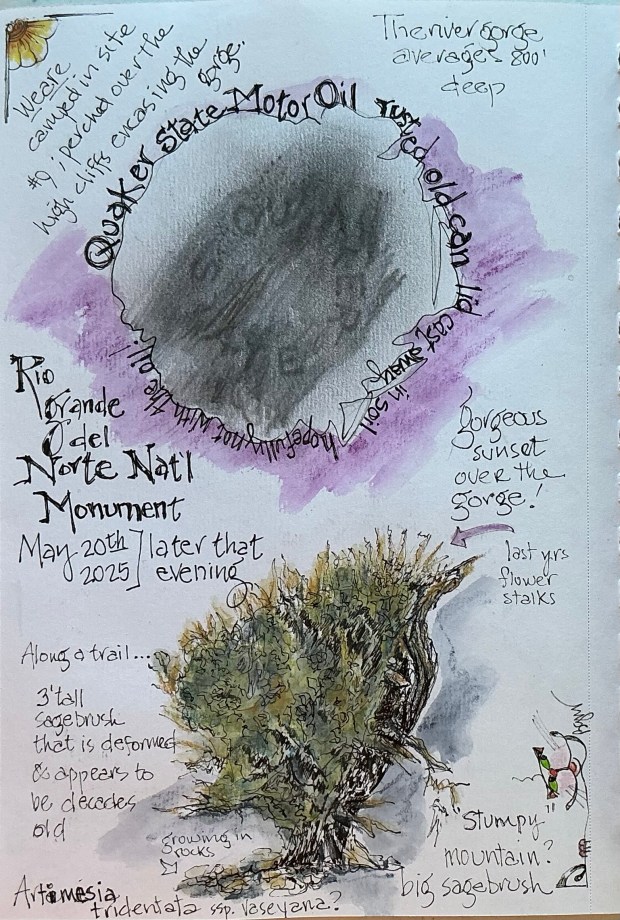
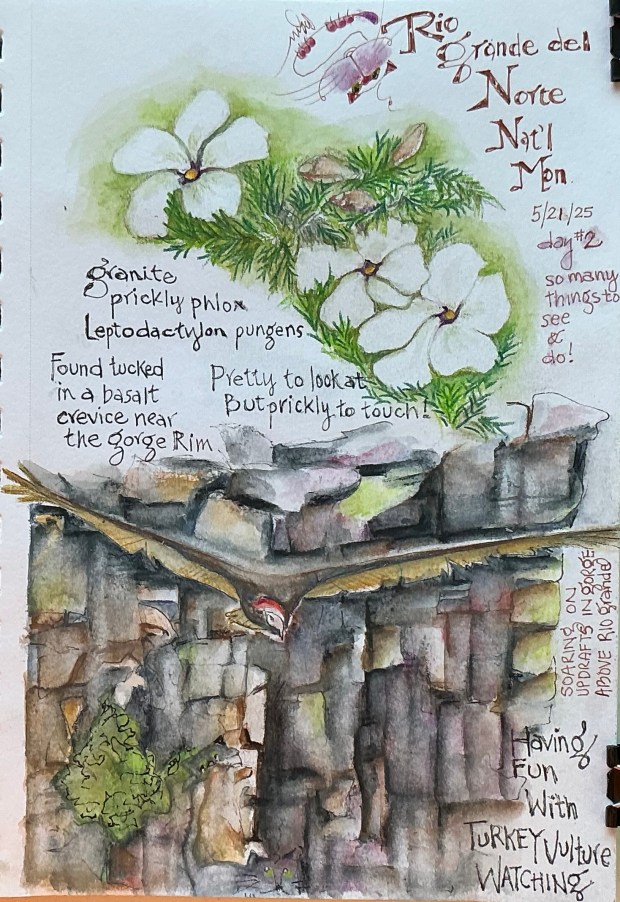
We backed our RV (‘Felix’) into what must’ve been the best designated camping site ever ….. #9 on the southern loop in Big Arsenic Springs Campground. After setting up, we discovered that Felix rested only a few steps west was the rim and the long plunge down to the Rio Grande! But immediately south of us, the rim formed a small peninsula where nearly every afternoon I could be found sketching the plants growing from the basalt cliffs, or the swifts and turkey vultures soaring along the cliffs and over the river aided by the canyon’s updrafts. This skinny little peninsula quickly became my favorite sit spot; then late one morning it became priceless …….
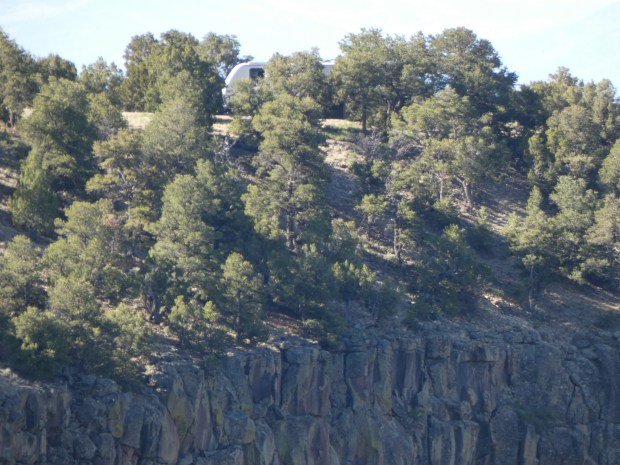
Can you spot our RV? We were precariously perched above the Rio Grande, right on the rim of the gorge!
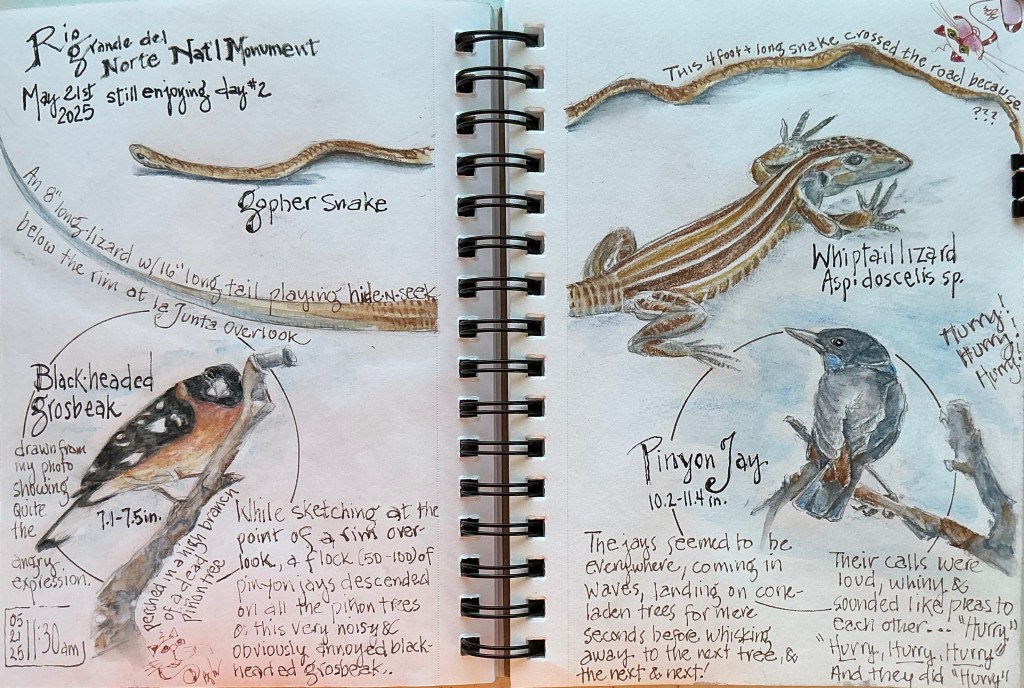
I could hear them approaching, like a swarm of bees. In a matter of seconds I was witnessing a cacophonous chorus of 100’s of pinyon jays. These noisy birds quickly moved in and onward while descending, like they were famished, on this year’s piñon pine cone-laden trees in large erratic groups, all the while screaming, “Hurry, Hurry, Hurry, Hurry!” Where exactly they came from or where they went remains a mystery. All I know was the spectacle must’ve lasted a good 10 minutes or more, as I watched wave after wave of these birds pass by. I still get goosebumps (jaybumps?) recalling those exciting moments.
We had planned to spend only one day camping in the Monument, but every morning we decided to stay at least another and then another day. We hiked every rim and interior trail (sometimes more than once), spent hours at all of the Overlooks getting ‘High on the Views,” were thrilled with our chance encounters of five (5) Rocky Mountain Big Horn Sheep rams (twice in one day), and marveled at how the forces of nature* collaborated to carve the narrow and steep 800 foot deep gorge within the Monument.
But alas, it became time to pack up our home away from home. Even tho a string of completely clear days allowed sun to shine on our solar panels from sunup to sundown, keeping Felix’s battery purring happily our entire stay, it did nothing to recharge our potable water tank. So the morning we found the water indicator light teetering on ‘Empty,’ was the day we headed for home (after enjoying a farewell hike, of course) with my nature journal full of sketches and memories for a lifetime!
Do you have an especially special place where you can spend time in nature? Please share your discovery and what makes it so awesome!
As always, thanks for stopping by!
*Geology 101
From the overlooks throughout the Monument, we could see stacks and stacks of basalt and ash lining the narrow canyon walls of the Rio Grande Gorge. It’s hard to imagine the volume of material deposited during two very active periods of volcanic activity that occurred 5 and 3 million years ago. Soon after these events, water moving through the major drainage in the area (today’s Red River) began eroding pathways into these deposits as it flowed downstream into the 10-16 million year old rift valley. Geologists refer to the ancient Red River drainage as the ‘original Rio Grande’ because the still-closed San Luis Basin to the north (in south central Colorado) would not overflow for a few million years. Then 400,000 years ago, coinciding with a change in climate resulting in an overabundance of snow and rain, the San Luis Basin filled and spilled. As water does so well, this new and powerful river, today’s Rio Grande, moved ‘downhill’ towards the ‘original Rio Grande’, cutting through everything in its path (including the ancient volcanic deposits). When it converged with the ‘original Rio Grande,’ the erosive force of both rivers became enough to eventually carve out an 800-foot deep gorge in the Rift.
Confluence of the Rio Grande and Red RiverSunset on basalt cliff
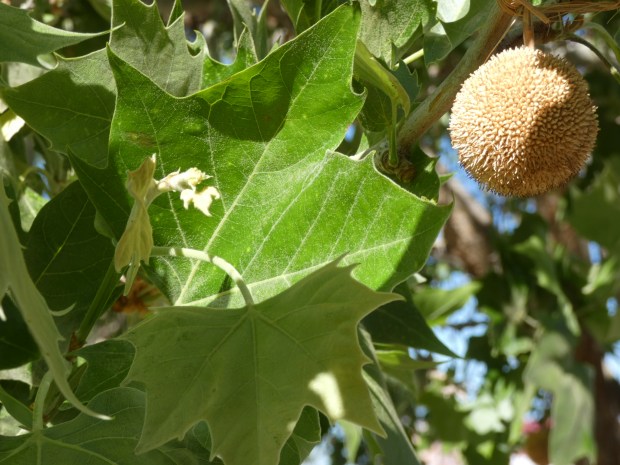
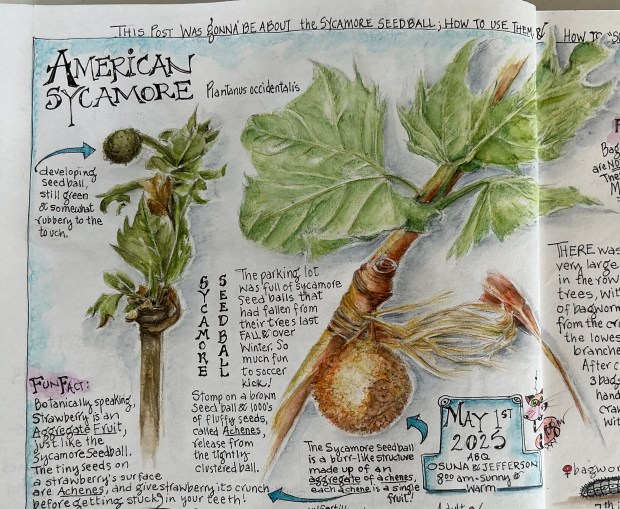
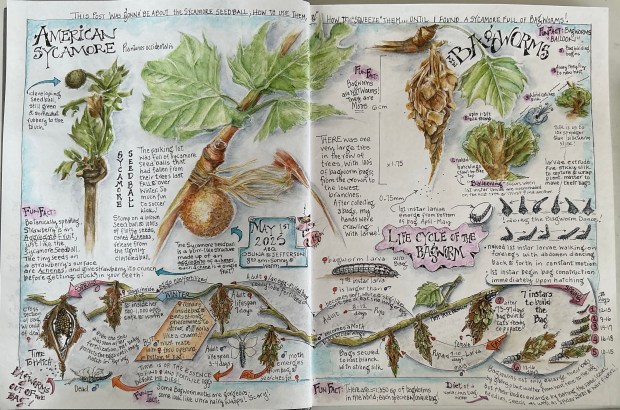
On a warm Spring morning, wandering around a grove of American Sycamore, I became curious about these magnificent trees: where in the US are they native; why are some leaves larger than the palm of my hand and some half the size; what about those odd pingpong sized seedballs lying on the ground everywhere you look ….. why don’t they roll away in search of an ideal spot to pop open so the seeds can germinate …… when the seedballs are kicked, stepped on or crushed beneath a car tire, do the 1,000’s of seeds inside blow away to sprout ….. are the seeds (all or some of them) even viable ….. do the seedballs make a good ink or dye or maybe they’re edible or even medicinal……. what, if any wildlife species eat the seedballs or seeds; and ooooohhhhhhh, sycamore bark! Why does this tree’s bark flaunt a pastel palette of greens, yellows and pinks. These and many more questions came to mind that it seemed about time the American Sycamore became a subject for my nature journal, until ……………..
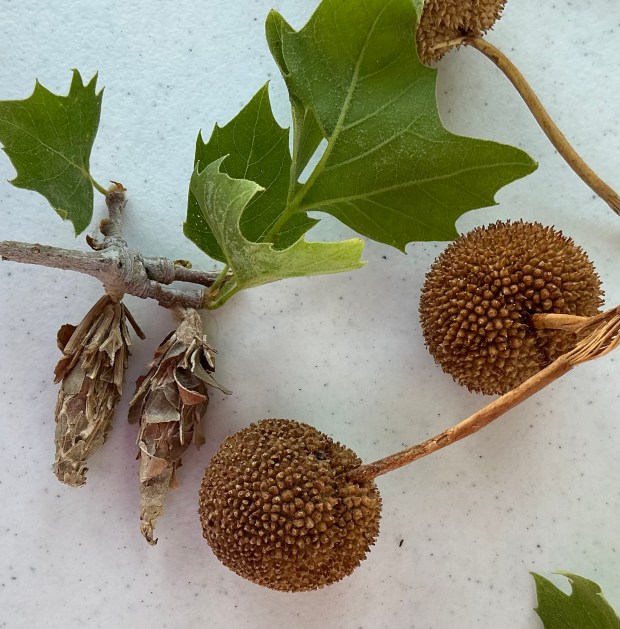
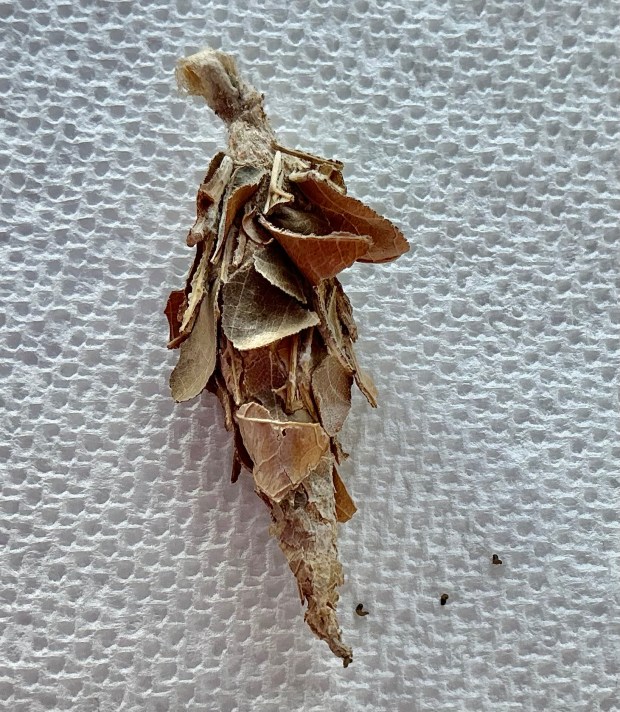
There! In the tree above my head, I spotted a most curious thing. Parting a few of that sycamore’s beautiful Spring green palmate-shaped leaves was a bundle of dead brown and beige leafy bits and sticks all haphazardly glued together. Wishing to get a closer look at that elongated ornament shaped “thing,” I found it was securely suspended from a branch. Trying to puzzle out this fascinating mystery while searching for my pen knife, a stiff breeze blew through the tree. It was then a I noticed hundreds of those 2-3” long bundles all over the tree; from the base to its crown!
Curiosity is the Essence of Nature Journaling
What continues to draw me to nature and nature journaling after so many years are the surprises in the familiar and in the unknown. I know well enough that new encounters in nature are infinite; you just have to open your eyes and look. Having learned by carefully observing what appears to be familiar, often leads to new discoveries. That’s when my curiosity kicks into high gear ….. when it’s time to engage in some serious poking around to figure something out; to learn what the “thing” is.
Curiosity, for me, is the very heart and soul of nature journaling. The ‘art’ of curiosity even precedes skill in observation. It’s what drives me out the door in the morning and fuels my exploration. Curiosity fills the mind with countless questions if for no other reason but to develop a deeper understanding of the natural world.
But I “wax philosophical.” Needless to say, my curious discovery on that warm and breezy Spring morning prompted an abrupt change of mind for my next blog post (this post). Anxious to learn about the “thing” suspended from a tree branch, probably minding its own business, I proceeded to cut it down (along with two more) and popped them in a bag along with a few sycamore leaves and seedballs.
Later that same day …….
Upon completing my journal sketches of sycamore leaves and seedballs, and posting a few photos to iNaturalist for an initial ID, it was time to take a closer look at my discovery. Reaching into the bag for one of the “things” (wiping my hand free of spider webbing?), I placed it on my examination table surrounded by several hand lenses, a larger magnifying glass, a penknife, and 2 pairs of tweezers. Before beginning the dissection, I noticed about a dozen black pepper-sized bits moving about the “thing.” Thinking tiny spiders had come from the bag, I didn’t give them a second thought (should’ve been curious!).
This bagworm bag was the subject of my dissection. Notice the pepper-sized black dots next to the bag ….. those are wiggling 1st instar larva.
iNaturalist ID Pick :::::::::::::: BAGWORM MOTH ::::::::::::::: iNaturalist ID Pick
(awaiting genus/species ID)
A Bagworm Moth!
How cool is that!?!
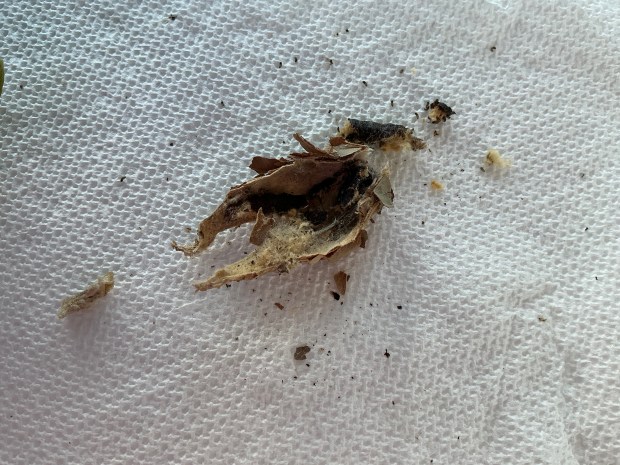
The opened bag of a female Bagworm moth. She’s very dead, but her progeny are escaping as fast as they can.
Dissection resumes ……
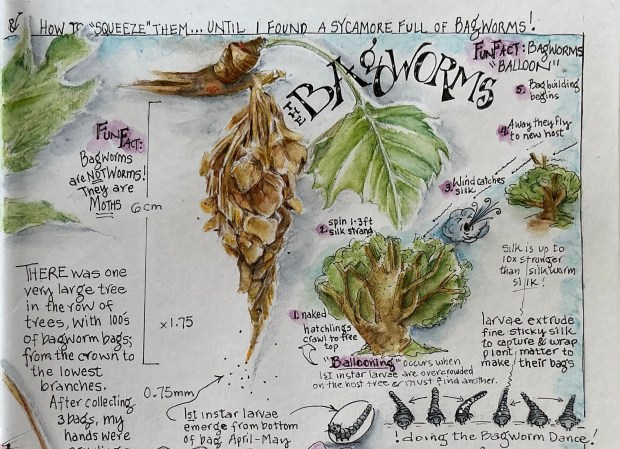
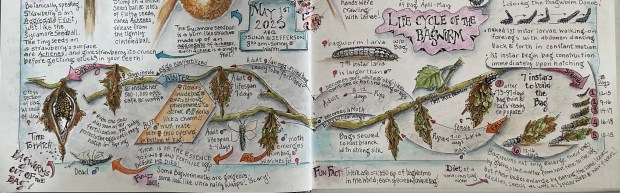
After finding out the “thing” I’ve been pondering over is the Bag of a bagwormmoth, I learned the Bag was built during last Spring, Summer and Fall by either a male or female bagworm moth. If a male, the Bag would be empty; if a female, the Bag would contain her remains …. she would’ve died last fall after a male fertilized 500-1,000+ eggs she overwintered inside her body until Spring when newly-hatched larvae would emerge from the bottom of the Bag and begin the species’ life cycle all over again.
The Bag, that took about 10 minutes and all my dissection tools to open, contained the black and mushy remains of a female and 100’s of wiggling/dancing larvae! They were on the move; escaping from the now wide open Bag, and quickly covering my examination table like a pepper grinder out of control.
And my effort to open the Bag? This made sense after reading about the high tensile strength of the silk they produce. These thin strands of silk, 10x stronger than that produced by silkworms, is used in abundance to construct their Bags.
The coolest thing ever! Notice the either late 2nd or early 3rd instar larva, no longer naked, but swaddled in very chewed up leafy bits glued together with strong silk. This dude was hiking up a sycamore branch, continually chewing, wiggling, and gluing.
After disposing of all the naked 1st instar larvae waggling and dancing across my examination table, I placed the dissected Bag, the two whole Bags, and collected leaf material into a clear plastic ziplock to observe what would happen. Over 10 days, the number of larvae multiplied and the naked 1st instar caterpillars grew in size (at least to 2nd instar) while building their individual Bags from tiny bits of leaf litter! Their wiggling dance seemed to be the way their silk strands wrapped and secured leafy bits around their bodies. It’s been fun to watch all the activity.
Have you ever encountered one or more of the 1,350+ species of bagworm moths? What materials were their Bags made from? Please share your experience with these fascinating members of the butterfly/moth family of insects.
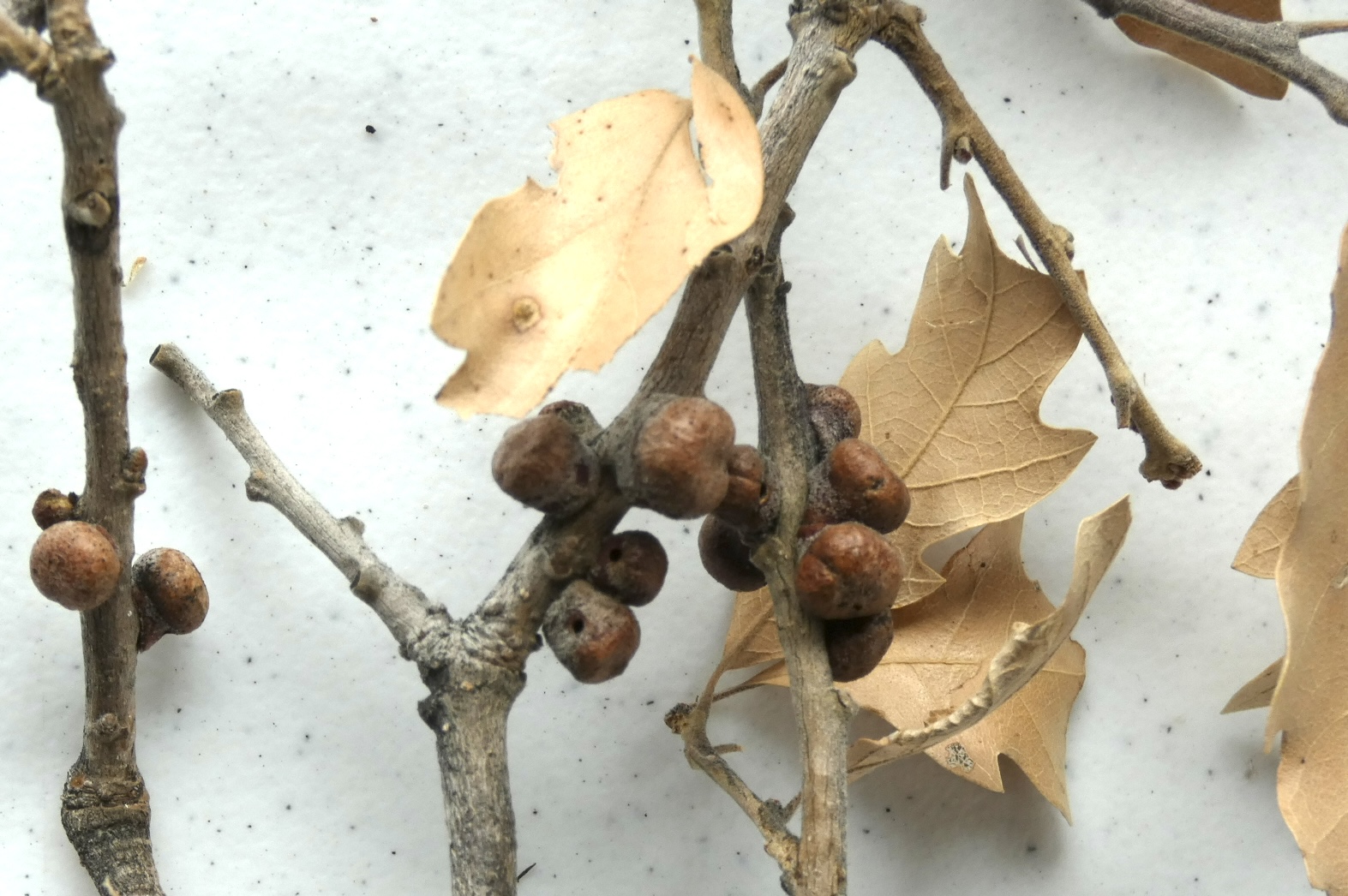
When the urge to nature journal is too hard to resist, but everything around you is still brown, crispy and covered in dust, I begin looking for any curious phenomena suitable for rabbit trailing (even rabbit tracks work!). The other day while hiking a steep hill, I was looking for sign the oaks were close to breaking bud. Spotting a string of little dark red beady objects lining many of the mostly leafless stems of am oak was certainly encouraging. From a distance they appeared to be swelling leaf buds; at least their color seemed right. But an up-close inspection revealed my hopeful find as last December’s vacated “homes” occupied by oak gall wasp larvae. Having never seen this species of stem gall before, naturally this would be a perfect most curious phenomenon to tackle. And that’s just what I did!
The Honeydew Gall-Wasp Gall
Arriving back home with a small collection of oak stems crowded with tightly packed galls (resembling miniature bread loaves), my work began. Assuming the host oak was a Gambel’s (Quercus gambelii), I began my search of stems galls on that species. Carefully scouring the literature the genus appeared to be Disholcaspis, but none of the species seemed a good match. So after many days in quandary, I consulted my favorite oak gall ID specialist, firing off a lot of questions, written descriptions and photos. Patiently awaiting his reply, I continued to find more resources to review. Gall wasps have a complex life cycle, and their galls are a challenge to identify.
After 2 weeks a welcome reply arrived from the specialist. Boy did I feel silly, knowing I should’ve known better! The oak host was not a Gambel’s but a cross between Gambel’s and Shrub Live Oak (Q. turbinella) which produces a hybrid called Wavyleaf oak (Quercus x undulata). Correcting my mistake was key to identifying the stem gall! Picky little wasps, huh? Happy the specialist agreed the genus is Disholcaspis, the obvious species responsible for the gall was turned out to be D. spissa; the Honeydew Gall-Wasp ….. making my discovery the Honeydew Gall-Wasp Gall!
Lesson Relearned
When nature journaling, despite how excited you may be to find answers, it’s always, always best to slow down, breathe, carefully observe, ponder, question, make connections, and enjoy the journey ahead of the destination!
Some Gall Descriptions and A Prize!
Outside appearance: Young galls of this wasp are yellowish and hairy. Mature galls have beige-brown to weathered grey sides, are black on top, and have a dull matte surface. They can have a round to ovoid to a rectangular ‘bread-loaf’ like shape. Texture appears mealy-granular. Galls sit snugly directly on the stems (sessile), and singly or in clusters of long compact chains that form all around the stems of host oak species.
Inside the gall and back outside again: Each gall has one thin walled cell or chamber (known as monothalamous) that sits above the bottom of the gall. This is the larval chamber and is imbedded in dense cellular tissue that becomes a pulpy flesh with age. While the larvae are actively feeding and growing, they produce a copious amount of sticky-sweet honeydew that accumulates on the top of the gall. All of this honeydew attracts hordes of hungry ants and yellowjackets. The ecological importance of these secretions is unmistakeable; it provides a high energy food source for the insects. And while the ants and yellowjackets feed, they inadvertently protect the gall, like little bodyguards, from parasites and predators intent on infecting or eating the growing larvae inside. And another interesting ecological thing ….. the reason the tops of the galls are black and not the same color as their sides, has to do with a fungus called black sooty mold. The sugary secretions produced by the larvae accumulate in quantities too irresistible to the sooty mold. Colonies of the fungus develop rapidly on the honeydew giving the gall tops a dusty or powdery black color. So honeydew is the perfect medium for black sooty mold to complete its life cycle.
What about that Prize? Read on to learn more! Close-up inspection of the galls I collected, and there were about 25, revealed all but one had a single exit hole in a side just below its crusty red-black top. I learned the adult wasps emerge from these stem galls by late December; sometimes waiting for warmish temps until mid January. What happened to the adult wasps in the one gall without an exit hole? Because the gall had a sooty top, implying the larvae had been eating, growing and secreting honeydew, maybe the larvae died at some point or failed to develop into an adult? Had to know! Cutting the gall to find out wasn’t easy. The outer crust fell away first, then using steady knife pressure on the punky innards, the gall popped open, like a box of ‘Cracker Jacks!’ And there, near the bottom of the package, was a single sealed chamber. Carefully I was able to tease out the contents with fine pointed tweezers until out blurped the Prize! An intact cream colored gooey looking larvae, followed by a small puddle of viscous liquid. Even though the larvae filled up most of the chamber, there wasn’t any sign it was alive. And after an hour, when there still wasn’t any movement …. well, darn, I felt he must’ve died sometime before morphing into adult form. But peeking inside the gall did answer the question about the absence of an exterior exit hole.
And now an interesting note about these types of cynipid oak gall wasps: On my diagram, I used the term ‘agamic’ which is a formal label included with the genus/species name (i.e. Disholcaspis spissa ‘agamic’). This means these wasps have an asexual all female population that emerges from galls in late fall/early winter to lay fertilized eggs without needing to mate with males. Then a bisexual generation follows where adults emerge from galls in late winter/spring/early summer. This is the typical 2 generation annual life cycle of cynipid gall wasps, where the galls developed from each generation usually look very different and even occur on different parts of the host plant (on stems vs leaves). It’s interesting that nothing is known about the bisexual generation of D. spissa, but the asexual generation is common, well documented and abundant.
Known host oak species for D. spissa: Look for these galls on Shrub live oak (Quercusturbinella), Wavyleaf oak (Quercus x undulata), Mexican blue oak (Q. oblongifolia), Arizona white oak (Q. arizonica), and Shinnery oak (Q. havardi).
Hope you found my post interesting. Have you ever been curious enough about plant galls to look inside? Recalling the first time I saw a gall, I had no clue what it was and why it was precariously clinging to a plant leaf. It was round and hard, and reminded me of a tiny rusty red ping-pong ball. Was there something inside? Would it be squishy, alive, have teeth and bite, or perhaps whatever it was was dead and oh so smelly? Maybe it was some weird kind of flower bud, or a fruit lost under the leaf? Despite being a bit nervous, I needed to know what, if anything was inside. So I cut it in half, and in the center of the ball, suspended on hundreds of delicate threads, was a tiny, wormy creature twisting and turning and wriggling to music only it could hear! That was over 45 years ago, and to this day I still find galls irresistible!
As always, thanks for stopping by!
A Few References
Russo, Ronald A.: (2021) Plant Galls of the Western United States, section on tree galls; oak galls of the SW, page 173.
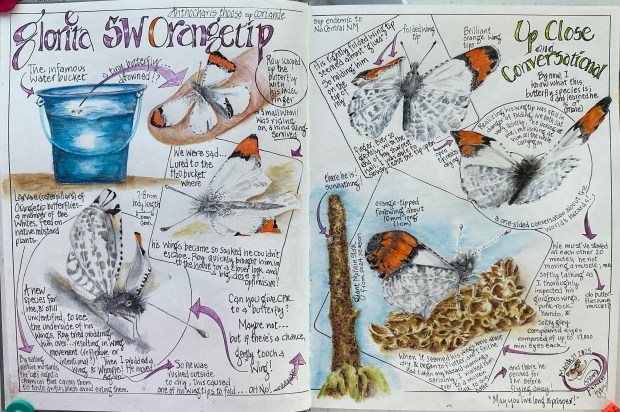
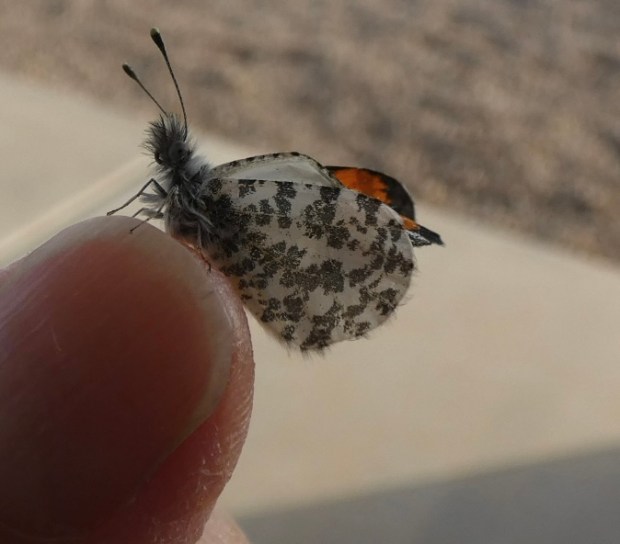
The ‘Glorieta’ Southwestern Orangetip (Anthocharis thoosa ssp coriande), are only known to occur in the central and north central counties of New Mexico. This recently recognized form of A. thoosa was described by M. Fisher and Scott in 2008, from specimens collected near Glorieta Pass southeast of Santa Fe1 (which just northeast of our home).
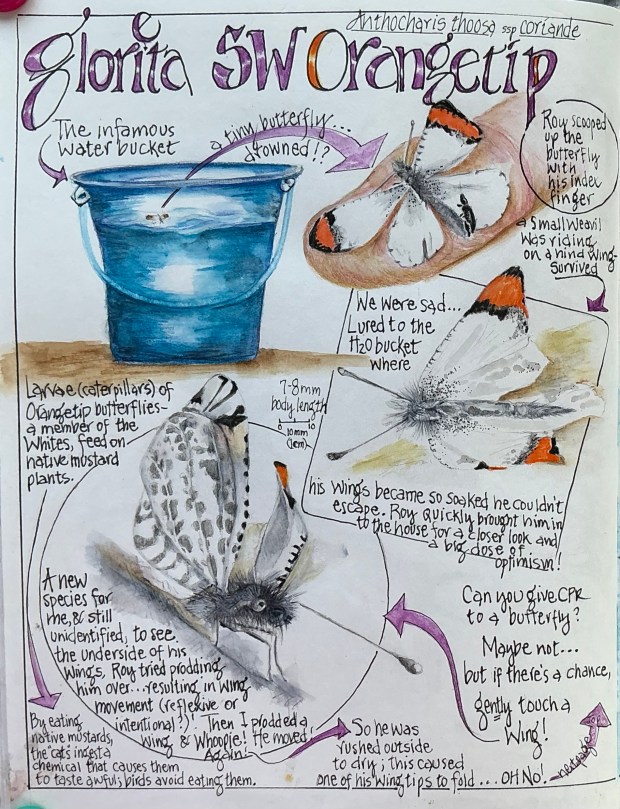
The Orangetips are classified in the Family Pieridae/Subfamily Pierinae ….. commonly called the Whites. In NM there are 16 known species of Whites, including the non-native European Cabbage White. After a wet winter, plentiful males compete for hilltop display locations while females search surrounding areas for the choicest of native plants in the mustard family (Brassicaceae) on which to lay their eggs. When the eggs hatch, the larvae (caterpillars) voraciously devour the leaves of their host mustard plants, until they’ve grown to over 1,000 times in size! Because this family of butterflies is common in desert habitats, to withstand drought conditions some species have the ability to suspend development during their pupal stage (when they are in their chrysalis), a mechanism called pupal diapause. And if winter rains do not cause favorable conditions for their larval hosts (the mustard plants), they can remain in pupal diapause for several years.
The White’s preference for mustard plants may not be about taste. It’s thought that chemicals contained in these host plants make butterflies in this group unpalatable. Entomologist, “Mike Toliver has witnessed only one attack by a bird on members of this group in more than 60 years of observation.”1
Early one morning (a few days ago), Roy discovered a miniature butterfly afloat, upside down, in a water bucket left outside overnight. Looking very drowned, Roy scooped him up with the tip of his index finger and brought him inside the house for my inspection. Excited and sad all at once, I snapped a few photos, having never seen this species before. Because this little guy had such striking marks and color, finding him in the online New Mexico butterfly field guide was easy. This beauty was a ‘Glorieta’ Southwestern Orangetip (Anthocharis thoosa ssp coriande)!
Roy was about to turn him over to take a look at the flip side when one of the wings fluttered a bit. Not believing our eyes, I gently prodded him, and sure enough! He seemed alive! But just how much alive we didn’t know.
Rushing this tiny guy outside where his wings might dry, he slowly became more active. Unfortunately the tip of a still damp forewing folded over and stuck like glue making it impossible to synchronize those wings …. he didn’t seem remotely interested in taking flight. Not to be defeated, he then crawled up to the tip of my pinky finger, looked me in the eyes, raised one of his six legs politely asking for help. Gathering my courage and willing any clumsiness ‘be gone’ from my fingers, I held my breath while using the edge of my longest fingernail to slowly and carefully separate the fold. Taking my time to tease up the delicate tip millimeter by millimeter, this butterfly never moved a muscle (do butterflies have muscles?). After what seemed like hours the wing unfolded, popping back into alignment without any apparent damage!
“The Talk”
He didn’t fly tho, so I sat with him for about 20 minutes as he perched on my finger. During my ultra close inspection of his eyes (you know I love eyes, and his were sultry grey and gorgeous), punk-rock style hairdo, and brilliant orange tipped wings, he seemed content while I carried on a lengthy one-sided conversation warning him of the world’s dangers.
Somewhat convinced he believed and would abide by my every word, I walked him over to a large mullein stalk, where he walked off my finger to enjoy a sunbath (hopefully to prepare to take wing). He wasn’t in much of a hurry tho. About an hour later and checking to see if the coast was clear, off he flew. That beautiful Glorieta Southwestern Orangetip butterfly was free!
All-in-all, it was an exciting encounter!
What exciting encounters are you experiencing during this change of seasons?
Many Hearty Thanks, Sharing Creative Ideas, Answering the ‘Kat’ Kwestion
April 1, 2025
Completing my 15th sketchbook, and beginning the next one is always cause for celebration! To do so, Kat and I thought it would be especially fitting to shout-from-the-treetops enthusiastically, THANK YOU! Thank you all, my loyal subscribers, for coming along on my interesting, hopefully educational, sometimes crazy, always curious nature journaling adventure.
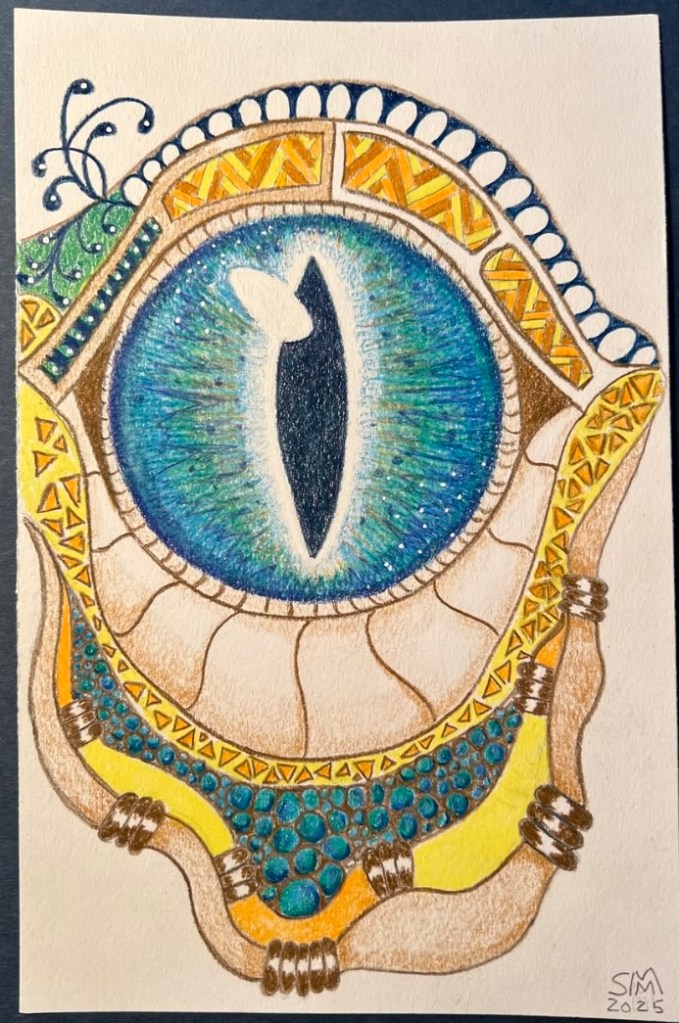
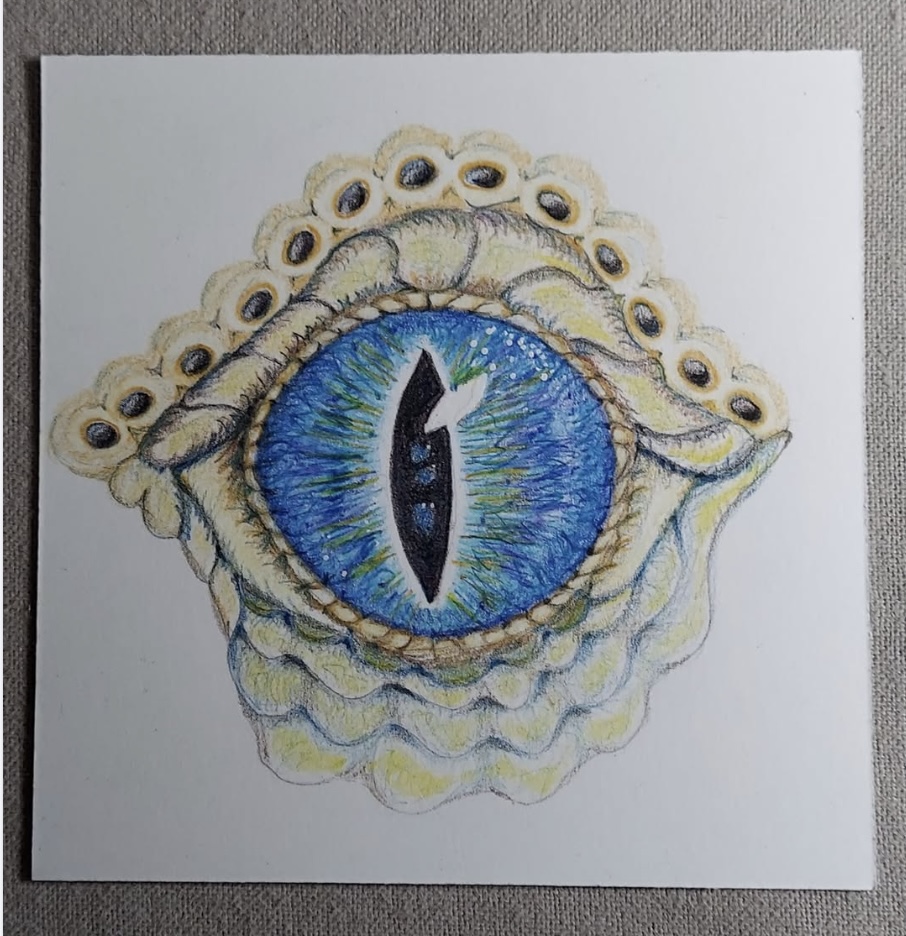
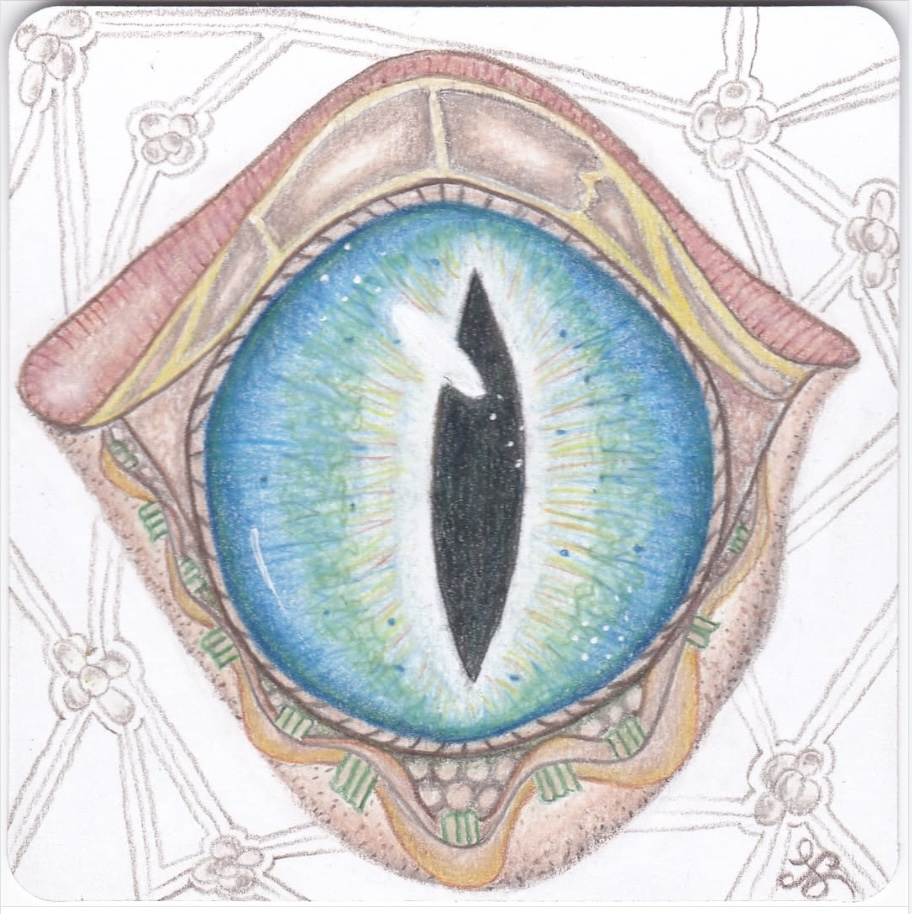
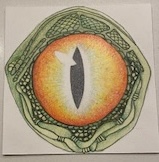
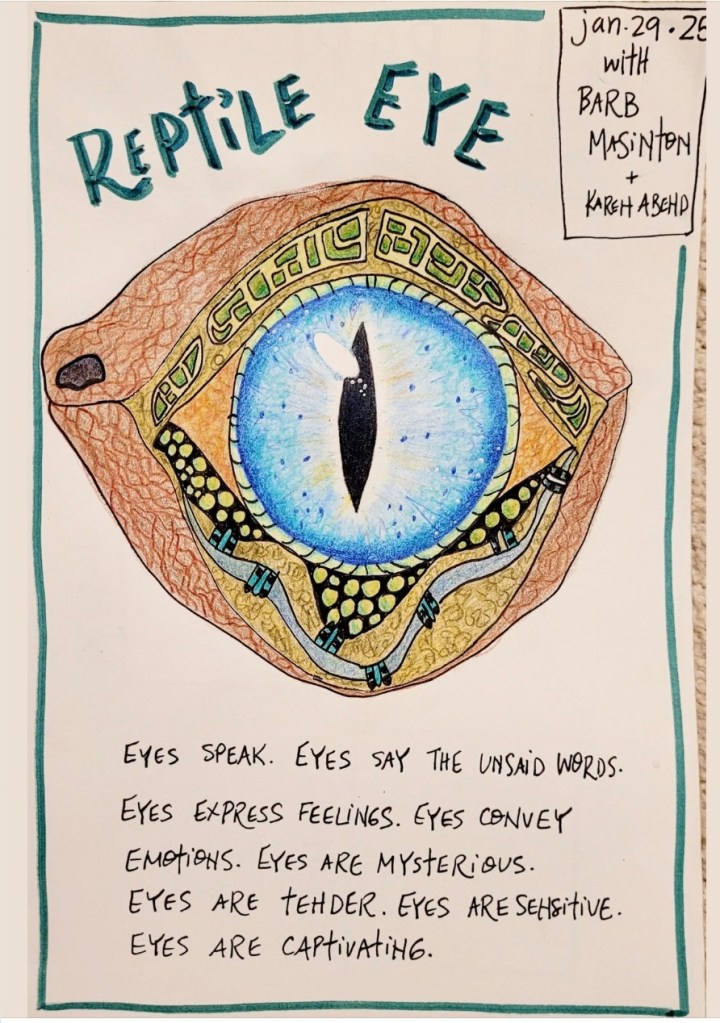
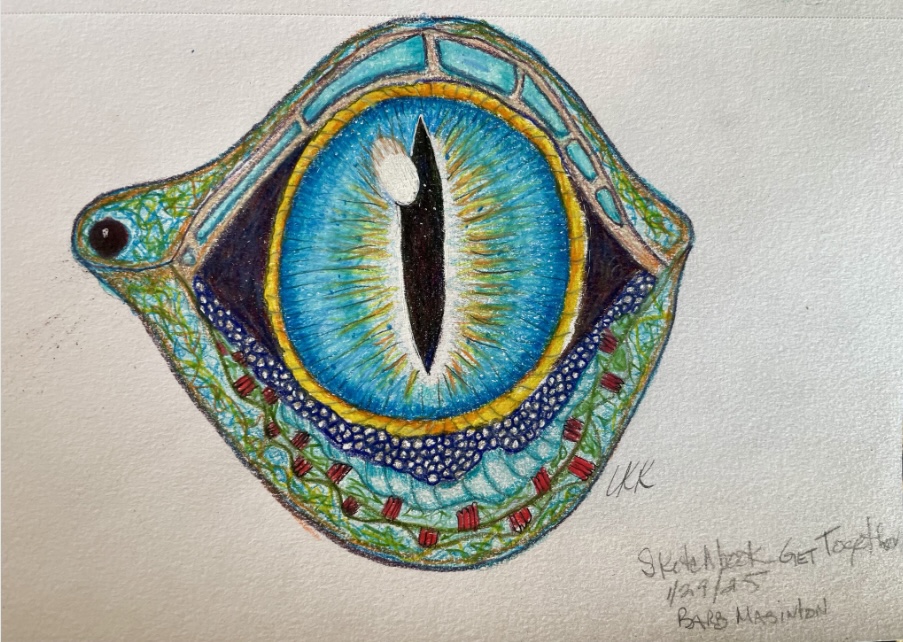
My recent webinar class, “Create a Colorful Reptile Eye1,” sponsored by Host Karen Abend (of Sketchbook Revival fame), generated many new subscribers to my web page and blog, “A Curious Nature.” Wow! And Thanks so much. A special thanks to those who attended the live and/or recorded class. I loved seeing so many colorful lizard eyes (a sampling below). They were incredible!
Sharing the Wonder of Nature
With all the past and current activity on my blog, I feel so fortunate and very encouraged to carry on. Even though new postings have been random lately, there’s lots of works-in-progress soon to be shared. Meanwhile, comments including what you like about my posts and what you’d like to see more of, are always appreciated. What inspired you to subscribe to this blog? If it’s just enjoy, that’s perfect! Or maybe you’d like tips to develop a regular or even a daily creative practice, how can I be more encouraging? I’d love to know if you are an active nature journaler or tangler, or express yourself by creating art in other ways, such as through music, poetry, or storytelling. Send me your ideas by commenting on this or any future posts. I’ve created my webpage and blog because of my insatiable curiosity about the natural world. It’s extraordinarily fun to go beyond learning what the names of flowers, animals, rocks, and clouds are. The excitement of wondering and discovering answers for all the why’s, who’s, when’s, and how’s is so rewarding. Sharing is my joy!
Explaining Kat
Thinking new subscribers may be puzzled by my constantly mentioning Flambé or Kat or both, now might be a good time for explanation and background (and perhaps provide a refresher for those who’ve been following along from day 1 of my blog):
In 2014, a young stray calico cat showed up one day on our doorstep when we (Roy and I) lived in Oriental, North Carolina (U.S.A.). This little wild miss seemed to magically appear from our backyard woods, perhaps in search of a meal or a friend. She sat and meowed for a few minutes, but when we opened the door, she ran away. Efforts to get close to her when she returned several times during the week were futile. Then one day she vanished and never returned. Not knowing what may have happened to this pretty kitty, Roy thought a nice remembrance of her visit would be to add a small cat sketch to my next drawing. A dandy idea!“But only one drawing,” I thought? It was at that moment that Flambé appeared on my creative doorstep, and has never left!
Flambé, aka Kat, is always smiling, popping in and out of all my art, regardless if the piece is imaginatively & whimsically tangled or a serious nature study. Along with forming the best part of my signature “chop,” she’s the heroine of some pretty wild and crazy tangled misadventures, sometimes pushing Kat’s 9-lives threshold to satisfy her insatiably curious nature (and appetite). Flambé adores being noticed, whether she hides inside the story, or shows up front and center. She makes everything creative more fun. Flambé may be just “Kat,” but she’s my inspiration for and reminder about the value of komic relief, and makes the perfect konstant kompanion!
Whew! That’s all for now. Hopefully your questions about this blog, inspiration and Kat have been answered. If you’re craving to learn answers to other related topics, let me know. Meanwhile, Flambé and I wish you an exciting and creative remainder of the year ….. have times full of happiness, creativity, and memorable adventures, but most of all laughter and fun!
Hope to hear from you soon, and as always, thanks for stopping by!
Meow!
1Unfortunately, the class or recording are no longer available for viewing. But I may have another live demo class some day in the future. If so, you can be sure the announcement will show up on my blog.
Come on along with us for 5 days of camping fun in the Land of Enchantment, where we had some weird and close encounters with botanical beauties, a bare-butted gopher, a swarm of bees, and voracious leaf-footed beetles! All this, and more while exploring a National Conservation Area, a Desert National Monument, and a New Mexico State Park, all within the Chihuahuan desert ecosystem.
The much anticipated finale, Snowbirds, and wrap-up to a grand anniversary week celebration in and around Tucson, AZ, follows!
Despite an unexpected snow the evening of our arrival, we never seemed to slow down, taking in as many sights and good eats as humanly possible. …… Open the full post for a recap of our week, and a bit about some of the birds we found while traveling around.
We totally get it! Why Mt. Lemmon is nicknamed “Tucson’s Great Escape.” Why the scenic highway is ”Cool!” From the Lower Sonoran Desert and the Tucson Valley (2,200 feet) to the upper reaches of a Spruce-Fir Forest (topping out at about 9,200 feet), the popular Scenic Highway up Mt. Lemmon offers breathtaking views, plants to discover, geology to learn, recreation opportunities, and temperatures often 30 degrees F lower than the desert below. That means a lot, especially when Tucson’s summer temps are in the triple digits!
But on the day of our driving adventure we found snow ….. on the highway, at scenic overlooks, and on walking trails. The storm hit 4 days earlier forcing closure of much of the highway. But on this day, most of the roads were clear and so was the sky.
So come along and learn what there’s to see along the Mt. Lemmon Scenic Highway.
We certainly enjoyed visiting Saguaro NP – East. Most of the Rincon Mountains Unit is wilderness and only accessible on foot; no dogs allowed. But the cactus Forest Loop Drive was scenic, with views of the Rincon Mountains to the East, and saguaro everywhere!
Really couldn’t seem to get enough saguaro! The highlights of this day were finding another crested saguaro while hiking an area Luna could enjoy, standing next to some shoulder high fishhook barrel cactus, and enjoying the Phainopeplas with their shimmery black feathers.
If you’re up for more saguaro botany, read on. This post will be dedicated to this largest of all North American cactus, Carnegieagigantea. (Beware. This post is long, so settle in!)

























 a curious nature