A Honey of a Prize!

Meet the Honeydew Gall-Wasp Gall

April 4, 2025

It’s Spring

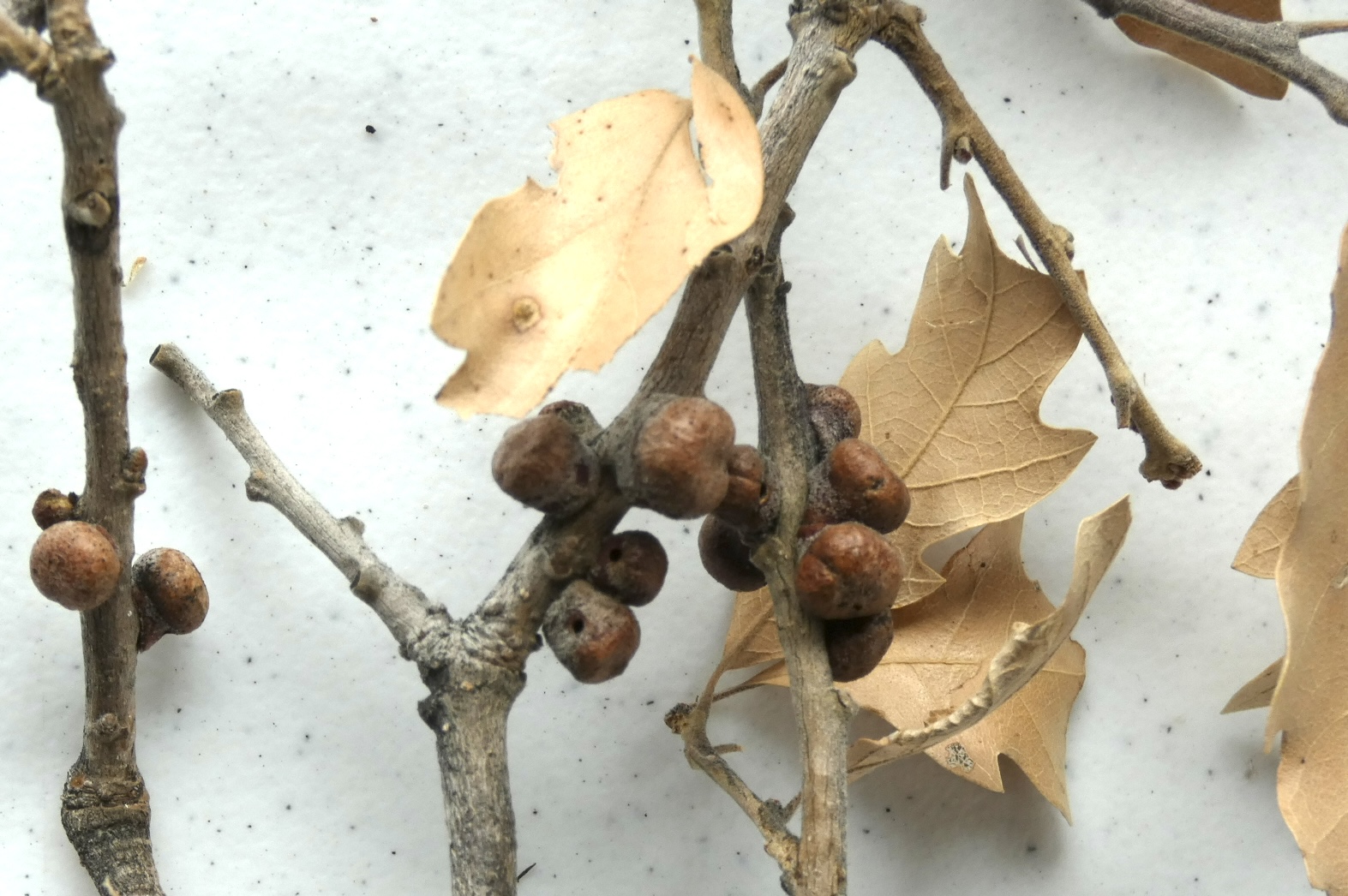
When the urge to nature journal is too hard to resist, but everything around you is still brown, crispy and covered in dust, I begin looking for any curious phenomena suitable for rabbit trailing (even rabbit tracks work!). The other day while hiking a steep hill, I was looking for sign the oaks were close to breaking bud. Spotting a string of little dark red beady objects lining many of the mostly leafless stems of am oak was certainly encouraging. From a distance they appeared to be swelling leaf buds; at least their color seemed right. But an up-close inspection revealed my hopeful find as last December’s vacated “homes” occupied by oak gall wasp larvae. Having never seen this species of stem gall before, naturally this would be a perfect most curious phenomenon to tackle. And that’s just what I did!

The Honeydew Gall-Wasp Gall

Arriving back home with a small collection of oak stems crowded with tightly packed galls (resembling miniature bread loaves), my work began. Assuming the host oak was a Gambel’s (Quercus gambelii), I began my search of stems galls on that species. Carefully scouring the literature the genus appeared to be Disholcaspis, but none of the species seemed a good match. So after many days in quandary, I consulted my favorite oak gall ID specialist, firing off a lot of questions, written descriptions and photos. Patiently awaiting his reply, I continued to find more resources to review. Gall wasps have a complex life cycle, and their galls are a challenge to identify. 

After 2 weeks a welcome reply arrived from the specialist.  Boy did I feel silly, knowing I should’ve known better! The oak host was not a Gambel’s but a cross between Gambel’s and Shrub Live Oak (Q. turbinella) which produces a hybrid called Wavyleaf oak (Quercus x undulata). Correcting my mistake was key to identifying the stem gall! Picky little wasps, huh? Happy the specialist agreed the genus is Disholcaspis, the obvious species responsible for the gall was turned out to be D. spissa; the Honeydew Gall-Wasp ….. making my discovery the Honeydew Gall-Wasp Gall!
Lesson Relearned  

When nature journaling, despite how excited you may be to find answers, it’s always, always best to slow down, breathe, carefully observe, ponder, question, make connections, and enjoy the journey ahead of the destination! 

Some Gall Descriptions and A Prize!

Outside appearance: Young galls of this wasp are yellowish and hairy. Mature galls have beige-brown to weathered grey sides, are black on top, and have a dull matte surface. They can have a round to ovoid to a rectangular ‘bread-loaf’ like shape. Texture appears mealy-granular. Galls sit snugly directly on the stems (sessile), and singly or in clusters of long compact chains that form all around the stems of host oak species. 

Inside the gall and back outside again: Each gall has one thin walled cell or chamber (known as monothalamous) that sits above the bottom of the gall. This is the larval chamber and is imbedded in dense cellular tissue that becomes a pulpy flesh with age. While the larvae are actively feeding and growing, they produce a copious amount of sticky-sweet honeydew that accumulates on the top of the gall. All of this honeydew attracts hordes of hungry ants and yellowjackets. The ecological importance of these secretions is unmistakeable; it provides a high energy food source for the insects. And while the ants and yellowjackets feed, they inadvertently protect the gall, like little bodyguards, from parasites and predators intent on infecting or eating the growing larvae inside. And another interesting ecological thing ….. the reason the tops of the galls are black and not the same color as their sides, has to do with a fungus called black sooty mold. The sugary secretions produced by the larvae accumulate in quantities too irresistible to the sooty mold. Colonies of the fungus develop rapidly on the honeydew giving the gall tops a dusty or powdery black color. So honeydew is the perfect medium for black sooty mold to complete its life cycle.

What about that Prize? Read on to learn more! Close-up inspection of the galls I collected, and there were about 25, revealed all but one had a single exit hole in a side just below its crusty red-black top. I learned the adult wasps emerge from these stem galls by late December; sometimes waiting for warmish temps until mid January. What happened to the adult wasps in the one gall without an exit hole? Because the gall had a sooty top, implying the larvae had been eating, growing and secreting honeydew, maybe the larvae died at some point or failed to develop into an adult? Had to know! Cutting the gall to find out wasn’t easy. The outer crust fell away first, then using steady knife pressure on the punky innards, the gall popped open, like a box of ‘Cracker Jacks!’ And there, near the bottom of the package, was a single sealed chamber. Carefully I was able to tease out the contents with fine pointed tweezers until out blurped the Prize! An intact cream colored gooey looking larvae, followed by a small puddle of viscous liquid. Even though the larvae filled up most of the chamber, there wasn’t any sign it was alive. And after an hour, when there still wasn’t any movement …. well, darn, I felt he must’ve died sometime before morphing into adult form. But peeking inside the gall did answer the question about the absence of an exterior exit hole.

And now an interesting note about these types of cynipid oak gall wasps: On my diagram, I used the term ‘agamic’ which is a formal label included with the genus/species name (i.e. Disholcaspis spissa ‘agamic’). This means these wasps have an asexual all female population that emerges from galls in late fall/early winter to lay fertilized eggs without needing to mate with males. Then a bisexual generation follows where adults emerge from galls in late winter/spring/early summer. This is the typical 2 generation annual life cycle of cynipid gall wasps, where the galls developed from each generation usually look very different and even occur on different parts of the host plant (on stems vs leaves). It’s interesting that nothing is known about the bisexual generation of D. spissa, but the asexual generation is common, well documented and abundant.

Known host oak species for D. spissa: Look for these galls on Shrub live oak (Quercus turbinella), Wavyleaf oak (Quercus x undulata), Mexican blue oak (Q. oblongifolia), Arizona white oak (Q. arizonica), and Shinnery oak (Q. havardi). 

******************************************************************************************

Hope you found my post interesting. Have you ever been curious enough about plant galls to look inside? Recalling the first time I saw a gall, I had no clue what it was and why it was precariously clinging to a plant leaf. It was round and hard, and reminded me of a tiny rusty red ping-pong ball. Was there something inside? Would it be squishy, alive, have teeth and bite, or perhaps whatever it was was dead and oh so smelly? Maybe it was some weird kind of flower bud, or a fruit lost under the leaf? Despite being a bit nervous, I needed to know what, if anything was inside. So I cut it in half, and in the center of the ball, suspended on hundreds of delicate threads, was a tiny, wormy creature twisting and turning and wriggling to music only it could hear! That was over 45 years ago, and to this day I still find galls irresistible!

As always, thanks for stopping by!

A Few References

Russo, Ronald A.: (2021) Plant Galls of the Western United States, section on tree galls; oak galls of the SW, page 173. 

Weld, LH: (1957) New American Cynipid Wasps From Oak Galls https://www.gallformers.org/gall/948

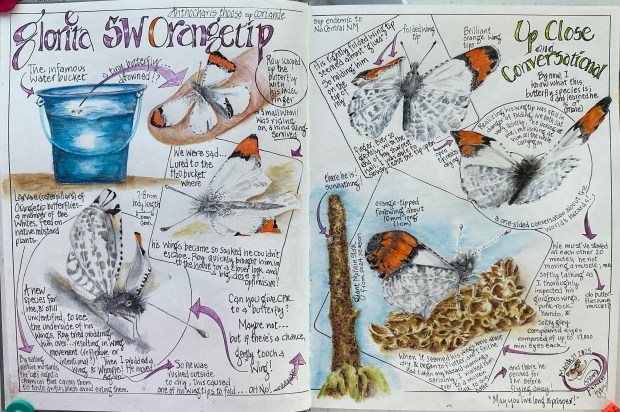
Up Close and Conversational .. ‘Glorieta’ Southwestern Orangetip Butterfly

April 2, 2025

New Mexico Orangetip butterflies

The ‘Glorieta’ Southwestern Orangetip (Anthocharis thoosa ssp coriande), are only known to occur in the central and north central counties of New Mexico. This recently recognized form of A. thoosa was described by M. Fisher and Scott in 2008, from specimens collected near Glorieta Pass southeast of Santa Fe1 (which just northeast of our home).

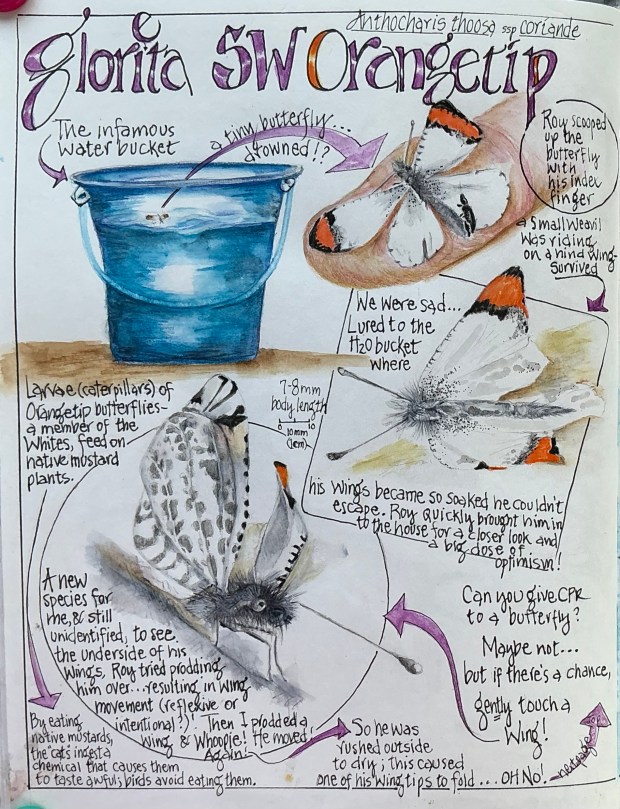
The Orangetips are classified in the Family Pieridae/Subfamily Pierinae ….. commonly called the Whites. In NM there are 16 known species of Whites, including the non-native European Cabbage White.  After a wet winter, plentiful males compete for hilltop display locations while females search surrounding areas for the choicest of native plants in the mustard family (Brassicaceae) on which to lay their eggs. When the eggs hatch, the larvae (caterpillars) voraciously devour the leaves of their host mustard plants, until they’ve grown to over 1,000 times in size!  Because this family of butterflies is common in desert habitats, to withstand drought conditions some species have the ability to suspend development during their pupal stage (when they are in their chrysalis), a mechanism called pupal diapause. And if winter rains do not cause favorable conditions for their larval hosts (the mustard plants), they can remain in pupal diapause for several years.   

The White’s preference for mustard plants may not be about taste. It’s thought that chemicals contained in these host plants make butterflies in this group unpalatable. Entomologist, “Mike Toliver has witnessed only one attack by a bird on members of this group in more than 60 years of observation.”1

1https://peecnature.org/butterflies-of-new-mexico/whites-pieridae-pierinae/

A Very Close Encounter

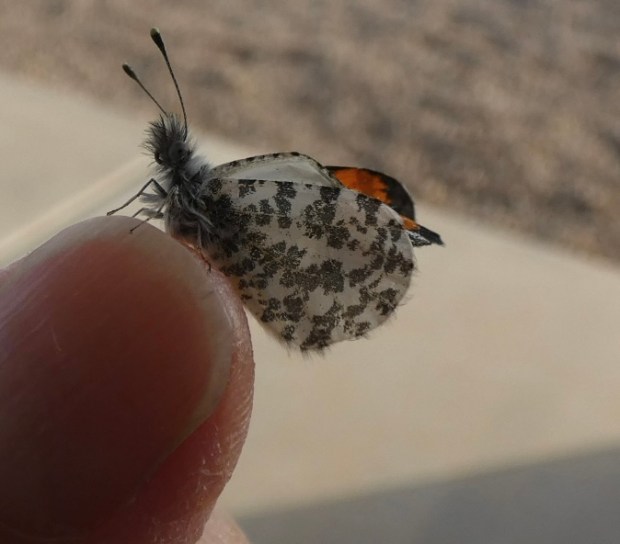
Early one morning (a few days ago), Roy discovered a miniature butterfly afloat, upside down, in a water bucket left outside overnight. Looking very drowned, Roy scooped him up with the tip of his index finger and brought him inside the house for my inspection. Excited and sad all at once, I snapped a few photos, having never seen this species before.  Because this little guy had such striking marks and color, finding him in the online New Mexico butterfly field guide was easy.  This beauty was a ‘Glorieta’ Southwestern Orangetip (Anthocharis thoosa ssp coriande)!

Roy was about to turn him over to take a look at the flip side when one of the wings fluttered a bit. Not believing our eyes, I gently prodded him, and sure enough! He seemed alive! But just how much alive we didn’t know.

Rushing this tiny guy outside where his wings might dry, he slowly became more active. Unfortunately the tip of a still damp forewing folded over and stuck like glue making it impossible to synchronize those wings  …. he didn’t seem remotely interested in taking flight. Not to be defeated, he then crawled up to the tip of my pinky finger, looked me in the eyes, raised one of his six legs politely asking for help. Gathering my courage and willing any clumsiness ‘be gone’ from my fingers, I held my breath while using the edge of my longest fingernail to slowly and carefully separate the fold. Taking my time to tease up the delicate tip millimeter by millimeter, this butterfly never moved a muscle (do butterflies have muscles?). After what seemed like hours the wing unfolded, popping back into alignment without any apparent damage! 

“The Talk”

He didn’t fly tho, so I sat with him for about 20 minutes as he perched on my finger. During my ultra close inspection of his eyes (you know I love eyes, and his were sultry grey and gorgeous), punk-rock style hairdo, and brilliant orange tipped wings, he seemed content while I carried on a lengthy one-sided conversation warning him of the world’s dangers. 

Somewhat convinced he believed and would abide by my every word, I walked him over to a large mullein stalk, where he walked off my finger to enjoy a sunbath (hopefully to prepare to take wing). He wasn’t in much of a hurry tho. About an hour later and checking to see if the coast was clear, off he flew.  That beautiful Glorieta Southwestern Orangetip butterfly was free!

All-in-all, it was an exciting encounter! 

What exciting encounters are you experiencing during this change of seasons? 

As always, thanks for stopping by!

Welcome New and Returning Subscribers

Many Hearty Thanks, Sharing Creative Ideas, Answering the ‘Kat’ Kwestion

April 1, 2025

Completing my 15th sketchbook, and beginning the next one is always cause for celebration!  To do so, Kat and I thought it would be especially fitting to shout-from-the-treetops enthusiastically, THANK YOU! Thank you all, my loyal subscribers, for coming along on my interesting, hopefully educational, sometimes crazy, always curious nature journaling adventure. 

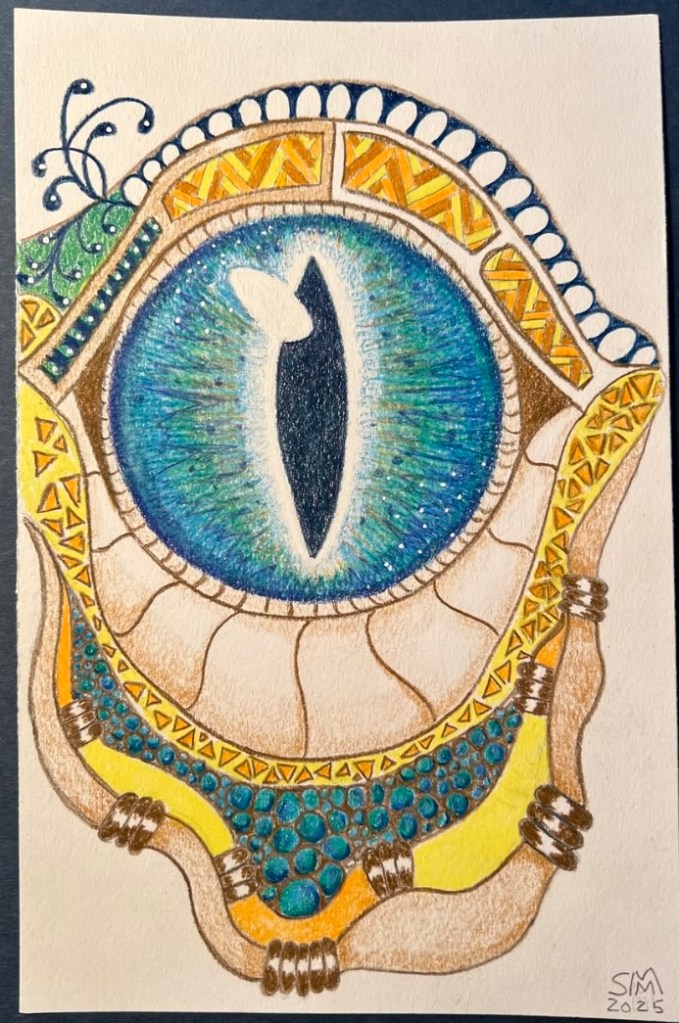
Zentangle patterns used: LoveBuzz, Membranart, Frostz, Chatoo, Sea Urchin, Toku, Rosie, Calibree

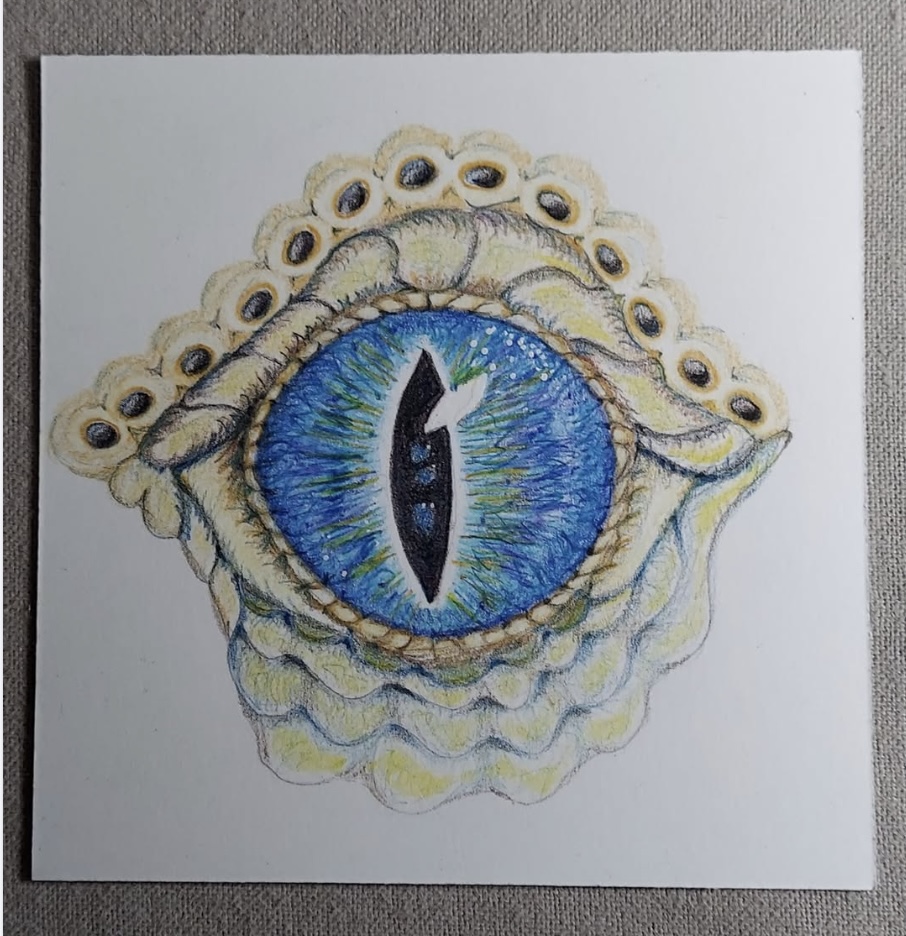
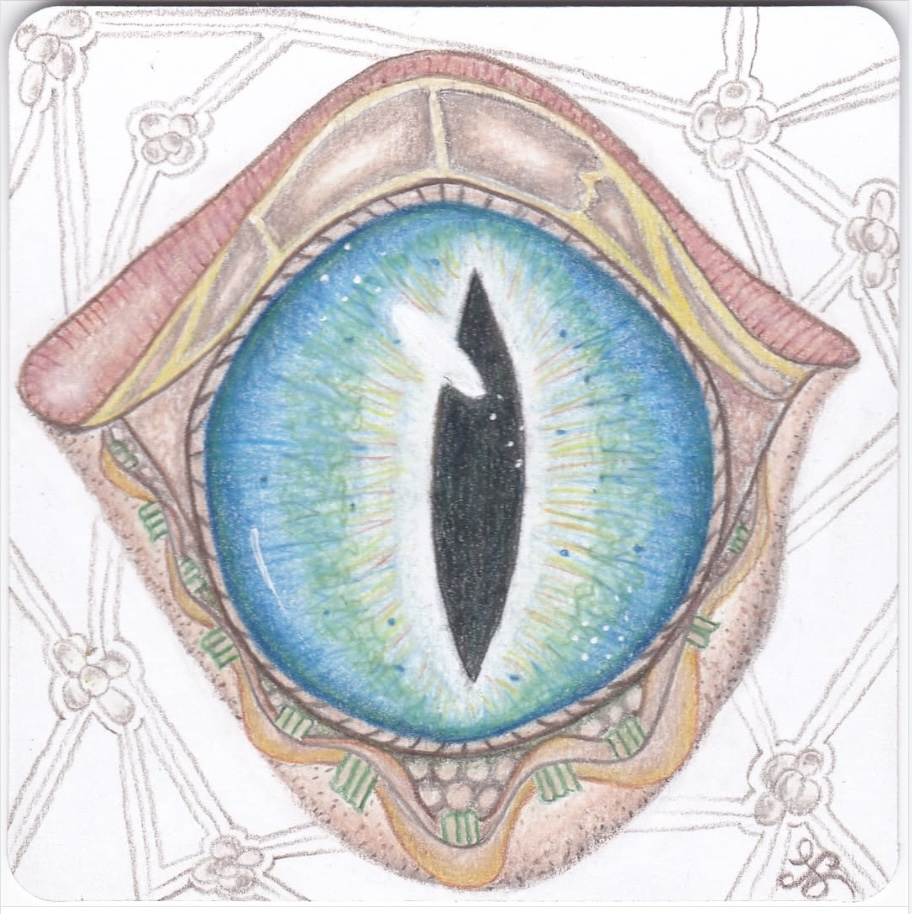
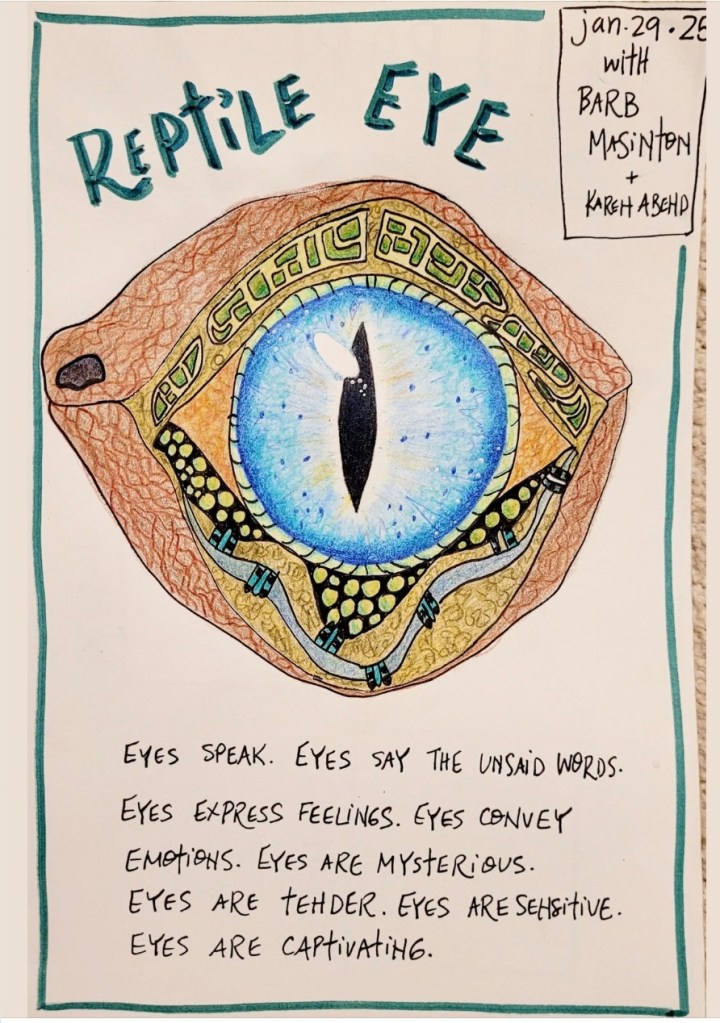
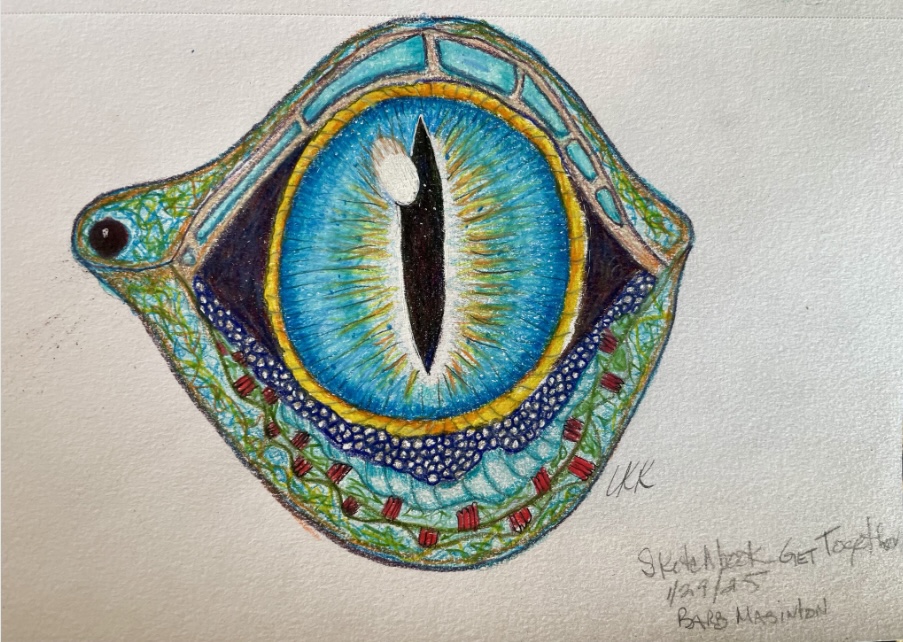
My recent webinar class, “Create a Colorful Reptile Eye1,” sponsored by Host Karen Abend (of Sketchbook Revival fame), generated many new subscribers to my web page and blog, “A Curious Nature.” Wow! And Thanks so much. A special thanks to those who attended the live and/or recorded class. I loved seeing so many colorful lizard eyes (a sampling below). They were incredible! 

Sharing the Wonder of Nature

With all the past and current activity on my blog, I feel so fortunate and very encouraged to carry on. Even though new postings have been random lately, there’s lots of works-in-progress soon to be shared. Meanwhile, comments including what you like about my posts and what you’d like to see more of, are always appreciated.  What inspired you to subscribe to this blog? If it’s just enjoy, that’s perfect! Or maybe you’d like tips to develop a regular or even a daily creative practice, how can I be more encouraging? I’d love to know if you are an active nature journaler or tangler, or express yourself by creating art in other ways, such as through music, poetry, or storytelling. Send me your ideas by commenting on this or any future posts. I’ve created my webpage and blog because of my insatiable curiosity about the natural world. It’s extraordinarily fun to go beyond learning what the names of flowers, animals, rocks, and clouds are. The excitement of wondering and discovering answers for all the why’s, who’s, when’s, and how’s is so rewarding. Sharing is my joy!

Explaining Kat

Thinking new subscribers may be puzzled by my constantly mentioning Flambé or Kat or both, now might be a good time for explanation and background (and perhaps provide a refresher for those who’ve been following along from day 1 of my blog):

In 2014, a young stray calico cat showed up one day on our doorstep when we (Roy and I) lived in Oriental, North Carolina (U.S.A.). This little wild miss seemed to magically appear from our backyard woods, perhaps in search of a meal or a friend. She sat and meowed for a few minutes, but when we opened the door, she ran away.  Efforts to get close to her when she returned several times during the week were futile. Then one day she vanished and never returned. Not knowing what may have happened to this pretty kitty, Roy thought a nice remembrance of her visit would be to add a small cat sketch to my next drawing. A dandy idea!“But only one drawing,” I thought? It was at that moment that Flambé appeared on my creative doorstep, and has never left!

Flambé, aka Kat, is always smiling, popping in and out of all my art, regardless if the piece is imaginatively & whimsically tangled or a serious nature study. Along with forming the best part of my signature “chop,” she’s the heroine of some pretty wild and crazy tangled misadventures, sometimes pushing Kat’s 9-lives threshold to satisfy her insatiably curious nature (and appetite). Flambé adores being noticed, whether she hides inside the story, or shows up front and center. She makes everything creative more fun.  Flambé may be just “Kat,” but she’s my inspiration for and reminder about the value of komic relief, and makes the perfect konstant kompanion!  

Whew! That’s all for now. Hopefully your questions about this blog, inspiration and Kat have been answered. If you’re craving to learn answers to other related topics, let me know.  Meanwhile, Flambé and I wish you an exciting and creative remainder of the year ….. have times full of happiness, creativity, and memorable adventures, but most of all laughter and fun!

Hope to hear from you soon, and as always, thanks for stopping by!   

Meow!

1Unfortunately, the class or recording are no longer available for viewing. But I may have another live demo class some day in the future.  If so, you can be sure the announcement will show up on my blog.

“The Felix” 2023: Escapito #1


Come on along with us for 5 days of camping fun in the Land of Enchantment, where we had some weird and close encounters with botanical beauties, a bare-butted gopher, a swarm of bees, and voracious leaf-footed beetles! All this, and more while exploring a National Conservation Area, a Desert National Monument, and a New Mexico State Park, all within the Chihuahuan desert ecosystem.

Continue reading ““The Felix” 2023: Escapito #1”

A Festive Anniversary Week in the Sonoran Desert. Part 7: Snowbirds

December 11-17, 2022

The much anticipated finale, Snowbirds, and wrap-up to a grand anniversary week celebration in and around Tucson, AZ, follows!

Despite an unexpected snow the evening of our arrival, we never seemed to slow down, taking in as many sights and good eats as humanly possible. …… Open the full post for a recap of our week, and a bit about some of the birds we found while traveling around.

Continue reading “A Festive Anniversary Week in the Sonoran Desert. Part 7: Snowbirds”

A Festive Anniversary Week in the Sonoran Desert. Part 6: Mt. Lemmon  – Tucson’s Majestic Backdrop and a Cool Summer Retreat

(December 11-17, 2022)

December 16, 2022

We totally get it! Why Mt. Lemmon is nicknamed “Tucson’s Great Escape.” Why the scenic highway is ”Cool!”  From the Lower Sonoran Desert and the Tucson Valley (2,200 feet) to the upper reaches of a Spruce-Fir Forest (topping out at about 9,200 feet), the popular Scenic Highway up Mt. Lemmon offers breathtaking views, plants to discover, geology to learn, recreation opportunities, and temperatures often 30 degrees F lower than the desert below. That means a lot, especially when Tucson’s summer temps are in the triple digits! 

But on the day of our driving adventure we found snow ….. on the highway, at scenic overlooks, and on walking trails.  The storm hit 4 days earlier forcing closure of much of the highway. But on this day, most of the roads were clear and so was the sky.

So come along and learn what there’s to see along the Mt. Lemmon Scenic Highway.

Continue reading “A Festive Anniversary Week in the Sonoran Desert. Part 6: Mt. Lemmon  – Tucson’s Majestic Backdrop and a Cool Summer Retreat”

A Festive Anniversary Week in the Sonoran Desert. Part 5: Saguaro National Park – East, Rincon Mountains Unit; All saguaro, all the time!

(December 11-17, 2022)

December 14, 2022

We certainly enjoyed visiting Saguaro NP – East. Most of the Rincon Mountains Unit is wilderness and only accessible on foot; no dogs allowed.  But the cactus Forest Loop Drive was scenic, with views of the Rincon Mountains to the East, and saguaro everywhere!

Really couldn’t seem to get enough saguaro! The highlights of this day were finding another crested saguaro while hiking an area Luna could enjoy, standing next to some shoulder high fishhook barrel cactus, and enjoying the Phainopeplas with their shimmery black feathers.

If you’re up for more saguaro botany, read on.  This post will be dedicated to this largest of all North American cactus, Carnegiea gigantea. (Beware. This post is long, so settle in!)

Continue reading “A Festive Anniversary Week in the Sonoran Desert. Part 5: Saguaro National Park – East, Rincon Mountains Unit; All saguaro, all the time!”

A Festive Anniversary Week in the Sonoran Desert. Part 4: King of Cowboys, Casa Grande Ruins, the Hohokam, and One Very Weird Fungus

(December 11-17, 2022)

December 13, 2022

This day we explored areas as far as 50 miles north of la Casita. Following the old highway between Tucson and Phoenix, we first came upon a roadside rest area and memorial to the legendary cowboy, Tom Mix, who died at this spot 83 years ago. Tom who?  Of course we had to stop and learn more about this interesting bit of history.  

Then on to Casa Grande Ruins National Monument where history dates back more than 1700 years, well before the first Spanish explorers showed up, exploring. Even Luna was permitted to wander around this cultural monument, but we may have appreciated the stories surrounding the Hohokam more than she did.  

Then to complete our tour for the day, we came upon a lonely ranch road on the way back to la Casita, where the saguaro stood tall over countless cholla, barrel cactus, iron trees and palo verde.  It was here, in the middle of “where-are-we-now?” that I peered under a creosote bush and found the weirdest puffball fungus ever.

Read on for a snapshot of our day.

Continue reading “A Festive Anniversary Week in the Sonoran Desert. Part 4: King of Cowboys, Casa Grande Ruins, the Hohokam, and One Very Weird Fungus”

A Festive Anniversary Week in the Sonoran Desert. Part 3: The Map of Adventure

(December 11-17, 2022)

Before getting too far ahead of myself, I thought it would be a dandy idea to build a map of the circles we traveled in and around Tucson.  This will not only aide those of you who are following along on our travels to see just where all these places are, but it helped me relive the week and will refresh my memory in years to come when browsing my journals.

Read on to view our trip highlights, and see just where all those parks, monuments, and mountains are found, and where to go to soak up the flora and fauna unique to the Sonoran Desert.  Also, this map gives you a sneak peak of journal posts to come.

Continue reading “A Festive Anniversary Week in the Sonoran Desert. Part 3: The Map of Adventure”

A Festive Anniversary Week in the Sonoran Desert. Part 2: Saguaro National Park West – Tucson Mountain District

(December 11-17, 2022)

December 12th! Happy Anniversary!

We woke early and excited, ready to explore. But wait! We woke to snow! What? Snow in Tucson?!!!  Not unheard of, but a surprise-for-us coating of fluffy white covering everything. No matter ….. we changed out of our shorts, donned long pants and heavy coats and set off from la Casita south, towards Tucson and Saguaro NP West, the Tucson Mountain District.

Come along and see what we discovered this day in the Sonoran Desert!

Continue reading “A Festive Anniversary Week in the Sonoran Desert. Part 2: Saguaro National Park West – Tucson Mountain District”