One of my virtues is impatience ……. when it comes to Spring ….. and its arrival ….. finally.
Admittedly, winter has its perks. After a long, hot summer and fall, winter’s crisp air is a mood lifter, and cooler air temps allow for cozy sleeping under piles of blankets. Longer nights mean my favorite constellations hang in the sky longer, and somehow the moon always seems brighter and friendlier. In New Mexico, winter hiking about is more casual without having to watch every step for rattlesnakes, and certainly any snowfall we’ve been fortunate enough to get helps recharge water tables, tempers our risk of wildfire, and is absolutely beautiful to watch while falling.
But ….. since Winter Solstice and with daytime hours lengthening, I’m ready for Spring. And the closer it gets, my impatience for the upcoming change in season is obvious. My nature journal, pencils and 10x magnifying loop are packed and ready, each daily hike begins by plucking from a yucca one of last year’s flower stalks to poke the ground for signs of growth, and I’m anxious to snap photos of any passing migrating bird or resident roadrunner in search of a perfect nesting spot.
Meanwhile, I’m thankful for my late winter attack of impatience, because it get’s me out there every day, in anticipation of the first flower bud!
Today is the second Monday in October ….. a day to pause and honor the deep roots, rich cultures, and enduring spirit of the first peoples of this land. Native American Day celebrates the history, contributions, and resilience of Native American tribes all across the nation.
Yesteryears
Native American Day honors all Native Americans. South Dakota led the way, officially changing Columbus Day to Native American Day in 1990 after a “Year of Reconciliation” was declared by Governor George S. Mickelson. California soon followed. In recent years, the movement has gained national momentum. Many states and cities have chosen to celebrate Indigenous Peoples’ Day on the same date. Then in 2021, President Joseph Biden issued the first-ever presidential proclamation for National Indigenous Peoples’ Day, marking a significant step in acknowledging and respecting the history and contributions of America’s first inhabitants.
Celebrating the second Monday in October is more than acknowledging the past ….. it’s a day to recognize the living cultures that continue to enrich our country’s tapestry. It’s an opportunity to move beyond stereotypes and learn about the diverse traditions, languages, and stories that have shaped this continent for millennia. Native American Day also highlights the efforts to revitalize and preserve hundreds of indigenous languages, each one a unique expression of culture and knowledge. When we celebrate Native American Day, we celebrate the incredible diversity of traditions. Instead of a single culture, there are hundreds of distinct nations, each with its own unique customs.
Storytelling and Art Making
Native Americans have a powerful storytelling tradition of oral history, where foundational stories, lessons, and legacies were and still are passed down through generations. Many of these stories of life and culture are told through artwork, from ancient pictographs (rock paintings) and petroglyphs (images cut into rocks by pecking, incising or abrading) created by the indigenous peoples that lived throughout America, the intricate beadwork of the Plains tribes, the iconic pottery of the Pueblo peoples of the Southwest, to contemporary painting and sculpture. Native art is a cornerstone of American culture.
New Mexico Rock Art
Images painted on and carved into rock that were used in ancient storytelling can be found throughout my home state of New Mexico. Many of these sites are protected and preserved by federal designation as National historic landmarks, National Parks, and by the Bureau of Land Management as Areas of Critical Environmental Concern, and as a significant part of our Archaeological heritage.
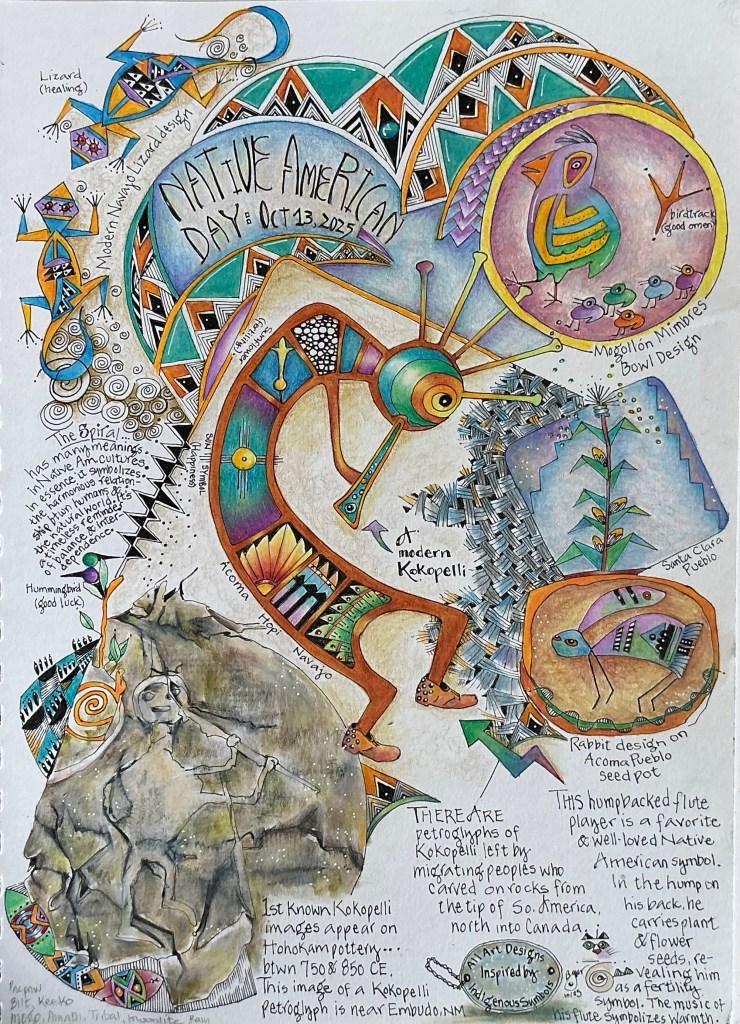
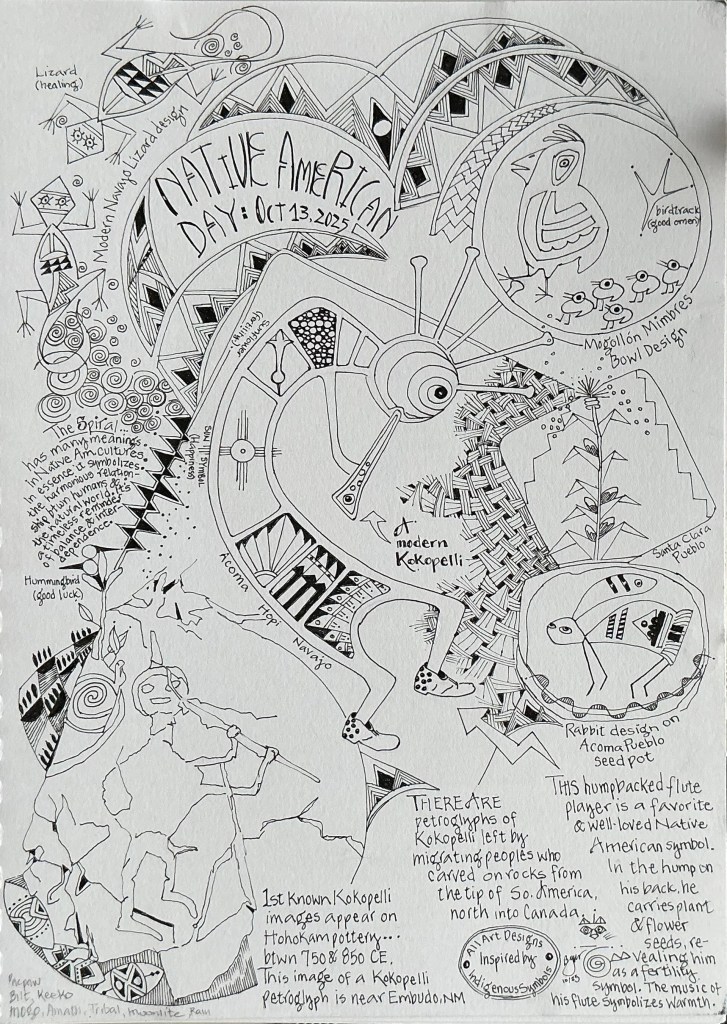
Traditional cultures and customs continue to fascinate me, and in “drawing” attention to the important contribution rock art has and continues to play, I wished to shared some of the designs (symbols) created by Native American tribes indigenous to the 4-corners region of the Southwest, with focus on those found in New Mexico. The Kokopelli symbol, the dancing flute player, is a familiar and favorite character throughout the area and has many meanings tied to fertility and harvest. The symbol depicted shows Kokopelli with a hump in his back where he carries seeds ready for planting, while he plays his flute, a symbol of warmth. He also carries a sunflower disk flower (the ‘complete’ inflorescence) to display fertility, the Sun symbol for happiness, and several crop symbols designed by the Acoma, Hopi, and Navajo.
A Kokopelli created in 2017 … on toned grey paper and colored with Prismacolors
The very first known Kokopelli images appeared on ancient Hohokam pottery, dating from between 850 and 750 C.E. The drawing of the Kokopelli petroglyph, in the bottom left of my panel, is inspired by one of these first images that was discovered near Embudo, NM.
Ideas to Celebrate Native American Day ….. Learn, listen and engage by …..
.…. reading a book by a Native American author, such as Louise Erdrich, Sherman Alexie or Tommy Orange,
….. exploring a museum or a state historic site to learn firsthand about the lives and history of the region’s tribes,
….. purchasing authentic arts, crafts, and goods from Native artists, which directly supports and helps preserve their cultural practices,
….. attending one of many community- or university-hosted talks, film screenings, or celebrations such as a powwow
Part 3 ….. An Allelopath Declares Chemical Warfare
August 15, 2025
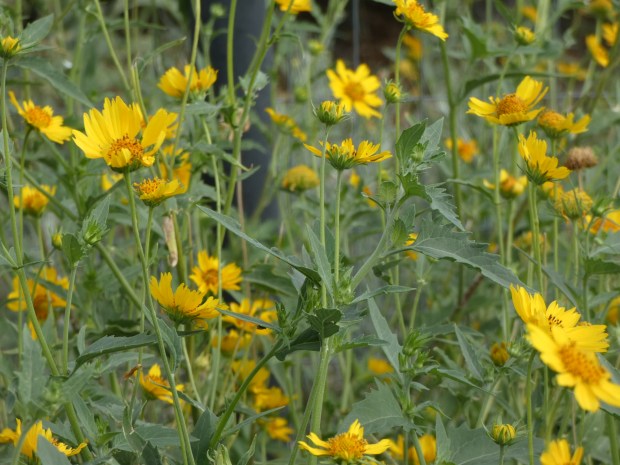
The more I learn about Cowpen Daisy (Verbesinaencelioides), the more the words Intrepid (fearless and bold), Interloping (meddlesome and smothering), and Impertinent (pushy and rude) come to mind.
Cowpen Daisy is literally a plant at war …..
Its adversaries are neighboring plants …..
Its weapons of choice are chemicals ….. 151 different Allelochemicals2 to be exact.
Cowpen Daisy shows no mercy to its most susceptible victims, and given the right conditions in the right locations, Cowpen Daisy can cripple ecosystems, and unravel biodiversity.
Oh No! What Have I Done! Have I unleashed a formidable enemy to run amok, bullying its way through our mostly intact biodiverse high desert ecosystem?
Maybe not! (Spoiler alert…… Allelopathy3can be bad, but I still love this happy Daisy)
On August 6th, I received an excellent question from one of my blog followers, based on my first Cowpen Daisy post :
“Do you have any concerns about this becoming an invasive plant? Best wishes, Nancy”
In reply, I expressed my concern about the number of “seedlings coming up late spring,” and how “I was definitely alarmed and wondered about the need for early control.” Fortunately, “as the season advanced, it became clear the density of plants seemed self-controlling.” Based on my limited experience with Cowpen Daisy, I explained how during the summer of 2023 “the plant completely covered an extremely large field near our home,” causing me concern about its invasive tendencies. But upon “[R]eturning the following year (2024) and again this past spring (2025) to see if the same field was blanketed again in these plants, “I couldn’t find a single Cowpen Daisy anywhere! So no, this annual [doesn’t appear to be] “invasive, at least not in central New Mexico.”
But Nancy’s question prompted me to dig deeper into on-line research. I wondered: Is Cowpen Daisy invasive outside of its native range, particularly where conditions are ideal for its aggressive growth? Yes, it is! And its invasiveness is further enhanced where neighboring plants are susceptible to the impacts of the allelochemicals released by Cowpen Daisy’s leaves, roots and decaying leaf matter in the soil.
One example where Cowpen Daisy is an introduced species and has become invasive is in India. Fields of mung bean, corn, chickpeas, and sweet melon are being outcompeted by invasive stands of Cowpen Daisies. These food crops are severely impacted by two allelochemicals released by the both roots and leaves of the Daisy; steroids and phenols. Studies of these four crops demonstrated not only “the suppression of germination and growth in these plants” but “also revealed an antagonistic effect on [their] chlorophylls, carotenoids and protein levels.” In other words, Cowpen Daisy is winning the war against India’s mung bean, corn, chickpea and melon crops, and farmers are currently engaged in a battle to develop a strategy of control and run this biological enemy out of their country.
Cowpen Daisy is only considered a native species to the Southwest U.S. and Northern Mexico. However, it has been introduced (either intentionally or by accident) and is considered naturalized in parts of Eastern North America, the Middle East, Spain, Argentina, Australia and the Pacific islands. As such, Cowpen Daisy’s nature to drop allelochemicals everywhere it grows allows it to behave like an invasive plant in countries where it is naturalized. Without diligent management (via herbicide application or mechanical control), it can thrive to the detriment of their desirable plant species’ survival.
Have I defeated my goal of reestablishing a diverse native plant community in disturbed areas surrounding our new home? “Not likely,” says I, optimistically! In addition to Cowpen Daisy, the variety of native plant species I intentionally seeded last fall and early this past spring, have germinated, grown, flowered and seeded or are in the process of flowering and seeding, most of which are adjacent to a Daisy. Of course time will tell. Meanwhile, I’ve declared this to be a happy ending to this post and my stand of happy Cowpen Daisies! However ……. next spring, if germination rates from my reseeders are low or zero, but Cowpen Daisy returns with renewed vigor, then I have a control job waiting for me. And the best advice I’ve read is to “pull out old plants and roots and selectively remove new seedlings.” That’s acceptable! That I can do!
Until then!
Do you struggle with weedy, invasive plant species in your garden or yard? Have you seen fields of blooming weeds and wondered …… “what weed is that?” Do you know the names of those pesty plants and do they seem to keep your favorite variety of cucumbers from growing? It might be interesting to learn if your local invasives are one of the many Allelopaths happily growing in our world! Let me know!
As always, thanks for dropping by!
1Cowpen Daisy is known to release up to 15 different allelochemicals2 from its leaves and roots, such as guanidine, phytosterols, phenolic acids, tripertenes, flavonoids, dicarboxylic acids, phytophenols, steroids, phenols, and others. Fresh and decaying leaf litter leach 14 of those allelochemicals into the soil.
2,3Allelopathy is a biological phenomenon by which an organism produces one or more biochemicals that influence the germination, growth, survival, and reproduction of other organisms. These biochemicals are known as allelochemicals and can have beneficial (positive allelopathy) or detrimental (negative allelopathy) effects on the target organisms and the community. Allelopathy is often used narrowly to describe chemically-mediated competition between plants. Allelopathic interactions are an important factor in determining species distribution and abundance within plant communities, and are also thought to be important in the success of many invasive plants. (source: Wikipedia)
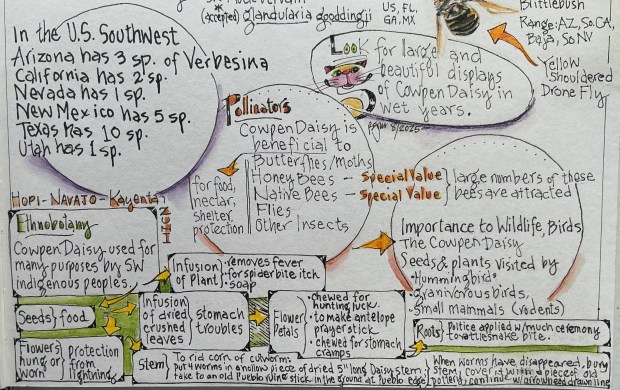
While compiling last week’s post about the happy Cowpen Daisy party taking place outside our back door, it was no surprise to find way more interesting info about this sunflower than could ever fit on my journal page. Decisions …… decisions! To keep the August 5th illustrated page relatively uncluttered, I decided to include just the botanical basics (mostly), focusing on Cowpen Daisy flowers, leaves and seeds.
Then the past week I found my nature journal wide open to a blank page, ‘begging me’ for another Cowpen Daisy entry ….. “What about all those interesting info bits?” she asked. Replying* to my journal with a hearty, “OK,” I proceeded to locate and gather my rabbit-trailing notes. This scavenger hunt reminded me just how many pages there were; so many fascinating things about the Cowpen Daisy I wanted to remember and share. Decisions …… decisions! How to keep this next post to one page? By limiting the topics to only three, was it possible?
Barely! (after some clever editing, not a single word dropped off the page)
A little bit closer view for those without a microscope!
P.S. By the way, you may have noticed I’ve indicated this post is Part 2 of what’s now become my Cowpen Daisy series. Unless I start journaling on larger than 8” x 11” paper, there’s likely to be more Parts in store. And this multi-part series resulted in a minor edit to last week’s post, not titled “One of the Happiest Sunflowers Ever! The Cowpen Daisy; Part 1 ….. Can There Be Too Many Sunflowers?” In case you missed it, please check it out here.
*Yes, you read that right; I talk with my nature journals. Don’t you? After all, we do spend quite a bit of time together!
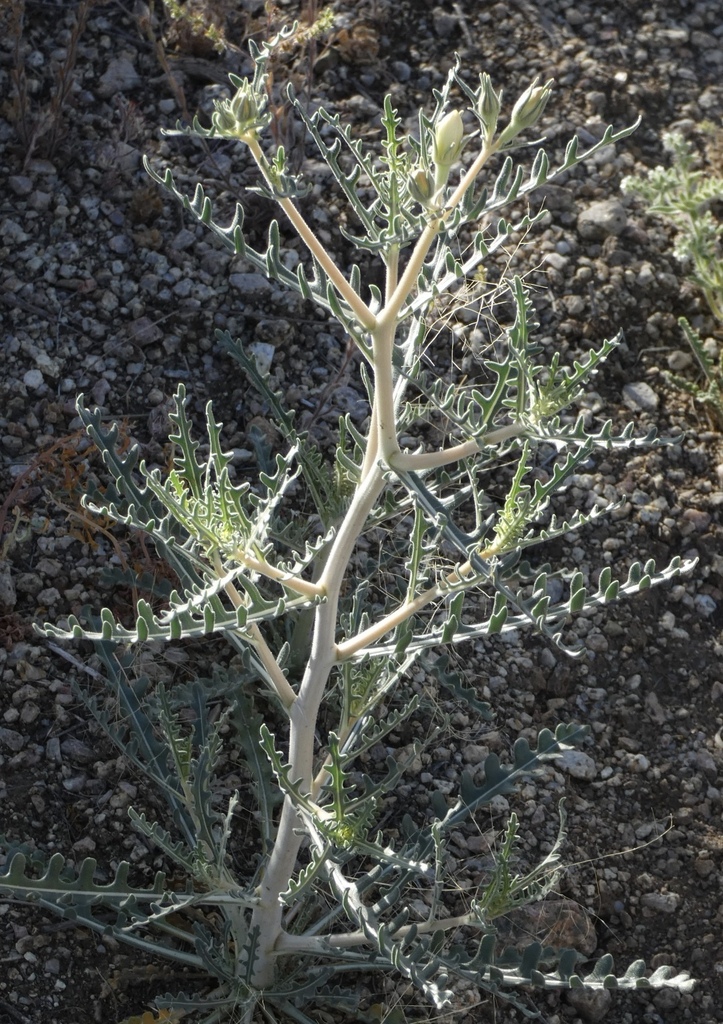
You must awake when the first rooster crows to enjoy the floral beauty of a fully flaired Blazingstar blossom. Appropriately named, these gorgeous flowers display a radiant combination of spoon-shaped petals, petal-like stamens, and hundreds of thread-like stamens, all colored in bold sulfur yellows, distinctive pale orange-yellows, brilliant star whites, or fluorescent blues, based on species. These superbly showy flowers unfurl overnight atop tall white, branching stems that resemble candelabras with narrow lobed green leaves. These large, 2” diameter flowers belong to the Mentzelia genus, plants that are all native to the Americas, and represented by 60-80 species, most found in the desert southwest.
In 1753, Carl Linneaus gave this plant its genus name, Mentzelia, after German botanist and sinologist Christian Mentzel. (Did you know a Sinologist is a specialist in the study of Chinese language, literature, and civilization? Huh!) But perhaps more fascinating and what’s always ‘captured’ my complete attention (and blue jeans) is that the Mentzelia genus fits perfectly in the Loasaceae family ….. commonly referred to as the Stickleafs.
About those leaves ……
Being primarily a day-time hiker, my first encounter with a Blazingstar occurred simultaneously with a misstep into the plant. Noticing some resistance in making my escape, I looked down at the ground and discovered my jeans had a collection of stuck leaves from my boots on up. And the leaves were really stuck tight along their entire length! Removing those leaves was like peeling a banana, only tougher. Wait! Forget the banana peel. Removing those sticky leaves sounded like and felt like tugging on and separating Velcro! I was reminded of the familiar ‘ripping’ noise made when Velcro hooks are forcibly released from their loops!
Eureka!!
Nature is full of surprises. Were the Stickleafs the source of accidental inspiration for today’s handy hook-n-loop fastener, called Velcro? Almost, but not quite! As it turns out, the tiny hooks on Cocklebur seedpods inspired a Swiss engineer to develop Velcro in 1941. But not to change subjects too much …….The reasons Stickleafs could’ve been the inspiration for Velcro, is similar to the Cocklebur story, but, I think, even better. Here’s why ……
The seedpods of both plants have tiny hooks that readily adhere to clothing and fur. And it was the hooks’ tenacity for stick-to-it-tiv-ness that grew the original Velcro idea. But Stickleafs go even further in ‘reinforcing’ the fastener concept. Not only does the seed pod (capsule) of Stickleafs have a covering of tiny hooks, but both leaf surfaces and even the stems of plants in this family can have multiple types of minuscule grappling-hooks and barbed needles, called Trichomes, visible only with an electron microscope. I summarize that if the Swiss engineer was visiting America in 1941, and had the good fortune to walk into a Mentzelia plant, he undoubtedly would’ve been super inspired to develop Velcro. After all, it’s the leaves that stick fast to clothing, resemble a strip of Velcro, and hold tight, mimicking an ideal hook-n-loop fastener.
Hooked on Trichomes
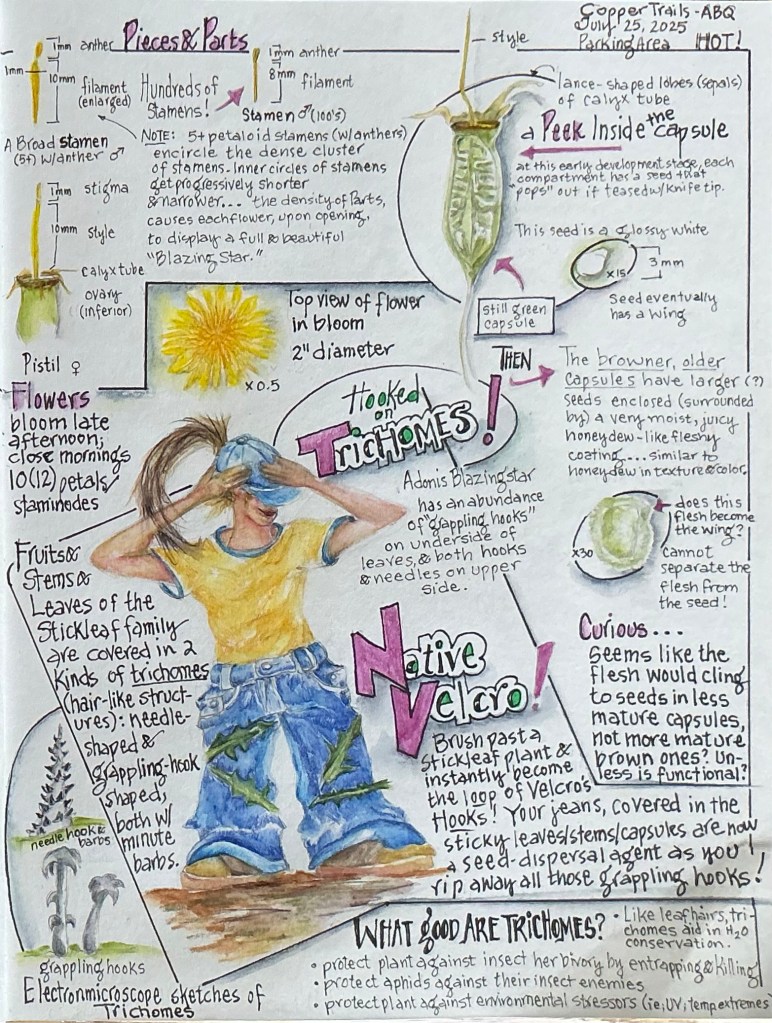
And now for the curious nature of the Mentzelia genus. When coming across the Adonis Blazingstar (Mentzeliamultiflora) over the past 8 years, it’s been fun to inspect the leaves, remove one and intentionally stick it to Roy’s jeans or mine. I’ve then wondered how this plant ‘sticks’ so well, and why. The time for answers arrived this month, and what I learned was fascinating. It’s all about Trichomes.
Trichome is a botanical term used to describe the small hair-like structures that occur somewhere on a plant; typically on plant leaves. Trichomes can be found throughout the plant kingdom (like on Cannabis sativa); they aren’t unique to the Stickleaf family, and are found on all species of the the Mentzelia genus. Some Mentzelia species have one type or shape of trichome; some have several types. Adonis Blazingstar has two types of trichomes – one is shaped like a grappling hook; one is shaped like a barbed needle. It’s the trichomes that grab on and hold tight. But what possible function do they serve the plant? Surely a leaf sticking to the fur of a passing animal or a person’s pant leg, while decorative, is otherwise pointless?
What Good are Mentzelia Trichomes?
Like plant hairs, trichomes aid a plant in water conservation in times of drought by reducing transpiration, and in situations of other environmental stressors, such as excessive UV light and extreme temperatures. The trichomes serve as a protective barrier between the leaf, stem, or other part of the plant, and the environment.
Trichomes can function as water collection, retention and funneling structures during a rainstorm.
The grab-and-hold nature of trichomes when they attach to fur or clothing can cause enough vibration of mature seed capsules to shake loose seeds ready for dispersal.
Trichomes are the plant’s primary defense against herbivory; not from livestock or rodents intent on munching leaves, but from insects that attempt crawling amongst the grappling hooks and barbed needles intent on causing damage. As can be seen in electron microscope images, insects have been photographed speared and hooked and killed because they were unable to escape their entrapment by trichomes.
But not all insects succumb to the fate of trichomes. Aphids are able to navigate the dense forest of hooks and needles without capture, allowing them to wreak havoc on vulnerable and tasty leaves, stems and seed capsules.
And that’s why the Mentzelia genus of the Stickleaf family is one of the natural curiosities of the plant kingdom. Maybe now, you too, are Hooked on Trichomes?
I hope you’ve enjoyed this post, and do thank you for stopping by!
And if you’re curious about how Trichomes contribute to the enjoyment and/or medicinal benefits of marijuana (Cannabis sativa), here’s what I found:
Trichomes are the primary site for cannabinoid production (i.e. compounds like THC & CBD responsible for the plant’s psychoactive/therapeutic effects.
Trichomes are the site of terpene production which gives different Cannabis strains their unique aromas/flavors.
Trichomes are the site of flavonoids known for antioxidant and medicinal properties.
When you think of ‘Barberry,’ does a shrubby knee-high landscaping bush that transforms to flame red in the fall, come to mind? If so, you may have seen hedge rows of the plant known as Japanese barberry ……
Japanese barberry (Berberisthunbergii) is a non-native shrub that was introduced from Japan in 1875 as an ornamental that’s planted for erosion control and as a living fence. But this invasive shrub outcompetes and displaces native plants, alters ecosystems, and is a host species of black-legged ticks that carry Lyme disease.
When you think of ‘Holly,’ does a plant with boughs of prickly green leathery leaves naturally ‘decorated’ for the holidays with red berries, come to mind? If so, you’re likely familiar with the iconic American holly ……
American holly (Ilexopaca) is a native shrub of eastern and south-central U.S. that grows well in both dry and swampy soils. The plant, which is also cultivated as an ornamental, forms thick a canopy cover for birds and other wildlife, and the female plants produce an abundance of shocking red berries, loved by birds but poisonous to dogs, cats and humans. Regardless of the risk, bountiful quantities of leafy boughs and clusters of red berries are harvested each fall and brought indoors to create holiday wreaths and other seasonal decorations.
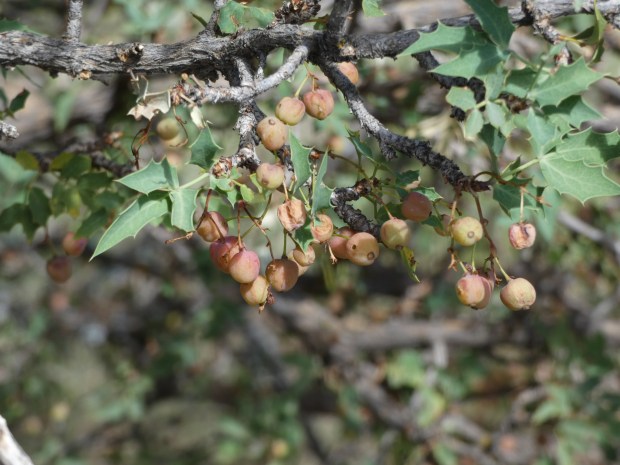
Red Barberry berries beginning to ripen
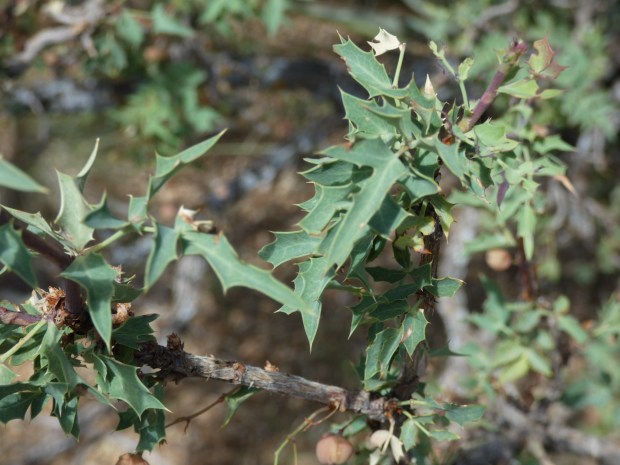
Now imagine you’re hiking in a pinyon-juniper forest of the American Southwest. You decide to bushwhack to a connecting trail and all of a sudden find yourself hopelessly stuck in a 10 foot high shrub covered in juicy red berries and very prickly holly-like leaves. This large (somewhat familiar) shrub is a surprisingly effective barricade; a formidable fence. You’ve become entangled in thousands of armed leaves preventing your forward or backwards movement without getting seriously poked and stabbed!
Is this the desert variety of American holly? Maybe it’s the giant living fence of a Japanese barberry gone rogue?
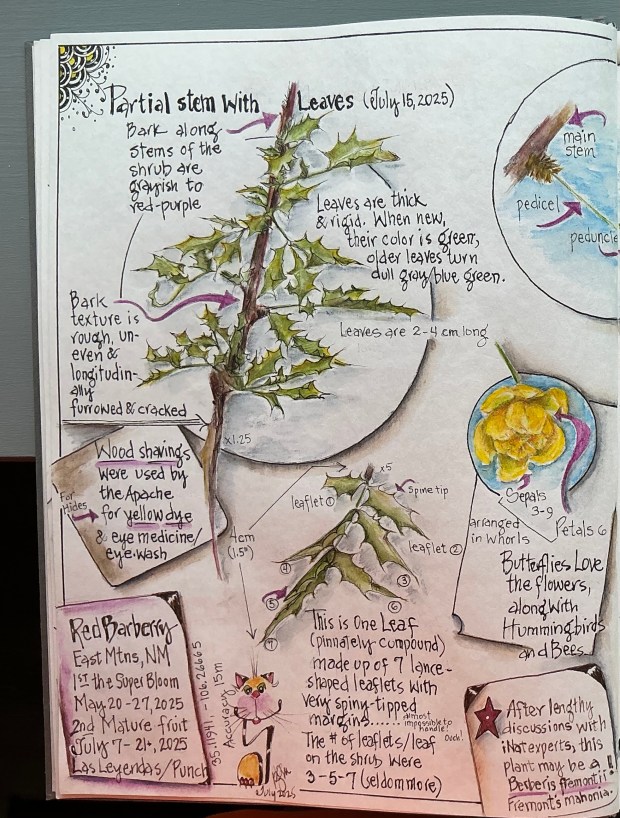
Nope! It’s neither. You’ve stumbled upon (into) a hardy specimen of the desert Southwest native Red Barberry (Berberishaematocarpa). But no wonder you were confused. This shrub, which can grow to 13 feet tall and nearly as wide, has an abundance of holly-shaped leaflets armed by a sharp spine on each lobe tip. And if birds haven’t devoured all of the red berries, you may find an ample supply of a refreshing (albeit tart) snack while you carefully and oh-so-slowly free yourself from the shrub’s embrace.
Red Barberry leaves – each lobe tip is armed with a needle-like spine
By now you’ve created lasting memories of Red Barberry, and have promised to always be alert for surprise encounters when visiting the desert island Southwest.
The hiking scenario above conjured up one of my hard-learned lessons from 8 years ago. Having just moved to New Mexico, Roy & I began avidly hiking local trails. Wishing to master the native flora as quickly as possible, one day I discovered clusters of red berries hanging inside the leafy canopy of a 5 foot shrub. What could they be?! Only having eyes for those juicy berries and an irresistible urge to gather a bunch for closer inspection, I plunged my open hand through several layers of small leaflets and successfully clutched a cluster. It was then I realized those spiny leaflets had poked, scratched and even penetrated my bare skin, as evidenced by tiny trickles of blood dripping from my hand and arm! Now that I had captured those pretty berries, it was obvious they had to be released to permit me the delicate maneuvers required to free my arm and minimize further injury. It was that day that I learned all about Red Barberry; lessons that will likely stick with me always!
Red Barberry berries amid armored leaves
Since that close encounter 8 years ago, it’s no surprise I’ve never been a big Red Barberry fan, until ……
Spring Super Bloom
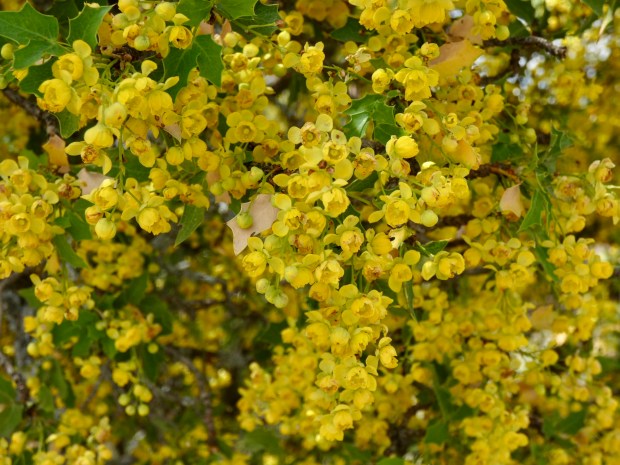
…… this past May a 13 foot tall plant in front of our home burst out in the most spectacular display of sunshine yellow flowers, literally covering the entire shrub front to back; top to bottom! The fragrance was overwhelming for the entire 2+ weeks the flowers were in bloom. And not only our Barberry was in full bloom, but about a dozen more barberries in our neighborhood and surrounding area were also covered in vibrant yellow. It was an amazing sight, causing me to figuratively re-embrace the native Red Barberry!
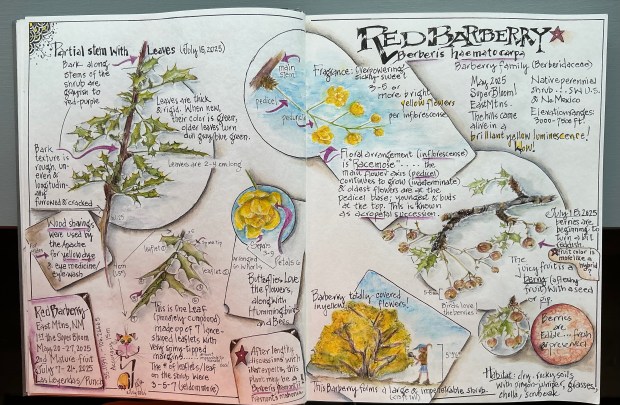
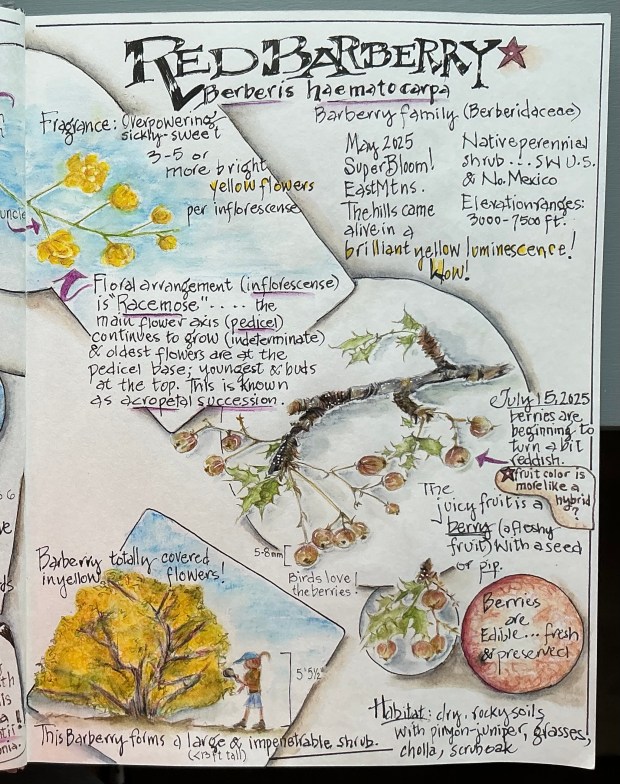
For more tidbits about Red Barberry, browse the text and illustrations displayed on my journal pages. Hope you enjoyed this post.
As always, thanks for stopping by!
P.S. In case you’d like to know about the etymology of the name Berberis haematocarpa…… ‘Berberis’ is a Latinized form of the Arabian name ‘barbaris, for barberry. “Haematocarpa” means ‘blood-red fruit’ referring to the bright red berries produced by this shrub. The word is derived from the Greek words “haima” (blood) and “karpos” (fruit).
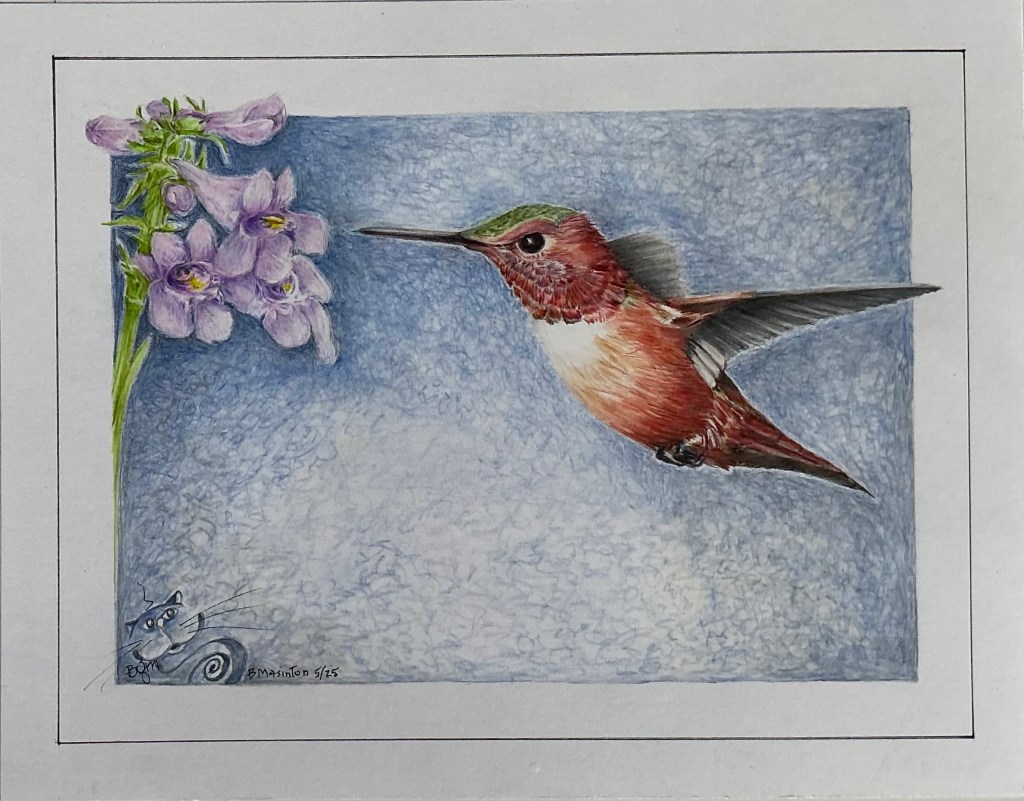
Of all the hummingbirds migrating through central New Mexico, the male Rufous ‘hummer’ (Selasphorusrufous) is the most spectacular. Showing up when our hot Summer temps begin to soar, he has two things on his mind ……. #1. find the best patch of nectar-rich tubular flowers, and #2. keeping that patch all to himself to refuel before completing his 4,000 mile migration from southern Mexico to southern Alaska. Upon arriving from Mexico, the flashy 2-1/2” long Rufous, garbed in a feathery cloak of flame colored oranges and reds, quickly lays claim to an area of sweetly blooming flowers that may include penstemon, columbine, scarlet gilia, Indian paintbrush, mint, lily, fireweed, larkspur, currant, and heath. Determined to defend his patch against all invaders, he performs a quick flower flyover. If satisfied the coast is clear (for now), he takes up a strategic observational post by perching on a nearby tree branch to watch for rival hummers.
Ever alert and constantly in motion, his perch gives him a great vantage point to scan the area by looking right and left/up and down, all the while making quiet chittering and chipping noises. If another hummer, and especially a male Rufous dares to enter his territory and sip from his flowers, oh no! Becoming highly agitated, the perched bird spreads his tail while flashing his colorful gorget (throat feathers) seconds before dive bombing his competitor, loudly screaming his alert call while attempting scare off the thief. If this tactic doesn’t work, i.e. the rival is determined to hold his piece of air space, a duel is declared.
Rufous hummers are well known for their aerial acrobatics. Perhaps you’ve witnessed their display, which likely put you in awe of this little powerhouse. If not, what you’ve missed is their incredible speed of initial attack, their precision, the cacophony of noise coming from such a tiny blur of a bird, the maneuverability of numerous aerial loop-de-loops and J-pattern sky displays allowing them to dive repeatedly at their foe, and their tireless determination in defending their rights to their flowers. It’s a spectacle you have to see to believe!
The Rufous will attack not only males and females of their species, but hummingbirds of all species, and even large insects, all with the audacity to steal precious nectar from his prized flowers.
And never, ever sit near or below a hummingbird feeder when there’s a Rufous in the neighborhood. I learned the hard way after being attacked over and over again by a surprisingly intimidating Rufous hummer. Despite being thankful I chose to wear a hat that afternoon, a large dose of common sense had me backing away from his feeder for fear he might have a stroke before drawing blood. My heart still races when recalling this thrilling yet scary encounter.
While reading about the Rufous, I learned that all ages and both sexes of this species are aggressive, even during their brief 1-2 week migration stopovers. This is certainly very good information to know about, having only witnessed males launch themselves at intruders, myself included!
Can’t wait for Rufous migration season!
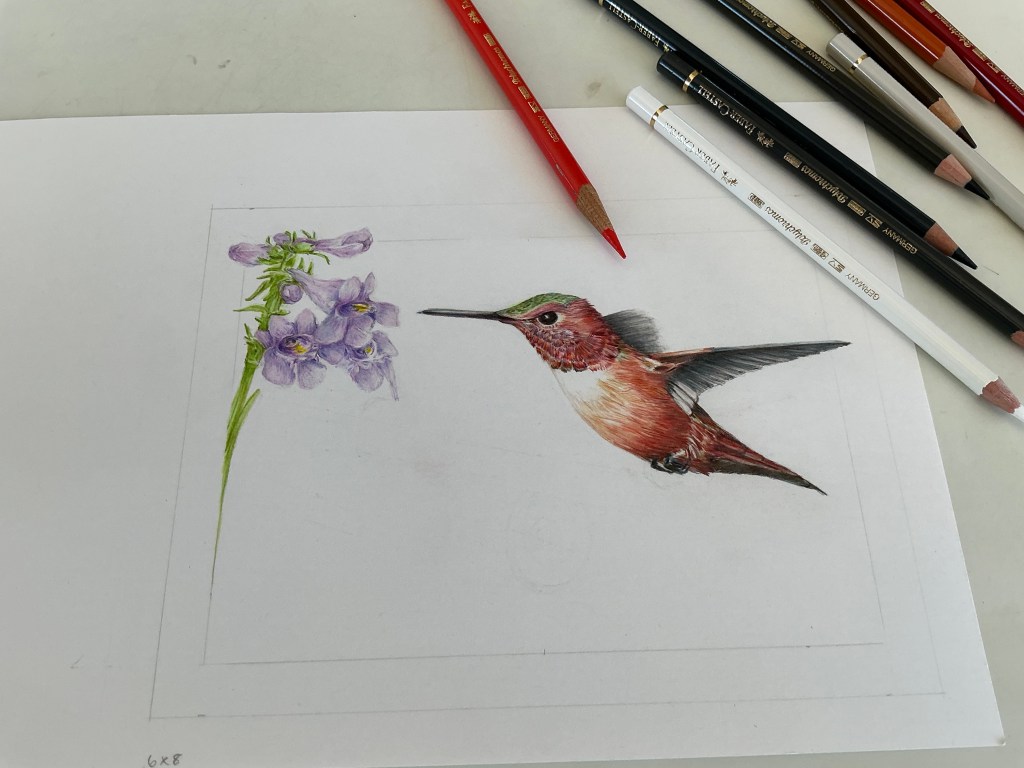
Have you learned something new about this wildly fascinating and fiery hot hummer of southern Mexico, the Western US, Canada and southern Alaska? If you have a Rufous or any hummingbird story to share, please do! Oh, I also hope you’ve enjoyed my colored pencil artwork of a male Rufous about to sip nectar from a freshly blooming penstemon.
Work in Progress …… showing an almost completed composition on smooth Bristol paper and a few of the Faber-Castell Polychromos colored pencils used in creating this Rufous hummer and penstemon.
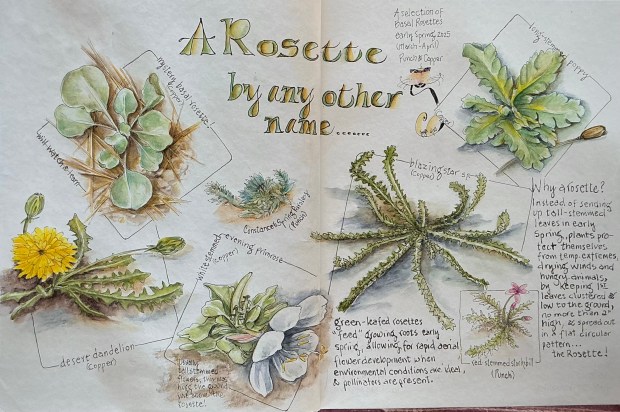
A selection of basal rosettes that popped out of the ground this Spring.
Have you ever noticed a dandelion? Oh sure …… you’ve seen hundreds, probably thousands of those ubiquitous sunburst yellow flowers blanketing a lawn or brightening an abandoned field. But before all that brilliance magically appears, have you ever looked below all those flower stalks? Have you ever noticed a dandelion before it blooms?
It’s early Spring in the mountainous areas of central New Mexico, and it seems like the high desert is slow to bloom this year. Anxious to spot even a hint of green during this transition time is always challenging, but if you look closely …….. Tucked beneath dry grasses and piled-high tumbleweed skeletons wedged next to swelling cholla you’ll find the green. Clusters of new leaves hugging the ground no more than an inch high, are beautifully arranged in a circular pattern like the unfolding petals of a rose.
Rosettes!
Rosette arrangements are found throughout nature,1 but in the flowering plants they are particularly common in the following families: Asteraceae (like dandelions), Brassicaceae (like cabbage), and Bromeliaceae (like pineapple). Many other families display the rosette morphology too. The needle sharp leaves of yucca and the bayonet-shaped leaves of century plant (in the Agave family) form tall rosettes. The intricate leaves of wild spring parsley (a tiny member of the Parsley family) and the petite red-stemmed stork’s bill (Geranium family) both form ground-hugging rosettes.
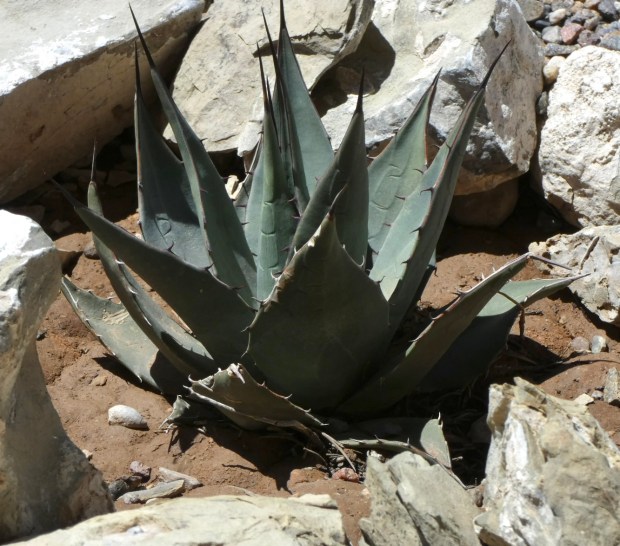
A century plant displaying a beautiful basal rosette.
Where Rosettes Form
Basal Rosettes grow close to the soil at or near the plant’s crown (the thick part of the stem where the roots attach). Their structure is an example of a modified stem in which the internode gaps between the leaves do not expand, ensuring all the leaves stay tightly bunched together and at a similar height. A protective function of a basal rosette makes it hard to pull from the ground; the leaves come away easily while the taproot is left intact (have you ever tried to pull a dandelion without snapping off the root?). Generally speaking, basal rosettes improve a plant’s odds at survival. For example, overwintering rosettes, like the basal leafy growth produced in year #1 of the 2-year life span of giant mullein, protect the plant and its roots from extreme cold temperatures. Emerging Spring rosettes, like those found in long-stemmed poppy, also protect the plant from late winter frosts. Basal rosettes are also more protected from changes in microclimate, gravity, wind, browsing, and mechanical damage if they are closer to the ground than tall leafy stems would be. help in water balance and conservation, especially important during periods of drought.
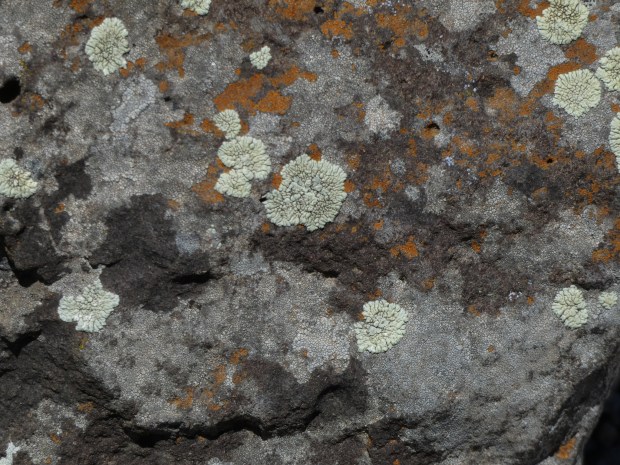
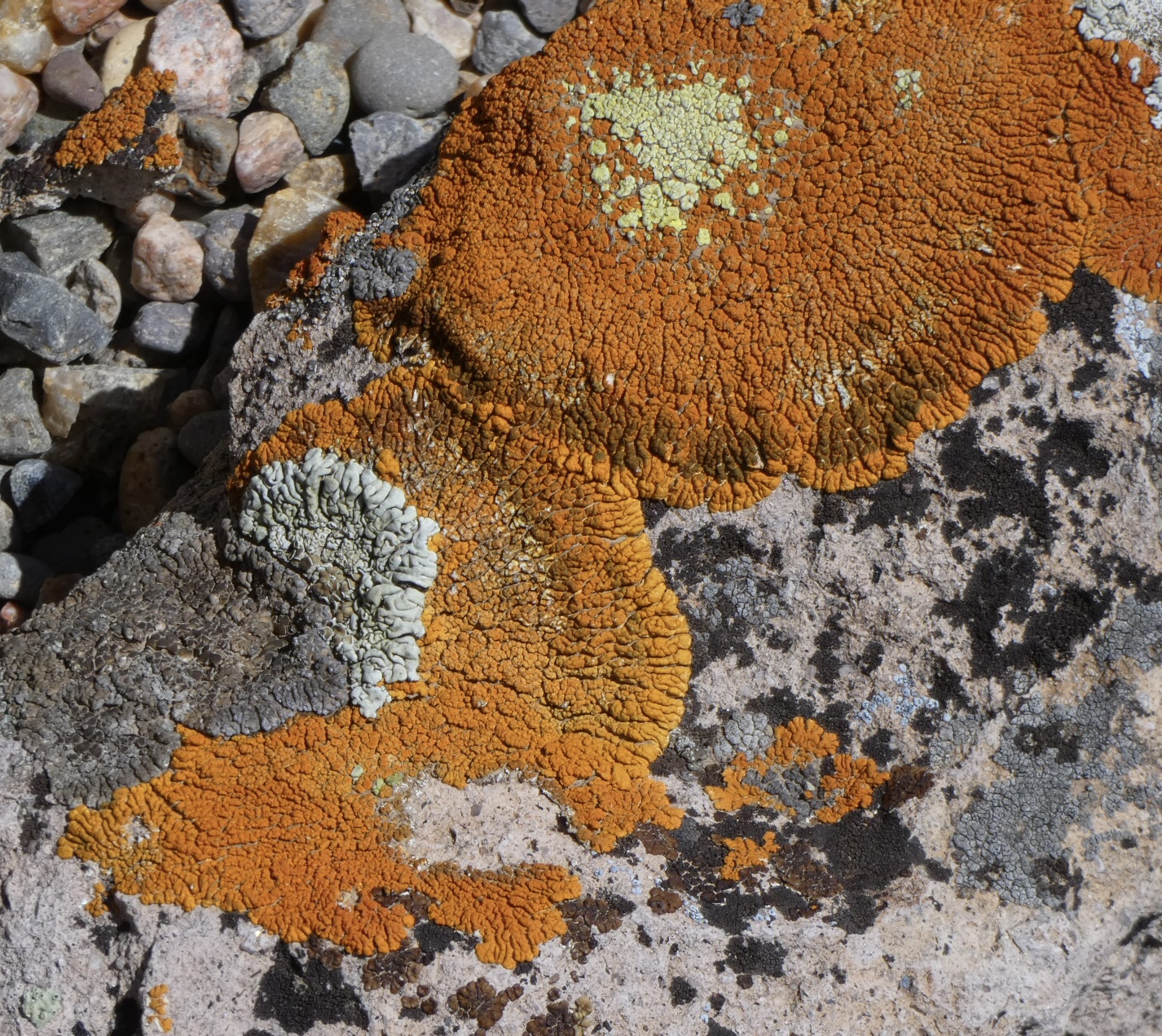
Lichen that has form small rosettes on rock.
But don’t only look down. Another form of rosette occurs when the internodes (those areas between leaves) along a stem are shortened, bringing leaves closer together as in lettuce and some succulents.2. And although not as common as basal rosettes, some plants form rosettes at the terminal or top end of their often naked stems, branches, or even trunks. One plant that does this is the native sedum called wild stonecrop. The top of the plant stems usually terminate in whorls or three fleshy leaves. Another example is the Hawaiian screwpine, which has a terminal rosette of sword-shaped leaves which sits atop an erect trunk, often supported by prop roots.
Know Your Local Rosettes
A number of desirable and undesirable (weedy) plant species produce rosettes, particularly basal rosettes. Being able to identify a species that pops up in the Spring by its rosette is so helpful in preventing a removal mistake by inadvertently digging them up. Many weedy, non-native plants gaze first at their world through rosette “eyes.” But not all plants with rosettes are undesirable. Do you know your local rosettes by their other names?
………………………………………………………………
1Rosettes are found throughout nature, not just in the flowering plants. Here’s some examples you may have seen or heard of:
In bryophytes and algae, a rosette results from the repeated branching of the thallusas grown by plant, resulting in a circular outline. Lichens also grow rosettes.
Tiny wasps and midges can induce the development of galls that become leafy rosettes.
Jaguars, leopards and other feline species display rose-like markings on their fur, referred to as rosettes.
Malaria parasites are known to form spontaneous rosettes in uninfected red blood cells.
Neural rosettes in the human brain are being studied to learn how new cells are born.
It is unknown why the Rosette-Nosed Pygmy chameleon, at home in the mountains of Tanzania, has evolved a distinctive, rosette-shaped, fleshy protrusion on the end of its nose.
The Rosette nebula, named for its rosette-like appearance, is a beautiful collection of gas and dust 5,200 light-years from Earth in the constellation Monoceros the Unicorn, and stretches about 130 light-years across.
A gorgeous lichen decorated rock from Colorado. Note the rosette patterns of growth (the thallus)
2 The horticultural definition of a succulent describes a drought-resistant plant where the leaves, stems, or roots have become fleshy and their tissues are able to store water. Succulents include aloe, euphorbia, sedum, the garden favorite hen-and-chicks, and bromeliads. But horticulturalists do not include cacti in the succulent group. huh? Even though cacti are frequently found in books describing succulents based the definition of a succulent, succulents are not cacti. In agreement with that last statement are many botanical and other scientific experts. (Can this get any more confusing?). So basically some experts are lumpers, while other are splitters. Which are you?
Basal rosette of a yucca in the NM foothills.
P.S. Cacti have stems that are thickened fleshy water-storing structures, and are considered to be a stem-succulent group of plants. Are there any cacti species that develop leafy rosettes? Because the spines are the leaves, greatly modified, in all my rabbit-trailing thru the internet and perusal of my collection of botanical references I’ve yet to see any spines forming whorled/rosette-like patterns. If you have, please contact me immediately!
……………………..……………..😂…………………………………………
Are you ready to explore the wide diversity of rosette forming plants in your neighborhood? Get on out there before those circularly-arranged leaves become disguised by an overabundance of gorgeous wildflowers!
As always, thanks for stopping by! And Happy Earth Day (week)!
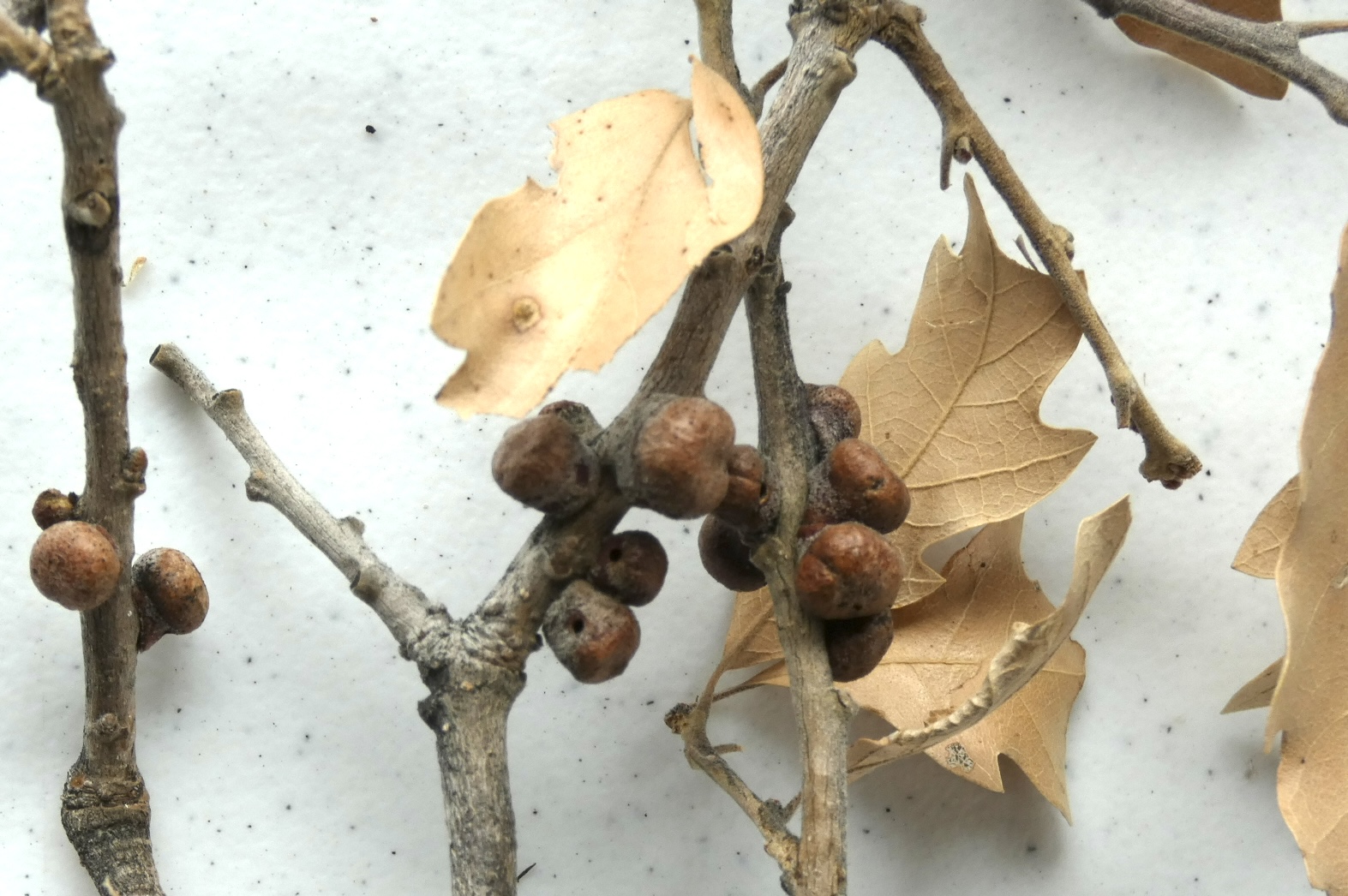
When the urge to nature journal is too hard to resist, but everything around you is still brown, crispy and covered in dust, I begin looking for any curious phenomena suitable for rabbit trailing (even rabbit tracks work!). The other day while hiking a steep hill, I was looking for sign the oaks were close to breaking bud. Spotting a string of little dark red beady objects lining many of the mostly leafless stems of am oak was certainly encouraging. From a distance they appeared to be swelling leaf buds; at least their color seemed right. But an up-close inspection revealed my hopeful find as last December’s vacated “homes” occupied by oak gall wasp larvae. Having never seen this species of stem gall before, naturally this would be a perfect most curious phenomenon to tackle. And that’s just what I did!
The Honeydew Gall-Wasp Gall
Arriving back home with a small collection of oak stems crowded with tightly packed galls (resembling miniature bread loaves), my work began. Assuming the host oak was a Gambel’s (Quercus gambelii), I began my search of stems galls on that species. Carefully scouring the literature the genus appeared to be Disholcaspis, but none of the species seemed a good match. So after many days in quandary, I consulted my favorite oak gall ID specialist, firing off a lot of questions, written descriptions and photos. Patiently awaiting his reply, I continued to find more resources to review. Gall wasps have a complex life cycle, and their galls are a challenge to identify.
After 2 weeks a welcome reply arrived from the specialist. Boy did I feel silly, knowing I should’ve known better! The oak host was not a Gambel’s but a cross between Gambel’s and Shrub Live Oak (Q. turbinella) which produces a hybrid called Wavyleaf oak (Quercus x undulata). Correcting my mistake was key to identifying the stem gall! Picky little wasps, huh? Happy the specialist agreed the genus is Disholcaspis, the obvious species responsible for the gall was turned out to be D. spissa; the Honeydew Gall-Wasp ….. making my discovery the Honeydew Gall-Wasp Gall!
Lesson Relearned
When nature journaling, despite how excited you may be to find answers, it’s always, always best to slow down, breathe, carefully observe, ponder, question, make connections, and enjoy the journey ahead of the destination!
Some Gall Descriptions and A Prize!
Outside appearance: Young galls of this wasp are yellowish and hairy. Mature galls have beige-brown to weathered grey sides, are black on top, and have a dull matte surface. They can have a round to ovoid to a rectangular ‘bread-loaf’ like shape. Texture appears mealy-granular. Galls sit snugly directly on the stems (sessile), and singly or in clusters of long compact chains that form all around the stems of host oak species.
Inside the gall and back outside again: Each gall has one thin walled cell or chamber (known as monothalamous) that sits above the bottom of the gall. This is the larval chamber and is imbedded in dense cellular tissue that becomes a pulpy flesh with age. While the larvae are actively feeding and growing, they produce a copious amount of sticky-sweet honeydew that accumulates on the top of the gall. All of this honeydew attracts hordes of hungry ants and yellowjackets. The ecological importance of these secretions is unmistakeable; it provides a high energy food source for the insects. And while the ants and yellowjackets feed, they inadvertently protect the gall, like little bodyguards, from parasites and predators intent on infecting or eating the growing larvae inside. And another interesting ecological thing ….. the reason the tops of the galls are black and not the same color as their sides, has to do with a fungus called black sooty mold. The sugary secretions produced by the larvae accumulate in quantities too irresistible to the sooty mold. Colonies of the fungus develop rapidly on the honeydew giving the gall tops a dusty or powdery black color. So honeydew is the perfect medium for black sooty mold to complete its life cycle.
What about that Prize? Read on to learn more! Close-up inspection of the galls I collected, and there were about 25, revealed all but one had a single exit hole in a side just below its crusty red-black top. I learned the adult wasps emerge from these stem galls by late December; sometimes waiting for warmish temps until mid January. What happened to the adult wasps in the one gall without an exit hole? Because the gall had a sooty top, implying the larvae had been eating, growing and secreting honeydew, maybe the larvae died at some point or failed to develop into an adult? Had to know! Cutting the gall to find out wasn’t easy. The outer crust fell away first, then using steady knife pressure on the punky innards, the gall popped open, like a box of ‘Cracker Jacks!’ And there, near the bottom of the package, was a single sealed chamber. Carefully I was able to tease out the contents with fine pointed tweezers until out blurped the Prize! An intact cream colored gooey looking larvae, followed by a small puddle of viscous liquid. Even though the larvae filled up most of the chamber, there wasn’t any sign it was alive. And after an hour, when there still wasn’t any movement …. well, darn, I felt he must’ve died sometime before morphing into adult form. But peeking inside the gall did answer the question about the absence of an exterior exit hole.
And now an interesting note about these types of cynipid oak gall wasps: On my diagram, I used the term ‘agamic’ which is a formal label included with the genus/species name (i.e. Disholcaspis spissa ‘agamic’). This means these wasps have an asexual all female population that emerges from galls in late fall/early winter to lay fertilized eggs without needing to mate with males. Then a bisexual generation follows where adults emerge from galls in late winter/spring/early summer. This is the typical 2 generation annual life cycle of cynipid gall wasps, where the galls developed from each generation usually look very different and even occur on different parts of the host plant (on stems vs leaves). It’s interesting that nothing is known about the bisexual generation of D. spissa, but the asexual generation is common, well documented and abundant.
Known host oak species for D. spissa: Look for these galls on Shrub live oak (Quercusturbinella), Wavyleaf oak (Quercus x undulata), Mexican blue oak (Q. oblongifolia), Arizona white oak (Q. arizonica), and Shinnery oak (Q. havardi).
Hope you found my post interesting. Have you ever been curious enough about plant galls to look inside? Recalling the first time I saw a gall, I had no clue what it was and why it was precariously clinging to a plant leaf. It was round and hard, and reminded me of a tiny rusty red ping-pong ball. Was there something inside? Would it be squishy, alive, have teeth and bite, or perhaps whatever it was was dead and oh so smelly? Maybe it was some weird kind of flower bud, or a fruit lost under the leaf? Despite being a bit nervous, I needed to know what, if anything was inside. So I cut it in half, and in the center of the ball, suspended on hundreds of delicate threads, was a tiny, wormy creature twisting and turning and wriggling to music only it could hear! That was over 45 years ago, and to this day I still find galls irresistible!
As always, thanks for stopping by!
A Few References
Russo, Ronald A.: (2021) Plant Galls of the Western United States, section on tree galls; oak galls of the SW, page 173.
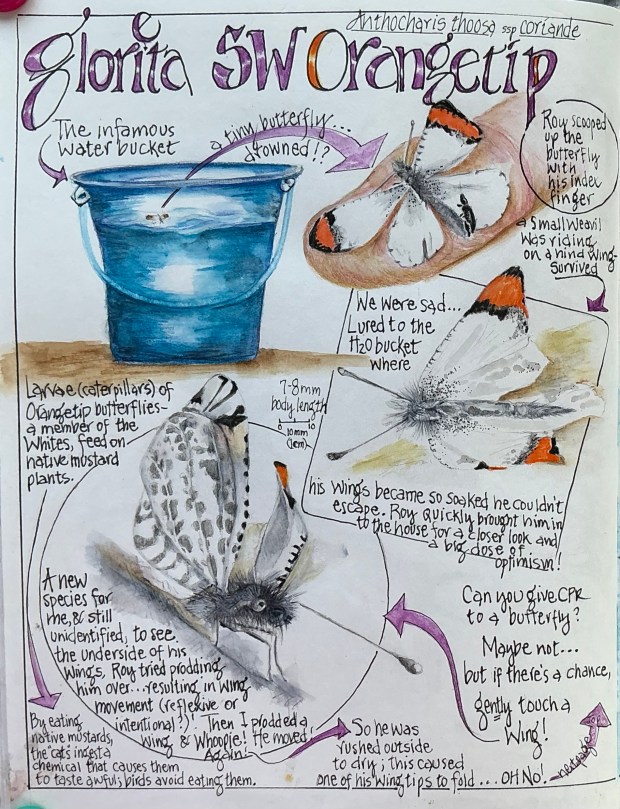
The ‘Glorieta’ Southwestern Orangetip (Anthocharis thoosa ssp coriande), are only known to occur in the central and north central counties of New Mexico. This recently recognized form of A. thoosa was described by M. Fisher and Scott in 2008, from specimens collected near Glorieta Pass southeast of Santa Fe1 (which just northeast of our home).
The Orangetips are classified in the Family Pieridae/Subfamily Pierinae ….. commonly called the Whites. In NM there are 16 known species of Whites, including the non-native European Cabbage White. After a wet winter, plentiful males compete for hilltop display locations while females search surrounding areas for the choicest of native plants in the mustard family (Brassicaceae) on which to lay their eggs. When the eggs hatch, the larvae (caterpillars) voraciously devour the leaves of their host mustard plants, until they’ve grown to over 1,000 times in size! Because this family of butterflies is common in desert habitats, to withstand drought conditions some species have the ability to suspend development during their pupal stage (when they are in their chrysalis), a mechanism called pupal diapause. And if winter rains do not cause favorable conditions for their larval hosts (the mustard plants), they can remain in pupal diapause for several years.
The White’s preference for mustard plants may not be about taste. It’s thought that chemicals contained in these host plants make butterflies in this group unpalatable. Entomologist, “Mike Toliver has witnessed only one attack by a bird on members of this group in more than 60 years of observation.”1
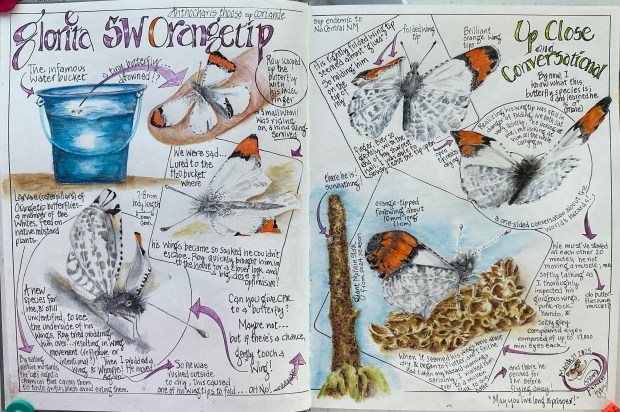
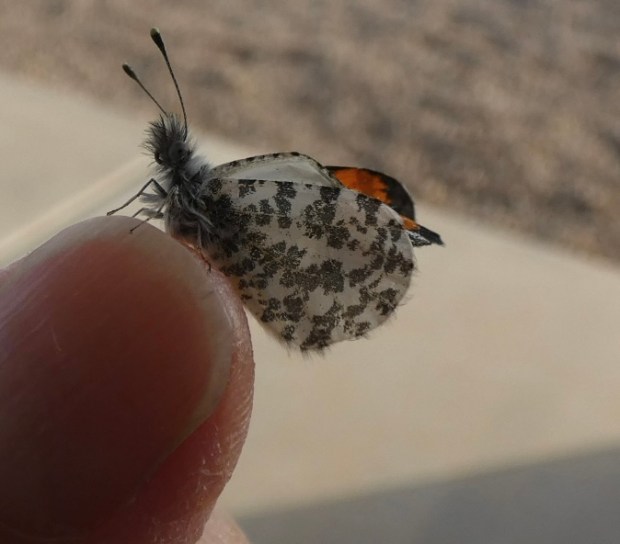
Early one morning (a few days ago), Roy discovered a miniature butterfly afloat, upside down, in a water bucket left outside overnight. Looking very drowned, Roy scooped him up with the tip of his index finger and brought him inside the house for my inspection. Excited and sad all at once, I snapped a few photos, having never seen this species before. Because this little guy had such striking marks and color, finding him in the online New Mexico butterfly field guide was easy. This beauty was a ‘Glorieta’ Southwestern Orangetip (Anthocharis thoosa ssp coriande)!
Roy was about to turn him over to take a look at the flip side when one of the wings fluttered a bit. Not believing our eyes, I gently prodded him, and sure enough! He seemed alive! But just how much alive we didn’t know.
Rushing this tiny guy outside where his wings might dry, he slowly became more active. Unfortunately the tip of a still damp forewing folded over and stuck like glue making it impossible to synchronize those wings …. he didn’t seem remotely interested in taking flight. Not to be defeated, he then crawled up to the tip of my pinky finger, looked me in the eyes, raised one of his six legs politely asking for help. Gathering my courage and willing any clumsiness ‘be gone’ from my fingers, I held my breath while using the edge of my longest fingernail to slowly and carefully separate the fold. Taking my time to tease up the delicate tip millimeter by millimeter, this butterfly never moved a muscle (do butterflies have muscles?). After what seemed like hours the wing unfolded, popping back into alignment without any apparent damage!
“The Talk”
He didn’t fly tho, so I sat with him for about 20 minutes as he perched on my finger. During my ultra close inspection of his eyes (you know I love eyes, and his were sultry grey and gorgeous), punk-rock style hairdo, and brilliant orange tipped wings, he seemed content while I carried on a lengthy one-sided conversation warning him of the world’s dangers.
Somewhat convinced he believed and would abide by my every word, I walked him over to a large mullein stalk, where he walked off my finger to enjoy a sunbath (hopefully to prepare to take wing). He wasn’t in much of a hurry tho. About an hour later and checking to see if the coast was clear, off he flew. That beautiful Glorieta Southwestern Orangetip butterfly was free!
All-in-all, it was an exciting encounter!
What exciting encounters are you experiencing during this change of seasons?









 a curious nature