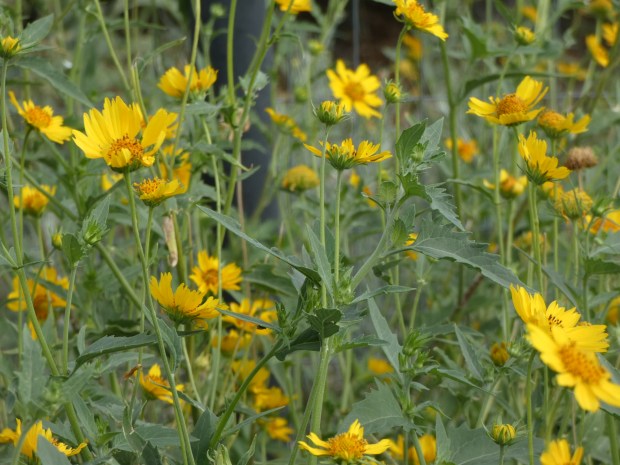
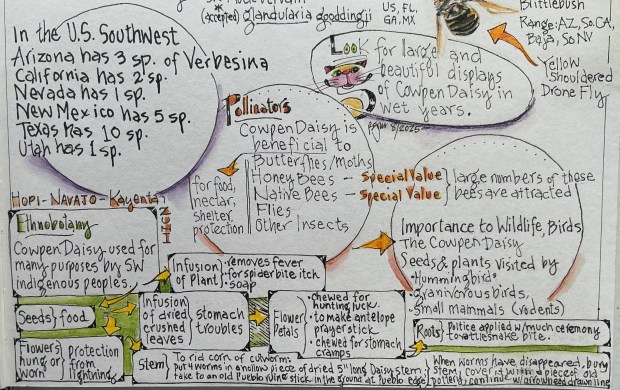
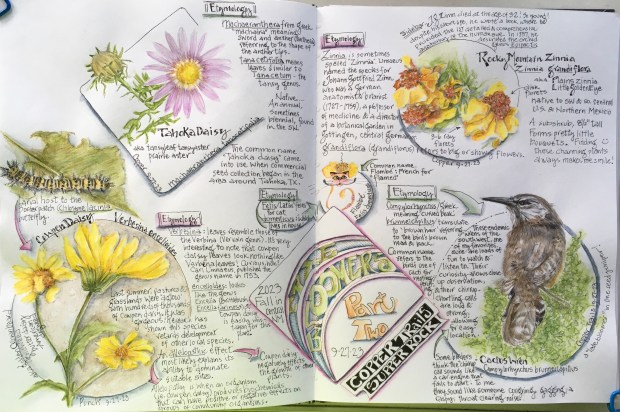
While compiling last week’s post about the happy Cowpen Daisy party taking place outside our back door, it was no surprise to find way more interesting info about this sunflower than could ever fit on my journal page. Decisions …… decisions! To keep the August 5th illustrated page relatively uncluttered, I decided to include just the botanical basics (mostly), focusing on Cowpen Daisy flowers, leaves and seeds.
Then the past week I found my nature journal wide open to a blank page, ‘begging me’ for another Cowpen Daisy entry ….. “What about all those interesting info bits?” she asked. Replying* to my journal with a hearty, “OK,” I proceeded to locate and gather my rabbit-trailing notes. This scavenger hunt reminded me just how many pages there were; so many fascinating things about the Cowpen Daisy I wanted to remember and share. Decisions …… decisions! How to keep this next post to one page? By limiting the topics to only three, was it possible?
Barely! (after some clever editing, not a single word dropped off the page)
A little bit closer view for those without a microscope!
P.S. By the way, you may have noticed I’ve indicated this post is Part 2 of what’s now become my Cowpen Daisy series. Unless I start journaling on larger than 8” x 11” paper, there’s likely to be more Parts in store. And this multi-part series resulted in a minor edit to last week’s post, not titled “One of the Happiest Sunflowers Ever! The Cowpen Daisy; Part 1 ….. Can There Be Too Many Sunflowers?” In case you missed it, please check it out here.
*Yes, you read that right; I talk with my nature journals. Don’t you? After all, we do spend quite a bit of time together!
When you think of ‘Barberry,’ does a shrubby knee-high landscaping bush that transforms to flame red in the fall, come to mind? If so, you may have seen hedge rows of the plant known as Japanese barberry ……
Japanese barberry (Berberisthunbergii) is a non-native shrub that was introduced from Japan in 1875 as an ornamental that’s planted for erosion control and as a living fence. But this invasive shrub outcompetes and displaces native plants, alters ecosystems, and is a host species of black-legged ticks that carry Lyme disease.
When you think of ‘Holly,’ does a plant with boughs of prickly green leathery leaves naturally ‘decorated’ for the holidays with red berries, come to mind? If so, you’re likely familiar with the iconic American holly ……
American holly (Ilexopaca) is a native shrub of eastern and south-central U.S. that grows well in both dry and swampy soils. The plant, which is also cultivated as an ornamental, forms thick a canopy cover for birds and other wildlife, and the female plants produce an abundance of shocking red berries, loved by birds but poisonous to dogs, cats and humans. Regardless of the risk, bountiful quantities of leafy boughs and clusters of red berries are harvested each fall and brought indoors to create holiday wreaths and other seasonal decorations.
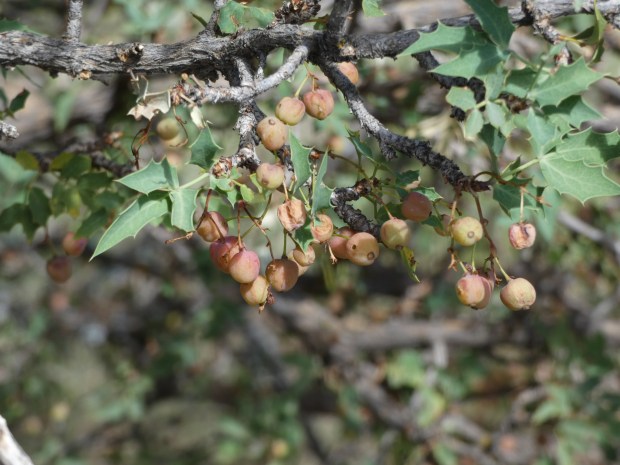
Red Barberry berries beginning to ripen
Now imagine you’re hiking in a pinyon-juniper forest of the American Southwest. You decide to bushwhack to a connecting trail and all of a sudden find yourself hopelessly stuck in a 10 foot high shrub covered in juicy red berries and very prickly holly-like leaves. This large (somewhat familiar) shrub is a surprisingly effective barricade; a formidable fence. You’ve become entangled in thousands of armed leaves preventing your forward or backwards movement without getting seriously poked and stabbed!
Is this the desert variety of American holly? Maybe it’s the giant living fence of a Japanese barberry gone rogue?
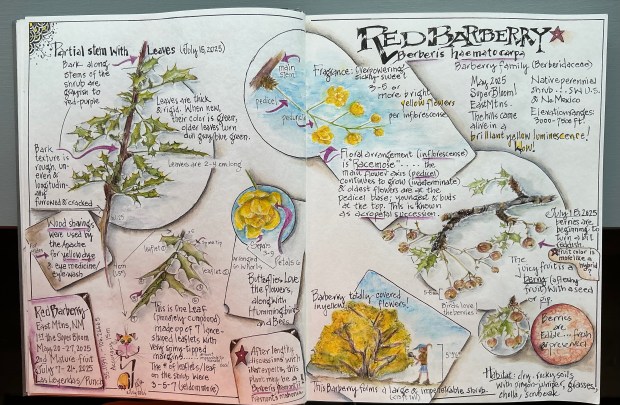
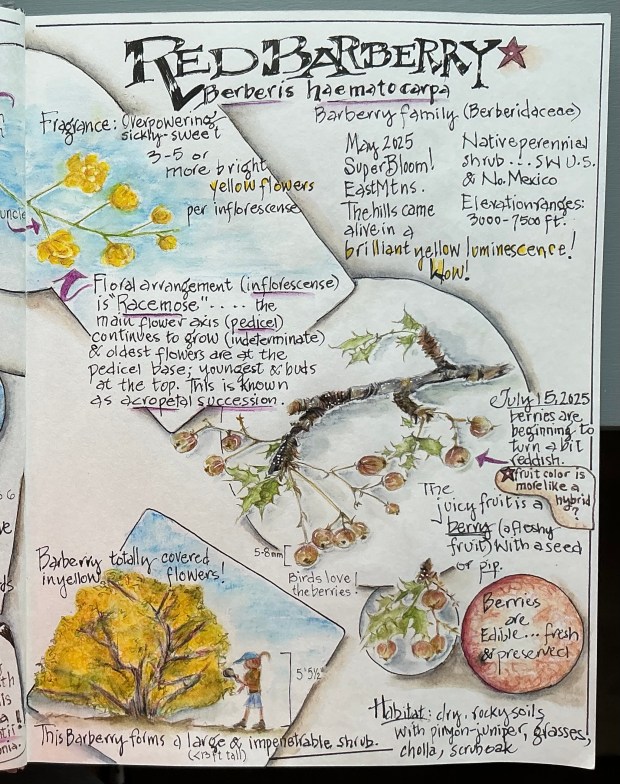
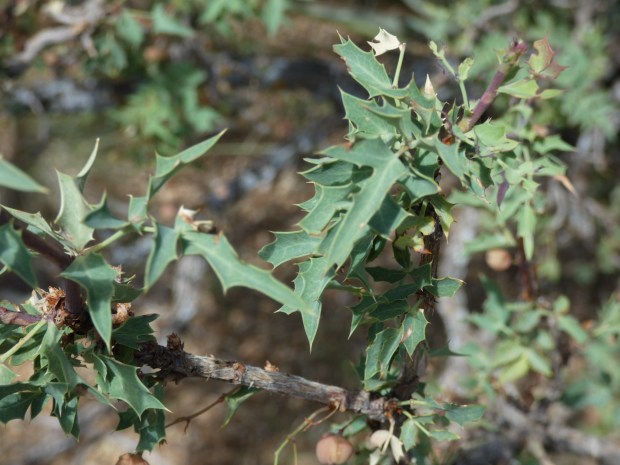
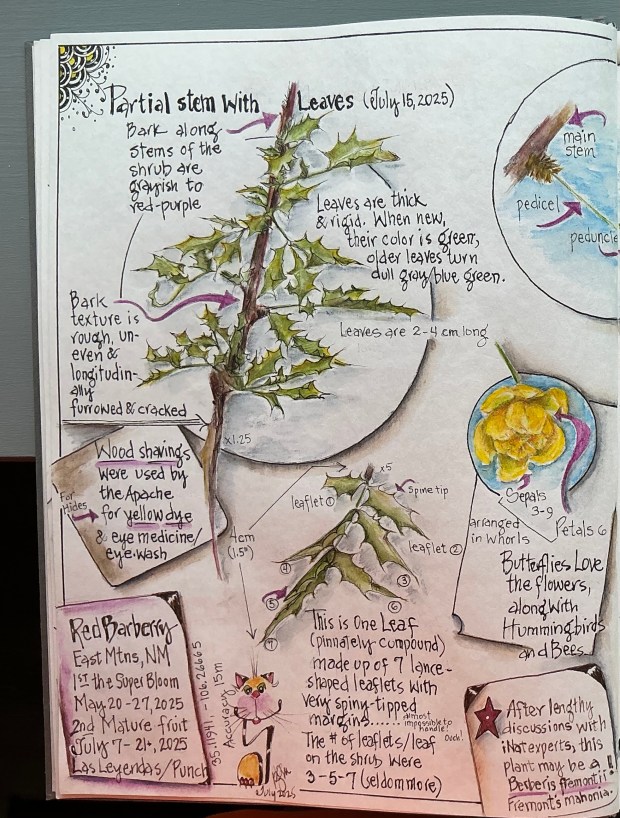
Nope! It’s neither. You’ve stumbled upon (into) a hardy specimen of the desert Southwest native Red Barberry (Berberishaematocarpa). But no wonder you were confused. This shrub, which can grow to 13 feet tall and nearly as wide, has an abundance of holly-shaped leaflets armed by a sharp spine on each lobe tip. And if birds haven’t devoured all of the red berries, you may find an ample supply of a refreshing (albeit tart) snack while you carefully and oh-so-slowly free yourself from the shrub’s embrace.
Red Barberry leaves – each lobe tip is armed with a needle-like spine
By now you’ve created lasting memories of Red Barberry, and have promised to always be alert for surprise encounters when visiting the desert island Southwest.
The hiking scenario above conjured up one of my hard-learned lessons from 8 years ago. Having just moved to New Mexico, Roy & I began avidly hiking local trails. Wishing to master the native flora as quickly as possible, one day I discovered clusters of red berries hanging inside the leafy canopy of a 5 foot shrub. What could they be?! Only having eyes for those juicy berries and an irresistible urge to gather a bunch for closer inspection, I plunged my open hand through several layers of small leaflets and successfully clutched a cluster. It was then I realized those spiny leaflets had poked, scratched and even penetrated my bare skin, as evidenced by tiny trickles of blood dripping from my hand and arm! Now that I had captured those pretty berries, it was obvious they had to be released to permit me the delicate maneuvers required to free my arm and minimize further injury. It was that day that I learned all about Red Barberry; lessons that will likely stick with me always!
Red Barberry berries amid armored leaves
Since that close encounter 8 years ago, it’s no surprise I’ve never been a big Red Barberry fan, until ……
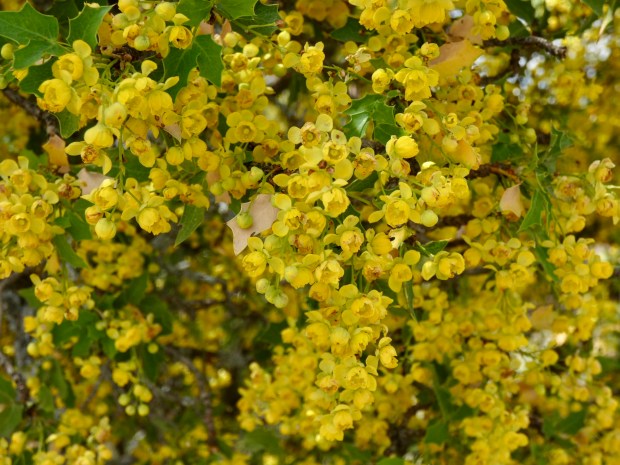
Spring Super Bloom
…… this past May a 13 foot tall plant in front of our home burst out in the most spectacular display of sunshine yellow flowers, literally covering the entire shrub front to back; top to bottom! The fragrance was overwhelming for the entire 2+ weeks the flowers were in bloom. And not only our Barberry was in full bloom, but about a dozen more barberries in our neighborhood and surrounding area were also covered in vibrant yellow. It was an amazing sight, causing me to figuratively re-embrace the native Red Barberry!
For more tidbits about Red Barberry, browse the text and illustrations displayed on my journal pages. Hope you enjoyed this post.
As always, thanks for stopping by!
P.S. In case you’d like to know about the etymology of the name Berberis haematocarpa…… ‘Berberis’ is a Latinized form of the Arabian name ‘barbaris, for barberry. “Haematocarpa” means ‘blood-red fruit’ referring to the bright red berries produced by this shrub. The word is derived from the Greek words “haima” (blood) and “karpos” (fruit).
A few years ago I stumbled across this plant while walking around our neighborhood. Being immediately awed by its richly-colored petals skirting an upright cylinder or cone, I knew it would be a perfect addition to our high elevation (7,300 feet) landscape. My idea was to wait until the flowers on the cone faded and collect some seed to scatter in our yard. After repeated trips hoping to find evidence of seed, I was skunked. Either I missed the dispersal event, or this plant was 100% sterile. On the outside chance there were microscopic seeds embedded in the cone, I resorted to cone collection. Fast forward to the next spring …… every spot I’d planted those cones was barren; nothing had sprouted; zero; zip.
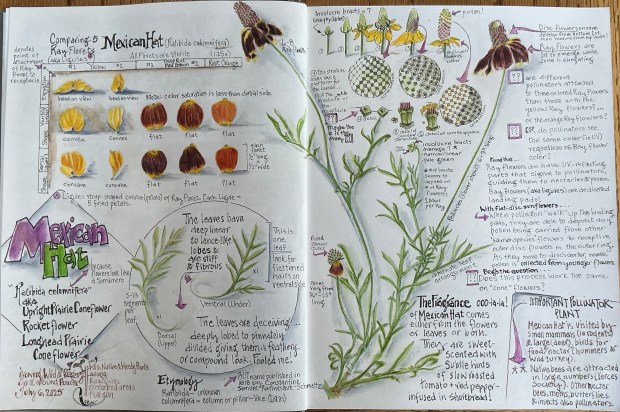
Fast forward again to early July 2025. This wildly blooming plant was growing vigorously in many of the dry disturbed openings and roadside areas throughout our new neighborhood! Time to learn more about such a charming member of the sunflower family called Mexican Hat.
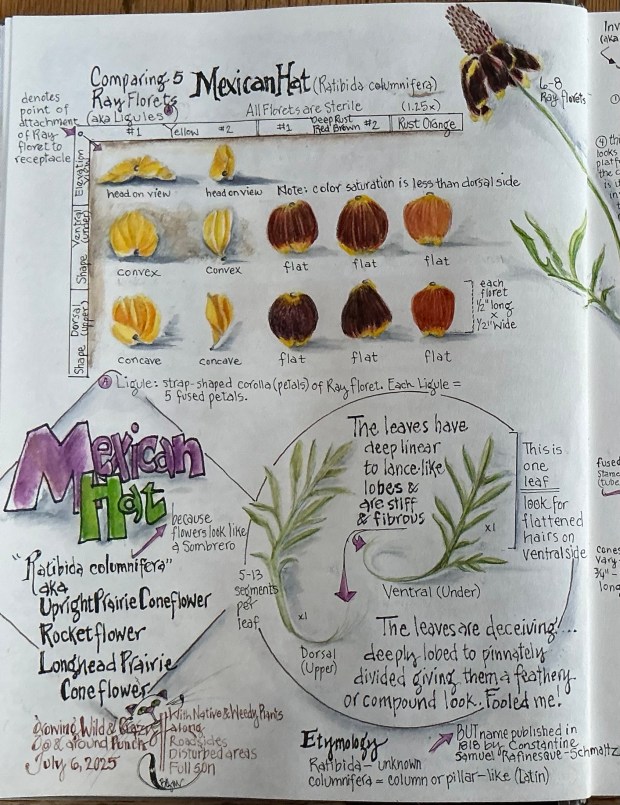
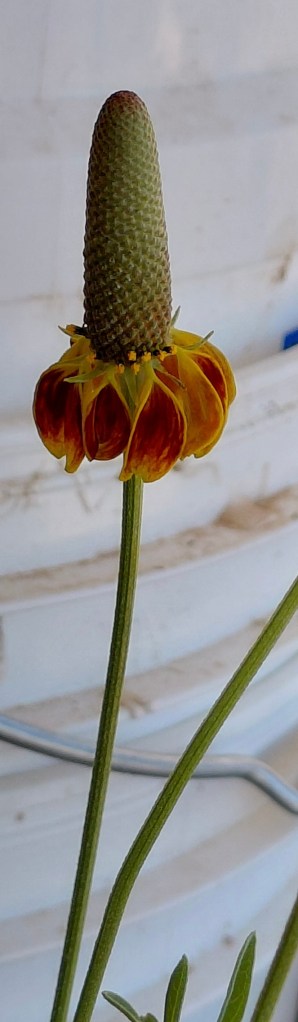
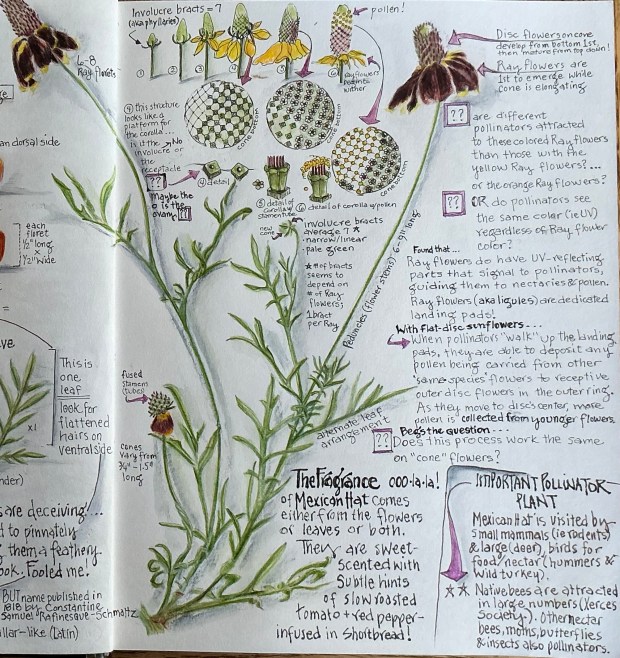
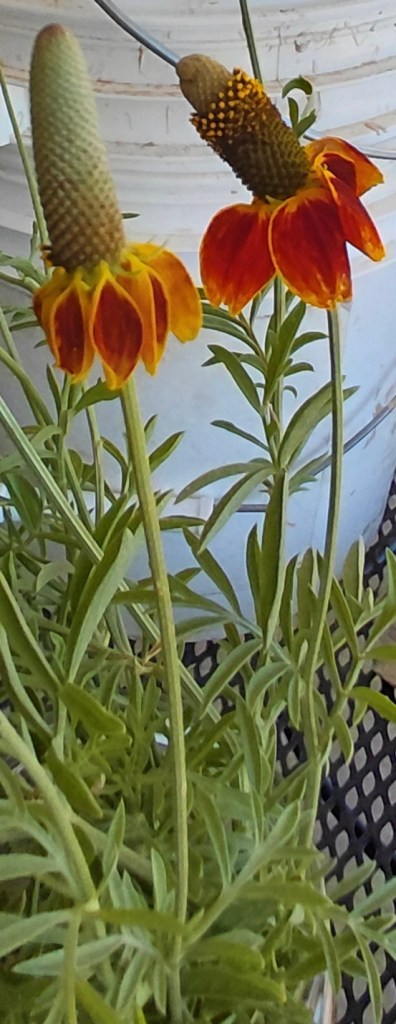
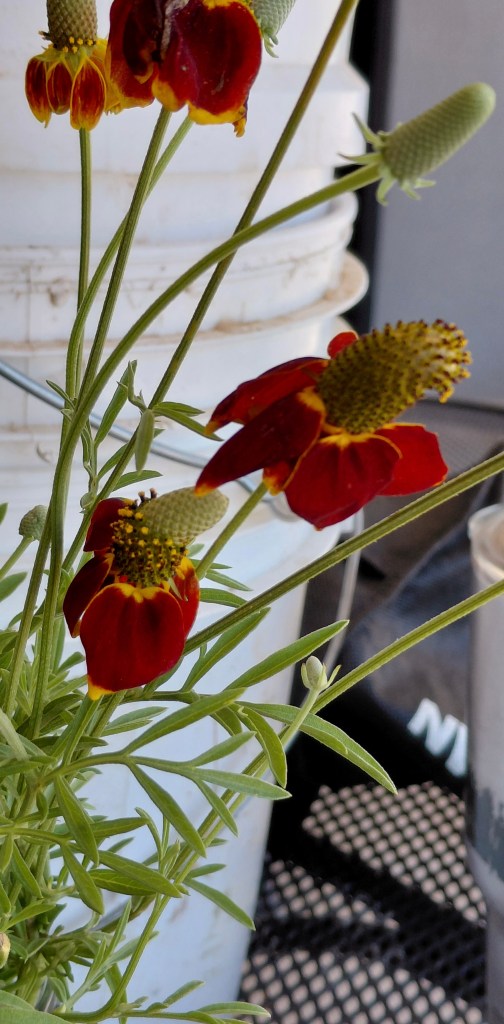
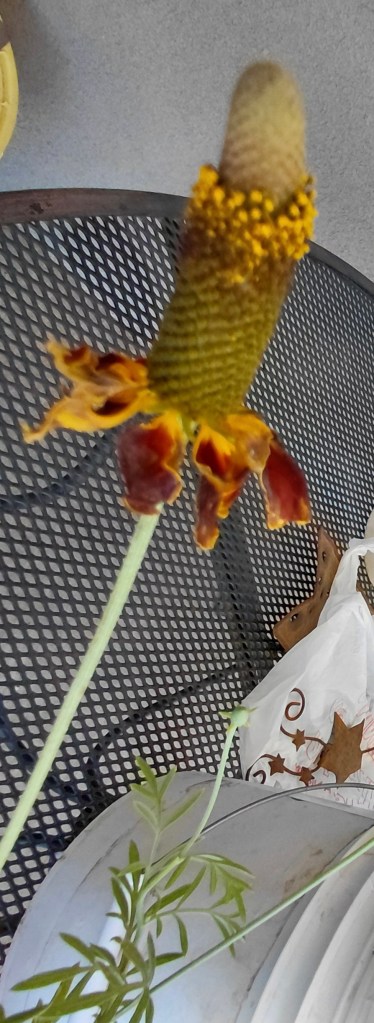
Mexican Hat (Ratibidacolumnifera), also commonly known as rocketflower, and both upright and longhead prairie coneflower, is a native perennial found across the Lower “48” (U.S.), southern Canada and northern Mexico at elevations ranging from 5,000-7,500 feet. Its Ray flowers come in a dazzling sunshine yellow, along with a soft velvety royal purple-brown, an intensely deep rust-red brown, and rusty oranges – all with some measure of sunshine yellow marginal accents. Each Disc flower (those tiny spots that spiral, Fibonacci fashion, around the upright cone) has 5 fused pale-green petals (the Corolla). The Corolla surrounds 5 fused purple/red oxide-colored Anthers (the pollen structures of the Stamens). The Anthers are shoved up through the Corolla by the developing Style (the stalk of the Pistil) where they burst into 5 sunshine yellow pollen “strands” resembling a hairdo of long, twisted, windblown dreadlocks! The shockingly beautiful colors unfailingly lure many insects hungry for pollen and/or nectar.
The entire Capitulum (the densely packed flowerhead of a composite “flower”) continually waves in the slightest of breezes as it perches atop the long stiff and naked stem (the Peduncle) of the flowerhead. Below the Peduncle are the many branched feathery-like, deeply lobed leaves. These leaves seem to be the primary source of a curiously fascinating fragrance. After handling the plants for several days, I began thinking of the aroma as being cautiously sweet-scented with subtle hints of slow roasted tomato + red pepper-infused homemade shortbread cookies! I’m looking for a recipe!
All “said and done,” Mexican Hat can grow from 8 inches tall to over 3 feet!
Benefits of and Curiosities About Mexican Hat
Special Value to Native Bees – According to The Xerces Society for Invertebrate Conservation, Mexican Hat is recognized by pollination ecologists as attracting large numbers of native bees.
Food Source for Wildlife Species – In addition to being an important source of pollen and nectar for native bees, Mexican Hat also attracts many other insects like butterflies and moths, and hummingbirds sip its sweet nectar. Wildlife that feast on its seeds include small song birds, wild turkey and rodents. Even white-tailed deer will eat the foliage, despite its reported deer-resistant qualities.
Supports Native Pollinators, Attracts Beneficial Insects, and Promotes Biological Diversity – Mexican Hat is a adaptable and resilient wildflower species, able to endure extended periods of drought, hot and cold temperatures, and diverse habitat and soil conditions. Because of these characteristics, and because the species is a self-seeder, Mexican Hat provides food and cover for wildlife, is a reliable source of pollen for at-risk native bees, and makes an excellent choice for sustainable gardening, habitat and soil restoration, and prairie conservation efforts. And not to be overlooked, Mexican Hat attracts beneficial insects like lady beetles and lacewings that help control garden pests like aphids and caterpillars, and makes a valuable contribution to natural pest management strategies.
Many Uses; the Ethnobotany of Mexican Hat – North American indigenous peoples prepared the leaves, stems, flowers and/or the cones in certain ways to treat specific ailments suffered by people and animals. By creating washes, by boiling, physically rubbing and crushing, decoctions, concoctions and infusions were used to treat chest pains, wounds, stomach aches, fevers, headaches, urinary problems, rattlesnake bites and to induce vomiting. Mothers wishing to wean their babies had crushed leaves rubbed on their breasts. Horses with urinary problems were hand fed the entire plant as a cure, and sheep that are “out of their minds” are given a cold infusion.
The cones were used as baby nipples. Leaves and flowerheads were boiled to make a pleasant tasting tea.
A Symbolic Meaning and Familiar Visual of Mexican Hat – In Mexican culture, this wildflower is often associated with traditional celebrations, ceremonies and festivals. Mexican Hat is a symbol of joy, abundance and cultural heritage. The common name “Mexican Hat” was given to this wildflower because it reminds many of the shape of a traditional Mexican sombrero.
Origin of the Scientific Name Ratibidacolumnifera – The Etymology of the genus name Ratibida was published in 1818 by Constantine Samuel Rafinesque-Schmaltz (1783–1840). Even to this day, the meaning of Ratibida is a mystery. It’s well known that Rafinesque-Schmaltz often assigned unexplained names to plants. Oh, and be aware that around 60 sites online use the spelling “Ratidiba” rather than Ratibida. So if poking around the internet for more information about Mexican Hat or any of the other prairie coneflowers, don’t be fooled by the typo!
The species epithet columnifera is a Latin name meaning “bearing columns.” This refers the tall cylindrical or cone-shaped flowerhead (Capitulum) which is the support structure (the Receptacle) for the numerous Disc flowers, the 7 Ray flowers, and the 7 small leafy bracts (Phyllaries).
Loving My Mexican Hat!
Early this spring I purchased 2 Mexican Hat plants for our garden. I’m happy to report they are doing great and loaded with 10-20 yet-to-mature pale green cones. Wonder what color the Ray petals will be?
I’m also planning to collect seed again this year, after learning the best time is early Fall when the cones look like they’re withering. Wish me luck!
Hope you enjoyed my exploration of this marvelous native perennial member of the sunflower family. Even though in a previous post I made a thorough plunge into the sunflower family, I learned even more putting this post together.
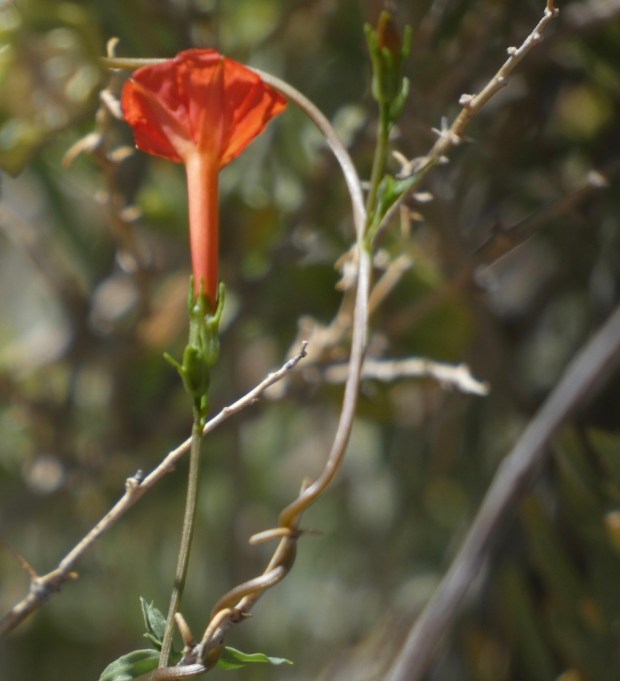
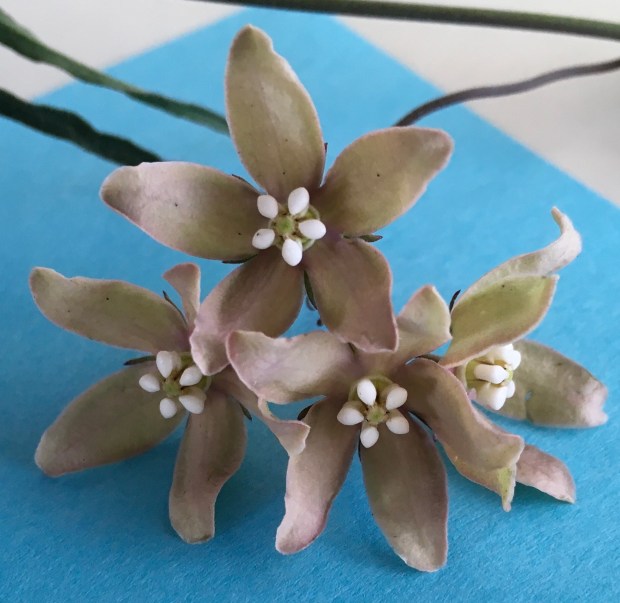
Just when I was feeling confident about the morphology of the milkweed family of plants, a new twist on the familiar leaps out shoutin’ “ Hey, lookie here!” Expecting to see a common vine gracefully twirling its way up a desert shrub, I paused ……. searching for the crimson red trumpet-shaped flowers of Ipomoeacristulata (Trans-Pecos morning glory). But instead there was an umbrella of 5 flowers, each with 5 widely spreading greenish-brownish-mauve colored petals crowned in the center of an unmistakable floral corona, a sure fire characteristic of a milkweed! Could it be?
Trans-Pecos Morning glory
Oh Yes!
This unexpected, undeniable discovery had me puzzled though. It’s been two years since I created a detailed post about the Asclepias genus of milkweed (see Summer Botany: Meet the Milkweeds). At that time and throughout the decades prior, my knowledge of milkweeds was limited to Asclepias, and the specific characteristics of that genus.
Spreading petals of Wavyleaf Twinevine
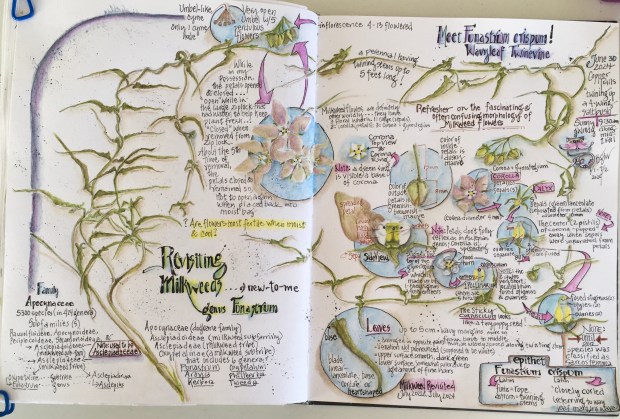
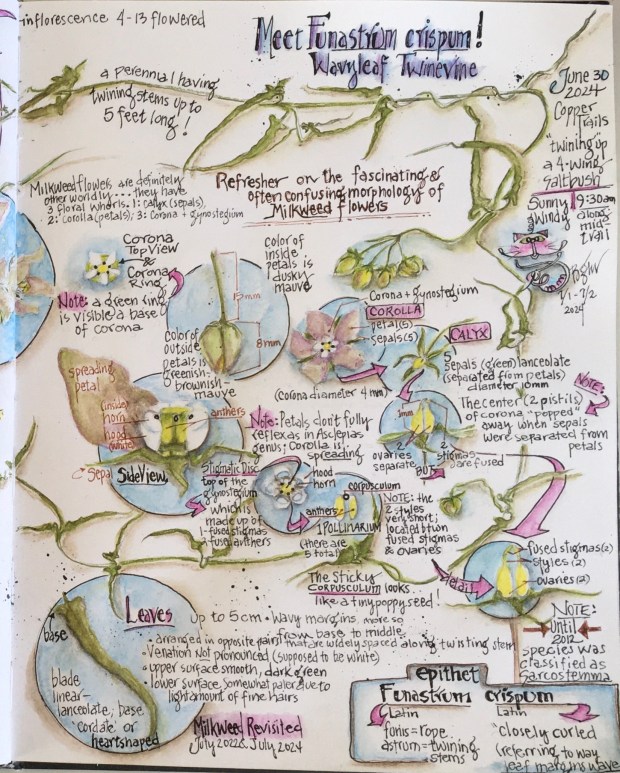
But here was something new-to-me; so worthy of whatever time it might take to learn all about this find in the dogbane family (Apocynaceae), aka the Milkweeds. I quickly confirmed this vine does not belong with the Asclepias species of milkweeds, but is of the genus Funastrum, which is Latin for rope (funis) with twining stems (astrum), commonly referred to as the “twinevines.” And the full name of this plant is Funastrum crispum, commonly called Wavyleaf Twinevine.
Most of what I uncovered about Wavyleaf Twinevine is included on my 2 journal pages, along with some confusing taxonomy involving family and subfamily names, tribe and subtribe names, and how until 2012, this plant was known as Sarcostemmacrispum. Curiosity about the taxonomic history will undoubtedly tempt me to sort through the confusion ……. maybe someday soon!
Have you discovered anything new-to-you in nature lately? What was it, and did it lease to more discoveries?
After a longer than planned for blog break, I’m glad to be back and sharing a few pages from my nature journal. Beginning in April, the riot of wildflowers popping up everywhere has, and still keeps me scurrying about my backyard, the “back 40,” and local hiking trails just to refresh my memory about familiar plant species while searching for new discoveries. I’ve been sketching daily, learning about new-to-me plants, and growing my knowledge about favorites.
Recording first seasonal sightings, it’s interesting to compare previous years’ emergence and abundance, and wonder why timings vary. For example, last year the white-stemmed evening primrose (Oenotheraalbicaulis) blanketed the hillsides with white; this year those beautiful white blooms have been scarce. Last year the tall crowded flower stems of White Point-Vetch (Oxytropis sericea) were few and far between. This year an explosion of these graceful plants that belong in the pea family (Fabaceae) began blooming in April and are still going strong!
White Point-Vetch, also called white locoweed, whitepoint crazyweed, and silky crazyweed, makes a striking bouquet that glows like a bright light as it blooms along tall flower stalks 15+ inches above bare brown ground. New stems push up through multiple dried stems packed with last year’s empty seedpods. But it’s obvious this species is an aggressive re-seeder; there are so many new plants this year where last year there were none!
It’s been a spectacular show!
Enjoying researching this species, dissecting a few fresh flowers, and searching for remnant seeds in the dried pods, kept me delving deep into the bits and pieces of what defines this group of plants. This large family, which houses well over 10,000 species world-wide, includes peas, acacias, mimosas, and licorice (see the list below for more residents).
The dried stem was drawn and shaded in graphite.
But one species at a time, please! Actually the locoweeds, which fall into the genera Oxytropis (like the White Point-Vetch) and Astragalus, contain over 600 species world-wide, 21 of which grow in the U.S. Many plants in these two genera are toxic, particularly to domestic ungulates. More about the toxin and what happens when these animals ingest even small quantities, along with other interesting facts are described on my two journal pages. ……
There is so much more to learn about this important family of plants, but I’ll save that for another post.
Thanks for stopping by and have a safe and happy Memorial Day weekend!
Thanks for stopping by …… have a safe and happy Happy Memorial Day!
It’s Spring in my neighborhood, and not a day too soon!! Along with gusty winds carrying clouds of yellow pollen come drifts of an outrageously bright yellow ‘sunflower’ named Perky Sue.
How Perky Sue got its common name is a mystery. My best guess is this herbaceous forb, native to New Mexico, has to be the Perky-est, Happiest Spring Flower, Ever!
What is your favorite native flower signaling the arrival of Spring in your world? Does its bloom cause you to smile; perhaps you break out in your happy dance?
Thanks for stopping by …… and Happy Mother’s Day to all!
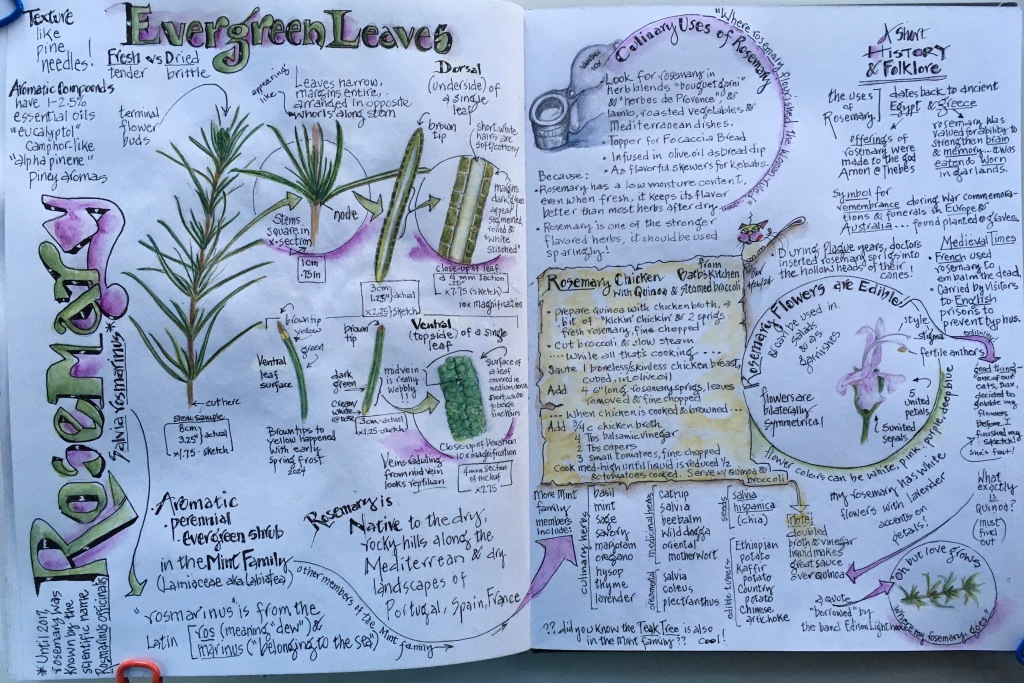
When trying to pin down exactly what’s so special about Herbs, a deliciously aromatic group of plants, I was stumped. Well, maybe not stumped, exactly. There are so many reasons to fall in love with Herbs, and picking one feature or even one Herb that’s especially special is nearly impossible. Best known for their culinary flavor enhancements, can you imagine pickles without Dill, pesto without Basil, salsa without Cilantro? What’s a dark chocolate circular pattie without Peppermint, or a cookie cutter man without Ginger?
Herbs excite memories, calm the mind, reduce inflammation. Does the aroma of sage conjur thoughts of Thanksgiving? Does a sprig of lavender make you sleepy? Does bold yellow turmeric soothe arthritic joints?
And many Herbs are decorative and lovely to look at, form beautiful shrubs, have gorgeous flowers.
But I keep coming back to the aroma. It’s hard to resist crushing the leaves of herbs like thyme or mint between my fingers. The essential oils released into the air and lingering on my fingers causes me to take a deep breath, inhaling the fragrance, embedding the aroma in my brain, resulting in a memory I can recall over and over again.
Herbs are Special!
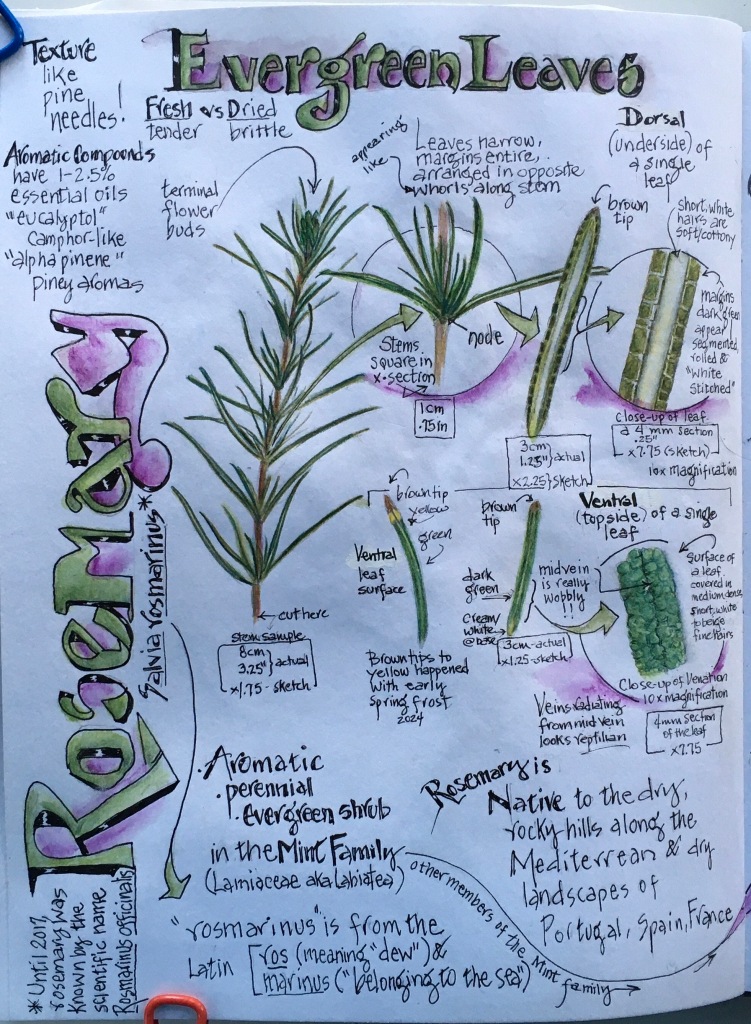
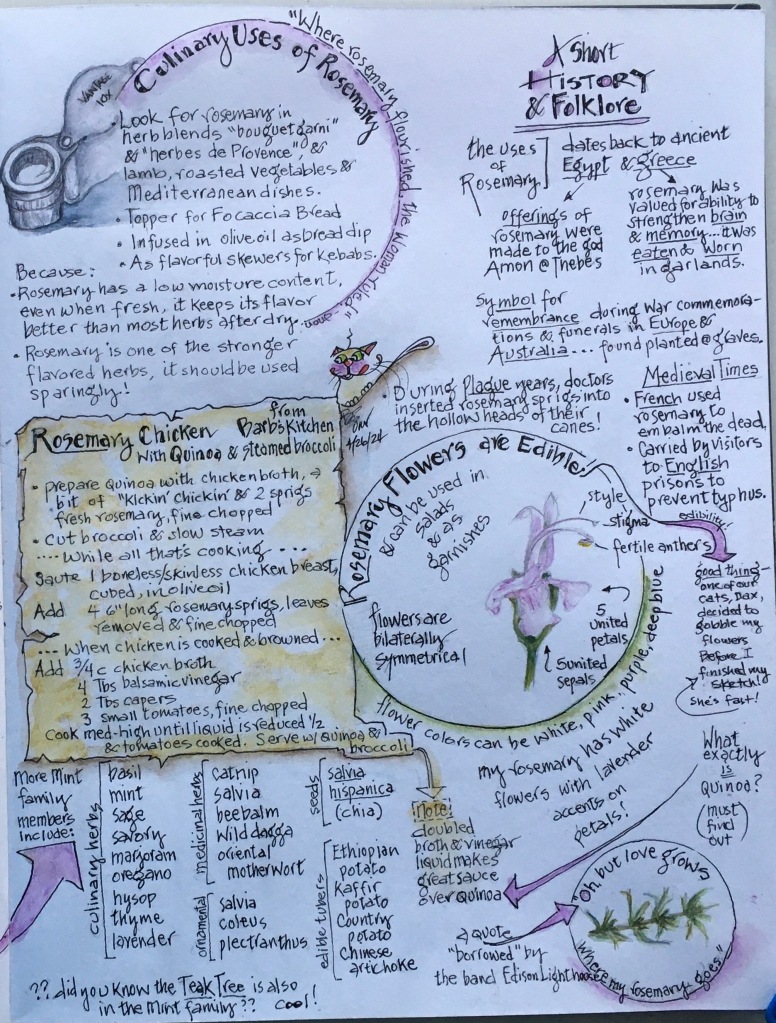
The Rosemary plant (actually a mini shrub) in my yard always invites my attention, and just this week it welcomed spring by coming into full bloom!
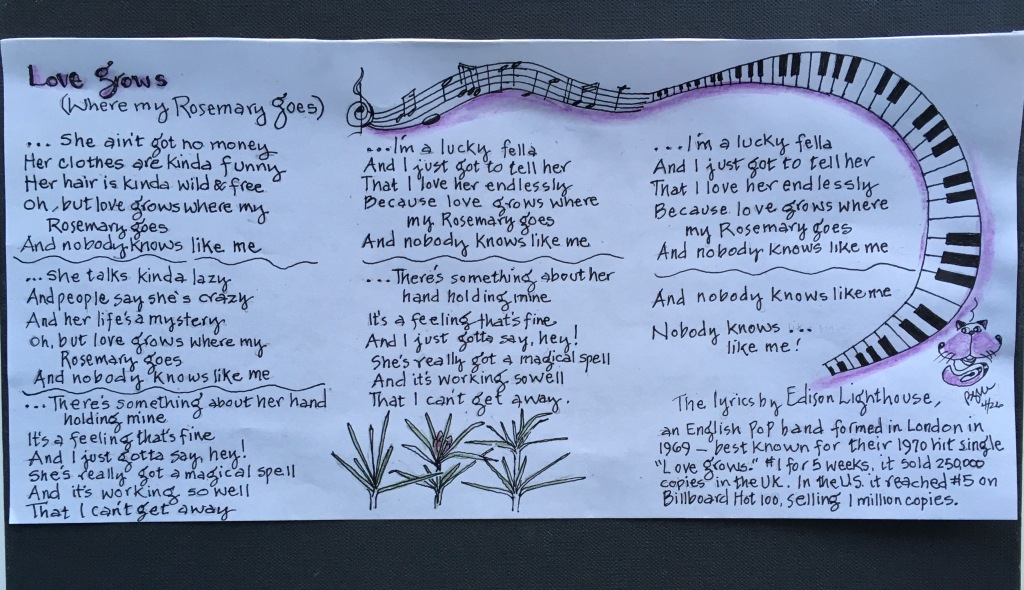
Who remembers this?! Now I can’t get it out of my head!
Do you have a favorite Herb? Why is it special? How do you use it? Please share! And thanks for stopping by!
After a well deserved rest from Inktober and from my self-imposed pressure to create something every day from a list of random prompts, I’m happy to be out again nature sleuthing. Curiosities in nature sometimes stare us in the face. But more often than not making discoveries require keen observational skills, noticing something new to you, and an ability to look for clues to a mystery with wide open eyes.
Double page post with an extra add on; all art work done with Graphgear 1000 loaded with 0.3mm 2B lead and all inked lettering done with Faber-Castell Pitt Artist Pen Fineliner, 0.3mm.
It was during a hike on an unseasonably warm day that I paused to admire the dried flower heads from one of the late blooming sunflowers. Have you ever noticed how they look like another kind of sunflower? Papery textured “petals” circle a central disk where a few weeks ago it was crammed full of puffy parachute-topped seeds. After the seeds become airborne, all that’s usually left is a slicked off surface punctuated with dots arranged in spirals radiating out from the center.
It’s hard now to imagine how extremely hot and dry the summer was this year. Without even a spittle of rain, the 100+ degree temps for weeks effectively suppressed the usual mid-season bloomers in and around the Albuquerque foothills/East Mountains. Even invasive plants, like goathead and tumbleweed, remained dormant or failed to germinate all together. It looked like winter browns had arrived early.
Then in less than a week, a small rain followed by several long downpours flooded the parched landscape, transforming browns to greens. You’ve heard this from me in a few earlier posts, but it was magical, and a reminder about the resiliency of desert vegetation.
Here’s a few pages highlighting a handful of the Late Bloomers I recorded in only 2 days. More than 2 dozen species had sprung back to life, setting flowers at all stages of accelerated vegetative growth. The landscape seemed wide awake. If plants could talk, I imagined them laughing while excitedly chanting, “hurry, hurry, hurry!” Only their roots prevented them from dancing!
In addition to the species on these journal pages, there are many (more) composites, native grasses, shrubs and sub shrubs, small forbs from Spring and early Summer actively growing and blooming right now, and (of course) the weedy invasives are growing and blooming with wild abandon.
Random thoughts and wonderings ….. are pollinators still hanging around …… or ….. how many of today’s bloomers are self fertile …… are local birds, insects, reptiles and mammals that depend on earlier summer pollen and/or fruit and seed production stressed with this timing change/availability of food sources … will there be noticeable shifts in species composition, including plants, insects, reptiles and animals (including birds) ….. what species can and will adapt to changes, and how quickly ….. etc. The answers to these and many more questions are probably best answered in coming years, if it’s even possible to answer them at all.
Have you observed vegetation anomalies that may be influenced by changes in climate? If so, please share your observations and where these changes are taking place. Meanwhile, keep your eyes wide open.
“Closing your eyes isn’t going to change anything. Nothing’s going to disappear just because you can’t see what’s going on. ……….. Closing your eyes and plugging up your ears won’t make time stand still.” – Haruki Murakami.