Native American Day/National Indigenous Peoples’ Day

October 13, 2025

Today is the second Monday in October ….. a day to pause and honor the deep roots, rich cultures, and enduring spirit of the first peoples of this land. Native American Day celebrates the history, contributions, and resilience of Native American tribes all across the nation.
Yesteryears

Native American Day honors all Native Americans. South Dakota led the way, officially changing Columbus Day to Native American Day in 1990 after a “Year of Reconciliation” was declared by Governor George S. Mickelson. California soon followed.  In recent years, the movement has gained national momentum. Many states and cities have chosen to celebrate Indigenous Peoples’ Day on the same date. Then in 2021, President Joseph Biden issued the first-ever presidential proclamation for National Indigenous Peoples’ Day, marking a significant step in acknowledging and respecting the history and contributions of America’s first inhabitants.
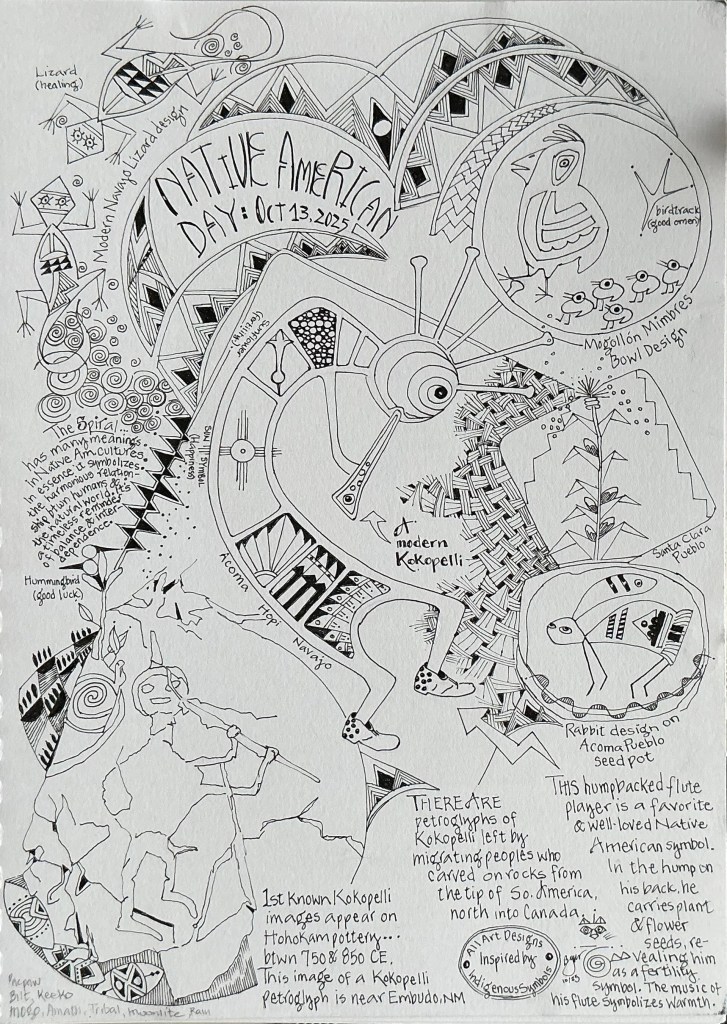
Zentangle patterns: Pacpaw, Bilt, Keeko, Mogo, Amath, Tribal, Moonlite, Rain

Present-day

Celebrating the second Monday in October is more than acknowledging the past ….. it’s a day to recognize the living cultures that continue to enrich our country’s tapestry. It’s an opportunity to move beyond stereotypes and learn about the diverse traditions, languages, and stories that have shaped this continent for millennia. Native American Day also highlights the efforts to revitalize and preserve hundreds of indigenous languages, each one a unique expression of culture and knowledge.  When we celebrate Native American Day, we celebrate the incredible diversity of traditions. Instead of a single culture, there are hundreds of distinct nations, each with its own unique customs.

Storytelling and Art Making

Native Americans have a powerful storytelling tradition of oral history, where foundational stories, lessons, and legacies were and still are passed down through generations. Many of these stories of life and culture are told through artwork, from ancient pictographs (rock paintings) and petroglyphs (images cut into rocks by pecking, incising or abrading) created by the indigenous peoples that lived throughout America, the intricate beadwork of the Plains tribes, the iconic pottery of the Pueblo peoples of the Southwest, to contemporary painting and sculpture. Native art is a cornerstone of American culture.

New Mexico Rock Art

Images painted on and carved into rock that were used in ancient storytelling can be found throughout my home state of New Mexico. Many of these sites are protected and preserved by federal designation as National historic landmarks, National Parks, and by the Bureau of Land Management as Areas of Critical Environmental Concern, and as a significant part of our Archaeological heritage. 

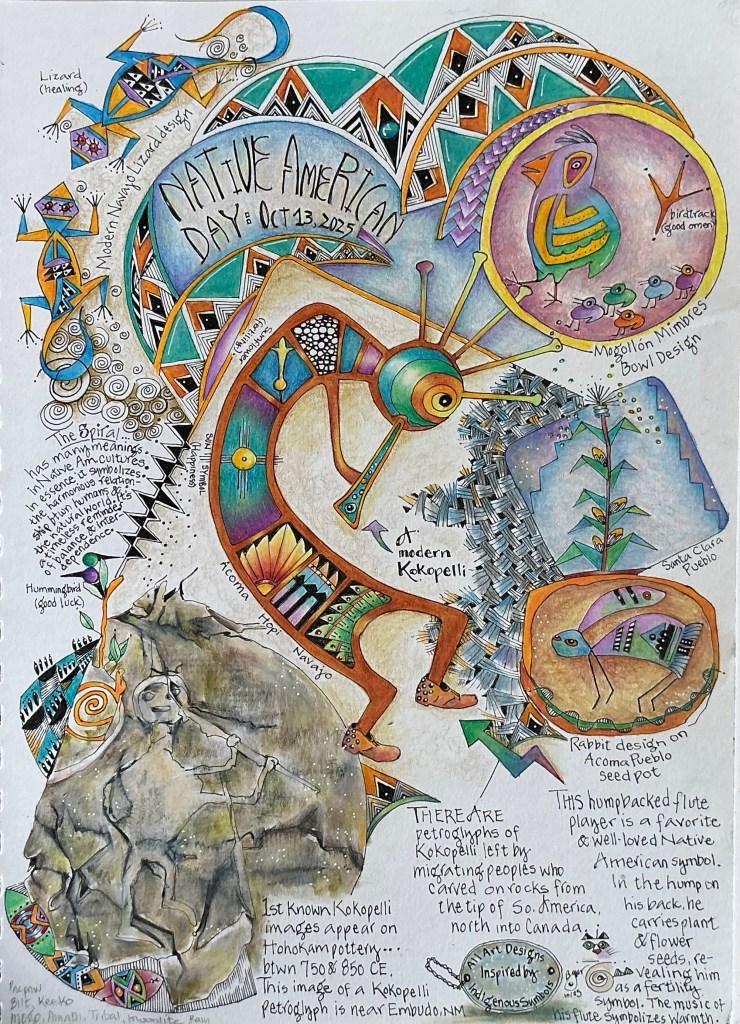
Traditional cultures and customs continue to fascinate me, and in “drawing” attention to the important contribution rock art has and continues to play, I wished to shared some of the designs (symbols) created by Native American tribes indigenous to the 4-corners region of the Southwest, with focus on those found in New Mexico. The Kokopelli symbol, the dancing flute player, is a familiar and favorite character throughout the area and has many meanings tied to fertility and harvest.  The symbol depicted shows Kokopelli with a hump in his back where he carries seeds ready for planting, while he plays his flute, a symbol of warmth. He also carries a sunflower disk flower (the ‘complete’ inflorescence) to display fertility, the Sun symbol for happiness, and several crop symbols designed by the Acoma, Hopi, and Navajo.   

A Kokopelli created in 2017 … on toned grey paper and colored with Prismacolors

The very first known Kokopelli images appeared on ancient Hohokam pottery, dating from between 850 and 750 C.E. The drawing of the Kokopelli petroglyph, in the bottom left of my panel, is inspired by one of these first images that was discovered near Embudo, NM.

Ideas to Celebrate Native American Day ….. Learn, listen and engage by …..

.…. reading a book by a Native American author, such as Louise Erdrich, Sherman Alexie or Tommy Orange,

….. exploring a museum or a state historic site to learn firsthand about the lives and history of the region’s tribes,

….. purchasing authentic arts, crafts, and goods from Native artists, which directly supports and helps preserve their cultural practices,

….. attending one of many community- or university-hosted talks, film screenings, or celebrations such as a  powwow

Thank you very much for stopping by!
Red Barberry – An Unforgettable Encounter

July 23, 2025

When you think of ‘Barberry,’ does a shrubby knee-high landscaping bush that transforms to flame red in the fall, come to mind? If so, you may have seen hedge rows of the plant known as Japanese barberry ……

Japanese barberry (Berberis thunbergii) is a non-native shrub that was introduced from Japan in 1875 as an ornamental that’s planted for erosion control and as a living fence. But this invasive shrub outcompetes and displaces native plants, alters ecosystems, and is a host species of black-legged ticks that carry Lyme disease. 

When you think of ‘Holly,’ does a plant with boughs of prickly green leathery leaves naturally ‘decorated’ for the holidays with red berries, come to mind? If so, you’re likely familiar with the iconic American holly ……

American holly (Ilex opaca) is a native shrub of eastern and south-central U.S. that grows well in both dry and swampy soils. The plant, which is also cultivated as an ornamental, forms thick a canopy cover for birds and other wildlife, and the female plants produce an abundance of shocking red berries, loved by birds but poisonous to dogs, cats and humans. Regardless of the risk, bountiful quantities of leafy boughs and clusters of red berries are harvested each fall and brought indoors to create holiday wreaths and other seasonal decorations. 

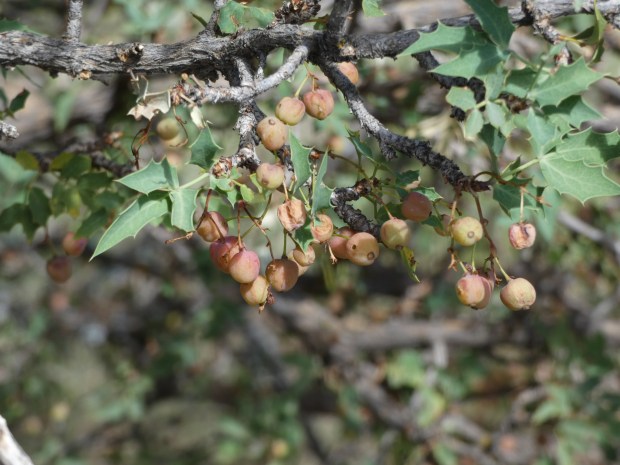
Red Barberry berries beginning to ripen

Now imagine you’re hiking in a pinyon-juniper forest of the American Southwest. You decide to bushwhack to a connecting trail and all of a sudden find yourself hopelessly stuck in a 10 foot high shrub covered in juicy red berries and very prickly holly-like leaves. This large (somewhat familiar) shrub is a surprisingly effective barricade; a formidable fence. You’ve become entangled in thousands of armed leaves preventing your forward or backwards movement without getting seriously poked and stabbed!

Is this the desert variety of American holly? Maybe it’s the giant living fence of a Japanese barberry gone rogue?

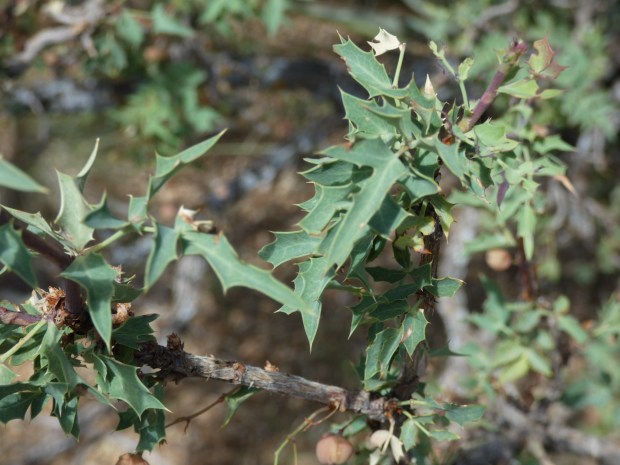
Nope! It’s neither. You’ve stumbled upon (into) a hardy specimen of the desert Southwest native Red Barberry (Berberis haematocarpa). But no wonder you were confused. This shrub, which can grow to 13 feet tall and nearly as wide, has an abundance of holly-shaped leaflets armed by a sharp spine on each lobe tip. And if birds haven’t devoured all of the red berries, you may find an ample supply of a refreshing (albeit tart) snack while you carefully and oh-so-slowly free yourself from the shrub’s embrace.  

Red Barberry leaves – each lobe tip is armed with a needle-like spine

By now you’ve created lasting memories of Red Barberry, and have promised to always be alert for surprise encounters when visiting the desert island Southwest.  

The hiking scenario above conjured up one of my hard-learned lessons from 8 years ago. Having just moved to New Mexico, Roy & I began avidly hiking local trails. Wishing to master the native flora as quickly as possible, one day I discovered clusters of red berries hanging inside the leafy canopy of a 5 foot shrub. What could they be?! Only having eyes for those juicy berries and an irresistible urge to gather a bunch for closer inspection, I plunged my open hand through several layers of small leaflets and successfully clutched a cluster. It was then I realized those spiny leaflets had poked, scratched and even penetrated my bare skin, as evidenced by tiny trickles of blood dripping from my hand and arm! Now that I had captured those pretty berries, it was obvious they had to be released to permit me the delicate maneuvers required to free my arm and minimize further injury. It was that day that I learned all about Red Barberry; lessons that will likely stick with me always!

Red Barberry berries amid armored leaves

Since that close encounter 8 years ago, it’s no surprise I’ve never been a big Red Barberry fan, until ……             

Spring Super Bloom

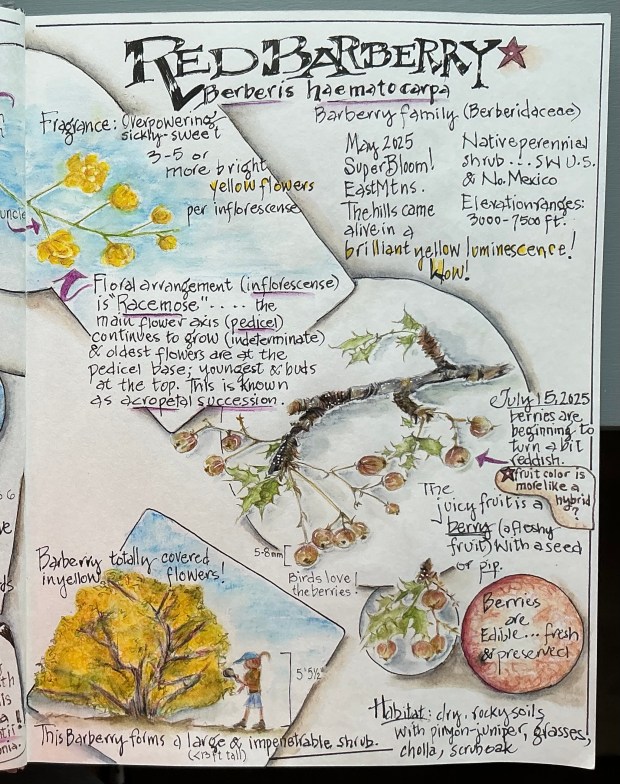
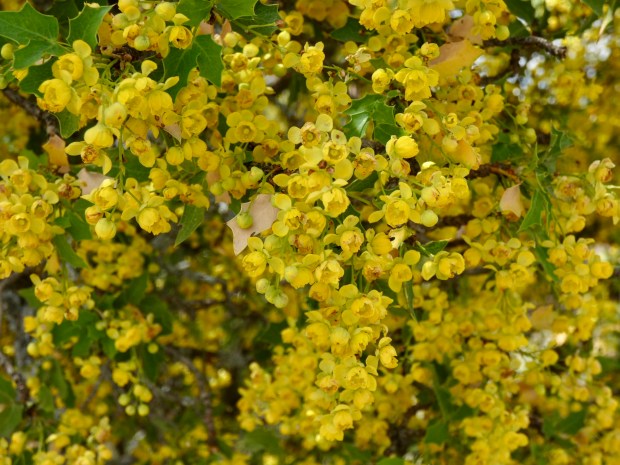
…… this past May a 13 foot tall plant in front of our home burst out in the most spectacular display of sunshine yellow flowers, literally covering the entire shrub front to back; top to bottom! The fragrance was overwhelming for the entire 2+ weeks the flowers were in bloom.  And not only our Barberry was in full bloom, but about a dozen more barberries in our neighborhood and surrounding area were also covered in vibrant yellow. It was an amazing sight, causing me to figuratively re-embrace the native Red Barberry!  

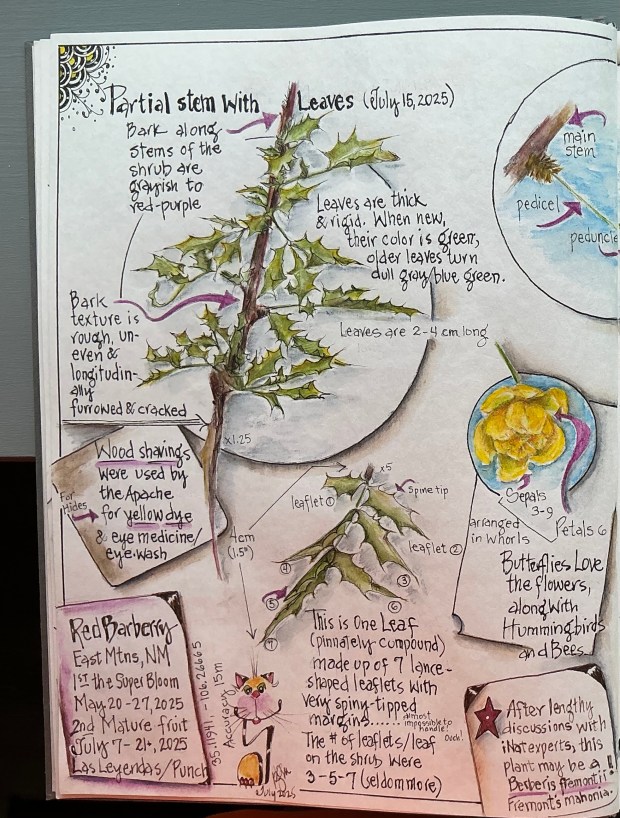
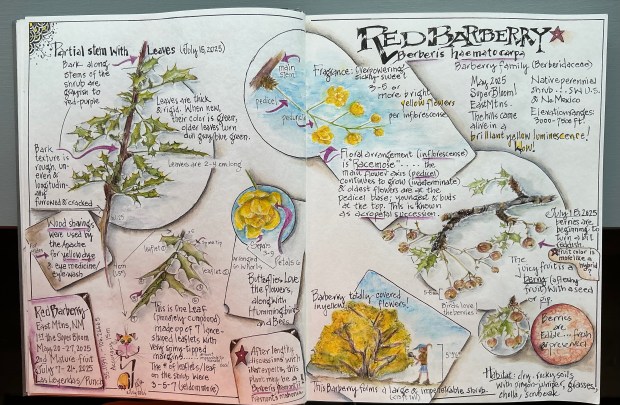
For more tidbits about Red Barberry, browse the text and illustrations displayed on my journal pages.                            Hope you enjoyed this post. 

As always, thanks for stopping by!

P.S. In case you’d like to know about the etymology of the name Berberis haematocarpa……   ‘Berberis’ is a Latinized form of the Arabian name ‘barbaris, for barberry.  “Haematocarpa” means ‘blood-red fruit’ referring to the bright red berries produced by this shrub. The word is derived from the Greek words “haima” (blood) and “karpos” (fruit).

September “Littles” …. featuring a “Little” Road Trip Full of Fun Discoveries

September 17, 2023

Ahhhh, September! The month of slowing down, hints of crisp morning air, tree leaves turning ever so slightly from green to golden, a bit of wanderlust satisfied. 

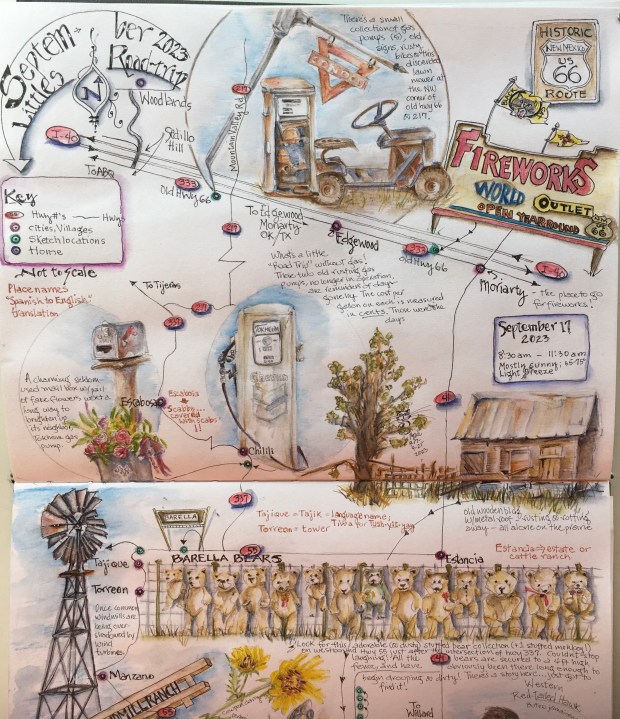
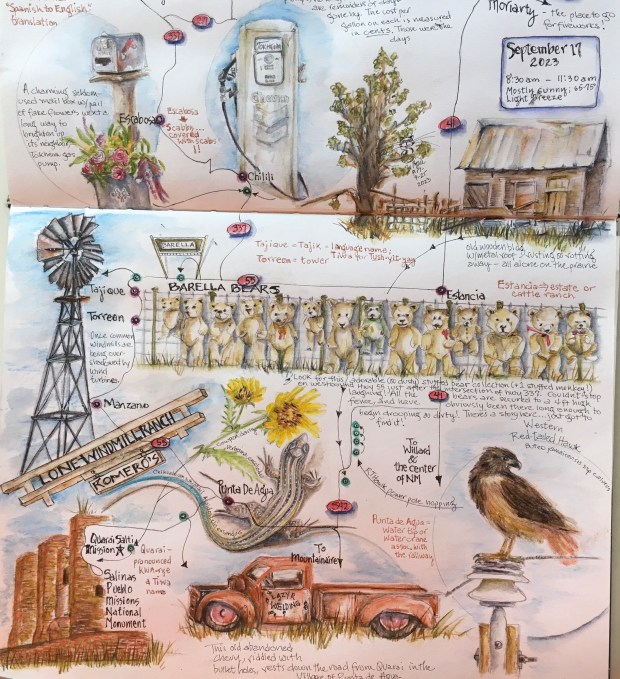
Instead of creating “Little” paintings of a month of highlights, and there have been many, I decided to focus on a single “Little” road-trip down the east side of the Manzano Mountains. My goal was to take a fresh look at, well, everything …….. and watch as the story of rural life unfolded. 

As we wound our way along scenic backroads, I mentally sketched out our route map to depict some of the historic and present day highlights across the landscape.  My imagination envisioned the full, prosperous and peaceful village life of the Tiwa Indians, and their conquest and struggle to survive Spanish occupation. There was evidence of the optimistic outlook of early settlers who came west to build a life centered around dryland farming and ranching.  And today, modern day ranchers live on the land adjacent to land grants where indigenous peoples live a rural lifestyle on their native lands.  I hope you enjoy my route map with some of these highlights, ranging from serious to funny, natural to commercial. 

I’d love to know what story unfolds for you as you travel along on this September “Littles” Road-trip. Be sure to pack a lunch! 


Once again, a big shout-out to “Made by Fay” for the inspiring “Littles” idea! These pages are fun to create, and remind me of monthly highlights and the random road-trip as I revisit my previous “Littles” posts. Hope you’re enjoying them too, along with the ending days of the season.
Stay tuned for the next installment of “Littles.” 

September 26, 2023

Chapter 230801: Flambé’s latest Misadventure ………………. August’s Full “Sturgeon” Moon  

Have you ever seen a living dinosaur? If you’ve seen a sturgeon, then count yourself among the lucky few. If not, a visit an aquarium where these 10 foot + fish are on display, will amaze. There are more than 2 dozen species of sturgeon worldwide, but in celebration of the August 1st Full Moon, look close as it rises and imagine an image (or 2) of the North American species of sturgeon swimming gracefully across the Moon’s smiling face.
Keep on reading to learn more about the August Full Sturgeon Moon and Flambé’s encounter with not one, but two of these incredible fish!

Continue reading “Chapter 230801: Flambé’s latest Misadventure ………………. August’s Full “Sturgeon” Moon  “

Chapter 230703: Flambé’s latest Misadventure ………………. July’s Full “Buck” Supermoon  

“Your growing antlers are proof of your intimate place in the forest—for of all the things that live and grow only the trees and the deer shed their foliage each year and replace it more strongly, more magnificently, in the spring.” – Felix Salten

A Fairy Tale in Silhouette – as told by Flambé 

Once upon a cloudless night, in a field of Warts ‘n Wobbles, roamed a fabled Vipson deer. The young buck, proudly dressed in softly felted antlers, quietly sniffed the air. He detected an artificial Hush afoot; a loud quiet in disguise, deeply hidden in newly-cropped Walu. His common-sense caution, an inherent trait which has served Vipson for as long as a day is honest, was suddenly overcome by his curious nature. Even tangles of braided Irevir wound tightly around his hooves were only momentarily effective in distracting the buck from investigating. The lush Oasis he called home has surely been invaded by a PdA …… a pesky darn anomaly, a peculiarity desiring admittance, a paradoxically divergent aberration ….. and the source must be rooted out, tout sweet!

don’t stop now! …………

Continue reading “Chapter 230703: Flambé’s latest Misadventure ………………. July’s Full “Buck” Supermoon  “

Chapter 230603: Flambé’s latest Misadventure ………………. The Full “Strawberry” Moon of June.   

mmmm, mmmmm, mmmmmm ….. 

Strawberry Fields Forever ……. John Lennon

I tried to resist, but why? And that’s exactly what Flambé thought when on this night of the Full June Moon, a delectable “forever” buffet of royal red strawberries glistened with sweet goodness before her. Read on to discover how Kat finally decided which one of the countless strawberry confectioneries sprawling before her, she indulgently picked. Spoon optional! 

Continue reading “Chapter 230603: Flambé’s latest Misadventure ………………. The Full “Strawberry” Moon of June.   “

Chapter 230505: Flambé’s latest Misadventure ………………. May’s Full “Flower” Moon

“The Full Moon of May brings bright brushes to paint the Earth canvas with infinite flowers. In the Full Moon light of this month, the flowers are said to grow at night, and even dance in honor of the moon.”

Kat and an entire family of hares …….

Continue reading “Chapter 230505: Flambé’s latest Misadventure ………………. May’s Full “Flower” Moon”

Summer Botany: Wild About Wild Potatoes

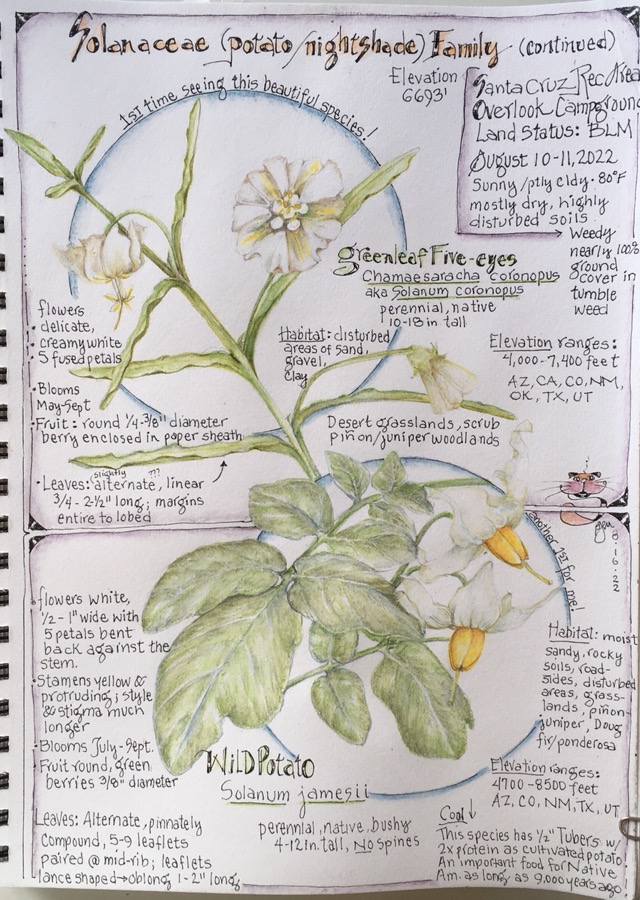
One of the weediest places we camped during our recent Reservoir tour, Santa Cruz Recreation Area, became a floral hot spot of discovery, at least for me. I shared a photo sampling of some of the flora in my last post……

Two new-to-me members of the Potato family really stood out. A plant called Greenleaf Five-eyes and another simply called Wild Potato.

Continue reading “Summer Botany: Wild About Wild Potatoes”

Summer Botany: My “Crayola” Potato

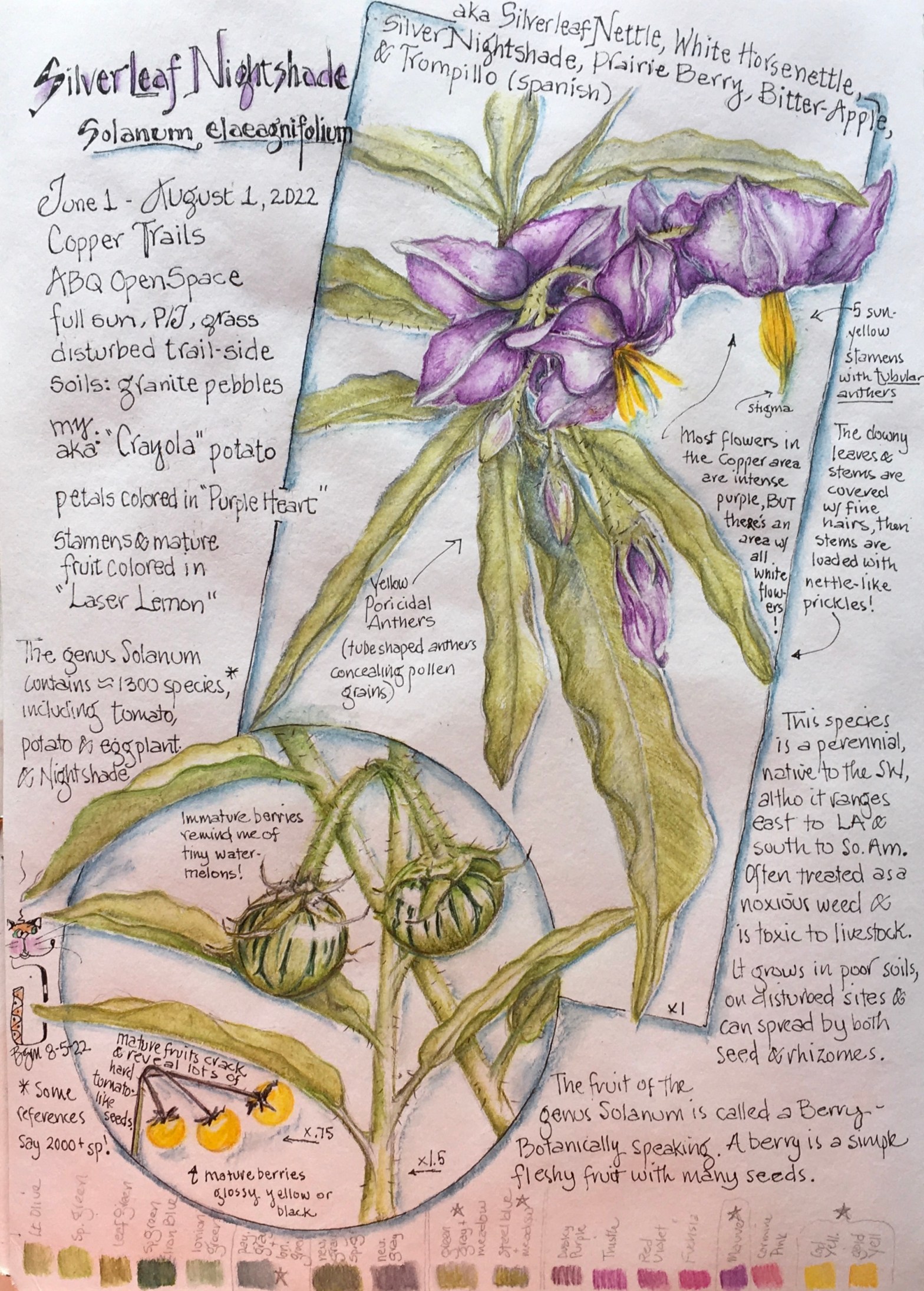
Oh I do love purple …… not sure why? Anything purple and any shade of purple ….. even a hint of purple will do! As a kid (then and now) my most treasured possession was a new box of crayons. Breaking the seal and inhaling that delicious aroma of color (admit it …. you know the smell) was only the first step in my love affair. Removing each crayon, one-by-one, and taking them for a test drive soon followed, with special care and attention paid to the purples, with names like ……….

Vivid violet, wisteria, twilight lavender, pearly purple, purple pizzazz and purple mountain’s majesty. Who wouldn’t love cyber grape and lilac; or plump purple and sugar plum. How could here be so many purples!

So when I literally stumbled into a mound of the exquisitely purple-hued Silverleaf Nightshade, my surprise and delight was audible. While carefully removing countless nettle-like prickles from my hands, Roy heard me explain, “My “Crayola” Potato!”

Continue reading “Summer Botany: My “Crayola” Potato”

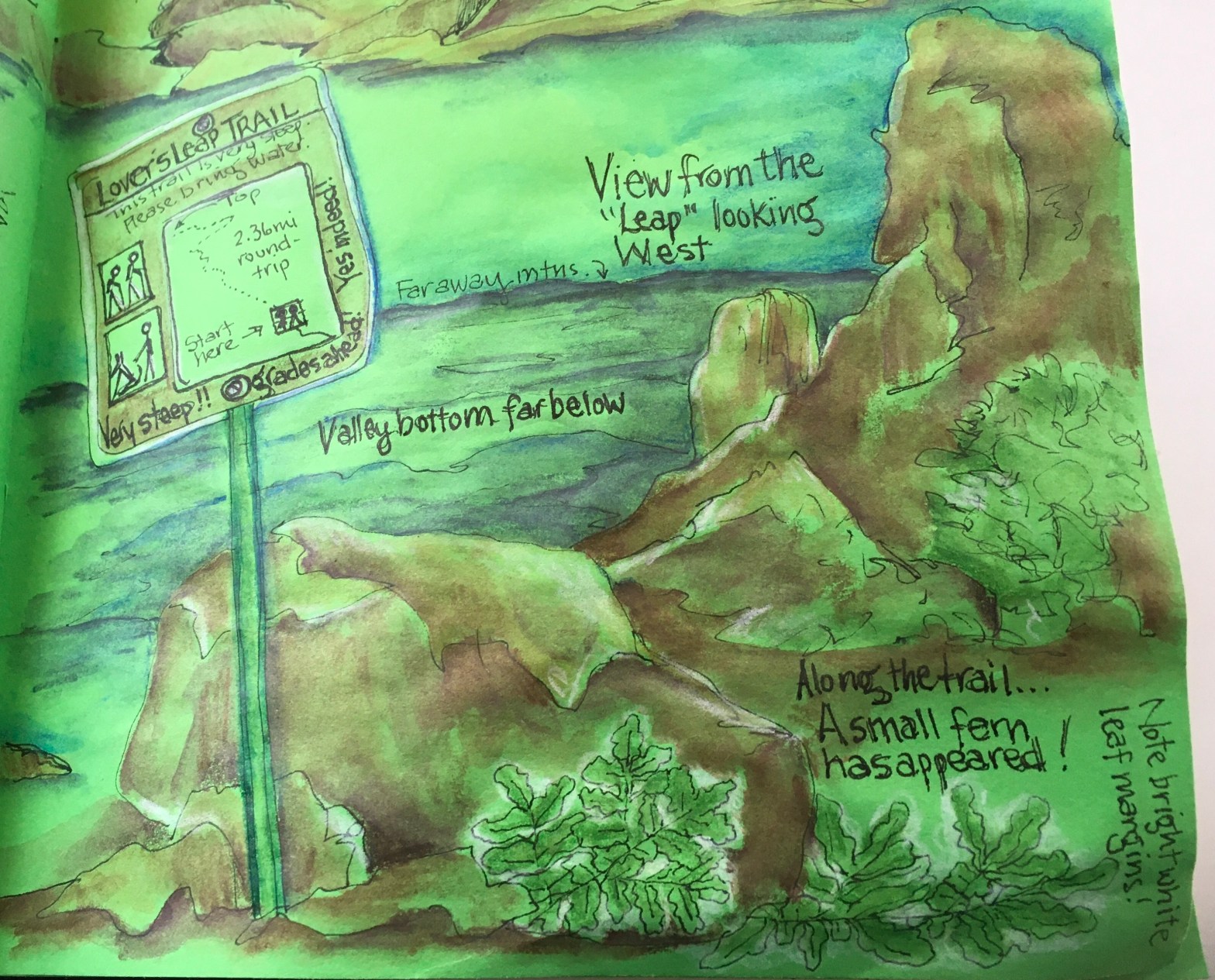
Travel Journal, Escapito #1, 2022: Exploring Southern NM

March 14-18, 2022

New Mexico, our home state, is a wonderful state to explore, and this little 5 day Escapito lived up to expectations.  Over 650 miles round-trip, from central NM south and then east, we visited  3 new-to-us state parks, and revisited one of our favorite Bureau of Land Management campgrounds. Our main objective was to find migrating birds; those coming north from south of the border to breed in the US, and those that overwintered along the Rio Grande River corridor and are heading way north to Canada and Alaska.  We found some beautiful birds while exploring some very rugged country to within 12 miles of the Mexican border. 

With my travel journal in hand, I was able to capture a few pages of images and notes from the week. 

Continue reading “Travel Journal, Escapito #1, 2022: Exploring Southern NM”