Ohhhhhh, what a sweet month …… August. It almost got away from me without sharing a small collection of Littles1 that reflect the inevitable shifts in nature that occur during the month. It’s always hard to imagine summer winding down; where did the time go? But as surely as butter melts on freshly baked bread, undeniably, August forms a reliable bridge between summer and autumn. It’s a time of change and transition; abundance and harvest; transformation and a period of letting go.
So before I “let go” and before the snow flies (and it will), here’s a handful of little discoveries during the month of August:
-A female Wheel Bug gone slightly astray while searching for a protected place to overwinter the eggs she’s about to lay.
-A female Soldier Beetle doing her best to attract a mate by sending out pheromones while munching late season pollen from the disk flowers of a brilliant yellow Showy Goldeneye.
-An acorn that made it to maturity, ready to drop beneath a still green-leaved Gambel Oak soon to be decked out in radiant fall colors.
-Some hot red trumpet-shaped Scarlet Gilia flowers, still irresistible to hummingbirds until migration, will all be pollinated in time for seed set and mature.
-The snowy white fruit dangling from the draping branches of Roundleaf Snowberry shrubs are ripe and ready for plucking by hungry birds flying south for the winter.
-And plump purple-black Chokecherry berries that will become a juicy dietary supplement for black bears needing to bulk up for hibernation.
Enjoy!
And as always, thanks for dropping by!
1“Littles” is part of a blog series I began posting several years ago, beginning in January 2023. The concept was inspired by Fay (thanks again Fay!) who came up with the idea for her blog madebyfay.wordpress.com
Part 3 ….. An Allelopath Declares Chemical Warfare
August 15, 2025
The more I learn about Cowpen Daisy (Verbesinaencelioides), the more the words Intrepid (fearless and bold), Interloping (meddlesome and smothering), and Impertinent (pushy and rude) come to mind.
Cowpen Daisy is literally a plant at war …..
Its adversaries are neighboring plants …..
Its weapons of choice are chemicals ….. 151 different Allelochemicals2 to be exact.
Cowpen Daisy shows no mercy to its most susceptible victims, and given the right conditions in the right locations, Cowpen Daisy can cripple ecosystems, and unravel biodiversity.
Oh No! What Have I Done! Have I unleashed a formidable enemy to run amok, bullying its way through our mostly intact biodiverse high desert ecosystem?
Maybe not! (Spoiler alert…… Allelopathy3can be bad, but I still love this happy Daisy)
On August 6th, I received an excellent question from one of my blog followers, based on my first Cowpen Daisy post :
“Do you have any concerns about this becoming an invasive plant? Best wishes, Nancy”
In reply, I expressed my concern about the number of “seedlings coming up late spring,” and how “I was definitely alarmed and wondered about the need for early control.” Fortunately, “as the season advanced, it became clear the density of plants seemed self-controlling.” Based on my limited experience with Cowpen Daisy, I explained how during the summer of 2023 “the plant completely covered an extremely large field near our home,” causing me concern about its invasive tendencies. But upon “[R]eturning the following year (2024) and again this past spring (2025) to see if the same field was blanketed again in these plants, “I couldn’t find a single Cowpen Daisy anywhere! So no, this annual [doesn’t appear to be] “invasive, at least not in central New Mexico.”
But Nancy’s question prompted me to dig deeper into on-line research. I wondered: Is Cowpen Daisy invasive outside of its native range, particularly where conditions are ideal for its aggressive growth? Yes, it is! And its invasiveness is further enhanced where neighboring plants are susceptible to the impacts of the allelochemicals released by Cowpen Daisy’s leaves, roots and decaying leaf matter in the soil.
One example where Cowpen Daisy is an introduced species and has become invasive is in India. Fields of mung bean, corn, chickpeas, and sweet melon are being outcompeted by invasive stands of Cowpen Daisies. These food crops are severely impacted by two allelochemicals released by the both roots and leaves of the Daisy; steroids and phenols. Studies of these four crops demonstrated not only “the suppression of germination and growth in these plants” but “also revealed an antagonistic effect on [their] chlorophylls, carotenoids and protein levels.” In other words, Cowpen Daisy is winning the war against India’s mung bean, corn, chickpea and melon crops, and farmers are currently engaged in a battle to develop a strategy of control and run this biological enemy out of their country.
Cowpen Daisy is only considered a native species to the Southwest U.S. and Northern Mexico. However, it has been introduced (either intentionally or by accident) and is considered naturalized in parts of Eastern North America, the Middle East, Spain, Argentina, Australia and the Pacific islands. As such, Cowpen Daisy’s nature to drop allelochemicals everywhere it grows allows it to behave like an invasive plant in countries where it is naturalized. Without diligent management (via herbicide application or mechanical control), it can thrive to the detriment of their desirable plant species’ survival.
Have I defeated my goal of reestablishing a diverse native plant community in disturbed areas surrounding our new home? “Not likely,” says I, optimistically! In addition to Cowpen Daisy, the variety of native plant species I intentionally seeded last fall and early this past spring, have germinated, grown, flowered and seeded or are in the process of flowering and seeding, most of which are adjacent to a Daisy. Of course time will tell. Meanwhile, I’ve declared this to be a happy ending to this post and my stand of happy Cowpen Daisies! However ……. next spring, if germination rates from my reseeders are low or zero, but Cowpen Daisy returns with renewed vigor, then I have a control job waiting for me. And the best advice I’ve read is to “pull out old plants and roots and selectively remove new seedlings.” That’s acceptable! That I can do!
Until then!
Do you struggle with weedy, invasive plant species in your garden or yard? Have you seen fields of blooming weeds and wondered …… “what weed is that?” Do you know the names of those pesty plants and do they seem to keep your favorite variety of cucumbers from growing? It might be interesting to learn if your local invasives are one of the many Allelopaths happily growing in our world! Let me know!
As always, thanks for dropping by!
1Cowpen Daisy is known to release up to 15 different allelochemicals2 from its leaves and roots, such as guanidine, phytosterols, phenolic acids, tripertenes, flavonoids, dicarboxylic acids, phytophenols, steroids, phenols, and others. Fresh and decaying leaf litter leach 14 of those allelochemicals into the soil.
2,3Allelopathy is a biological phenomenon by which an organism produces one or more biochemicals that influence the germination, growth, survival, and reproduction of other organisms. These biochemicals are known as allelochemicals and can have beneficial (positive allelopathy) or detrimental (negative allelopathy) effects on the target organisms and the community. Allelopathy is often used narrowly to describe chemically-mediated competition between plants. Allelopathic interactions are an important factor in determining species distribution and abundance within plant communities, and are also thought to be important in the success of many invasive plants. (source: Wikipedia)
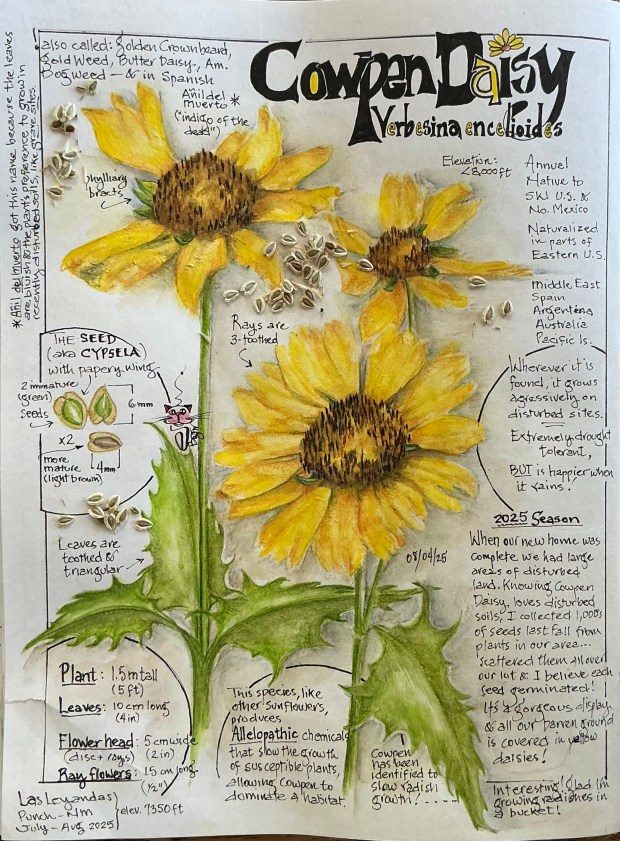
While compiling last week’s post about the happy Cowpen Daisy party taking place outside our back door, it was no surprise to find way more interesting info about this sunflower than could ever fit on my journal page. Decisions …… decisions! To keep the August 5th illustrated page relatively uncluttered, I decided to include just the botanical basics (mostly), focusing on Cowpen Daisy flowers, leaves and seeds.
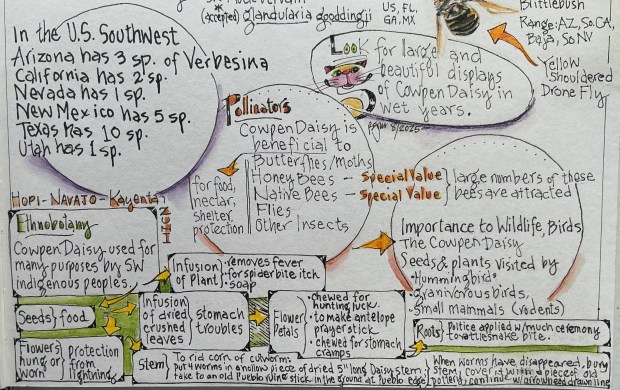
Then the past week I found my nature journal wide open to a blank page, ‘begging me’ for another Cowpen Daisy entry ….. “What about all those interesting info bits?” she asked. Replying* to my journal with a hearty, “OK,” I proceeded to locate and gather my rabbit-trailing notes. This scavenger hunt reminded me just how many pages there were; so many fascinating things about the Cowpen Daisy I wanted to remember and share. Decisions …… decisions! How to keep this next post to one page? By limiting the topics to only three, was it possible?
Barely! (after some clever editing, not a single word dropped off the page)
A little bit closer view for those without a microscope!
P.S. By the way, you may have noticed I’ve indicated this post is Part 2 of what’s now become my Cowpen Daisy series. Unless I start journaling on larger than 8” x 11” paper, there’s likely to be more Parts in store. And this multi-part series resulted in a minor edit to last week’s post, not titled “One of the Happiest Sunflowers Ever! The Cowpen Daisy; Part 1 ….. Can There Be Too Many Sunflowers?” In case you missed it, please check it out here.
*Yes, you read that right; I talk with my nature journals. Don’t you? After all, we do spend quite a bit of time together!
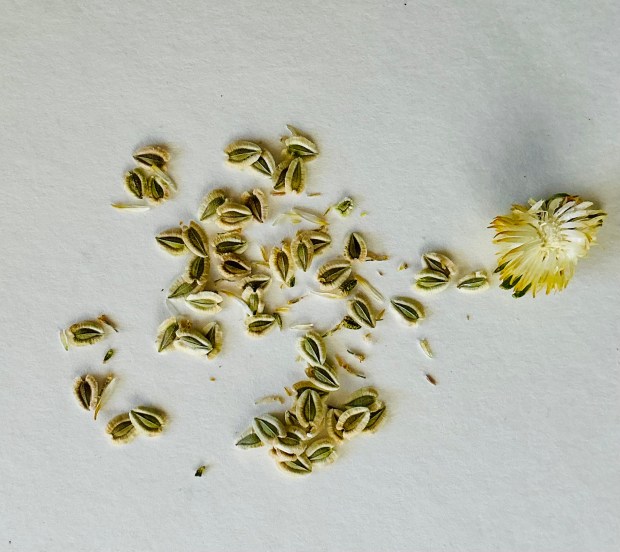
It was the Fall of 2024. A small cluster of Cowpen Daisies (Verbesinaencelioides) flourishing on the severely disturbed ground surrounding our new home was going to seed. Waiting several weeks until the migratory birds ate their fill, I spent an hour or so collecting as many remaining dried seeds (cypselas) as possible, stuffing full two quart-sized ziplock bags. About 1/3 of the seeds I scattered around the house where they would overwinter on the ground. The rest were poured into large pill vials that were labeled with species name, location, and date, then placed in the refrigerator to simulate cold storage until Spring.
Cowpen Daisy cypselas (seeds) 08/04/2025 at Punch
It was late April 2025. The chances of heavy frost seemed a distant memory. My fingers crossed, I chose a sunny 42 degree morning to liberate those refrigerated seeds from 6 months of cold storage, and scattered them in disturbed areas not seeded last Fall. Then I waited like an expectant parent, watching for signs of germination, worrying that runoff from late season snows might wash away my scattered seeds, expecting that flocks of migratory birds would gobble them all up, and hoping for gentle rain showers to swell those thousands of seed coats to aid those tiny embryos in growing their first roots (radicles) and first leaves (cotyledons).
Then early June 2025. Success! Cotyledons were literally popping up everywhere, which meant the radicles were already expanding into the soil. They were especially crowded where I’d scattered all the cold storage seeds, and germination was obvious where seeds had been scattered the Fall of 2024. By early July, those Cowpen daisies were crowding out many of the other native species I’d also seeded in the same areas.
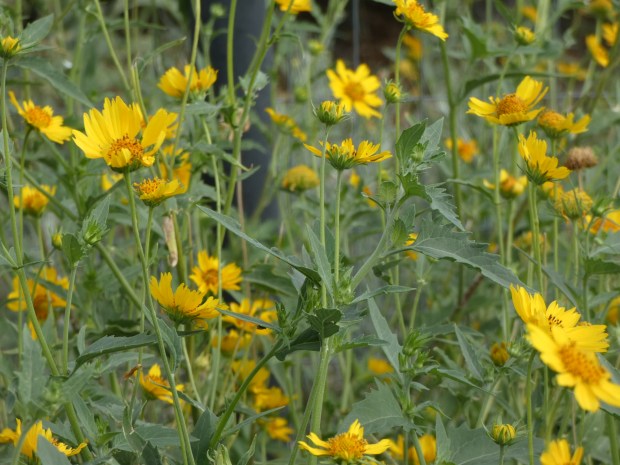
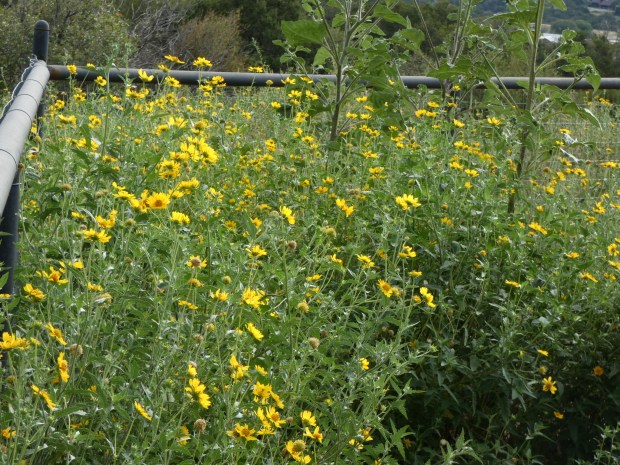
Backyard and overflow Cowpen Daisies, robust growth after Fall 2024 seeding (08/03/2025)
And now it’s early August 2025, and what a dazzling show! Even though the sunflower yellow flowers of Cowpen Daisy are small (2” wide), there are up to 75 long-stemmed flowers on each plant that can grow from 4-5’ tall! They are so dense, the backyard fence is hardly visible, our walking paths are totally draped with 4” long leaves, and if there’s a rattlesnake lurking around under our massive Cowpen Daisy canopy, we’d probably (hopefully) hear him well before he slithered into view!
Goals and Lessons Learned
I’ve learned a lot by parenting these Daisies; from the best time to scatter seed (in the late Spring following cold storage) and where (not so close to other desirable natives or pathways), to managing the mass of growth (by organizing through selective removal). Our initial goal of seeding and growing native plant species was to attract and help feed wildlife (pollinators, reptiles, rodents, birds and mammals), and we are optimistic that achieving this goal long-term seems realistic with the success we’ve had to date. However, because so many of our native plants are losing the battle against habitat loss caused by invasive species encroachment and takeover, land development, and climate change, we will continue to explore ideas to expand our initial goal to address the habitat situation. As we gain insight about the best native plants to grow to help restore our disturbed soils, we will learn and share with our neighbors those species that: are drought tolerant; aid in building soils; are effective at invasive weed suppression; provide wildlife benefits; and increase plant diversity.
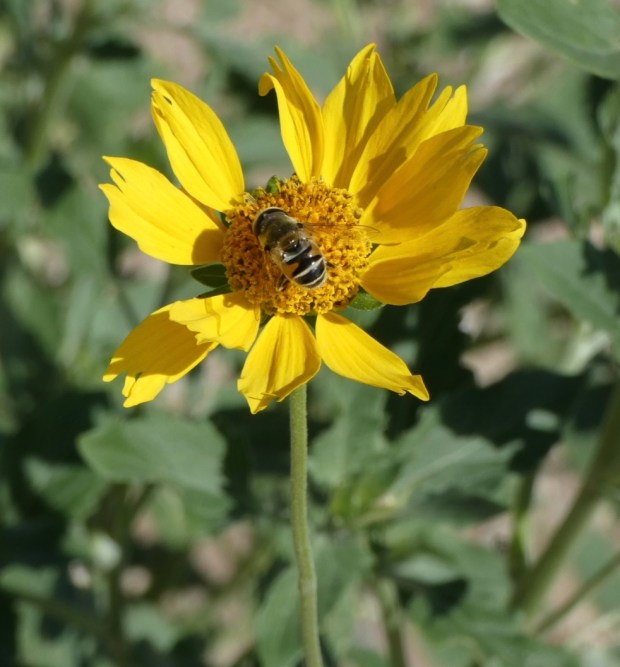
Cowpen Daisy and pollinator 08/01/2025 at Punch
Happy – Happy – Happy! Will I be collecting Cowpen Daisy seed again this Fall? You bet! Having all that sunshine yellow around our home is thrilling. Every morning all those thousands of sunflower faces looking East towards a new day are about the happiest sight ever! And having such wild, uninhibited growth of a native annual out our back door has been ideal for observing the pollinators that benefit from the abundant nectar and pollen, enjoying the aerial acrobatics of several phoebe families that have been feasting on those pollinators, and promises to be a perfect spot for bird watching this Fall when all those cypselas ripen into high protein food.
Can’t wait!
Do you ‘know’ a special native plant? How about a native butterfly garden? Are you a bird watcher? Maybe you enjoy the occasional deer, coyote, or bobcat wander through your yard? Please share your favorite wildlife encounter!
As always, thanks for stopping by!
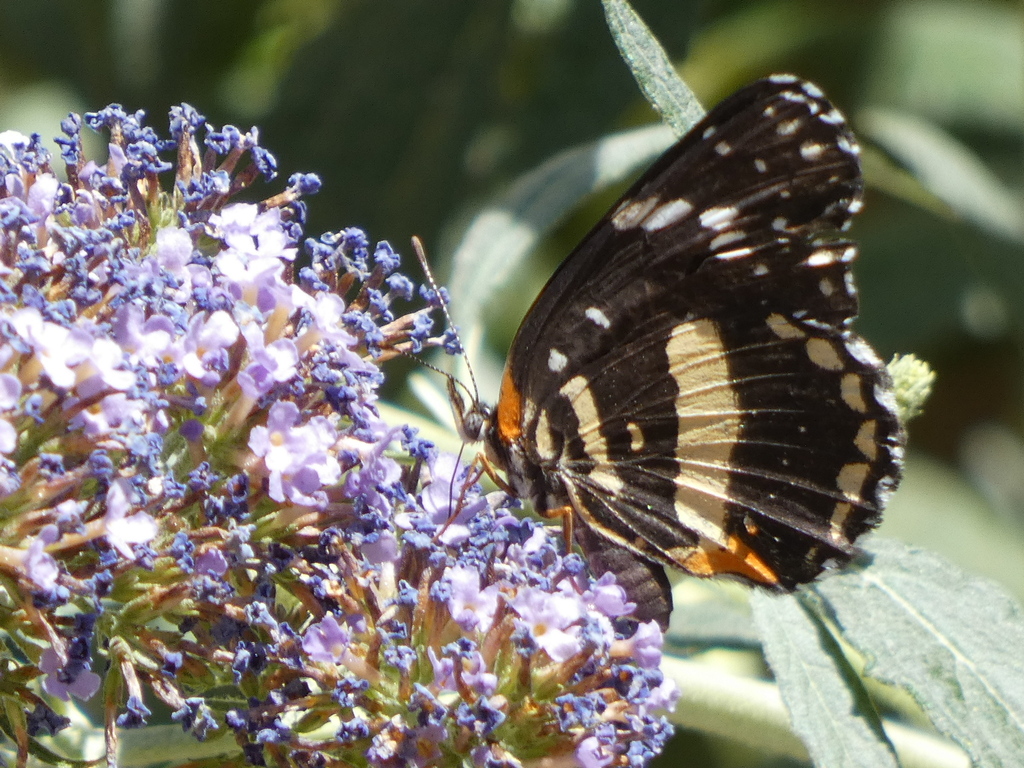
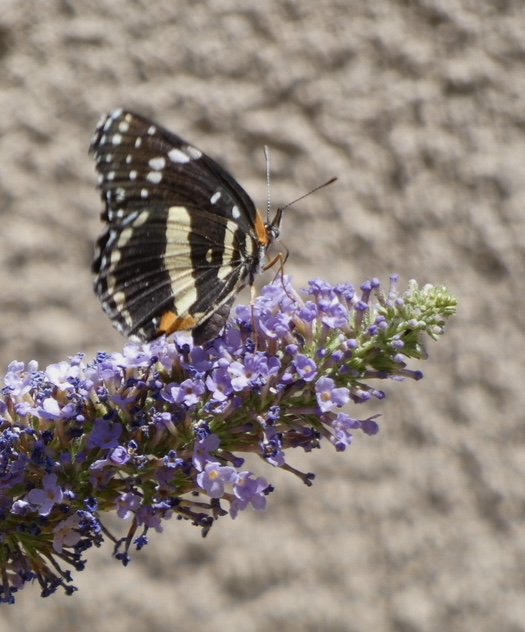
Bordered Patch (my photo/2023 – on butterfly bush)Bordered Patch catBordered Patch (my photo taken 2023These dandy little butterflies, the Bordered Patch, often choose the Cowpen Daisy as their larval host. (The butterfly nectaring on butterfly bush flowers are from my home collection)
Sunflowers!🌻 Absolutely the happiest flower on Earth. Wouldn’t you agree?
Sunflowers, a symbol of adoration, loyalty, and longevity, represent happiness, friendship, and intelligence. Much like the sun, sunflowers reflect vibrancy and an energy of life. While National Sunflower Day is the official day to celebrate these beautiful flowers, why not declare the entire growing season reason a-plenty to radiate your inner sunshine and mirror the smiling faces of every sunflower encountered!
Then and Now
Did you know sunflowers have been around since about 1000 BCE? In the U.S. indigenous peoples used sunflowers as a valuable food source, for oil, paint, and textiles, and during ceremonies. Some archaeologists even believe sunflowers may have been cultivated before corn. Today, sunflowers are still used for food (seeds, salad mixes) and beverages (tea), cooking oil, in beauty and skin care treatments, for medicinal purposes, and for hobbies and crafts.
Annual Sunflower over 6 feet tall!
The sunflower crop
The U.S. is a mass producer of sunflowers, particularly in the plains states, and is a major crop in both North Dakota and South Dakota. The average cultivated sunflower plant is five to six feet tall, and the central face of disc flowers can grow bigger than a human head. As the weight of the sunflower head becomes heavy, it begins to fall forward causing the petals to fall off. Shortly after the harvest begins. On average, one sunflower can produce up to 2,000 seeds per head. In 2022, North Dakota produced 762 billion pounds of sunflower seeds!
The Happiest and the most Intelligent flower
Have you ever noticed sunflowers track the sun, from sunrise to sunset? It’s true! Sunflowers follow the sun’s movements throughout the day. You may notice that before sunrise, a sunflower is in sort of a sleeping position with its head slightly down. As the sun comes over the horizon, the flower awakens and slowly lifts its face to ‘look’ directly at the rising sun. As the day progresses and we observe the sun moving from east to west, so too does the sunflower by turning its face in sync with the sun’s apparent movements until sunset.1 When the sun sets in the evening, sunflowers nod off to sleep, but not before untwisting themselves and slowly return to face the east. Ingenious!
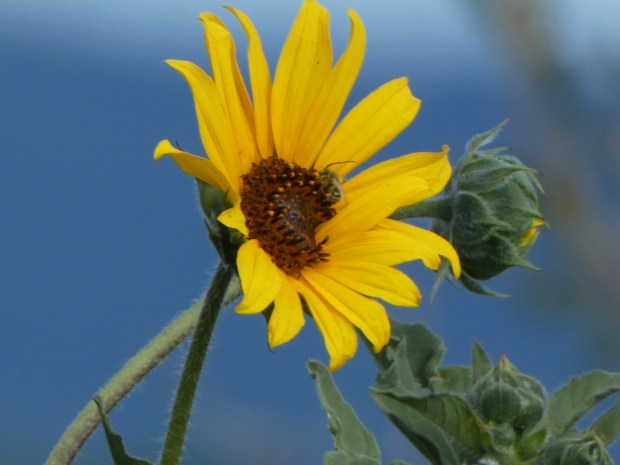
This charmer is called Cowpen Daisy
1 However, on very hot days, sunflowers tend to avoid looking directly at the sun to keep from overheating. And I’ve noticed on cloudy days, sunflowers may appear confused about the sun’s location, seeming to make their best guess on which way to face.
A season of yellows and oranges
Although you can find flowers in the Aster (sunflower) family in the Spring, August is the peak growing and blooming season for these cheerful plants. Brilliant displays of yellow flowers welcoming the morning sun can be found wherever sunflowers grow. Witnessing fields of sunflowers is guaranteed to lift your spirits as you oooooh and aaaaaaaah at their breathtaking beauty.
A trio of cowpen daisies
Ideas to celebrate a day, week, month or year of sunflowers
Spend a day with a wild sunflower and watch its face track the sun.
Take a drive to view fields of sunflowers to see their true beauty in mass.
Give a bouquet of sunflowers to a friend to brighten their day.
Add sunflower petals and seeds to your salad.
Create a painting of your favorite sunflower and frame it to enjoy year-round.
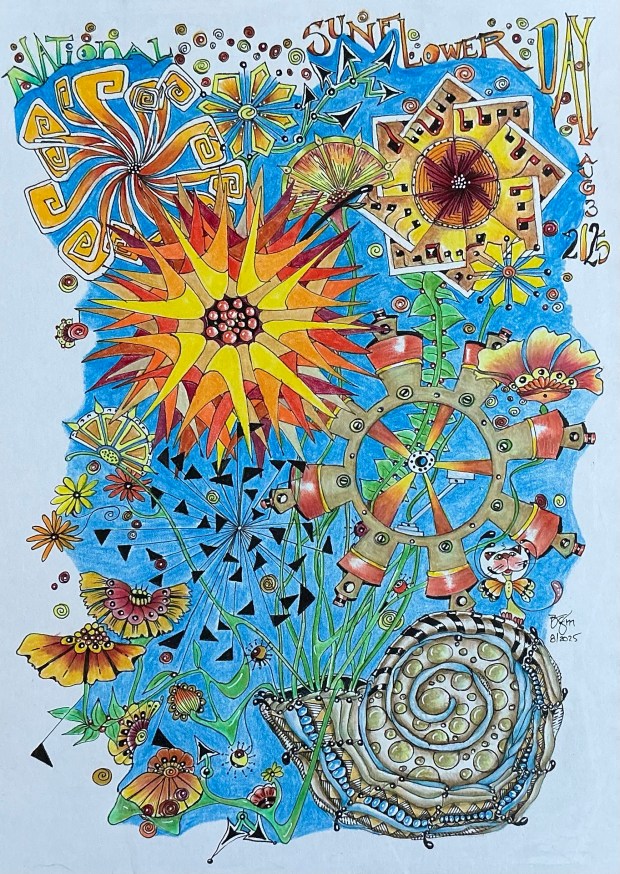
Try your hand at a Zentangled sunflower bouquet ….. there are as many pattern possibilities as there are blooming sunflowers!
Plan a road trip to North Dakota in August and coordinate places to stop to visit sunflower fields and get updates from local farmers who cultivate sunflowers.
A collection of cowpen daisies in my backyard.
If you missed celebrating this year’s National Sunflower Day, no worries! Every time you come across any sunflower, of any size, anywhere, pause and hold a personal celebration in honor of its splendiferous magnificence!
As always, thanks for stopping by!
Sunflower photos were taken in our backyard ….. all volunteers too!
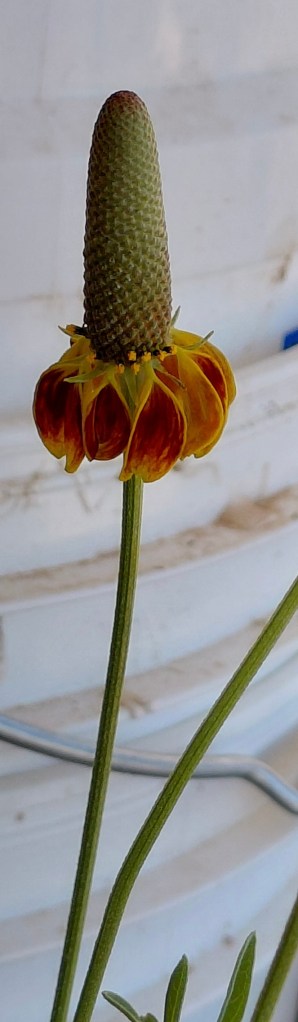
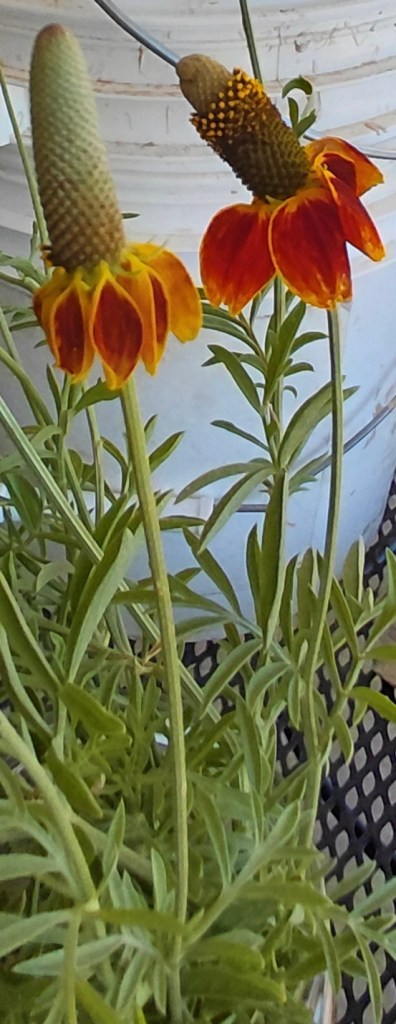
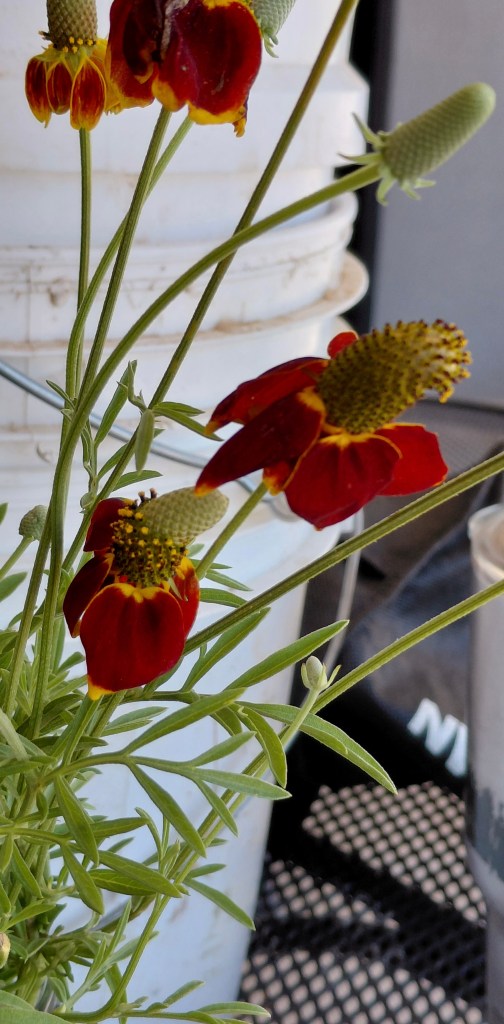
A few years ago I stumbled across this plant while walking around our neighborhood. Being immediately awed by its richly-colored petals skirting an upright cylinder or cone, I knew it would be a perfect addition to our high elevation (7,300 feet) landscape. My idea was to wait until the flowers on the cone faded and collect some seed to scatter in our yard. After repeated trips hoping to find evidence of seed, I was skunked. Either I missed the dispersal event, or this plant was 100% sterile. On the outside chance there were microscopic seeds embedded in the cone, I resorted to cone collection. Fast forward to the next spring …… every spot I’d planted those cones was barren; nothing had sprouted; zero; zip.
Fast forward again to early July 2025. This wildly blooming plant was growing vigorously in many of the dry disturbed openings and roadside areas throughout our new neighborhood! Time to learn more about such a charming member of the sunflower family called Mexican Hat.
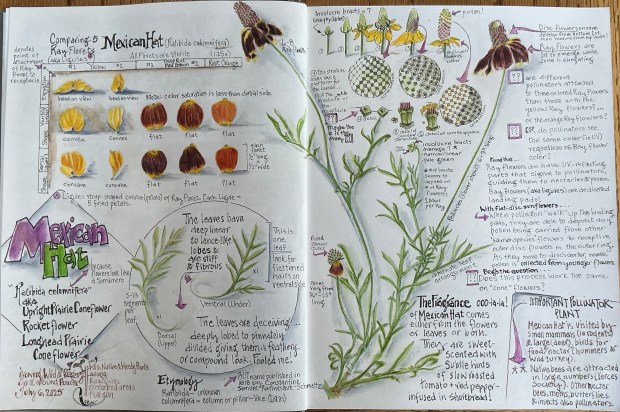
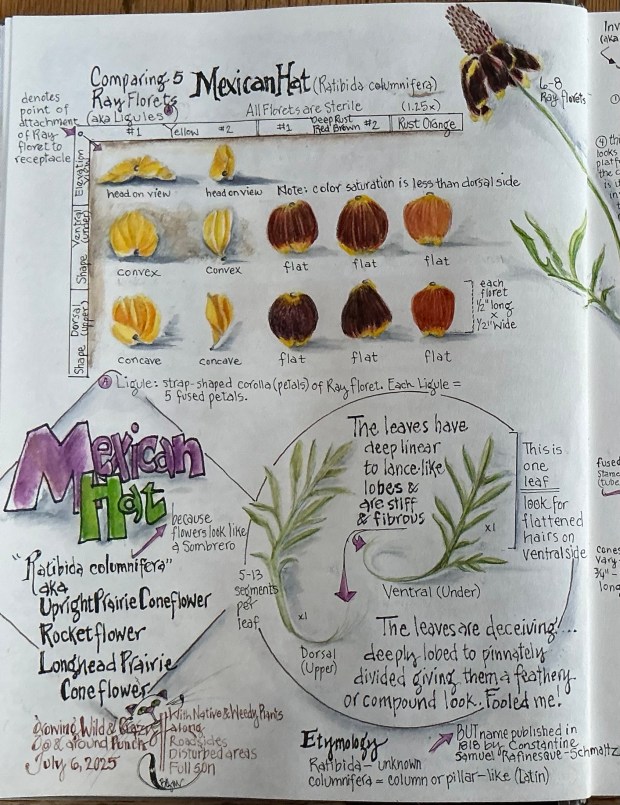
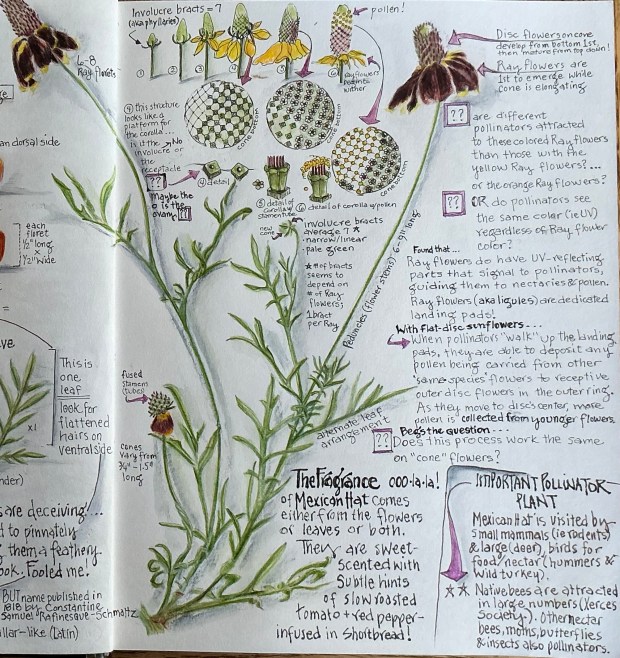
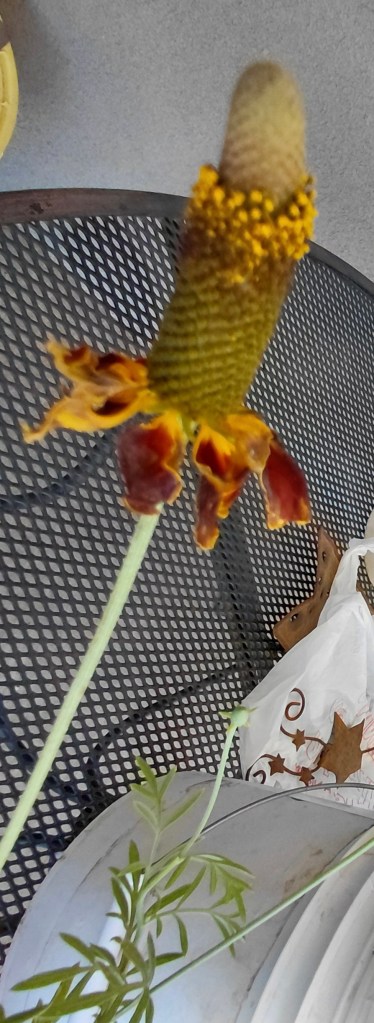
Mexican Hat (Ratibidacolumnifera), also commonly known as rocketflower, and both upright and longhead prairie coneflower, is a native perennial found across the Lower “48” (U.S.), southern Canada and northern Mexico at elevations ranging from 5,000-7,500 feet. Its Ray flowers come in a dazzling sunshine yellow, along with a soft velvety royal purple-brown, an intensely deep rust-red brown, and rusty oranges – all with some measure of sunshine yellow marginal accents. Each Disc flower (those tiny spots that spiral, Fibonacci fashion, around the upright cone) has 5 fused pale-green petals (the Corolla). The Corolla surrounds 5 fused purple/red oxide-colored Anthers (the pollen structures of the Stamens). The Anthers are shoved up through the Corolla by the developing Style (the stalk of the Pistil) where they burst into 5 sunshine yellow pollen “strands” resembling a hairdo of long, twisted, windblown dreadlocks! The shockingly beautiful colors unfailingly lure many insects hungry for pollen and/or nectar.
The entire Capitulum (the densely packed flowerhead of a composite “flower”) continually waves in the slightest of breezes as it perches atop the long stiff and naked stem (the Peduncle) of the flowerhead. Below the Peduncle are the many branched feathery-like, deeply lobed leaves. These leaves seem to be the primary source of a curiously fascinating fragrance. After handling the plants for several days, I began thinking of the aroma as being cautiously sweet-scented with subtle hints of slow roasted tomato + red pepper-infused homemade shortbread cookies! I’m looking for a recipe!
All “said and done,” Mexican Hat can grow from 8 inches tall to over 3 feet!
Benefits of and Curiosities About Mexican Hat
Special Value to Native Bees – According to The Xerces Society for Invertebrate Conservation, Mexican Hat is recognized by pollination ecologists as attracting large numbers of native bees.
Food Source for Wildlife Species – In addition to being an important source of pollen and nectar for native bees, Mexican Hat also attracts many other insects like butterflies and moths, and hummingbirds sip its sweet nectar. Wildlife that feast on its seeds include small song birds, wild turkey and rodents. Even white-tailed deer will eat the foliage, despite its reported deer-resistant qualities.
Supports Native Pollinators, Attracts Beneficial Insects, and Promotes Biological Diversity – Mexican Hat is a adaptable and resilient wildflower species, able to endure extended periods of drought, hot and cold temperatures, and diverse habitat and soil conditions. Because of these characteristics, and because the species is a self-seeder, Mexican Hat provides food and cover for wildlife, is a reliable source of pollen for at-risk native bees, and makes an excellent choice for sustainable gardening, habitat and soil restoration, and prairie conservation efforts. And not to be overlooked, Mexican Hat attracts beneficial insects like lady beetles and lacewings that help control garden pests like aphids and caterpillars, and makes a valuable contribution to natural pest management strategies.
Many Uses; the Ethnobotany of Mexican Hat – North American indigenous peoples prepared the leaves, stems, flowers and/or the cones in certain ways to treat specific ailments suffered by people and animals. By creating washes, by boiling, physically rubbing and crushing, decoctions, concoctions and infusions were used to treat chest pains, wounds, stomach aches, fevers, headaches, urinary problems, rattlesnake bites and to induce vomiting. Mothers wishing to wean their babies had crushed leaves rubbed on their breasts. Horses with urinary problems were hand fed the entire plant as a cure, and sheep that are “out of their minds” are given a cold infusion.
The cones were used as baby nipples. Leaves and flowerheads were boiled to make a pleasant tasting tea.
A Symbolic Meaning and Familiar Visual of Mexican Hat – In Mexican culture, this wildflower is often associated with traditional celebrations, ceremonies and festivals. Mexican Hat is a symbol of joy, abundance and cultural heritage. The common name “Mexican Hat” was given to this wildflower because it reminds many of the shape of a traditional Mexican sombrero.
Origin of the Scientific Name Ratibidacolumnifera – The Etymology of the genus name Ratibida was published in 1818 by Constantine Samuel Rafinesque-Schmaltz (1783–1840). Even to this day, the meaning of Ratibida is a mystery. It’s well known that Rafinesque-Schmaltz often assigned unexplained names to plants. Oh, and be aware that around 60 sites online use the spelling “Ratidiba” rather than Ratibida. So if poking around the internet for more information about Mexican Hat or any of the other prairie coneflowers, don’t be fooled by the typo!
The species epithet columnifera is a Latin name meaning “bearing columns.” This refers the tall cylindrical or cone-shaped flowerhead (Capitulum) which is the support structure (the Receptacle) for the numerous Disc flowers, the 7 Ray flowers, and the 7 small leafy bracts (Phyllaries).
Loving My Mexican Hat!
Early this spring I purchased 2 Mexican Hat plants for our garden. I’m happy to report they are doing great and loaded with 10-20 yet-to-mature pale green cones. Wonder what color the Ray petals will be?
I’m also planning to collect seed again this year, after learning the best time is early Fall when the cones look like they’re withering. Wish me luck!
Hope you enjoyed my exploration of this marvelous native perennial member of the sunflower family. Even though in a previous post I made a thorough plunge into the sunflower family, I learned even more putting this post together.
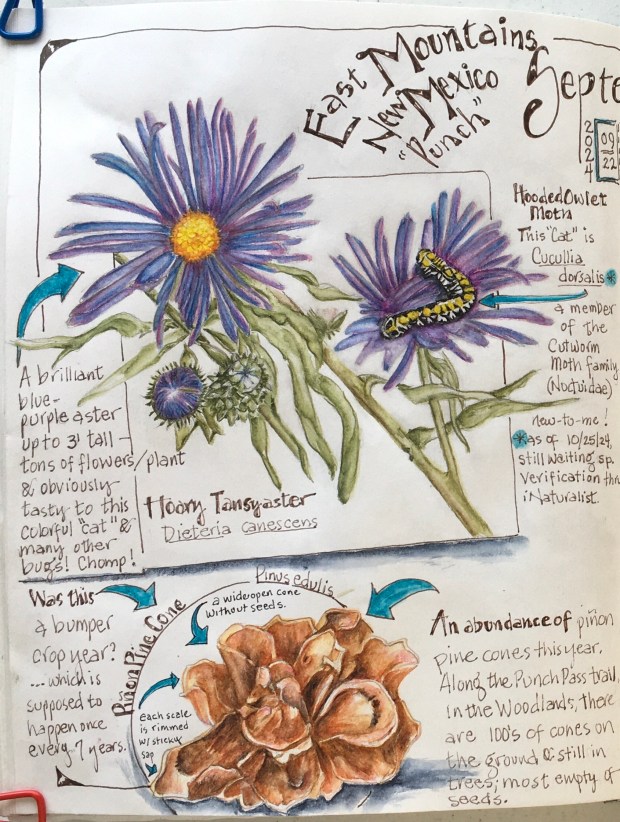
September 22nd was a morning full of new-to-me discoveries in nature. That was more than a month ago; a time when temperatures were still in the upper 80’s and flowers in full bloom.
But plenty of hints of what was to come ….. the inevitable change in seasons ….. existed. There were seeds of spring and summer bloomers blowing in the wind; squirrels stockpiling pine nuts from recently shed cones; darkling beetles mating and laying eggs in the ground to hatch next year’s population; caterpillars feasting on energy-packed flower petals needed to spin their cocoons; the chortling chatter of sandhill cranes high overhead migrating to Bosque del Apache for the winter.
Still it is hard to believe that today, a little more than a month later, everything has turned brown, and our first hard frost is forecasted for tomorrow morning!
In an effort to cling to a not-so-long ago summer, this small selection of the botanical and entomological happenings on the cusp of Fall, is now a part of my nature journal. Enjoy!
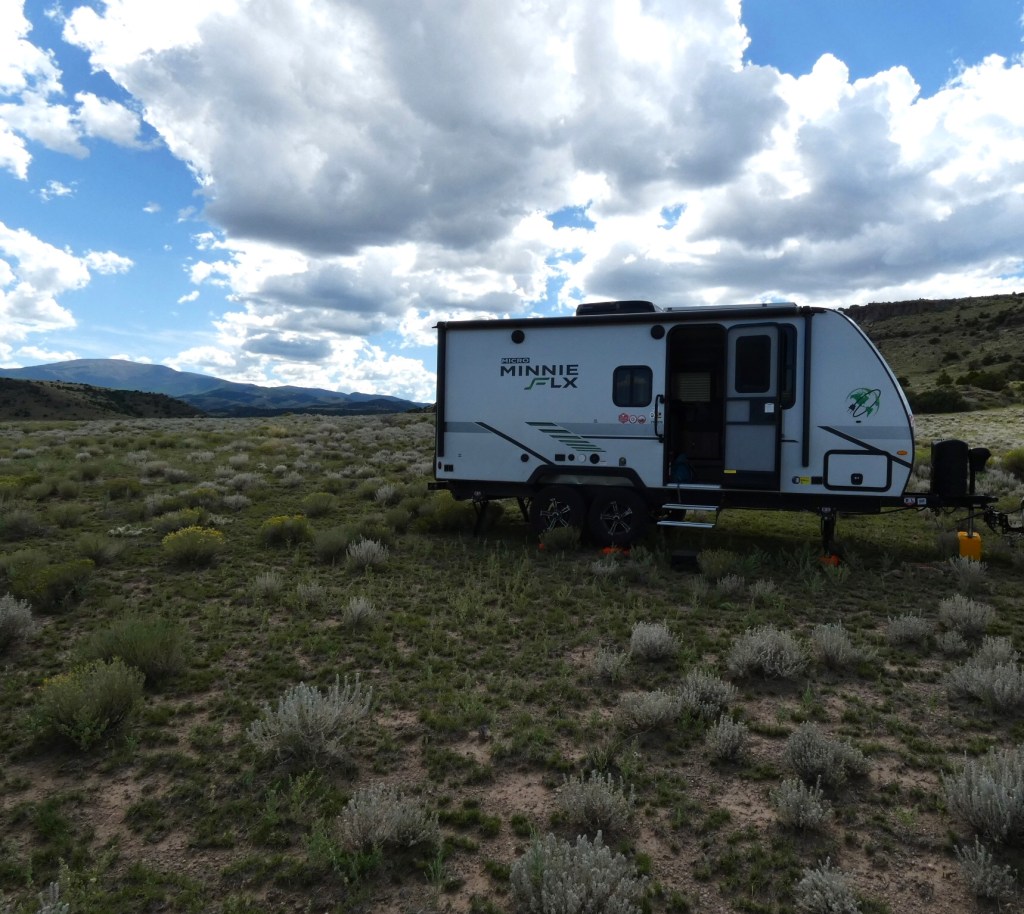
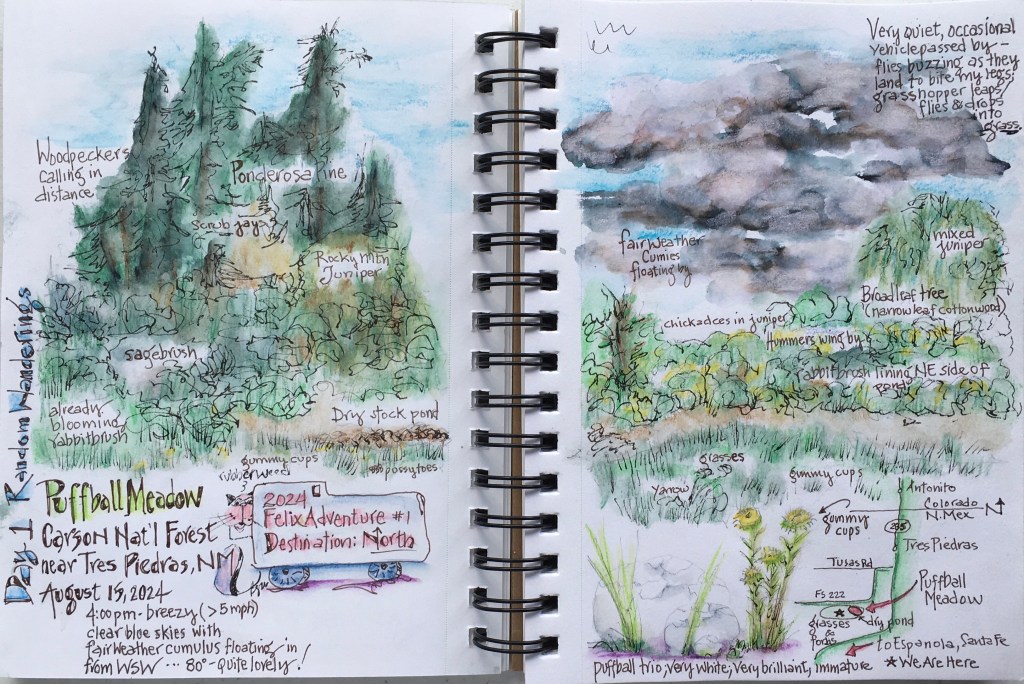
Felix parked along the Old Spanish Trail route, south central Colorado
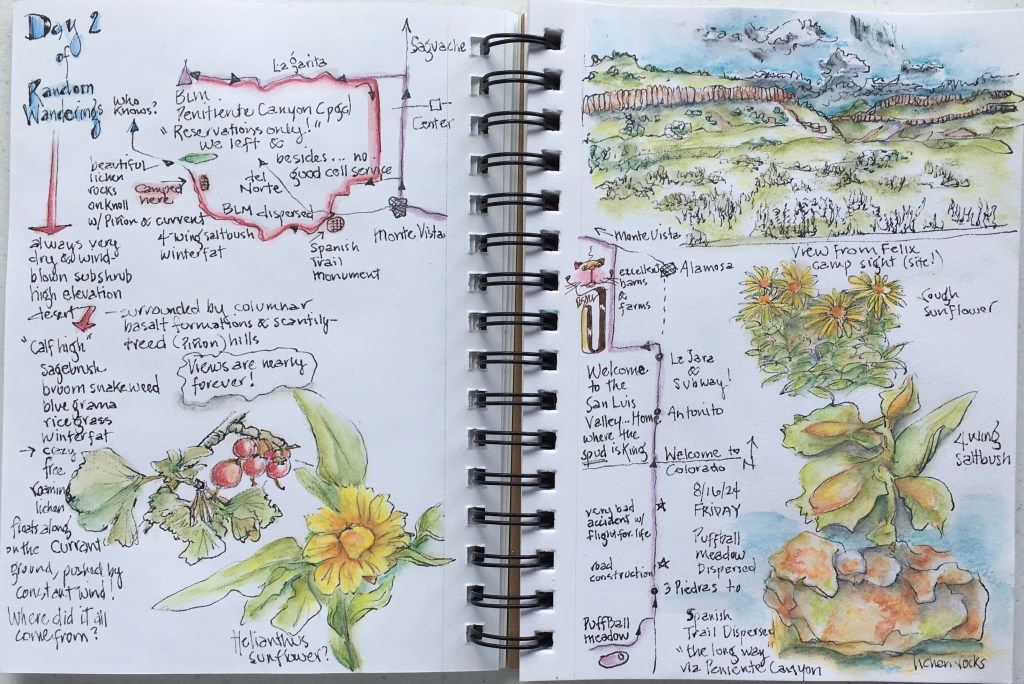
With no defined route or objective, we decided it was high time we hitch up the trailer (Felix) and tote it north just to see what’s going on in south central Colorado this time of year. As we made our way through the San Luis Valley, we found acres of lush greenery topping almost-ready-to-harvest potatoes. Alfalfa was nearing its second cutting. Carrots had already been shipped to market. The wildlife refuges were patiently awaiting the arrival of migratory birds. And the last of the summer tourists were excitedly boarding the Cumbres and Toltec Scenic Railroad in Antonito, for the 64 mile steam engine journey to Chama, NM.
Day 1. Our first stop was in northern New Mexico, just south of Tres Piedras, Carson NF. An unlikely dispersed camping spot that I nicknamed “Puffball Meadow.” A nice level spot adjacent to a dry stock pond. The meadow was full of fist sized puffball fungi, and a coyote paid us a visit during the night.
We enjoy boondocking on our public lands managed by the US Forest Service and Bureau of Land Management. Having a trailer that’s self-contained, we can easily find lovely off-the-grid areas to set up camp. And thanks to our solar panels (and lots of sunny days) and large water tank, we can stay out for up to 5 days without needing refills. This allows us to explore lesser visited areas, which suits our tastes beautifully!
Day 2. Made it to the San Luis Valley, Colorado. Wandered around until we found a wide open area of dispersed camping in the vicinity of the Old Spanish Trail. Lots of wildflowers blooming, and plenty of hiking opportunities.
But I think one of the best things about random travel is the spare time …… we drive for 3-4 hours, find a place to camp ….. then the rest of the day involves hiking, wildlife watching, nature journaling, collecting drawable items, photography, more sketching, identifying the unknowns, reading, napping, and a bit of ukulele strumming! Perfection!
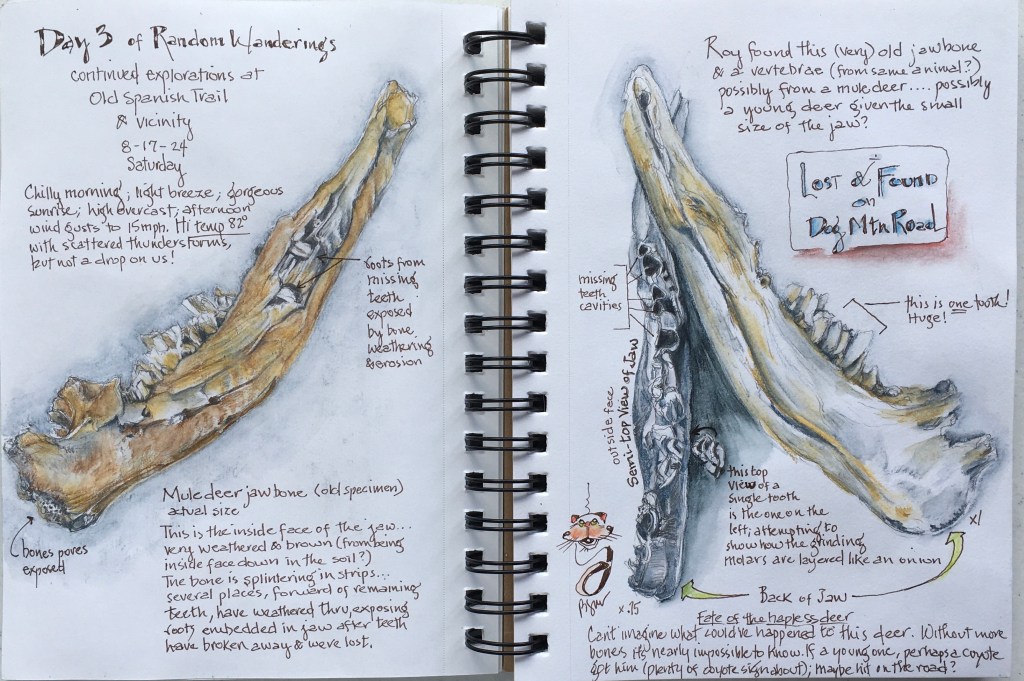
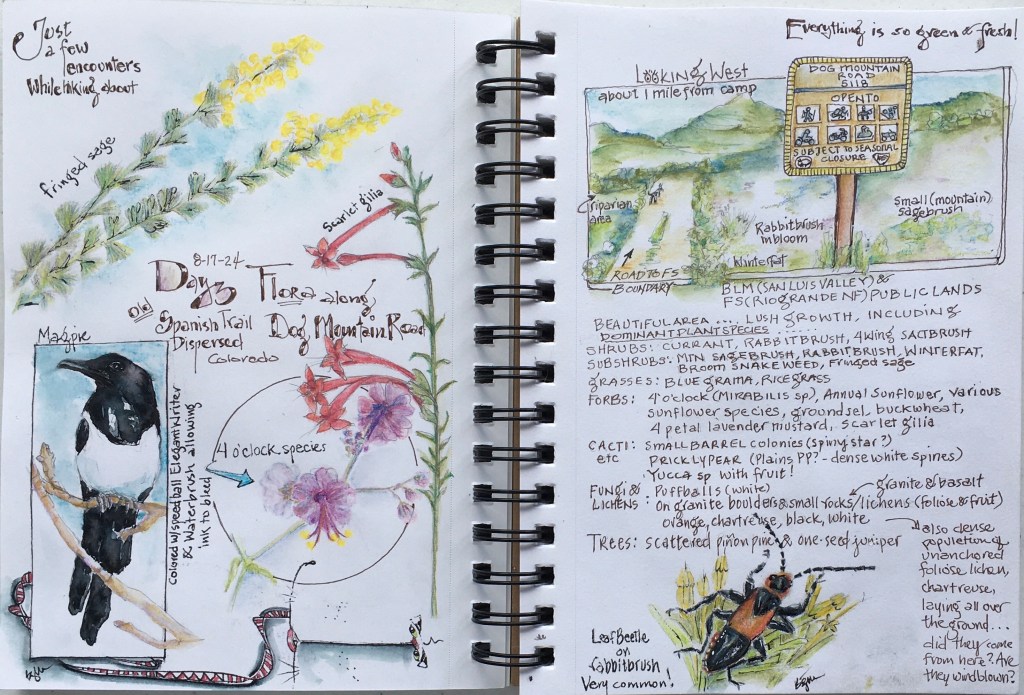
Day 3. We enjoyed the area so much, Roy suggested we stay for another day! And then he found this weathered mule deer jaw bone. Day 3, continued. Magpies! Can’t understand why these gorgeous birds don’t come south at least as far as Albuquerque and East Mountains.
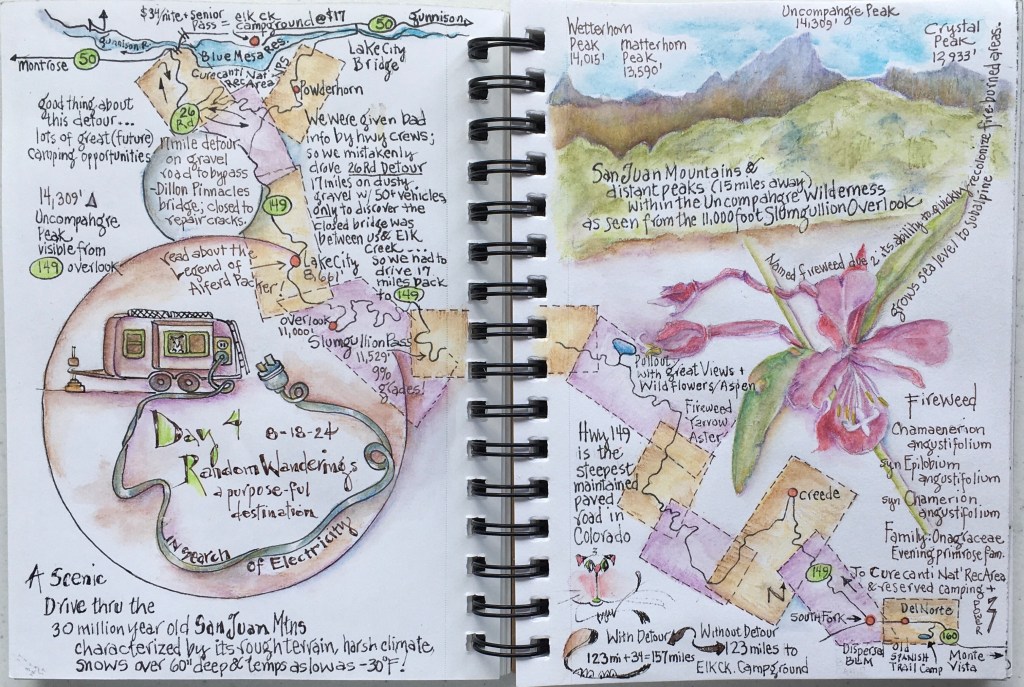
Although the 6-day trip wasn’t remarkable, it was good to get away. Scattered about this post are my journal pages highlighting Days 1 to 5.
Day 4. Our travel route as we made our way to a campground to charge our battery and top off our water tank. An inconvenient, unplanned for detour led to future camping possibilities.
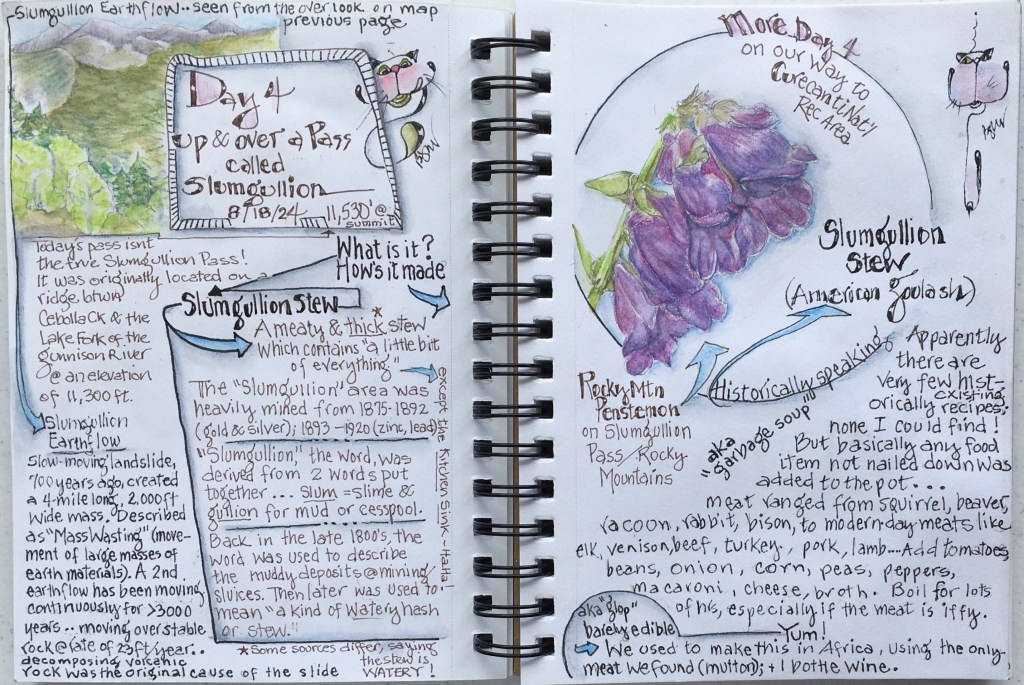
On Day 4, we decided to make our way up and over Slumgullion Pass (11,530 ft) on our way towards Gunnison Country. Not having been this way in years, we really enjoyed the crisp mountain air and spectacular views up and over the Pass. The villages of Creede and Lake City have grown swollen with tourist amenities and summer cabins dotting the once open meadows. As we got closer and closer to Lake City, we couldn’t help recall the story of Colorado’s notorious cannibal, Alferd Packer. Wanting to reread the tale as we passed near Cannibal Plateau and Deadman’s Gulch, the crime scenes, here’s what I found:
BriefBackground: Alfred Packer (newspaper misspelling as “Alferd” Packer, which stuck) (1842-1909) was a prospector who set out for Colorado gold fields in 1873. By the winter of 1874, he reached the rugged San Juan Mountains with a party of five men where they became lost and stranded during one of the worst winters on record. The men, with only had 3-4 days provisions quickly consumed and no firearms, were forced to cook their rawhide moccasins. Places where “snow had blown away from patches of wild rose bushes,” ….. they “were gathering buds from these bushes, stewing them and eating them.”
When the snow finally crusted over, Packer, the only man to survive the ill-fated trip, walked out of the mountains after 60 days. He told a story about the demise of his fellow prospectors, and how he managed to survive by eating them. His story involving cannibalism became legend, and continues to be passed down to today! (Whether the story is true or not will never be known, but it makes for colorful history.)
Based on historical records and news reports, Alferd Packer was tried several times for murder and cannibalism (even though the act of cannibalism wasn’t considered illegal in the US). Convicted of these heinous crimes, Judge M.B. Gerry supposedly uttered this famous quote while handing down the sentence in Packer’s first trial ……
“Stand up yah voracious man-eatin’ sonofabitch and receive yir sintince. When yah came to Hinsdale County, there was siven Dimmycrats. But you, yah et five of ’em, goddam yah. I sintince yah t’ be hanged by th’ neck ontil yer dead, dead, dead, as a warnin’ in reducin’ th’ Dimmycratic populayshun of this county. Packer, you Republican cannibal, I would sintince ya ta hell but the statutes forbid it.”
This is the quote I’d grown up hearing many times, over and over and over! It makes for good reporting, but is a ways from the actual sentence and what Judge Gerry sounded like while reading it (nope, he didn’t talk like Yosemite Sam!). Here’s what the record shows:
“Alfred Packer, the judgment of this court is that you be removed from hence to the jail of Hinsdale County and there confined until the 19th day of May, A.D. 1883, and that on said 19th day of May, 1883, you be taken from thence by the sheriff of Hinsdale County to a place of execution prepared for this purpose, at some point within the corporate limits of the town of Lake City, in the said country of Hinsdale, and between the hours of 10 A.M. and 3 P.M. of said day, you, then and there, by said sheriff, be hung by the neck until you are dead, dead, dead, and may God have mercy upon your soul.”
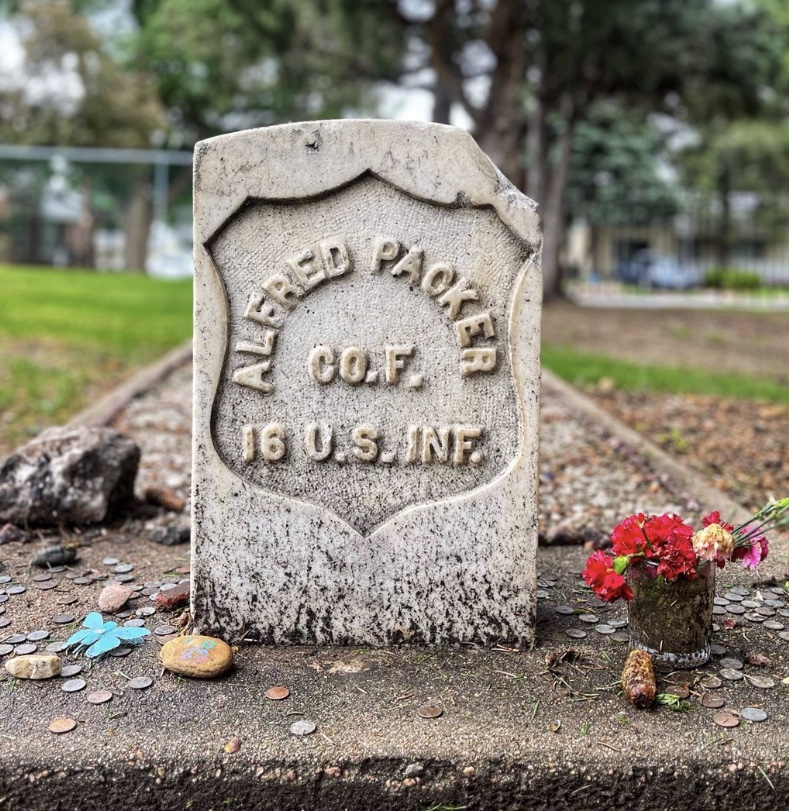
Alfred Packer tombstone in Littleton Cemetery where he was originally buried in 1909. Today, he now lies back in Hinsdale County, near Lake City.
Alferd Packer never did hang. It’s quite a detailed story following his first trial, including a jail escape, nine years on-the-lam, and recapture. There was a second trial in 1885 where he was charged for only one murder; after serving only 16 years of his 40-year sentence, he was released and died peacefully one year later at the age of 60. He was buried in Littleton, Colorado where his tombstone properly reads Alfred Packer.
Day 4. Supplemental information about that strange name “Slumgullion.” Is it a stew? Is it a drink? Is it the sludge that puddles below an 1870 sluice box? Day 5, on our way back to Old Spanish Trail (because we liked it so much). Discovered a new-to-me plant; after a bit of checking with iNaturalist, learned it was Black Henbane, but not before handling all parts of this very poisonous noxious weed!
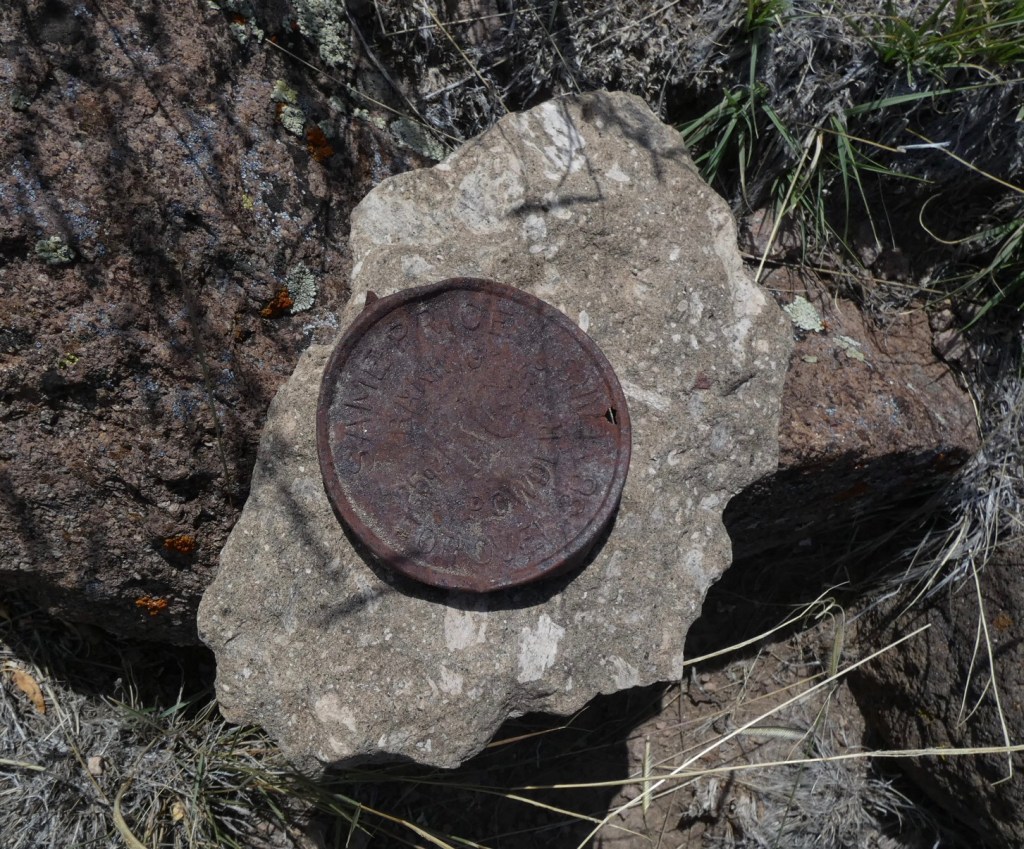
A short comment on the KG Baking Powder tin lid we found near our trailer. It was old and rusted, but very readable. The tin and its contents were probably long gone. Tried to find any information on the KG brand; sure curious about the age of the lid. If you’ve heard of this brand, please let me know.
KG Baking Powder tin lid we found near Old Spanish Trail.
Day 6. Headed for home. Hope you enjoyed my travel journal.
San Juan Mountains …… up and over Slumgullion Pass. The view of the 700 year old earth flow.
It’s Spring in my neighborhood, and not a day too soon!! Along with gusty winds carrying clouds of yellow pollen come drifts of an outrageously bright yellow ‘sunflower’ named Perky Sue.
How Perky Sue got its common name is a mystery. My best guess is this herbaceous forb, native to New Mexico, has to be the Perky-est, Happiest Spring Flower, Ever!
What is your favorite native flower signaling the arrival of Spring in your world? Does its bloom cause you to smile; perhaps you break out in your happy dance?
Thanks for stopping by …… and Happy Mother’s Day to all!
As the Fall season rapidly came and went, and the first snows blanketed the landscape, I focused my hiking time (and some of my drawing hours) on collecting local native seeds. Always careful that plenty of seeds remained available for overwintering birds, I still managed to harvest hundreds from about 25 plant species. All sorted and packaged in separate pill containers, my collection is now stored in the refrigerator at 40 degrees, until growing conditions are optimal for planting. This treatment method is referred to as stratification.**
Why collect native seeds? All throughout the Spring, Summer and Fall, a diverse assortment of pollinators visited our locally blooming wildflowers and shrubs. Along with these butterflies, moths, bees, wasps, beetles and flies, were the insects, spiders, and birds that prey on unwary pollinators. Such an amazing show; a kaleidoscope of colors and shapes! The air was a buzz with activity. My goal is to mimic the native banquet in hopes of attracting these pollinators and predators.
Also, seeds are absolutely fascinating. I like to think of them as gift-wrapped, living plants-to-be. Tucked neatly inside of the seed coat are food stores enough to feed the makings of a complex root system; flowers, leaves, stems, branches and even a trunk. Seeds can be tiny, some microscopic and some as large as a softball. Seeds come in a variety of shapes, colors, textures and decor both inside and out. Some seeds have “wings” to fly; some have silky or puffy “feathers” to float; some are like “lead,” heavy enough to intentionally sink under water.
So I pulled out my 10x hand lens to investigate, drawing most of the seed species in my collection. It was very cool to compare seeds of different species that are in the same family (like the composites of the Aster family and the penstemons of the Plantain family). Until creating this journal page, I’d never held the seeds of 3 different species of yucca in one hand at the same time. Observing the similarities and differences, I finally confirmed in my mind that the genus Herperaloe and Yucca are indeed in the Agave family. And then I found examples of seeds from completely different families that evolved similar dispersal mechanisms (convergent evolution). This phenomenon was visually obvious in the delicate feathery, silky, and poofy hairs or bristles attached to grass, aster, and milkweed seeds, facilitating seed dispersal by wind.
Finally, I felt the need to draw the seeds in case they happened to spill into one big jumble while being planted! Yes, I would be clumsy enough to create chaos out of order. Should that happen, I’ll be able to sort the mess by species by referring to my field guide page.
** Seed-producing plants pass along to their seeds the specific requirements(s) necessary to break dormancy and germinate. These genetic codes determine if optimal conditions exist for seeds to sprout and hopefully grow to maturity. But key to successful germination depends on seed ripeness (in most cases). Knowing the plant species from which a seed is produced; whether the plant is an annual, biennial or perennial; habitat, moisture needs and the type of “treatment” method(s) are all important bits of information tied to successful germination.
I’ll have to create a future post describing the variety of treatment methods (germination patterns) inherent in the seeds.
Are you a seed collector? If so, share your why’s and how’s!










 a curious nature