After an unseasonably warm, almost spring-like December in the mountains of central New Mexico, January clearly has something else in mind. Winter! Windy days have resulted in bitter cold as they brought us cloud-cover and a few mini-snowstorms.
The change in weather and absence of wildlife, combined with an abundance of dried vegetation is making it challenging to find nature journaling subjects. So a few days ago, I followed Luna around to see what was capturing her attention. Turns out burrowing rodents expanding their underground tunnels are leaving behind fresh mounds of soil with fascinating odors (to Luna, at least; I couldn’t smell a thing).
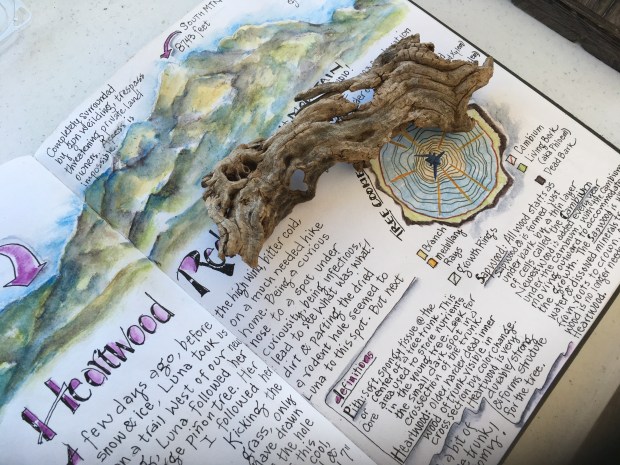
When one of her explorations led me under a good sized pinyon tree, I noticed a very interesting piece of bark lying on the ground. Turning the piece over and over, examining all the beautiful patterns in the wood, the colors, old bug holes, and woodpecker drillings, I was surprised and delighted to see a good-sized hole in the shape of a perfect Heart! Eureka!
The 7” piece of pinyon bark …. Can you find the Heart?
Many things crossed my mind in that moment …… but the one word that stuck was “Heartwood!!” Could this small piece of bark redefine the meaning of heartwood? Could this tree have been wearing it’s true emotions on its bark in the form of a heart-shaped window?
After a refresher on basic tree anatomy, and reconfirming that heartwood surrounds the core of the trunk, my imagination went wild. Could that heart-shaped hole in the bark been the opening of a mysterious pathway through the inner workings of the tree?!!! If I could’ve returned the piece of bark to the exact place from where it fell, could the heartbeat of the tree be heard?
My finished pages mostly about Redefining Heartwood, but also featuring the view of South Mountain (to the NE) as seen from our new home (including my studio) and the trail where the “Heartwood” bark was found.
While sketching the piece of bark with its perfectly-shaped heart, I wondered if peering at the inner workings of a tree through this window would make a fun children’s picture book? ….. Where the layers of a trunk and how they work would be experienced first hand by a child walking down the pathway?
After you stop laughing from all this nonsense, let me know what you think?
As always, thanks for stopping by (on my magic carpet ride!)
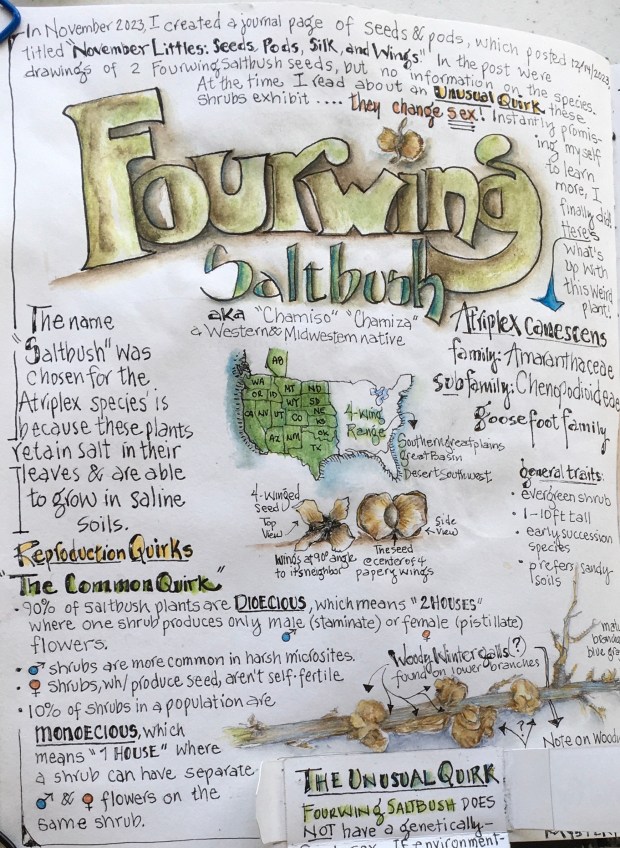
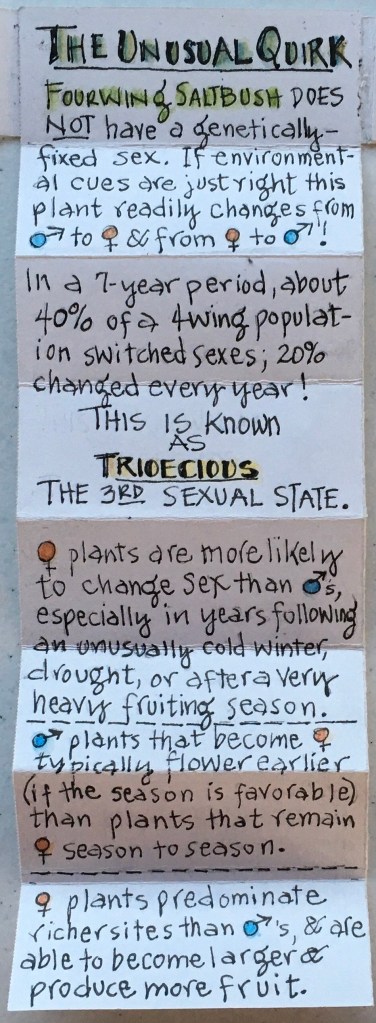
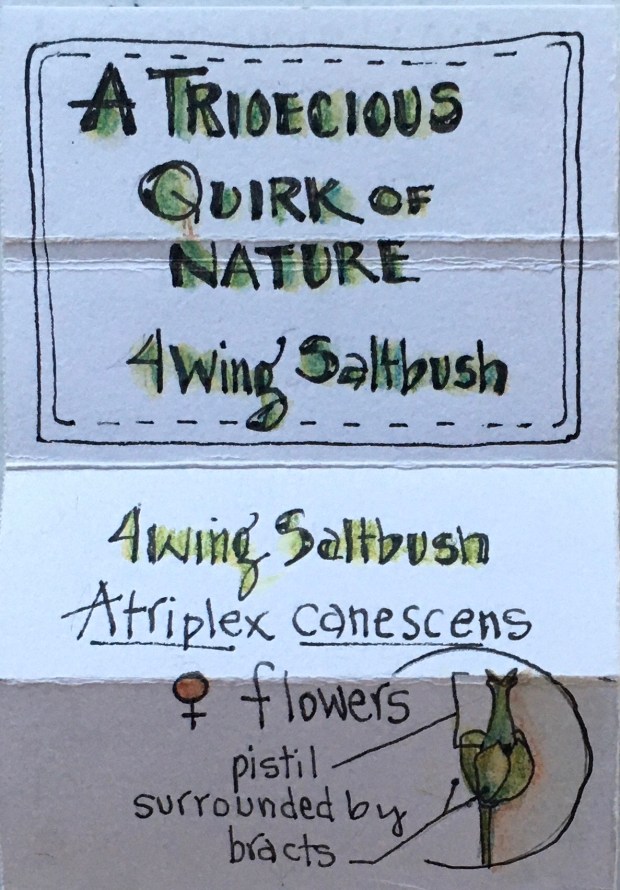
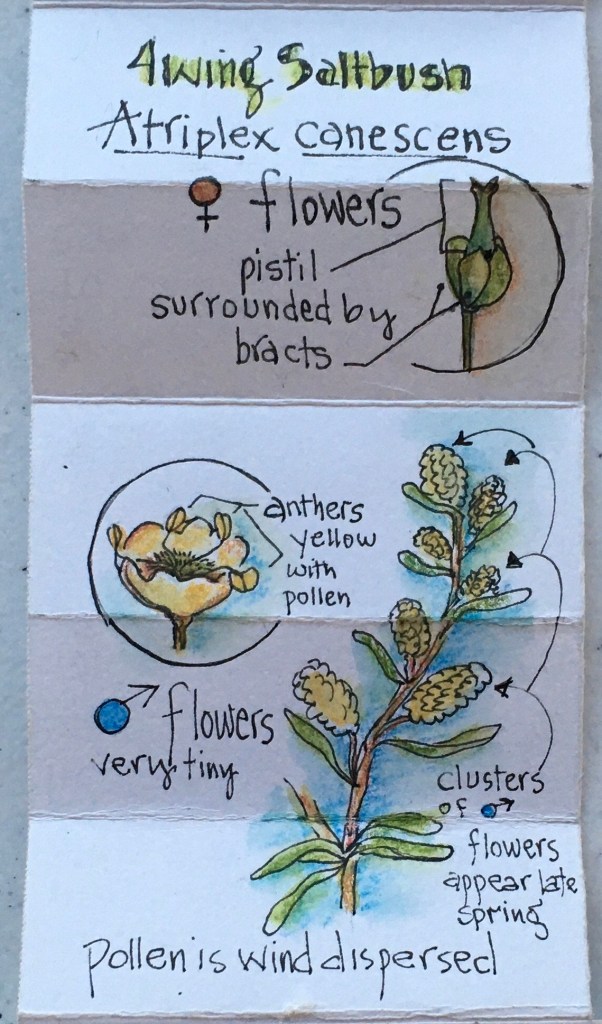
In November 2023, I created a journal page of seeds and seed pods, which posted on 12/14/2023, under the title November Littles: Seeds, Pods, Silk, and Wings. On that page was a small drawing of two Fourwing Saltbush seeds, absent any information about this plant species, Atriplexcanescens. At that time I remember finding a wealth of articles and research documents about this widespread shrub, but what really stuck in my mind was a very unusual quirk exhibited by this plant. Finally, a year later and WOW! I discovered Fourwing Saltbush has a reproductive superpower …… this species has the ability to change sex!
An Unusual Quirk
My first dive into the literature revealed that within a 7-year period of time, 40% of a Fourwing population switches sexes with 20% of a population changing sex every year. Botanically, this is known as Trioecious, or the 3rd Sexual State.
But clearly a bit of back peddling is needed ……. if Trioecious is the 3rd Sexual State in plants, what about the 1st and 2nd sexual states, huh? Yes, they exist …….. but before explaining them, which requires comparison with the more common sexual state in plants, I must describe this sexual norm.
And now for a little Botany 101 ……..
The Sexual Norm …… Plants with Perfect or Complete Flowers
You are likely familiar with plants like roses, tulips, lilies, garden strawberries, beans, peas and cabbage. If you’ve closely examined their flowers while inhaling their fragrant aromas, you may have noticed their centers have both female and male parts. These are known as plants with Perfect or Complete flowers (aka hermaphroditic or bisexual) defined by each individual flower having a fully functional pistil (the female part) and stamens (the male parts). Worldwide, about 90% of flowering plants have Perfect or Complete flowers.
Monoecious ….. the 1st Sexual State
Here again you are likely familiar with many plant species described as Monoecious (moh-NEE-shuhs). These include corn, all of the plants in the gourd family (i.e. cucumber, squash, watermelon), oak, birch, pine, spruce and dogwood. Monoecious, which means “one house” in Greek, describes plants having separate female and male flowers in different places on the same plant, often blooming at different times. Visualize corn growing in a field; the tassels are the male (staminate) flowers, and the corn kernels you eat are the female (pistillate) flowers. Around 10% of all flowering plant species worldwide are Monoecious.
Not to confuse the matter, but sometimes botanical experts refer to Monoecious species as Perfect or Complete because they have both male and female flowers on the same plant, even though these flowers are separate and considered sexually Incomplete (aka unisexual) by themselves.
Dioecious ….. the 2nd Sexual State
A plant species with individual plants in a population having only female flowers, and individual plants of the same species in the same population with only male flowers is called Dioecious (dahy-EE-shuhs). This Greek word meaning “two houses,” describes plants such as spinach, asparagus, sumac, currant, box elder, willow, holly, ginkgo, juniper and aspen. Only 5% of all flowering plant species worldwide are Dioecious.
Another confusing matter once again. There are botanical experts that refer to plant species with Perfect or Complete flowers as Dioecious because they require cross-pollination to produce seeds (fruit). Tree fruit species such as apples, pears, cherries and plums are common examples.
Trioecious ….. the 3rd Sexual State
An extremely rare reproductive strategy among flowering plants, Trioecious (aka trimonoecious or “three houses”), is characterized by a species that can have Incomplete (unisexual) male, Incomplete (unisexual) female, and Perfect or Complete (bisexual or hermaphroditic) male/female flowers on separate plants in a population or even all on the same plant! Just over 3% flowering plant species worldwide are Trioecious (trahy-EE-shuhs).
This is where Fourwing Saltbush (Atriplexcanescens) enters the story
Primarily a Dioecious species, some Fourwing Saltbush populations have a Monoecious component ranging from entirely male (staminate) or female (pistillate) individuals to those that are Perfect or Complete (hermaphroditic or bisexual). And in this Dioecious–Monoecious–Hermaphroditic gender system, referred to as Trioecy, switching sexes occurs. To reiterate from an earlier paragraph, on average, in a 7-year period, about 40% of a Fourwing Saltbush population switches sexes with 20% changing from male to female or from female to male every year.
Reasons Behind and Benefits of Fourwing’s Sex Change Phenomenon
Fourwing Saltbush has evolved to be one of the most adaptable plant species found throughout central and the western US. It grows from sea level to 8500 feet elevation, and in a multitude habitats within a wide range of plant communities, no matter the successional stage. Fourwing can adapt to all soil textures, soil depths and all but the wettest of soil conditions. The species is able to tolerate hot (+100F) and dry (6” precipitation annually) summers, and bitter cold (-50F) and dry winters.
The ability of the species to adapt to such a wide range of physical and climatic conditions is, in part, due to this sex change phenomenon. Environmental stressors seem to be the major triggers resulting in Fourwing plants switching sexes. Female plants are more likely to change sex than male plants, especially following a drought, an extremely cold winter, or after a heavy fruiting season. Because fourwing is so tasty as range forage, overgrazing can also trigger a sex change, with male plants tending to dominate regularly grazed sites. Male plants that change to female typically flower earlier than plants that remain female season after season. And female plants dominate richer sites than do male plants, becoming larger and producing more seed.
Undoubtably there’s more environmental stressors, such as wildfire and other climate change-induced factors, that may result in Fourwing Saltbush to switch sex. I’ll be curious to learn what they are and how these triggers influence the adaptability and survivability of this robust species. And I’m excited get busy marking this season’s female and male plants that we see nearly every day, and will begin more closely observing these populations for gender changes and possible stressors that may have triggered these switches.
A Retrospective and Thoughts on Prospective Studies
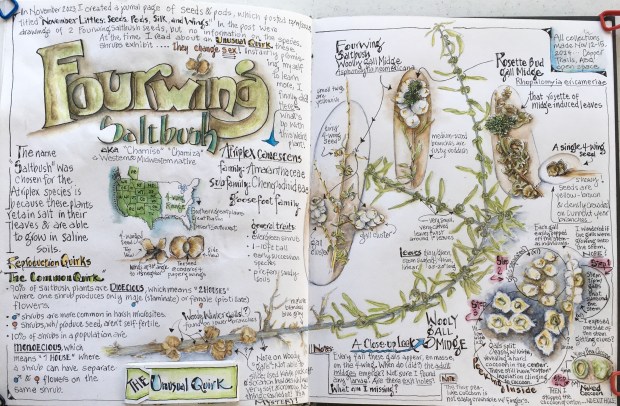
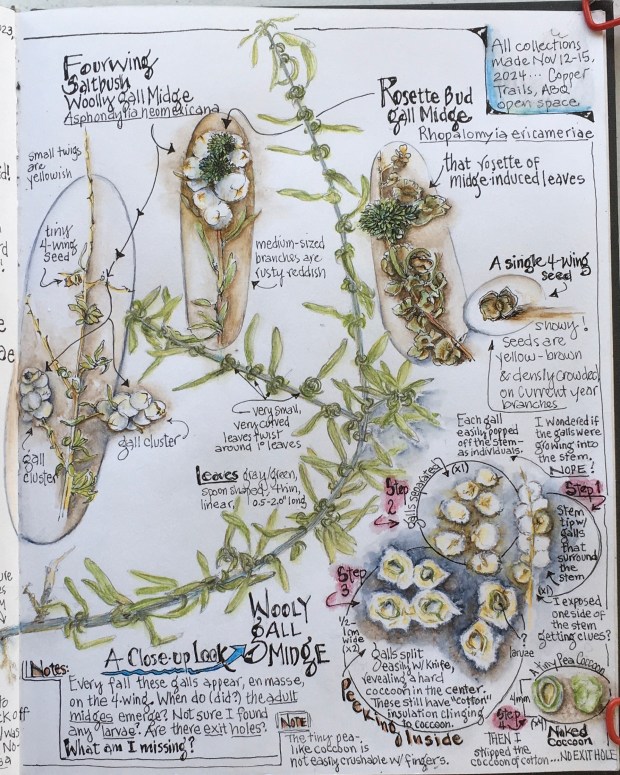
There’s so much to learn about Fourwing Saltbush that it seemed logical to tackle one characteristic at a time. Originally I had planned to discuss both the plant’s reproductive quirk and several of its common galls, but found there would be too much information for one post. While deciphering the complexities of the Fourwing’s sex change abilities, I found it necessary to describe certain key botanical terms in my buildup to the crucial piece of the puzzle ….. the Trioecious reproductive strategy. So this post focused on the first of my two journal pages; my beginning exploration into this plant. The galls illustrated on my second journal page, that could not be easily chopped away from the first page, serve as a preview of a future post about the fascinating Fourwing Saltbush.
And Finally ……….
For a shrub I used to describe as a messy tangle of branches haphazardly cloaked with unremarkable features like dusty little grey-green leaves, nearly invisible flowers, shreddy dull grey trunks and a chaotic canopy, Fourwing Saltbush has captured my imagination, respect, and love as an almost invincible survivor of our changing world!
Hopefully you found this interesting and informative. Bet you never look at flowering plants in casual ways again. Let me know if you are familiar with Fourwing Saltbush. Where does it grow? Have you ever marveled at the thousands of winged seeds densely crowded at the tops of these shrubs? And then satisfied an irresistible urge to strip dozens of skinny branches of those ripe seeds, tossing them in the air like confetti? If so, please share.
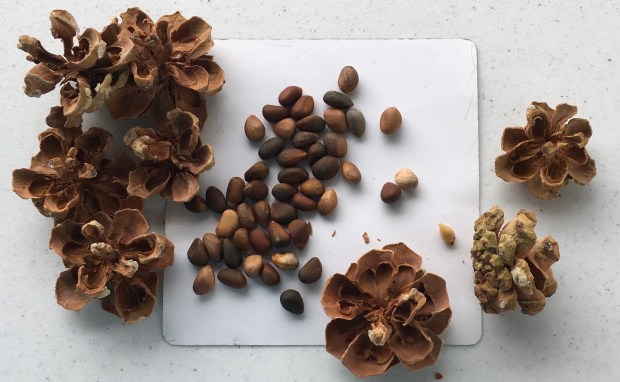
A fallen cone from Pinus edulis. Still a few seeds remain, tucked in the lowest scales. Typically there are 2 seeds per scale; 10-30 seeds are common per cone. Seed viability is uncertain until the inside kernel is exposed.
Pine Nuts Come From Where?
Many years ago, maybe about 45 of them, Roy and I, his sister and her husband, set off on a pine nut safari in the mountains of south central Colorado. They knew of a large stand of a specific pine tree, called Pinyon (Piñon**) heavy with cones and ready to harvest. This was my first encounter with the Colorado Pinyon Pine (Pinus edulis), and my first taste of the buttery rich tear-drop shaped seeds produced by these trees. I was hooked! After 4-5 hours collecting wide open seed stuffed cones from low hanging branches and off the ground, we had to stop. Our fingers were impossibly stuck together from the cones’ copious coating of resin, definitely stickier than Super Glue! Without a solvent to dissolve this adhesive pine tar, we were in danger of losing our fingerprints.
Having made a less-than-minor dent in the harvestable nuts, ample quantities of this energy rich bounty remained for foraging wildlife, such as migrating birds like pinyon jays, deer and squirrels.
For the past 45 years I truly believed pine nuts (which are, botanically speaking, not true nuts but the edible seeds of pinyon pines) only came from stands of Colorado Pinyon Pine. When the popularity of pesto skyrocketed, I thought “wow, you couldn’t pay me enough to harvest the amount of pine nuts necessary to make even one batch!” I honestly thought that was the reason the seeds were so expensive ….. harvesting is such a tedious and labor intensive job. Alas, we never returned to harvest pine nuts, and I never made pesto until years later.
The result of my Pinus edulis cone and seed sketching exercise.
While studying a few dozen pine cones for my sketches, the seeds kept falling out and bouncing across my drawing table. This got me thinking about pine nuts and wondering how the Colorado Pinyon Pine could possibly fill the insatiable global demand! Of course by now I was well aware that this tree species is endemic in the southwest, but still ?…….
News to Me ….
Of the 126 different species of pine in the world, 29 are considered edible; 20 of which have seeds large enough to be marketed. The biggest producers and exporters are China, Russia, Mongolia, Turkey, and Pakistan, in that order. I found it interesting that China is also the largest importer of pine nuts, who’s marketing goal is to export 60% of the world’s demand.
What about the US? The pine nuts harvested from Colorado Pinyon Pine (Pinus edulis) is rated the best tasting in the world, with those produced by the One Leaf Pine (Pinus monophylla), harvested primarily from these California trees, comes in a close second. Yet, the US is a major importer of shelled pine nuts, primarily from China. But if China is the largest importer and the largest exporter of shelled pine nuts, then the pine nuts on the shelves of Trader Joe’s and Costco, labeled as imported from China, probably came from a variety of pinyon species from a combination of suppliers importing seeds to China?!
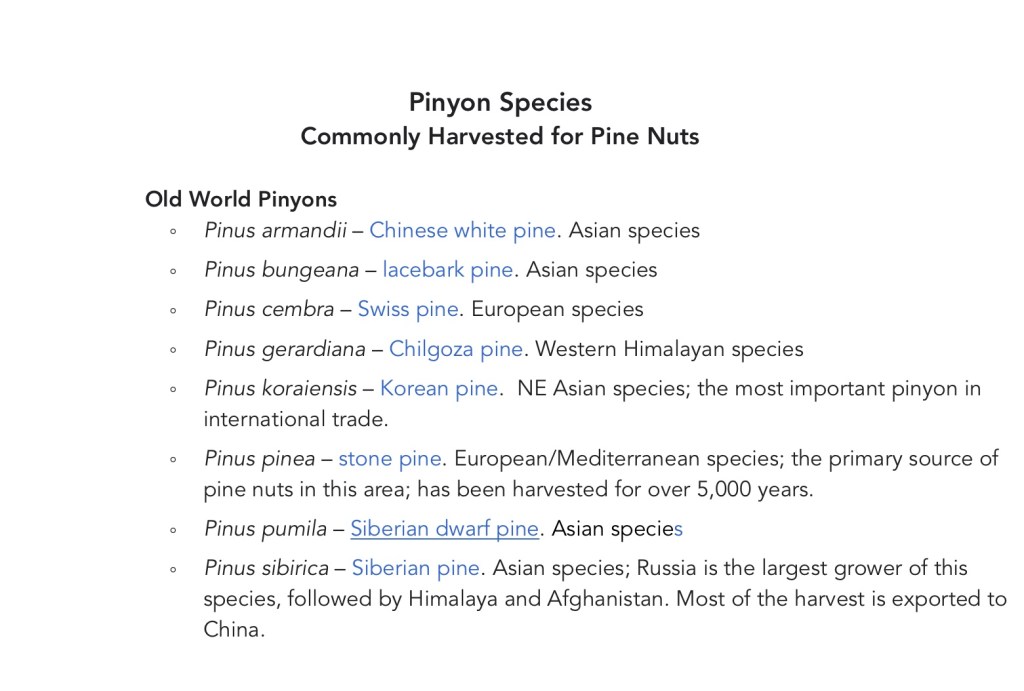
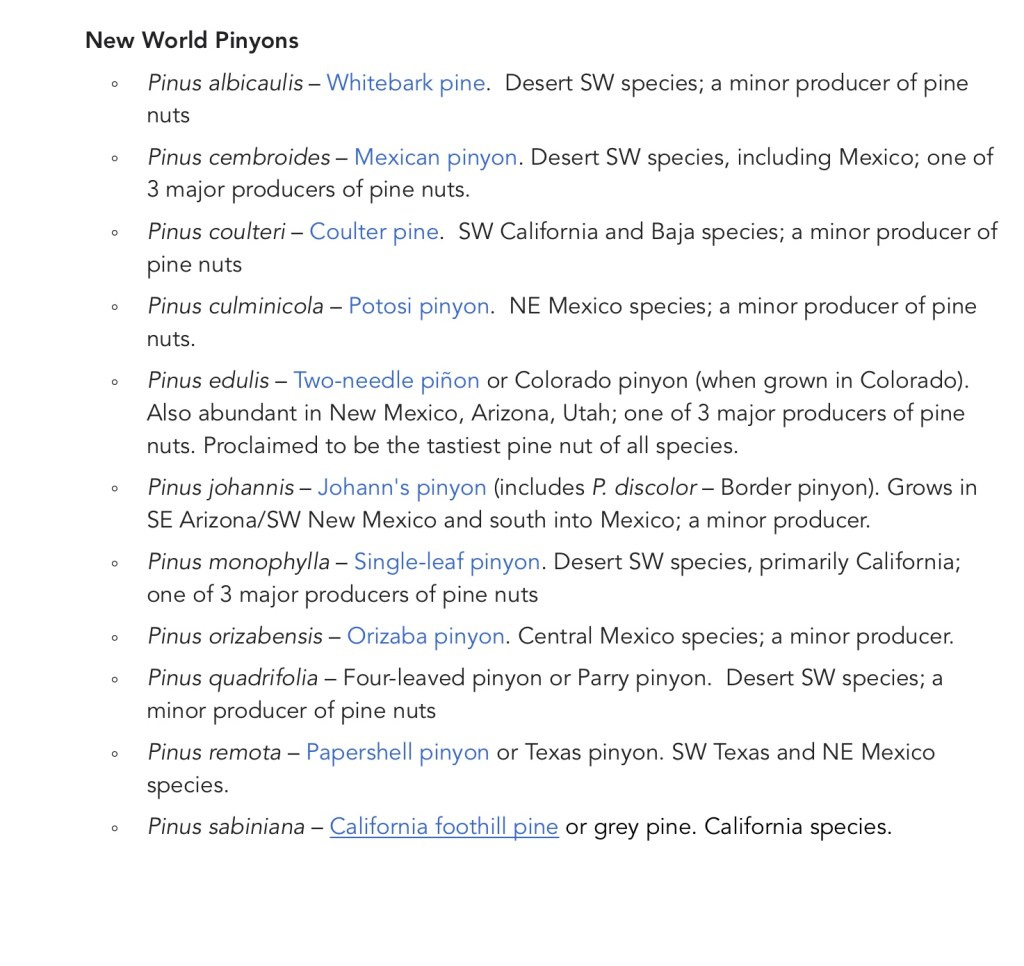
Being naturally curious about the Pinyon species that grow in various countries around the world, I included a list of 16 of the most commonly harvested trees the end of this post.
What’s the Real Reason Pine Nuts are so Expensive?
It’s said that “pine nuts are the most expensive seeds we would never buy!” (**** Check out this footnote for the 2024 costs/pound and my random calculations per serving and for a batch of pesto). Pine nuts are the second most expensive “nut” in the world, second only to the macadamia nut. Butwhy? While it’s true the seemingly exorbitant price of shelled pine nuts is directly influenced by labor costs, compounded by the annoying sticky factor, other challenges exist.
Harvesting Pine Cones
Cones are harvested by hand, directly gathering those that have fallen on the ground, and from tree branches (where the densest number congregate in the upper 1/4th of 30 foot tall trees). Another common harvesting technique is to whack the branches (which reportedly does not injure the trees [hmmmmm?]). But a faster method used in many countries is to cut off branches with cones, resulting in a number of detrimental effects to the trees (open entry points for insects and pathogens; stunted growth; stalled production; tree death).
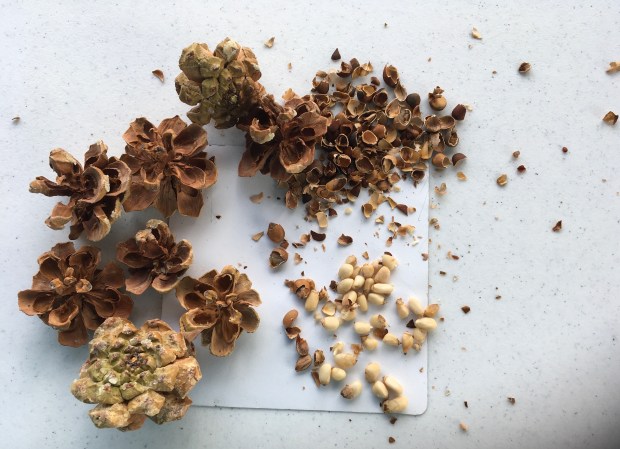
A sampling of Pinus edulis cones with hard coated seeds removed, ready for cracking. There’s a single kernel between the two lower right cones.
Pine Nuts
Once the seeds are taken out of the cones, their hard shells (seed coats) must be removed without damaging the soft edible kernels inside, the “pine nuts.” (And not every seed is viable ….. more about that below.) The shelled pine nuts must now be handled quickly and properly due to their short shelf life. It only takes a few weeks or even days in warm and humid conditions for shelled pine nuts to lose flavor, turn rancid, and completely deteriorate. Until they can be marketed for export, pine nuts must be kept frozen. Ideally, shelled pine nuts should remain frozen during export/import and until consumer purchase and consumption.
There were the remains of the Pinus edulis seeds extracted from these cones; 30 tasty kernels were viable; 20 were either missing or dried up.
Tree Characteristics
Slow growing trees and inconsistent production are several more reasons pine nuts are so expensive. Pinyon pines are notoriously slow to grow, mature (10 years) and produce a harvestable crop of cones with viable seeds (75-100 years). But pinyon pines typically live an average 350 years, and have the potential to produce tons of harvestable seeds. However, all pinyons exhibit a common characteristic called “masting,” where they may produce a bumper (harvestable) crop only once in as many as every eleven years. Good years are not predictable either, as many factors influence growth and production, with local droughts and a changing climate having the biggest impact.
Gifford Pinchot (1909), U.S. Forest Service Chief said: “Seasons of especially abundant production occur, as a rule, at intervals of from five to seven years, although heavy crops are sometimes produced for two or three consecutive years, and heavy seed years are not the same throughout the range of the tree.”
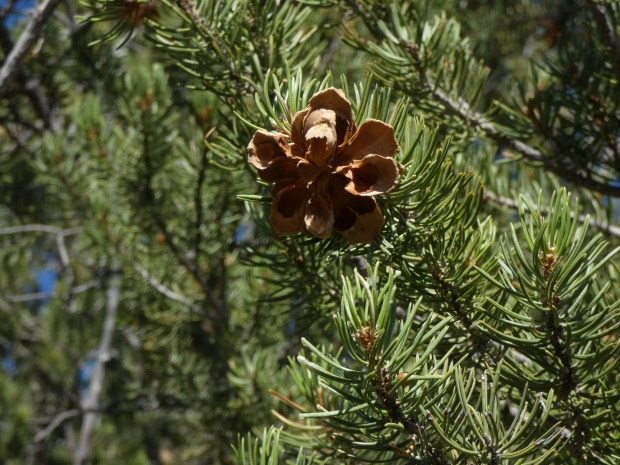
A Pinus edulis tree showing the 2 needles/fascicle densely covering the branches, and a remaining cone ready to fall..
______________________________________________________________ A Few Footnotes
**Piñon or Pinyon?
The most common common name for Pinus edulis is “Colorado” Pinyon Pine, even though the species is widespread in New Mexico, Utah and Arizona as well as Colorado. The words pinyon and piñon are usually considered interchangeable. Use of the word “piñon” (Spanish for pine nut) is tied to the seed (i.e. piñon seed or pine nut seed) and the tree (i.e. piñon pine or pine nut pine) particularly used by Native Americans in the southwest US. Because references consulted during my research were not consistent in their use of common names for Pinus edulis, to avoid (my) confusion I’ve opted to call the piñon seed (pine nut seed) a “pine nut” and the pine trees with edible seeds “pinyons.”
**** The 2024 retail market cost (shelled raw or roasted seeds) averages $40/pound
1 pound of seeds = about 4 cups (depending on seed size)
1 cup of seeds weighs about 4 ounces (price $10§)
1 ounce or 1/4 cup of seeds = 1 serving (price $2.50)
1 serving = about 167 seeds (price 1.5 cents/seed)
167 seeds = 191 calories (pine nuts are extremely high in unsaturated, heart-healthy fats and carbohydrates)
1 cup of seeds = about 668 seeds = 764 calories
4 cups of seeds = about 2,672 seeds = 3,056 calories
Number Play
Of the 50 seeds I harvested, only 30 were viable (price 45 cents)
It took me about 45 minutes to crack open the 50 seeds (this doesn’t include the time it took to collect the resin-coated cones and remove the seeds)
It would take me 67 hours to fill a 1 pound bag with 2,672 viable shelled seeds!
At $40/pound, a pine nut cracker would be paid only $0.59/hour for their labor, a wage earned back in the 1950’s and 1960’s which didn’t even come close to supporting a family then, let alone today.
Assuming a pine nut cracker makes a minimum wage of $7/hour, it would cost $468 to fill a 1 pound bag. That’s 1,170% more than the 2024 retail cost of a pound of pine nuts!
Obviously, a professional pine nut cracker is far more efficient than I was, using some form of mechanization to crack the seed coats (requiring more research on my part).
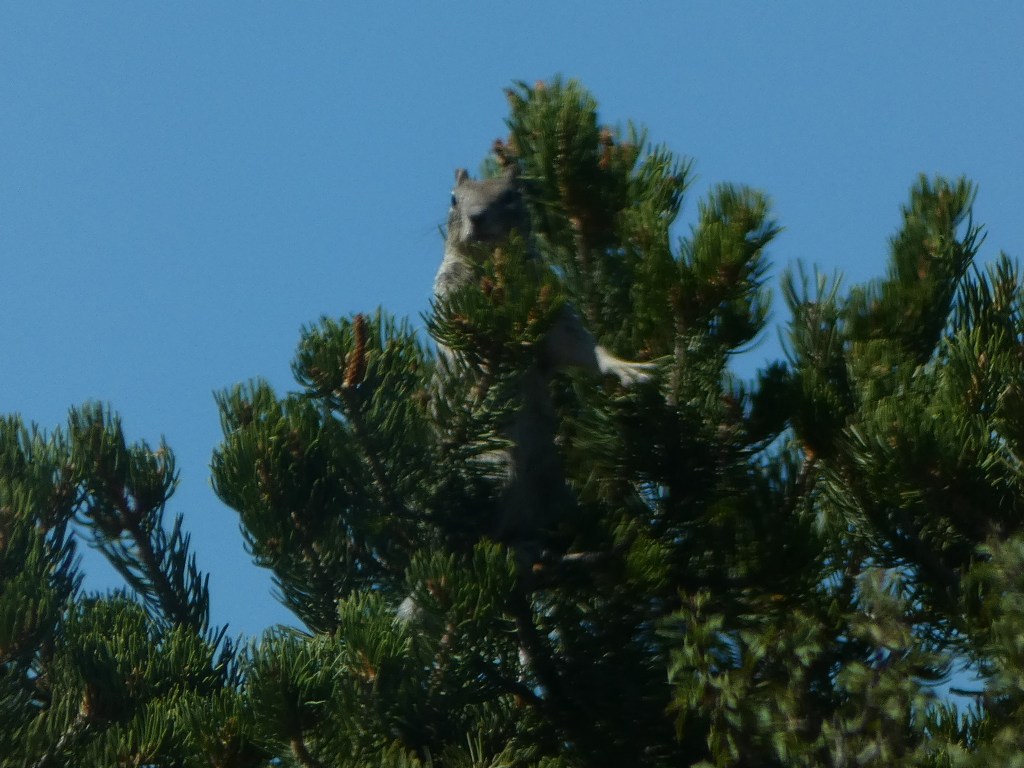
A rock squirrel high in a Pinus edulis tree, keeping watch for red tailed hawks while searching for pine nuts.
§Pesto ……. most pesto recipes I found call for the addition of 1 cup of shelled pine nuts, or 668 seeds. At 1.5 cents/seed, you’d be adding $10 of pine nuts to make one batch of pesto. Enjoy slowly!
Living in the East Mountains of central New Mexico ensures daily appreciation of hundreds and hundreds of Piñon Pines (Pinusedulis). This iconic pine, the state tree of New Mexico, has been a source of nutrient rich seeds for wildlife and indigenous peoples for millennia. It was fun learning more about this tree and the many Pinyon species that grow around the world.
After a well deserved rest from Inktober and from my self-imposed pressure to create something every day from a list of random prompts, I’m happy to be out again nature sleuthing. Curiosities in nature sometimes stare us in the face. But more often than not making discoveries require keen observational skills, noticing something new to you, and an ability to look for clues to a mystery with wide open eyes.
Double page post with an extra add on; all art work done with Graphgear 1000 loaded with 0.3mm 2B lead and all inked lettering done with Faber-Castell Pitt Artist Pen Fineliner, 0.3mm.
It was during a hike on an unseasonably warm day that I paused to admire the dried flower heads from one of the late blooming sunflowers. Have you ever noticed how they look like another kind of sunflower? Papery textured “petals” circle a central disk where a few weeks ago it was crammed full of puffy parachute-topped seeds. After the seeds become airborne, all that’s usually left is a slicked off surface punctuated with dots arranged in spirals radiating out from the center.
It’s hard now to imagine how extremely hot and dry the summer was this year. Without even a spittle of rain, the 100+ degree temps for weeks effectively suppressed the usual mid-season bloomers in and around the Albuquerque foothills/East Mountains. Even invasive plants, like goathead and tumbleweed, remained dormant or failed to germinate all together. It looked like winter browns had arrived early.
Then in less than a week, a small rain followed by several long downpours flooded the parched landscape, transforming browns to greens. You’ve heard this from me in a few earlier posts, but it was magical, and a reminder about the resiliency of desert vegetation.
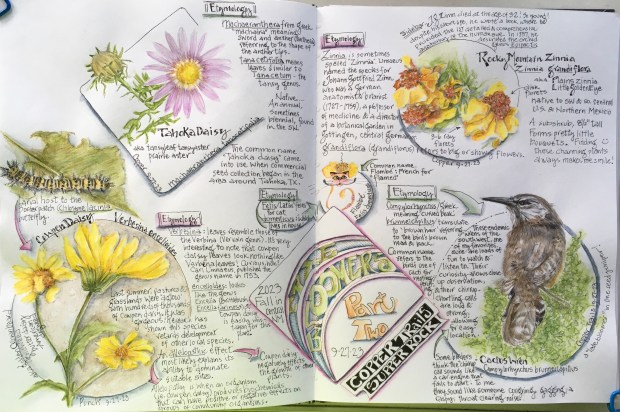
Here’s a few pages highlighting a handful of the Late Bloomers I recorded in only 2 days. More than 2 dozen species had sprung back to life, setting flowers at all stages of accelerated vegetative growth. The landscape seemed wide awake. If plants could talk, I imagined them laughing while excitedly chanting, “hurry, hurry, hurry!” Only their roots prevented them from dancing!
In addition to the species on these journal pages, there are many (more) composites, native grasses, shrubs and sub shrubs, small forbs from Spring and early Summer actively growing and blooming right now, and (of course) the weedy invasives are growing and blooming with wild abandon.
Random thoughts and wonderings ….. are pollinators still hanging around …… or ….. how many of today’s bloomers are self fertile …… are local birds, insects, reptiles and mammals that depend on earlier summer pollen and/or fruit and seed production stressed with this timing change/availability of food sources … will there be noticeable shifts in species composition, including plants, insects, reptiles and animals (including birds) ….. what species can and will adapt to changes, and how quickly ….. etc. The answers to these and many more questions are probably best answered in coming years, if it’s even possible to answer them at all.
Have you observed vegetation anomalies that may be influenced by changes in climate? If so, please share your observations and where these changes are taking place. Meanwhile, keep your eyes wide open.
“Closing your eyes isn’t going to change anything. Nothing’s going to disappear just because you can’t see what’s going on. ……….. Closing your eyes and plugging up your ears won’t make time stand still.” – Haruki Murakami.
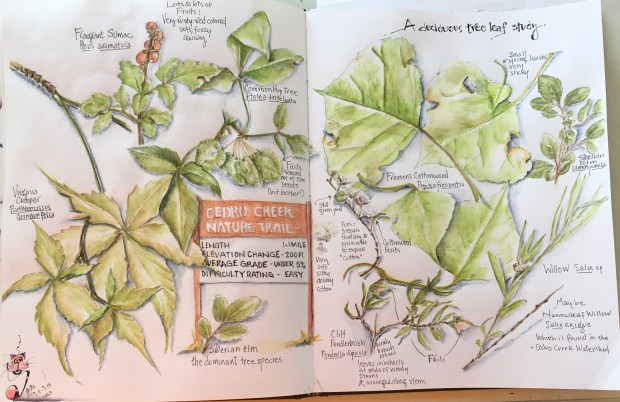
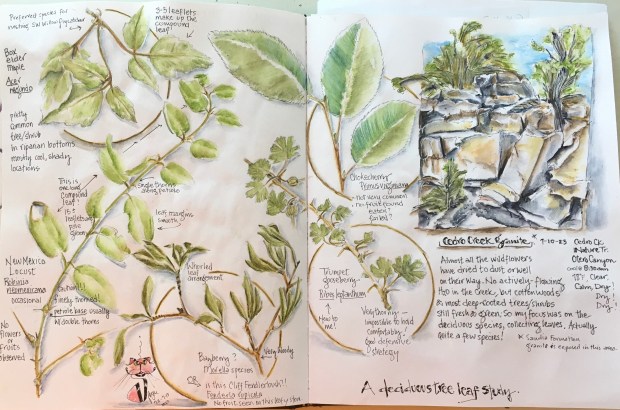
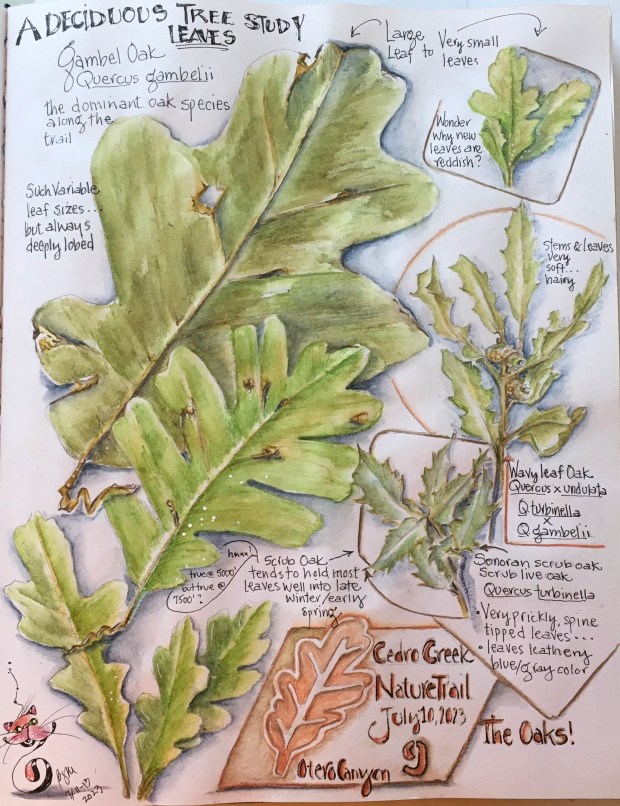
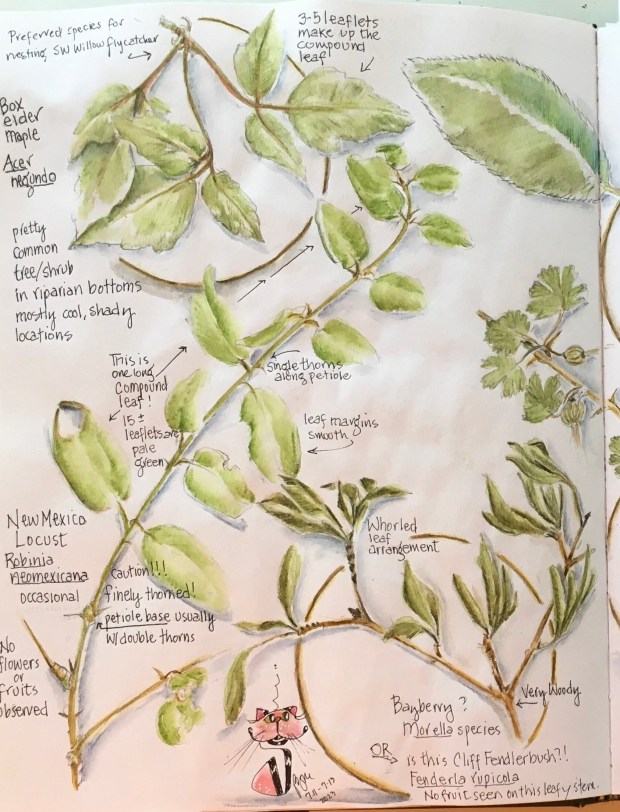
Learning the deciduous Trees and Shrubs shading Cedro Creek Nature Trail ….. Grab n Go Nature Journaling
The timing and location of our daily hikes are being influenced by the extreme summer temperatures we’re experiencing throughout central New Mexico, and throughout the desert southwest. Whew! Even at 7300-8300’ elevation, 95-100F has become the norm, with no relief (or moisture) in sight. I don’t even want to think about Albuquerque temperatures; over 100F before noon, and soaring.
Because hiking in the Albuquerque foothills, at any time of the day, is out of the question, we’ve begun revisiting some our favorite mountain trails. But even tho these areas are higher in elevation, and shadier, it’s still plenty hot. That means if we set out between 7-8am, we can still manage a few miles before our water, like all the creeks, runs dry.
A few mornings ago, we decided to hike Cedro Creek Nature Trail, a rocky but easy dirt path under the shade of big cottonwoods. Expecting to find some water in the creek (there was none), I was hoping to find some interesting wildflowers (which had all withered and dried). The further along the trail we hiked, my focus quickly changed from wildflowers to other natural elements.
Geology is always interesting in these mountain drainages, and Cedro Creek is no exception. The overlying shales and limestones have long ago eroded to reveal large granite boulders that showed signs of erosion from long ago flowing water. That’s a nice thought!
And then there were so many varieties of deciduous trees and shrubs; their leafy greens not only provided relief from the heat, but became a visual treat as we explored the riparian areas alongside the dry creek bed.
As my curiosity about the diversity of tree and shrub species began to grow, so did the air temperature. Not wanting to become reduced to a sweaty puddle in the middle of the trail, and sensing a swarm of drooling, biting gnats and flies giving me a hungry eye, I resorted to collecting leaf and branch samples using a Grab n Go technique. By the time we got back to the car, I had 3 large ziplocks stuffed with over a dozen species of tree and shrub leaves and some fruits.
Back at home, in the comfort of my cool studio, I began my detailed study of these leaves (and the few bugs that managed to hitch a ride). Three days and several gallons of iced tea later, I had completed the 5 journal pages in this post.
That iced tea was deliciously cool, but not as cool as learning what’s growing overhead along Cedro Creek!
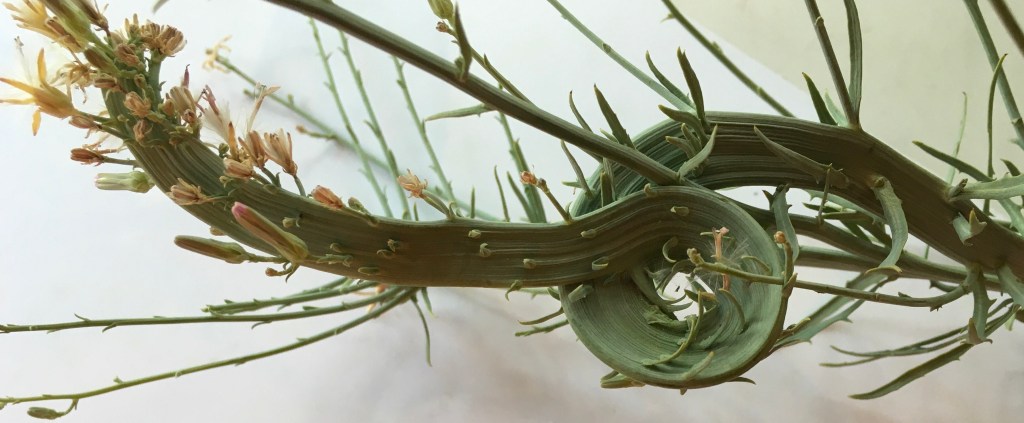
In my last blog post, FascinatingFasciations, I shared my discovery of an extremely malformed Rush Skeletonplant. While researching this much branched and dainty member of the plant family, Asteraceae (which includes asters, sunflowers and daisies), I became entangled in the winding and seemingly never-ending number of rabbit trails on my journey, until finding myself on a surprising detour. Totally absorbed in the subject of plant malformations, and learning a lot of cool stuff about Rush Skeletonplant along the way …….
The weirdly wild fasciated Rush Skeletonplant
………. I tripped and fell flat on my face (only figuratively!). One of the published research papers appeared to be in error …… regarding the seed (aka fruit) name of this plant. Known to me for decades by the name “Achene,” the researchers had labeled the seed “Cypsela.” And not only did they call seed of Rush Skeletonplant a “Cypsela,” but they used this name when referring to all the seeds of the Aster family!
What! No Way! Who was responsible for this name change? When did this happen? Why oh Why